Introduction
Dignity is a construct characterized by the representation of the self, of the self from others’ point of view and of the interaction of the individual with the environment and social context (Chochinov et al., Reference Chochinov, Hack and McClement2002; Rodríguez-Prat et al., Reference Rodríguez-Prat, Monforte-Royo and Porta-Sales2016; Street & Kissane, Reference Street and Kissane2001).
Currently, research on dignity is essential to offer a comprehensive patient-centered approach aiming to promote a state of physical, mental, social, and spiritual well-being (Chochinov, Reference Chochinov2007; Ferri et al., Reference Ferri, Muzzalupo and Di Lorenzo2015; Grassi et al., Reference Grassi, Costantini and Caruso2017; Guo & Jacelom, Reference Guo and Jacelon2014). In this regard, the Patient Dignity Inventory (PDI) (Chochinov et al., Reference Chochinov, Hassard and McClement2008) enables evaluation of the different sources of the dignity-related distress and the study of the complexity of human suffering among patients facing life-threatening or life-limiting conditions. Recent studies displayed additional advantages of using PDI in clinical practice: the differences between volunteers and physicians’ perception of dignity were highlighted (Albers et al., Reference Albers, de Vet and Pasman2013) and previously unreported concerns were detected in 76% of cases (Chochinov et al., Reference Chochinov, McClement and Hack2012). Research has pointed out the relevance of a peculiar patient-centered dignity assessment, with a particular focus on health professionals’ dignity perception during their daily practice.
There are various international PDI validations (Chochinov et al., Reference Chochinov, Hassard and McClement2008; Di Lorenzo et al., Reference Di Lorenzo, Cabri and Carretti2017; Grassi et al., Reference Grassi, Costantini and Caruso2017; Ripamonti et al., Reference Ripamonti, Buonaccorso and Maruelli2012; Rullàn et al., Reference Rullàn, Carvajal and Nùnez-Còrdoba2015; Sautier et al., Reference Sautier, Vehling and Mehnert2014), but none used a sample specifically related to a particular stage of illness, and the literature presents suggestions for further research that could explore this topic on more particular samples. For this reason, the primary aim of this study is to validate an Italian version of the PDI (PDI-IT) with a sample with specific clinical characteristics: a life expectancy of a few weeks, a Karnofsky Performance Status (KPS) ≤ 40 (Karnofsky & Burchenal, Reference Karnofsky, Burchenal and MacLeod1949) and admission to hospice. The validation might provide further data in support of the validity of the PDI and, as a consequence, it may be possible to consider the relevance of a specific clinical assessment, improved by this version of PDI-IT, for terminally ill cancer patients in the contest of the palliative care.
Dignity is a key factor in such patients. In fact, at this stage of illness, the patient's sense of dignity can be profoundly impaired; its preservation is a crucial element in the process of death. Moreover, dignity is interconnected with psychological, social, and spiritual aspects and it cannot be considered separately in the clinical practice. This suggests the relevance of developing research in this field. For this reason, the second purpose of this study was to assess the relation between the dignity dimensions and a set of psychosocial and spiritual variables, which includes styles of coping, spirituality, anxious and depressive symptomatology, quality of life, and demoralization.
Methods
Patients were recruited at the “Vittorio Valletta” hospice in Turin between October 2015 and October 2016. All participants were diagnosed with cancer, had a life expectancy of a few weeks, and scored 40 or less on the KPS. To be eligible to participate in the study, patients were asked to complete the Mini-Mental State Examination (Folstein et al., Reference Folstein, Folstein and McHugh1975). Patients who obtained a score of ≤19 were excluded because they might not be able to provide informed consent knowingly or give accurate responses to the tests used in the study. Those who were not able to speak Italian fluently were excluded from the study as well. All the participants provided written informed consent.
The study was conducted in accordance with principles embodied in the Declaration of Helsinki. The study was approved by “Comitato Etico Interaziendale A.O.U. San Giovanni Battista di Torino A.O. C.T.O./Maria Adelaide di Torino” protocol number 0073054, procedure number 255, date of approval: April 14, 2015.
Instruments
Clinical data were gathered in a medical chart by researchers (NAS, AB, and CT), and sociodemographic data and psychosocial variables were collected through a semistructured interview conducted by the same authors and a set of self-administered rating scales. Each rating scale was translated and validated in Italian.
The PDI-IT (Ripamonti et al., Reference Ripamonti, Buonaccorso and Maruelli2012) is a 25-item self-report questionnaire. Each item describes a theme or a subtheme of the Dignity Model and it is rated on a 5-point Likert scale, from 1 (not a problem) to 5 (an overwhelming problem). The overall score reflects the patient's perceived dignity-related distress.
The visual analog scale (Scott & Huskisson, Reference Scott and Huskisson1979) consists of a 10-cm horizontal line. Patients mark a cross on the line to express the intensity of their current pain. The score is determined by measuring the distance between the lowest point of the line (no pain) and the patient's cross.
The Hospital Anxiety and Depression Scale (HADS) (Costantini et al., Reference Costantini, Musso and Viterbori1999) is a 14-item self-report scale that outlines anxious and depressive symptoms. The two subscales both comprise seven questions to answer on a Likert scale from 0 to 3, which rates the severity of the problem described in the item.
The Brief Coping Orientation to Problem Experienced (Brief COPE) (Sica et al., Reference Sica, Novara and Dorz1997) is a 28-item self-report measure used to assess specific coping strategies. The items are designed to measure 14 conceptually different coping reactions: active coping, planning, positive reframing, acceptance, humor, religion, use of emotional support, use of instrumental support, self-distraction, denial, venting, substance use, behavioral disengagement, and self-blame. Each coping scale consists of two items, whose ratings are on a 4-point Likert scale, from 1 (I haven't been doing this at all) to 4 (I've been doing this a lot).
The Functional Assessment of Cancer Therapy Scale–General Measure (FACT-G) (Cella et al., Reference Cella, Tulsky and Gray1993) consists of 27 questions, which refer to four quality of life critical domains: physical well-being, social/family well-being, emotional well-being, and functional well-being. Patients answer each question on a 5-point Likert scale, ranging from 0 (not at all) to 4 (very much).
The Functional Assessment of Chronic Illness Therapy-Spiritual Well-Being Scale (FACIT-Sp) (Peterman et al., Reference Peterman, Fitchett and Brady2002) assesses spiritual well-being. It uses two subscales (faith and meaning/peace) through 12 items on a 5-point Likert scale, ranging from 0 (not at all) to 4 (very much).
The Demoralization Scale (DS) (Costantini et al., Reference Costantini, Picardi and Brunetti2013) measures demoralization level. It contains 24 items on a 5-point Likert scale, ranging from 0 (never) to 4 (always) and is subdivided into five subscales: loss of meaning and purpose in life, dysphoria, disheartenment, helplessness, and sense of failure.
The Daily Spiritual Experience Scale (Underwood, Reference Underwood2006) investigates the individual's daily spiritual experiences. It contains 15 items on a 6-point Likert scale ranging from 1 (many times a day) to 6 (never) and one item that explores the feeling of closeness to God, ranging from 1 (not at all) to 4 (as close as possible).
Statistical analysis
SPSS Statistics version 23.0 (IBM Corp. Armonk, NY) software was used to execute statistical analysis. All the tests were carried out and reported on a two-tailed basis. p values were considered significant if <0.05. Descriptive statistics included means, standard deviations, frequencies, skewness, and kurtosis. For multivariate analysis, bivariate Pearson's correlations, explorative multiple linear regressions, and means comparisons through t test and analysis of variance were calculated.
To investigate the PDI-IT factor structure, there was used an exploratory factor analysis. A principal component solution was undertaken, followed by Oblimin rotation. Kaiser-Meyer-Olkin measure was calculated for the sampling adequacy. The optimum number of factors was based on Guttman-Kaiser criterion (eigenvalues >1) and analysis of the scree plot. The internal consistency of each factor was estimated by calculating Cronbach's coefficient alpha. Concurrent validity was analyzed by determining Pearson's correlation coefficient of factors with other measures thought to be conceptually overlapping.
Results
Participants
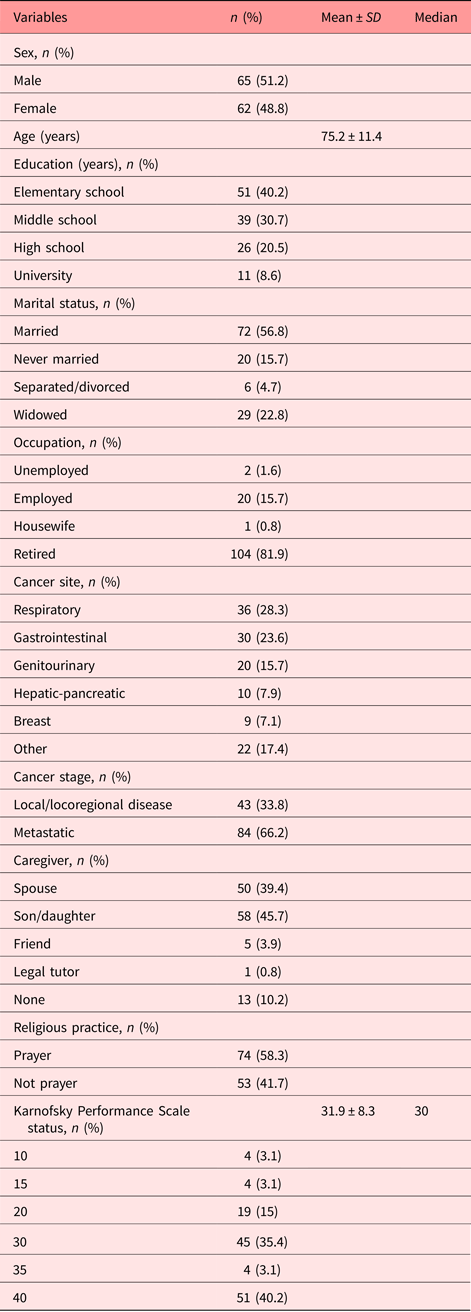
A total of 127 patients took part in the study. The average age of the participants was 75 years (standard deviation = 11.40); 62 participants (48.8%) were female and 65 (51.2%) were male. Fifty-six percent did not have a high school education, whereas 1.6% had an academic qualification. Eighty-two percent were retired. Fifty-seven percent were married, 23% widowed, and 16% never married. Thirty-nine percent of the caregivers were spouses, 46% were sons, and 10% of the patients had no caregiver. Stage of cancer was metastatic in 66% of the cases and local/locoregional for 34%. All patients had a KPS ≤40; the KPS average value was 31.9. The average duration of hospitalization in hospice was about 18 days, ranging from <24 hours to 120 days. Clinical and demographic characteristics are presented in Table 1.
Sociodemographic and clinical data

SD = standard deviation.
Factor structure
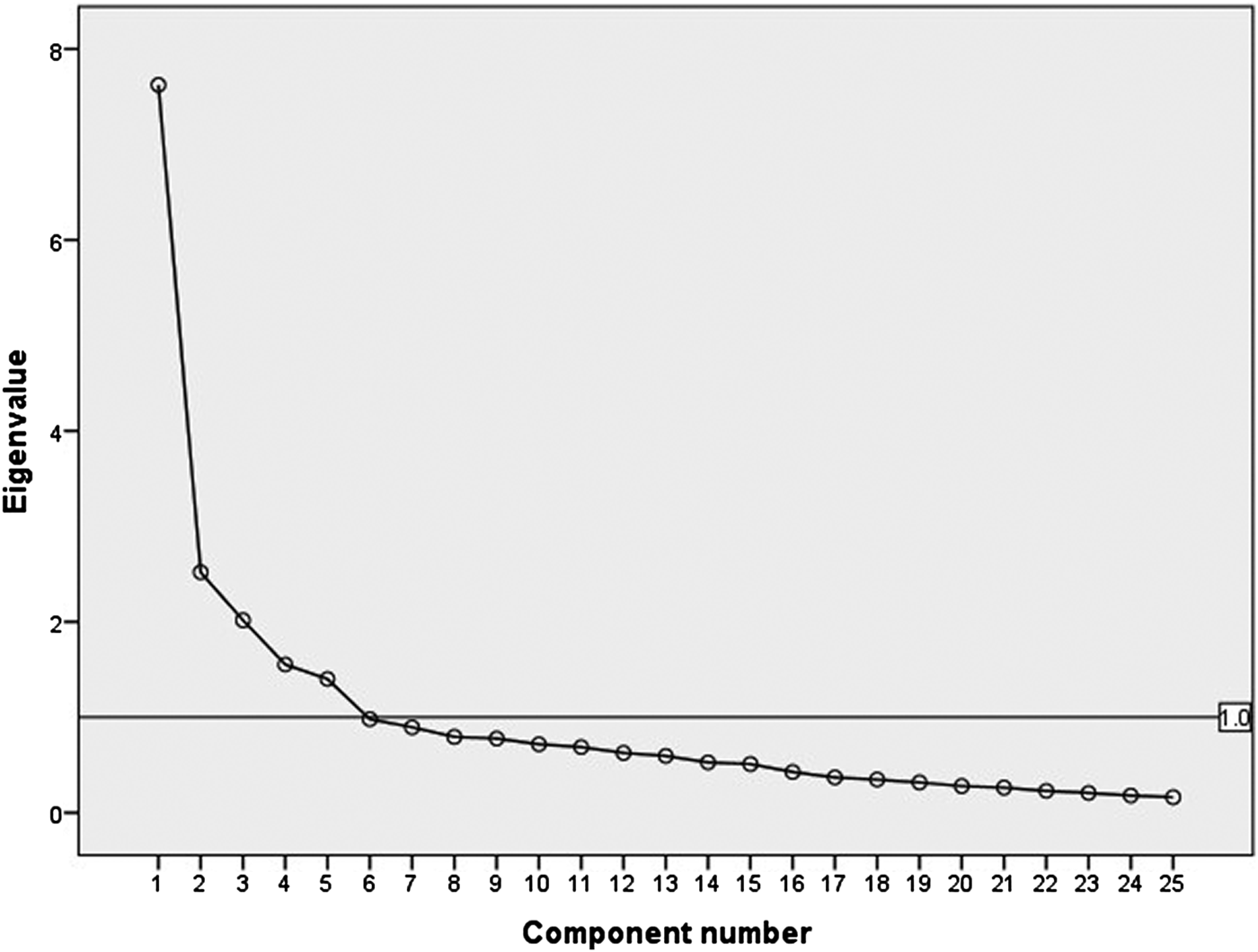
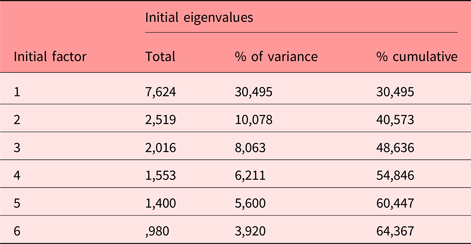
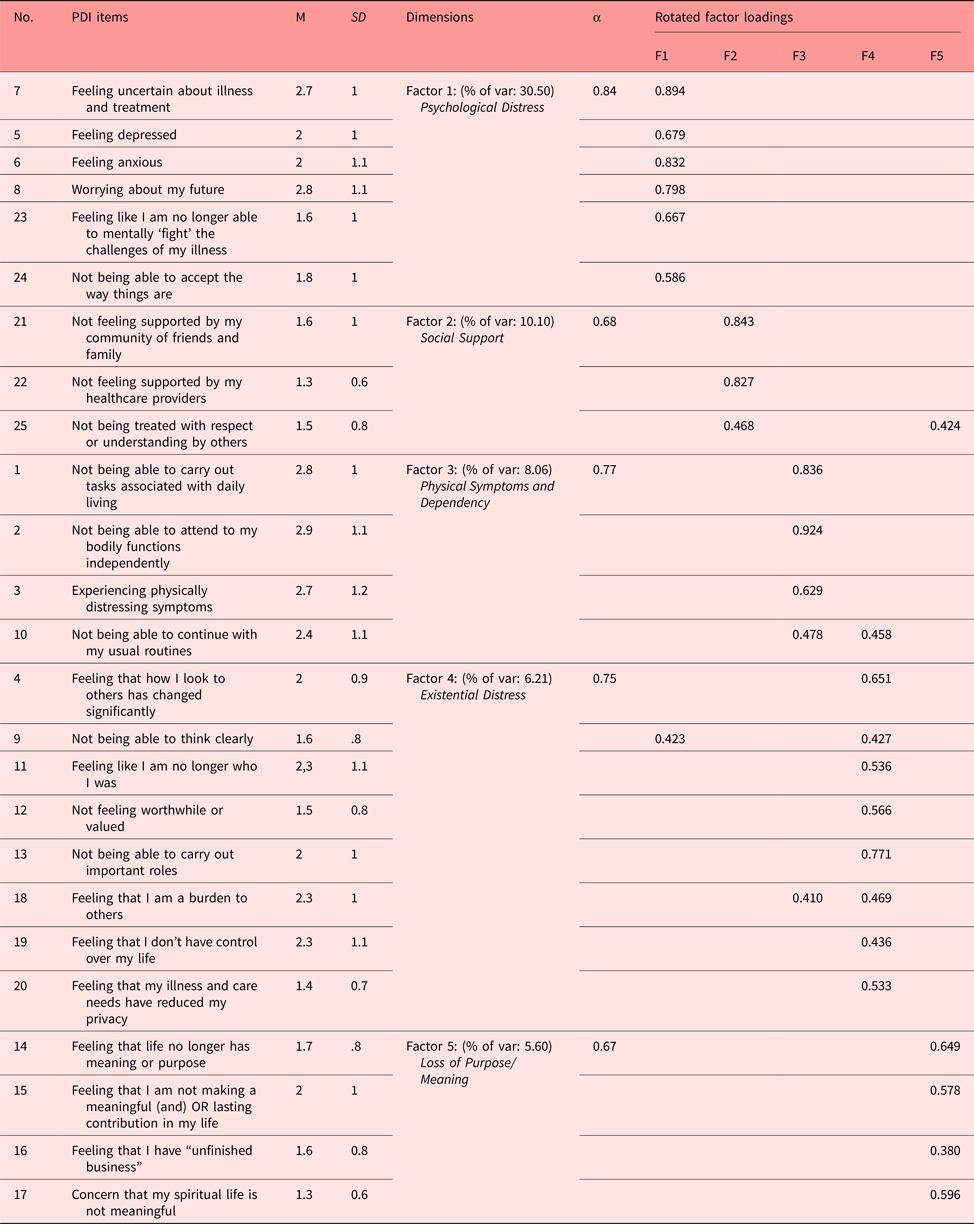
The Kaiser-Meyer-Olkin measure of 0.85 indicated that the factor analysis was appropriate. The component principal analysis identified five factors accounting for 60.4% of the overall variation. Table 2 shows the six initial eigenvalues and the percentages of variance associated with them; the scree plot is represented in Figure 1. Factor loadings after orthogonal rotation are represented in Table 3. Factors were labeled as follows: Psychological Distress, Social Support, Physical Symptoms and Dependency, Existential Distress, and Loss of Purpose/Meaning.
Factor analysis of the PDI-IT. Scree plot.

Initial factor loading for the PDI-IT

PDI-IT = Italian version of the Patient Dignity Inventory.
Factor analysis of the PDI-IT (PCA, Oblimin-rotated five-factor solution)

α = Cronbach's coefficient; F1 = Psychological Distress; F2 = Social Support; F3 = Physical Symptoms and Dependency; F4 = Existential Distress; F5 = Loss of Purpose/Meaning; M = mean; No. = number of items; SD = standard deviation.
Internal consistency, concurrent validity, and factor details
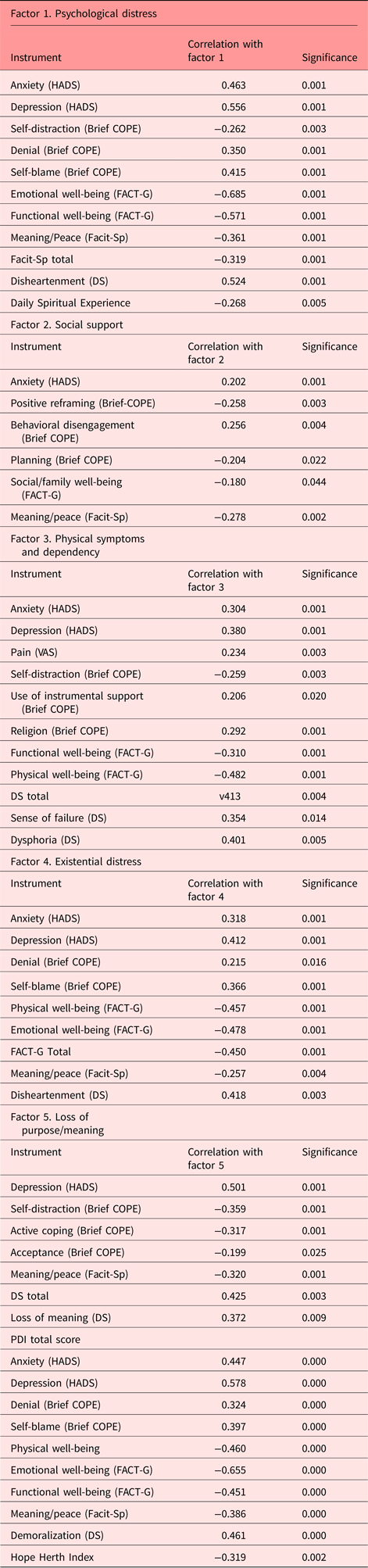
Cronbach's alpha coefficients for each factor's internal consistency are represented in Table 3. Significant correlations of the factors with other measures, representing concurrent validity, are listed in Table 4.
Correlation of the PDI-IT with psychosocial variables

Brief-COPE = Brief Coping Orientation to Problem Experienced; DS = Demoralization Scale; Facit-Sp = Functional Assessment of Chronic Illness Therapy-Spiritual Well-Being Scale; FACT-G = Functional Assessment of Cancer Therapy Scale–General Measure; HADS = Hospital Anxiety and Depression Scale; VAS, visual analog scale.
The first factor, Psychological Distress, consisted of six items that refer to psychological concerns. All of the items belonging to this factor are included in the Psychological and Existential Distress and Anxiety and Uncertainty factors of the Spanish PDI (PDI-S) (Rullàn et al., Reference Rullàn, Carvajal and Nùnez-Còrdoba2015) and of the German PDI (PDI-G) (Sautier et al., Reference Sautier, Vehling and Mehnert2014), respectively. Psychological Distress was also pointed out by Grassi et al. (Reference Grassi, Costantini and Caruso2017), who highlighted a similar factor composed by five of the six items identified in this study. This factor also included four of the six items, which constituted the original PDI Symptom Distress factor.
Social Support included three items that define the feeling of being supported by caregivers and healthcare providers. It matched the original PDI Social Support factor. Moreover, these three items were incorporated in Social Support, Loss of Sense of Worth and Meaning, and Existential Distress factors, in the PDI-S, PDI-G, and Grassi et al. study, respectively.
Physical Symptoms and Dependency factor consisted of four items linked to patients’ physical symptoms and their daily routine abilities. This factor matched the Physical Distress factor identified by Grassi et al. All of the items in this factor were included in the PDI-S Physical Symptoms and Dependency factor and were divided in the PDI-G Physical Symptom Distress and Body Image (items 3–10) and Loss of Autonomy (items 1–2) factors. Items 1 and 2 – together with item 20 – formed the original PDI factor Dependency.
Existential Distress included eight items associated with the sense of integrity and continuity of the person's self and to others’ perception of it. Two clusters of five items (4–11–12–13–18; 9–12–13–18–19) were featured in the Existential Distress factor in the original PDI study and Grassi et al. study, respectively.
Loss of Purpose/Meaning consisted of four items assessing the meaning given to life and to spirituality. This factor, except for item 14, overlapped with the original PDI Peace of Mind factor. Existential Distress and Loss of Sense of Worth and Meaning factors in the Grassi et al. study and PDI-G, respectively, composed the four items.
Associations of dignity with sociodemographic and clinical variables
There was no significant relationship between the PDI-IT scores and the sociodemographic and medical variables (sex, age, marital status, education, caregiver, localization, and stage of disease). Patients were also asked if they usually prayed or not: those who reported praying regularly had significantly greater average scores in the Physical Symptoms and Dependency factor (M = 11.31, standard error = 0.43), than those who did not pray (M = 10.08, standard error = 0.37), t(125) = 2.19; p < 0.05, r = 0.20.
Patients’ KPS score negatively affected the Loss of Purpose/Meaning factor (F(1, 123) = 6.18; p < 0.02, adjusted R 2 = 0.04, β = −0.22).
Correlations of dignity with psychosocial and spiritual variables
Dignity significantly correlated with styles of coping, spirituality, anxious and depressive symptomatology, quality of life, and demoralization. All significant correlations are presented in Table 4.
Regression of dignity on psychosocial and spiritual variables
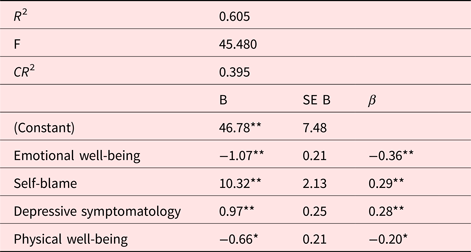
Results of the regression showed that, among all the variables that significantly correlated with dignity, Self-blame (Brief COPE), Emotional well-being, Physical well-being (FACT-G), and Depression (HADS) were the significant predictors of the loss of dignity, accounting for 61% of the overall variation of the PDI-IT total score (Table 5).
Dignity significant predictors

Notes: Summary of standard multiple linear regression between Self-blame, Emotional well-being, Depression, Physical well-being, and PDI-IT.
R 2, total explained dependent variable variance; F, analysis of variance test F; CR2, communal explained dependent variable variance; B, unstandardized regression coefficients; SE B, standard error β, standardized regression coefficients; sr2, squared partial independent coefficients.
*p < 0.05; **p < 0.01.
Discussion
The present study aimed to carry out further examinations of the PDI factor structure and to analyze the relationship between dignity and a set of psychosocial variables relevant to articulately an appropriate clinical assessment in a homogeneous sample of 127 terminally ill cancer patients.
For the first time, the PDI-IT factor analysis was executed on a sample of patients with a life expectancy of a few weeks, with a KPS ≤ 40, and admitted to hospice. In this regard, it is essential to underscore that the mean length of hospitalization in the “Vittorio Valletta” hospice is 18 days.
The results revealed a five-factor internal structure that differs from the other validations reported in literature, with the exception of Chochinov and colleagues’ study (Reference Chochinov, Hassard and McClement2008). In fact, the two Italian validations executed by Di Lorenzo et al. (Reference Di Lorenzo, Cabri and Carretti2017) and Grassi et al. (Reference Grassi, Costantini and Caruso2017) and the Spanish validation (2015) revealed three factors, whereas the German validation (2014) and the Italian validation of Ripamonti et al. (Reference Ripamonti, Buonaccorso and Maruelli2012) proposed four factors and one factor, respectively.
The reason the psychometric studies on the PDI have shown various internal structure patterns is still unclear. The observation of four different PDI-IT validations may suggest that the intercultural differences might not be the appropriate explanation. All the existing validations have examined samples of patients that were in different clinical conditions: patients with a life expectancy < 6 months (Chochinov et al., Reference Chochinov, Hassard and McClement2008); patients recruited in the psychiatry unit (Di Lorenzo et al., Reference Di Lorenzo, Cabri and Carretti2017), patients with an average KPS of 94 (Grassi et al., Reference Grassi, Costantini and Caruso2017) and of 83.2 (Sautier et al., Reference Sautier, Vehling and Mehnert2014); patients with a median KPS of 70 (Rullàn et al., Reference Rullàn, Carvajal and Nùnez-Còrdoba2015); and patients with KPS > 80 (Ripamonti et al., Reference Ripamonti, Buonaccorso and Maruelli2012). Therefore, it is not unlikely, as stated by Ripamonti et al. (Reference Ripamonti, Buonaccorso and Maruelli2012), that such variability might be due to a minor expression of existential suffering in cancer patients in previous stages of illness, receiving oncological therapies with curative intent, compared with terminal cancer patients. For these reasons, considering the previously mentioned peculiarity of our sample, this study points out a new factor structure, addressed to patients with a life expectancy of a few weeks, with a KPS ≤ 40, and admitted to hospice. This might suggest the relevance of conducting an appropriate dignity assessment, tailored to the stage of the illness, to articulate an accurate care intervention. This concept is confirmed by the detected negative influence of KPS on the PDI Loss of Purpose/Meaning factor that underlines how adjusting the clinical practice to the different phases of the illness is essential for maintaining patients’ sense of dignity. The second purpose of this study analyzed the relation between dignity and a set of psychosocial and spiritual variables. Regression pointed out that coping style Self-blame of the Brief COPE appeared as a significant dignity-related distress predictor, together with emotional well-being, depressive symptomatology, and physical well-being. This result might suggest that dysfunctional coping was not a collateral consequence of the psychological and existential distress but a causative factor of it. Consequently, personality traits might also be involved in the process of loss of dignity. In fact, Chochinov and colleagues (Reference Chochinov, Krstjanson and Hack2006) highlighted that personality could be a filter through which end-of-life distress can be modulated; thus, it could influence the subjective experience and coping responses. Such relationships may help clinicians identify vulnerable individuals who are most likely to have poorer adjustments to the illness and may benefit from earlier targeted interventions approaches. Moreover, proceeding with the analysis of the regression results, depressive symptoms, identified through Depression HADS_D subscale, were also significant predictors of an impairment of patients’ sense of dignity. Also, emotional and physical well-being, which are two dimensions of patients’ quality of life, significantly affecting the scores of the PDI-IT. Therefore both the physical and the psychological aspects, in particular the emotional ones, could determine a reduction of patients’ sense of dignity. Dignity appeared as strictly connected to these two dimensions, underlying how these aspects are crucial part of the patients’ perceived quality of life.
At the same time, despite the fact that it is possible to identify a direct causative effect only of the previously mentioned variables, dignity might be considered as connected with existential and spiritual aspects, as shown by different correlations.
The positive correlations between Physical Symptoms and Dependency PDI-IT factor, the total score at DS and scores at “sense of failure” and “dysphoria” DS subscales indicated a link among dignity, demoralization, and physical problems, as shown by Vehling and Menhert (Reference Vehling and Mehnert2014) in their dignity mediation model. In fact, a high number of physical symptoms may heighten the risk of a loss of the sense of dignity, which may then increase the risk of demoralization. Further studies should be carried out to better understand the nature of these relations. Moreover, a positive correlation was found between total score at PDI-IT and total score at DS and scores at DS subscales “disheartenment” (indicating a sense of discouragement about life), “failure” (underlying a feeling of loss of worth and pride in one's life), “meaninglessness” (measuring loss of role and purpose in life), and “dysphoria” (indicating psychological distress symptoms). Only the “social support” PDI-IT dimension did not show any significant correlations with DS. These data could suggest a possible link between existential concern (loss of dignity) and existential distress (demoralization), which are crucial to understand end-of-life patients’ existential suffering.
Furthermore, the significant correlation between the total score of PDI-IT and that of FACIT-Sp-12 showed that PDI could also be a tool to explore the spiritual dimension, represented by the Loss of Purpose/Meaning factor. In fact, the absolute factor-loading value of PDI item 17 (“concern that my spiritual life is not meaningful”) resulted in a load on four of the five emerged factors.
Moreover, the significant positive correlation existing between Daily Spiritual Experience Scale total score and Psychological Distress PDI-IT factor might suggest that having daily spiritual experiences and feeling close to God are particularly beneficial to dignity-related psychological distress.
Last, the coping style Religion significantly correlated with the Physical Symptoms and Dependency PDI factor; its average score was also significantly higher in patients who pray regularly. This might suggest that religious practice, used as resource for facing illness, is more frequent in patients suffering higher amounts of distress caused by physical symptoms and loss of autonomy and self-determination.
The strength of this study is that it is the first Italian study to assess dignity in patients at the end of life, admitted to hospice, and with a life expectancy of a few weeks.
In terms of limitations, a larger population would reinforce the results achieved in this study, despite the fact that the Kaiser-Meyer-Olkin measure has confirmed the sampling adequacy. Furthermore, this study should be replicated, taking into account a personality traits assessment, to improve the comprehension about the relationship between loss of dignity and personality.
The PDI-IT can help assess the level of dignity-related distress in patients with advanced cancer, admitted to hospice, and with a life expectancy of a few weeks, contributing to identifying their existential suffering and improving their quality of life. In fact, its factor structure spans various domains, covering the spectrum of distress and might provide new opportunities to examine and better understand this field, primarily among patients with specific clinical characteristics. This should help clinicians detect the areas of distress that are often overlooked and are almost inaccessible. Identifying these sources of discomfort is a critical step toward recognizing their importance within the realm of human suffering.
In conclusion, evaluating sense of dignity could be used as an important criterion in interventional studies regarding life-threatening diseases and the end of life. Finally, these findings emphasized the importance of dignity-related psychosocial interventions, which enhance or maintain the patients’ sense of dignity. Further studies should be carried out to improve knowledge about the nature of relations between dignity and other domains explored in this study. Moreover, it could be interesting analyzing samples with other specific clinical characteristics.
Acknowledgments
The authors thank the research staff for their precious contribution, Dr. Marta Opezzo for the help with translation and all the patients participating in the study.
The present study was approved by “Comitato Etico Interaziendale A.O.U. San Giovanni Battista di Torino A.O. C.T.O./Maria Adelaide di Torino”: protocol number 0073054, procedure number 255, date of approval: December 24, 2012.
Conflicts of interest
None.