





Introduction
In much of the Western tradition, formal organisation has historically been regarded as central to musical meaning, with structure articulated in hierarchical terms that imply a direct compositional narrative (Cook Reference Cook2013). Certain dominant strands of Western art music discourse have privileged intention and symbolic representation, frequently assuming a linear transmission of musical significance from the composer to the listener through shared formal conventions (Lynch et al. Reference Lynch, English, Scott and Drummond2025). These models partially account for forms of musical sense-making that depend on engagement, situated attention and perceptual exploration rather than score-based decoding alone (Clarke Reference Clarke2005).
Research in ecological psychology and music cognition has redefined representational models of perception, emphasising that listeners actively explore sound environments using perceptual skills shaped by embodiment, action and experience (Gaver Reference Gaver1993; Boersen Reference Boersen2022). Contemporary composition unfolds within perceptual, technological and ecological conditions that challenge composer-centred paradigms (Gilmurray Reference Gilmurray2017). The expansion of sound materials and the diversification of situations have led composers and theorists to reconsider music as an experiential process grounded in perception, participation and context (Cook Reference Cook2013; Schiavio et al. Reference Schiavio, Moran, van der Schyff, Biasutti and Parncutt2022a). Ecological music is not proposed here as a new genre opposed to existing sound-based practices, but as a transversal framework that makes explicit ecological tendencies present in acousmatic, soundscape, electroacoustic, improvisational and hybrid work. It focuses on the ways musical situations afford perceptual engagement. Composition is understood as the organisation of conditions that guide attention, shape expectation, support exploration and invite listeners to develop modes of auditory sense-making. Structure is located within listening as a perceptual activity shaped by listeners’ capacities, expectations and situated practices.
The framework builds on acousmatic music, musique concrète, soundscape composition and eco-composition, which have contributed significantly to the theorisation of listening. Its contribution is to foreground listening affordances as a primary site of compositional organisation. Building on ecological acoustics and affordance theory (Gaver Reference Gaver1993), musical structure is approached as a configuration of perceptual conditions that can direct attention, sustain expectation and enable exploratory modes of listening (Windsor and de Bézenac Reference Windsor and de Bézenac2012). Representation becomes an implicit dimension of compositional strategy. Composition functions as a perceptual learning environment, shaping listening awareness and supporting an ethics in which composing entails responsibility for the perceptual conditions offered to others (Schafer Reference Schafer1992; Westerkamp Reference Westerkamp2002).
The following research question drives the article: How can ecological and embodied theories of perception be operationalised as compositional strategies – specifically, as the design of listening affordances – in music composition?
The article treats ecology as a set of designable perceptual constraints that guide compositional decision-making. The term ecological listening refers to situated and embodied modes of auditory engagement; ecological composition refers to the compositional design of conditions that support listening engagement; and ecological music designates the broader aesthetic and theoretical orientation emerging from this approach. It develops a practice-based theoretical framework and proceeds in five stages. First, it outlines the practice-based methodology. Second, it analyses selected compositional works as examples of designed listening affordances. Third, it situates the framework in relation to ecological listening, sound events and affordance theory. Fourth, it clarifies the relation with soundscape, acousmatic and electroacoustic traditions. Finally, it discusses implications, limitations and future research.
Methodology: practice-based compositional inquiry
This article adopts a practice-based research perspective in which research and practice operate as interdependent and complementary processes leading to new and original forms of knowledge (Candy et al. Reference Candy, Edmonds, Vear and Vear2021). The practice-based inquiry focuses on selected works that address different perceptual problems: embodied rhythm and entrainment, threshold listening, ambiguity, recognition and abstraction, and the transformation of attention over time. Ecological music is defined as a compositional orientation in which sound materials are organised according to the perceptual actions they afford.
The compositional activity is not treated as an application of theory, but as a form of knowledge production. This perspective is consistent with previous research showing that compositional processes develop through cycles of reflection, interaction, evaluation and adaptation in response to evolving creative situations (Biasutti Reference Biasutti2018). The framework developed here emerges from a long-term interaction between compositional practice, research in music perception and ecological theories. The article proposes a practice-based framework and analyses compositional strategies from the perspective of the composer-researcher. It does not provide systematic listener-response data. Claims about listening affordances should be understood as hypotheses generated through compositional practice rather than as verified accounts of audience experience.
The listener-centred framework is informed by my long-term research on music perception, composition and improvisation, where action and perception are treated as mutually constitutive processes (Biasutti Reference Biasutti1999, Reference Biasutti2017). The approach adopts a bottom-up orientation, deriving its conceptual foundations from practical compositional challenges: the perceptual accessibility of musical structures, temporal organisation and the relationship between sound material and listener engagement.
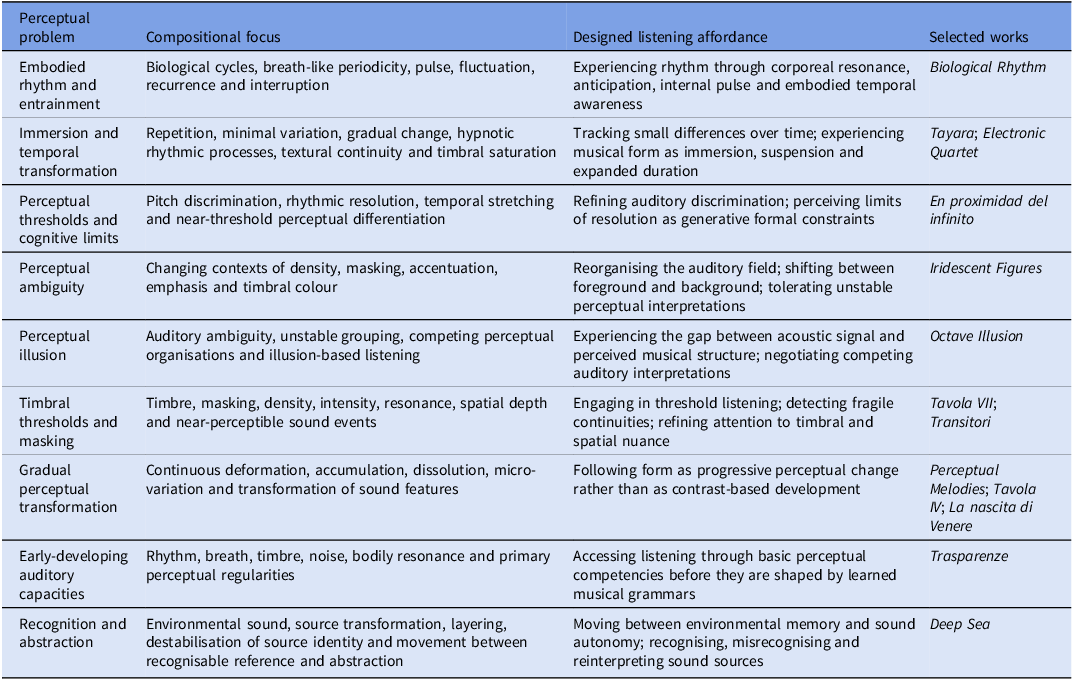
In my compositional practice, musical form is defined as a perceptual process shaped by compositional strategies aligned with listening grammar. Across my instrumental and electroacoustic works, I developed several compositional strategies. Table 1 summarises the main perceptual problems and relates them to compositional strategies and intended listening affordances. The selected works illustrate how ecological composition may organise sound according to the perceptual actions it affords, including entraining, tracking, anticipating, recognising, misrecognising, tolerating ambiguity and refining auditory discrimination.
Practice-based mapping of perceptual problems, compositional strategies, listening affordances and selected works

Table 1. Long description
The table has six columns: Perceptual problem, Compositional focus, Designed listening affordance, and Selected works. It contains seven rows, each describing a different perceptual problem and its relation to compositional strategies and listening affordances. Row 1: Embodied rhythm and entrainment, Biological cycles, breath-like periodicity, fluctuation, recurrence and interruption, Experiencing rhythm through corporeal resonance, anticipation, internal pulse and embedded temporal awareness, Biological Rhythm. Row 2: Immersion and temporal transformation, Repetition, minimal variation, gradual change, hypnotic rhythmic processes, textual density and timbral saturation, Tracking small differences over time, experiencing musical form as suspension and expanded duration, Toyaro; Electronic Quartet. Row 3: Perceptual thresholds and cognitive limits, Pitch discrimination, rhythmic resolution, temporal stretching and near-threshold perceptual differentiation, Refining auditory discrimination; perceiving limits of resolution as generative formal constraints, En proximidad del infinito. Row 4: Perceptual ambiguity, Changing contexts of density, masking, accentuation, emphasis and timbral colour, Reorganising the auditory field; shifting between foreground and background; tolerating unstable perceptual interpretations, Iridescent Figures. Row 5: Perceptual illusion, Auditory ambiguity, unstable grouping, competing perceptual organisations and illusion-based listening, Experiencing the gap between acoustic signal and perceived musical structure; negotiating competing auditory interpretations, Octave Illusion. Row 6: Timbral thresholds and masking, Timbre, masking, density, intensity, resonance, spatial depth and near-perceptible sound events, Engaging in threshold listening; detecting fragile continuities; refining attention to timbral and spatial nuance, Tavola VII; Transitor. Row 7: Gradual perceptual transformation, Continuous deformation, accumulation, dissolution, micro-variation and transformation of sound features, Following form as progressive perceptual change rather than as contrast-based development, Perceptual Melodies; Tavola IV; La noscita di Venere. Row 8: Early-developing auditory capacities, Rhythm, breath, timbre, noise, bodily resonance and primary perceptual regularities, Accessing listening through basic perceptual competencies before they are shaped by learned musical grammars, Trasparenze. Row 9: Recognition and abstraction, Environmental sound, source transformation, layering, destabilisation of source identity and movement between recognisable reference and abstraction, Moving between environmental memory and sound autonomy; recognising, misrecognising and reinterpreting sound sources, Deep Sea.
Practice-based examples: designing listening affordances
The following examples clarify how listening affordances are designed in compositional practice and represent case studies of the compositional activities. Audio recordings from Ecological Music I and Ecological Music II are available online at:
https://music.youtube.com/playlist?list=OLAK5uy_mMea6-U2ZquDWqyTpLJq-a0r9FHsH1QdE;
https://music.youtube.com/playlist?list=OLAK5uy_mzNZaMUkOnMV3-pCCCxZ8LphawJVhrEv 0
Works were selected because they foreground specific perceptual problems, including entrainment, ambiguity, recognition and abstraction, threshold perception and temporal immersion. Each work was analysed in terms of compositional decisions, sound organisation and intended listening affordances. For each piece, compositional procedures were mapped onto possible listening actions, such as tracking, anticipating, entraining, recognising, misrecognising or refining discrimination. These mappings were interpreted in relation to ecological psychology, embodied cognition, and soundscape and acousmatic traditions. The analyses function as practice-based evidence for the listener-centred framework. Where the article describes a work as ‘inviting’, ‘affording’ or ‘encouraging’ a particular mode of listening, these terms refer to compositional orientation and perceptual possibility.
Repetition, minimal variation, immersion
In Tayara and Electronic Quartet, repetition functions as an affordance for temporal immersion. Repeated rhythmic or textural patterns create expectations, but these expectations are continually adjusted through minimal changes in density, register, articulation or timbral profile. The works are designed to invite the listener to compare the present event with previous events and to notice small differences that might otherwise remain peripheral. The compositional aim is not to communicate a fixed structure, but to create a listening situation in which form emerges from the listener’s tracking of gradual change.
Embodied temporality
In Biological Rhythm, rhythmic organisation is derived from biological cycles, especially respiratory patterns. The compositional process begins from bodily temporality and translates it into musical time, inviting listeners to experience rhythm as embodied movement rather than as symbolic metre. Breath-like periodicity, fluctuation, recurrence and interruption shape the temporal organisation of the piece, creating a form of listening grounded in breath, cyclicity and bodily resonance. The central listening affordance is entrainment; the listener may perceive rhythmic organisation through corporeal resonance, anticipation and an internal sense of pulse. Perceptual coherence emerges not from fixed metric regularity, but from cyclic recurrence and bodily perceptual invariants. Biological Rhythm offers an example of listener-centred composition because its structure is designed around perceptual and corporeal engagement. Listening becomes an experiential practice, rooted in lived bodily time. The work addresses the research question by showing how rhythm can be composed not only as formal organisation, but also as an affordance for embodied temporal engagement.
Perceptual ambiguity
In Iridescent Figures, perceptual ambiguity is treated as a compositional material and formal principle. Identical or closely related rhythmic figures are placed in changing contexts of density, masking, accentuation, emphasis and timbral colour, causing the same or similar material to be heard differently across the piece. As the auditory context shifts, what was previously perceived as foreground may become background; what seemed stable may become unstable; and what initially appeared as a rhythmic figure may dissolve into texture. Form emerges not through conventional thematic development, but through continual shifts in perceptual organisation. The listener is invited to reorganise the auditory field repeatedly, encountering ambiguity as a productive condition of listening. The central affordance is not recognition alone, but perceptual reconfiguration; listeners are invited to participate in the changing construction of rhythmic and textural meaning.
Recognition and abstraction
In Deep Sea, recorded sea sounds are not used primarily as documentary evidence of a marine environment. Although the work is constructed from sea recordings, its ecological significance does not lie simply in representing the sea. The compositional process gradually transforms, layers and destabilises the source material, moving the listener between environmental recognition and abstraction. At certain moments, the sounds afford environmental memory: water, depth, immersion, distance and marine space. At others, transformation and threshold manipulation weaken source recognition and redirect attention towards spectral movement, density and texture. The sea initially functions as a recognisable reference, but progressively becomes an ambiguous sound field. The listener-centred dimension of Deep Sea lies in this oscillation between knowing and not knowing, recognising and reinterpreting. Listeners are invited to move between perception and memory, source identification and sound autonomy, environmental reference and perceptual novelty. The piece treats environmental sounds as listening affordances. The work demonstrates how environmental material can be treated ecologically not through documentary reference alone, but through the design of shifting affordances between recognition, memory and abstraction.
Threshold listening
In Tavola VII, timbral thresholds, masking and near-perceptible sound events are used to make attention itself a compositional parameter. The piece proposes conditions in which listening becomes active, unstable and progressively refined. Quiet, dense or partially masked materials require the listener to adjust focus continually, raising the question of what counts as an event, what remains in the background and how small differences in timbre, intensity, resonance or spatial placement become meaningful.
The central affordance of the piece is threshold listening. Listeners are invited to detect small differences, follow fragile continuities and refine auditory discrimination over time. Repetition establishes a perceptual ground, allowing listeners to anticipate recurrence and use memory to compare successive events. Minimal variation then shifts attention away from large-scale contrast and towards subtle changes in attack, resonance, density, spectral colour, intensity and spatial depth. As change becomes gradual, musical time may be experienced less as linear progression and more as immersion, suspension or expanded duration.
Timbral saturation reinforces this transformation by reducing the dominance of discrete melodic or rhythmic figures and directing attention towards texture, vibration, resonance and spatial depth. Tavola VII transforms the perception of time and space by creating a perceptual environment in which listeners are encouraged to listen more slowly, make finer comparisons and experience form as a gradual reorganisation of attention.
Situated listening in Tavola VII emerges through engagement with perceptual thresholds: listeners have to negotiate near-audible events, masking and subtle timbral differences. Form becomes a dynamic achievement, allowing multiple formal interpretations to coexist without any single interpretation claiming absolute priority outside the listening context in which it arises (Clarke Reference Clarke2005).
My compositional activity is conceived as the design of perceptual conditions rather than the construction of fixed musical objects. Musical works function as environments in which listeners actively explore, test and progressively refine strategies over time. Concepts such as affordances, auditory events and perceptual coherence are not applied retrospectively as explanatory categories, but emerge directly from compositional decision-making and practice. The ecological approach to music composition draws on an integrated theoretical background that includes the ecology of mind, ecological psychology, everyday listening, auditory event perception, soundscape studies and research on early and pre-cultural auditory experience. These perspectives support a listener-centred compositional approach as an emergent and perceptually grounded process.
Background: From formalist models to ecological accounts of musical meaning
Ecology of mind and listening as a situated activity
Ecology of mind (Bateson Reference Bateson1972) proposes that cognition is not confined to the individual brain but unfolds within the networks of relations between individuals, society and environment. Ecological psychology (Gibson Reference Gibson1979) departs from representational models by emphasising the direct pickup of information from the environment; perception is an active and situated process grounded in the structure of energy arrays and in the ongoing relation between organism and environment. Situated listening describes listening as an embodied and context-dependent activity shaped by body, place, memory, culture, attention and technological mediation. Situated listening involves both a theoretical concept and a methodological practice concerned with the relationship between the listening body and the politics of place, space and culture. Listening is not only perception, but also a situated practice shaped by social, cultural and ecological conditions (Loveless et al. Reference Loveless, Rennie, Søndergaard and Zinovieff2025).
Applied to musical listening, this perspective challenges the idea that sound is first encoded as abstract features and only later interpreted cognitively (Windsor and de Bézenac Reference Windsor and de Bézenac2012). Instead, music can be approached as structured action, rich with information that listeners can apprehend through skilled engagement. Rhythm, timbre, pitch, intensity and spatial qualities are not neutral data to be decoded, but meaningful properties emerging from interactions between sound-producing events and embodied presence (Clarke Reference Clarke2005). Musical listening is inseparable from context, bodily orientation, cultural practice and environmental competence (Krueger Reference Krueger2014). This shift foregrounds the continuity between everyday listening, musical experience, and action, rather than treating musical understanding as a purely symbolic competence (Reybrouck Reference Reybrouck2019).
Listening has often been theorised in relation to environmental awareness, acoustic communication, place or source recognition, whereas the present framework focuses on listening affordances as compositional units. Just as vision involves bodily and ocular movements to sample the visual environment, auditory perception involves shifts of attention, bodily orientation and active engagement with sound sources. The listener explores acoustic information to detect invariants – relatively stable patterns that specify events, sources and relations (Gaver Reference Gaver1993). In musical contexts, the exploratory nature of listening becomes evident. Listeners track changes over time, anticipate continuations, adjust attention to different layers and respond physically or affectively to sound events (Clarke Reference Clarke2005). Listening thus unfolds as a dynamic process shaped by intention, expectation and action. Even in apparently still situations, such as concert attending, the listener is engaged in temporal exploration – following trajectories of tension and release, density and silence. Listening is not something that happens to the listener but something the listener does, drawing on experience while remaining open to affordances offered by the sound environment (Reybrouck Reference Reybrouck2019).
Sound events, meaning and perceptual organisation
A key concept in ecological approaches to listening is the sound event (Gaver Reference Gaver1993). Rather than treating sounds as isolated stimuli or abstract signals, ecological listening focuses on events caused by actions and unfolding in time. Sound events are interpreted through the listener’s aural competence: the learned capacity to extract patterns, infer causes, recognise contextual relations and orient attention within a sounding situation. A musical or environmental sound gesture may specify movement, effort, material resistance, intention or interaction, but these meanings depend on the listener’s ability to relate auditory information to embodied experience, contextual knowledge and expectations.
Aural competence is the capacity to understand how sounds behave within a context: what caused them, how they unfold, what they make possible, and how they relate to prior experience. Meaning emerges from the relation between sound events, their possible causes, the listener’s embodied and cultural knowledge and the context in which listening takes place. Listeners extract meaning by recognising patterns of change, inferring actions or materials, distinguishing foreground from background and relating auditory events to expectations.
Gaver’s (Reference Gaver1993) distinction between musical listening, oriented towards acoustic attributes, and everyday listening is useful. When everyday sounds become salient and are attended to in the foreground, listeners may analyse their temporal, timbral, spatial and dynamic features with a degree of refinement close to musical listening. Conversely, musical listening often involves causal, gestural and source-based inference rather than purely abstract attention to acoustic attributes. The difference between everyday and musical listening is one of orientation and context rather than an absolute division. This is consistent with Schafer’s (Reference Schafer1977) emphasis on active listening; the ecological significance of sound depends on the listener’s attentional stance and cultivated aural awareness.
This has compositional consequences for ecological music. If listeners make sense of sound events through aural competence, then composition can operate by shaping the conditions under which such competence is activated, challenged or transformed. The composer organises situations in which listeners are invited to infer, compare, track, recognise, misrecognise and reconfigure auditory events over time.
Affordances and designing perceptual conditions for listening
Affordances refer to action possibilities offered by the environment to a perceiver (Gibson Reference Gibson1979). Applied to musical listening, affordances (e.g., entrainment, exploratory attention, threshold listening) are shaped through compositional decisions and describe what sounds invite listeners to do physically, perceptually, cognitively and emotionally (Windsor and de Bézenac Reference Windsor and de Bézenac2012). Affordances may include invitations to move, entrain, anticipate, imitate, resonate affectively and imaginatively engage with sound materials. Rhythmic structures may afford entrainment (Phillips-Silver et al. Reference Phillips-Silver, Aktipis and Bryant2010), and timbral qualities may afford affective, expressive and atmospheric associations (Di Stefano Reference Di Stefano2023). Affordances are not fixed properties of sound alone: they depend on experience, cultural background and context. Clarke (Reference Clarke2005) argues that musical meaning arises through perception of affordances within culturally situated listening practices. Listening becomes an ecological skill developed through repeated engagement with musical environments.
If listening is an active, affordance-based process, perceptual conditions play a central role in shaping what can be perceived. Ecological approaches emphasise that perception is situated, and that changes in environment, task and bodily engagement can alter listening (Reybrouck Reference Reybrouck2019). Composition can be understood as the design of perceptual conditions that support exploration.
Emergence, ambiguity and perceptual illusions
A central implication of ecological listening is that perception is emergent rather than predetermined (Gibson Reference Gibson1979; Clarke Reference Clarke2005). Auditory events do not impose a single fixed meaning but allow multiple perceptual organisations depending on how listeners engage (Gaver Reference Gaver1993). Ambiguity functions generatively, enabling perceptual flexibility and maintaining openness to multiple interpretations (Stoffregen Reference Stoffregen2000).
In addition, musical illusions, the perceptual phenomena in which the brain’s interpretation of sound differs from the physical audio signal, are relevant. Illusions show the gap between sound as vibration and music as perception: what we hear is shaped not only by frequencies and timing, but also by the brain’s expectations, grouping rules, attention and prior experience. Illusions cause listeners to hear tones, rhythms, movements or structures that are not objectively present – or to hear the same sound in fundamentally different ways. This aligns with enactive theories emphasising sense-making as participatory (Schiavio et al. Reference Schiavio, Ryan, Moran, van der Schyff and Gallagher2022b); meaning emerges through interaction, not passive reception.
The listener as part of an ecological system
From an ecological point of view, the listener is part of a broader system including body, environment, cultural practices and sounding activity (Gibson Reference Gibson1979; Clarke Reference Clarke2005). Perception emerges from this system in which posture, movement, spatial setting, social context and prior musical engagement contribute to how sound is perceived and understood (Clarke Reference Clarke2005; Windsor and de Bézenac Reference Windsor and de Bézenac2012). Conceptualising the listener as part of an ecological system has direct implications for composition; it supports practices that emphasise active listening, movement and musical experience, recognising that learning to listen is inseparable from learning to act within musical environments (Clarke Reference Clarke2005; Krueger Reference Krueger2014).
Traditional notions of musical form treat coherence as an intrinsic property of the work, grounded in compositional organisation and structural intention. By contrast, listener-centred perspectives emphasise that form is actively constructed through perceptual organisation over time (Clarke, Reference Clarke2005). Listeners segment, group and relate sound events according to affordances, attentional focus, prior experience and evolving expectations (Gaver Reference Gaver1993; Windsor and de Bézenac Reference Windsor and de Bézenac2012).
Time is central to this process. Rather than serving as a neutral container for musical form, time is experienced as a lived dimension shaped by memory, anticipation and attention. Composition operates on listening time: how duration is felt, how events accumulate and how perceptual focus shifts over the course of the experience. Gradual processes, repetition, sustained textures and slow transformations may enhance perceptual coherence by inducing listeners to explore sound in depth. Conversely, rapid stylistic shifts or excessive density may fragment attention, limiting perceptual engagement. Ecological composition evaluates material not by its internal sophistication but by its capacity to sustain perceptual sense-making over time.
Soundscape studies, ecological listening and soundscape composition
Soundscape studies and acoustic ecology have made listening central to musical and cultural reflection. Schafer’s (Reference Schafer1977) foundational work framed acoustic environments as meaningful auditory fields and positioned listening as a cultural and ethical practice. Truax’s (Reference Truax2001) theory of acoustic communication further developed environmental listening as a relational process involving sound, listener, community and context. Westerkamp’s (Reference Westerkamp2002) soundscape composition similarly treats listening as an active, critical and transformative practice. Gilmurray’s (Reference Gilmurray2017) overview of ecological sound art has shown how environmentally engaged sound practices connect sonic experience with ecological awareness, activism and environmental ethics.
Ecological approaches to sound and music have provided frameworks for addressing the relations between sound, environment, perception and ecological monitoring. Soundscape ecology examined how soundscapes correlate with environmental variables, ecological indicators and biotic communities (Turlington et al. Reference Turlington, Suárez-Castro, Teixeira, Linke and Sheldon2024). Soundscape studies, eco-composition, acousmatic music and ecological models have expanded musical thought by challenging the autonomy of abstract musical structure and by foregrounding listening, context, sound environments and perceptual experience (Schafer Reference Schafer1977; Truax Reference Truax2001; Westerkamp Reference Westerkamp2002; Gilmurray Reference Gilmurray2017; Keller and Lazzarini Reference Keller and Lazzarini2017).
Subsequent developments shifted attention from soundscapes as physical settings to soundscapes as lived and experiential phenomena shaped by perception, memory and interpretation (Westerkamp Reference Westerkamp2002). From an enactive perspective, soundscape composition may be understood less as the representation of environments and more as the staging of perceptual actions – that is, as compositional practices that invite modes of exploratory listening (Boersen Reference Boersen2022).
Soundscape composition and ecological music share affinities, particularly in their emphasis on listening, situated perception and sensory experience. Soundscape composition often begins from environmental sound, place, acoustic memory or contextual listening, whereas the ecological framework proposed here generalises these concerns into a broader compositional model centred on listening affordances. Soundscape composition is not opposed to ecological music; rather, it represents one of its most important precedents and possible instantiations.
Ecological music can be applied also to instrumental music. Although it may begin from listening, perception and environmental awareness, it allows ecological listening to be explored beyond environmental sound materials. Composers can intervene freely, developing musical ideas that are not necessarily bound to soundscape. The compositional gesture in ecological music is generally less constrained than that of soundscape composition, which remains connected to the identity, origin and meaning of the soundscape. Instead, ecological music can transform ecological listening into a broader creative and expressive process.
Relation to acousmatic music
Ecological music overlaps with acousmatic music, but it does not replace it. Rather, it offers a broader perspective on how different musical practices organise sound through listening. Acousmatic music has explored source ambiguity, reduced listening, sound transformation and the perception of sound objects offering important foundations for the ecological approach. The main difference is one of emphasis. Acousmatic music often concentrates on how sounds are perceived and transformed. Ecological music focuses on the listening opportunities a musical situation creates. These may include tracking sounds, anticipating events, recognising or misrecognising sources, synchronising with rhythms, tolerating uncertainty or developing finer listening skills. This distinction is not absolute. Acousmatic works can be understood as ecological when they are organised around shaping listening experiences and guiding perceptual engagement.
Perceptual grounding of listening affordances
The relevance of rhythm, breath, repetition, timbral continuity and threshold perception in ecological composition should not be understood as evidence of universal or culturally neutral listening responses. Rather, these dimensions indicate perceptual capacities that may provide a basic grounding for listening before they are shaped, specialised and transformed by cultural experience. Research on early auditory development suggests that listeners become sensitive to temporal, dynamic and timbral regularities before these are organised into explicit musical categories (Arenillas-Alcón et al. Reference Arenillas-Alcón, Ribas-Prats, Puertollano, Mondéjar-Segovia, Gómez-Roig, Costa-Faidella and Escera2023; Movalled et al. Reference Movalled, Sani, Nikniaz and Ghojazadeh2023; Nguyen et al. Reference Nguyen, Flaten, Trainor and Novembre2023). Such capacities explain why certain sound configurations can afford attention, anticipation, entrainment and perceptual comparison (Clarke Reference Clarke2005; Windsor and de Bézenac Reference Windsor and de Bézenac2012).
From an ecological perspective, listening develops as an attunement to regularities in the sounding environment (Gibson Reference Gibson1979; Gaver Reference Gaver1993). Repetition, fluctuation, pulse, breath-like periodicity and gradual transformation can therefore function as compositional resources because they invite listeners to track change, anticipate recurrence and refine auditory discrimination over time. These affordances depend on the listener’s body, memory, cultural background, listening history and the specific context of reception (Clarke Reference Clarke2005; Reybrouck Reference Reybrouck2019).
This perspective clarifies the compositional role of works such as Biological Rhythm and Tavola VII. In Biological Rhythm, breath-related temporal organisation functions as an affordance for embodied entrainment and corporeal temporal awareness, connecting rhythmic organisation with bodily anticipation and coordinated temporal engagement (Phillips-Silver et al. Reference Phillips-Silver, Aktipis and Bryant2010; Reybrouck Reference Reybrouck2019). In Tavola VII, timbral continuity, masking and near-threshold sound events invite slow attention and the refinement of auditory discrimination, foregrounding listening as an exploratory process (Gaver Reference Gaver1993; Clarke Reference Clarke2005).
From composer-to listener-centred composition
Western art music traditions have often privileged the composer’s intent as the primary source of meaning, assuming a fixed work whose content is encoded by the composer and decoded by competent listeners. Research in event perception and ecological approaches challenges a direct correspondence between compositional intention and perceptual outcome supporting a shift from a composer-to a listener-centred composition. Soundwalks provide a crucial precedent for listener-centred ecological composition because they transform listening itself into a compositional process, redistributing the roles of composer, performer and listener within a single act of auditory attention. Soundscape listening practices encourage active, critical, imaginative and contextual listening beyond causal recognition. Musical meaning emerges through interaction with sounding materials in context (Clarke Reference Clarke2005). From a listener-centred perspective, composer intent becomes one factor shaping experience rather than its determining cause. Intent is reframed as a set of possible perceptions rather than a prescription of meaning.
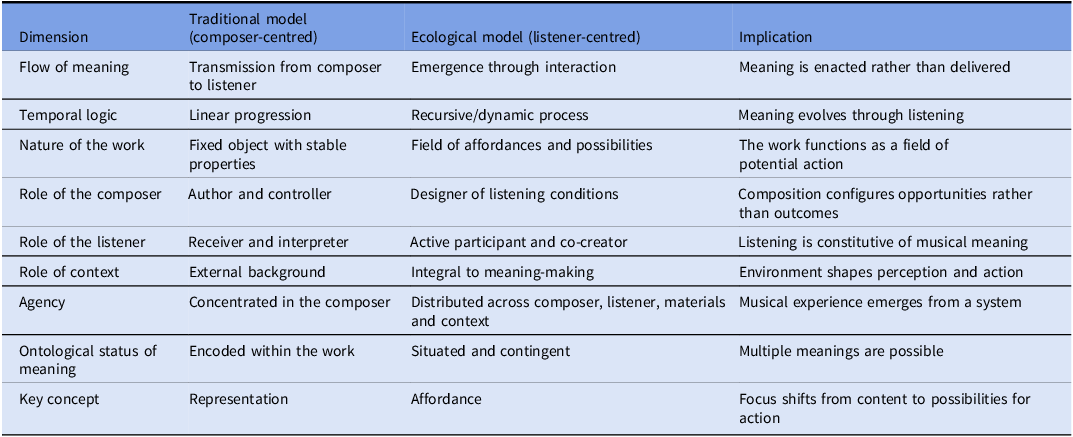
The conceptual shift from traditional to ecological models of composition is summarised in Figure 1, which contrasts traditional composer-centred models with the listener-centred ecological framework developed here. The upper panel illustrates a traditional composer-centred model in which musical meaning is assumed to be encoded by the composer, embodied in the work and transmitted to the listener through structure and representation. The lower panel presents the listener-centred ecological framework, which is understood as the design of listening affordances rather than the transmission of fixed meanings. Musical meaning emerges through the dynamic interaction among composer, listener, sound materials and contextual factors. Listening is conceived as an active, situated and embodied process through which perceptual actions such as attending, tracking, anticipating, entraining, recognising, tolerating ambiguity and refining auditory discrimination contribute to the emergence of musical form and meaning. Additional contrasting conceptions of composition are reported in Table 2.
Traditional and ecological models of composition.

Contrasting traditional and ecological conceptions of composition

Table 2. Long description
A table with nine rows and four columns comparing traditional and ecological models of composition. The columns are labeled Dimension, Traditional model (composer-centred), Ecological model (listener-centred), and Implication. The rows are labeled Flow of meaning, Temporal logic, Nature of the work, Role of the composer, Role of the listener, Role of context, Agency, Ontological status of meaning, and Key concept. Each row provides a comparison between the traditional and ecological models along with the implications of these differences.
Conceptualising composition as the design of perceptual conditions resonates with process-oriented models of musical improvisation, where meaning emerges through real-time interaction, anticipation, feedback and embodied listening rather than through predefined structures (Biasutti and Frezza Reference Biasutti and Frezza2009). Research on electroacoustic compositional processes suggests that creative decisions emerge through the continuous interaction of artistic intentions, technological affordances and evolving sonic materials highlighting composition as a dynamic and process-based practice (Biasutti and Concina Reference Biasutti and Concina2021; Reference Biasutti, Concina, Devaney, Fautley, Grow and Ziegenmeyer2023). Compositional decisions – timbre, temporal organisation, density, spatialisation, ambiguity – function as constraints and invitations guiding engagement. This aligns with practices emphasising process, emergence and listener participation, including experimental and electroacoustic composition (Landy Reference Landy2007). It becomes less about prescribing a fixed trajectory and more about creating a field of perceptual possibilities.
This position builds on earlier work in electroacoustic music concerned with the relationship between composer’s intention and listener reception. Landy’s discussion of sound-based music foregrounds the problem of accessibility, arguing that listeners may need a point of orientation while engaging with works whose materials do not follow conventional musical syntax (Landy Reference Landy2007). The intention/reception project examined how listeners respond to electroacoustic compositions in relation to composers’ stated intentions, in works involving real-world sound references (Weale Reference Weale2006). These studies are precedents for a listener-centred approach because they shift attention from the work as an autonomous object towards the listener’s strategies of access, interpretation and meaning-making. Such reframing has implications; it invites composers to consider perceptual trajectories and to use sound-based practice to develop listening awareness. Sound awareness is an intrinsic dimension of ecological music, which involves the redefinition of compositional agency.
Redefining compositional agency
Compositional agency refers to the composer’s capacity to act intentionally and make meaningful creative choices, shaping a musical work through deliberate decisions while negotiating constraints such as commissions, stylistic conventions, deadlines and available technologies (Barclay Reference Barclay2021). It includes control over musical materials (harmony, orchestration, style, and form), the expression of identity, culture and values, and the ability to define roles and expectations with performers, producers, institutions and audiences (Cook Reference Cook2013). In the traditional view, agency largely coincides with the composer’s control over musical objects – notes, structure and formal organisation – so that authorship is primarily defined through the intentional manipulation of musical material (Landy Reference Landy2007).
In ecological music, compositional agency is redistributed, and it becomes a form of responsibility and relational practice grounded in ethical awareness, leadership, relational design and intentional listening. The composer shapes the work by designing the conditions through which music emerges and constructing systems of interaction among humans, technologies and listening communities (Burtner Reference Burtner2011). This view aligns with enactive accounts of musical experience, in which meaning emerges through participation, sensorimotor coupling and dynamic interaction (Schiavio et al. Reference Schiavio, Ryan, Moran, van der Schyff and Gallagher2022b). Composer agency becomes the capacity to shape the work through choices made within, or against, constraints, including the definition of compositional priorities and the development of new grammars and principles. Ecological composition expresses this agency through the cultivation of ecological attention and the alignment of compositional choices with sustainability and community engagement (Allen and Titon Reference Allen and Titon2023).
Under an ecological framework, agency is relational and processual rather than hierarchical (Burnard Reference Burnard2012). Composers conceptualise their creative work through interconnected processes involving perception, reflection, imagination, emotion and interaction with musical materials (Schiavio et al. Reference Schiavio, Biasutti, Kempf, Popescu and Benedek2024). Composition does not relinquish structure or intention, but repositions compositional responsibility as the design of conditions in which meaningful listening can emerge through shared perceptual activity. This perspective aligns with ecological frameworks emphasising interdependence, situatedness and accountability, where agency is expressed not only through aesthetic decisions but also through the ethical orientation of compositional practice and its capacity to foster ecological awareness (LaBelle Reference LaBelle2010).
Defining ecological music
The concept of ecological music is distinguished here from narrow associations with environmental sound sources, naturalistic references or explicit ecological themes. Rather than defining ecology in terms of what sounds represent or where they originate, ecological music is reconceptualised as a framework grounded in listening as a situated and relational process (Gibson Reference Gibson1979). It does not describe a category of sound materials, but a way of structuring sound in relation to how listeners perceive, explore and make sense of auditory events (Gaver Reference Gaver1993). The ecological dimension lies in the relation between sound organisation and perceptual activity; musical structures are designed with regard to listening processes rather than imposed independently of them (Windsor and de Bézenac Reference Windsor and de Bézenac2012).
Ecological composition aims to establish a correspondence between compositional grammar and listening grammar. Compositional grammar refers to the strategies, constraints and principles used by the composer to shape sound over time (Keller and Capasso Reference Keller and Capasso2006). Listening grammar refers to the perceptual habits, expectations and exploratory strategies through which listeners make sense to sound (Clarke Reference Clarke2005). The ecological approach does not prescribe meaning, but aligns these two grammars so that musical form and meaning may arise through perceptual engagement rather than symbolic decoding alone (Reybrouck Reference Reybrouck2019).
Ecological music can be defined as a compositional approach that treats musical experience as an ecological process of sense-making, unfolding through the interaction between sound material, temporal organisation, listening affordances and the situated listener (Windsor and de Bézenac Reference Windsor and de Bézenac2012). Within this framework, musical meaning is an emergent phenomenon that develops over time through attention, memory, bodily orientation and contextual interpretation (Reybrouck Reference Reybrouck2019). This definition marks a shift from formalist models, which locate meaning primarily in internal structural relations, and from representational models, which anchor meaning in external reference. It foregrounds relationality; music exists as an event that comes into being through the co-dependence between sound organisation and listening activity (Cook Reference Cook2013).
This framework supports a broad understanding of ecological compositional practice, encompassing instrumental, electroacoustic, improvisational, soundscape-based and hybrid forms without privileging any specific material domain (Keller and Lazzarini Reference Keller and Lazzarini2017). Improvisation provides a productive bridge into ecological composition because it foregrounds the mutual constitution of action and perception, allowing instrumental and vocal practices to be understood as situated processes rather than fixed structures (Biasutti Reference Biasutti2017). Ecological music is thus the organisation of sound according to the perceptual actions it affords: attending, tracking, grouping, anticipating, entraining, recognising, misrecognising, tolerating ambiguity and refining auditory discrimination. Its ecological dimension is procedural; it concerns how listening is activated, sustained, redirected and transformed.
The listener-centred ecological framework is summarised in Figure 2. The model conceptualises composition as the design of listening affordances. Compositional decisions shape a listening situation in which sound materials, listeners and ecological contexts interact dynamically through perceptual information and exploratory listening actions. Musical meaning emerges through these situated interactions.
Listener-centred ecological framework for composition.

Figure 2. Long description
A diagram of a listener-centred ecological framework for composition. Panel A: Compositional Design. The composer as designer of listening affordances. Selects and transforms sound materials. Organises temporal, spectral and spatial relations. Shapes perceptual conditions. Anticipates possible modes of engagement. Panel B: Listening Situation. Ecological Context. Physical environment, social setting, cultural practices, technologies. Sound Materials and Events. Acoustic, electronic, instrumental, environmental. Listening Affordances. Possibilities for action-perception. Listener. Embodied, experienced, active, situated. Memory, body, culture, tasks, intentions, prior listening. Panel C: Emergent Outcome. Situated Musical Meaning. Emerges through the interaction of listener, sounds and context. Multiple possible meanings and experiences. Dynamic and evolving over time.
Principles of listener-centred ecological composition
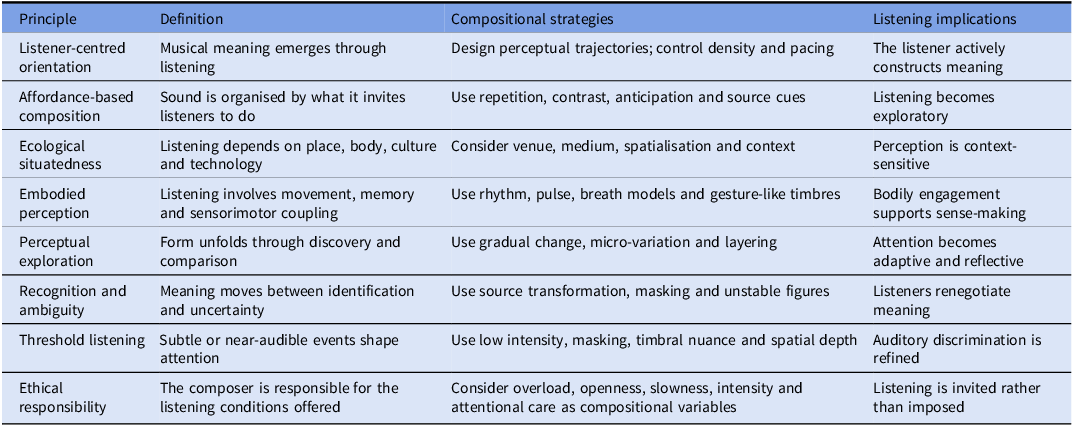
The listener-centred ecological framework can be summarised through a set of interrelated principles that describe how composition, perception and meaning are understood within an ecological perspective as reported in Table 3. These principles should not be understood as rigid criteria defining a distinct genre, but as conceptual orientations that foreground listening affordances, embodied engagement and the situated emergence of musical meaning.
Principles of listener-centred ecological composition

Table 3. Long description
A table with eight rows and four columns. The columns are labeled Principle, Definition, Compositional strategies, and Listening implications. The rows are labeled with different principles: Listener-centred orientation, Affordance-based composition, Ecological situatedness, Embodied perception, Perceptual exploration, Recognition and ambiguity, Threshold listening, and Ethical responsibility. Each row provides a definition, compositional strategy, and listening implication for the respective principle.
Discussion
The article makes three main contributions: conceptual, methodological and analytical. Conceptually, it defines listener-centred ecology as a relational system in which attention, exploration, perceptual organisation, bodily orientation, memory, culture and environmental context interact dynamically through listening. Rather than treating ecology as a property of sound materials or environmental references, the article locates the ecological dimension in the relations that become perceptually available within musical experience.
Methodologically, the article proposes a practice-based operationalisation of ecological concepts such as auditory events, affordances and perceptual thresholds. These concepts are translated into compositional variables including density, temporal organisation, masking, timbral saturation, spatialisation, repetition, ambiguity and transformation processes. This approach clarifies how theoretical notions from ecological psychology and embodied cognition can inform compositional decision-making without reducing composition to the application of perceptual research.
Analytically, the article introduces an affordance-based reading of musical form. Structure is described not as a hierarchy of symbolic relations alone, but as a configuration of perceptual conditions that guides exploratory behaviour over time. Entrainment, threshold listening, ambiguity management, recognition and auditory discrimination become ways of understanding how form is experienced, negotiated and reorganised in listening.
Ethics of affordance-based composition
An ethical dimension follows from the ecological conception of composition as the design of listening affordances. If musical meaning emerges through the interaction between sound materials, listeners, bodies, contexts and cultural practices, then compositional decisions do not simply organise sonic objects; they shape the field of perceptual possibilities offered to others (Clarke Reference Clarke2005; Windsor and de Bézenac Reference Windsor and de Bézenac2012; Reybrouck Reference Reybrouck2019). The composer’s responsibility is to create conditions to accompany the listener.
This responsibility does not imply simplicity, accessibility or predetermined clarity. Ecological composition may involve ambiguity, density, instability, silence, threshold perception and perceptual difficulty. These conditions become ethically significant when they are treated as part of a listening situation. The central question is not whether the listener receives an intended meaning, but whether the work offers conditions in which attention, exploration, discrimination, memory and interpretive agency can meaningfully operate (Schafer Reference Schafer1992; Westerkamp Reference Westerkamp2002; Clarke Reference Clarke2005).
An ethics of ecological composition is embedded in compositional technique itself: in decisions concerning rhythm, timbre, repetition, spatialisation, masking, intensity, duration, density, recognition, abstraction and transformation. To compose ecologically is to design situations in which listening can become active, situated and exploratory, rather than merely receptive (Schafer Reference Schafer1977; Truax Reference Truax2001; Windsor and de Bézenac Reference Windsor and de Bézenac2012). The ethical task of the composer is not to guarantee meaning, but to cultivate conditions through which meaning may emerge without denying the listener’s perceptual and interpretive agency (Reybrouck Reference Reybrouck2019).
Limits and open questions
A listener-centred ecological framework raises issues. First, it cannot account for all modes of musical engagement, since it offers limited explanatory power for listening practices oriented towards symbolic analysis, score-based interpretation or stylistic competence – domains in which meaning is often negotiated through learned conventions and analytical categories (Landy Reference Landy2007; Cook Reference Cook2013). Second, the emphasis on perceptual openness complicates evaluative criteria. If musical meaning and form emerge differently for each listener, compositional success cannot be assessed solely through shared structural standards without reintroducing the formalist assumptions the framework seeks to move beyond (Reybrouck Reference Reybrouck2019). Evaluation may include additional criteria such as the musical piece’s capacity to sustain attention, support exploratory listening and meaningfully engage audiences within specific contexts of reception (Duffy Reference Duffy2013).
Another implication is that listening affordances are not activated uniformly across listeners. Factors such as age, musical expertise, cultural background, listening history and the conditions of reception may significantly influence how affordances are perceived and enacted. For example, rhythmic entrainment, source recognition, threshold listening or the tolerance of ambiguity may vary according to perceptual training, familiarity with particular musical practices and culturally shaped listening habits. The listening environment itself – including the use of headphones, concert halls, domestic spaces, mobile listening or shared social settings – can alter the salience of perceptual information and the possibilities for exploratory engagement. Affordances are not properties of sounds alone but relational phenomena emerging through the interaction between body, environment, sound and culture.
A further limitation concerns listener-response evidence. The present article proposes a practice-based framework and analyses compositional strategies from the perspective of the composer-researcher. It does not provide systematic listener-response data. Claims about listening affordances should be understood as hypotheses generated through compositional practice rather than as verified accounts of audience experience.
Finally, methodological issues remain in translating perceptual principles into compositional practice without reducing composition to applied psychology. Perceptual and psychological research can function as inspiration – supporting reflective design choices – rather than as deterministic rules. Maintaining this balance remains a challenge for ecological composition, particularly in practice-based contexts where compositional activity constitutes a site of inquiry and knowledge production (Truax Reference Truax2015; Keller and Lazzarini Reference Keller and Lazzarini2017; Boersen Reference Boersen2022).
Directions for future research
The integration of compositional practice and perceptual research opens multiple and complementary directions for future investigation. A first avenue concerns empirical studies of listener experience in ecological, listener-centred works. Listening experiments – focusing on attention, perceptual organisation and temporal engagement – could inform compositional practice, offering empirical insight into listening affordances without constraining creative freedom (Clarke Reference Clarke2005; Windsor and de Bézenac Reference Windsor and de Bézenac2012). Future research should investigate whether and how listeners perceive the intended affordances through surveys, interviews, listening diaries and creation–reception methodologies. Empirical research is not intended to validate compositional outcomes, but to refine our understanding of how perceptual conditions operate within musical experience and sense-making over time (Reybrouck Reference Reybrouck2019). Further studies should examine listener-response language, conceptual structures, accessibility, familiarity and the relationship between perceived objects and physical signals in ecological music (Landy Reference Landy2007; Duffy Reference Duffy2013). Building on this literature, future research could focus on how listeners identify, negotiate and transform listening affordances over time.
A second direction lies in pedagogy. Ecological composition has the potential to function as a powerful tool for cultivating perceptual awareness, attentional flexibility and listening responsibility. Future research could explore how compositional strategies grounded in ecological music – such as ambiguity, gradual transformation and perceptual thresholding – can be integrated into music education, fostering listening as an active, embodied and exploratory practice rather than a purely analytical skill (Schafer Reference Schafer1992).
Finally, interdisciplinary collaboration between composers, psychologists and sound researchers represents a fertile ground for advancing ecological music as both theory and practice. The ecological framework situates composition within perception, learning and cultural engagement, where artistic practice and scientific inquiry mutually inform one another (Keller and Lazzarini Reference Keller and Lazzarini2017; Boersen Reference Boersen2022). The ecological music framework should be understood not as a closed theory, but as the outcome of a long-term, practice-based inquiry and as an open research programme. By integrating compositional experience, perceptual research and theoretical reflection, it proposes a way of thinking in which musical meaning emerges as an open process through attentive, situated and shared acts of listening.



 Open access

