The public-interest website <www.thespurioushandel.com> has been established to explore the many meanings and uses of the term ‘spurious’ as they relate to the life and works of George Frideric Handel (1685–1759). During his extraordinary career, which ranged across much of Western Europe, this great musician produced an enormous number of compositions in almost all existing genres and some of his own invention. After a long life of incessant creativity, from which there survive compositions from as early as his tenth year, Handel left one of the largest musical legacies of all classical composers – one that historians, editors, performers and critics have been struggling to document, authenticate and codify since 1760. Despite all their efforts, which include four attempts to produce a collected edition of the composer's works, there remains to this day a very considerable corpus of music, both vocal and instrumental, that is doubtfully attributed to Handel or presently rejected as ‘spurious’.
Any conception of the ‘Spurious Handel’ necessarily involves its correlative conception of the ‘Authentic Handel’, and so our website also aims to encourage thought and debate about all dimensions of ‘authenticity’ as it relates to or affects the notation, interpretation and critical appreciation of Handel's music. This inquiry will extend from examining the status of complete compositions – even entire genres – as ‘spurious’ or ‘authentic’ to the most minute details of musical notation and their practical interpretation or critical significance. Since the extensive and diverse literature on these subjects is still mostly confined to specialist publications, we aim to widen the discussion by engaging the interest and participation of music lovers in general, and of Handel devotees in particular. For too long, we believe, the musical public has been (accidentally, not deliberately) excluded from the specialist debates about the nature, extent, interpretation and significance of Handel's compositions, and the traditions – executive, editorial, scholarly and critical – associated with those works.
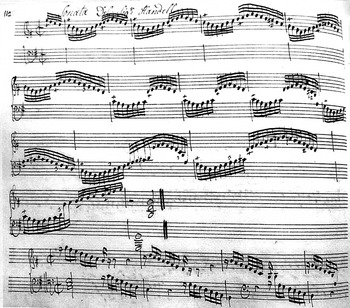
Given the present organization of knowledge, the general public suffers from lack of access to the actual sources of ‘doubtful’ and ‘spurious’ works attributed to Handel, as well as lack of information on traditional or current interpretations of Handel which are accepted as ‘authentic’ but might sometimes be questionable or entirely spurious. We aim to change this situation, first, by making reliable transcriptions of disputed or questionable works available online – and, where possible, reproductions of original sources – so that interested music-lovers can study them, perform them and make up their own minds. Consider, for example, the ‘Sonata del Sigr Handell’ which is preserved in a unique manuscript copy at the Gerald Coke Handel Collection (Figure 1): is this just a misattribution, or could it possibly be an authentic record of a masterly improvisation? (See Graham Pont, ‘Reminiscences of Rinaldo: The Keyboard Transcriptions of “Vo' far Guerra”’, Ad Parnassum 9/17 (2011), 7–35, especially 11 and 27, note 21.) The sonata is currently considered to be ‘spurious’ and is tentatively ascribed to William Babell. (See Terence Best, Georg Friedrich Händel: Klavierwerke I–IV, Kritischer Bericht, Hallische Händel-Ausgabe, series 4, volume 7 (Kassel: Bärenreiter, 2000), 38.)
The beginning of the ‘Sonata del Sigr Handell’, Gerald Coke Handel Collection, accession no. 1275, f. 56v. Reproduced by kind permission of the Gerald Coke Handel Collection, Foundling Museum, London

In bringing such relics to light, we will include notes and commentaries on the musical texts, as well as references to the early sources of the music and the relevant scholarly and popular literature. Even if such works remain ‘doubtful’ or ‘spurious’, readers will be introduced to some interesting early music and perhaps alternative interpretations which might otherwise have escaped their notice. Most of this material, which is not subject to copyright, can be freely downloaded.
This is a long-term and open-ended project with no foreseeable conclusion. Our venture into musicological cyberspace has begun with online transcriptions by Thomas Goleeke of some little-known keyboard works that have been attributed to Handel in manuscripts held by the Staatsbibliothek zu Berlin, which were previously unavailable in any other form.