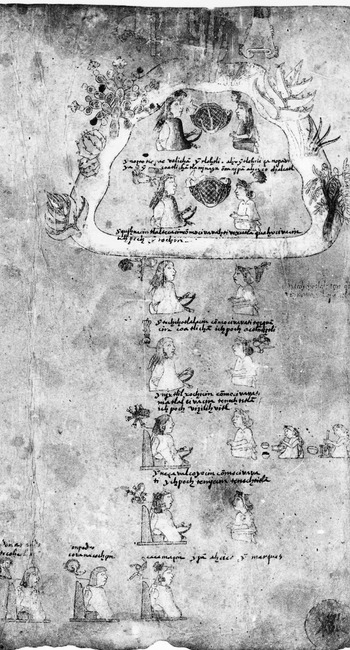
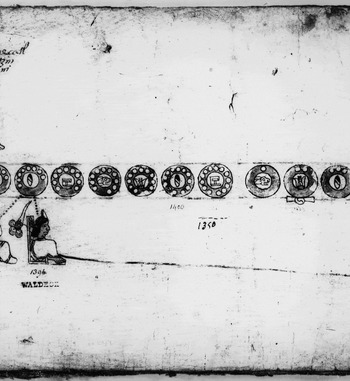
As wives, daughters, and mothers, noblewomen were a necessary component of the Aztec political system because of its focus on legitimate descent and hereditary rule. Indeed, many Aztec pictorial histories, such as the Codex Telleriano-Remensis (1995:Folio 29 v), Codex Xolotl (Reference Dibble1996:2–3), Mapa Quinatzin (Reference Betancourt2004:plate 1), Mapa Tlotzin (Figure 1), and the Tira de Tepechpan (1978:4)—record marriages between the earliest Chichimec migrant leaders, who would found future Aztec cities, and noblewomen from Culhuacan, an already established city in central Mexico associated with the ancient, noble Toltecs. As newcomers to the Valley of Mexico, these Chichimec migrants needed to marry women with Toltec blood in order to establish a noble ruling dynasty, for Toltec blood was an essential means of legitimizing rulership in early Late Postclassic central Mexico (Calnek Reference Calnek, Collier, Rosaldo and Wirth1982:49; Diel Reference Diel2005:84–86; Gillespie Reference Gillespie1989:25–56; Rounds Reference Rounds, Collier, Rosaldo and Wirth1982:66). Thus, in the Mapa Tlotzin (Figure 1), the founding couple of Texcoco are seated in a cave, and both wear the unrefined animal-skin clothing and unkempt hair associated with Chichimec status. Their son and the heir to the Texcocan throne sits below them, and he continues to wear the characteristic Chichimec garments. His wife is seated opposite him, but her more civilized Toltec status is indicated by her white-cotton woven clothing and styled hair. She is a product of a union between a Chichimec father and Toltec mother; thus, she brings noble Toltec blood to the Texcocan ruling dynasty. Shown immediately below, their child, the next Texcocan ruler, wears pure white clothing, indicating his Toltec status and the instigation of a legitimate, royal bloodline for Texcoco (Douglas Reference Douglas2000:135–138).
Texcocan rulers and their wives, Mapa Tloztin. Courtesy of the Bibliothèque Nationale de France, Paris.

Once a noble dynasty was formed through the merging of Toltec and Chichimec bloodlines, elite marriages took on a different role, being used to establish and secure loyalties between polities (Carrasco Reference Carrasco, Harvey and Prem1984:44; Hassig Reference Hassig1992:147–148; Wolf Reference Wolf1999:144–145). Among Nahua elites, it was typical for superordinate rulers to provide their daughters as wives to subordinate leaders, a system called interdynastic hypogamy (Carrasco Reference Carrasco, Harvey and Prem1984:45). This daughter then became the principal wife of the subordinate ruler and the mother of the heir to the throne. This system allied the two cities while publicly communicating the hierarchical ranking of the two. Marriage, then, and by extension the royal wife, was a visible sign of a city's political alliances and rank (Marcus Reference Marcus1992:224; Townsend Reference Townsend2006:368). As such, marriages were an important political weapon that could be wielded for political gain or maneuvering. Indeed, so ingrained was this marital system that unconventional marriages—that is, marriages that flouted traditional expectations—stand out as especially obvious political statements. For example, by not taking the daughter of a superordinate tlatoani, or ruler, as his principal wife, a lesser tlatoani signaled a wish to break an existing alliance. In this article, I examine two such cases and their political ramifications; both marriages ended with the assassination of the subordinate rulers—Ixtlilxochitl of Texcoco and Quaquauhtzin of Tepechpan—by their superiors. With a ruler's choice of spouse having potential life-or-death consequences, marriage must have been a key aspect of political control.
No doubt aware of the political signals sent by marital alliances, Tenochtitlan, the leading power in the Aztec empire, effectively wrote its royal wives out of its history. Though ostensibly a confederation of three city-states often referred to as the Triple Alliance, the Mexica of Tenochtitlan were clearly the leading force of the three, with the Acolhua of Texcoco typically accepted as the second most powerful, while Tlacopan, the third member of the confederacy and associated with the Tepanec people, must have been the lowest in rank. Royal wives rarely appear in the pictorial histories associated with Tenochtitlan, perhaps because they signaled its early subordination to and dependence on other polities (Diel Reference Diel2005:95–99). Indeed, the marriages of later Mexica rulers to agnates—that is, members of their own dynasty—effectively signified Tenochtitlan's autonomy and supremacy in the Aztec empire (Carrasco Reference Carrasco, Harvey and Prem1984:56–57). The message was that the Tenochca ruler could not take the daughter of a superordinate leader as a wife because no such woman existed; no one was above the Tenochca leader. Moreover, Tenochtitlan's agnatic marriage pattern diminished the threat of split loyalties inherent in the taking of an outside bride. Although these noble wives were largely political pawns, they also had the potential to be active agents and spies, ready to report any transgressions or political machinations by their husbands back to their original homelands (Umberger Reference Umberger, Berdan, Blanton, Boone, Hodge, Smith and Umberger1996:97).
As both agent and pawn, then, the noble wife occupied a precarious role in Aztec politics. For example, by marrying Tenochca noblewomen, the rulers of cities such as Texcoco and Tlatelolco signaled their secondary status relative to Tenochtitlan. Accordingly, these royal wives became fitting targets for rulers bristling under Tenochca control. Indeed, the way in which two particular rulers of Texcoco and Tlatelolco treated their Tenochca wives must have communicated their increasing dissatisfaction with their subordination to Tenochtitlan. This discontent became manifest through the abuse of these royal wives, which I believe effectively signified a proclamation of independence from Tenochtitlan without the necessity of an outright declaration of war. To further signal autonomy, the leaders of these two cities attempted to emulate the Tenochca marriage pattern. By selecting wives from within their own dynasties, these leaders further asserted their freedom from Tenochtitlan.
Information on these elite marriages comes from histories—pictorial and alphabetic, Nahua and Spanish—that were recorded after the Conquest. Therefore, although they elaborate on pre-Conquest history, they do so with colonial intentions. Moreover, these histories fit better our notions of political argument than “true” history and thus are clearly biased in favor of the local patron community. I consider these biases in relation to the political import of each particular marriage for the local community both before and after the Conquest. Nevertheless, I am not as interested in whether or not these events truly took place (and as will be seen, some of these events are quite extraordinary); instead, I am interested in the fact that these histories are preserved and that the telling of the events did happen. That they were recorded in the Colonial period reveals that some elite marriages continued to send important political messages well after the Conquest. Nevertheless, mentions of royal wives are relatively uncommon in Aztec histories, and it is usually only under extraordinary circumstances that we hear about these women, typically when tensions were high between two cities in an alliance or when an important political statement needed to be sent. Though infrequent, these references do indicate that the noble Aztec wife could be a key political participant, with some elite marriages serving as significant a function in the workings of empire as war.
THE MARRIAGE OF IXTLILXOCHITL OF TEXCOCO AND MATLACIHUATL OF TENOCHTITLAN
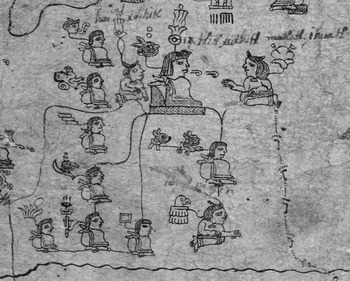
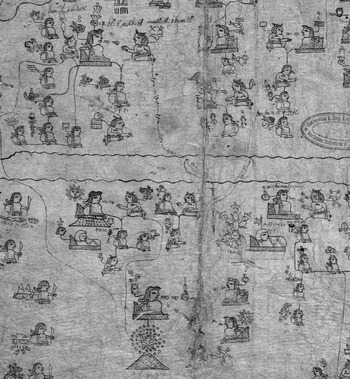
Before the emergence and growth of the Aztec empire in the fifteenth century, the most powerful altepetl, or city-state, in central Mexico was Tepanec-controlled Azcapotzalco. Following the system of interdynastic hypogamy, the Azcapotzalco ruler Tezozomoc offered his daughters as wives to lesser rulers. These marriages were meant to ensure the loyalty and continued subjugation of these lesser cities and publicly declare the superior position of Azcapotzalco in the marital alliances. Accordingly, Tezozomoc sent his daughter Tecpaxochitl to Texcoco to marry its future tlatoani, Ixtlilxochitl. This marriage is recorded in Map 6 of the Codex Xolotl (Figure 2), a cartographic history painted in Texcoco in the mid-sixteenth century (the following reading follows Alva Ixtlilxochitl Reference Alva Ixtlilxochitl and O'Gorman1997:1:326–327 and Dibble Reference Dibble1996:86). Here, Tecpaxochitl, identified by her “Flint Flower” name glyph, is seated behind Ixtlilxochitl, who is identified with an “Eye Flower” name glyph. In the Aztec pictorials, women are distinguished by their kneeling postures and wrapped hairstyle, while the men have shorter hair and sit with knees drawn up in front. A line leads from the foot of Tecpaxochitl toward the bottom of the map and ends at the “Ant Heap” place glyph of Azcapotzalco, which is linked to its ruler Tezozomoc (identified with a “Smoking Stone” name glyph) and indicates that she is his daughter (Figure 3). That the marriage was consummated is suggested by the group of men, who must be their sons, seated to the left of and underneath the couple.
Marriages of Ixtlilxochitl. Codex Xolotl, Map 6. Courtesy of the Bibliothèque Nationale de France, Paris.

Genealogies of Ixtlilxochitl's wives. Codex Xolotl, Map 6. Courtesy of the Bibliothèque Nationale de France, Paris.

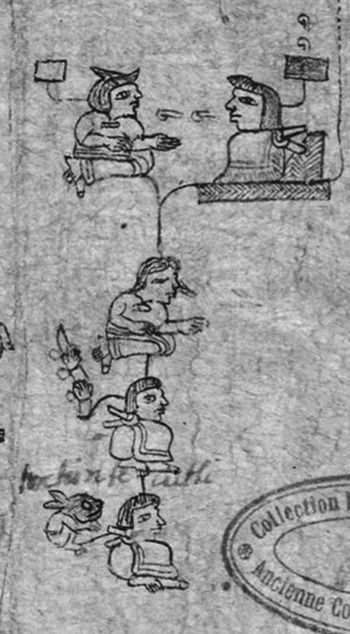
Nevertheless, the painter of the Codex Xolotl does not show the two in the compositional pattern that identifies traditional marriages throughout the manuscript, which signals that Tecpaxochitl is not the principal wife of Ixtlilxochitl. Throughout the Codex Xolotl, principal wives are shown seated in front of their husbands. For example, in Figure 4 (a detail from Figure 3, upper right), a husband and wife appear on the same level facing each other and visually linked. The wife gestures toward her husband, while the husband speaks to his wife, as indicated by the speech scrolls that issue from the husband toward his wife. Lines from each connect and join the two to figures below, indicating their children. This same composition is seen again in Figure 3 toward the lower right. Here, the Mexica ruler Chimalpopoca, or “Smoking Shield,” is shown with his principal wife and their children. Moving to the left of the same map, we see the same compositional device recording two more traditional marriages. Following this pattern, Ixtlilxochitl's principal wife must be the woman seated before him. This woman is named Matlacihuatl (Blue Woman), and a series of footprints lead toward her, indicating her homeland and lineage (Figure 3). These footprints begin at the funerary bundle of the Mexica ruler Huitzilihuitl (identified with a “Hummingbird Feather” name glyph), which is placed next to the Tenochtitlan place glyph of stones (for te-tl) and a nopal cactus (for noch-tli). Ixtlilxochitl's principal wife, then, is the daughter of this former Tenochca tlatoani and a sister of Tenochtitlan's next tlatoani, Chimalpopoca, who is shown just above his father. That Matlacihuatl must be the principal wife of Ixtlilxochitl is further indicated by the inclusion immediately underneath the couple of their son Nezahualcoyotl (identified by his “Fasting Coyote” name glyph) who will inherit the Texcocan throne; the sons of principal wives were favored as heirs to the throne. Moreover, Matlacihuatl is drawn larger than Tecpaxochitl and in communication with her husband, revealing her increased significance.
Detail of a traditional marriage statement in the Codex Xolotl, Map 6. Courtesy of the Bibliothèque Nationale de France, Paris.

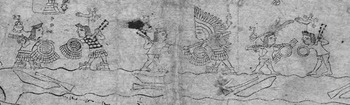
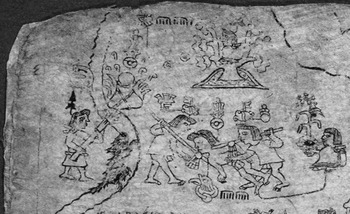
Writing in the sixteenth century, the Acolhua historian Fernando de Alva Ixtlilxochitl (Reference Alva Ixtlilxochitl and O'Gorman1997:1:326–327) used the Codex Xolotl as a source for his work and elucidated this scene, explaining that Tezozomoc had sent his daughter to Texcoco to be the principal wife of Ixtlilxochitl, but Ixtlilxochitl decided to take Tezozomoc's daughter as a concubine instead, a clear insult to the Tepanec leader. Ixtlilxochitl then requested a principal wife from the Tenochca dynasty. Consequently, his marriage to Matlacihuatl and the associated wedding celebration, to which he was said to have invited noblemen from other cities, effectively functioned as a public declaration of a new political alliance between Texcoco and Tenochtitlan. Indeed, Tezozomoc was apparently furious over this public humiliation of himself and his daughter, but rather than declare war outright, he punished Texcoco by demanding excessive tribute of the city. Ixtlilxochitl would not capitulate and hostilities soon broke out between the Acolhua of Texcoco and the Tepanecs of Azcapotzalco, as is also described in the Codex Xolotl, where a series of vignettes on Map 7 (Figure 5) show Acolhua warriors, marked by hieroglyphic compounds reading Water (a-tl) Arm (col-li) for Acolhua; fighting Tepanec soldiers, marked by hieroglyphs reading Stone (te-tl) Flag (pan-tli) for Tepanec. In the upper-left corner of the same map (Figure 6), we see the outcome of Ixtlilxochitl's marriage choice and political machinations: Tepanec warriors assassinate the Texcocan ruler.
Outbreak of war between Acolhua and Tepanec forces. Codex Xolotl, Map 7. Courtesy of the Bibliothèque Nationale de France, Paris.

Assassination of Ixtlilxochitl, Codex Xolotl, Map 7. Courtesy of the Bibliothèque Nationale de France, Paris.

Clearly, Ixtlilxochitl's choice of a Tenochca principal wife was a politically charged decision, signifying Texcoco's desired autonomy from Azcapotzalco and its new alliance with Tenochtitlan. Such a statement must have been potent because, based on Acolhua tradition, it led to the outbreak of the Tepanec War, in which Tenochtitlan and Texcoco would join forces, as secured by Ixtlilxochitl's marriage alliance, and be victorious in their defeat of Azcapotzalco. This marriage, then, was important for Texcocan history because it solidified the alliance between Tenochtitlan and Texcoco that, according to Acolhua historians, led to the growth of the Aztec empire. By showing the Texcocan ruler openly defying Azcapotzalco and allying with Tenochtitlan, the painter of the Codex Xolotl presented the official Acolhua view that Texcoco was a key player in the formation of the empire. Susan Gillespie (Reference Gillespie, Boone and Cummins1998:233–234) has argued that the extant descriptions of the Aztec empire, which emphasize the Triple Alliance of Tenochtitlan, Texcoco, and Tlacopan, may have been a Colonial tradition, meant to bolster the prestige of the lesser members of the Alliance—namely, Texcoco and Tlacopan (see also Gibson Reference Gibson, Wauchope, Ekholm and Bernal1971:389). Certainly, Nahua histories in general are more accurately described as political arguments, in that they are clearly biased toward the patron community. Accordingly, Acolhua historic tradition stressed Texcoco's position as a significant member, if not the key instigator, of the Aztec imperial alliance, as secured through Ixtlilxochitl's marriage, despite its deadly consequences.
THE MARRIAGE OF QUAQUAUHTZIN OF TEPECHPAN AND XOCHTZIN OF TENOCHTITLAN
Once Tenochtitlan and Texcoco had usurped Azcapotzalco's power and established the Triple Alliance, they used marriage alliances to secure the loyalty of their subordinate cities, much as Azcapotzalco had done. Accordingly, the next Texcocan tlatoani, Ixtlilxochitl's son Nezahualcoyotl, would offer his daughters in marriage to the leaders of the fourteen cities subordinate to him (Motolinía Reference Motolinía and O'Gorman1971:394; this is also discussed in Carrasco Reference Carrasco, Harvey and Prem1984:47–52). One of these subject cities was the relatively minor altepetl of Tepechpan. However, according to the Tira de Tepechpan (1978), a pictorial history painted during the sixteenth century in Tepechpan that records Tepechpan's history on the upper register and the history of Tenochtitlan on the lower (see Noguez Reference Noguez1978 and Diel in press), the Tepechpan ruler under Nezahualcoyotl instead married a Mexica noblewoman, thereby signaling a break in its alliance with Texcoco, much as Ixtlilxochitl's earlier marriage choice had communicated a split from Azcapotzalco.
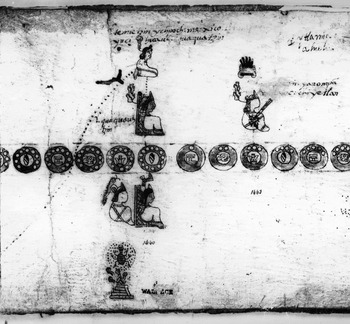
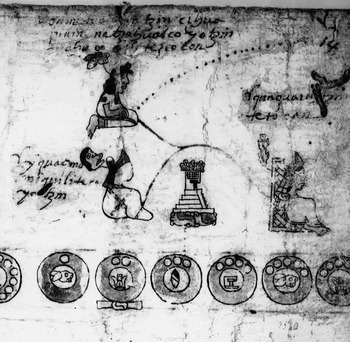
The inauguration of the Tepechpan ruler Quaquauhtzin (Wooden Stick) is shown above the year 13 Flint, or 1440 (Figure 7). Identified by a Flower (xoch-itl) name glyph, perhaps reading Xochtzin, his wife is seated above and linked to her husband by a dotted line, a compositional device that must identify them as a married couple. The alphabetic annotation here also identifies her as Quaquauhtzin's wife (Y temictzin ychpoch mexico ynçihuauh quaquatzin “This is Quaquauhtzin's wife, the daughter of Temictzin of Mexico”). Another dotted line leads from Xochtzin to the lower register and, going back into time, ends at an earlier representation of a warrior named Temictzin (translated as “Dream,” his name is recorded with a sleeping man name glyph) on the lower register; this composition identifies the warrior as her father (Figure 8). A solid line from Temictzin joins one from the Mexica tlatoani Chimalpopoca and, continuing back into time, connects the two to the former ruler Huitzilihuitl (Figure 9), thereby marking Temictzin and Chimalpopoca as sons of Huitzilihuitl and, hence, brothers. Temictzin and his daughter are, therefore, of the highest Mexica nobility.
Marriage of Quaquauhtzin and Xochtzin in 13 Flint and death of Quaquauhtzin in 3 Reed, top register, Tira de Tepechpan. Courtesy of the Bibliothèque Nationale de France, Paris.

Xochtzin's father Temictzin and uncle Chimalpopoca. Tira de Tepechpan. Courtesy of the Bibliothèque Nationale de France, Paris.

Xochtzin's grandfather Huitzilihuitl. Tira de Tepechpan. Courtesy of the Bibliothèque Nationale de France, Paris.

Lineage statements are rare in Aztec annals (Boone Reference Boone2000:198), which makes this composition particularly stand out. Moreover, the painters of the Tira de Tepechpan record eleven rulers of Tepechpan, but they only picture the wives of three of these rulers. Therefore, the very inclusion of Quaquauhtzin's marriage in the Tira de Tepechpan reveals its political import, signifying an alliance between Tepechpan and Tenochtitlan. Although the Aztec empire was ostensibly a confederation of three cities, Tenochtitlan was clearly the leading force of the three. By emphasizing Tepechpan's marital alliance with the imperial capital, the painter of the Tira de Tepechpan must have attempted to enhance the political prestige of Tepechpan, and in so doing denied its true subject status to Texcoco. Indeed, Texcoco's reaction to this marriage reveals the political consequences of this blatant political maneuver.
Quaquauhtzin died just three years after his accession (Figure 7). His funerary bundle above the year 3 Reed (1443) is pierced with an arrow, signaling that he died of unnatural causes. This terse reference calls forth the story of his death, which is not elaborated in the Tira de Tepechpan but is recorded in some detail by the Acolhua historian Alva Ixtlilxochitl (Reference Alva Ixtlilxochitl and O'Gorman1997:1:544, 2:118–120). According to Alva Ixtlilxochitl, the Texcocan tlatoani Nezahualcoyotl visited Tepechpan and dined with Quaquauhtzin, whose fiancée (the same Tenochca woman recorded in the Tira de Tepechpan as Quaquauhtzin's wife) served the two men. It is surely significant that Alva Ixtlilxochitl identifies Xochtzin as Quaquauhtzin's fiancée rather than wife; perhaps he sought to make Nezahualcoyotl's subsequent actions less treacherous while also downplaying Quaquauhtzin's insubordination. On first sight, Nezahualcoyotl fell in love with the Mexica noblewoman and, determined to have her, ordered the Tepechpan ruler into a battle in which he had arranged his killing. As a subject of Texcoco, Quaquauhtzin could not refuse his superior's request, and his inevitable death is communicated in the Tira de Tepechpan. After the battle, Nezahualcoyotl married Quaquauhtzin's widow; she would be his principal wife and the mother of the future Texcocan leader Nezahualpilli (for more complete analyses of this event, see Martínez Reference Martínez1972:60–61; Noguez Reference Noguez1978:1:90–92; Offner Reference Offner1983:228–230; and Diel Reference Diel2005:89–90).
Nezahualcoyotl's seemingly innocent visit to Tepechpan, then, was more likely taken to check up on his subject city. With his suspicions that Tepechpan was breaking its alliance with him confirmed, he punished the Tepechpan ruler for his disloyalty by ordering his killing, ample warning to any other city wishing to defy Texcoco. Indeed, a poem that Quaquauhtzin was said to have recited the night before his death and later preserved alphabetically in two separate manuscripts (the poem appears twice in the Cantares Mexicanos, a sixteenth-century manuscript held by the Mexican National Library, and once in a manuscript now called the Romances de los señores de Nueva España, in the University of Texas collection) suggests the popularity of this cautionary tale (see León-Portilla Reference León-Portilla1992:99–111 for a transcription, translation, and analysis of this poem). Although the poem does not refer directly to these events and the woman who instigated them, Quaquauhtzin's statement, “You have hated me/You have marked me for death,” suggests an underlying antagonism between himself and Nezahualcoyotl. Nevertheless, his subject position is clear, he has no choice but to accept his death, “Now I go to his house/I will perish.”
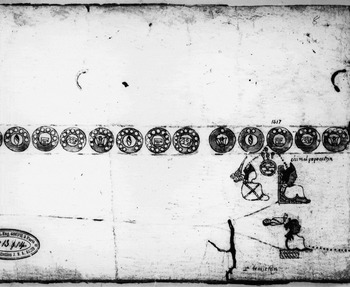
Ultimately, Tepechpan's political machinations proved unsuccessful. Nezahualcoyotl ended the marriage and later installed his daughter as the principal wife of the next Tepechpan ruler. This Texcocan wife is recorded in the Tira de Tepechpan (Figure 10), where she is shown above and linked to her husband in marriage, though the only indication of her nationality comes from an alphabetic annotation added later to the manuscript. This annotation identifies her as Ome Tochtzin, a daughter of Nezahualcoyotl of Texcoco (Y ome tochtzin cihuapillin netzahualcoyotzin ychpoch tezcocon, or “This is Ome Tochtzin, a noblewoman and the daughter of Nezahualcoyotl of Texcoco”). Nevertheless, a strict reading of the paintings in the Tira de Tepechpan only informs us of the alliance between Tepechpan and Tenochtitlan. In fact, Ome Tochtzin was most likely included here not because of her link to Texcoco but because she acted as regent, or ruler stand-in, for Tepechpan after the death of her husband in 2 Reed (1507) and before the installation of their son as Tepechpan's next ruler in 5 Rabbit (1510; Boone Reference Boone2000:231, 264–265; Diel Reference Diel2005:90–92). Like the Acolhua historians mentioned earlier, the Tepechpan painter presented his city as a key ally of Tenochtitlan, thereby presenting an illustrious image for this relatively minor altepetl.
Marriage of Lady Ome Tochtzin, daughter of Nezahualcoyotl of Texcoco, to a ruler of Tepechpan, Tira de Tepechpan. Courtesy of the Bibliothèque Nationale de France, Paris.

Interestingly, the Franciscan historian Juan de Torquemada (Reference Torquemada1986:1:154–156) describes a version of this same story but with slight variations. He claims that the ruler whose assassination Nezahualcoyotl arranged was named Temictzin. Although subject to Nezahualcoyotl, Temictzin married instead a daughter of a ruler of Tlacopan. Thus, the setting and characters have changed, but a subordinate ruler to Nezahualcoyotl still defied his superior, now by taking a Tepanec noblewoman as a wife rather than a daughter of the Acolhua tlatoani. In this version, too, Nezahualcoyotl arranged the death of his disobedient subject and married his widow. Both Alva Ixtlilxochitl (Reference Alva Ixtlilxochitl and O'Gorman1997:1:217) and Torquemada (Reference Torquemada1986:1:155) noted the similarities of this tale with the biblical story of David, Uriah, and Bathsheba, with Nezahualcoyotl in the role of David, who fell in love with Uriah's wife, Bathsheba and, determined to have her, ordered Uriah into a battle in which his death was arranged. As Salvador Velazco (Reference Velazco1998:41–43) has argued, Alva Ixtlilxochitl may have enhanced the similarities between David and Nezahualcoyotl in an attempt to make Texcoco appear the true place of the Christian faith. Moreover, although these accounts emphasize Texcoco's control over its subjects, they also mask the underlying political intrigue by rather romantically tying the ordered killing of a political subordinate to Nezahualcoyotl's love for his future wife, not because of her original husband's disloyalty. These records, then, may reveal Texcoco's disinclination to admit its tenuous hold over its subject cities, especially in the face of contestations over its subject cities in the Colonial period (for examples, see Gibson Reference Gibson1964:51–53).
Furthermore, the role of Tenochtitlan in the Tepechpan affair cannot be ignored. By providing a wife for the Tepechpan ruler, Tenochtitlan was openly appropriating one of Texcoco's subject cities, and through marriage alliance rather than conquest. Practically, this new alliance may be reflected in the inclusion of Tepechpan as a tribute payer of Tenochtitlan in the Codex Mendoza (Reference Berdan and Anawalt1992:Folio 21v), though the Acolhua Mapa Quinatzin contradicts the Codex Mendoza by including Tepechpan as one of Texcoco's fourteen subject cities under both Nezahualcoyotl and his son and heir Nezahualpilli (see Douglas Reference Douglas2003:298–302). Indeed, such machinations on the part of the Tenochca, along with competition for subject communities and their associated tribute, may have propagated an increasing enmity between Tenochtitlan and Texcoco, which is reflected in records of subsequent Texcocan rulers' marriages. Nevertheless, by marrying the widowed Xochtzin, Nezahualcoyotl may have been attempting to re-strengthen Texcoco's alliance with Tenochtitlan in the light of the increasing tensions between these recently allied cities, although his successors would soon reverse the course set by their predecessor.
THE MARRIAGE OF NEZAHUALPILLI OF TEXCOCO AND CHALCHIUHNENETZIN OF TENOCHTITLAN
If superordinate rulers typically gave daughters in marriage to their subordinates, then by marrying Tenochca noblewomen, the Texcocan rulers communicated Texcoco's secondary status relative to Tenochtitlan within the empire (Carrasco Reference Carrasco, Harvey and Prem1984:48; Marcus Reference Marcus1992:228). However, I suspect that the outcome of the marriage of the next Texcocan tlatoani, Nezahualpilli, suggests Texcoco's increasing dissatisfaction with its secondary status and an attempted break from Tenochtitlan.
The Codex en Cruz (Dibble Reference Dibble1981; Figure 11) is a pictorial year-count annals likely from the city of Chiauhtla, which was an Acolhua subject of Texcoco (Dibble Reference Dibble1981:59). In this manuscript, the wife of Nezahualpilli is shown seated at the top of the column of the year 6 Rabbit (1498). She is depicted with a garrote around her neck, as are the three funerary bundles under her, all indicating execution by strangulation (Dibble Reference Dibble1981:34). This terse record refers to extraordinary events surrounding this woman. According to Alva Ixtlilxochitl (Reference Alva Ixtlilxochitl and O'Gorman1997:2:135–136), Nezahualpilli selected Chalchiuhnenetzin, a daughter of the Mexica ruler Axayacatl, as his principal wife. At the time, Chalchiuhnenetzin was quite young, so Nezahualpilli had her sequestered with her numerous servants until she was of an appropriate age to consummate the marriage. Checking up on her one night, Nezahualpilli found her having sexual relations with three other men, named Huitzilihuitl (Hummingbird Feather), Maxtla (Loincloth), and Chiauhcoatl (Water Snake), each of whom is also pictured in the Codex en Cruz. Apparently Nezahualpilli had been duped for a while, for his young bride had previously taken a great number of men as lovers and, after the act, had them killed. Rather extraordinarily, Chalchiuhnenetzin is described as commissioning posthumous portrait statues of these men, which were made using their skeletons as frameworks. As punishment for such debauchery, Nezahualpilli had her, her lovers, and her servants, whom he saw as co-conspirators, executed. The Texcocan ruler sent word of this to Tenochtitlan and went as far as to invite neighboring rulers and their families to witness the execution. The truth of Chalchiunenetzin's actions can never be known, but the extraordinary nature of this event as recorded in these Acolhua histories suggests that the accusations against the Mexica noblewoman were embellished (perhaps even made up) to humiliate Tenochtitlan and establish a split between the two cities.
Punishment of Chalchiuhnenetzin and her lovers, Codex en Cruz. Courtesy of the Bibliothèque Nationale de France, Paris.

Indeed, in other sources, references to these unusual events are somewhat vague. The Anales de Cuauhtitlan (Reference Bierhorst1992:119), a history written in Nahuatl in the sixteenth century in Cuauhtitlan, simply states that in 6 Rabbit, “Chiauhcoatl, Huitzilihuitl, and Maxtla met their death. They had cuckolded Nezahualpilli of Tetzcoco.” Here, Chalchiuhnenetzin's role is only alluded to indirectly, and her punishment is unmentioned. The Nahua historian Domingo Chimalpahin Cuauhtlehuanitzin (Reference Chimalpahin Cuauhtlehuanitzin and Tena1998:1:301, 2:135) only mentions the death of Chiauhcoatl, who was married to a noblewoman of Amaquemecan, Chimalpahin's hometown, but he fails to provide any details. These historians may have found it politically expedient to leave out the Mexica noblewoman's role in the humiliating affair, as both authors stress the alliances between their hometowns and Tenochtitlan.
In her analysis of these events, Susan Evans (Reference Evans1998:178) argues that Nezahualpilli's execution of the participants must have been carried out to restore balance and harmony to his palace. Moreover, the Tenochca could not object to the excessive penalty because punishments for nobles were typically harsher than those for commoners; according to Evans, Texcoco had “the moral high ground” on this issue. Nevertheless, according to Alva's (Reference Alva Ixtlilxochitl and O'Gorman1997:2:181) history, the next Mexica leader, Motecuhzoma II, held a grudge against Nezahualpilli for the execution of Chalchiuhnenetzin, who as Axayacatl's daughter was also Motecuhzoma's sister (Offner Reference Offner1983:237). Certainly also upsetting to the Tenochca ruler was the public nature of the sentence, as is emphasized in the associated description from the Bancroft Dialogues (Reference Karttunen and Lockhart1987:155), a collection of conversations and speeches written in Nahuatl and most likely originally recorded in Texcoco sometime in the late sixteenth century (Karttunen and Lockhart Reference Karttunen, Lockhart, Karttunen and Lockhart1987:7):
All the world assembled, people came from the towns all around to behold. … Even the Tlaxcalans, and the people of Huexotzinco and Atlixco, although they were our enemies, all came to see. … And as to how the lord ruler Nezahualpilli fed people, there were all the containers with hollow bases, the reed baskets, and the sauce bowls, by which the Mexihca were very much put to shame.
The execution and its almost festival-like atmosphere, as suggested by the Bancroft Dialogues' focus on feasting, must have served as a very public declaration of a break in ties between Texcoco and Tenochtitlan and a particularly shameful event for the Tenochca royal family.
The animosity between the two rulers lasted a number of years, and as Pedro Carrasco (Reference Carrasco1999:46) notes, Nezahualpilli does not seem to have played as great a role in the Aztec empire as had his father Nezahualcoyotl, which may be partly explained by his accusations against and punishment of his Mexica wife. In Juan Bautista de Pomar's (Reference Pomar and Vázquez1991:50) response to Texcoco's Relación Geográfica, a series of questions by the Spanish crown to learn about its new territories, he blames the war for succession in Texcoco, which followed Nezahualpilli's death, on Nezahualpilli's execution of the Mexica noblewoman. Because Nezahualpilli had her killed before she could bear him a son and legitimate successor, the next ruler of Texcoco had to be elected from among his other sons. Not surprisingly, and surely in an attempt to reassert control over the increasingly independent Texcoco, Tenochtitlan favored his older son Cacama, whose mother was a Mexica noblewoman, as was his wife. However, some Acolhua communities supported Ixtlilxochitl II, Nezahualpilli's younger son, who gained support by promising to free the Acolhua from Mexica tyranny (see Hicks Reference Hicks and Keber1994 for a full treatment of this battle for succession). Though Ixtlilxochitl II's mother is sometimes identified as a relative of Motecuhzoma II, her exact identity and hometown are highly varied in the sources (see Offner Reference Offner1983:238–239), perhaps because Acolhua historians wished to downplay any connection to Tenochtitlan. Moreover, Ixtlilxochitl II's marriage to an agnate, an Acolhua queen rather than a Mexica noblewoman (Carrasco Reference Carrasco, Harvey and Prem1984:66), further signified his desire to be free from Tenochtitlan.
Also illustrating the growing break between Texcoco and Tenochtitlan is the king's list from the Mapa Tlotzin (Figure 1). The first half of the rulers' list for Texcoco includes both husbands and wives. For example, Ixtlilxochitl I is shown with his Mexica wife, Matlacihuatl; both are named alphabetically and hieroglyphically (shown fourth from the top, both carry the same name glyphs used in the Codex Xolotl). Below, his successor Nezahualcoyotl is pictured with his wife, but she is not named hieroglyphically, and the associated alphabetic text only tells us that she is a noblewoman from Tenochtitlan (in fact, she was Quaquauhtzin's widow). The heir, Nezahualpilli (Fasting Nobleman), faces his wife, but she is not named glyphically, nor is there an alphabetic text to identify her. The following rulers of Texcoco, including Cacama, are all shown alone. Therefore, the final Mexica wives were either unnamed or omitted from Texcocan history. By doing so, the painter of the Mapa Tlotzin presented an independent Texcoco, equal and no longer subordinate to Tenochtitlan (Diel Reference Diel2005:94–95).
Nezahualpilli's accusations against his Tenochca wife and her subsequent public execution were clear moves toward increasing autonomy for Texcoco, and the agnatic marriage of Ixtlilxochitl II continued Nezahualpilli's push toward independence. How this attempt at political restructuring would have played out is impossible to say, for in the midst of the civil war between Cacama and Ixtlilxochtil II, the Spaniards arrived. Ixtlilxochitl II quickly allied with the Spanish invaders and, according to Alva Ixtlilxochitl (Reference Alva Ixtlilxochitl and O'Gorman1997:2:221–224, 241–243), played an important role in helping them to defeat the Tenochca and their allies. The assertions of Texcoco's autonomy in the years before the Conquest and later preserved in the early Colonial histories surely would have bolstered Texcoco's claims for privileges in the Colonial period, for Texcoco's recent break with the Tenocha, as instigated through Nezahualpilli's execution of his Mexica wife, would help to explain and justify Texcoco's new alliance with the Spaniards.
THE MARRIAGE OF MOQUIHUIX OF TLATELOLCO AND CHALCHIUHNENETZIN OF TENOCHTITLAN
Although the outcome of Texcoco's move toward autonomy was cut short by the Spanish invasion, Tlatelolco's earlier strike for independence set in motion a war between Tlatelolco and Tenochtitlan in which the former was bitterly defeated. A number of sources connect this war to the marriage of the Tlatelolcan ruler Moquihuix and his principal wife, a Tenochca noblewoman. As Chimalpahin (Reference Chimalpahin Cuauhtlehuanitzin, Anderson and Schroeder1997:1:137) succinctly puts it, “The year Seven House, 1473. At this time because of concubines Tlatelolco was no more.”
The exact political relationship between Tlatelolco and Tenochtitlan is poorly understood (Berdan and Anawalt Reference Berdan and Anawalt1992:2:33). Mexica migrants first founded Tenochtitlan on an unoccupied, dismal island in Lake Texcoco. Later, a splinter group of these Mexica settlers split apart and founded Tlatelolco on the same island, just to the north of Tenochtitlan. The sister cities remained independent altepetl, each with its own ruling line, until 1473, when the Mexica ruler Itzcoatl conquered Tlatelolco, after which it became subject to Tenochtitlan (Chimalpahin Cuauhtlehuanitzin Reference Chimalpahin Cuauhtlehuanitzin and Tena1998:2:75; Codex Mendoza Reference Berdan and Anawalt1992:Folio 5v–6r). Accordingly, Moquihuix, the next ruler of Tlatelolco, married a Mexica noblewoman (she is variously identified as the sister or daughter of the Tenochca ruler Axayacatl), thereby publicly communicating Tlatelolco's political subordination to Tenochtitlan. Nevertheless, to judge by his abusive treatment of his wife, Moquihuix could not have been happy with this marriage and its political implications.
The Nahua chronicler Chimalpahin (Reference Chimalpahin Cuauhtlehuanitzin, Anderson and Schroeder1997:1:137–139) provides a vivid account of Moquihuix's abuse of his wife, who, like Nezahualpilli's wife mentioned earlier, is also named Chalchiuhnenetzin, an appellation that may function on a more symbolic level, perhaps referencing “women of discord,” a term used by Gillespie (Reference Gillespie1989:24) to describe women who played significant roles in Aztec history, typically instigating key changes within the empire. Moquihuix is alleged to have despised Chalchiuhnenetzin because of her thinness and ugly face, which to him must have signified Tlatelolco's subjugation to her hometown of Tenochtitlan. Additionally, although Axayacatl had sent Chalchiuhnenetzin fine garments to wear, Moquihuix gave them instead to his mistresses, forcing his wife to wear coarse garments in clear denial of her elite status. Moreover, Chimalpahin mentions twice that Moquihuix forced his wife to sleep “among the grinding stones, [hidden] in a corner,” while the rooms of his palace were filled with his mistresses. Indeed, Moquihuix only slept with these mistresses and had no desire for Chalchiuhnenetzin. He even took his aggressions out on his wife in a more physical manner by beating her. According to an alphabetic annotation in the Codex Cozcatzin (Reference de García Lascuráin1994:Folio 14v–15r, translated from Nahuatl into Spanish in Barlow Reference Barlow, Monjarás-Ruiz, Limón, de la Cruz and Paillés1989:78), even Moquihuix's concubines joined in the abuse of his wife: “When Moquihuix reigned, he was engaged to the older sister of Axayacatl. … She was not at the side of Moquihuix for long when Moquihuix's women mistreated her. They did not see her as a spouse; they mistreated her a lot.”
The Anales de Cuauhtitlan (Reference Bierhorst1992:113), written from the point of view of Cuauhtitlan in the mid-sixteenth century, fills in more details of the abuse. According to the author of that history, Moquihuix had scandalous sexual activities with both his concubines and his wife:
Well, at this time Moquihuixtli was scandalizing the people in many ways. He was fattening all his women until they were huge. And as for the lady who was Axayacatzin's daughter, he would thrust his forearm into her crotch and feel inside her body. … And then, it had come about that he had settled his concubines inside the palace. And, to give himself pleasure, he would bathe the concubines with a slippery [pad of] nopal. Well, he would undress his women, so that they could be rubbed with oil, and he cohabited with each one.
The Anales de Cuauhtitlan (Reference Bierhorst1992) emphasize the role of Cuauhtitlan in the upcoming battle between Tlatelolco and Tenochtitlan, claiming that Moquihuix had solicited aid from Cuauhtitlan for his rebellion against Tenochtitlan, but the city refused it and helped the Tenochca instead. Thus, by emphasizing Moquihuix's ill-treatment of his wife in this history, the author of the Anales de Cuauhtitlan justified Cuauhtitlan's having positioned itself with Tenochtitlan in the war. Indeed, one of the main themes of the Anales is the friendship between Tenochtitlan and Cuauhtitlan (Anales de Cuauhtitlan Reference Bierhorst1992:6).
Moreover, the author of the Anales de Cuauhtitlan (Reference Bierhorst1992:113) relates a rather fantastic tale of Chalchiuhnenetzin's vulva speaking to Moquihuix, prophesying the downfall of Tlatelolco. Though they do not elaborate on Moquihuix's abuse of his wife, the accounts by the Spanish mendicant Fray Diego Durán (Reference Durán and Heyden1994:255) and the Nahua historian Hernando Alvarado Tezozomoc (Reference Alvarado Tezozomoc and Berra1987:383–384) also mention the prophetic role of Chalchiuhnenetzin's private parts, which here, too, warned of the coming destruction of Tlatelolco. The legendary nature of these accounts suggests the divine legitimacy of Tenochtitlan's eventual defeat of Tlatelolco. In contrast, of course, the Anales de Tlatelolco (Reference Berlin and Barlow1948:59), written by a Tlatelolcan historian in the mid-sixteenth century, mentions no reasons for the battle nor sacred prophesies of Tlatelolco's defeat; it merely states that the Tenochca fought Tlatelolco and killed Moquihuix. Here the Tenochca come off as the aggressors against the presumably innocent Tlatelolca.
Fed up with the bad behavior of Moquihuix and his concubines, Chalchiuhnenetzin told her brother about the abuse to which she had been subjected, whereupon Axayacatl declared war against Tlatelolco (Chimalpahin Cuauhtlehuanitzin Reference Chimalpahin Cuauhtlehuanitzin, Anderson and Schroeder1997:2:91–93; Codex Cozcatzin Reference de García Lascuráin1994:Folio 14v–15r). As Evans (Reference Evans1998:174–175) points out, more was involved here than just the slighting of a royal wife: “the sex story served the purpose of publicly reinforcing the moral lesson: maintain moderate behavior and do not harm the dignity and sanctity of your official wife and palace.” To be sure, Moquihuix's actions were much more than a simple lapse in morality; the rejection of the Tenochca queen through abusive treatment effectively functioned as a declaration of war with Tenochtitlan. Moreover, according to some sources (Anales de Cuauhtitlan Reference Bierhorst1992:113–114; Chimalpahin Cuauhtlehuanitzin Reference Chimalpahin Cuauhtlehuanitzin, Anderson and Schroeder1997:1:137–139), Chalchiuhnenetzin also told her brother about Moquihuix's planned rebellion against Tenochtitlan, about which she had presumably overheard him talking. As the author of the Anales de Cuauhtitlan puts it, Chalchiuhnenetzin “was telling Tenochtitlan everything. All Moquihuix's secret war talk she was passing on to Axayacatzin.” In these sources, Axayacatl's ensuing actions seem to have been precipitated by both the abuse of his sister/daughter and news of Moquihuix's rebellion; indeed the two actions might be read as one and the same thing.
In other sources that describe the war between Tlatelolco and Tenochtitlan but do not elaborate on the abuse of Chalchiuhnenetzin, she still plays a large role. In these sources, Chalchiuhnenetzin warns Axayacatl of Tlatelolco's aggressions (Durán Reference Durán and Heyden1994:255; Historia de los mexicanos por sus pinturas Reference Angel1965:73), which reveals the active political role the noble wife could take, in effect acting as a spy. Thus, royal wives were likely sent to subordinate cities not only to secure alliances but also to act as a means of surveillance, ready to report to their homelands any breaks in loyalties. For example, according to the Anales de Cuauhtitlan (Reference Bierhorst1992:98–99), the daughter of Tecocoatzin, a ruler of Cuauhtitlan, was sent to marry the ruler of its subject Toltitlan. While there, she kept an eye on her husband and reported his war plans back to her father: “Whenever they talked war, she sent word to the ruler Tecocoatzin. And for this reason, when the battle had begun, she was very definitely on the watch.” In fact, when the battle began, she even set fire to the temple of Toltitlan. With loyalties tied to her father over her husband, this royal wife was both spy and military agent. Though it is unclear how often this was the case, stories such as these indicate that, at the very least, the possibility of these royal wives acting as spies “affected a community's consciousness” (Townsend Reference Townsend2006:376). Ultimately, then, as an outsider from a more powerful city and a potential spy, a royal wife such as Chalchiuhnenetzin was a clear threat to a city like Tlatelolco, whose ruler so clearly bristled under Tenochtitlan's control. As a sign of Tenochtitlan, Chalchiuhnenetzin was a perfect target in a political battle. Nevertheless, her reports to her brother suggest that she was no passive target; indeed, these reports eventually lead to her husband's defeat, which confirms the active political role this royal wife assumed.
Moquihuix's break from Tenochtitlan was also attempted on yet another level. As Chimalpahin (Reference Chimalpahin Cuauhtlehuanitzin, Anderson and Schroeder1997:2:43–45) relates, Moquihuix took another woman as a wife after his marriage to Chalchiuhnenetzin, a daughter of Teconal: “he made her his wife and now disliked the noblewoman who was Axayacatzin's elder sister. Moquihuix no longer went to her.” This statement suggests that this new wife replaced Chalchiuhnenetzin as Moquihuix's principal wife. Though Chimalpahin does not identify Teconal further, this same man appears in Durán's (Reference Durán and Heyden1994:254) and Alvarado Tezozomoc's (Reference Alvarado Tezozomoc and Berra1987:376) accounts of the battle between Tlatelolco and Tenochtitlan; he was one of the main warriors and noblemen of Tlatelolco. Thus, Moquihuix's marriage to a Tlatelolcan noblewoman mimics Tenochtitlan's agnatic marriage pattern, which reduced the threat of a wife with split loyalties, like Chalchiuhnenetzin. Moreover, by taking a Tlatelolcan noblewoman as his new principal wife, Moquihuix tried to assert Tlatelolco's autonomy from Tenochtitlan, just as was done by Ixtlilxochitl II in his efforts to become leader of an independent Texcoco.
Ultimately, Moquihuix was unsuccessful in his attempts at independence. Civil war broke out between the sister cities, and at the final stand at the temple of Huitzilopochtli in Tlatelolco, Moquihuix was either slain by Mexica forces or, aware of his inevitable defeat, jumped from the temple to his death. The sources vary. The Tenochca army then sacked Tlatelolco, and its people were forced to pay tribute to Tenochtitlan (Durán Reference Durán and Heyden1994:261). After this, Tenochtitlan directly appointed military governors to lead Tlatelolco until finally naming Cuauhtemoc, a son of the Tenochca ruler Ahuitzotl, as its tlatoani (Carrasco Reference Carrasco1999:109). Though Tenochtitlan continued to supply Tenochca noblewomen as wives for the rulers of some subordinate centers, the capital also sometimes placed sons of Tenochca rulers directly on the thrones of other secondary city-states, as was done in Tlatelolco (Carrasco Reference Carrasco, Harvey and Prem1984:68–69). These Tenochca noblemen would then marry local noblewomen, thereby securing the loyalty of their children (and future heirs) to Tenochtitlan. Presumably, the Tenochca ultimately found it more politically expedient to take direct control over some altepetl through men than to depend on women. This new system would then diminish the role of noblewomen in Aztec imperial politics.
CONCLUSION
The four case studies elucidated here reveal that for Nahua rulers, marriage was a key means of political control. Alliances could be made or broken through marriage, which made it a significant tool in imperial consolidation. Nevertheless, analyses of Aztec imperial politics typically focus on the role of war in the formation and consolidation of the empire. As women were not primary actors in war, their possible role in Aztec politics is often overlooked. For example, June Nash (Reference Nash1978) has argued that there was an ideology of male dominance over women within the Aztec empire, which she links to an Aztec imperial focus on warfare. Nash (Reference Nash1978:359) maintains that as the empire grew in power, an ideology of dominance over women emerged. In contrast, Sharisse McCafferty and Geoffrey McCafferty (Reference McCafferty and McCafferty1988:55) recover Aztec women's access to power by revealing a system of gender complementarity. They argue that men and women may have had differential access to power at the upper levels, but that men and women were necessary components of the social system, through which women had access to power. This position, however, forces us to look outside politics to recover female agency. Recently, some scholars have presented a more nuanced understanding of Aztec gender relations, especially as they relate to political control. Rosemary Joyce (Reference Joyce2000:168) sees the central Mexica ideology as one not necessarily of male dominance, but of military dominance. Yet even in this system, women still play a key role. As Joyce (Reference Joyce2000:168–169) writes, “[B]oth men and women were encouraged to think of themselves as warriors for the state, engaged in complementary actions that supported the expansion of the Mexica domain.” The noble wife, then, can be seen as one of these state warriors, with the royal palace being her battleground.
Even so, Elizabeth Brumfiel (Reference Brumfiel and Klein2001:75) points out that the Aztec focus on the military, specifically drafting men into military service, did introduce “asymmetries in female and male ideologies and identities.” Thus, although Aztec society and politics may have been structured around gender complementarity, or what Susan Kellogg (Reference Kellogg1995) calls “parallelism,” there was by no means equality between men and women. Aztec gender relations were still an essentially hierarchical division, especially when one takes into account the issue of class (Kellogg Reference Kellogg1995:564). That is, there may have been more control over gender at the state level, while at the local level there was more freedom (Joyce Reference Joyce2000:164–65). Consequently, these royal wives likely had little choice in the matter of their marital partners. However, Chalchiunenetzin's key role in the conflict between Tlatelolco and Tenochtitlan reveals that, once established in their new homelands, royal wives could be much more than passive political pawns. They could also be political agents by acting as spies in their new residences. Thus, women could be active agents of change in the Aztec empire, which explains why some Aztec noble wives (such as the two Chalchiunenetzins) were seen as potential threats in need of neutralization.
Of course, royal wives are mentioned in Aztec histories infrequently, at best, most likely because the majority of elite marriages followed traditional expectations and were therefore not worthy of mention. Moreover, although the royal wife from a higher-status, outside city-state was a sign of that city's alliance, she also functioned symbolically as a sign of her adopted home's political subordination. Thus, it is easy to imagine that some city-states would fail to include royal wives in histories created after the Conquest because they did not want to communicate their pre-Conquest subject status. This means not that these royal wives were unimportant, but that those few marriages that were recorded after the Conquest must have been especially significant because they continued to signal important political messages about alliances and conflicts that were important to assert in the colonial present when new claims to status and position could be made.
Hence, the unconventional marriages of Ixtlilxochitl I of Texcoco and Quaquauhtzin of Tepechpan were recorded in the pictorial and alphabetic histories made after the Conquest because they established key alliances for their home cities. Moreover, Quaquauhtzin's marriage in particular may have exacerbated increasing tensions between Texcoco and Tenochtitlan, seemingly the two key members of the Aztec empire. Indeed, with the establishment of Tenochtitlan as the leading force in the empire, some marriage alliances were not so easy to opt out of. Thus, the marriages of Nezahualpilli and Moquihuix to Tenochca noblewomen branded Texcoco and Tlatelolco as subordinates to Tenochtitlan, and to assert their autonomy, these rulers had to publicly disavow these marriages, in the case of Nezahualpilli by accusing his Tenochca wife of a heinous crime and overseeing her execution and in the case of Moquihuix by abusing his wife and consorting openly with others. These two cities then turned to agnatic marriages to assert their future autonomy from Tenochtitlan. Though the veracity of these accounts is impossible to determine, the recording of these events continued into the Colonial period, which reveals their political significance. Records of the abusive treatment of these wives explain ensuing tensions between Tenochtitlan and Texcoco, on the one hand, and Tenochtitlan and Tlatelolco, on the other. Through these histories and their adoption of agnatic marriages, the elite of Texcoco and Tlatelolco distanced themselves from Tenochtitlan and emphasized their autonomy in the pre-Conquest period, an autonomy they hoped would continue under Spanish rule. Meanwhile, for Tenochtitlan, its defeat of Tlatelolco and subsequent control over the city is justified because of the abuse to which its noblewoman was subjected.
These unconventional marriages suggest that, by the time the Spaniards arrived in central Mexico in 1519, the Aztec empire and its key alliances were in a state of flux, with more cities turning toward agnatic marriage to assert independence from Tenochtitlan. Moreover, these tensions may have inspired Tenochtitlan to change its marital-alliance system. Rather than always sending a Tenochca noblewoman to marry a subordinate leader, the Tenochca rulers also placed Tenochca noblemen directly on the thrones of subordinate cities, which suggests that Tenochtitlan was finding it necessary to exert more control over its subordinate centers. Presumably this was easier to do through the direct rule of a Tenochca nobleman than through the indirect influence and surveillance of a Tenochca noblewoman. Thus, the agnatic marital system that the Tenochca developed, their placement of sons as rulers in foreign lands (rather than daughters as wives), and the progressively isolationist tendencies of other major altepetl, such as Texcoco and Tlatelolco, suggest that the political role of noblewomen was progressively being diminished in Aztec imperial politics, while political tensions were increasing.
Ultimately, in Late Postclassic central Mexico, royal marriage was used as a system of alliance and as a marked sign of loyalties and rank. Therefore, all elite marriages sent strong political messages. Though much has been made of the fierce war machine of the Aztec empire, political maneuvering could also take place on a different, more subtle level, through marriage rather than war and with wives rather than soldiers.
RESUMEN
En el México central del posclásico, matrimonios nobles eran una sistema de alianza y una señal visual de jerarquía porque era típico para gobernantes superiores ofrecer sus hijas como esposas a dirigentes subordinados. En efecto, las reglas para matrimonios nobles eran tan estandarizadas que matrimonios poco convencionales enviaron declaraciones políticos muy fuertes. Este articulo examina cuatro ejemplos de matrimonios pocos convencionales—dos matrimonios que violaron alianzas políticas ya establecidos y dos matrimonios en que las esposas nobles eran maltratado. En los primeros dos casos, Ixtlilxochitl de Texcoco y Quaquauhtzin de Tepechpan casaron con mujeres nobles de Tenochtitlan para crear alianzas con esta ciudad. Sin embargo, los dos deberon de casar con otras mujeres, Ixtlilxochitl con una hija del gobernante de Azcapotzalco y Quaquauhtzin con una hija del gobernante de Texcoco. Por no casando con la hija de su gobernante superior, Ixtlilxochitl y Quaquauhtzin manda un mensaje de su gusto de rompar sus alianzas ya establecidos y de crear alianzas nuevas con Tenochtitlan. Además, los matrimonios de Nezahualpilli de Texcoco y Moquihuix de Tlatelolco con mujeres nobles de Tenochtitlan comunicaron el estado inferior de Texcoco y Tlatelolco relativo a Tenochtitlan. Para mandar un mensaje diferente, los gobernantes de Texcoco y Tlatelolco maltrataron a sus esposas Mexicas, efectivamente comunicando su disatisfación con su subordinación a Tenochtitlan. Los malos tratos de estas esposas significan una proclamación de independencia de Tenochtitlan sin la necesidad de una declaración de guerra. Estos ejemplos revelan alianzas cambiando en el imperio azteca que no son tan claros cuando examinando solo historias de conquistas. Además, estos matrimonios revelan el papel político, potencial pero en gran parte escondido, de las mujeres nobles en el México central del posclásico.
ACKNOWLEDGMENTS
I am grateful to Elizabeth M. Brumfiel, Delia Cosentino, Cecelia F. Klein, and an anonymous reviewer for generously taking the time to read and comment on earlier drafts of this article. Also, a preliminary version of this paper was first presented at the College Art Association Annual Conference in Atlanta in 2005, and I thank William Barnes and Billie Follensbee for their helpful comments and advice on this presentation.