I. INTRODUCTION
While metal oxides, nitrides, carbides, sulfides, etc. are widely used in numerous applications, such as electronics, optoelectronics, photocatalysis, and energy technologies, superior materials may be found in mixed anion inorganic materials, such as metal oxynitrides, Reference Xie and Bert Hintzen1,Reference Moriya, Takata and Domen2 oxychalcogenides, Reference Ishikawa, Takata, Kondo, Hara, Kobayashi and Domen3–Reference Pei, He, Li, Li, Liu, Pan, Barreteau, Berardan, Dragoe and Zhao5 oxycarbides, Reference Wei and Lo6 carbonitrides, Reference Jhi, Ihm and Louie7 borocarbides, Reference Müller and Narozhnyi8 and boronitrides. Reference Imamura, Mizoguchi and Hosono9 Due to their varied crystal structures, anion ordering, Reference Yang, Oró-Solé, Rodgers, Jorge, Fuertes and Attfield10 and ability to tune properties with anion composition, mixed anion inorganic materials span a broad range of physical, chemical, and electronic properties, providing opportunities to improve material performance for a variety of applications. Reference Schottenfeld, Benesi, Stephens, Chen, Eklund and Mallouk11 In comparison to the extensive studies on mixed cation materials, Reference Green, Takeuchi and Hattrick-Simpers12 relatively few synthesis methods and thus experimental evaluations of mixed anion materials exist.
Due to their tunable optical properties with N/O ratio, oxynitride materials are attractive candidates as visible-light-driven photoelectrocatalysts, spectral conversion phosphors, and transparent windows. Reference Xie and Bert Hintzen1 In the field of solar fuels, the development of an efficient photoanode has remained a bottleneck due to the deep valence band energy (with respect to the standard equilibrium potential for water oxidation) of typically studied metal oxide semiconductors. Reference Walter, Warren, McKone, Boettcher, Mi, Santori and Lewis13 Metal nitride semiconductors generally exhibit desirable band energetics for solar water oxidation with valence band energies more positive than metal oxide analogs, yet the chemical instability of metal nitrides in aqueous conditions has largely rendered them unsuitable for aqueous photoelectrocatalysis. Initial investigations into metal oxynitride compounds and oxide–nitride alloys have demonstrated the combined desirable properties of aqueous stability and band energetics necessary for a photoanode in a solar fuel device. Reference Wu, Lazic, Hautier, Persson and Ceder14
To enable efficient exploration of metal oxynitride phase space, we describe a methodology for synthesis of oxynitride thin films using a combination of physical vapor deposition (PVD) and rapid thermal processing (RTP). We note that the technique may be expanded for the general synthesis of mixed anion materials. By regulating the partial pressure (PP) of O2 and N2 gases during reactive magnetron sputtering, anion stoichiometry can be systematically controlled and is unchanged during RTP crystallization of the film into high-temperature phases.
A variety of techniques, Reference Ebbinghaus, Abicht, Dronskowski, Müller, Reller and Weidenkaff15 such as ammonolysis, Reference Xie and Bert Hintzen1,Reference Pokrant, Maegli, Chiarello and Weidenkaff16 chemical vapor deposition, Reference Dupuis, Fourmond, Ballutaud, Bererd and Lemiti17 intercalation, Reference Kim, Paik and Avdeev18 reactive cathodic arc evaporation, Reference Laurikaitis, Dudonis and Milčius19 wet-chemical approaches, Reference Moriya, Takata and Domen2 and PVD Reference Mohamed and Anders20,Reference Mohamed, Abd El-Rahman and Ahmed21 have been used for the synthesis of metal oxynitride materials. While ammonothermal treatments have been widely used for the synthesis of oxynitrides, Reference Xie and Bert Hintzen1 high-temperature processing of oxides in NH3 to form oxynitrides requires careful control of reaction kinetics, as the formation of nitrides is thermodynamically favored over oxynitrides in the oxygen-free and high-nitrogen chemical potential environment. RTP of metal films in O2 and then in NH3 (Ref. Reference Matylitskaya, Bock, Thoma and Kolbesen22) or directly in mixed O2/N2 (Ref. Reference Cristea, Crisan, Barradas, Alves, Moura, Vaz and Cunha23) has also been used to synthesize oxynitride thin films and requires careful calibration and control of annealing time-temperature-heating/cooling rate to obtain the desired composition and phase throughout the thickness of the film. While flux-assisted nitridation and ammonothermal synthesis have been used to achieve morphology and defect control in the synthesis of oxynitrides, Reference Moriya, Takata and Domen2 precise tailoring of synthesis conditions for individual phases is necessary, limiting their application for exploration of new oxynitride phases.
The aim of our approach is to develop a versatile protocol that allows fine control of anion stoichiometry with independent heat treatment and is extendable to multi-cation synthesis. Reactive sputtering, using a mixture of reactive gases and a variety of sources (metals, metal oxides, metal nitrides, etc.), provides the ability to synthesize versatile mixed anion chemistries. Reference Ford, Welch, Caskey, Van Zeghbroeck, Parilla, Ginley, Zakutayev and Perkins24 Specifically, oxynitride compositions have been successfully deposited using mixed O2/N2 reactive sputtering. For N2 PPs sufficient to introduce significant nitrogen into the films, N/O stoichiometry varies nonlinearly as a function of the ratio of N2 and O2 gas flow rates, highlighting the importance of careful control and calibration of the reaction gas atmosphere. Reference Mohamed and Anders20,Reference Mohamed, Abd El-Rahman and Ahmed21,Reference Venkataraj, Kappertz, Jayavel and Wuttig25–Reference Chappé, Martin, Lintymer, Sthal, Terwagne and Takadoum29 Using a variable leak valve to control O2 PP, we demonstrate the ability to carefully control O2 PPs and fine-tune oxynitride chemistries. We further discuss a heuristic approach to rapidly obtain the optimal O2 PP for depositing oxynitride films.
Typically, sputtered oxynitride thin films are either amorphous or contain a mixture of metal oxides and metal nitride phases. Reference Mohamed and Anders20,Reference Mohamed, Abd El-Rahman and Ahmed21,Reference Cristea, Crisan, Barradas, Alves, Moura, Vaz and Cunha23,Reference Venkataraj, Kappertz, Jayavel and Wuttig25,Reference Mohamed, Kappertz, Ngaruiya, Niemeier, Drese, Detemple, Wakkad and Wuttig27 While oxynitride phases have been observed in the as-deposited films in some cases, Reference Venkataraj, Kittur, Drese and Wuttig26,Reference Rawal, Chawla, Jayaganthan and Chandra30,Reference Tao, Chai, Wong, Zhang, Pan and Wang31 several factors such as total pressure, power, and substrate temperature during sputtering are likely to simultaneously control both the composition and crystal structure of the as-deposited oxynitride chemistries. To decouple the temperature-dependent reactivity of the growing film in sputter atmosphere and thermally activated crystallization, we demonstrate RTP as post-deposition, iso-compositional crystallization process that provides access to high-temperature phases without compromising anion stoichiometry. We discuss the variation of metal nitride, oxide, and oxynitride phase fractions as a function of reactive gas stoichiometry on a Ta–O–N system, a system of particular interest as a photocatalyst. Reference Hitoki, Takata, Kondo, Hara, Kobayashi and Domen32
II. EXPERIMENTAL
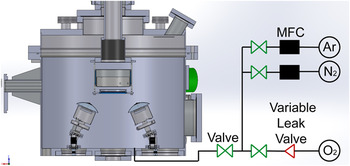
The TaO x N y films were prepared in a custom-designed vacuum chamber (CMS 24, Kurt J. Lesker, Jefferson Hills, PA), as shown in Fig. 1, with base pressure of 6.7 × 10⁻⁶ Pa maintained by a helium-cooled cryopump (CTI Cryo-Torr 8F). All the films were deposited at room temperature using 100 W direct current (DC) reactive magnetron sputtering of a metallic tantalum target (99.95% purity from ACI Alloy, Inc.) in a mixed atmosphere of Ar, N2, and O2 at a constant total working pressure of 0.8 Pa. The flow rates of Ar and N2 gases were controlled using mass flow controllers (MFCs; MKS, 1179A Mass-Flo®) with total pressure controlled by a capacitance manometer (MKS, 626B Baratron®) feedback to a throttle valve on the cryopump. Control of O2 pressure was realized by adjusting a variable leak valve (Granville-Philips, series 203) providing 10−4 Pa precision, and the O2 pressure was measured by an ion gage prior to addition of other gases. The substrates used were 100 mm diameter Si (001) with a thermal oxide coating of approximately 170 nm (diffusion barrier) and were rotated at 5 rpm during the deposition to ensure spatial uniformity of film composition and thickness. The Ta source was tilted at 20° toward the chamber center, the vertical distance between target face and substrate was 65.5 mm and the horizontal distance between source center and substrate center was 165 mm.
Cross-section schematic of the custom-designed PVD chamber (Kurt J. Lesker CMS 24) and schematic of the gas flow manifold. The flow rates of Ar and N2 gases are controlled using MFCs, while O2 PP is controlled by adjusting the variable leak valve capable of pressure control at 10−4 Pa level.

To calibrate and characterize the reactive sputtering rate, the mass deposition rate γ (g s−1 cm−2) was measured using a quartz crystal microbalance (QCM, Inficon SL-A configured with 6 MHz Au-coated quartz crystals). The QCM sensor was placed in the same position as substrate center during thin film depositions. The measurement of mass deposition rate is independent of the film density, and measurements were made early in the QCM sensor lifetime to mitigate sensitivity to the film Z-factor, which was set to 1 for all measurements.
For each deposition, the Ta target was presputtered in argon (Ar) atmosphere at 0.8 Pa for 10 min to clean the target from possible target poisoning and contaminations. A series of TaO x N y thin films were deposited by varying O2 PP from 0 to 0.067 Pa, while the N2 pressure was maintained at a relatively high PP of 0.2 Pa to ensure significant nitrogen incorporation. The as-deposited TaO x N y films were then annealed at approximately 1173 K for 30 s by RTP under flowing N2. To avoid anion exchange with surrounding atmosphere, an atmosphere better than 99.9% pure N2 was obtained by purging the 9 L RTP chamber at 13 lpm for 240 s. A lower N2 flow rate of 3 lpm was used during RTP to avoid convective heat losses, followed by a flow rate of 13 lpm during cool down. The active time of the RTP process is usually limited to few seconds, which limits significant in-film diffusion, and N2 gas maintains sufficient N2 vapor pressure to limit preferential nitrogen loss from the films.
The N/O ratios in the as-deposited and post-RTP films were measured using an Oxford Instruments X-Max 80 mm2 energy dispersive x-ray spectroscopy (EDS; Oxford Instrument, Concord, MA) detector on a FEI Nova NanoSEM 450 (FEI, Hillsboro, OR) using 15 keV electron beam. The crystal structure and phases of the films were determined by x-ray diffraction (XRD) measurements using a Bruker DISCOVER D8 diffractometer (Bruker AXS, Inc., Madison, WI) with Cu Kα radiation. XRD images were collected using a two-dimensional VÅNTEC-500 detector (Bruker AXS, Inc., Madison, WI) and integrated into one-dimensional patterns using DIFFRAC.SUITE™ EVA software. For patterns in which multiple crystalline phases were identified, the relative phase fraction of each phase was approximated by normalizing the measured intensity of the most intense peak of each phase. While more quantitative models of phase concentrations can be applied, this straightforward calculation accurately captures the desired trends in phase concentration with respect to deposition conditions.
III. RESULTS AND DISCUSSION
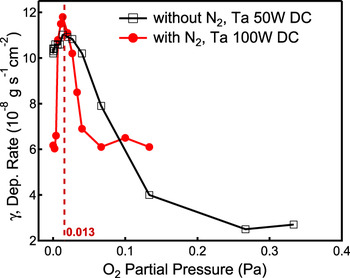
In a reactive sputtering experiment, poisoning of the target surface may be characterized by the variation of mass deposition rate (γ) as a function of reactive gas PP at fixed sputtering power. Mapping this relationship can provide insight into critical reactive gas pressures for anion incorporation into the sputtered films. For reactive sputtering from a Ta target, Fig. 2 shows variation of γ as a function of O2 PP with and without the presence of N2. Variation of γ in the absence of N2 shows increase in γ with increasing O2 PP until 0.013 Pa, followed by continuous decrease of γ and stabilization to a low γ value beyond 0.27 Pa. The initial increase may be in part due to the incorporation of oxygen interstitials in the growing metallic Ta film and is likely dominated by oxidation of the growing film at the substrate. Reference Hollands and Campbell33 In the range of 0.013–0.27 Pa, the increase of O2 PP results in a lower deposition rate, likely due to a corresponding increase in target poisoning by a surface oxide layer, which indicates the onset of significant target poisoning at 0.013 O2 PP. Beyond 0.27 Pa, a steady state metal oxide layer is likely formed on the target surface resulting in a relatively constant, low value of γ. For reactive sputtering in the presence of N2, the variation of γ as a function of O2 PP is observed to be qualitatively similar to its variation in the absence of N2, with the maximal deposition rate attained over a very fine range of O2 PP near the critical value (0.013 Pa) for the onset of oxide target poisoning. Since Ta–O affinity is significantly higher than Ta–N affinity, we suggest that optimal O2 PP for oxynitride synthesis is near the critical O2 PP for the onset of target poisoning. The variation of deposition rate as a function of O2 and N2 PPs has been used to guide oxynitride film synthesis. Reference Mohamed, Abd El-Rahman and Ahmed21,Reference Venkataraj, Kittur, Drese and Wuttig26 However, deposition rate profiles in the presence of both O2 and N2 are not always easily interpreted due to several phenomena, such as competing metal-nitride and metal-oxide poisoning, varying sputtering rates of different metal-nitrides and corresponding variation in the sputter voltage. Reference Mohamed, Kappertz, Ngaruiya, Niemeier, Drese, Detemple, Wakkad and Wuttig27 In such cases, a simple, heuristic identification of optimal O2 PP for oxynitride synthesis is the O2 PP at the onset of target poisoning, as observed from deposition rate profile in Ar–O2 mixtures.
Mass deposition rate γ versus O2 PP using 100 and 50 W DC power and 0.8 Pa total pressure with and without the presence of N2 (0.2 Pa), respectively. The critical O2 PP (0.013 Pa) at which the maximal deposition rate is observed is marked.

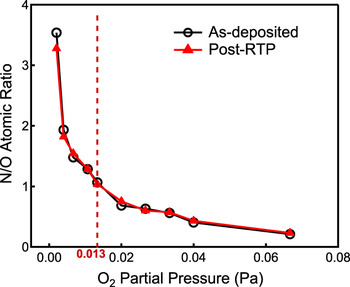
To illustrate the ability to tailor the N/O ratio in the deposited films, we present characterization of 10 independent thin films deposited at room temperature in the presence of 0.2 Pa N2 and with O2 PP varying from 0.002 to 0.067 Pa. Elemental analyses using energy dispersive spectroscopy (Fig. 3) before and after RTP confirm that the bulk-averaged N/O ratio in each film does not change significantly during the thermal processing. The thin film deposited at 0.013 Pa O2 PP, corresponding to the onset of target poisoning, contains the N/O ratio close to 1, verifying our heuristic for determination of optimal O2 PP for the synthesis of oxynitrides.
N/O stoichiometry obtained from EDS measurements on both the as-deposited and post-RTP TaO x N y thin films as a function of O2 PP in the presence of 0.2 Pa N2.

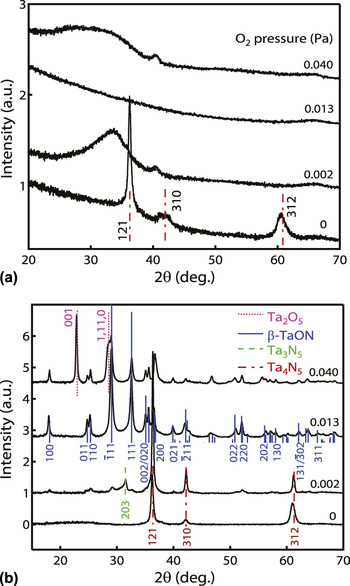
Figure 4(a) shows raw XRD patterns for the as-deposited TaO
x
N
y
films. Here, we present diffraction patterns without background subtraction to capture information regarding signal to background ratio of the weakly crystalline as-deposited films. Only the pure nitride thin film shows significant crystallinity, predominantly corresponding to the Ta4N5 phase. The XRD pattern for thin film deposited at 0.002 O2 PP shows a broad peak centered at θ = 33.4°, possibly due to short range order representative of the Ta3N5 and Ta4N5 phases. The XRD pattern of the thin film deposited at 0.013 O2 PP, for which the N/O ratio is close to 1, does not show any crystallographic features. Similar observations have been noted in the literature for poorly crystalline or amorphous oxynitride thin films.
Reference Mohamed and Anders20,Reference Mohamed, Abd El-Rahman and Ahmed21,Reference Cristea, Crisan, Barradas, Alves, Moura, Vaz and Cunha23,Reference Venkataraj, Kappertz, Jayavel and Wuttig25,Reference Mohamed, Kappertz, Ngaruiya, Niemeier, Drese, Detemple, Wakkad and Wuttig27
The XRD pattern for thin films deposited at 0.040 O2 PP shows the presence of a broad amorphous peak centered around the expected value for the (1, 11, 0) peak of Ta2O5. A similar observation of low crystallinity for refractory oxide phases was observed during reactive sputter deposition of tungsten
Reference Mohamed and Anders20
and titanium oxynitrides.
Reference Mohamed, Kappertz, Ngaruiya, Niemeier, Drese, Detemple, Wakkad and Wuttig27
The observation of poorly crystalline or amorphous thin films for the N/O stoichiometries of interest is in agreement with previous reports, and as described by Cristea et al.,
Reference Cristea, Crisan, Barradas, Alves, Moura, Vaz and Cunha23
sputter deposited TaO
x
N
y
with
 ${{\rm{p}}_{{{\rm{O}}_2}}} + {{\rm{p}}_{{{\rm{N}}_2}}} > 0.15\,{\rm{Pa}}$
encourages the formation of amorphous phases, which highlights the need for an independent thermal processing step to achieve amorphous to crystalline transitions in oxynitride systems.
XRD patterns of the TaO x N y samples as a function of O2 PP with 0.2 Pa N2 PP. (a) XRD patterns of the as-deposited samples where only the sample with O2 PP of 0 exhibits a crystalline phase. (b) XRD patterns for the samples after being annealed with RTP at approximately 1173 K for 30 s under N2 flow. The patterns of XRD peaks for four phases are noted.

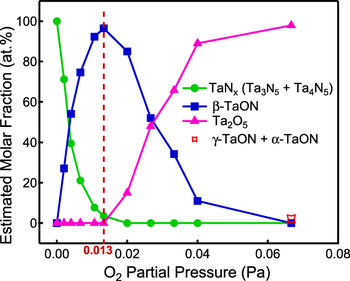
Figure 4(b) shows XRD patterns of the corresponding four TaO x N y thin films after RTP, revealing systematic changes in the thin film structure with increasing O2 PP. The full set of 11 TaO x N y thin film XRD patterns is shown in Fig. S1. The film deposited under the gas mixture of Ar and N2 without O2 shows the presence of the Ta4N5 phase (tetragonal, PDF 01-075-0627). With introduction of O2 at PP as low as 0.002 Pa, an oxynitride β-TaON (monoclinic, PDF 01-071-0178) appears and the Ta4N5 phase is partially transformed to the Ta3N5 (monoclinic, PDF 03-065-1247) structure. The appearance of higher oxidation state nitride (Ta3N5) in the presence of low-O2 PP may be due to O-incorporation in the film, and for the purpose of tracking the evolution of oxynitride phases with respect to nitride and oxide structures, Fig. 5 shows the combined fractions of nitride phases along with the fractions of oxide and oxynitride phases for each O2 PP. The molar fraction of tantalum nitride phases (Ta3N5 and Ta4N5) decreases with increasing O2 PP and almost disappears at critical O2 PP of 0.013 Pa, where β-TaON is the primary phase. As shown in Fig. 2, this value of O2 PP corresponds to the maximum mass deposition rate both in the presence and absence of N2. On increasing O2 PP above this critical PP, tantalum nitride phases are no longer observed, and Ta2O5 (orthorhombic, PDF 00-025-0922) appears and grows at the expense of the β-TaON phase. This is consistent with the onset of oxide target poisoning at O2 PP of 0.013 Pa. An interesting note is that at the highest O2 PP of 0.067 Pa, additional minor XRD peaks are observed and can be explained by the introduction of two minority TaON phases, γ-TaON (monoclinic, PDF 01-076-3258) and α-TaON (hexagonal, PDF 01-072-2067), which are polytypes of the β-TaON phase obtained at lower O2 PP (see Fig. S1 in Supplementary Document). The as-deposited film contains sufficient nitrogen to form these minority phases (see Fig. 3), and further investigation will be required to determine whether these phases grow within the Ta2O5 matrix or on the film surface during RTP.
The estimated molar fraction of the different phases formed at each TaO x N y thin film deposited at various O2 PPs and fixed N2 PP of 0.2 Pa. The critical O2 PP corresponding to maximum deposition rate is marked and corresponds to the maximum molar fraction of the β-TaON phase.

In total, the evolution of nitride, oxynitride, and oxide phases with O2 PP between 0 and 0.067 Pa is quite similar to that of a pseudo-binary phase diagram with end-member nitride and oxide phases that exhibit low solubility of N onto O sites and vice-versa. The primary ternary compound, β-TaON, appears as a line compound at O2 PP of 0.013 Pa, as the N/O stoichiometry varies nonlinearly with O2 PP. The phase distributions suggest that the total anion concentration with respect to Ta, i.e., (O + N)/Ta, increases from 1.25 to 2 to 2.5 as the dominant phase evolves from Ta4N5 to β-TaON to Ta2O5. The EDS measurements are not sensitive to anion point defects in these structures, and under the assumption that the compounds are nearly stoichiometric, the as-deposited anion concentration in the poorly crystalline films is approximately equal to that of the targeted line compounds. These results indicate that the optimized reactive sputtering introduces the appropriate anion concentration such that subsequent crystallization into line compounds can occur without additional anion incorporation. The QCM-based heuristic identification of the near-optimal deposition atmosphere of a metal oxynitride can be readily applied for other metal sputter targets. The independent variation of the RTP temperature can be used to optimize oxynitride film quality for a given application or to form specific high-temperature phases.
IV. CONCLUSIONS
We demonstrate the synthesis of oxynitride films with varying N/O composition via reactive magnetron sputtering of Ta in the presence of N2 and very low-O2 PP. The tunability of the N/O composition is achieved by controlling the O2 PP between 0 and 0.067 Pa using a variable leak valve with a fixed N2 PP of 0.2 Pa and Ar-balanced total pressure of 0.8 Pa. For deposition from a given metal target, the mass deposition rate as a function of O2 PP can be measured in situ. The O2 PP that maximizes the deposition rate can be readily determined and serves as a heuristic measure of the near-optimal O2 PP for synthesizing oxynitride phases, as this O2 PP corresponds to the onset of substantial oxide poisoning of the target. Crystallization of nitride, oxide, and oxynitride phases without anion exchange is demonstrated using RTP. This method is applicable to mixing anions using other reactive gases (NH3, CH4, H2S, etc.) and can be extended for multi-cation depositions as well, providing a new platform for efficient synthesis and exploration of multi-anion thin films.
Supplementary Material
To view supplementary material for this article, please visit http://dx.doi.org/jmr.2015.140.
ACKNOWLEDGMENTS
This study is based upon work performed by the Joint Center for Artificial Photosynthesis, a DOE Energy Innovation Hub, supported through the Office of Science of the U.S. Department of Energy (Award No. DE-SC0004993). The authors thank the Kurt J. Lesker company for assistance with the design of the custom PVD gas handling system.