Introduction
For many, Emergency Medical Services (EMS) represents the frontline of the nation's health care delivery system when they experience a medical or traumatic emergency. The stability of the United States EMS workforce and its ability to meet public need are in question. A recent national report identifies the gaps in EMS workforce data and research, and highlights the concern about recruitment and retention of EMS personnel in the United States. 1 Further compounding the problem of EMS workforce retention are recent trends within the EMS profession itself. As EMS continues to advance as a profession, the role of the EMS professional is transitioning into other clinical settings. Paramedics now are being employed in specialty areas, such as critical care and air medical programs, emergency departments, and urgent care centers, further diluting the workforce available for the traditional prehospital role.Reference Ball 2 Additionally, there is a need to expose prospective paramedics to the increasing number of degree opportunities within EMS education, and to encourage the selection of EMS as a primary career.Reference Hubble 3 , Reference Patterson, Probst, Leith, Corwin and Powell 4 Consequently, EMS stakeholders must ensure a stable workforce by investigating and implementing effective strategies that expose the EMS profession to youth who are formulating their career paths. Strategies that target individuals who already have expressed an interest in a health career, such as those students found in high school allied health programs, may prove effective.
Most high schools offer allied health occupations courses in which students learn the basic skills necessary to advance into an allied health career. As part of these courses, students are provided information about the various allied health careers, making these courses an optimal setting in which to present information about the EMS profession and EMS educational opportunities. However, little is known about the current exposure of students to EMS within these courses, how high school students perceive EMS as a potential career, and/or how they choose their professions. By investigating these factors, it may be possible to develop effective recruiting strategies for this audience, and potentially increase the number of high school graduates choosing EMS as a career. The purposes of this study were to assess the exposure of high school allied health students to EMS as a career option, measure their attitudes and beliefs towards the EMS profession, and identify factors associated with pursuing EMS as a career.
Methods
Institutional Review Board approval for this study was obtained from Western Carolina University, and written consent was obtained from each survey respondent. Students under the age of consent also submitted parental consent.
A cross-sectional survey was conducted in May 2010 to assess the exposure, knowledge, attitudes, and beliefs about EMS as a career among high school allied health students. The survey was designed by the authors, and piloted among a small group of students not connected with the study. Based on the responses to the pilot, the survey was revised for clarity. The final survey consisted of 57 questions covering six constructs: (1) demographic information (four questions); (2) career intentions (eight questions); (3) exposure to EMS (seven questions); (4) factors related to career decisions (seven questions); (5) attitudes and beliefs about EMS as a career (18 questions); and (6) specific reasons for not choosing to pursue a career in EMS (13 questions).
A convenience sample of all high school students (grades 9–12) enrolled in allied health courses within the Johnston County, North Carolina USA school system was selected for participation. The school system includes six high schools, all of which offer allied health occupations courses and Health Occupation Students of America (HOSA) club opportunities.
All data were entered into a Microsoft Excel 2007 spreadsheet (version 12; Microsoft Corporation, Redmond, Washington USA), then imported into SPSS (version 17.0; Chicago, Illinois USA) for analysis. Data analysis consisted of descriptive statistics, unadjusted odds ratios, and a multiple logistic regression model developed to identify independent factors associated with the intention to pursue EMS as a career. Relevant Likert-scale questions were re-coded for calculating odds ratios and for logistic regression. “Disagree” and “strongly disagree” were collapsed into a single category; “agree” and “strongly agree” were similarly combined. All variables were entered into the model, and backward, stepwise elimination was used to select the most predictive variables based on the likelihood ratio. The resulting model then was reduced to the simplest model possible without substantially degrading the overall model accuracy. All statistical analyses were two-tailed, with statistical significance established at P ≤ .05.
Results
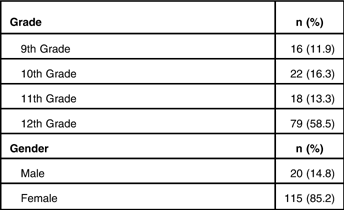
Of the 171 allied health students within the school system, 135 (78.9%) responded to the survey. Seniors (12th graders) represented 58.5% (n = 79) of the participants; the majority (85.2%, n = 115) of the respondents were female. Sixty percent of the students (n = 81) planned to attend a two-year college, while 72.5% (n = 98) planned to attend a four-year college. Demographic characteristics of the respondents are provided in Table 1.
Demographic characteristics of the respondents

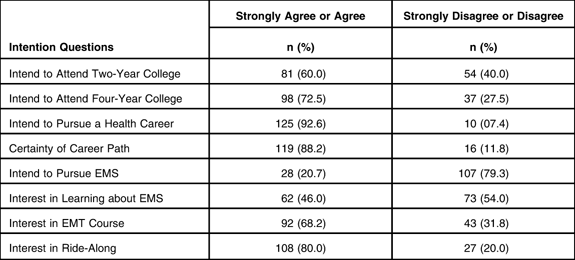
With regard to career intentions, 125 respondents (92.6%) agreed or strongly agreed that they would pursue a health career after high school and 119 (88.2%) agreed or strongly agreed that they were certain about their career paths (Table 2). Only 28 students (20.7%) indicated that they planned to pursue an EMS career, but 62 (46.0%) indicated a desire to learn more about the profession. When asked about their interest in being involved with EMS, 92 (68.2%) agreed or strongly agreed with wanting to attend an emergency medical technician (EMT) course if offered as part of their high school curriculum, and 108 (80.0%) expressed an interest in riding along with local EMS system personnel through an observational program.
Career intentions of respondents

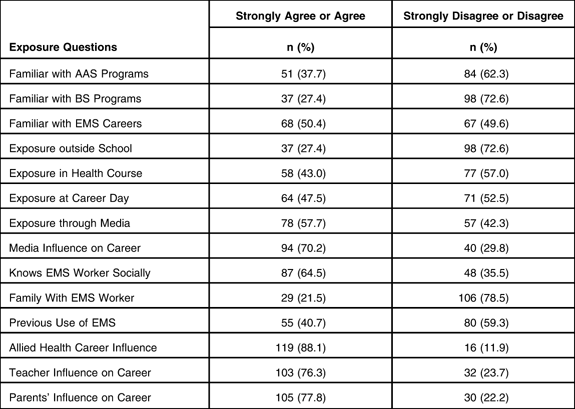
When asked about their exposure to educational options during their allied health course, 51 students (37.7%) indicated familiarity with Associate of Applied Science (AAS) programs for EMS, and 37 (27.4%) were familiar with baccalaureate programs (Bachelors of Science) for EMS. Only 58 (43.0%) indicated that they were exposed to EMS in their allied health classes, and 64 (47.5%) were exposed to EMS through school career day activities. With regard to non-school-related exposures to EMS, 87 (64.5%) reported knowing an EMS worker socially, 29 (21.5%) had family associated with EMS, and 55 (41.0%) reported previous utilization of EMS. Many respondents (70.2%, n = 94) indicated their career decisions were influenced by the media, 76.3% (n = 103) indicated that their decisions were influenced by teachers or guidance counselors, and 77.8% (n = 105) were influenced by their parents. Career exposure data are provided in Table 3.
Exposures and influences of respondents

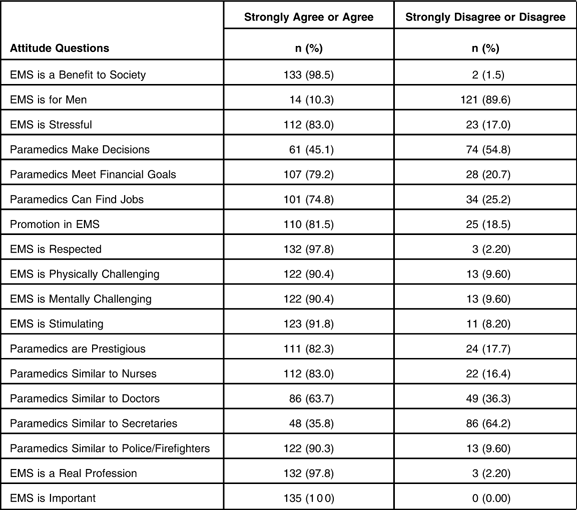
When asked about their attitudes and beliefs toward the profession, 122 (90.4%) agreed or strongly agreed that EMS is physically challenging and mentally challenging, and 123 (91.8%) agreed that an EMS career would be stimulating. Almost all respondents (98.5%, n = 133) considered EMS to be a benefit to the society, 132 (97.8%) believed paramedics to be respected by society, and 111 (82.3%) agreed that paramedics are part of a prestigious group. When asked about independent decisions, only 61 (45.1%) believed paramedics could make their own decisions about patient care. Fourteen (10.3%) respondents thought the profession was only for men. With regard to financial stability, 107 (79.2%) of the respondents believed paramedics could reach financial goals such as owning a home.
In answer to questions concerning similarities between paramedics and other professions, 35.8% (n = 48) thought that paramedics shared a status similar to secretaries; 63.7% (n = 86) felt that paramedics shared a status similar to doctors; 83.0% (n = 112) believed paramedics shared a status similar to nurses; and 90.3% (n = 122) equated the social status of paramedics with that of police officers and firefighters. Most (81.5%, n = 110) thought there was appropriate opportunity for advancement and promotion within EMS, and 74.8% (n = 101) believed paramedics always can find jobs. Finally, 97.8% (n = 130) of respondents agreed or strongly agreed that EMS is a real profession and 100% (135) agreed or strongly agreed that EMS is an important profession. Attitudes and belief data are provided in Table 4.
Respondent attitudes and beliefs toward the EMS profession

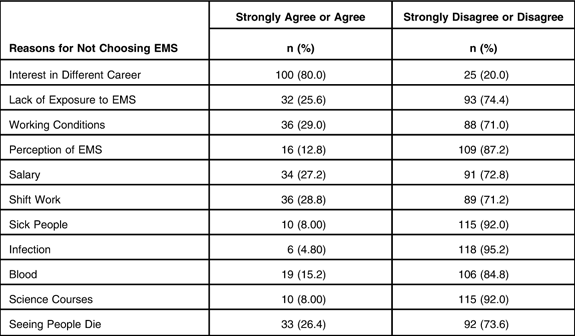
Most respondents (80.0%, n = 100) who completed the section on specific reasons for not choosing to pursue a career in EMS indicated they would not choose EMS as a primary career because of interest in a different career (Table 5). The most commonly cited alternative career choice was nursing (40.7%, n = 55). Lack of exposure to EMS as a primary reason for not selecting EMS was reported by 32 respondents (25.6%), and only 16 (12.8%) believed their perception of EMS was a factor causing them to select a different career. Thirty-four (27.2%) agree that salary was the primary reason for not selecting EMS, while shift work and working conditions were cited by 28.8% (n = 36) and 29.0% (n = 36) of respondents, respectively. A low percentage of respondents reported dealing with sick people (8.0%, n = 10), fear of infection (4.8%, n = 6), and fear of blood (15.2%, n = 19) as reasons for not selecting EMS. Prerequisite science courses were cited as a barrier by 8.0% (n = 10) of respondents. When asked about watching people die as a barrier to EMS, 26.4% (n = 33) agreed or strongly agreed with this being a reason for not selecting the profession.
Factors associated with not choosing EMS as a profession

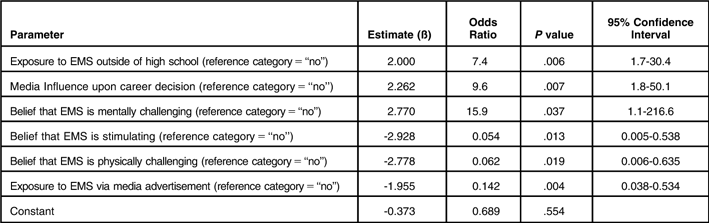
Independent predictors of pursuing an EMS career included exposure to EMS outside of high school (P = .006, OR = 7.4, 95% CI = 1.7-30.4), media influence upon career choice (P = .007, OR = 9.6, 95% CI = 1.8-50.1), and the belief that EMS was a mentally challenging profession (P = .037, OR = 15.9, 95% CI = 1.1-216.6). Negative predictors of pursuing an EMS career included the beliefs that an EMS career was stimulating (P = .013, OR = 0.05, 95% CI = 0.005-0.538), the belief that EMS was physically challenging (P = .019, OR = 0.06, 95% CI = 0.006-0.635), and prior exposure to EMS via media advertisement (P = .004, OR = 0.14, 95% CI = 0.03-0.53). Logistic regression odds ratio and 95% confidence intervals for multivariate prediction of intention to pursue EMS are presented in Table 6.
Adjusted odds ratios of predictors of intent to pursue EMS as a career

Discussion
Because high school years represent a time in which students commonly plan their careers or post-secondary educational pursuits, the high school setting is an effective location for recruitment into the allied health field. Reference Mishoe, Valeri and Beveridge 5 , Reference Al-Kandari and Lew 6 Among the high school allied health students participating in this study, many indicated a plan to pursue a health career. Unfortunately, less than a quarter of them planned to enter the EMS profession, and less than half of them indicated they had received any exposure to the EMS profession within their allied health courses.
While there is a paucity of research focusing on recruiting efforts specific to EMS, the effectiveness of recruiting in high school has been demonstrated by other allied health professions. In one study performed in rural North Carolina, a collaborative effort by the Area Health Education Center, local hospital, and school system offered additional classroom information and job shadowing opportunities. Since this program's inception in 1992, 70% of participants have chosen health careers. Reference Bumgarner, Means and Ford 7 Other studies suggest recruitment initiatives may be more effective if conducted prior to high school. In one investigation, a portion of the participating middle school students were exposed to nursing camps, nursing recruitment videos, and various handouts about the nursing profession. Following these interventions, there was a statistically significant increase in the number of students who wanted to pursue nursing as a career. Reference Matutina 8 Another study in the nursing literature noted career development benefits through exposure within the K-12 (kindergarten through grade 12) educational setting.Reference Wirecenski, Wircenski and Nimon 9 Among the participants in this study, a majority of students indicated certainty regarding their career paths, which supports earlier investigations suggesting that career recruiting may need to take place prior to the student reaching high school.Reference Cohen, Burns, Frank-Stromborg, Flanagan, Askins and Ehrlich-Jones 10 , Reference Hoke 11
Students in this study maintained a strong outlook on attending college, with the majority planning to attend a four-year college. However, knowledge of college EMS programs was lacking, with many students unaware of AAS and BS programs for EMS. Based on the reported effectiveness of EMS degree programs, community college and universities offering EMS programs of study should consider the high school allied health curriculum as a recruitment tool and potential pathway to EMS degree programs.Reference Hubble, Paschal and Sanders 12 , Reference Dickison, Hostler, Platt and Wang 13
Ride-along programs garnered considerable interest among the participants and should be implemented where feasible to provide students exposure to the profession. The level of interest in ride-along programs, along with interest in an EMT course, expressed by students in this study may indicate that students are not as certain about their career choices as they believe. The high school allied health curriculum has a clinical component, and could include an EMS clinical option to that curriculum that would provide the most realistic exposure possible.
Despite the lack of intent to pursue education or a career in EMS, students expressed a positive attitude toward the profession, indicating that although exposure to the profession is low, a positive outlook toward the profession exists among the students. Through further exposure, it may be possible to increase recruitment into the EMS profession.
When rating the similarities of paramedics with doctors, nurses, secretaries, firefighters, and police officers, students consider the profession of EMS to be most closely aligned with those of firefighters and police officers. This demonstrates that the public safety image EMS continues to maintain, without accurate accounting for the health care component that complements it. Emergency Medical Services organizations should improve recruitment strategies to include accurate acknowledgement of the health care aspect of the profession.
Interest in a different career was the primary reason most students cited for deciding not to pursue an EMS career. This finding is contradictory to previous literature indicating a lack of knowledge, rather than a lack of interest, as the reason students do not select specific careers. Reference Bumgarner, Means and Ford 7 This study cannot account for factors associated with interest in careers other than EMS, or the involvement of the allied health courses in promoting interest in other careers. Further studies regarding these factors and the specific exposure for the allied health courses are providing should be considered.
When asked about alternative career choices, the most frequent selection was nursing. This finding is consistent with widespread knowledge and acceptance of nursing as a fundamental allied health career. Many students considered their allied health teachers to be influential in their career decisions, but a factor not accounted for by this study is the professional background of the allied health course instructor, which traditionally is nursing. This warrants further investigation, as the background and subsequent knowledge of the teacher may have an impact on the student's career perception. Students reported a greater influence in career choice by teachers and guidance counselors than by the media. Substantial influence on career choice by parents also was observed in this study, which is consistent with previous literature in allied health and adolescent behavior.Reference Slater and ller 14 , Reference Keller and Whiston 15
Exposure to EMS outside of high school was found to be a predictor of the intention to pursue EMS, along with media influence upon career choice, and the belief that an EMS career would be mentally challenging. These findings indicate that exposure to EMS has a positive effect on choosing the career, and perhaps should be implemented inside the allied health classroom. The specific exposures students acquired outside of school are unknown. Those students who agreed that media had influenced their decisions were more likely to pursue EMS, but those who were exposed to EMS recruitment in the media were less likely to pursue EMS. This is a seemingly counterintuitive result, and may suggest that not all EMS recruitment techniques through various forms of media are effective, and perhaps should be modified. This study suggests that to be effective, recruitment should focus on topics such as the mentally challenging aspect of EMS, which was found to be a positive predictor of pursuing EMS. Although students who recognized EMS as being mentally challenging were more likely to pursue EMS, those who felt EMS was stimulating were less likely to pursue the profession. This again could be caused by the lack of information from which to draw concrete conclusions about the profession, or by the students wanting to pursue more stimulating career choices. The adjusted OR for exposure outside of high school and career choice being influenced by the media were high, indicating increased odds of pursuing EMS as a career is associated with these factors. The nursing literature has demonstrated increased interest in nursing among individuals who are socially acquainted with nurses. However, knowing someone socially who works in EMS was not included in this study's final model.Reference Rossiter, Foong and Chan 16
A negative predictor for pursuing EMS was feeling that the profession was physically challenging. Given that the majority of students were female, this finding may suggest that female students are concerned about the physical challenges of EMS. Recruiting techniques specifically targeted to females could help overcome the perception of physical barriers.
Limitations
This study has several limitations. The sample group in this survey is limited to students already enrolled in allied health courses, and thereby already displaying an interest in the health profession. Consequently, the study's findings cannot be extrapolated to the overall high school population. Furthermore, the sample is limited to students, mostly female, enrolled in a single North Carolina school system. Because of these limitations, the ability to generalize the findings to other locations and to male students is unknown. The results of this study may not be consistent with urban areas, more populated areas, or areas that have greater EMS marketing.
Another bias that may be present in this study's sample is the unexpectedly high rate of EMS use by students in our sample. It is unclear how this may have influenced students’ perceptions of EMS and career choices, compared to students without similar experiences.
With respect to the survey, certain factors were not fully explored. For example, it was not possible to ascertain exactly what types of prior media exposures students had to the EMS profession, nor was it possible to quantify their exposures within their allied health courses.
Conclusion
In this rural high school system, the allied health curriculum was effective in exposing students to health occupations, although few students intended to pursue an EMS career. Overall, there was a lack of exposure to both career and educational options in EMS. However, most students had favorable opinions of EMS, and indicated that they would like to learn more about EMS professional and educational programs, particularly ride-along programs and basic EMT courses. This level of interest suggests that students may not be as confident in their career choices as they believe, and that allied health courses may offer an opportunity to inform students about the EMS profession. With more exposure to educational and professional options, along with observation opportunities with local EMS providers, more students may choose to pursue careers in EMS.
Abbreviations
- AAS:
-
Associate of Applied Science
- BS:
-
Bachelors of Science
- EMS:
-
Emergency Medical Services
- EMT:
-
Emergency Medical Technician