Introduction
The vital processes of fertility and mortality are known to fuel the evolutionary machinery. Natural selection, being an important part of the evolutionary mechanism, is defined by the differential fertility and survival of individuals in populations. Fertility in excess of self-replacement would crowd an area resulting in stiff within-species competition. Differential fertility and survival rates have been used to quantify selection intensities operating in human populations living in different ecological and environment settings. It is assumed under this model that differential fertility and mortality are due to differential genetic fitness. Selection intensity has been defined as a measure of the fitness of a population, assuming that the heritability of fitness is complete and that birth and death rates are both selective (Crow, Reference Crow1972). A selection index value of zero indicates no change.
High-altitude environmental stressors have varied physiological effects on health. Studies have been conducted to study fertility and mortality in high-altitude populations. Hypoxia is a major stressor at high altitude. It is assumed that people living at high altitude for generations who are evolutionary adapted (developmentally and/or genetically) have the ability to survive and reproduce successfully. However, successful reproduction does not necessarily mean reproductive success. The physiological effects of hypoxia on fertility and fecundity have been studied in both experimental animals and humans by Clegg and Harrison (Reference Clegg and Harrison1971), Baker and Dutt (Reference Baker and Dutt1972), Hoff and Abelson (Reference Hoff and Abelson1976) and Goldstein et al. (Reference Goldstein, Tsarong and Beall1983), Vitzthum and Wiley (Reference Vitzthum and Wiley2003), Reyes et al. (Reference Reyes, Farias, Henríquez-Olavarrieta, Madrid, Parraga, Zepeda and Moreno2012) and Parraguez (Reference Parraguez, Urquieta, Pérez, Castellaro, De los Reyes and Torres-Rovira2013). The principle of maximization of fitness, as assessed by the differential success of fertility and mortality indicators, which is central to evolutionary biology, cannot be applied simply to assess maximum fitness in humans. In fact, among humans, genetic factors play a relatively small role in differential fertility and mortality as compared with the interplay of a host of environmental (physical, socioeconomic, cultural) and behavioural factors (Crow, Reference Crow1966; Matsunga, Reference Matsunaga1966).
Through a combination of health, family planning measures and modernization, humans in many parts of the world have seen a decline in fertility and mortality levels. Evolutionary biologists and anthropologists have drawn attention to the negative relationship that exists between wealth and fertility. More investment in resource generation has the potential to greatly increase the survival probability of descendent lineages resulting in lower fertility (Hill & Reeve, Reference Hill and Reeve2005). Most of the world’s population growth occurs in poor and developing countries. The continued decline in fertility and mortality in many parts of the world has resulted in what is known as the demographic transition, and this results in change in the opportunity for natural selection as well as the total variance in relative fitness (Crow, Reference Crow1958; Terrenato et al., Reference Terrenato, Ulizzi and San Martini1979; Arnold & Wade, Reference Arnold and Wade1984; Korpelainen, Reference Korpelainen2003). Such a change may affect significantly the strength of total selection on other traits, as has been reported for body size and physique in an African population (Courtiol et al., Reference Courtiol, Rickard, Lummaa, Prentice, Fulford and Stearns2013). Natural selection is one of the mechanisms of evolution and is not evolution by itself. Natural selection would also occur when variance covaries with phenotypes in different segments of human populations, whether it is due to biological (genetic) factors or due to environmental factors, whether social, cultural, medical or economic. Changes in the relative contributions of fertility and mortality would result in a selection gradient, and this would make prediction of evolutionary change difficult (Courtiol et al., Reference Courtiol, Rickard, Lummaa, Prentice, Fulford and Stearns2013). For these reasons, natural selection has been continuously assessed in human populations (Byars et al., Reference Byars, Ewbank, Govindaraju and Stearns2010; Rotkirch & Lummaa, Reference Rotkirch and Lummaa2012).
To explain demographic transition in Western populations, three evolutionary hypotheses have been proposed (Borgerhoff, Reference Borgerhoff1998; Newson et al., Reference Newson, Postmes, Lea and Webley2005). First, couples might prefer a smaller number of children for the sake of quality (quantity–quality trade-off) to maximize Darwinian fitness in a changing, modern environment (the behavioural ecology perspective). Second, the influence of kith and kin might have changed reproductive behaviour (the cultural transmission hypothesis) to have a smaller family size. Third, low fertility might be a maladaptive response to the fast-changing environment (the evolutionary psychology perspective). A lot of theoretical and empirical attention has been given to each of these hypotheses in an attempt to understand demographic transition (Kaplan, Reference Kaplan1996; Lawson & Mace, Reference Lawson and Mace2011; Goodman et al., Reference Goodman, Koupil and Lawson2012; Moorad, Reference Moorad2013; Milot & Pelletier, Reference Milot and Pelletier2013).
The people of India are socially organized into distinct endogamous reproductively isolated groups and thus provide an opportunity to understand the dynamics of the different evolutionary processes. For this purpose, the present study was conducted on three populations with ethnic, cultural and altitudinal differences in their habitats. The major aims and objectives of the study were: 1) to study selection intensities based on fertility and mortality differentials operating in three populations living in the two north-west Indian states of Haryana and Himachal Pradesh at different altitudes, ranging from a high altitude of around 3500 m to the plains at an altitude of around 220 m; 2) to study geospatial variations in natural selection indices among populations with different ethno-cultural histories in a population living in the eastern and western Himalayan states based on published reports.
Methods
The study sample
The study was based on both primary and secondary data. The primary data were collected from two regions of the north-west Himalayas: Shimla in Himachal Pradesh and Jind district, Haryana. The secondary data were from the Kinnaur district of Himachal Pradesh.
The primary data were collected from ever-married women who had completed their fertile period. Women were interviewed to obtain a detailed reproductive history. The information was later checked with their husbands and elderly members of the family. The interview schedule included questions on the following key demographic characteristics: fertility, mortality, mortality, marriage and menopause. The inclusion criteria were that the woman’s family were permanent residents of the village, and that she was naturally post-menopausal. The excluding criteria were households where there was a second, premenopausal wife and where there was no information on the first wife.
The Shimla sample (primary data)
Data were collected from 75 post-menopausal women from three villages in the Mashobra tehsil of Shimla at an altitude of 2150 m above sea level: Sangti, Neri and Chaeli. The majority of the respondents (79%) were housewives from middle class families. The Indian population is divided into a number of castes, communities and tribes. The caste system is primarily based on occupation and these groups are socially separable endogamous groups with four major categories: the Brahmins, Kshatryias/Rajputs, the Vaishayas and the Shudras. In the Shimla region the Rajputs and Brahmins are the major caste groups, forming gotra exogamy and caste endogamy groups. The majority of the families were Rajputs (56%), with Brahmins constituted about 19%, Vaishyas 9% and the Shudras 16%. They have been living in the area for the generations. The majority of the respondent families (96%) had land holdings. The sample was culturally homogeneous.
The Jind sample (primary data)
The second sample was taken from the north-west Indian plains. Data were collected from 100 married women drawn from three villages in the Safidon tehsil of Jind district, Haryana, located between 76° 35' and 76° 40' N latitude and 29° 15' and 29° 20' W longitude at an altitude of 227 m. The population of the area is principally composed of Jats and Scheduled Castes. The Jats are landowners and cultivators and are the predominant caste in the area. The Scheduled Castes are predominantly agricultural labourers performing menial tasks.
The Kinnaur sample (secondary data)
The data for the third sample were taken from secondary published sources (see Gautam et al., Reference Gautam, Kapoor and Kshatriya2009) for 85 married women from different villages in the Hangrang, Morang, Nichar and Pooh tehsils of Kinnaur district, Himachal Pradesh, at an average altitude of 3420 m. On the basis of the characteristics of the decline in the oxygen dissociation curve compared with that at sea level, an elevation of 2500 m is often taken as a delimiter of high-altitude stress (Pawson & Jest, Reference Pawson and Jest1978). People in these villages live in a harsh environment and face tough challenges, being economically and politically weak with limited agricultural activity. Their food habits and cultural patterns are similar and thus form a homogeneous sample from a cultural perspective. Fraternal polyandry is present in this area. The people of lower Kinnaur in the Sangla Valley adjoining Shimla district are ethnically similar to those of the adjoining Shimla district and are primarily Rajputs belonging to the Mediterranean physical type. The people of the middle Kinnaur, between the Kalpa and Kanan Valleys, are an admixture of Mediterranean and Mongoloid physical types. The people of the upper Kinnaur are predominantly Mongoloid with some Mediterranean admixture. The sample included in this study was from the middle and upper Kinnaur and they were ethnically different from the samples taken from the Mashobra tehsil in Shimla and the plains of Haryana. All three samples included in the study were individually culturally homogeneous but had among-group differences in ethnic, cultural and food habits.
Analysis
Selection intensity was divided into two components: selection due to differential fertility (I f) and selection due to differential mortality prior to reproductive age (I m); the cut-off age was 15 years. Crow’s index is considered to be one of the most feasible means of inferring selection, it being difficult to measure selection directly in human populations (Crow, Reference Crow1972). It is the most widely used index worldwide. Since the index only covers postnatal mortality, Johnston and Kensinger (Reference Johnston and Kensinger1971) revised the computation to include prenatal mortality.
Crow’s index (I l) was computed using the formula described by Crow (Reference Crow1958); a modified selection intensity (I 2) index that included prenatal losses was calculated using Johnston and Kensinger’s revised computation.
 $${\rm Crow’s\,\, index}\,\left( {I_{1} } \right){\,\equals\,}I_{{\rm m}} {\plus}I_{{\rm f}} /P_{{\rm s}} ,$$
and
 $$I_{{\rm m}} {\,\equals\,}P_{{\rm d}} /P_{{\rm s}} \,{\rm and}\,\,I_{{\rm f}} {\,\equals\,}V_{{\rm f}} /X^{2} ,$$
where I m is the index of selection due to mortality, I f is the index of selection due to fertility, P s is the proportion of survivals from birth to reproductive age, P d is the proportion of deaths from birth to pre-reproductive age (≤15 years; measured as total postnatal deaths before pre-reproductive age/total live births) and P s=1−P d; V f is the variance due to fertility (live births) and X is the mean number of live births of women aged over 45 years or who were post-menopausal.
 $${\rm Johnston}\,{\rm and}\,{\rm Kensinger’s}\,{\rm index }\,\left( {I_{{\rm 2}} } \right){\rm {\,\equals\,}}I_{{{\rm me}}} {\rm {\plus}}I_{{{\rm mc}}} {\rm /}P_{{\rm b}} {\rm {\plus}}I_{{\rm f}} {\rm /}P_{{\rm b}} {\rm {\times}}P_{{\rm s}} ,$$
and
 $$I_{{{\rm me}}} {\,\equals\,}P_{{{\rm ed}}} /P_{{\rm b}} ;\,P_{{\rm b}} {\,\equals\,}1{\minus}P_{{{\rm ed}}} ;\,I_{{{\rm mc}}} {\,\equals\,}P_{{\rm d}} /P_{{\rm s}} ;\,P_{{\rm s}} {\,\equals\,}1{\minus}P_{{\rm d}} \,\,{\rm and}\,\,I_{{\rm f}} {\,\equals\,}V_{{\rm f}} /X^{2} {\rm ,}$$
where I me is the index of total selection due to prenatal mortality, P ed is the proportion of deaths before birth and I mc is the index of total selection due to postnatal mortality.
Comparison of selection intensities with other Himalayan populations
To study geospatial differences in selection intensities among different Himalayan populations (ranging from western Himalayas to eastern Himalayas), secondary data on about 59 populations (see Sarkar Reference Sarkar1997; Bhasin & Nag Reference Bhasin and Nag2002; Gautam et al., Reference Gautam, Kapoor and Kshatriya2009; Kapoor et al., Reference Kapoor, Singh, Kaur and Sinha2011; Sarma, Reference Sarma2013) were further analysed to study the within-state and between-states trends in live births and selections intensities. Within- and between-population differences were studied using analysis of variance (ANOVA).
Results
Selection intensities in the three samples in north-west India
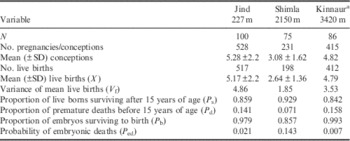
The fertility and mortality indices results are given in Table 1. The mean numbers of conceptions/pregnancies and live births were highest in the low-altitude population of Jind, lowest in the mid-altitude population of Shimla and intermediate in the high-altitude population of Kinnaur. On the other hand, the proportion of embryonic deaths was lowest, and the proportion of premature deaths was highest, in Kinnaur. The results on differential fertility performance revealed that the mean numbers of conceptions and live births were lowest in Shimla, intermediate in Kinnaur and highest in Jind. These results reject the hypothesis that lower couple fertility performance was associated with high-altitude hypoxia.
Fertility and mortality indices of post-menopausal women in the north-west Himalayas
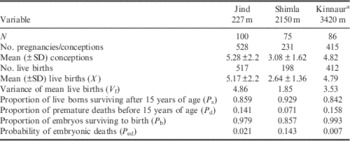
a Secondary data from Gautam et al. (Reference Gautam, Kapoor and Kshatriya2009).
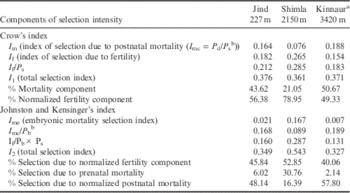
The results of the indices of intensity of selection and their components based on Crow’s and Johnston and Kensinger’s indices are given in Table 2. The total selection intensity index calculated using Johnston and Kensinger’s method was higher than the Crow index, due to the inclusion of the contribution of prenatal mortality. The postnatal mortality selection intensity component was highest in Kinnaur and lowest in Shimla. The fertility selection component was highest in Shimla and lowest Kinnaur. The total selection intensity index based on Johnston and Kensinger’s index was highest in Shimla and lowest in Kinnaur. The contribution of prenatal mortality to total selection was highest in Shimla (30.76%) and lowest (2.14%) in Kinnaur, while normalized postnatal mortality levels were 16.39% and 57.80%, respectively, in the two areas. The fertility component of selection was higher than the mortality component in Shimla, while in the other two places the fertility component was lower than the mortality component based on their relative contribution/weightage to the total selection index derived using the Johnston and Kensinger methods. The picture was slightly different for Crow’s index due to the exclusion of prenatal mortality.
Selection intensity components and their relative contributions
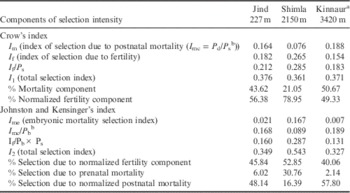
a Secondary data from Gautam et al. (Reference Gautam, Kapoor and Kshatriya2009).
b P s: proportion of survivals from birth to reproductive age; P d: proportion of deaths from birth to pre-reproductive age (≤15 years; measured as total postnatal deaths before pre-reproductive age/total live births).
Geospatial variations in selection intensities among Himalayan states
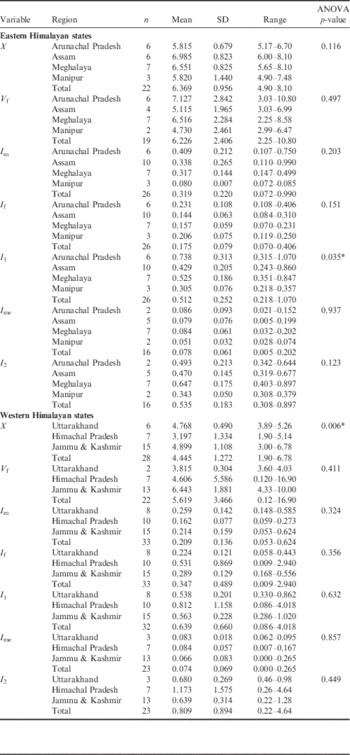
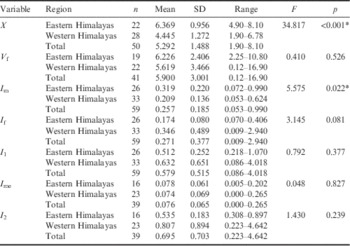
The results of the geospatial analysis of within-state and between-state trends in live births and selection intensities among different Himalayan populations are presented in Tables 3 and 4. Table 3 summarizes the differences among the populations of the eastern and western Himalayan states. The eastern states had a mean of about six live births, with Assam and Meghalaya having the highest mean values; the differences between the different states were not statistically significant. The postnatal mortality index, fertility index and Crow’s selection intensity index were highest in Arunachal Pradesh and lowest in Manipur, except for the fertility index. The differences were statistically significant for Crow’s index of selection. The prenatal mortality index and Johnston and Kensinger’s index were lowest in Manipur.
Geospatial differences in selection intensity components among different populations of Indian states in the eastern and western Himalayas
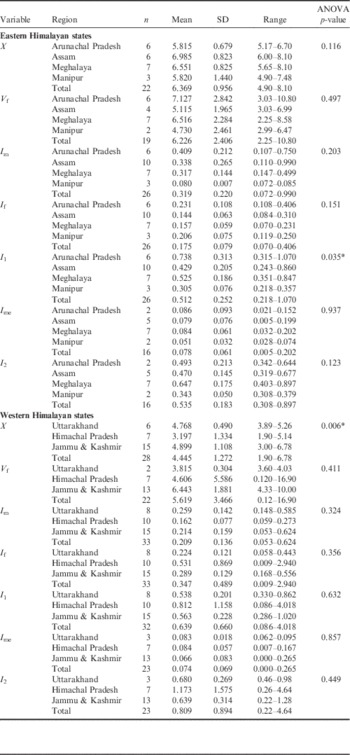
*Significant at p<0.05.
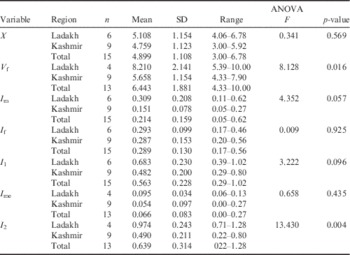
ANOVA of selection intensity components between Ladakh and Kashmir Valley
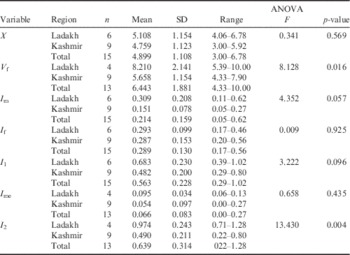
Among the western Himalayan states, Himachal Pradesh had the lowest mean number of live births and the differences were statistically significant. The fertility index was highest, and the postnatal mortality index lowest in Himachal Pradesh. The prenatal mortality index, Crow’s index and Johnston and Kensinger’s index were highest in Himachal Pradesh. The state of Jammu & Kashmir had the highest mean number of live births and was closely followed by Uttarakhand. The postnatal mortality selection index was highest in Uttarakhand and lowest in Himachal Pradesh. A converse picture was observed for the fertility index, being lowest in Uttarakhand and highest in Himachal Pradesh. Crow’s and Johnston and Kensinger’s indices were highest in Himachal Pradesh. The prenatal index was lowest in the state of Jammu & Kashmir. Table 3 also shows the differential contributions of the fertility and mortality components of selection in different populations; in some the fertility component made a greater contribution, while in others the mortality component contributed more. These differential contributions may be attributed to differences in various ecological, cultural and socioeconomic factors.
The state of Jammu & Kashmir has three major divisions that differ from each other climatically as well as ethno-linguistically. The Kashmir Valley has an average altitude of 1700 m and its people are predominantly Muslim. The Ladakh plateau is one of the highest places on earth at over 3000 m above sea level. The Ladakh region has two districts: Leh and Kargil. The people of Leh district are predominantly Buddhist, and majority those of Kargil district are Shia Muslims. Kashmir Valley and the Ladakh plateau differ enormously and therefore needed separate analysis; the results are presented in Table 4. The fertility indices of selection were almost the same in the two regions. The postnatal mortality index was about two times higher in Ladakh than in the Kashmir Valley. The prenatal mortality index was also higher in the Ladakh region, and so were Crow’s index and Johnston and Kensinger’s index, indicating a much higher magnitude of natural selection was operative in Ladakh than in the Kashmir Valley, mostly due to a higher mortality index. The Ladakh plateau has a two times higher average altitude than the Kashmir Valley.
People living in the eastern Himalayan states are ethnically, culturally and ecologically different from those living in the western Himalayan states. Due to the higher altitude and latitude, the temperature is much lower in the western Himalayas. The results of the analysis showing differences between the eastern and western states for various selection intensity indicators are given in Table 5. The mean number of live births and the postnatal mortality index were significantly higher in the eastern Himalayan states than in the western Himalayan states. The fertility index, Crow’s index and Johnston and Kensinger’s index were higher in the western states than in the eastern states; while the prenatal mortality index was of similar magnitude in the two regions, these indicators were not statistically significant.
ANOVA of selection intensity components between eastern and western Himalayan populations
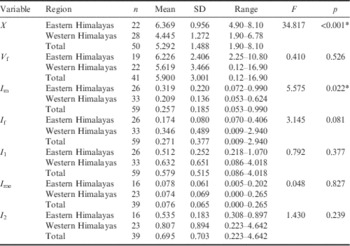
*Significant at p<0.05.
Discussion
The results of this study in north-west and eastern Himalayan populations clearly reflect geospatial differences in various indicators of selection intensities. These differential contributions may be attributed to differences in ethnic, behavioural ecology, environmental, cultural and socioeconomic factors. In support of this contention, there is much empirical evidence for changes in selection opportunities with changing environment over a period, and studies have demonstrated the relevance of socioeconomic change to the evolution of selective patterns (Terrenato et al., 1979; Ulizzi et al., Reference Ulizzi, San Martini and Terranato1979).
Though the results of the present study do not allow the effect of hypoxia on selection intensities to be inferred, because of the presence of confounding factors like ethnic and cultural differences among the populations, some idea of the altitudinal differences in selection intensities can be had. On the basis of fertility and mortality differentials, a higher mortality than fertility component was noted in populations sampled at high altitude (3420 m) than in those sampled at lower altitudes, i.e. from Mashobra near Shimla and rural Jind on the plains of Haryana in north-west India. The results show that high altitude does not have any significant effect on the completed fertility performance of couples. The results on the effect of hypoxia on mortality patterns are confounding. The mortality component was higher than the fertility component of selection coefficient at high altitude, while in the mid-level altitude highlands of 2100 m above sea level in the state of Himachal Pradesh the reverse was seen (Table 2). Similar results were seen in data from the Kashmir Valley (1700 m) and Ladakh plateau at more than 3000 m (Table 4). But when the comparison was made with rural population living on the plains of Haryana, no such dichotomy was seen, as both the populations living at higher altitude and plains had higher mortality than fertility components of selection. However, it seems that people living at mid-level altitudes in the state of Himachal Pradesh may have different determinants of differential fertility and mortality indicators than the other Himalayan populations.
The finding of higher mortality than fertility components of selection at high altitude in this study is in conformity with studies in Latin American high-altitude populations (Cruz-Coke et al., Reference Cruz-Coke, Cristoffanini, Aspillaga and Biancani1966; Garruto & Hoff, Reference Garruto and Hoff1976). Contrary to these studies, Gupta (Reference Gupta1980) reported a higher fertility component in the upper Khumbu (Nepal) situated at high altitude than in the Kalimpong subgroup at low altitude. In the Ladakh region too there were inter-population differences. The fertility component was reported to be higher among Bodhs and Arghuns than the mortality component, while the reverse has been observed among Balits and Brokpas (Bhasin & Nag, Reference Bhasin and Nag2002), in whom the mortality component was higher. These contrarian results indicate that factors other than altitudinal differences may be responsible for the differential contributions of fertility and mortality components to the total selection index.
The results of the present study do not reveal any decrease in the fertility performance of couples among high-altitude native populations in the western Himalayas. However, when populations of the eastern Himalayan states were compared with those of the western Himalayan states significant differences in average live births per couple were observed; eastern Himalayan populations had a significantly higher mean number of live births. Though there are altitudinal differences between the two regions, it would not be prudent to link these with differences in altitude, because no such disparity was visible for reproductive performance among the western Himalayan populations with reference to change in altitude, as the western Himalayan population in Shimla, lying at a mid-level altitude of 2100 m, had a lower number of live births than the high-altitude western Himalayan populations of Ladakh and Kinnaur. Thus no evidence was found of any reproductive pattern specific to high altitude. Similarly, a study on 906 Bolivian women residents of low, medium and high altitudes from lower socioeconomic strata, and who had no history of using contraceptives, revealed no significant altitude-related differences in the number of live-births (Dutt, Reference Dutt1980).
Geospatial differences in live births between eastern and western Himalayan population can also be viewed as the flexibility of human reproduction as a functional reality that is seen in human populations. Family size is determined by cultural factors, socioeconomic factors and level of modernization. In the present study, in the sample from Shimla, contraceptive measures seem to have been used to limit their family size; and this may be due to local factors prevalent in this population. Reduction in family size in modernized societies has to be viewed as a shift strategy from pure reproductive value to a mixture of resource and reproductive value as parental investment for offspring success (Kaplan, Reference Kaplan1996; Low, Reference Low2000; Kaplan et al., Reference Kaplan, Lancaster, Tucker and Anderson2002), triggering mechanisms of fertility regulation to ensure offspring quality over quantity (Mace, Reference Mace2007). However, it has been argued that low fertility and high socioeconomic position predict increased descendent socioeconomic success over generations, but do not predict increased reproductive success, thus contradicting adaptive models suggesting that low fertility and high socioeconomic position maximize long-term fitness (Goodman et al., Reference Goodman, Koupil and Lawson2012).
The results of this study do not indicate a higher embryonic fetal loss at high altitude than at lower altitude. There were no differences for this indicator between populations of the eastern and the western Himalayas. Also, it was found that the proportion of embryonic loss at an altitude of 2000 m was higher than that among residents of the plain areas of rural Haryana, as well as at the high altitude of more than 3000 m in the Kinnaur region. Gautam et al. (Reference Gautam, Kapoor and Kshatriya2009) reported greater embryonic mortality at a mid-to-high altitude of 2000 m than at the higher altitude of more than 3000 m. Mid-term or late-term spontaneous abortions have been reported to be extraordinarily low in the native highland populations of Chile (Cruz-Coke et al., Reference Cruz-Coke, Cristoffanini, Aspillaga and Biancani1966) and Peru (Buck et al., Reference Buck, Sasaki, Anderson, Hitchcock and Leigh1968; Hoff & Abelson, Reference Hoff and Abelson1976). By comparing studies on populations living in the central Andes with those from the southern Andes, Gonzales (Reference Gonzales2007) observed that the populations of the south Andes with longer multi-generational residence had lower still birth rates than the latter. Niermeyer (Reference Niermeyer2013) have argued that the hypothesis of a higher probability of fetal loss under high-altitude conditions looks logically attractive, but has not been substantiated. Prolonged residence at high altitude confers protection against the effects of hypoxia (Giussani et al., Reference Giussani, Salinas, Villena and Blanco2007).
On the basis of this cross-cultural comparative data analysis, it may be concluded that high altitude seems to have little effect on the fertility and embryonic mortality rates of indigenous people adapted to their local environmental conditions. The observed geospatial differences in various indicators of selection intensities were more due to differences in ethnic, behavioural ecology, environmental and cultural factors. The selection coefficient of postnatal mortality was higher at high altitude.
Acknowledgments
The primary data for this study were collected by Ms Rajni Kapoor and Ms Mayuk Bansal under the supervision of the author.