1. Introduction
What explains the growth of partisan polarization in the United States, both in Congress and in many state legislatures? Few questions have been more extensively researched in recent decades, with scholars proposing a variety of different explanations, including voter preferences, electoral rules, and the mass media (for a review, see McCarty, Reference McCarty2019). But less attention has been paid to an important, but largely overlooked, factor: the role of interest-group lobbying.
Previous literature has found the practice of lobbying to mitigate legislative party polarization (e.g., Baumgartner et al., Reference Baumgartner, Berry, Hojnacki, Leech and Kimball2009; Grossmann and Dominguez, Reference Grossmann and Dominguez2009). Although this can be true, I argue that its effect will depend on the lobbyist's client. Although lobbying from business and governmental clients may not result in party-voting, lobbying from non-profit interest groups, primarily citizen-based advocacy organizations and trade associations, can generate polarization by party. These groups have increasingly aligned with one of the major parties in recent decades (Koger et al., Reference Koger, Masket and Noel2009; Waterhouse, Reference Waterhouse2015), as their broad policy demands often require the pursuit of policy change through electoral replacement (Wright, Reference Wright1985; Franz, Reference Franz2008). Therefore, their advocacy is likely to push legislators to the party line on roll-call votes.
Using bill-level lobbying reports from the US Congress and three state legislatures, I find a consistent pattern. There is more party difference, meaning that the parties are internally united and opposed to one another, on bills lobbied by more non-profit interest groups. The magnitude of this relationship is meaningful; a one standard deviation increase in the number of non-profits lobbying a bill in Congress (about four groups) leads to a 13 percent increase in party difference within a policy area. This means that lobbying from a handful of groups is equivalent to the difference between an average healthcare bill before the unified Republican Congress in 2005 and an average healthcare bill in 2011, a Congress where the House repealed Obamacare with H.R. 2. Meanwhile, there is no additional partisan difference on bills with more business and public sector lobbying.
The state data are more detailed, which helps identify the mechanisms underpinning the positive association between lobbying and polarization. For example, the association is strongest early in the legislative process and when interest groups are negatively lobbying to stop a bill. Also, institutional variation in the states can help rule out a number of factors that can confound the relationship in Congress, such as party leader agenda control and bill salience. I also use the state data to show that over multiple sessions, changes in the interest group population precede changes in the average partisan difference of subsequent sessions, but not the inverse relationship. Finally, I use a dataset of bills with identical passages across the three states to show that the context created by interest groups relates to partisan legislative behavior, and not the content of the legislation alone.
The results help explain high levels of partisan polarization in Congress and an uneven pattern in the states. State legislative sessions lobbied by more non-profit interest groups tend to be more polarized by party, and a dramatic increase in Congressional lobbying expenditures since 1999 decades tracks a rise in party difference on passage votes. Overall, these results suggest that the type of outside group that initiates lobbying is a crucial factor in shaping how it affects legislative polarization. Scholars of interest group activity should disaggregate the lobbying population by group type if partisan behavior is relevant, as this heterogeneity is an important factor.
2. The partisan effects of lobbying
Lobbying is the private transmission of information from outside groups to public officials or their staffs (De Figueiredo and Richter, Reference De Figueiredo and Richter2014). Theoretical models of lobbying posit that the information provided from outside groups is meant to either persuade legislators to change their position on an issue, known as the informational model (Schnakenberg, Reference Schnakenberg2017), or mobilize legislators to pursue mutual goals, known as the subsidy model (Hall and Deardorff, Reference Hall and Deardorff2006). A number of researchers have concluded that the practice of lobbying has generally not caused legislative polarization.Footnote 1 The primary explanation for this view is that many groups that hire lobbyists have requests that can cross party lines (Baumgartner et al., Reference Baumgartner, Berry, Hojnacki, Leech and Kimball2009). Ultimately, if lobbying can affect legislator behavior, the polarizing effect of a group will be determined by its tactical decision to align with one party or attempt to win friends in both parties (Gray et al., Reference Gray, Cluverius, Harden, Shor and Lowery2015).
This partisan tactical decision can be traced to their general strategy (Goldstein, Reference Goldstein1999). Literature on campaign finance has shown how political action committees (PACs) attempt to affect policy by either pursuing access to incumbent legislators or attempting to replace legislators in elections (Wright, Reference Wright1985; Franz, Reference Franz2008). Groups that pursue policy change via electoral replacement usually work with a single party. The overlap of their goals—interest groups would like parties to implement their preferred policies, and parties would like interest groups to help them achieve and maintain power (Heaney, Reference Heaney, Maisel, Berry and Edwards2010)—requires being the majority party, so groups need to choose one or the other. Moreover, groups often find the most leverage in party primary elections, which are lower salience, and where their endorsements carry more weight (Masket, Reference Masket2009; Dominguez, Reference Dominguez2011). Groups pursuing access are more likely to work with both parties, and are more likely to target legislators based on their standing within the legislature, such as directing their campaign contributions to committee chairs as a way to gain access to legislators with agenda setting powers (Fouirnaies and Hall, Reference Fouirnaies and Hall2018).
The strategy that groups choose is often a function of their goals. Wright (Reference Wright1985) notes that groups are more likely to choose the electoral replacement route if they assume policy positions are fixed on an issue. Candidate and legislator positions are more likely to be fixed on salient national issues that citizens want issue representation from their members on (Lapinski et al., Reference Lapinski, Levendusky, Winneg and Jamieson2016). Legislators have more flexibility on issues that are not covered in the press and their constituents pay little (to no) attention to. Therefore, groups with broader goals are likely to pursue electoral replacement and align with one party. Groups with more discrete goals are likely to pursue access to sitting legislators and align with both major parties.
The goals, and therefore the partisan alignment, or interest groups vary a great deal, so the first step to predict the effects of their advocacy is to disaggregate groups on relevant lines. Schattschneider (Reference Schattschneider1960) saw the primary division between “two major power systems, government and business” (p. 118). Walker (Reference Walker1983) operationalizes this concept by assigning organizations based on two criteria. First, is a group public or private? Public refers to a government agency. If an organization is private, he then attempts to divide groups by profit motive. Therefore, for-profit organizations are business firms, and non-profit organizations run the gamut of trade associations representing business-type interests (e.g., Soybean Producers Association) to citizen-based advocacy organizations (e.g., Citizens for Clean Air) representing broader interests of citizens. With these conceptual categories in mind, this section examines the lobbying population to determine its likelihood of associating with one party.
2.1. Disaggregating the lobbying community
Most lobbyists in Congress represent businesses. In 2014, 79 percent of expenditures on Congressional lobbying were from businesses.Footnote 2 Drutman (Reference Drutman2015) reports that business lobbyists typically work on technical issues that draw little public scrutiny. Concerning hearings of the 1986 tax reform debate, a Senate staffer said: “The fewer the number of taxpayers affected, and the more dull and arcane the subject, the longer the line of lobbyists” (Birnbaum and Murray, Reference Birnbaum and Murray1988, 178). Having such particular goals does not incentivize these lobbyists representing businesses to associate with one party. Instead, they look to work with legislators in power who can help them advance their specific goals.
Campaign finance research indicates that businesses pursue friends in both parties. Ansolabehere et al. (Reference Ansolabehere, Snyder and Tripathi2002) look at PACs linked to businesses that lobby more, and find they tend to donate across both parties. Bonica (Reference Bonica2013) observes campaign finance activity to estimate ideal points for PACs on the traditional liberal-conservative dimension, which can indicate if groups are usually donating to one party or both parties. He finds that the distribution of PACs is unimodal and centered between the parties, which means they are choosing to cooperate with both parties, on average.
However, non-business groups often are organized to pursue broader goals (Walker, Reference Walker1991). Amid frustration with the major parties during the progressive era, Clemens (Reference Clemens1997) argues that modern interest groups were “invented” when collections of farmers, women, and workers formed organizations that adopted lobbying tactics employed by corporations at the time. Modern citizen-based advocacy organizations pursue topics like good governance, family values or civil rights (Berry, Reference Berry1999). This has led to a tighter alignment with the parties. These groups have formed coalitions with each other and one of the major parties in the electoral setting (Grossmann and Dominguez, Reference Grossmann and Dominguez2009; Koger et al., Reference Koger, Masket and Noel2009). By recruiting candidates or endorsing incumbents that support their demands in primary elections, these “intense policy demanders” look to enact policy change through winning elections (Bawn et al., Reference Bawn, Cohen, Karol, Masket, Noel and Zaller2012). Although, Bawn et al. (Reference Bawn, Cohen, Karol, Masket, Noel and Zaller2012) mention how groups face a principal-agent problem when these candidates become legislators and are wont to moderate their positions to stay in office (Lindstadt and Vander Wielen, Reference Lindstadt and Vander Wielen2011), and groups cannot observe their behind-the-scenes actions, which necessitates hiring lobbyists to monitor legislators and hold them to their earlier positions.
Ideal point estimates indicate that these many of these groups associate with just one party. Bonica (Reference Bonica2013) finds that PACs associated with “single-issue” groups have ideal points located toward the extremes. Crosson et al. (Reference Crosson, Furnas and Lorenz2020) estimate ideal points using the public positions of groups, and find the median liberal and conservative public-interest groups to have more extreme preferences than lawmakers in either party.
Another category of non-profit groups that lobby heavily are trade associations and unions. These groups are the brackish water between businesses and citizen-based advocacy organizations. Trade association interests are broader than those of their individual members, as firms tend to lobby individually when looking for particularistic demands from government (De Figueiredo and Tiller, Reference De Figueiredo and Tiller2001), which can make their behavior resemble single-issue groups that choose one party to fulfill their long-term goals. Waterhouse (Reference Waterhouse2015) shows how the three largest business associations: the United States Chamber of Commerce, the National Association of Manufacturers, and the Business Roundtable made a decided “right-turn” in the 1970s to oppose the New Deal style welfare state and associate primarily with the Republican party.
Trade association groups are not easy to pin down in this framework. The distribution of ideal point estimates for these groups vary on the public nature of the input data. Publicly available campaign finance data suggests labor to have extreme donation patterns like single-issue groups, but trade associations to be centrist like businesses (Bonica, Reference Bonica2013). However, using their private lobbying positions revealed through transaction reports, Thieme (Reference Thieme2020) estimates that trade association lobbying activity is actually more extreme in a conservative direction than the contribution data suggests.
The third major category of organizations is public sector lobbying. Intergovernmental lobbying is usually governments or agencies concerned with securing appropriations from the legislative branch (Payson, Reference Payson2020), or bureaucratic oversight. These very particular demands increase their likelihood of working with both parties. In line with this expectation, Crosson et al. (Reference Crosson, Furnas and Lorenz2020) find civil servant/public employee groups to have a unimodal distribution located between the party medians.
2.2. Predictions of partisan effects of lobbying from different groups
Variation in interest group goals affects their preferred association with one or both parties. This section predicts how the lobbying behavior of the different categories of groups will affect how legislators vote on a bill under an informational model of lobbying, where groups are capable of persuading members to change their positions. Mahoney and Baumgartner (Reference Mahoney and Baumgartner2015) note that legislators observe the distribution of interest groups that are active on an issue, so I will proceed using the number of groups on a bill as the unit of analysis.
First, as non-profit interest groups tend to associate with a single party, when lawmakers hear from more of these groups, it is likely to be from the same (partisan) direction, on average. Therefore, my first prediction is that there will be more party polarization on roll-call votes on bills lobbied by more non-profit interest groups.
Second, businesses have a less consistent pattern of party affinity. Although business executives usually support the modern Republican party (Bonica, Reference Bonica2016), the lobbying positions of businesses are not as consistently conservative as those of trade associations (Thieme, Reference Thieme2020). Therefore, it is not clear that business lobbying preferences would push legislators to a single partisan camp. Therefore, I predict that business lobbying will result in no additional partisan polarization.
Third, the positions of intergovernmental lobbyists are unlikely to consistently map on either side of the partisan divide (Payson, Reference Payson2020). Therefore, I predict that inter-governmental lobbying will result in no additional partisan polarization.
3. Methodology
Testing these predictions requires observing the behavior of lobbyists and legislators on individual bills. This paper joins a small, but growing literature that measures interest group activity at the bill-level using transaction reports (Grasse and Heidbreder, Reference Grasse and Heidbreder2011; Grossmann and Pyle, Reference Grossmann and Pyle2013; Lewis, Reference Lewis2013). Transaction reports have become widely available at the national level since the implementation of the 1995 Lobbying Disclosure Act; however, only a small minority of states require bill-level disclosure, and even fewer mandate reporting of the lobbying client's position on the bill.Footnote 3 Transaction reports have a number of limitations, notably that a lobbying client's positions are not observed with much precision. For example, Wisconsin reports lobby positions on its state ethics website, but the client's position is only recorded once, therefore it is not possible to observe when it lobbied on a bill (such as before or after a committee vote) or who was lobbied (such as Democratic or Republican members, or party leadership or committee chairs).
My research design starts with Congress, which is the subject of the vast majority of literature on partisan polarization (Lee, Reference Lee2016). I expand my analysis to the states, as they offer an opportunity to observe institutional variation that can better explain the relationship between lobbying and polarization in Congress. Although my sampling approach is limited by data availability, Colorado, Ohio, and Wisconsin represent two different geographic regions, and vary in the partisan control and ideological polarization of their legislators (Shor and McCarty, Reference Shor and McCarty2011). Next, I give an overview of the variables in my analysis.
3.1. DV: party difference
To identify where the parties are cohesive and opposed to one another, I collected the universe of floor votes for the following legislative venues and years: the US Congress (1999–2014),Footnote 4 and the Colorado (2011–2016), Ohio (2011–2014), and Wisconsin (2009–2014) state legislatures.Footnote 5 The sample only includes regular bills from regular legislative sessions,Footnote 6 dropping resolutions and bills from special sessions.
I calculate the party difference on each vote using Equation 1. This is an adaption of the RICE score or party unity measure which has a long tradition in the field (Sinclair, Reference Sinclair1977). Party difference is the absolute value of the difference between the two major parties’ unity measures. Ideal point estimation is usually employed in the polarization literature, but it cannot be calculated for each bill, as it requires a number of votes to assign ideal points to individual legislators. Although party difference is measuring party polarization and not ideological polarization, these concepts are similar. Figure 4 in the online Appendix shows there is a positive association between average party difference and the distance between party median ideal points calculated through NOMINATE during the sample years

3.2. Number of interest groups lobbying on a bill
To observe the number and type of lobbying clients on each bill in these venues, I use the universe of transaction reports filed by lobbyists in these four venues. Transaction reports list the lobbyist's “principal” or client, and the subject of their lobbying activity. Section A of the online Appendix discusses the data collection and standardization across these four venues. I classify groups according to Walker's (Reference Walker1983) criteria that stratifies groups into three categories using two questions. Is a group public or private? Public could mean a government agency or actor (e.g., the modal lobbyist in Ohio represents the Governor's office and is excluded), and then if it is private, is it for-profit or non-profit? Table 6 in the online Appendix lists the exact terms used by each state's Secretary of State to code each organization.Footnote 7
I count the number of interest groups that register a position on each bill to capture the size and diversity of a lobbying “side” or coalition. This is advantageous as Mahoney and Baumgartner (Reference Mahoney and Baumgartner2015) stress that lawmakers perceive the overall distribution of group positions on an issue, more than any one group. Table 1 shows the average number of groups lobbying bills in all four venues. In Congress, the modal bill is lobbied by very few groups, as many bills that are introduced do not receive a roll-call vote. However, bills that are heavily lobbied in Congress tend to receive astronomical amounts of lobbying. For example, the 2009 Affordable Care Act was lobbied by 1522 groups. To account for this skewed distribution, I take the natural logarithm of the number of groups lobbying each bill after adding one.Footnote 8 There is more average lobbying on each bill in the states, which can be a function of states considering fewer bills. Colorado legislators can only introduce five bills in a session.Footnote 9
Lobbying and roll-call voting data: 1999–2016

a Regular sessions only.
b Bills that receive a recorded vote. Regular House and Senate bills only.
c The legislature does not report the passage votes.
3.3. Bill and vote characteristics
A potential factor that could confound the relationship between lobbying and polarization is the salience of the legislation, as Baumgartner et al. (Reference Baumgartner, Berry, Hojnacki, Leech and Kimball2009) note that “partisanship and policy salience tend to go hand in hand” (p. 108). To control for salience in the states, I use the method employed by Grasse and Heidbreder (Reference Grasse and Heidbreder2011) and Lewis (Reference Lewis2013), by conducting a content analysis of the paper(s) of record for each state legislature: the Denver Post, Columbus Dispatch or Wisconsin State Journal and Madison's Capital Times. I searched the LexisNexis Academic Universe for every article during the sample that contained the term “house bill,” “hb,” “senate bill,” or “sb.” I then hand-coded these articles to assign them to an individual bill, and validate that they were referring to bills before the state's legislature. For the US Congress, I use the method of identifying salient and significant legislation employed by LaPira and Thomas (Reference LaPira and Thomas2017), and include an indicator if a bill is mentioned in the Congressional Quarterly Almanac, as collected by the Policy Agendas Project (PAP).
Some bills are more likely to divide the parties by nature, so I take a number of steps to rule out a concern that the association is the result of there being more votes on partisan bills. First, I measure the ideological extremity of a bill's sponsors. Although partisan voting and ideological positioning are not the same concept, on average, there is substantially more party difference on bills introduced by extreme members of either party. Extremity is estimated using ideal point estimation, provided at the state level by Shor and McCarty (Reference Shor and McCarty2011)Footnote 10 and Poole and Rosenthal (Reference Poole and Rosenthal2000)Footnote 11 for Congress, and I multiply liberal scores by −1.Footnote 12 Some states report more than one sponsor, so I average the ideal points of all the sponsors before multiplying liberal scores by −1.
Certain policy areas in Congress have historically divided the parties, such as votes on macroeconomic policy (Lapinski, Reference Lapinski2013). To account for such policy variation, I use indicators for the PAP major topic areas.Footnote 13 Employing fixed effects for these different policies allows for the model's intercept to vary for each policy area. This effectively allows for a comparison of bills within a policy area, so an education bill is being compared with other education bills. I also use temporal fixed effects for each session that account for changes in the average party difference over time.
I also account for the different types of votes legislators take. Snyder and Groseclose (Reference Snyder and Groseclose2000) note the importance of this delineation as substantive votes tend to be less partisan than many procedural votes. I include indicators for three types of floor votes: (1) procedural votes, (2) amendment amendments, and (3) final passage votes, and two types of committee votes: (1) passage votes and (2) amendment votes.
These different data sources are combined in Equation 2. The key independent variable is the number of organizations in each category that lobby each bill, as a reminder I use the natural logarithm of this count, plus one. Taking the logarithm of the count accounts for outlier bills with thousands of lobbying groups, and the Laplace smoothing method of adding one keeps bills with zero registered lobbying groups in the sample:

In Equation 2, v = vote, b = bill. The unit of analysis is individual votes, but since the number of groups lobbying are only observed once per bill, the standard errors are clustered by bill. The model is run separately for Congress, Colorado, Ohio, and Wisconsin. A number of indicators are absorbed to account for the context of the vote: α represents each session that the vote took place, δ represents whether the vote took place in an upper or lower chamber, γ represents the three different types of floor votes, and λ represents the policy agenda project major topic areas.
4. Results
Table 2 shows that across these four legislative venues, when more non-profit interest groups lobby on a bill it tends to be more polarized by party. These results allow me to reject a null hypothesis of no effect for my first prediction at conventional levels of significance in both Congress and the states. The magnitude of the effect is meaningful; increasing the number of non-profits lobbying a bill within a policy area in Congress by one standard deviationFootnote 14 increases the expected party difference by about 12 percent. This means that lobbying from about four groups can make the average Congressional bill go from looking like one before the unified Republican Congress in 2005 ($\hat {PD}$ = 0.47) to one after John Boehner (R-OH) became Speaker of the House in 2011 ($\hat {PD}$
 = 0.61).Footnote 15 The relationship between non-profit lobbying and party difference is stronger in Congress than the states, but it is very consistent in the states, which is a particularly robust finding considering the different institutional rules and actors across the venues.
There is more partisan difference on bills lobbied by more non-profit interest groups

Robust standard errors clustered by bill in parentheses.
*p < 0.05, **p < 0.01
Across these four venues, on average, neither business lobbying nor public-sector lobbying associate with any additional partisan difference. Business lobbying associates with party difference in Ohio, but does not in Congress, Colorado, or Wisconsin. The unusual pattern in Ohio may reflect the close ties between the business community and Governor John Kasich's administration during this time. A controversial effort to reduce public sector collective bargaining rights took place during this period,Footnote 16 and may have structured the business communities preferences in an unusual fashion.Footnote 17
In line with the expectation of Baumgartner et al. (Reference Baumgartner, Berry, Hojnacki, Leech and Kimball2009), salience is a positive correlate of lobbying and partisan difference, but including it in the model does not eliminate the relationship between lobbying and partisan difference. This suggests that it is not a necessary condition for lobbying to affect partisanship. Citizens pay significantly less attention to state politics than national politics (Rogers, Reference Rogers2016), so this is a particularly low bar for salience, and interest group lobbying still has an effect.
4.1. When does lobbying lead to polarization?
Fine-grained observations of interest group lobbying in Colorado and Wisconsin can show when the number of interest group lobbyists on a bill is most closely related to partisan difference. Table 3 breaks interest group lobbying out by its direction, and finds that the observed association between non-profit lobbying and partisan difference is driven by negative lobbying, when groups are attempting to stop legislation. It also shows that the association between negative lobbying and party difference is stronger at the committee stage in Colorado compared to floor votes.Footnote 18
There is a stronger association between partisan difference and negative lobbying

Also, that relationship is stronger in committee votes in Colorado compared to floor votes.
Robust standard errors clustered by bill in parentheses
*p < 0.05, **p < 0.01
The relationship between negative lobbying and partisan difference being concentrated on bills with negative lobbying and at the committee stage is notable because these are two circumstances where informational lobbying is more likely to be successful. At early stages, legislator preferences are more flexible, and groups can provide legislators with information before other sources, such as colleagues, party leadership, or the media. Wright (Reference Wright1990) observed informational lobbying in the low-visibility setting of Congressional committees and Box-Steffensmeier et al. (Reference Box-Steffensmeier, Christenson and Craig2019) find that endorsements from well-connected interest groups are more powerful earlier as well. In terms of negative lobbying, McKay (Reference McKay2012) finds that it takes 3.5 groups lobbying for a Congressional bill to offset just one group lobbying against a measure, as she argues that policymakers have an asymmetric preference to avoid action in the face of negative lobbying. Haeder and Yackee (Reference Haeder and Yackee2015) observe a similar bias toward inaction in the face of negative lobbying in the Office of Management and Budget's rule-making process.
5. Robustness tests
5.1. Party leadership agenda control
The state-level data can be used to address concerns about the Congressional data generating process. For example, Baumgartner et al. (Reference Baumgartner, Berry, Hojnacki, Leech and Kimball2009) and Grossmann and Pyle (Reference Grossmann and Pyle2013) note how partisanship is nearly a fait accompli as bills approach passage in Congress. One reason for this pattern is that Congressional leaders control which bills receive final consideration, and the “Party Cartel” theory predicts that only legislation that is favorable to the majority party comes up for a vote (Cox and McCubbins, Reference Cox and McCubbins2005). This theory serves as the rationale for the Hastert rule, named after the former Republican Speaker of the House who said he would only bring a bill to the floor if the majority of his party supported it (Richman, Reference Richman2015). If faithfully applied, the Hastert rule could bias the results in the direction of party difference because only votes with a high degree of party unity from the majority party would be observed, which is half of the equation of party difference. Figure 1 provides evidence that this is a valid concern. During the Obama administration, only about 4 percent of bills that were proposed in Congress received a passage vote.
There is more agenda control in US Congress than in the states. In Colorado, the GAVEL policy leads to a much higher share of bills receiving a passage vote.

The state legislatures vary in the “non-reporting rights” held by party leaders that allow the majority party to control the agenda (Anzia and Jackman, Reference Anzia and Jackman2013). Figure 1 shows that Colorado, in particular, presents a unique opportunity to observe a legislature without much majority party control. In 1988, Colorado voters passed GAVEL, which stands for “give a vote to every legislator,” and curtails the “non-reporting rights” of party leadership, such that approximately 80 percent of the bills in Colorado received a passage vote (Binder et al., Reference Binder, Kogan, Kousser, Daum, Duffy and Straayer2011). A much higher share of bills pass the committee stage in Colorado compared to Ohio or Wisconsin, which resemble more typical cases (Seawright and Gerring, Reference Seawright and Gerring2008). The positive coefficients for non-profit lobbying in columns 2–4 of Table 2 suggest that the relationship between interest group lobbying and partisan difference is not an artifact of the selection process.
5.2. Simultaneity
Other scholars have viewed the relationship between non-profit interest groups and polarization in different light, positing that it may have a different causal ordering. In a bitter partisan context, Gray et al. (Reference Gray, Cluverius, Harden, Shor and Lowery2015) speculate that lawmakers may be requesting help from interest groups in passing legislation, which they label “reverse lobbying” (p. 183). Reverse lobbying is in line with the subsidy model of lobbying, where legislators summon interest groups (Hall and Deardorff, Reference Hall and Deardorff2006). My theory section is more consistent with the informational model of lobbying, where groups are proactive and affect the positions of legislators, and Table 3 shows that the association between non-profit interest group lobbying and partisan difference was strongest in the circumstances when informational lobbying has been found to be more effective: in a negative direction, and earlier in the process. However, no one theory of lobbying can explain all legislator and lobbyist interactions.
Therefore, to untangle the relationship between interest groups and partisan conflict, this section uses aggregate data to look over multiple sessions within many states. Lobbying operations tend to be “sticky” (Drutman, Reference Drutman2015), such that firms that hire a lobbyist tend to do more lobbying in the future. If firms were attracted to partisanship, after partisan sessions we would expect to see an effect on future lobbying operations over time. On the other hand, if the relationship between interest groups and partisanship is consistent with the account described in my argument, their continued presence should affect the partisanship of later sessions.
I use a Granger causality framework to test this relationship (Hood et al., Reference Hood, Kidd and Morris2008). It is built on time-series cross-sectional data of the number of interest groups that register to lobby in all the state legislatures,Footnote 19 and the average party difference of passage votes on an annual basis in a nationally representative sample of 30 states.Footnote 20 Granger tests use the history of a variable to build a projection of its future values. A variable is said to “Granger cause” a second variable if including it in the model improves that prediction. Table 4 reports the top-line findings of a Granger causality test using the number of interest groups and the average party difference of 21 states from 2009 to 2014. It shows that the number of interest groups registered to lobby affects the subsequent polarization of these chambers. However, the observed polarization has no impact on subsequent interest group densities.Footnote 21 In other words, lobbying can Granger cause partisan difference, but not the inverse.
Granger causality test: changes in the number of non-profit interest groups, businesses, and government groups registered to lobby predict future changes in the average party difference of state legislative chambers, but not the inverse relationship

5.3. Bill content
LaPira and Thomas (Reference LaPira and Thomas2017) note how “lobbying bandwagons” form on Congressional bills that are more important or ticketed for final consideration. However, lobbyists have a hand in setting the context of legislation, which affects its perceived importance. Therefore, this section attempts to rule out that the content of bills is driving this relationship, and instead show that the context set by the distribution of lobbyists in a state matters. To do so, I find nearly identical bills in two states, and show that roll-call voting only relates to the actual lobbying taking place in that state, and does not relate to the lobbying taking place on a matched bill in a separate state, even though the bills are essentially the same.
For example, in Ohio's 129th legislative session, the legislature considered HB 163 which was meant to revise coal mining laws,Footnote 22 and which was lobbied by a handful of non-profit groups and businesses. There were three nearly unanimous roll-call votes on the bill, so the parties were not divided. Meanwhile, Wisconsin's 2013 SB 1 used much of the same legislative text to revise coal mining laws. However, in Wisconsin the non-profit interest groups were extremely active on the bill. The advocacy organization CleanWisconsin issued a press release before any votes took place that said, “This mining bill jeopardizes the health of our families and our environment to support the interests of wealthy, out-of-state mining executives.”Footnote 23 In line with my predictions, the roll-call votes were almost entirely on party lines.
This pair of bills demonstrates the ability of interest groups to change the context on a bill, holding content near fixed. To find bills whose content can be held fixed, I utilize a database of bills demonstrating text reuse, or substantial amounts of overlap in legislation, including identical passages, compiled by Burgess et al. (Reference Burgess, Giraudy, Katz-Samuels, Walsh, Willis, Haynes and Ghani2016).Footnote 24 In line with my expectations, I find that legislator behavior is sensitive to the actual lobbying taking place on a bill, as demonstrated in Figure 2 by a positive bivariate relationship between non-profit lobbying and partisan difference. However, legislator behavior has no relationship with the number of non-profit groups lobbying on the matched bill in another state.
Actual non-profit lobbying has a positive association with party difference on passage votes, but not lobbying from non-profits in the matched state. There are 45 actual bills matched up in five state dyads: for example, Colorado (actual)–Ohio (matched), CO–OH, CO–WI, WI–OH, WI–CO, and OH–WI.

Table 5 reproduces the full model from Equation 2 with both actual and matched lobbying. Also in line with my expectation, it shows that only actual non-profit lobbying associates with partisan difference. There is no relationship between lobbying in the matched state and partisan voting on the paired bills. Unfortunately, there are only 212 votes on 45 dyads of paired bills with identical passages in these sessions. Altogether, these results imply that the context of legislation created by interest groups, and not just its content, affects legislator behavior.
Only lobbying in the actual state is associated with party difference the actual state

There is no relationship between the lobbying on a matched bill in another state and party difference in the actual state.
Standard errors (clustered by actual bills) in parentheses
*p < 0.05, **p < 0.01.
5.4. Generalizability
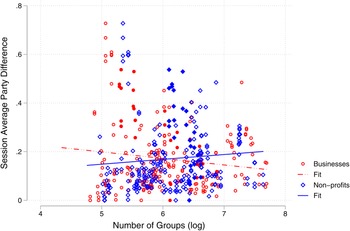
This section examines if the relationship between non-profit interest group lobbying and party difference scales to a higher unit of analysis. Figure 3 shows a positive relationship between the average party difference of passage votes during a state legislative session, and the natural log of the number of non-profit interest groups registered to lobby that year.Footnote 25 This relationship is consistent with Gray et al.'s (Reference Gray, Cluverius, Harden, Shor and Lowery2015) findings for 2007. However, there is a negative such relationship between party difference and the number of business groups that are registered to lobby. Overall, this aggregate look shows a robust relationship between non-profit interest group lobbying activity and partisan polarization on roll-call voting, which helps to explain an uneven pattern of partisan polarization in the state legislatures. It also shows that sample of states from the main analysis are fairly typical cases.
There is a positive relationship between non-profit lobbying and average party difference in a state legislative chamber: 2009–2014. There is a negative such relationship for business lobbying. The filled markers are the states in the sample used in the main analysis (CO, OH, and WI).

In terms of ideological polarization, Table 8 in the online Appendix compares the number of groups that register to lobby with the distance between party medians in each state legislature, as measured for all 50 states from 2006 to 2014 by Shor and McCarty (Reference Shor and McCarty2011) and updated in Shor and McCarty (Reference Shor and McCarty2015). It finds a similar pattern: in the presence of more non-profit interest group lobbying there is a greater difference between the parties.
In Congress, both expenditures on lobbying and party polarization have dramatically increased over the period 1999–2013.Footnote 26 There is a positive relationship between the total amount of expenditures on lobbying and the average party difference of floor votes (r = 0.46, n = 8), and this relationship is even stronger in terms of ideological polarization in the US House (r = 0.70, n = 8), or US Senate (r = 0.71, n = 8).Footnote 27
6. Discussion
Thousands of lobbyists roam the halls of Capitol Hill and the state capitals with different goals and objectives. This study highlights the behavior of lobbyists representing non-profit interest groups, like trade associations and citizen-based advocacy organizations, which primarily partner with one party to pursue their policy goals. It argues that when more of these interest groups lobby on a bill, it will polarize the roll-call record by party.
Bill-level lobbying disclosure reports from Congress, and the Colorado, Ohio, and Wisconsin state legislatures indicate that there is more party difference—where the parties are united but opposed to one another—on bills lobbied by more non-profit interest groups. The size of the effect is meaningful. Increasing the number of non-profits lobbying on a bill within a policy area in a Colorado legislative session by one standard deviation (about 2.5 groups, see Mummolo and Peterson (Reference Mummolo and Peterson2018)) is like the difference between an average vote on a transportation bill ($\hat {PD} = 0.22$ ) and a criminal justice bill ($\hat {PD} = 0.26$
 ), a more controversial segment of the agenda. This relationship generalizes to the chamber level, as state legislative sessions with more non-profit lobbyists tend to have more party difference. Also, an explosion in expenditures on Congressional lobbying since 1998 tracks a dramatic increase in partisan polarization over that time.
Previous literature has not found lobbying to have a polarizing effect on legislator behavior (Ansolabehere et al., Reference Ansolabehere, Snyder and Tripathi2002; Baumgartner et al., Reference Baumgartner, Berry, Hojnacki, Leech and Kimball2009; Grossmann and Dominguez, Reference Grossmann and Dominguez2009). However, disaggregating the interest group community by type can reconcile these results with that finding. The majority of lobbying, which comes from businesses, results in no additional partisan voting, nor does public sector lobbying. Baumgartner et al. (Reference Baumgartner, Berry, Hojnacki, Leech and Kimball2009) note how interest groups can make odd personal connections to mitigate rampant partisanship (p. 109). But when it comes to the non-profit community, it appears that the weight of the lobbying community is pulling legislators to their party lines. Therefore, these results should caution legislative scholars from using the amount of lobbying as a single variable in the context of partisan activity.
The state-level data allow me to rule out a number of factors that could confound this relationship in Congress. For example, party leaders in Congress, Ohio, and Wisconsin exert strong control over the legislative calendar, which can bias the roll-call record in a partisan direction. However, in Colorado, party leaders’ “non-reporting rights” are severely limited. Despite this key difference, the links between non-profit lobbying and partisan difference are similar across these different contexts. I use detailed lobbying reports from Colorado and Wisconsin to show the mechanisms underlying this relationship, finding the effect of non-profit lobbying on partisan voting to be highest early at the committee stage and when interest groups are lobbying to block to a bill.
To show the robustness of the relationship between lobbying and partisan polarization, I look over multiple years to show that changes in the interest group community lead to changes in the partisanship of later sessions, but the opposite pattern does not exist. This indicates that interest group lobbying leads to more polarization over time, and is not just attracted to partisan conflict. Also, I show that legislators respond to the context of legislation created by interest group lobbying, and not just the content of legislation. I use a database of bills in different states with identical text passages, and find that legislators in the actual state only respond to the actual lobbying in their state and there is no relationship between partisan voting and lobbying in the other state.
This study calls for attention to the ways in which citizen-based advocacy organizations, which have dramatically increased their presence in Washington since the 1970s (Berry, Reference Berry1999) affect legislator behavior. For example, the results suggest that interest groups discipline legislators in the early legislative stages, presumably using their influence in primary elections as leverage, such as in 2015 when Rep. Renee Ellmers (R-NC) withdrew her co-sponsorship of the Pain Capable Unborn Child Protection Act, an anti-abortion bill. This drew the ire of the National Right to Life Committee, which had supported Ellmers since her first run in 2010. Even though Ellmers quickly changed her position and voted for passage of the bill, the NRLC endorsed her primary opponent the next year and stated, “There is no member of Congress in recent memory who has done greater harm to a major piece of pro-life legislation, while claiming to be pro-life, than Renee Ellmers.”Footnote 28 Ellmers lost that primary.
In this way, this study also helps build our understanding of the role of interest groups in political parties. The UCLA School of party politics sees parties in the United States as coalitions of interest groups “seeking to capture and use government for their particular goals” (Bawn et al., Reference Bawn, Cohen, Karol, Masket, Noel and Zaller2012); but it has been criticized for its lack of specificity on how this coalition interacts with elected officials (McCarty and Schickler, Reference McCarty and Schickler2018). These results suggest that interest group lobbyists provide an important link between the party network and incumbent legislators. Many arcane legislative procedures help members hide their positions, and lobbyists can allow groups to monitor legislators and signal how certain pieces of legislation are important to the groups, and by extension, the party coalition, which pulls legislators to the party line.
The partisanship of business associations and industry groups, which are coded as non-profits in this study, also deserves reconsideration. Depending on how ideal points are estimated, this population either appear to be more centrist (Bonica, Reference Bonica2013) or ideologically extreme (Thieme, Reference Thieme2020) than most lawmakers. But my results suggest that when it comes to their behavior behind closed doors in the context of lobbying, partisan extremity is more likely to be the norm for this segment of the population. This development was accelerated when Tom DeLay (R-TX) became US House Majority Leader in 1995, and declared a new set of rules for any interest group that wanted its lobbyist to see him. “You need to hire a Republican,” he said, “We don't like to deal with those who want to see the end of our revolution” (Maraniss and Weisskopf, Reference Maraniss and Weisskopf1996, 117). DeLay later formalized this practice with the K Street Project, to encourage lobbying firms to hire former Republican staffers (Continetti, Reference Continetti2006).
These results have implications for representation. Lobbyists serve as an essential link between citizens and public officials. Broockman and Skovron (Reference Broockman and Skovron2018) found that state legislators are notoriously poor at estimating the opinion of their constituents on policy issues. Hertel-Fernandez et al. (Reference Hertel-Fernandez, Mildenberger and Stokes2019) found that Congressional staff are also poor at estimating the opinion of constituents, and staffers that deal with interest group lobbyists more are biased by that information. This suggests that in their role as the link between citizens and elected officials, interest group lobbyists are biasing the process in a partisan direction. So although interest group lobbyists do stand in to make the public's voice heard in Congressional and state legislative debate, that voice has a partisan accent.
Supplementary material
The supplementary material for this article can be found at https://doi.org/10.1017/psrm.2021.5.
Acknowledgments
Previous versions of this paper were presented at the 2016 APSA Annual Meeting in Philadelphia, PA, 2016 MPSA Annual Meeting in Chicago, IL, the Dartmouth College program in Quantitative Social Science, and the 2015 Philadelphia Region American Politics Conference. I thank Dan Bowen, David Cottrell, Jeremy Gelman, Michael Herron, Joshua Jansa, Mary Kroeger, John Lapinski, Matt Levendusky, Marc Meredith, Herschel Nachlis, Brendan Nyhan, Janine Parry, Richard Winters, Gerry Wright, PSRM Editor Paul Kellstedt and the anonymous reviewers for helpful comments. The data described in this article are available for download at the Harvard Dataverse: https://doi.org/10.7910/DVN/RRC08M.