Scholars of religion and politics have long noted the need for greater attention to how individuals translate their religion from abstract concepts to action (Glock and Stark Reference Glock and Stark1965; Davidson Reference Davidson1975; Benson and Williams Reference Benson and Williams1982; Leege and Kellstedt Reference Leege, Kellstedt, Leege and Kellstedt1993; Guth et al. Reference Guth, Green, Smidt, Kellstedt and Poloma1997; Mockabee, Wald, and Leege Reference Mockabee, Wald and Leege2007). Additionally, there are concerns about how political entrepreneurs use religious cues to influence public opinion (Calfano and Djupe Reference Calfano and Djupe2009; Albertson Reference Albertson2011; Weber and Thornton Reference Weber and Thornton2012; McLaughlin and Wise Reference McLaughlin and Wise2014; McLaughlin and Thompson Reference McLaughlin and Thompson2016). A subset of this work examines how religious cues influence policy preferences (Djupe and Gwiasda Reference Djupe and Gwiasda2010; Adkins et al. Reference Adkins, Layman, Campbell and Green2013; Djupe and Calfano Reference Djupe and Calfano2013). The rhetoric about recent health care reform was filled with a great deal of religious language. Specifically, observers noted that the rhetoric among supporters of reform evoked the Social Gospel (Sheeran Reference Sheeran2009), a Christian religious interpretation that calls on people to eradicate social and economic disparities (Rauschenbusch Reference Rauschenbusch1918). Social scientists, historians, and theologians have long noted the importance of the Social Gospel in American politics. However, their discussions of this religious belief system have focused on elites and have provided no clear evidence that it is a politically relevant belief system among ordinary citizens. Further, it is not clear if invoking the Social Gospel is an effective way for elites to influence public opinion. The new Republican president and congressional majority in 2016 have made it a top priority to unwind the health care policies adopted in 2010. A better understanding of how the Social Gospel influences citizens’ views on health care and how elites’ rhetoric can prime these considerations can clarify our expectations of how these policy shifts will be discussed by elites and received by the public.
The purpose of this study is to address these gaps in the study of religion and politics. To accomplish this, we focus on two questions. First, do those who adhere to the Social Gospel have distinct political attitudes? Using the Social Gospel as an example, we examine how differences in the translation of religious beliefs are associated with differences in political attitudes. Second, can political elites prime this religious belief system to influence policy attitudes? Specifically, we are concerned with the ability of political elites to use the language of the Social Gospel to influence public opinion. In addressing these two questions, we hope to bring together these streams of research in the religion and politics literature to understand better how different religious beliefs can encourage the formation of conflicting policy attitudes and how elites can take advantage of them.
Our empirical analysis relies on three sources of evidence. First, we use a 2009 national survey to demonstrate the importance Social Gospel supporters place on certain issues compared with others. Second, we use a 2010 survey of TX residents to examine how support for the Social Gospel is associated with policy attitudes. Finally, we use an experiment conducted with undergraduates to assess how exposure to language that invokes the Social Gospel influences policy preferences. Throughout, our analysis concentrates on those who identity as Christian because the Social Gospel is primarily a Christian religious belief system.
The results from our analyses demonstrate that supporters of the Social Gospel are more likely emphasize the importance of social welfare issues, but deemphasize issues associated with traditional morality. Second, the language of the Social Gospel may influence attitudes, but so can messages that contradict the Social Gospel. Finally, elites that use the Social Gospel are at less risk of visceral reactions than those who combine a message of religion and individualism.
RELIGIOUS BELIEFS AND POLITICAL ATTITUDES
Religious beliefs help individuals become aware of the “fundamental problems of human existence” and “prescribes the process of their solution” (Leege and Kellstedt Reference Leege, Kellstedt, Leege and Kellstedt1993, 216). In doing this, religious beliefs shape how people see the world and how engage it. This paper examines the importance of one particular belief, the Social Gospel. The Social Gospel maintains that every Christian has an obligation to both herself and to society as a whole (Curtis Reference Curtis1991). Rauschenbusch (Reference Rauschenbusch1918), one of the early proponents of the Social Gospel, defines sin as selfishness and the sinful mind as “the unsocial and anti-social mind” (50). Thus, a concern for the well-being of others is the heart of the Social Gospel. It argues that individual salvation is all but impossible to achieve without attempting to create an equal society (Rauschenbusch Reference Rauschenbusch1918; Musser and Price Reference Musser and Price1992).
Supporters of the Social Gospel are concerned with the societal pressures placed on people and how these pressures influence behavior. In particular, supporters of the Social Gospel are concerned with inequalities and how these inequalities lead to risky or uncivil behavior (Leege and Kellstedt Reference Leege, Kellstedt, Leege and Kellstedt1993; Morone Reference Morone2003; Smidt, Kellstedt, and Guth Reference Smidt, Kellstedt, Guth, Smidt, Kellstedt and Guth2009). Further, the Social Gospel's emphasis on structural issues generates more concern for ensuring a strong social welfare system, such as education and health care, to prevent the public from potential harm (Morone Reference Morone, Mechanic, Rogut, Colby and Knickman2005). Further, Social Gospel supporters are less concerned traditional definitions of morality, which emphasize individual behavior (McDaniel Reference McDaniel2016). We expect Social Gospel supporters to place more importance on the social safety net, while being less concerned with traditional morality. Based on this, we have three have three hypotheses concerning the political and social attitudes of adherents of the Social Gospel:
H1:
Adherents of the Social Gospel will place greater importance on social welfare issues.
H2:
Adherents of the Social Gospel will place less importance on traditional morality.
H3:
Adherents of the Social Gospel will be more supportive of policies that expand the social safety net.
RELIGIOUS RHETORIC AND POLICY
In addition to this link between religious belief systems and policy attitudes, we expect elite rhetoric to also factor in how citizens apply these beliefs. Citizens use elites as cue givers to help them understand where they should place themselves in regards to policy alternatives. Further, through the framing of issues political elites are able to shape the way the public thinks about issues and subsequently change their mind about the issue (for a review see Gilens and Murakawa Reference Gilens, Murakawa, Carpini, Huddy and Shapiro2002). Elites are constantly searching for new ways to frame policies in order to advance their political agenda (Riker Reference Riker1996). By changing how an issue is framed, politicians are able to change the considerations, values, and beliefs citizens bring to bear when evaluating it (Druckman Reference Druckman and Keren2011; Stone Reference Stone2012). The use of frames is constrained by social norms, values and political opportunities. Further, the effectiveness of different frames relative to one another is unknown (Chong Reference Chong2000). If the frame is successful, other politicians will adopt it (Riker Reference Riker1996). Within American politics, numerous frames have been used to advance policies, such as egalitarianism and individualism (Barker Reference Barker2005) and race (Mendelberg Reference Mendelberg2001; Valentino, Hutchings, and White Reference Valentino, Hutchings and White2002). In the health reform debate of the 1990s, supporters framed it as an issue of equality, while opponents framed it as government intrusion and an impediment to individualism (Jacobs and Shapiro Reference Jacobs and Shapiro1995). The success of the opposition reflected their ability to more successfully frame the health care reform debate as an issue of government intrusion (Cobb and Kuklinski Reference Cobb and Kuklinski1997; Koch Reference Koch1998).
Since the latter half of the 20th century there has been a notable increase in the use of religious language among political leaders to frame their campaigns and policies (Layman Reference Layman2001; Kuo Reference Kuo2006; Wald and Calhoun-Brown Reference Wald and Calhoun-Brown2007; Domke and Coe Reference Domke and Coe2008). Even though other western industrialized nations have become progressively secular, the United States has kept religion salient through repeated revivals (Morone Reference Morone2003; Putnam and Campbell Reference Putnam and Campbell2010). Because of this, a large share of U.S. politics and policy is debated along religious grounds. Arguments about budgets, taxes, and government action are not just statements about what is best for the nation; they also carry an element of divine judgment (Reinhardt Reference Reinhardt2002). In the 2013 food stamp debate, several members of Congress used religious references to justify their support or opposition to lowering allotments (Collins Reference Collins2013; Delaney and Kaleem Reference Delaney and Kaleem2013).
During the 2010 health care reform debate, the themes of equality versus big government reemerged; however, contrary to the 1990s supporters framed health care as a moral imperative (Nichols Reference Nichols2007; Rosen and Clement Reference Rosen and Clement2009; Simon Reference Simon2009). President Obama framed his discussion of health care reform as a moral obligation (Hefland Reference Hefland2009). He used phrases such as “give justice to the poor,” taken from Proverbs, to justify his quest for a more equitable health care system. In defending his reforms from critics he stated that they are “bearing false witness,” taken from the 10 Commandments. Seeing an ally in Obama and the ability to fulfill their religious duty, several faith groups took up the cause of health reform arguing that it is not a question about liberty or finances, but one of morality (Gilgoff Reference Gilgoff2009; Rosen and Clement Reference Rosen and Clement2009; Salmon Reference Salmon2009; Walling Reference Walling2010). Rev. Thomas (Reference Thomas2009), in an editorial titled “Would God Back Universal Health Care?”, argued that the parable of the Good Samaritan directly spoke to the need to expand health care access. Groups such as Faith Reform in Health Care offering their “Moral Vision” in reform (Walling Reference Walling2010). In August of 2009, faith groups came together to launch a national campaign titled “40 Days for Health Reform.” Using television ads, prayer rallies and sermons, the campaign attempted to convince legislators and citizens that providing health care to all was the morally correct action (Hefland Reference Hefland2009; Spolar Reference Spolar2009). President Obama repeatedly leaned on these groups to mobilize support and combat opponents (Hefland Reference Hefland2009; Rosen and Clement Reference Rosen and Clement2009). While all of this rhetoric has been noted (Javers Reference Javers2009), it is not clear if these messages worked. President Obama's support from religious progressives would indicate that his message resonated with those who adhere to the Social Gospel, but it has not been thoroughly examined how open appeals to tenets of the Social Gospel may influence policy attitudes.
The religion and politics literature offers evidence that this tactic on the part of the Obama administration had the potential to influence public opinion. Several studies find that using religious cues helps political entrepreneurs advance their campaigns and policy agendas. The majority of work in this area demonstrates that religious language and symbols can shape how citizen perceive candidates (McDermott Reference McDermott2009). Specifically, it is argued that implicit cues work best (Calfano and Djupe Reference Calfano and Djupe2009; Albertson Reference Albertson2011; Weber and Thornton Reference Weber and Thornton2012), while overt cues have the danger of alienating certain portions of the electorate (McLaughlin and Wise Reference McLaughlin and Wise2014). The work that has examined policy support finds that religious cues can influence policy preferences. Adkins et al. (Reference Adkins, Layman, Campbell and Green2013) demonstrate that religious group cues influence citizen policy support. Djupe and Gwiasda (Reference Djupe and Gwiasda2010) find that when religious elites emphasize the role of prayer and the consultation of religious texts in their decision-making process, they are more likely to persuade religious citizens. Pertinent to this study, Djupe and Calfano (Reference Djupe and Calfano2013) demonstrate that exposure to certain types of religious messages can influence the religious values citizens bring to bear when evaluating government action. Specifically, they find that when respondents were primed with exclusive religious values, values that enforce narrow group boundaries and resistance to cooperating with outsiders, they expressed more hawkish attitudes (p. 644). These results indicate that exposure to certain religious messages can influence policy attitudes.
Based on these previous findings, we have three expectations concerning the roles of elite rhetoric and religious cues. First, we expect that an equality message by elites will make a more persuasive case for expanded public assistance. Second, we expect that religious frames of all kinds will prime Social Gospel considerations among its adherents. Third, a religious egalitarian message, consistent with the Social Gospel, will have a stronger persuasive effect among Social Gospel adherents. More formally stated, our hypotheses are as follows:
H4:
Those who are exposed to an equality message will be more supportive of expanding the welfare state than those who are exposed to an individualism message.
H5:
Social Gospel believers will be more responsive to both a message that intertwines religion with individualism and a message that intertwines egalitarianism.
H6:
There will be greater polarization between Social Gospel adherents and non-adherents when exposed to a religious egalitarianism message as opposed to a religious individualism message.
EXAMINING THE RELEVANCE OF THE SOCIAL GOSPEL IN POLICY ATTITUDES
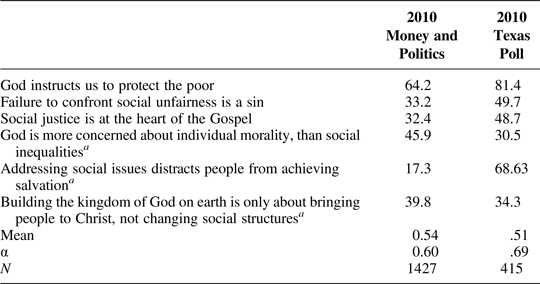
We begin by examining the association between adherence to the Social Gospel and issue importance. To accomplish this, we use 2009 University of Texas Money and Politics Survey, which contains measures of Social Gospel support and issue importance. The survey was conducted through YouGov/Polimetrix using a stratified sample that attempted to reflect the general U.S. population. The Money and Politics survey yielded 2,500 respondents with 72.3% identifying as Christians. To assess their adherence to the Social Gospel, respondents were asked to state their level of agreement with six statements, on a five-point Likert scale (the measurement closely follows McDaniel (Reference McDaniel2016) and is described in detail in Appendix A). Limiting the analysis to those who identify as Christians reduces the sample size to 1,515. For ease of analysis the measure is scaled to range from 0 to 1 with corresponding values in between (Achen Reference Achen1982). Table 1 demonstrates that the Social Gospel measure has a mean of 0.54, and 12.68% of the respondents are in the bottom third, while 18.78% of the respondents are in the top third of this measure.
Agreement with Social Gospel measures

a Reverse worded item.
Analysis limited to those who identify as Christian.
Sources: 2009 University of Texas Money and Politics Survey and 2010 Texas Poll.
To assess issue salience, we use items that ask respondents about the importance of social welfare issues, such as health care reform, education, and employment. Given our argument, we expect adherence to the Social Gospel to be positively correlated with the importance respondents place on these issues. In addition to these issues, we examine the relationship between the Social Gospel and the decline of traditional values. Because the literature notes that adherents of the Social Gospel are more likely to place greater emphasis on social issues as opposed to traditional values, it is essential to note the salience that Social Gospel adherents place on preservation of traditional norms and values. Each of the measures is an 11-point index scaled to range from 0 to 1. Zero indicates not at all important, while 1 indicates extremely important. Of the issues examined, jobs and unemployment (0.92) has the highest mean level of importance, followed by education (0.86), values (0.82), and health care reform (0.75).
The model also accounts for religious and sociodemographic covariates. The religious covariates include measures of affiliation, religiosity, and biblical literalism. Religious affiliation is captured using dummy variables for Catholic (25%), Evangelical Protestant (47%), Mainline Protestant (21%), and Other Christians (14%).Footnote 1 Evangelicals are the reference category in the models. Religiosity is assessed through the creation of an additive index (α = .78) comprised subjective religious importance, frequency of church attendance and prayer. Finally, biblical literalism is accounted for by obtaining the respondent's view of the bible: the actual word of God and is to be taken literally, word for word; the word of God but not everything should be taken literally; or a book written by men and is not the word of God.
The sociodemographic covariates are age, sex, education, family income, region, race, ideology, and partisanship. As in the discussion of the measures of the Social Gospel and the dependent variables, these variables range from 0 to 1 with corresponding values in between.
RESULTS
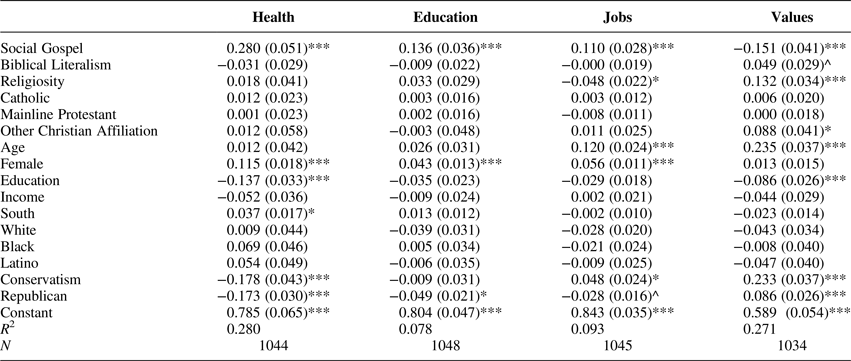
The findings from the analysis provide support for H1 and H2. The results, in Table 2, demonstrates that adherents of the Social Gospel place greater emphasis on social welfare issues (H1) and less concerned with traditional values (H2). Strong supporters of the Social Gospel significantly rate health care reform, education, and jobs and unemployment as more important than those with low levels of support. Additionally, strong supporters rate the decline of traditional values as less important than those with low levels of support. In comparison with the other religious measures, the Social Gospel is the only measure consistently associated with these attitudes. This is not surprising given Wilson's (Reference Wilson, Smidt, Kellstedt and Guth2009) review of the literature that finds the established measures of religion are not consistently correlated with social welfare attitudes. Religiosity is negatively related to the importance of jobs and unemployment, while being positively correlated with the decline in traditional values. Biblical literalism is only significantly associated with the importance of the decline in traditional values.
OLS analysis of the relationship between Social Gospel and issue importance

Source: 2009 University of Texas Money and Politics Survey.
^p < 0.1, *p < 0.05, ***p < 0.01, two tailed test Analysis limited to those who identify as Christian.
Because all the variables range from 0 to 1, we can observe that those who fully reject versus those who fully accept the Social Gospel differ by 28 points on the importance health reform, by 14 points on schools, by 11 points on jobs and unemployment, and by 15 points on decline of traditional values.
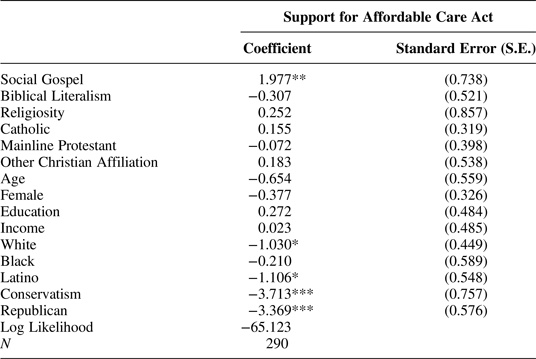
The 2009 Money and Politics Survey allows us to understand the issues salient to those who support the Social Gospel; however, it is limited in its ability to help us understand their policy preferences. To help fill this void, we use the 2010 University of Texas/Texas Tribune Texas Statewide Survey. The survey is a random sample of 800 Texans conducted between May 14 and 20, 2010. Specifically, the survey allows us to test H3, that adherents of the Social Gospel will be more supportive of expanding the social safety net. We measure support for expanding the social safety net, by examining attitudes toward the Affordable Care Act. Given that the ACA has been painted as the most recent victory for Social Gospel supporters, we believe attitudes toward it provide an opportunity to examine the relationship between the Social Gospel and policy preferences. We measure the extent to which respondents support the new law using two measures: approval of the recently passed national health care reform and support for the Texas Attorney General's participation in a lawsuit against the ACA.Footnote 2 Among Texans, there are few who approve of the law (32.3%) and the vast majority support the lawsuit against the law (65.7%). Among those who identify as Christians, support for the law decreases (26.4%) and support for the lawsuit increases (73.1%). Given that responses to the measures are highly correlated (r = −0.93) we created a single additive measure that accounts for both support and opposition to the ACA. To create this measure we reverse coded the lawsuit measure and added it to the health care reform approval measure. Doing this creates a three-point measure where one indicates full support for the ACA (23.5%) and zero indicates full opposition (73.9%). A score of 0.5 indicates mixed support (2.6%), meaning that the respondent approves of the ACA and also supports the lawsuit or the respondent disapproves of the health law and opposes the lawsuit. Given our earlier argument, we expect the Social Gospel to be associated with increased support for the health care reform law. The model to analyze this relationship uses the same measures as in the above models. The only exception is that this model does not account for region. Table 1 offers a comparison of the Social Gospel measure in both surveys, which demonstrates that the measure was replicated with similar results.
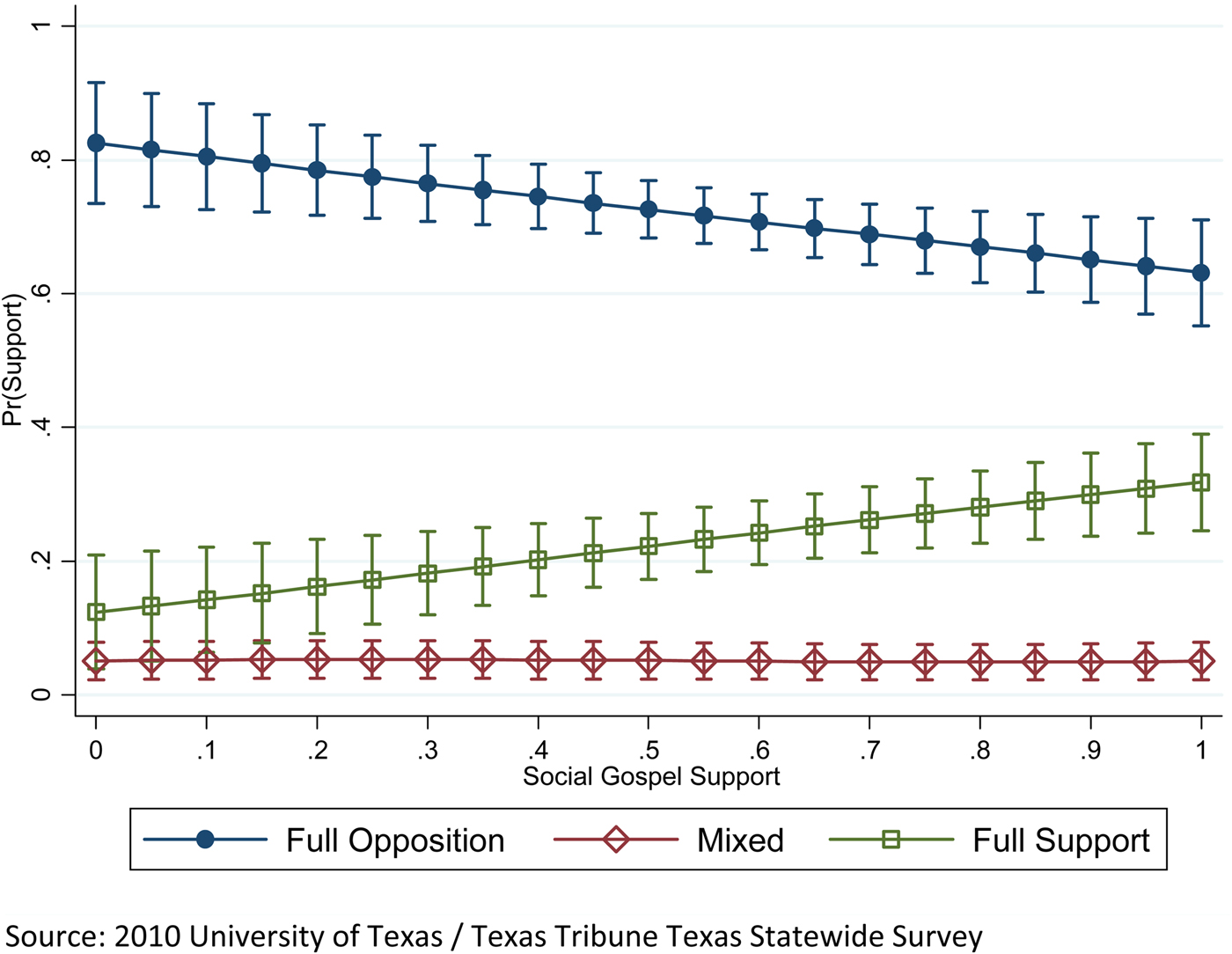
To analyze the measure of support for the ACA, we employ an ordered probit model. Predicted probabilities from this model, shown in Figure 1, demonstrate that higher levels of support for the Social Gospel are associated with a higher probability of belonging to the full support category and a lower probability of being in the full opposition category.Footnote 3 When the modal respondent is at the lowest level of Social Gospel support she has an 82.5% chance of belonging to the full opposition group, a 5.1% chance of being in the mixed group, and a 12.4% chance of being in the full support group. If that same individual strongly supports the Social Gospel, she has a 63.1% chance of belong to the full opposition group, 5.1% of belong to the mixed group, and a 31.8% chance of belonging to the full support group. These results indicate that there is a 19.4 percentage point difference in the probability of belonging to the full opposition or full support group between low and strong supporters of the Social Gospel.
Predicted probability of Support for Affordable Care Act, given Social Gospel support

The results from the survey analyses support H1, H2, and H3 by demonstrating that adherents of the Social Gospel have distinctive political attitudes. Supporters of the Social Gospel place greater emphasis on social welfare issues and are more supportive of expanding the social safety net. Further, they are less concerned with the culture wars. In sum, these results demonstrate that Social Gospel is a relevant belief system for understanding how some Christians understand politics. Furthermore, the Social Gospel has an association with political attitudes that is distinct from traditional religious measures, such as denomination and views of the Bible.
However, what these results do not establish is the extent to which elites can tap into this belief system to gain support for their policies. The following section provides an analysis of the extent to which elites can use the language of the Social Gospel to influence policy preferences.
ELITE RHETORIC HEALTH CARE REFORM AND THE SOCIAL GOSPEL
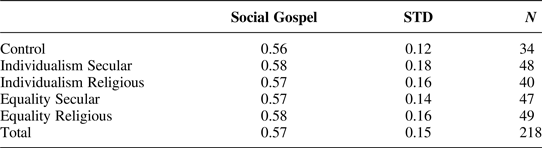
The second objective of this study is to assess if messages that evoke the Social Gospel can persuade. To make this assessment, we use data collected from an online survey experiment to 332 students at large southwestern university from March 7 through April 9, 2010. The experiment was administered during the passage of health care reform. Given the intensity of debate, this was an ideal time to examine how elite rhetoric might sway public opinion.Footnote 4 The experiment manipulates the content of the message and appeal of the message. The respondents were exposed to a message that emphasized the importance of individualism or equality. The appeal of the message was either secular or religious. It is important to note that none of the treatments mention health care; they just stress the need for the nation to pursue a policy agenda that stressed individualism or egalitarianism and used secular or religious language. Because the treatments do not mention specific policies, this is a more conservative test of whether these types of language can persuade health reform attitudes. In the secular frame, the speaker made statements that he attributed to Thomas Jefferson, in the religious frame the statements were attributed to the Bible. To maintain consistency, the quotes in both the individualism conditions remained the same, as were those in the equality condition. The inclusion of the secular and religion frames allows us to examine if the difference in persuasion effects depends upon the source of evidence. Finally, in the control condition the respondents were asked to read an article about a cell phone application. The treatments and the control can be referenced in Appendix B.Footnote 5
The analysis focuses on two key themes, support for the expansion of coverage and the financing of coverage expansion. Support for expansion is measured through attitudes toward universal health care and guaranteed health care for children. Support for financing is measured using support for requiring everyone to purchase insurance and increased income taxes for people from families making more than $1 million a year and individuals making more than $500,000. These measures are seven-point Likert scales that range from strongly oppose to strongly favor. As in the earlier analysis, all measures range from 0 to 1. Finally, as in the earlier sections, the analysis is limited to those who identify as Christians, which decreases the sample size to 225.
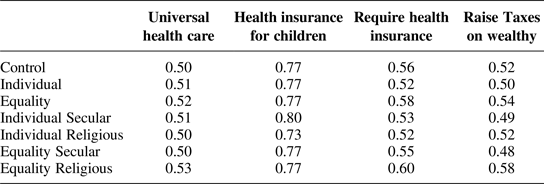
An analysis of first order effects does not find good support for H4. Attitudes toward the expansion and financing of health reform across experimental conditions shown in Table 3 indicate that the type of message, individualism or egalitarianism, does not appear to sway opinion on health care reform. Small differences were seen on attitudes in several individual treatments, but these effects fall just short of the standard threshold of statistical significance in a one-tailed test (p < 0.05).Footnote 6 Those exposed to an egalitarian message may have been more supportive of various aspects of health care reform, particularly when the appeals were intermingled with religious appeals, but the magnitude of the effects were too small to be considered significant with the small sample sizes within each treatment group.
Mean attitudes toward the expansion and financing of health care reform given condition

Analysis limited to those who identify as Christian.
Control 36 respondents; Individualism Secular 48; Individualism Religious 42; Equality Secular 49; Equality Religious 51.
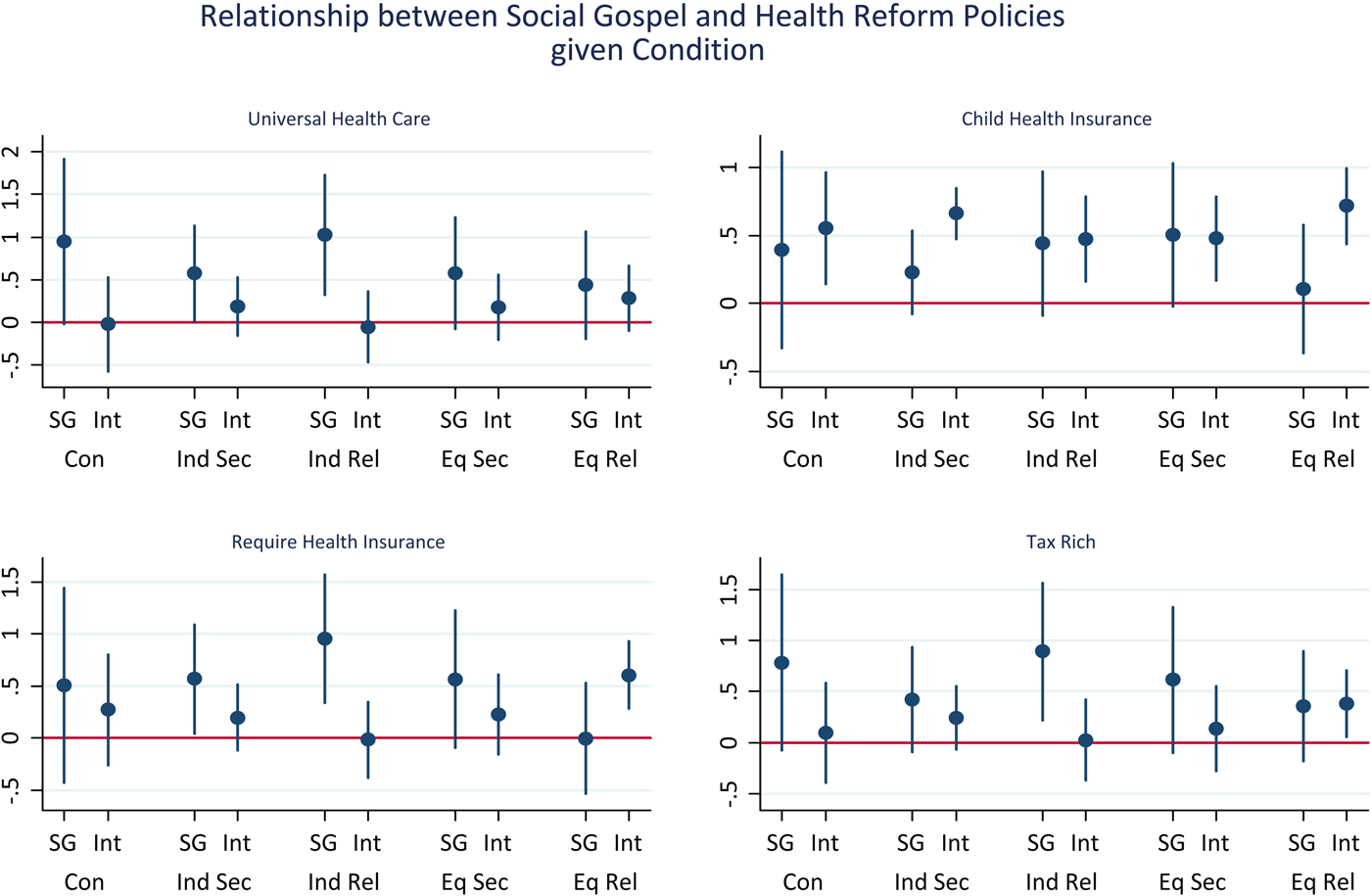
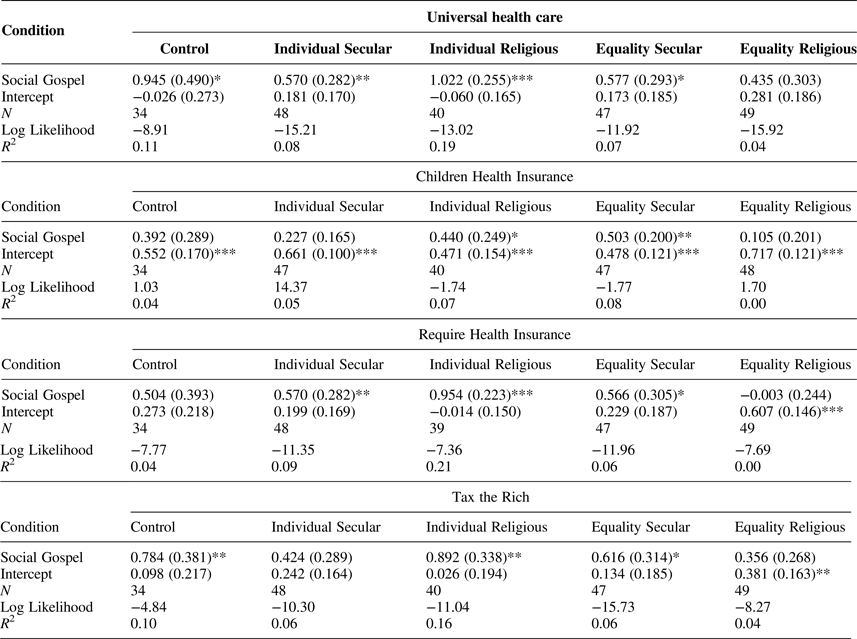
Transitioning from the analysis of means, we begin to focus on the how adherence to the Social Gospel moderates the effect of these messages. Specifically, we believe that the gap between low supporters and strong supporters will be greatest when the respondents are exposed to the message that intertwines religion and egalitarianism. To accomplish this, we interacted the Social Gospel measure with the treatments, shown in Figure 2. These graphs plot the coefficients (Social Gospel adherence and an intercept term) as predictors of policy support in each experimental condition (full results of these regressions are provided in Appendix C; Table C2). The results of these interactions demonstrate that the Social Gospel was primed as often in the secular and control conditions as in the individual religious condition. Further, the Social Gospel was least likely to be primed in the equality religious condition, which contradicts H5. The weaker association between Social Gospel adherence and policy support in the equality religious condition, particularly for child health insurance and the health insurance requirement, can be explained in part by the higher intercept values. In other words, the Social Gospel measure is weakly associated in this condition because of a higher starting point. The slope of the Social Gospel in the individual religious condition is significantly steeper than in the equality religious condition regarding support for the insurance mandate (p-value = 0.01).
Relationship between Social Gospel and health reform policies given condition
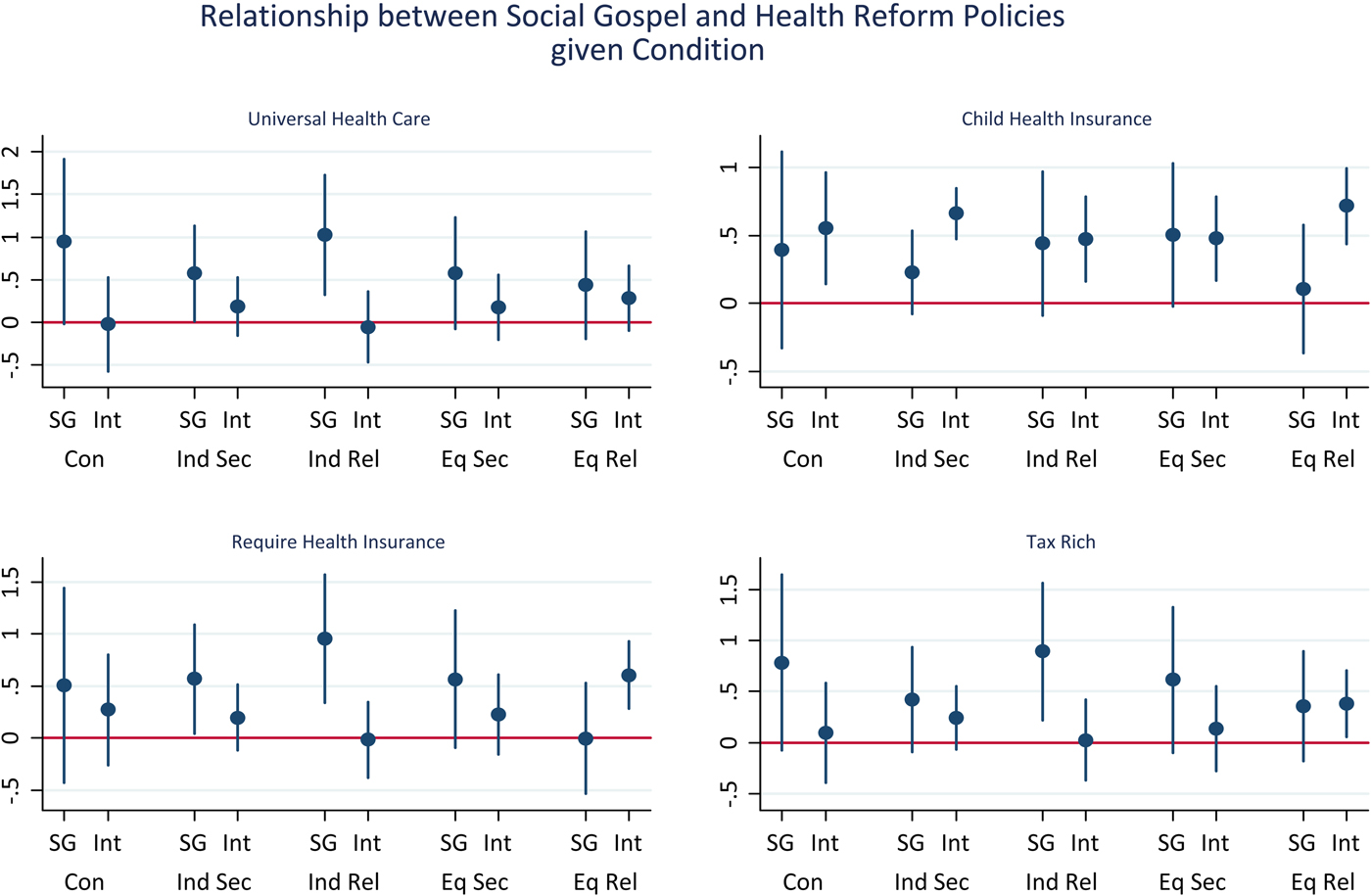
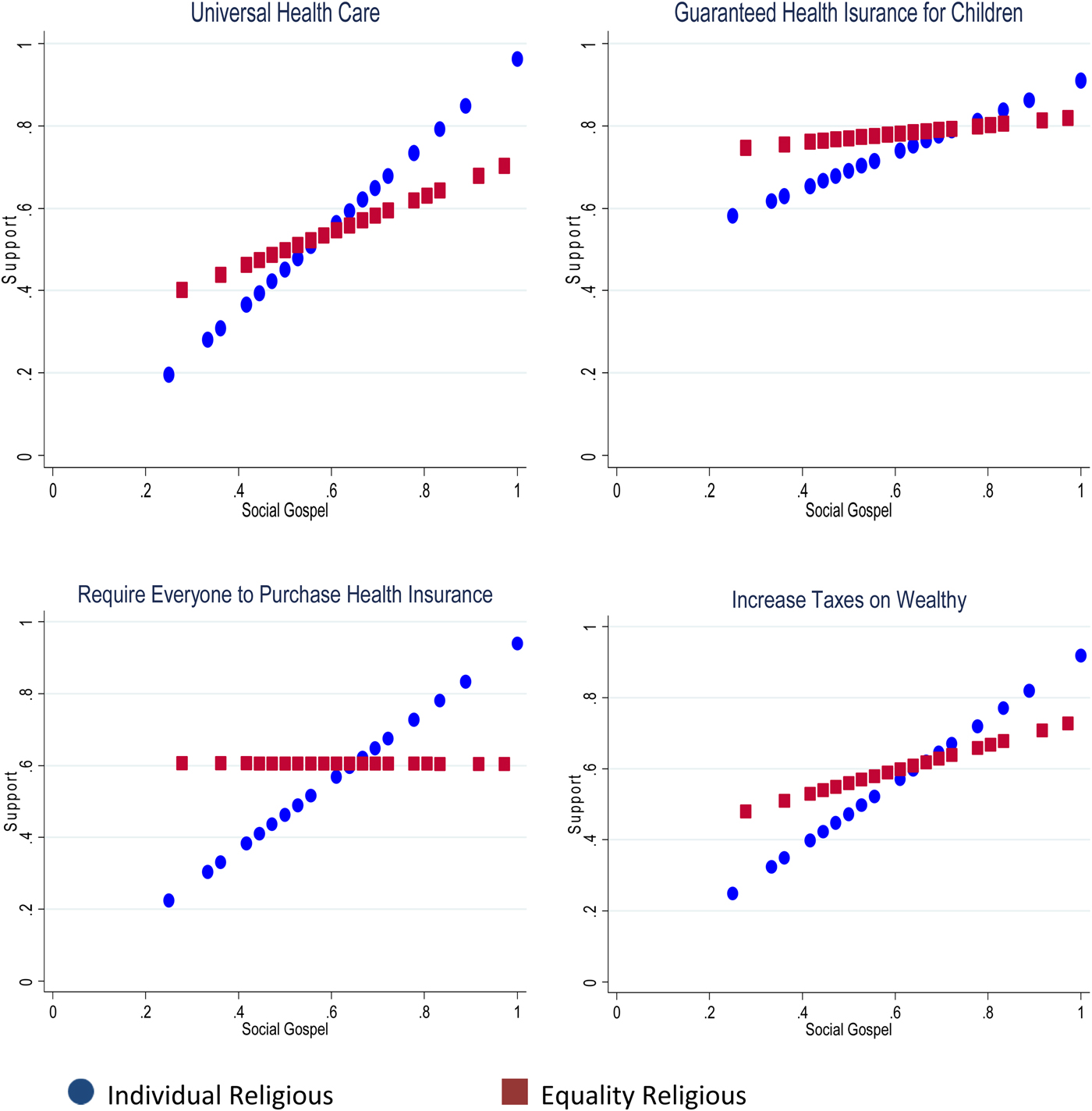
One explanation for these contrary findings is that the Social Gospel may be a chronically salient concept, like race is for African-Americans (Gurin, Hatchett, and Jackson Reference Gurin, Hatchett and Jackson1989; Dawson Reference Dawson1994; Harris-Lacewell Reference Harris-Lacewell2004). Given the length and intensity of the debate over health care reform at the time of the experiment, we should expect the Social Gospel to be a readily accessed belief system in the justification of this policy change. Another explanation may be that the persuasion effect was on skeptics, those with weak support for the Social Gospel, not strong devotees. An examination of the predicted probabilities, in Figure 3, demonstrates that the slope of the Social Gospel in the equality religious treatments is shallower than the individual religious condition for almost all of the measures. However, it is important to note that the intercept, which represents those with the lowest level of support, for the equality religious condition is higher than the individual religious condition for the mandate (p-value = 0.01). A probable reason for the lack of a noticeable difference between the Social Gospel skeptics and strong devotees is that the equality religious message persuades the skeptics, but does not move the strong supporters. Moving the attention from the skeptics to those who strongly adhere, the predicted probabilities demonstrate higher levels of support for these policies in the individual religious condition compared with the equality religious condition. While this difference is only significant in regards to support for the insurance mandate (p-value = 0.02), these overall patterns suggest that messages intertwining religion and individualism are more polarizing than those that intertwine religion and egalitarianism. These results stand in direct opposition to H6, which argues that polarization should be its strongest in the equality religious condition.
Fitted values for support of health care reform policies given adherence to Social Gospel and condition

An explanation for greater polarization in the individual religious treatment may be reactance or negative persuasion, an instance where the respondent's actions contradict what is recommended by an untrustworthy source (Druckman Reference Druckman2001; Lupia Reference Lupia and Kuklinski2002). Given the polarizing nature of the health care reform deliberation, supporters may be more ardent in their defense of it. To investigate whether this response to the religious individualism condition might be an issue of reactance, we analyze the evaluation of the speaker, response to the message and beliefs about religion and politics. The evaluation of the speaker is a measure reflecting agreement with eight traits that describe the speaker. The traits are: honest, helpful, intelligent, kind, bad, selfish, cold, and arrogant. The responses were combined into an additive index (a = 0.87). Agreement with the message is a binary response, yes is coded as 1 no is coded as 0. Finally, we account for perceptions about the role of religion in politics, because we are interested in attitudes toward the use of religious frames in politics. Specifically, we are concerned with how the type of religious message may make people open or resistant to the religious framing of issues. The role of religion in politics is an additive index (a = 0.82) that reflects the respondents” agreement with three statements: religion has no place in politics; people have gone too far inserting their religion in American politics; religion serves as a positive force in American politics.
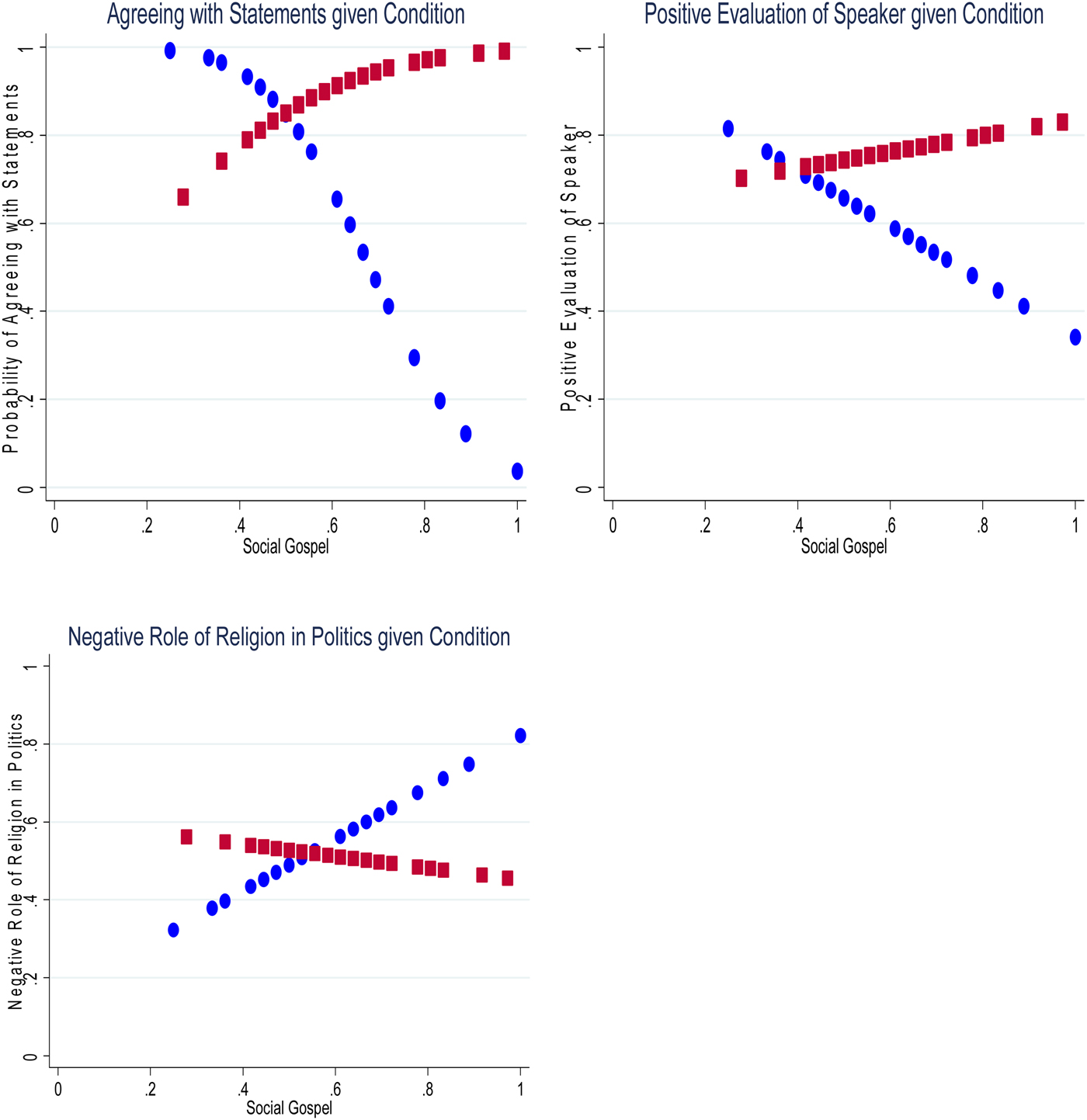
As expected, those who adhere to the Social Gospel have a positive evaluation of the speaker in the equality treatment and a negative evaluation in the individualism treatment (see Figure 4). Further, these coefficients are statistically distinct from each other. The gap persists in regards to agreement and a negative evaluation of religion's role in politics. A closer examination of the treatments demonstrates that the individual religious condition drives the difference. The Social Gospel is only significant in this condition and its coefficient is significantly larger than the coefficients in the other conditions. Those who ascribe to the Social Gospel have a significantly lower evaluation of the speaker, are more likely to disagree with the message and are significantly more likely to have a negative evaluation of religion's role in politics. The predicted probabilities and values in Figure 4 illuminate this relationship. Those exposed to the individualism religious message are clearly distinct. Skeptics are significantly more likely to agree with the statements, hold a more positive view of the speaker and possess less negative views about the role of religion and politics in the individualism religious condition. Conversely, strong adherents are more likely to disagree with the statements, derogate the speaker and hold a more negative view of religion and politics.
Fitted values and probabilities for evaluation of message, speaker and role of religion in politics given Social Gospel adherence and religious condition

These findings demonstrate a high level of reactance. Adherents of the Social Gospel take a strong stance against those who contradict their belief system. In this example, the best way to prime the Social Gospel is to contradict it. This should be expected, given the hard-fought battle over health care reform. Those who adhere to the Social Gospel may be more attentive to contradictory messages and respond by taking a more intense stance on their issues of importance.
A final point to make in the analysis is that skeptics derogate the speaker significantly less in the equality religious condition than strong adherents in the individual religious condition. The skeptics have about a 60% chance of agreeing with the speaker in the equality religious condition, while strong adherents have a virtually zero percent chance of agreeing with the speaker in the individual religious condition. The evaluation of the speaker further demonstrates the differences in derogation. The skeptics provide the speaker with a positive evaluation around 0.7 in the equality religious condition, while the strong adherents give the speaker an evaluation of 0.33 in the individual religious condition. This further demonstrates the polarizing nature of rhetoric that intertwines religion with individualism. These findings are in line with the findings from Campbell, Green, and Layman (Reference Campbell, Green and Layman2011), Adkins et al. (Reference Adkins, Layman, Campbell and Green2013), and McLaughlin and Wise (Reference McLaughlin and Wise2014) who demonstrate that certain religious cues create visceral reactions.
DISCUSSION
The results from the survey analysis demonstrate the importance of the Social Gospel in public opinion. The Social Gospel was the most reliable religious correlate of attitudes. Traditional measures of belonging, behaving and believing were far less consistent in their association with these attitudes and were only statistically significant on an overtly religious issue, the decline traditional values. Adherence to the Social Gospel is associated with greater support and emphasis on social welfare issues. The Social Gospel is a distinct dimension of religious perspective with separate implications for political attitudes, and by accounting for the multidimensional nature of religious beliefs we are able to provide greater insight into why religious people may take two sides of an issue.
The results from the experiment did not provide compelling support that the Social Gospel is an important construct in people's decision making, but the findings may have been obscured by small samples in each experimental condition. The direction of effects suggest that sending a message that intertwines religion and egalitarianism may have persuasive power, but further research will be necessary to determine if these are significant differences. The evidence suggests that the Social Gospel is chronically salient in these people's minds, so they do not necessarily need to receive a cue from political elite. However, when presented with messages that directly contradict the Social Gospel; they become more intense in their support of their policies. While this phenomenon may have been a consequence of the health reform debate, the intensity of the response indicates that the group was aware of those whose religious ideology opposes theirs.
Further, this analysis demonstrates the risk elites take when evoking these appeals. Elites who intertwine individualism with religion face a great deal of hostility from adherents of the Social Gospel. In contrast, those who intertwine egalitarianism and religion face less hostility from skeptics of the Social Gospel. While the persuasion findings are not overwhelmingly clear, the analysis of the speaker demonstrates that elites must be strategic in the use of religious appeals. Certain appeals have a much greater risk of inciting opposition than others.
CONCLUSION
The Social Gospel has long been noted by scholars as an important part of the American religious discourse. While the official movement died out close to 80 years ago, elements of the movement still exist in the rhetoric of religious and political leaders. This was most noticeable in the 2010 passage of health care reform and can currently be seen in the rhetoric of the leaders, such as Rev. William Barber the founder of the Moral Mondays protests in North Carolina (Barber and Wilson-Hartgrove Reference Barber and Wilson-Hartgrove2016). However, this discussion of the Social Gospel has been at the elite level. There has been little systematic examination of this religious belief system's relationship to policy attitudes among ordinary citizens or how elites can use it to persuade. This paper sought to undertake this task by first demonstrating that the concept is readily available in citizen's minds in regards to social policies, specifically health policy. This paper offers evidence that political elites” use of rhetoric that intertwines egalitarianism and religion can be persuasive, specifically to those who are skeptical of the Social Gospel. These findings indicate that the Social Gospel is an important belief system in shaping attitudes. Further, it highlights the myriad of religious interpretations and their role in the American religious discourse and subsequently the political discourse. As the new administration and Congress work to dismantle the Affordable Care Act, counterarguments grounded in the Social Gospel are likely to emerge. The findings here suggest that these arguments can be persuasive.
Along with concerns in religion and politics, the study of the Social Gospel may offer answers to questions plaguing health policy. A major concern in health policy is defining who is sick. Given that illness is a social construct which is open to subjective evaluation (Parsons Reference Parsons1951; Conrad and Schneider Reference Conrad and Schneider1980; Schneider and Ingram Reference Schneider and Ingram1993), the boundaries of illness expand and contract given the prominence of certain belief systems (Morone Reference Morone, Mechanic, Rogut, Colby and Knickman2005). By paying attention to the growth and decline of these beliefs, we can predict the direction of health and other policies.
The framing of these issues as moral issues may shed light on the success and past failures of reform movements. Religion and morality offer fuel for activism; when called upon by a divine force, people are more willing to make sacrifices and stronger demands (Wald and Calhoun-Brown Reference Wald and Calhoun-Brown2007). Framing issues as moral means that they cannot be debated and offers no gray areas. Fueled by a religious zeal, adherents of the Social Gospel may have greater endurance in pursuing their interests than their secular counterparts.
Appendix A
MEASUREMENT OF THE SOCIAL GOSPEL
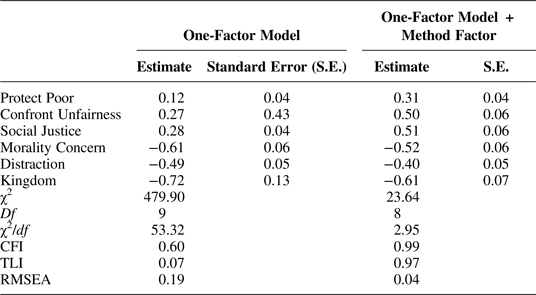
Table A1 provides the results from the confirmatory factor analysis. The poor fit statistics and factor loadings, in the One-Factor Model, indicate that it may be two factors instead of one. This is a common occurrence when incorporating negatively worded items into an index. Because of the nature in which people respond to Likert scaled items they may be some correlated measurement error which produces two factors instead of one. To account for correlated measurement error a common method factor was included in the model (For a detailed discussion of this method see Weisberg, Haynes and Krosnick Reference Weisberg, Haynes, Krosnick and Weisberg1995, 256–8; Nelson Reference Nelson1999, 340–3; Sears, Henry and Kosterman Reference Sears, Henry, Kosterman, Sears, Sidanius and Bobo2000, 376.). The method factor is uncorrelated with the Social Gospel factor and its effects on the observed indicators are constrained to be equal. This construction allows the factor to account for common variance in the observed measures due to question wording and response options. The fit statistics demonstrate that the model fits the data well. The χ2 ratio (2.95) is at an acceptable level (A ratio of 5:1 to 2:1 is within the acceptable range) (Tanaka Reference Tanaka, Bollen and Long1993). The Root Mean Square Error of Approximation (RMSEA), which is at 0.04, demonstrates that this is a good fit to the data (Browne and Cudeck Reference Browne and Cudeck1992). The Comparative Fit Index (CFI) and the Tucker–Lewis Index (TLI), 0.99 and 0.97 respectively, indicate that the appropriateness of the model (Bentler and Bonett Reference Bentler and Bonett1980; Bentler Reference Bentler1990). Finally, an examination of the One-Factor Model + Method Factor column, demonstrates higher factor loadings for the statements that may have been viewed as a bad fit if the method factor was not accounted for.
Results from the analysis of the one factor and the one factor plus method factor confirmatory factor analysis

Ordered probit analysis of support for the affordable care act

Appendix B
Analysis limited to those who identify as Christian

Correlation matrix of Social Gospel, traditional religion measures, and ideology

Appendix C
SCRIPTS FOR EXPERIMENT CONTROL AND TREATMENTS
Control condition
Google demonstrates phone that translates text
BARCELONA, Spain (AP)—Stumped by foreign languages when you're traveling? Google Inc. is working on software that translates text captured by a phone camera.
At a demonstration Tuesday at Mobile World Congress, a cell phone trade show in Barcelona, an engineer shot a picture of a German dinner menu with a phone running Google Inc.’s Android software. An application on the phone sent the shot to Google's servers, which sent a translation back to the phone.
It translated “Fruhlingssalat mit Wildkrautern” as “Spring salad with wild herbs.”
There was no word on when the software would be available.
Software that translates text from pictures is already available for some phones, but generally does the processing on the phone. By sending the image to its servers for processing, Google can apply a lot more computing power, for faster, more accurate results. The phone still won't order for you, though—you'll have to point at the menu.
The demonstration was part of Google CEO Robert Protman's keynote speech at the trade show, the largest for the wireless industry. He said phone applications that take advantage of “cloud computing”—servers accessible through the wireless network—will bring powerful changes to the industry.
Protman's speech also featured a demonstration of videos and a game running on an Android phone using Flash, a format that is ubiquitous on Web pages intended for PCs, but has not worked on many phones, including the iPhone. Support for Flash in Android and a few other smart phone operating systems are expected later this year.
INVIDUALISM CONDITIONS
Foundation Director Addresses Policy Makers
WASHINGTON (AP)—In the keynote address given last Wednesday, Robert Protman, director of the Future of Hope Foundation, gave his vision of what America should be. Speaking to a bi-partisan audience, Mr. Protman argued that the nation should embrace its heritage of individual effort. In particular he argued, “The nation has been its greatest when men and women were willing to step out on their own, take risks, and succeed or fail on their own.”
The Future of Hope Foundation, which is based in Reston, VA, was formed in 1937 to better connect leaders with needs of everyday people. The foundation has worked closely with members from both parties. Mr. Protman, who was named director in 2007, has served as a trusted advisor for both Presidents Bill Clinton and George W. Bush. In his speech, Mr. Protman emphasized the need for the nation to reclaim individual effort. Below is an excerpt from his speech.
We are intelligent people who fail or succeed based on our commitment to work, we do not need government dictating our actions. We must work for ourselves and not expect the government to shield us. Our ability to achieve greatness is in our adherence to a strong work ethic, not dependence on government. As Thomas Jefferson [the Bible] stated, “Lazy hands make a man poor, but diligent hands bring wealth.” Mr. Jefferson [the Bible] also stated “Work hard and become a leader; be lazy and never succeed.” We should heed these words, because they set forth a framework for how this nation and its citizens should behave.
Mr. Protman argued that these sentiments should be widely embraced. Further, he argued that all future policies should reflect individual effort. In his concluding statement, Mr. Protman stated that, “once the nation embraces these values; we will be able to see it reach the highest heights.”
EQUALITY CONDITIONS
Foundation Director Addresses Policy Makers
WASHINGTON (AP)—In the keynote address given last Wednesday, Robert Protman, director of the Future of Hope Foundation, gave his vision of what America should be. Speaking to a bi-partisan audience, Mr. Protman argued that the nation should embrace its heritage of equality. In particular he argued, “The nation has been its greatest when men and women were given the equal opportunity to succeed and fail and not held back because of race, gender, or class.”
The Future of Hope Foundation, which is based in Reston, VA, was formed in 1937 to better connect leaders with needs of everyday people. The foundation has worked closely with members from both parties. Mr. Protman, who was named director in 2007, has served as a trusted advisor for both Presidents Bill Clinton and George W. Bush. In his speech, Mr. Protman emphasized the need for the nation to reclaim equality. Below is an excerpt from his speech.
We are intelligent people who fail or succeed based on our commitment to work, and the willingness of the government to ensure equality. We must work for each other and expect the government to provide equal protection. Our ability to achieve greatness is in our adherence to equal opportunity, not ignoring disparities. As Thomas Jefferson [the Bible] stated, “Defend the cause of the weak and fatherless; maintain the rights of the poor and oppressed.” Mr. Jefferson [the Bible] also stated, “You shall freely open your hand to your brother, to your needy and poor in your land.” We should heed these words, because they set forth a framework for how this nation and its citizens should behave.
Mr. Protman argued that these sentiments should be widely embraced. Further, he argued that all future policies should reflect equality. In his concluding statement, Mr. Protman stated that, “once the nation embraces these values; we will be able to see it reach the highest heights.”
Distribution of the Social Gospel measure given condition

Relationship between Social Gospel and health reform policies given condition