




No CrossRef data available.
Article contents
Evolutionary relationships between 15 Plasmodium species from New and Old World primates (including humans): a 18S rDNA cladistic analysis
Published online by Cambridge University Press: 18 November 2004
Abstract
We present a new phylogenetic analysis of 15 primate Plasmodium species based on 18S rDNA sequences including new sequences of Plasmodium coatneyi, P. fieldi, P. gonderi, P. hylobati and P. simium. The results are discussed in the context of the parasite host species and their geographical distribution. Contrary to other phylogenies constructed with this 18S rDNA molecule, we observed that the topology of phylogenetic trees was not affected either by the quality of the nucleotide matrices, or by the species present in the outgroup. This analysis showed the following. (1) The polyphyly of human Plasmodium is confirmed. (2) The monophyly of Plasmodium from Old World monkeys is confirmed by the new added sequences and P. gonderi, an African species, possibly could be at the root of this group. (3) The most parsimonious biogeographical hypothesis is that P. vivax originated in Asia; thus, its related species P. simium appears to be derived through a transfer from the human P. vivax to New World monkey species in South America. (4) Sampling efforts of non-human primate Plasmodium could permit improvement of the knowledge of primate Plasmodium phylogeny and also consideration of the risks of malaria emergence from monkey reservoirs.
Information
- Type
- Research Article
- Information
- Copyright
- © 2004 Cambridge University Press
INTRODUCTION
Environmental disturbances are creating the opportunities for microbes and parasites to colonize new ecological niches and thus increasing the risk for new pathogens to emerge. In this context, molecular phylogenies are important for understanding the evolution of pathogenicity since they permit determination of whether virulence in a given taxa is genetically inherited. Although sequences of the whole genomes are available for Homo sapiens, Anopheles gambiae and Plasmodium falciparum (Holt et al. 2002; Garner et al. 2002), all involved in the life-cycle of 1 of the 4 human malaria species, the origin of the 4 human Plasmodium spp. is still far from being solved and is controversial (Waters, Higgins & McCutchan, 1991, 1993; Escalante & Ayala, 1994; Quari et al. 1996; Escalante et al. 1997; Rathore et al. 2001). This group of malaria parasites includes at least 172 known species, parasites of birds, reptiles, rodents and primates. Four are human parasites. P. falciparum, which causes acute infections and is responsible for clinical infections in 500 million people and 1·5 million deaths per year, mainly in Sub-Saharan Africa (WHO, 1998). P. vivax and P. ovale cause acute infections and are also implicated in relapsing infections. P. vivax is responsible for 75 million acute episodes per year mainly in Asia and South America (Sina, 2002), while P. ovale is rare. P. malariae is involved in chronic infections that may persist with low parasitaemia for many years without causing true relapses (Carnevale et al. 1984).
Many descriptions of malaria parasites in African and Asian monkeys made during the first half of the 20th century were re-examined. In his book on malaria parasites and other Haemosporidia, Garnham (1966) gave details on primate Plasmodium but, since this work, very few observations have been added. Poirriez et al. (1995) noted that before 1993 only 1 species of Plasmodium (P. gonderi) was known for African monkeys in the Cercopithecidae family; these authors described 2 more species (P. georgesi and P. petersi) in the same primate family.
Currently, 22 species are recognized as non-human primate Plasmodium (Gysin, 1998): 2 species (P. brasilianum1
Taxa available from ATCC (American Type Culture Collection).
In this paper, using a parsimonious cladistic phylogenetic analysis from 18S rDNA sequences, we present a phylogeny of primate Plasmodium including the 10 primate Plasmodium sequences available in GenBank and 5 new primate Plasmodium sequences, P. coatneyi, P. fieldi, P. gonderi, P. hylobati, P. simium. We tested the impact of two matrices of alignment data and of several outgroup species on the phylogenetic results. We also discuss the biogeography and the possible evolution of these parasite taxa as a function of the geographical distribution of their hosts.
MATERIALS AND METHODS
Parasite samples
Several Plasmodium species (P. berghei, P. falciparum, P. vivax) have been found to contain 2 or 3 distinct copies of 18S rDNA genes, expressed in a specific stage of the life-cycle (Gunderson et al. 1987; McCutchan et al. 1988; Li et al. 1997). The A ribosome type occurs in infected erythrocytes and corresponds to the trophozoite stage of the parasite; the S ribosome type occurs in the sporozoite stage, while the O ribosome type occurs in the oocyst stage of the parasite. The 18S rDNA A type (trophozoite stage) sequences are the most available in GenBank and phylogenies were built from this sequence type.
The GenBank accession numbers of 15 sequences (18S rDNA type A) and isolate origins are presented in Table 1. The P. simiovale species (from Macaca sinica), a proximate species to P. vivax could not be supplied by ATCC because of the risk of human infection.
Table 1. Origin and reference numbers (ATCC and GenBank Accession number) of the Plasmodium species (*From, Garnham (1966) and Gysin (1998).)

Although 3 sequences of P. knowlesi have already been published, we sequenced a new one because there were notable differences between the two A type sequences referenced in GenBank (Accession numbers U83876 and U72542). Sequence U83876 was close to 3 sequences of the sporozoite stage (i.e. S type) of P. vivax and may correspond to a sequence of the sporozoite stage of P. knowlesi. For the same reason, we sequenced a new isolate of P. simium. The U69605 sequence referenced in GenBank as a sequence of the trophozoite stage of P. simium was also close to the 3 sequences of the sporozoite stage of P. vivax. We also included the sequence of P. vivax Belem type, which is a reference strain.
DNA isolation and PCR amplification
For the 7 isolates (P. coatneyi, P. fieldi, P. gonderi, P. hylobati, P. knowlesi, P. simium and P. vivax Belem type), DNA was isolated and purified using the QIAamp DNA Blood Kit following the manufacturer's instructions (Qiagen, CA). Amplification of 18S rDNA was performed using 2 genus-specific primers employed by Snounou et al. (1993), which give PCR products around 1050 bp long: rPLU6 5′TTAAAATTGTTGCAGTTAAAACG-3′ and rPLU5 5′CCTGTTTGTTGCCTTAAACTTC-3′. PCR was performed in a reaction mixture of 20 μl containing around 20 ng of genomic DNA, 1X reaction buffer, 2·5 mM MgCl2, 80 μM of each deoxynucleotide triphosphate, 6 pmol of each primer and 1·3U of Taq polymerase (Promega). The amplification cycle involved a denaturation step of 2 min at 94 °C, followed by 35 cycles of denaturation 1 min at 94 °C, 1 min of annealing at 48 °C and 1 min of extension at 70 °C and a final elongation of 2 min. The PCR products were sequenced using an ABI PRISM 377 sequencer (Genaxis, Nîmes, France). The direct sequencing of P. gonderi PCR product produced a mixed sequence of the 2 types of 18S rDNA (trophozoite and sporozoite types). The P. gonderi PCR product was thus cloned into pGEM-Teasy vector (Promega) (Biofidal, Vaulx en Velin, France), previous to sequencing. The P. gonderi sequence was not fully obtained due to the likely presence of a recombinant site causing the loss of the first 300 bp at the 5′ end during the PCR product cloning step. Consequently, the sequences's length used for the phylogenetic analyses was adjusted according to the P. gonderi sequence (689 base pairs).
Phylogenetic analyses
Sequences were aligned using the CLUSTAL X program (Thompson et al. 1997) with editing and management using the MUST package (Philippe, 1993). Sequence alignment was manually improved according to criteria proposed by Barriel (1994) in order to minimize the mutation number and reduce the phylogenetic effects. For the analyses, 2 sequence data sets were taken into account, the whole sequences and only sequences without ambiguous alignments. Alignments are available from the authors on request. The most parsimonious trees were calculated using the heuristic search of PAUP 4 (Swofford, 1999) with simple stepwise addition, TBR (tree bisection-reconnection) branch swapping and branches with maximum length zero collapsed to yield polytomies. Tree robustness was determined in terms of bootstrap (BS) proportions (Felsenstein, 1985) with 10000 replicates. The 3 outgroup species used in the analysis belong to the Apicomplexa phylum to which Plasmodium also belongs: Babesia bovis in the class Hematozoa, the same class as Plasmodium and Sarcocystis fusiformis and Toxoplasma gondii in the class Coccidia. The GenBank Accession numbers of their 18S rDNA sequences are L19077, U03071, U87145 respectively. The data concerning the primate Plasmodium host species and their geographical distribution were obtained from Garnham (1966), Collins & Aikawa (1993), Poirriez et al. (1993) and Gysin (1998).
RESULTS
The total length of the aligned sequences without ambiguous alignments was 584 positions of which 212 were informative for parsimony. The PAUP analysis yielded 3 most parsimonious trees 561 steps in length, with a consistency index of 0·7219 and a retention index of 0·7997. The strict consensus tree is presented in Fig. 1A. The total length of the aligned sequences with all positions was 705 positions of which 319 were relevant for a cladistic analysis. The PAUP analysis yielded 8 most parsimonious trees, 991 steps in length, with a consistency index of 0·6697 and a retention index of 0·7588. No illustration is provided of the whole tree but only of the branch topology (Fig. 1B), which differs from the consensus tree obtained previously (Fig. 1A). Whatever the number of taxa included in the outgroup, the phylogenies obtained were the same.

Fig. 1. (A) Strict consensus tree of the 3 most parsimonious trees obtained from 584 aligned positions of the SSU rDNA of 21 Plasmodium species. In bold the bootstrap values over 70% (based on 10000 replicates). Other numbers on the branches indicate the minimal/maximal number of synapomorphies and autapomorphies according to the optimization of informative sites. (B) Branch topologies characterizing the strict consensus tree obtained with 705 aligned sequences, only topologies that differ from (A) are shown.
Fig. 1A shows the topology of a cladistic tree (i.e. the most parsimonious tree among 3 solutions). Clearly, the rodent Plasmodium species (P. berghei and P. yoelii) are outside all other Plasmodium (with 95% of BS value and 18/39 synapomorphic characters). The primate Plasmodium are polyphyletic and split into 3 major groups. The relative positions of these 3 groups are not resolved (in term of BS value). P. ovale constitutes one of these groups. The second group (80% of BS, and 9/18 synapomorphic characters) includes 7 Plasmodium species (P. coatneyi, P. cynomolgi, P. fieldi, P. gonderi, P. fragile, P. inui, P. knowlesi) infecting Cercopithecidae from Asia except P. gonderi which parasitizes Cercopithecidae from Africa, one Plasmodium species (P. hylobati) infecting Hylobatidae from Asia, and P. vivax human plasmodium which is closely related to P. simium, a species of New World monkeys. Inside this second group, the relative positions of P. fragile, P. gonderi, P. hylobati, P. inui, (P. coatneyi, P. knowlesi), (P. fieldi, P. cynomolgi (P. simium, P. vivax)) are questionable (Fig. 1A and B). The third group (70% of BS and 5/17 synapomorphic characters) includes the 2 human parasites, P. falciparum and P. malariae, related respectively to P. reichenowi (with 100% of BS and 16/22 synapomorphic characters) infecting great apes from Africa, and to P. brasilianum (with 100% of BS and 7/13 synapomorphic characters) infecting New World monkeys. The bird Plasmodium species (i.e. P. gallinaceum, P. juxtanucleare and P. lophurae) and 1 lizard Plasmodium species (i.e. P. mexicanum) are also included in this third group where they constitute a subgroup sustained by 89% of BS value and 12/15 synapomorphic characters. The topology of Fig. 1B is different but the same main groups as in Fig. 1A are respectively resolved and unresolved in terms of BS values, except the positions of the 3 subgroups (P. falciparum-P. reichenowi), (P. malariae-P. brasilianum), (birds and lizard Plasmodium).
Fig. 2 shows the cladistic consensus tree obtained for Plasmodium species (i.e. only bootstrap values over 70% in Fig. 1A were considered), with their host species and their geographical distribution.
Fig. 3 shows the Cercopithecidae phylogeny (Purvis, 1995) and their known Plasmodium parasite species.

Fig. 2. Phylogenetic relationships of 21 Plasmodium lineages. For each Plasmodium species, their host species (primates, birds, lizard or rodents) and their geographical distribution are shown. In the tree, only nodes that were sustained by a BS value over 70% in Fig. 1A are shown.

Fig. 3. Cercopithecidae phylogeny from Purvis (1995) and their known Plasmodium parasite species. Underlined parasite species found in more than one host genus.
DISCUSSION
Surprisingly, the rodent Plasmodium appear in the phylogenetic trees at the root of primate Plasmodium, whereas Quari et al. (1996) and Escalante & Ayala (1994) showed in their phylogenetic trees that these rodent parasites were inside the primate parasites. Indeed, the same results were found by Perkins & Schall (2002) using cytochrome b. The human Plasmodium species are not monophyletic. This result is in accordance with previous results from rDNA sequence phylogenies (Waters et al. 1993; Escalante & Ayala, 1994; Quari et al. 1996) and from cytochrome b phylogenies (Perkins & Schall, 2002; Ricklefs & Fallon, 2002).
From our analysis, P. falciparum and its counterpart species parasites of great apes (i.e. P. reichenowi) do not originate from avian Plasmodium as suggested by Waters et al. (1991, 1993), and the relative position of the 2 subgroups stays unresolved. Indeed, these authors proposed that P. falciparum shares a common ancestor with avian malarial parasites, and that a host switching from avian to human took place at the beginning of agricultural development, when the human habitat was settled 10000 years ago. Perkins & Schall (2002) and Ricklefs & Fallon (2002) in their study on cytochrome b recently showed that parasites of birds and lizards were clearly separated from mammalian parasites.
We produced 5 new sequences of primate Plasmodium. Three of them (P. coatneyi, P. fieldi, P. hylobati) originate from Asian monkeys, 1 of them (P. gonderi) from African monkeys, and P. simium is a New World monkey parasite. They cluster with the Old World monkey Plasmodium. These results are coherent with the results of Waters et al. (1993), Escalante & Ayala (1994), Quari et al. (1996), Perkins & Schall (2002) and Ricklefs & Fallon (2002). The position of P. gonderi, stays here unresolved, while from cytochrome b phylogenies, Escalante et al. (1998), Perkins & Schall (2002) and Ricklefs & Fallon (2002) found that its position was at the root of the Old World monkeys group. However, 24/25 autapomorphic characters distance P. gonderi from other species, which could mean an older origin. Otherwise, for 8 species (P. coatneyi, P. cynomolgi, P. fieldi, P. fragile, P. hylobati, P. inui, P. knowlesi, P. vivax), a recent radiation from a common ancestor could explain the small number of synapomorphic and autapomorphic characters displayed on the phylogenetic tree.
P. vivax appears to be the most recent parasite with P. simium inside a subgroup including P. fieldi and P. cynomolgi, two parasites of Asian Cercopithecidae. This observation argues that the origin of P. vivax would be from Asian Cercopothecidae. Thus, it seems that the most parsimonious hypothesis from a biogeographical point of view is to propose that P. simium (parasite of New World monkeys) derives from P. vivax rather than the reverse solution as previously discussed by Escalante, Barrio & Ayala (1995). However, we cannot exclude a molecular convergence of 18S rDNA sequences for geographically distant Plasmodium. Li et al. (2001) found differences in 18S rDNA sequences of sporozoite type between P. vivax originating from the Old and New World, but no difference between P. simium, P. cynomolgi and Old World P. vivax. Carter (2003) supporting Li et al. (2001), proposed that P. vivax was introduced to the Americas twice on separate occasions: first by pre-Columbian human migration from Asia and secondly during the period of the European conquest, in which case P. simium would originate from the first entrance of P. vivax in the Americas while the New World P. vivax would date from the European arrival. In the same way, P. brasilianum, which displayed a sequence close to that of P. malariae, could also originate from a parasite transfer from humans to New World monkeys, but our phylogenetic analysis did not allow us to discuss this evolutionary scenario. Fandeur et al. (2000) proposed that monkeys of the rainforest in French Guiana are reservoirs for P. brasilianum/P. malariae. Generally, it is agreed that zoonose does exist and that Wild primates could represent a reservoir for human pathogens (Wolfe et al. 1998), but with the example of the pair P. vivax–P. simium, it seems that anthroponose should be considered.
Otherwise, it appears that only 4 Cercopithecidae genera are parasitized by Plasmodium species. Eight Plasmodium species parasitize the Asian genus Macaca (i.e. a genus including 16 species with very wide geographical distribution, Groves, 1993). The three Cercopithecidae genera from Asia (i.e. Pygathrix, Simias and Nasalis), were never found to be parasitized, but are comparatively less diversified in terms of species richness than the Macaca genus (Groves, 1993). Surprisingly, in Africa, the Cercopithecus genus, which includes 20 species with wide geographical distribution (Groves, 1993) appears never to have been parasitized whereas the Cercocebus genus (i.e. only 3 species) is parasitized by 3 Plasmodium species. Some species may have associated parasites, but we have not yet identified the parasites. Sampling efforts might improve our knowledge of primate Plasmodium phylogeny and by this way, the lemur Plasmodium species could show new light on this. Likewise, we have no information on the evolutionary relationships between the two type species found in Pongo pygmaeus of South Asia (i.e. P. pitheci and P. silvaticum) and other primate Plasmodium species.
In conclusion, three remarks could be made. (i) Once more, a phylogenetic study cannot permit any statement about an African origin of primate malaria. We only observe that the African rodent Plasmodium are located at the root of the primate parasite phylogeny. Inside the primate Plasmodium, the phylogenetic relationships remain unresolved for deep branching patterns. The P. gonderi position in the clade of Old World monkey Plasmodium could not be resolved but the high number of autapomorphic characters, another significant phylogenetic character, is in favour of a deep branching of this taxon in the clade. (ii) The investigation gap in the sampling of monkey Plasmodium appears to be one of the principal reasons why the phylogenetic knowledge of primate Plasmodium is so limited. (iii) Given the opportunity for lateral transfers in the Plasmodium genus as illustrated by P. vivax–P. simium, the emergence of new virulent Plasmodium taxa in humans from wildlife and vice versa constitutes a real possibility.
We would like to thank Dr Peter David who provided purified DNA of P. vivax from the Belem strain, Dr Benedicte Lafay and Professor Colette Merigot for revision of the English version. This work was supported by CNRS (Centre National de la Recherche Scientifique) and IRD (Institut de Recherche pour le Développement) grants and by VIVANIS European program.
References
REFERENCES
BARRIEL, V. (
1994).
Phylogénies moléculaires et insertions-délétions de nucléotides.
C.R.A.S. Paris, Sciences Vie/Life Sciences
317,
693–701.Google Scholar
CARNEVALE, P.,
BAUDON, D.,
MOLEZ, J. F. &
GUIGUEMDE, T. R. (
1984).
Aspects classiques et modernes des cycles de développement des plasmodiums humains.
Etudes Médicales
2,
61–78.Google Scholar
CARTER, R. (
2003).
Speculations on the origins of Plasmodium vivax malaria.
Trends in Parasitology
19,
214–219.CrossRefGoogle Scholar
COLLINS, W. E. &
AIKAWA, M. (
1993).
Plasmodia of nonhuman primates. In
Parasitic Protozoa
(ed. Kreier, J. P.), Vol. 5, pp.
105–133.
Academic Press,
New York.
ESCALANTE, A. A. &
AYALA, F. J. (
1994).
Phylogeny of the malarial genus Plasmodium, derived from rRNA gene sequences.
Proceedings of National Academy of the Sciences, USA
91,
11373–11377.CrossRefGoogle Scholar
ESCALANTE, A. A.,
BARRIO, E. &
AYALA, F. J. (
1995).
Evolutionary origin of human and primate malarias: evidence from the circumsporozoite protein gene.
Molecular Biology and Evolution
12,
616–626.Google Scholar
ESCALANTE, A. A.,
GOLDMAN, I. F.,
DE RIJK, P.,
DE WACHTER, R.,
COLLINS, W. E.,
QARI, S. H. &
LAL, A. A. (
1997).
Phylogenetic study of the genus Plasmodium based on the secondary structure-based alignment of the small subunit ribosomal RNA.
Molecular and Biochemical Parasitology
90,
317–321.CrossRefGoogle Scholar
ESCALANTE, A. E.,
FREELAND, D. E.,
COLLINS, W. E. &
LAL, A. A. (
1998).
The evolution of primate malaria parasites based on the gene encoding cytochrome b from the linear mitochondrial genome.
Proceedings of the National Academy of Sciences, USA
95,
8124–8129.CrossRefGoogle Scholar
FANDEUR, T.,
VOLNEY, B.,
PENEAU, C. &
de THOISY, B. (
2000).
Monkeys of the rainforest in French Guinea are natural reservoirs for P. brasilianum/P. malariae malaria.
Parasitology
120,
11–21.Google Scholar
FELSENSTEIN, J. (
1985).
Confidence limits on phylogenies: an approach using the bootstrap.
Evolution
39,
783–791.CrossRefGoogle Scholar
GARDNER, M. J.,
HALL, N.,
FUNG, E.,
WHITE, O.,
BERRIMAN, M.,
HYMAN, R. W.,
CARLTON, J. M.,
PAIN, A.,
NELSON, K. E.,
BOWMAN, S.,
PAULSEN, I. T.,
JAMES, K.,
EISEN, J. A.,
RUTHERFORD, K.,
SALZBERG, S. L.,
CRAIG, A.,
KYES, S.,
CHAN, M. S.,
NENE, V.,
SHALLOM, S. J.,
SUH, B.,
PETERSON, J.,
ANGIUOLI, S.,
PERTEA, M.,
ALLEN, J.,
SELENGUT, J.,
HAFT, D.,
MATHER, M. W.,
VAIDYA, A. B.,
MARTIN, D. M.,
FAIRLAMB, A. H.,
FRAUNHOLZ, M. J.,
ROOS, D. S.,
RALPH, S. A.,
McFADDEN, G. L.,
CUMMINGS, L. M.,
SUBRAMANIAN, G. M.,
MUNGALL, C.,
VENTER, J. C.,
CARUCCI, D. J.,
HOFFMAN, S. L.,
NEWBOLD, C.,
DAVIS, R. W.,
FRASER, C. M. &
BARRELL, B. (
2002).
Genome sequence of the human malaria parasite Plasmodium falciparum.
Nature, Genetics
419,
498–511.CrossRefGoogle Scholar
GARNHAM, P. C. C. (
1966).
Malaria Parasites and Other Haemosporidia.
Blackwell Scientific Publications,
Oxford.
GROVES, C. P. (
1993).
Order Primates. In
Mammal Species of the World: A Taxonomic and Geographic Reference
(ed. DonWilson, E. & Reeder, D. M.), pp.
243–277.
Smithsonian Institution Press,
Washington, D.C.
GUNDERSON, J. H.,
SOGIN, M. L.,
WOLLETT, G.,
HOLLINGDALE, M.,
de la CRUZ, V. H.,
WATERS, A. P. &
McCUTCHAN, T. F. (
1987).
Structurally distinct, stage-specific ribosomes occur in Plasmodium.
Science
238,
933–937.CrossRefGoogle Scholar
GYSIN, J. (
1998).
Animal models: primates. In
Malaria: Parasite Biology, Pathogenesis and Protection
(ed. Sherman, I. W.), pp.
419–441.
ASM Press,
Washington, DC.
HOLT, R. A.,
SUBRAMANIAN, G. M.,
HALPERN, A.,
SUTTON, G. G.,
CHARLAB, R.,
NUSSKERN, D. R.,
WINCKER, P.,
CLARK, A. G.,
RIBEIRO, J. M.,
WIDES, R.,
SALZBERG, S. L.,
LOFTUS, B.,
YANDELL, M.,
MAJOROS, W. H.,
RUSCH, D. B.,
LAI, Z.,
KRAFT, C. L.,
ABRIL, J. F.,
ANTHOUARD, V.,
ARENSBURGER, P.,
ATKINSON, P. W.,
BADEN, H.,
de BERARDINIS, V.,
BALDWIN, D.,
BENES, V.,
BIEDLER, J.,
BLASS, C.,
BOLANOS, R.,
BOSCUS, D.,
BARNSTEAD, M.,
CAI, S.,
CENTER, A.,
CHATURVERDI, K.,
CHRISTOPHIDES, G. K.,
CHRYSTAL, M. A.,
CLAMP, M.,
CRAVCHIK, A.,
CURWEN, V.,
DANA, A.,
DELCHER, A.,
DEW, I.,
EVANS, C. A.,
FLANIGAN, M.,
GRUNDSCHOBER-FREIMOSER, A.,
FRIEDLI, L.,
GU, Z.,
GUAN, P.,
GUIGO, R.,
HILLENMEYER, M. E.,
HLADUN, S. L.,
HOGAN, J. R.,
HONG, Y. S.,
HOOVER, J.,
JAILLON, O.,
KE, Z.,
KODIRA, C.,
KOKOZA, E.,
KOUTSOS, A.,
LETUNIC, I.,
LEVITSKY, A.,
LIANG, Y.,
LIN, J. J.,
LOBO, N. F.,
LOPEZ, J. R.,
MALEK, J. A.,
McINTOSH, T. C.,
MEISTER, S.,
MILLER, J.,
MOBARRY, C.,
MONGIN, E.,
MURPHY, S. D.,
O'BROCHTA, D. A.,
PFANNKOCH, C.,
QI, R.,
REGIER, M. A.,
REMINGTON, K.,
SHAO, H.,
SHARAKHOVA, M. V.,
SITTER, C. D.,
SHETTY, J.,
SMITH, T. J.,
STRONG, R.,
SUN, J.,
THOMASOVA, D.,
TON, L. Q.,
TOPALIS, P.,
TU, Z.,
UNGER, M. F.,
WALENZ, B.,
WANG, A.,
WANG, J.,
WANG, M.,
WANG, X.,
WOODFORD, K. J.,
WORTMAN, J. R.,
WU, M.,
YAO, A.,
ZDOBNOV, E. M.,
ZHANG, H.,
ZHAO, Q.,
ZHAO, S.,
ZHU, S. C.,
ZHIMULEV, I.,
COLUZZI, M.,
della TORRE, A.,
ROTH, C. W.,
LOUIS, C.,
KALUSH, F.,
MURAL, R. J.,
MYERS, E. W.,
ADAMS, M. D.,
SMITH, H. O.,
BRODER, S.,
GARDNER, M. J.,
FRASER, C. M.,
BIRNEY, E.,
BORK, P.,
BREY, P. T.,
VENTER, J. C.,
WEISSENBACH, J.,
KAFATOS, F. C.,
COLLINS, F. H. &
HOFFMAN, S. L. (
2002).
The genome sequence of the malaria mosquito Anopheles gambiae.
Science
298,
129–149.CrossRefGoogle Scholar
LI, J.,
GUTELL, R. R.,
DAMBERGER, S. H.,
WIRTZ, R. A.,
KISSINGER, J. C.,
ROGERS, M. J.,
SATTABONGKOT, J. &
McCUTCHAN, T. F. (
1997).
Regulation and trafficking of three distinct 18S ribosomal RNAs during development of the malaria parasite.
Journal of Molecular Biology
269,
203–213.CrossRefGoogle Scholar
LI, J.,
COLLINS, W. E.,
WIRTZ, R. A.,
RATHORE, D.,
LAL, A. &
McCUTCHAN, T. F. (
2001).
Geographic subdivision of the range of the malaria parasite Plasmodium vivax.
Emerging Infectious Diseases
7,
35–42.CrossRefGoogle Scholar
McCUTCHAN, T. F.,
de la CRUZ, V. F.,
LAL, A. A.,
GUNDERSON, J. H.,
ELWOOD, H. J. &
SOGIN, M. L. (
1988).
Primary sequences of two subunit ribosomal RNA genes from Plasmodium falciparum.
Molecular and Biochemical Parasitology
28,
63–68.CrossRefGoogle Scholar
PERKINS, S. L. &
SCHALL, J. J. (
2002).
A molecular phylogeny of malaria parasites recovered from cytochrome b gene sequences.
Journal of Parasitology
88,
972–978.CrossRefGoogle Scholar
PHILIPPE, H. (
1993).
MUST: a computer package of Management Utilities for Sequences and Trees.
Nucleic Acids Research
21,
5264–5272.CrossRefGoogle Scholar
POIRRIEZ, J.,
DEI-CAS, E.,
DUJARDIN, L. &
LANDAU, I., (
1995).
The blood-stage of Plasmodium georgesi, P. gonderi and P. petersi: course of untreated infection in their natural hosts and additional morphological distinctive features.
Parasitology
111,
547–554.Google Scholar
PURVIS, A. (
1995).
A composite estimate of primate phylogeny.
Philosophical Transactions of the Royal Society of London, B
348,
405–421.CrossRefGoogle Scholar
QARI, S. H.,
SHI, Y. P.,
PIENIAZEK, N. J.,
COLLINS, W. E. &
LAL, A. A. (
1996).
Phylogenetic relationships among the malaria parasites based on small subunit rRNA gene sequences: monophyletic nature of the human malaria parasite, Plasmodium falciparum.
Molecular Phylogenetics and Evolution
6,
157–165.CrossRefGoogle Scholar
RATHORE, D.,
WAHL, A. M.,
SULLIVAN, M. &
McCUTCHAN, T. F. (
2001).
A phylogenetic comparison of gene trees constructed from plastid mitochondrial and genome DNA of Plasmodium species.
Molecular and Biochemical Parasitology
114,
89–94.CrossRefGoogle Scholar
RICKLEFS, R. E. &
FALLON, S. M. (
2002).
Diversification of host switching avian malaria parasites.
Proceedings of the Royal Society of London, B
269,
885–892.CrossRefGoogle Scholar
SINA, B. (
2002).
Focus on Plasmodium vivax.
Trends in Parasitology
18,
287–289.CrossRefGoogle Scholar
SNOUNOU, G.,
VIRIYAKOSOL, S.,
ZHU, X. P.,
JARRA, W.,
PINHEIRO, L.,
do ROSARIO, V. E.,
THAITHONG, S. &
BROWN, K. N. (
1993).
High sensitivity of detection of human malaria parasites by the use of nested polymerase chain reaction.
Molecular and Biochemical Parasitology
61,
315–320.CrossRefGoogle Scholar
SWOFFORD, D. L. (
1999).
PAUP: Phylogenetic Analysis Using Parsimony (and other Methods), Version 4.
Sinauer,
Sunderland,
Massachusetts.
THOMPSON, J. D.,
GIBSON, T. J.,
PLEWNIAK, F.,
JEANMOUGIN, F. &
HIGGINS, D. G. (
1997).
The clustal X windows interface: flexible strategies for multiple sequence alignment aided by quality analysis tools.
Nucleic Acids Research
25,
4876–4882.CrossRefGoogle Scholar
WATERS, A. P.,
HIGGINS, D. G. &
McCUTCHAN, T. F. (
1991).
Plasmodium falciparum appears to have arisen as a result of lateral transfer between avian and human hosts.
Proceedings of the National Academy of Sciences, USA
88,
3140–3144.CrossRefGoogle Scholar
WATERS, A. P.,
HIGGINS, D. G. &
McCUTCHAN, T. F. (
1993).
Evolutionary relatedness of some primate models of Plasmodium.
Molecular Biology and Evolution
10,
914–923.Google Scholar
WOLFE, N. D.,
ESCALANTE, A. A.,
KARESH, W. B.,
KILBOURN, A.,
SPIELMAN, A. &
LAL, A. A. (
1998).
Wild primate population in emerging infectious disease research: the missing link?
Emerging Infectious Diseases
4,
149–158.Google Scholar
WORLD HEALTH ORGANIZATION (
1998).
Malaria. Unpublished document. Available from http://www.Who.ch/.

Table 1. Origin and reference numbers (ATCC and GenBank Accession number) of the Plasmodium species
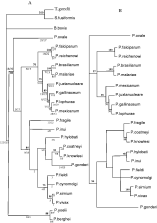
Fig. 1. (A) Strict consensus tree of the 3 most parsimonious trees obtained from 584 aligned positions of the SSU rDNA of 21 Plasmodium species. In bold the bootstrap values over 70% (based on 10000 replicates). Other numbers on the branches indicate the minimal/maximal number of synapomorphies and autapomorphies according to the optimization of informative sites. (B) Branch topologies characterizing the strict consensus tree obtained with 705 aligned sequences, only topologies that differ from (A) are shown.
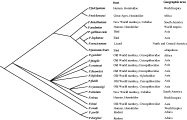
Fig. 2. Phylogenetic relationships of 21 Plasmodium lineages. For each Plasmodium species, their host species (primates, birds, lizard or rodents) and their geographical distribution are shown. In the tree, only nodes that were sustained by a BS value over 70% in Fig. 1A are shown.
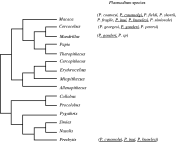
Fig. 3. Cercopithecidae phylogeny from Purvis (1995) and their known Plasmodium parasite species. Underlined parasite species found in more than one host genus.
 You have
Access
- 57
- Cited by