Kefir is a dairy product obtained by fermentation of milk with kefir grains. Kefir grains are clusters of micro-organisms that include primarily lactic acid bacteria (lactobacilli, lactococci, leuconostoc), yeasts and acetic acid bacteria held together in a matrix of polysaccharides and proteins (Angulo et al. Reference Angulo, Lopez and Lema1993; Garrote et al. Reference Garrote, Abraham and De Antoni2001). Several health-promoting properties are associated to kefir consumption; indeed, in vitro and animal trials showed that kefir and its constituents could have anticarcinogenic, antimutagenic, antiviral and antimicrobial properties (Garrote et al. Reference Garrote, Abraham and De Antoni2000; Farnworth, Reference Farnwoth2005).
The interactions between different micro-organisms in kefir grains may contribute to the maintenance of grain structure and composition over time. In this process, ionic or Coulombic interactions, hydrogen bonding, hydrophobic effect or microbial surface macromolecules such as (glyco)proteins and polysaccharides could be involved.
Yeast surfaces have three major cell wall components, namely glucans, mannans, and chitin, all of which may play a role in coaggregation and coadhesion events (Chaffin et al. Reference Chaffin, Lopez-Ribot, Casanova, Gozalbo and Martinez1998; Millsap et al. Reference Millsap, Van Der Mei, Bos and Busscher1998). Mannans form a capsule-like structure on the yeast cell surface and bacteria may associate with sugars in this capsule by means of a lectin-like activity (Millsap et al. Reference Millsap, Van Der Mei, Bos and Busscher1998).
Our workgroup isolated several S-layer carrying Lactobacillus kefir (Lb. kefir) strains from kefir grains. These strains showed differences in surface and probiotic properties such as adhesion to Caco-2 cells, bile salts resistance and inhibitory power against intestinal pathogens in vitro assays (Garrote et al. Reference Garrote, Abraham and De Antoni2001, Reference Garrote, Delfederico, Bibiloni, Abraham, Pérez, Semorile and De Antoni2004; Golowczyc et al. Reference Golowczyc, Mobili, Garrote, Abraham and De Antoni2007).
To gain insight into the nature of the interactions between microorganisms present in kefir grains, we characterized surface components of Lb. kefir involved in the interaction with Saccharomyces lipolytica cells.
Materials and Methods
Strains and media
Yeast and lactobacilli used in this study were isolated from kefir grains (Garrote et al. Reference Garrote, Abraham and De Antoni2001). Lactobacillus kefir strains (CIDCA 8310, 8314, 8315, 8317, 8319, 83110, 83111, 83113, 83115, 83116, 8321, 8325, 8326, 8332, 8335, 8343, 8344, 8345, 8347 and 8348) and Saccharomyces lipolytica CIDCA 812 were cultured in MRS broth (Biokar Diagnostics, Beauvais, France) at 30°C for 48 h.
Surface proteins extraction
Surface protein extraction from Lb. kefir with 5 m-LiCl was performed according to Golowczyc et al. (Reference Golowczyc, Mobili, Garrote, Abraham and De Antoni2007). Extraction with SDS was performed using the same experimental procedure with 2% (w/v) SDS (Sigma Chemical Co., USA) in a proportion of 4 ml of solution per ml of bacterial suspension.
Scanning electron microscopy
Samples for scanning electron microscopy (SEM) were collected by centrifugation (6000 g for 10 min) and fixed by incubation in 2·5% (v/v) glutaraldehyde containing phosphate buffer for 90 min at 4°C. Then, samples were dehydrated gradually by successive passage through 10 to 100% (v/v) ethanol. Samples were placed on isoamylate and dried in a critical-point drying apparatus in liquid CO2 (Baltec CP-30). Specimens were sputter coated with gold and examined in a JSM-T 100 (Jeol Ltd, Japón) scanning electron microscope at an accelerating voltage of 20 kV (Bibiloni et al. Reference Bibiloni, Perez, Garrote, Disalvo, De Antoni and Doyle2001).
Aggregation assays
Lactobacilli or yeasts were harvested by centrifugation (10 000 g for 10 min), washed twice and resuspended in 0·5 m-phosphate buffer (pH 7·2). Aggregation assays were performed at 20–25°C in 0·5 m-phosphate buffer (pH 7·2) unless indicated. In all experiments the initial concentration of microorganisms was standardized to OD550 nm=1 approximately. One milliliter lactobacilli suspension and 1 ml yeast suspension were added in glass test tubes. Optical density at 550 nm was measured in a spectrophotometer (Spectronic 20D+, Thermo Scientific, Waltham, MA, US) at regular intervals without disturbing the microbial suspension. Percentage of co-aggregation (% C) was calculated as:

where ODi is the initial optical density of the microbial suspension and ODt is the optical density at t time (Golowczyc et al. Reference Golowczyc, Mobili, Garrote, Abraham and De Antoni2007).
In order to identify the structures involved in co-aggregation process, assays were performed after thermal (100°C in a boiling water bath for 10 min) or protease (2·5 mg ml−1 proteinase K, trypsin or chymotrypsin, obtained from Sigma Chemical Co., in 0·05 m-Tris-HCl buffer, 0·1 m-NaCl, pH 8, at 37°C for 1 h, followed by enzyme inactivation with bovine fetal serum and washing) bacterial treatments. Co-aggregation assays were also performed after the extraction of S-layer (as indicated above) or in presence of 0·024 mg ml−1 S-layer protein from Lb. kefir.
To study the nature of these interactions, co-aggregation assays were performed in 0·5 m-phosphate buffer at different pHs (3 or 10), or in 0·5 m-phosphate buffer (pH 7·2) added with 0·1 m-sugar (mannose, fructose, sucrose or glucose, obtained from Sigma) or after yeast treatment with 0·05 m-sodium periodate at 37°C for 30 min.
Haemagglutination assay
Haemagglutination activity was studied in U-bottom microtitre plates (Nunc, Roskilde, Denmark). Bacterial cells were washed twice with 0·5 m-phosphate buffer and resuspended in the same buffer to an OD550 nm=3. Twenty-five microliters of two-fold serial dilutions of bacterial suspensions were mixed with 25 μl 2% human erythrocytes suspension. After incubation for 1 h at room temperature, the haemagglutination was observed and confirmed by microscopic observation of the erythrocyte clusters stabilized by bacterial bridges (Bibiloni et al. Reference Bibiloni, Perez, Garrote, Disalvo, De Antoni and Doyle2001).
Statistical analysis
Differences in percentage of co-aggregation were statistically tested by using Analysis of Variance (ANOVA) to determine any significant difference between effects and/or interactions at P⩽0·05 (SYSTAT software, version 2.1).
Results
Lactobacilli-Yeast interaction
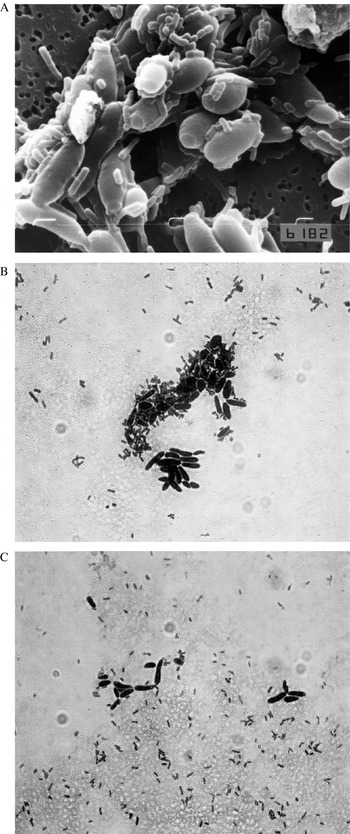
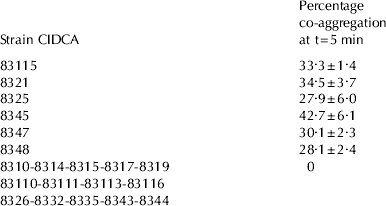
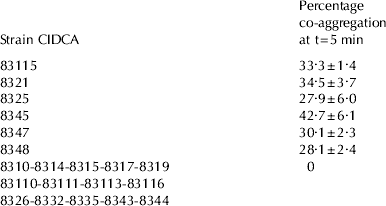
Interaction between Lb. kefir and Sacch. lipolytica CIDCA 812 isolated from kefir grains was studied and percentages of co-aggregation (% C) of 20 different lactobacilli strains with the yeast were calculated. Only six Lb. kefir strains had the ability to co-aggregate with the yeast under study (Table 1). As an example, Fig 1 shows the microscopic aspect of a coaggregating strain and a non coaggregating one. A tight surface interaction between Lb. kefir CIDCA 8321 and Sacch. lipolytica CIDCA 812 was observed by scanning electron microscopy (Fig 1A). Optical microscopy showed bigger clumps in co-aggregating mixtures than in non-co-aggregating ones (Fig 1B & C).
Scanning electron micrographs of Lb. kefir CIDCA 8321 and Sacch. lipolytica CIDCA 812 (5000×) (A). Optical microscopy (Gram staining) of the same suspension (1000×) (B). Optical microscopy (Gram staining) of Lb. kefir CIDCA 83113 and Sacch. lipolytica CIDCA 812 (C).

Co-aggregation of Lb. kefir with Sacch. lipolytica
Values are means±sd for at least n=3
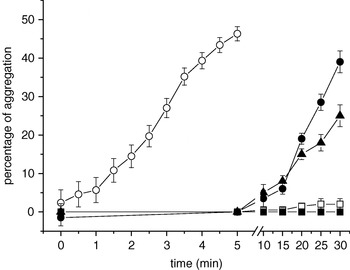
In standardized conditions microbial co-aggregating mixtures showed a high percentage of aggregation (Fig 2). It is important to point out that co-aggregation takes place in a short time in which no aggregation of individual microorganisms is observed.
Co-aggregation assays of Sacch. lipolytica CIDCA 812 with Lb. kefir CIDCA 8321(○) or CIDCA 83113 (□). Auto-aggregation assays of Lb. kefir CIDCA 8321 (•), Lb. kefir CIDCA 83113 (▪), Sacch. lipolytica CIDCA 812 (▴) are also shown.

Role of bacterial surface proteins in lactobacilli-yeast interaction
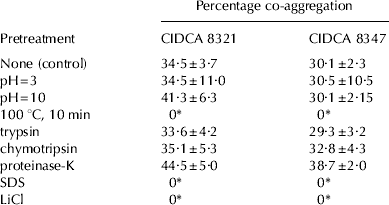
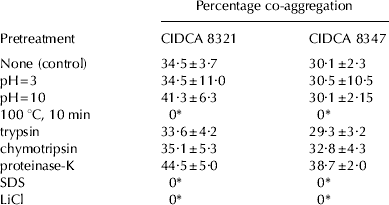
Co-aggregation of Lb. kefir with Sacch. lipolytica was studied before and after different treatments. Heating of bacterial cells at 100°C for 10 min completely inhibited the co-aggregation, while treatment of strains CIDCA 8321 or CIDCA 8347 with three proteolytic enzymes and changes in pH had no effect on co-aggregation (Table 2).
Influence of different pretreatments on Lb. kefir – Sacch. lipolytica interaction
Values are means±sd for at least n=3
* Significantly different from the control (P<0·05)
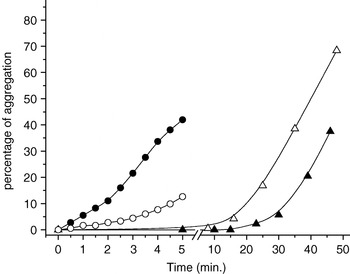
Treatment of Lb. kefir with LiCl or SDS completely eliminates S-layer protein from bacterial cells (Garrote et al. Reference Garrote, Delfederico, Bibiloni, Abraham, Pérez, Semorile and De Antoni2004) and abolished their co-aggregation ability (Table 2). In addition, the co-aggregation of yeast CIDCA 812 with Lb. kefir CIDCA 8321 was diminished when the assay was performed in the presence of extracted Lb. kefir surface proteins (S-layer), whereas the auto-aggregation of the yeast was increased when these proteins were present (Fig 3). Note again that no significant auto-aggregation of the yeast occurs in the period in which co-aggregation takes place.
Aggregation assays in 0·5 m-phosphate buffer (pH 7·2) (solid symbols) and in the same buffer with 0·024 mg ml−1 surface proteins from Lb. kefir 8321 (open symbols). Co-aggregation of Sacch. lipolytica CIDCA 812 and Lb. kefir CIDCA 8321 (•, ○) and auto-aggregation of Sacch. lipolytica CIDCA 812 (▴, ▵).

Evidence for lectin-like activity of bacterial surface protein
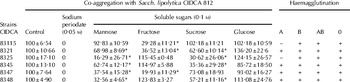
In order to demonstrate a lectin-like activity on the surface of lactobacilli, co-aggregation assays were performed after yeast surface carbohydrate oxidation with periodate or in presence of different sugars (Table 3). The pre-treatment of yeast CIDCA 812 with sodium periodate completely eliminated the co-aggregation with all Lb. kefir studied. The percentage of co-aggregation for strains Lb. kefir CIDCA 8321, 8325, 8345, 8347 y 8348 was significantly lower than control when the assay was performed in the presence of mannose. Presence of fructose inhibited significantly the co-aggregation of Lb. kefir CIDCA 83115, 8321, 8347, whereas the presence of sucrose affected Lb. kefir CIDCA 8321, 8325, 8345 and 8348 co-aggregation. In contrast, glucose had no effect in the co-aggregation on all lactobacilli strains studied (Table 3).
Effect of periodate and soluble sugars in the interaction of Lb. kefir with Sacch. lipolytica (co-aggregation) and ability of Lb. kefir to agglutinate red blood cells (haemagglutination)

* Significantly different from the control (P<0·05)
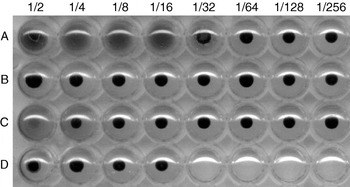
Haemagglutination assay showed that all aggregative Lb. kefir strains studied in this work had the ability to agglutinate with human red blood cells expressing different ABO antigens (Table 3). In addition, this ability was lost after treatment with LiCl and purified S-layer proteins were able to induce the agglutination of human red blood cells. As example, Fig 4 shows the results obtained with Lb. kefir CIDCA 8321. In addition, it is important to point out that purified S layer is able to induce haemaglutination. (Fig 4, line C dilution 1/2)
Haemagglutination in presence of Lb. kefir CIDCA 8321 (A), Lb. kefir CIDCA 8321 treated with 5 m-LiCl (B), purified S-layer from Lb. kefir CIDCA 8321 (C) and control of red blood cells (D).

Discussion
Co-aggregation is a process by which genetically distinct microorganisms become attached one to another via specific molecules. Cumulative evidence suggests that such adhesion influences the development of complex multispecies biofilms (Nikolaev & Plakunov, Reference Nikolaev and Plakunov2007). Kefir grains constitute a natural complex ecosystem in which different microorganims, such as lactic and acetic acid bacteria and yeast, are naturally immobilized into a protein-polysaccharide matrix. Adhesion of microorganims to the matrix and co-aggregation between them could have an important role in the maintenance of the number and species balance in the kefir grain over time. The microorganims attached into the grain probably have advantages over free living microorganisms in reference to the survival in stress conditions such as low pH, low nutrient concentration and sub-optimal temperatures.
In the present work we demonstrate that there is a strong surface interaction between Lb. kefir and Sacch. lipolytica isolated from kefir grains. This interaction is strain-specific since only six out of 20 Lb. kefir strains had the ability to co-aggregate with the selected yeast. Strain specificity was also previously reported by Pretzer et al. (Reference Pretzer, Snel, Molenaar, Wiersma, Bron, Lambert, de Vos, van der Meer, Smits and Kleerebezem2005) for Lb. plantarum strains with different capacity to agglutinate with Sacch. cerevisiae.
Inhibition of co-aggregation after heating of bacteria showed that surface molecules involved in the interaction of Lb. kefir and Sacch. lipolytica CIDCA 812 are thermo-labile, suggesting that proteins act as mediators in the aggregation process.
Garrote et al. (Reference Garrote, Delfederico, Bibiloni, Abraham, Pérez, Semorile and De Antoni2004) described that strains of Lb. kefir isolated from kefir present S-layer, a macromolecular paracrystalline array of proteins that completely cover bacterial cell surface. It has been described that, in lactobacilli, S-layer participates in adherence to extracellular matrix components (Antikainen et al. Reference Antikainen, Anton, Sillanpaa and Korhonen2002; Avall-Jääskeläinen & Palva, Reference Avall-Jääskeläinen and Palva2005; De Leeuw et al. Reference De Leeuw, Li and Lu2006; Jakava-Viljanen & Palva, Reference Jakava-Viljanen and Palva2007) and in interactions with other microorganims (Golowczyc et al. Reference Golowczyc, Mobili, Garrote, Abraham and De Antoni2007). We previously reported that removal of S-layer proteins abolished the autoaggregation capability of Lb. kefir CIDCA 8321 (Garrote et al. Reference Garrote, Delfederico, Bibiloni, Abraham, Pérez, Semorile and De Antoni2004). In the present study the treatment of aggregating Lb. kefir strains with LiCl or SDS drastically diminished percentages of co-aggregation, suggesting an important role for S-layer proteins in bacteria-yeast interaction.
The reduction of co-aggregation percentage observed when Lb. kefir S-layer proteins were added to a mixture of Lb. kefir CIDCA 8321 and Sacch. lipolytica CIDCA 812 showed a competition between free protein and bacterial surface for the attachment to yeast cells. The increasing in aggregation percentage of yeast when purified Lb. kefir S-layer proteins were added to a suspension of Sacch. lipolytica CIDCA 812 provides additional support for the idea of a direct protein-yeast interaction. The failure of the performed proteolytic treatments to inhibit the co-aggregation could be attributed to a high resistance of bacterial S-layer against hydrolysis by proteases, as was previously observed for other S-layers (reviewed in Engelhardt & Peters, Reference Engelhardt and Peters1998).
Roos & Jonsson (Reference Roos and Jonsson2002) described the influence of pH on the affinity of Lb. reuteri surface proteins for carbohydrate structures in mucus and Kos et al. (Reference Kos, Šuškovic, Vukovic, Šimpraga, Frece and Matošic2003) reported a pH dependence in auto-aggregation of Lb. acidophilus. In contrast, in the present work the lack of influence of pH on co-aggregation between Lb. kefir and Sacch. lipolytica suggests that ionic interactions are not involved.
Lectins are proteins or glycoproteins of non-immunological origin that bind to specific carbohydrates. Their first use as cytological tools was for differential binding of human erythrocytes in blood typing (Boyd et al. Reference Boyd and Shapleigh1954) and several works about their role in different types of interactions (bacteria-bacteria, biofilm formation, bacteria-yeast, bacteria-host cell) have been reported (Roos & Jonsson, Reference Roos and Jonsson2002; Tielker et al. Reference Tielker, Hacker, Loris, Strathmann, Wingender, Wilhelm, Rosenau and Jaeger2005; Sun et al. Reference Sun, Le, Shi and Su2007). The role of lectins in haemagglutination phenomena is well known (Mukai et al. Reference Mukai, Kaneko and Ohori1998) and recently Uchida et al. (Reference Uchida, Kinoshita, Kawai, Kitazawa, Miura, Shiiba, Horii, Kimura, Taketomo, Oda, Yajima and Saito2006a) described a surface lectin activity in lactic acid bacteria with the ability to bind to ABO antigens expressed in intestinal mucosa. The ability of the co-aggregating Lb. kefir strains studied in the present work to agglutinate human erythrocytes, together with the loss of this ability in Lb. kefir after removal of S-layer proteins and the ability of purified S-layer protein to induce haemagglutination allowed us to hypothesize that S-layer proteins have a lectin-like activity. The fact that co-aggregation between lactobacilli-yeast was significantly decreased in the presence of different sugars and that yeast pretreated with sodium periodate (which oxidizes surface carbohydrates) became non co-aggregative strongly support our hypothesis. Significant decrease in co-aggregation of five out of six aggregative lactobacilli strains in presence of mannose could be attributed to the presence of mannans in the yeast surface.
Other authors also reported a lectin-like activity of surface proteins in probiotic strains of lactobacilli (Lakhtin et al. Reference Lakhtin, Lakhtin, Pospelova and Shenderov2006) and co-aggregation mediated by bacterial surface peptides and yeast carbohydrates (Ocaña & Nader–Macías, Reference Ocaña and Nader-Macías2002), but to our knowledge a lectin-like activity of S-layer proteins in Lactobacillus genus was only reported by Uchida et al. (Reference Uchida, Kinoshita, Kawai, Kitazawa, Miura, Shiiba, Horii, Kimura, Taketomo, Oda, Yajima and Saito2006b) for Lb. brevis strains with ability to bind to human A-antigen in intestinal mucosa.
The present work is the first report of a strain-specific lectin-like activity of S-layer proteins involved in the interaction between microorganisms. It contributes to the study of the relations among lactobacilli and yeast present in a complex microbial ecosystem as the kefir grain, in particular the co-aggregation of Lb. kefir and Sacch. lypolitica. Taking into account the complexity of this community, further studies are needed to demonstrate the specific role of this kind of interaction in the ecology of the kefir grains and the technological and probiotic properties of kefir-fermented products.
A.G. Abraham, G.L. Garrote and M. A. Serradell are members of the Carrera del Investigador Científico y Tecnológico of CONICET, G.L. De Antoni is a member of the Carrera del Investigador Científico y Tecnológico of CIC-PBA. M. Golowczyc and P. Mobili are fellows of CONICET. This work was supported by Agencia Nacional de Promoción Científica y Tecnológica (ANPCyT), CONICET, CIC-PBA and Universidad Nacional de La Plata (UNLP).