Chlorhexidine gluconate (CHG) bathing prevents bloodstream infections and transmission of multidrug-resistant organisms. Reference Climo, Yokoe and Warren1–Reference Huang, Septimus and Kleinman3 Although widely recommended for use in care of intensive care unit (ICU) patients, Reference Buetti, Marschall and Drees4 CHG bathing across most hospitals is administered without routine monitoring of quality. A prior single-center study of ICU patients found that measurement of patients’ CHG skin concentrations could identify important bathing deficiencies and trigger improvement in bathing quality. Reference Supple, Kumaraswami and Kundrapu5
The aims of our multicenter study were 2-fold: (1) to assess the baseline quality of CHG bathing across geographically diverse ICUs and (2) to assess whether measurement and feedback of patient CHG skin concentrations to ICU leadership could lead to objective improvements in bathing practice. We also explored the impact of CHG formulation on our findings.
Methods
Study population and setting
Patients ≥18 years of age in medical ICUs from 7 academic hospitals were eligible (see Supplementary Material online for participating sites). The median ICU bed capacity was 22 (range, 12–27 beds). At the start of the study, 3 ICUs routinely used 2% CHG-impregnated cloths (Stryker Corporation, Kalamazoo, MI) and 4 ICUs used 4% CHG liquid (Cardinal Health, Dublin, Ohio; Mölnlycke Health Care, Gothenburg, Sweden) either in solution (3 ICUs) or foam (1 ICU). One ICU switched from CHG liquid solution to impregnated cloth between the second and third baseline surveys due to factors independent of the study. Each ICU utilized their hospital CHG bathing protocol (Supplementary Table S1 online).
Study design
We performed a before-and-after quality improvement study involving patients in medical ICUs with routine CHG bathing. The intervention was measurement and feedback of unit-level patient CHG skin concentrations to unit leadership, and we assessed the impact of the intervention on patient CHG skin concentrations over time. Single-day point-prevalence surveys of patient CHG skin concentrations were conducted (3 surveys each during baseline and intervention periods) between January 2018 and February 2019 (Fig. 1).
Timeline of point-prevalence surveys during baseline and intervention periods.

During each point-prevalence survey, trained research staff collected 5×5-cm Reference Bleasdale, Trick, Gonzalez, Lyles, Hayden and Weinstein2 skin swab samples from patients at unilateral anterior neck, axilla, and inguinal body sites using a sterile water-moistened swab (Bio-Swab, Arrowhead Forensics, Lenexa, KS) for each site. Reference Rhee, Palmer and Okamoto6 Swab samples were tested at a central laboratory (Rush University Medical Center) for CHG concentration by laboratory personnel blinded to swab collection characteristics using a previously described semiquantitative colorimetric assay with a step-wise range of detection from 4.9 µg/mL to 20,000 µg/mL. Reference Edmiston, Krepel, Seabrook, Lewis, Brown and Towne7
We assessed the following patient covariates at time of survey: demographic information (age [≥90 years old recorded as 90 years], sex, body mass index), ICU and hospital length of stay, presence of invasive devices (mechanical ventilation via endotracheal tube or tracheostomy; central venous catheter), and receipt of CHG bath prior to swab collection.
During the baseline period, as an adjunctive assessment of CHG bathing quality, each hospital’s local research staff performed direct observation of at least 5 routine CHG baths using a standardized form. Research staff did not provide any real-time feedback but did ask personnel about perceived barriers to bathing.
Intervention period
At the start of the intervention period, local study staff provided aggregate baseline-period results of patient CHG skin concentrations to ICU leadership and staff. Updated unit-level CHG measurements were also fed back to ICU leadership following each subsequent point-prevalence survey (Fig. 1). The time lag between feedback to ICU leadership and next point-prevalence survey was approximately 6–8 weeks. Feedback data included descriptive statistics of patient CHG skin concentrations by body site and proportion of body sites with no detectable CHG (Supplementary Fig. S3 online). Informed by CHG feedback data, leadership in each ICU used routine education and quality improvement activities to optimize adherence to CHG bathing protocols and to improve overall CHG bathing practice. Site-specific activities, such as staff education, were chosen by each ICU and are listed in Supplementary Table S2 (online). Local research staff from each hospital also participated in periodic study-wide conference calls to share data on aggregate CHG patient skin concentrations and ideas for CHG bathing improvement.
Statistical analysis
Patients were included in analysis if ICU length of stay at time of survey was >1 calendar day, to ensure adequate opportunity to receive a CHG bath. CHG concentrations below the limit of detection (ie, <4.9 µg/mL) were coded as 0 µg/mL. Nonparametric tests (Wilcoxon rank-sum test and Kruskal-Wallis test) and χ2 tests were used for simple statistical comparisons. We used multilevel linear models to assess the intervention impact on CHG skin concentrations (which were transformed such that a 1-point change represented a doubling of concentration), accounting for clustering of CHG measurements across body sites within patients and hospitals over time. Models included the terms CHG formulation (cloth versus liquid/foam), time (months relative to start of feedback), and potential clinical confounders (age, presence of central venous catheter, presence of mechanical ventilation, and hours since last CHG bath). Additional potential confounders (ICU and hospital length of stay, sex, and body mass index) were unrelated to CHG skin concentrations and were excluded from subsequent analyses. An interaction of CHG formulation and study period (baseline vs intervention) allowed the testing of differential intervention effects for CHG-impregnated cloth versus liquid/foam formulations. Logistic models to assess the impact of intervention on CHG nondetection were adjusted for CHG formulation and hospital. SAS version 9.4 software (SAS Institute, Cary, NC) was used for all analyses.
The project was evaluated by each institution’s institutional review board and was either deemed exempt or was approved with waiver of informed consent.
Results
Enrollment and demographics
We enrolled 681 (93%) of 736 eligible ICU patients, with an overall mean of 16.2 (standard deviation, 5.1) patients per ICU per survey. Patient demographics and clinical characteristics are shown in Table 1.
Demographic and Clinical Factors for Intensive Care Unit Patients from 7 Hospitals

Data for 681 patients. Note: BMI, body mass index; CHG, chlorhexidine gluconate; ICU, intensive care unit; IQR, interquartile range; SD, standard deviation.
a Units unless otherwise specified.
b Days from admission to swab specimen collection.
Baseline CHG bathing quality
During the baseline period, median CHG skin concentrations varied by body site: neck (9.8 µg/mL; IQR, <4.9–78.1 µg/mL), axilla (19.5 µg/mL; IQR, 4.9–156.3 µg/mL), and inguinal region (39.1 µg/mL; IQR, 9.8–312.5 µg/mL) (P < .001). CHG concentrations on the neck were lower than on both axilla and inguinal regions (P < .001), while no difference was seen between the axilla and inguinal regions (P = .12).
CHG was not detectable on 33% of necks, 19% of axillae, and 18% of inguinal body sites (P < .001 for differences in body sites). Direct observations of routine CHG bathing in a smaller number of patients (n = 37) also confirmed inconsistent CHG bathing practices, with the front of the neck, both axillae, and both inguinal regions not bathed 30%, 40%, and 30% of the time, respectively.
Impact of feedback intervention
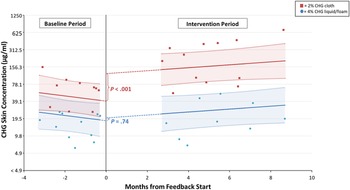
During the intervention period, unadjusted median CHG skin concentrations across all body sites increased for patients regardless of CHG formulation type (Table 2). In adjusted analysis that included an interaction term by CHG formulation, an increase in CHG skin concentrations was observed in ICUs that used CHG-impregnated cloths (3-fold increase in CHG concentration; P = <.001) (Fig. 2), while no significant change in CHG skin concentrations was observed in ICUs that used CHG liquid/foam (P = .74).
Unadjusted Median Chlorhexidine Gluconate Skin Concentration Measurements on Intensive Care Patients during Baseline and Intervention Periods

Note: CHG, chlorhexidine gluconate. Total skin swab specimens obtained = 2,000 (cloths: 1,127; liquid/foam: 873). CHG concentrations below the level of detection (<4.9 µg/mL) were coded as 0 µg/mL for analysis. P values were determined using Wilcoxon rank-sum test.
Modeled chlorhexidine gluconate (CHG) skin concentration measurements on 681 intensive care unit (ICU) patients during baseline and intervention periods. CHG skin concentrations are expressed in means (solid lines) and 95% confidence intervals (dotted lines) on 3 body sites (neck, axilla, inguinal region) combined. The first 3 surveys occurred without any feedback (baseline period), followed by surveys 4–6 during which feedback of CHG skin concentrations and bathing education occurred (intervention period). Month 0 corresponds to the time when the first set of CHG skin concentration results was made available to each ICU for feedback. For ICUs that used 2% CHG-impregnated cloths, there was a 3-fold increase in mean CHG skin concentration between the baseline and intervention periods. This difference was not seen with use of 4% liquid/foam CHG formulations.

CHG skin concentrations on all 3 body sites increased with intervention but varied by body site (P = .02). CHG concentrations on the neck increased about 64% more than CHG skin concentrations on the axilla (P = .004); other pairwise comparisons were not significant. The proportion of patients with no detectable CHG on any body site was not significantly different between the baseline versus feedback period (11.4% vs 6.5%, adjusted P = .21).
Results of analyses did not change significantly when patients admitted to the ICU for <1 day were included (data not shown).
2% CHG-impregnated cloths vs 4% CHG liquid/foam
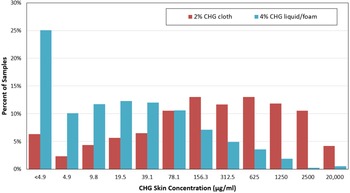
In comparison to patients bathed with CHG liquid/foam, patients bathed with CHG-impregnated cloths had 2-fold higher skin concentrations during the baseline period (P = .01) and 6-fold higher concentrations during the intervention period (P < .001). Analysis of CHG skin concentrations within a single hospital that switched from CHG liquid to CHG-impregnated cloth during the baseline period also demonstrated a 4-fold increase in median CHG skin concentrations (P = .006), consistent with interhospital comparisons. CHG skin concentrations during the intervention period ranged from <4.9 µg/mL to 20,000 µg/mL for patients bathed with either CHG formulation (Fig. 3).
Chlorhexidine gluconate (CHG) skin concentration ranges on intensive care unit (ICU) patients during the intervention period. In total, 599 swab samples were collected for 2% CHG-impregnated cloths and 367 swabs were collected for 4% CHG liquid/foam. Includes all ICU patients who received at least 1 CHG bath during the intervention period.

Discussion
In this multicenter study, CHG skin concentration measurement identified bathing deficiencies, such as missed body sites and patient-to-patient variability, that were otherwise unrecognized during routine infection prevention practice. Feedback of unit-level CHG skin concentrations to ICU leadership provided motivation to improve bathing practices, though objective improvement in CHG skin concentrations varied by CHG formulation used by the ICU.
Our study identified important common CHG bathing deficiencies that would likely impact infection prevention. For example, CHG bathing was often inadequate in the neck area, which is a common site for central venous catheter insertion. Reference Buetti, Marschall and Drees4 Some guidelines for CHG bathing recommend use of CHG “below the jawline” to avoid CHG contact to the eyes and ear canal 8 ; however, many staff misinterpret the instruction by avoiding the neck altogether. Our multicenter study expands on a prior single-center study, Reference Supple, Kumaraswami and Kundrapu5 demonstrating that routine CHG bathing in hospitals is a modifiable activity that can improve with objective measurement and feedback, similar to other activities that fall under infection control surveillance. Reference Gaynes, Richards and Edwards9 Currently, CHG measurement is performed using a published protocol that relies on trained laboratory personnel. Reference Edmiston, Krepel, Seabrook, Lewis, Brown and Towne7 Our proof-of-concept findings provide a rationale for developing a point-of-care assay for CHG skin measurement, to improve accessibility of this testing to more hospitals to reduce hospital-associated infections. Reference Reagan, Chan and Vanhoozer10
Consistent with findings from prior single-center studies of healthy volunteers and patients, we found that CHG formulation (impregnated cloth versus liquid/foam) impacted the levels of CHG skin concentrations achieved Reference Rhee, Palmer and Okamoto6,Reference Alserehi, Filippell and Emerick11 and, furthermore, impacted the modifiability of CHG skin concentrations during quality improvement. Differences in CHG formulation may be related to both intrinsic differences in CHG delivery to the skin and opportunities for practice variability. While CHG-impregnated cloths are manufactured with a standard amount of CHG per cloth and are applied without rinse, the use of CHG liquid formulations varies across hospital protocols by application volume, dilution, skin dwell time, Reference Edmiston, Lee and Krepel12–Reference Borer, Gilad and Porat14 and type of cloth used for application (Supplementary Table S1 online). A no-rinse approach to CHG liquid bathing has been found to achieve CHG skin concentrations comparable to no-rinse CHG-impregnated cloths. Reference Alserehi, Filippell and Emerick11
Notably, the optimal CHG skin concentration for infection prevention is unknown. Microorganism in vitro CHG minimal inhibitory concentrations (MICs) vary, with gram-positive bacteria generally having lower MICs than gram-negative bacteria Reference Kampf15 (eg, the concentration of CHG required to inhibit 90% of methicillin-resistant Staphylococcus aureus strains is estimated at 4 µg/mL, Reference Hayden, Lolans and Haffenreffer16 compared to 64 µg/mL for carbapenem-resistant Klebsiella pneumoniae). Reference Moore, Lolans and Fogg17 Whether a target level of CHG skin concentration is needed to reduce the bioburden of certain skin microorganisms is unclear. Reference Lin, Lolans and Blom18–Reference Miller, Richter and Flores22 A better understanding of the relationship between CHG skin concentrations, in vitro measurement of microbial susceptibility to CHG, and clinical outcomes is needed.
Our study has several limitations. First, while the main intervention was measurement and feedback of CHG skin concentrations to ICU leadership, our study was not prescriptive of, and did not provide funding for, specific bathing improvement interventions. Furthermore, local improvements involved multiple activities, which precluded our ability to analyze the efficacy of any individual component. However, our study demonstrated that measurement and feedback of CHG skin concentrations could be a key impetus for improving CHG bathing quality through routine quality improvement channels, and that these results could be generalizable across multiple hospitals. Second, CHG formulations used by each participating ICU were not randomized; thus, the impact of CHG formulation on our study outcomes may have been confounded by unmeasured ICU-related factors. Our study was not specifically designed to compare differences between CHG formulations, and we were not powered to analyze clinical outcomes such as bloodstream infections. Third, CHG skin concentration measurement was performed in a cross-sectional manner by research staff, leading to between-patient variation in time from CHG bath to CHG skin measurement. We accounted for this variation by adjusting for hours since last CHG bath in our models. Fourth, feedback of CHG skin concentration results were provided in aggregate to ICU leadership, rather than in real time to bathing personnel. Real-time feedback may be more beneficial for practice improvement but would require point-of-care testing that is not currently available. Direct observation of CHG bathing is a possible alternative to CHG skin testing. Lastly, our study had limited follow-up after CHG skin-concentration surveys were completed, and the durability of any single feedback activity is unknown. However, quality surveillance and feedback is generally a continuous process rather than a discrete time-limited activity.
In summary, our study found that CHG bathing performance was variable in routine clinical practice across multiple hospitals, regardless of whether CHG-impregnated cloth or liquid/foam formulations were used. CHG skin measurement and feedback may provide a pathway for hospitals to ensure that a key component of infection prevention is performed optimally.
Supplementary material
To view supplementary material for this article, please visit https://doi.org/10.1017/ice.2023.177
Acknowledgments
We thank the patients as well as the following contributors to this study: Khaled Aboushaala, Candice Cass, Carol Daddio Pierce, Onofre Donceras, Tondria Green, Barbara Gulczynski, Tony James, Sue Johns, Nadia Khan, Thelma Lim, Thelma Majalca, Robert Mielczarek, Renee Partida-McClenic, Simon Tingem, Lahari Thotapalli, and Robert Weinstein. We thank the research microbiology laboratory at Rush University Medical Center. We also thank the administrative staff, research personnel, MICU nursing, staff, and infection preventionists at Brigham and Women’s Hospital, Cook County Health, Duke University Hospital, Penn Presbyterian Medical Center, Rush University Medical Center, University of California Irvine, and Washington University School of Medicine.
Financial support
This study was funded by the Centers for Disease Control and Prevention (Cooperative Agreement no. U54 CK000481).
Competing interests
M.K.H. has been a coinvestigator on several research studies for which Sage Products (now part of Stryker Corporation), Mölnlycke, and Medline provided chlorhexidine products at no charge to hospitals and skilled nursing facilities participating in the research. Neither M.K.H. nor her employer (Rush University Medical Center) received chlorhexidine products. S.G. is a coinvestigator on a study in which participating hospital and nursing homes received contributed antiseptic product from Stryker (Sage Pharmaceuticals), Clorox, Medline, and Xttrium; companies had no role in the design, conduct, analysis, or publication of these studies. C.R. reports royalties from UpToDate, Inc, and consulting fees from Pfizer and Cytovale for topics unrelated to this study. D.W. was a consultant for Mölynlycke Health Care AB after completion of the study. M.Y.L. has received research support in the form of contributed product from Sage Products (now part of Stryker Corporation).