








1. Introduction
A partition λ of a positive integer n is a finite weakly decreasing sequence of positive integers  $\lambda_1\geq\lambda_2\geq\cdots\geq\lambda_r \gt 0$ such that
 $\sum_{i=1}^{r}\lambda_{i}=n$. The numbers λi for
 $1\leq i\leq r$ are called the parts of the partition λ. Such a partition λ is frequently represented by its Ferrers graph (or Young diagram) [Reference Andrews1, Chap. 1.3], which we take to be a left-justified array of square boxes with r rows such that the ith row consists of λi boxes (see Figure 1). This graphical representation of partitions naturally gives rise to further statistics defined on each partition. A notable one is the notion of hook length. Each box ν is assigned a hook, which is composed of the box ν itself as well as boxes to the right of ν and below ν. The hook length of ν is the number of boxes the hook consists of.
Ferrers graph for  $\lambda=(5,4,2,2)$ with hook lengths filled in

For a given  $t\geq2$, a partition λ is called a t-core partition if none of hook lengths is a multiple of t. Let
 $a_t(n)$ denote the number of t-core partitions of n. For any
 $k\geq1$, a partition k-tuple of n is the k-tuple of the form
 $\big(\Lambda_1,\Lambda_2,\ldots, \Lambda_k\big)$, where each
 $\Lambda_i$ for
 $1\leq i\leq k$ is a partition and
 $\Lambda_1+\Lambda_2+\cdots+\Lambda_k=n$. Let
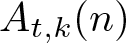
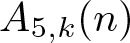
 $A_{t,k}(n)$ denote the number of partition k-tuples of n with t-cores. As usual,
 $A_{t,1}(n)$ is often denoted as
 $a_t(n)$. In 1990, Garvan, Kim and Stanton [Reference Garvan, Kim and Stanton8, Eq. (2.1)] deduced that
 \begin{align}
\sum_{n=0}^\infty a_t(n)q^n=\dfrac{(q^t;q^t)_\infty^t}{(q;q)_\infty},
\end{align}
where here, and in what follows, we always assume that q is a complex number such that  $|q| \lt 1$ and adopt the following customary notation:
 \begin{align*}
(a;q)_\infty:=\prod_{j=0}^\infty(1-aq^j).
\end{align*}
According to (1.1), one easily finds that the generating function of  $A_{t,k}(n)$ is
 \begin{align}
\sum_{n=0}^\infty A_{t,k}(n)q^n=\dfrac{(q^t;q^t)_\infty^{kt}}
{(q;q)_\infty^k},
\end{align}
Garvan, Kim and Stanton [Reference Garvan, Kim and Stanton8, Corollary 1] derived that for any  $n\geq1$ and
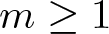
 $m\geq1$,
 \begin{align}
a_t\big(t^mn-(t^2-1)/24\big)\equiv0\pmod{t^m},
\end{align}
where  $t\in\{5,7,11\}$. Since then, many scholars have been successively investigated arithmetic properties for t-core partition functions
 $a_t(n)$; see, for example, [Reference Boylan4–Reference Garvan7, Reference Hirschhorn and Sellers11, Reference Hirschhorn and Sellers12, Reference Radu and Sellers15]. In particular, Granville and Ono [Reference Granville and Ono9] proved some congruences similar to (1.3), namely,
 \begin{align}
a_{5^j}\big(5^jn-\beta_{5,j}\big) &\equiv0\pmod{5^j},
\end{align}
 \begin{align}
a_{7^j}\big(7^jn-\beta_{7,j}\big) &\equiv0\pmod{7^{\lfloor j/2\rfloor+1}},
\end{align}
 \begin{align}
a_{11^j}\big(11^jn-\beta_{11,j}\big) &\equiv0\pmod{11^j},
\end{align}
where  $j\geq1$,
 $n\geq1$ and
 $\beta_{t,j}$ is the least positive integer such that
 $24\beta_{t,j}\equiv1\pmod{t^j}$ for
 $t\in\{5,7,11\}$. Motivated by (1.3)–(1.6), some scholars also considered congruence properties modulo high powers of 5 for
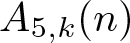
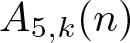
 $A_{5,k}(n)$ with
 $k\geq2$. More precisely, Ranganatha [Reference Ranganatha16, Theorem 8] proved that for any
 $n\geq0$ and
 $m\geq1$,
 \begin{align}
A_{5,2}\big(5^mn+5^m-2\big)\equiv0\pmod{5^m}.
\end{align}
Later, Majid and Fathima [Reference Majid and Fathima14, Theorem 6] proved that for any  $n\geq0$ and
 $m\geq1$ (a typo has been corrected),
 \begin{align}
A_{5,3}\big(5^{m+1}n+5^{m+1}-3\big)\equiv0\pmod{5^m}.
\end{align}
Quite recently, Saikia, Sarma and Talukdar [Reference Saikia, Sarma and Talukdar18] investigated congruence properties modulo powers of 5 for  $A_{5,k}(n)$ with
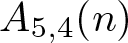
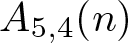
 $k\in\{2,3,4\}$. In particular, they [Reference Saikia, Sarma and Talukdar18, Theorem 11] deduced that for any
 $n\geq0$ and
 $m\geq1$,
 \begin{align}
A_{5,4}\big(5^{m+1}n+5^{m+1}-4\big)\equiv0\pmod{5^{m+4}}.
\end{align}
There are another congruence properties satisfied by  $A_{t,k}(n)$; see, for example, [Reference Baruah and Nath3, Reference Lin13, Reference Ranganatha17, Reference Tang19–Reference Xia22].
For (1.7)–(1.9), it is natural to ask whether there exist some congruence families modulo high powers of 5 for  $A_{5,k}(n)$ with
 $k\geq5$. The following theorem provides an affirmative answer.
Theorem 1.1. For any  $n\geq0$ and
 $m\geq1$,
 \begin{align}
A_{5,4}\big(5^{2m}n+5^{2m}-4\big) &\equiv0\pmod{5^{6m-1}},
\end{align}
 \begin{align}
A_{5,4}\big(5^{2m+1}n+5^{2m+1}-4\big) &\equiv0\pmod{5^{6m}},
\end{align}
 \begin{align}
A_{5,5}\big(5^{m+1}n+5^{m+1}-5\big) &\equiv0\pmod{5^m},
\end{align}
 \begin{align}
A_{5,6}\big(5^{m+1}n+5^{m+1}-6\big) &\equiv0\pmod{5^{m+1}},
\end{align}
 \begin{align}
A_{5,7}\big(5^{m+1}n+5^{m+1}-7\big) &\equiv0\pmod{5^{m+1}},
\end{align}
 \begin{align}
A_{5,8}\big(5^{m+1}n+5^{m+1}-8\big) &\equiv0\pmod{5^m},
\end{align}
 \begin{align}
A_{5,9}\big(5^{m+1}n+5^{m+1}-9\big) &\equiv0\pmod{5^{2m}},
\end{align}
 \begin{align}
A_{5,10}\big(5^{m+1}n+5^{m+1}-10\big) &\equiv0\pmod{5^m},
\end{align}
 \begin{align}
A_{5,11}\big(5^{m+1}n+5^{m+1}-11\big) &\equiv0\pmod{5^{m+1}},
\end{align}
 \begin{align}
A_{5,12}\big(5^{m+1}n+5^{m+1}-12\big) &\equiv0\pmod{5^m},
\end{align}
 \begin{align}
A_{5,13}\big(5^{m+2}n+5^{m+2}-13\big) &\equiv0\pmod{5^m},
\end{align}
 \begin{align}
A_{5,14}\big(5^{m+2}n+5^{m+2}-14\big) &\equiv0\pmod{5^{2m}},
\end{align}
 \begin{align}
A_{5,15}\big(5^{m+2}n+5^{m+2}-15\big) &\equiv0\pmod{5^m},
\end{align}
 \begin{align}
A_{5,16}\big(5^{m+1}n+5^{m+1}-16\big) &\equiv0\pmod{5^m},
\end{align}
 \begin{align}
A_{5,17}\big(5^{m+1}n+5^{m+1}-17\big) &\equiv0\pmod{5^{m+1}},
\end{align}
 \begin{align}
A_{5,18}\big(5^{m+2}n+5^{m+2}-18\big) &\equiv0\pmod{5^m},
\end{align}
 \begin{align}
A_{5,19}\big(5^{m+2}n+5^{m+2}-19\big) &\equiv0\pmod{5^{2m}},
\end{align}
 \begin{align}
A_{5,20}\big(5^{m+2}n+5^{m+2}-20\big) &\equiv0\pmod{5^m},
\end{align}
 \begin{align}
A_{5,21}\big(5^{m+1}n+5^{m+1}-21\big) &\equiv0\pmod{5^m},
\end{align}
 \begin{align}
A_{5,22}\big(5^{m+1}n+5^{m+1}-22\big) &\equiv0\pmod{5^m},
\end{align}
 \begin{align}
A_{5,23}\big(5^{m+2}n+5^{m+2}-23\big) &\equiv0\pmod{5^m},
\end{align}
 \begin{align}
A_{5,24}\big(5^{m+2}n+5^{m+2}-24\big) &\equiv0\pmod{5^{2m}},
\end{align}
 \begin{align}
A_{5,25}\big(5^{m+2}n+5^{m+2}-25\big) &\equiv0\pmod{5^m}.
\end{align}
Remark 1.2. Obviously, (1.10) and (1.11) are two improvements of (1.9). Further, the numerical evidence suggests that the moduli in (1.10)–(1.32) are best possible.
Moreover, we deduce the following internal congruence family modulo high powers of 5 for  $A_{5,4}(n)$.
Theorem 1.3. For any  $m\geq1$ and
 $n\geq0$,
 \begin{align}
A_{5,4}\big(5^{m+2}n+5^{m+2}-4\big)\equiv15625\,A_{5,4}
\big(5^m n+5^m-4\big)\pmod{5^{7m+5}}.
\end{align}
Remark 1.4. The appearance of (1.33) is somewhat surprising. For the other cases in Theorem 1.1, we have not found any similar phenomenon yet.
The rest of this paper is organized as follows. In  $\S$ 2, we first collect a necessary lemma and next establish the exact generating functions of certain infinite sequences involving
 $A_{5,k}(n)$, where
 $4\leq k\leq25$. The proofs of Theorems 1.1 and 1.3 are presented in
 $\S$ 3. Finally, we conjecture that there exists an infinite family of congruences modulo high powers of 5 for
 $A_{5,k}(n)$, where k is a positive integer greater than 25.
2. Generating functions of infinite sequences
In this section, we deduce the exact generating functions of certain infinite sequences involving  $A_{5,k}(n)$, where
 $4\leq k\leq25$. For the sake of convenience, we denote
 \begin{align*}
E(q):=(q;q)_\infty.
\end{align*}
Now, we introduce the following three auxiliary functions, given by
 \begin{align}
\Psi_k=E(q)^{5k-6}E(q^5)^{-k+6},\qquad\zeta=\dfrac{E(q)}{qE(q^{25})},
\qquad\xi=q\dfrac{E(q^5)^6}{E(q)^6}.
\end{align}
Next, for a given Laurant series  $\sum_{n=-\infty}^\infty a(n)q^n$, the U-operator is defined by
 \begin{align*}
U{\left(\sum_{n=-\infty}^\infty a(n)q^n\right)}
=\sum_{n=-\infty}^\infty a(5n)q^n.
\end{align*}
The following lemma is necessary.
Lemma 2.1. Let ζ and ξ be defined as in (2.1). Then for any integer i,
 \begin{align}
U\big(\zeta^{i+5}\big)
&=-5U\big(\zeta^{i+4}\big)-15U\big(\zeta^{i+3}\big)
-25U\big(\zeta^{i+2}\big)-25U\big(\zeta^{i+1}\big)
+\xi^{-1}U\big(\zeta^i\big),
\end{align}
where
 \begin{align}
U\big(\zeta^0\big)=1,\quad U(\zeta)=-1,
\quad U\big(\zeta^2\big)=-1,\quad U\big(\zeta^3\big)=5,
\quad U\big(\zeta^4\big)=-5.
\end{align}
Proof. The first case in (2.3) is obvious, and the remaining four cases in (2.3) follow from [Reference Hirschhorn10, Eq. (6.3.3)] immediately. Moreover, we need the following modular equation of fifth order [Reference Hirschhorn10, Eq. (6.2.14)]:
 \begin{align}
\zeta^5=-5\zeta^4-15\zeta^3-25\zeta^2-25\zeta
+\dfrac{E(q^5)^6}{q^5E(q^{25})^6}.
\end{align}
For a given integer i, multiplying the factor ζ i by both sides of (2.4) and applying the U-operator, we obtain (2.2).
The following theorem is the main ingredient in the proof of Theorem 1.1.
Theorem 2.2. For any  $m\geq1$ and
 $4\leq k\leq25$,
 \begin{align}
\sum_{n=0}^\infty A_{5,k}\big(5^{m+1}n+5^{m+1}-k\big)q^n=I_kM_k^mP_k,
\end{align}
where Ik is a  $1\times k$ integral matrix, Mk is a k × k integral matrix,
 \begin{align*}
P_k=\big(\Psi_k,\Psi_k\xi,\Psi_k\xi^2,\ldots,\Psi_k\xi^{k-1}\big)^T,
\end{align*}
and where  $\Psi_k$ and ξ are defined as in (2.1).
Proof. We first prove that for any  $m\geq1$,
 \begin{align}
\sum_{n=0}^\infty A_{5,14}\big(5^{m+1}n+5^{m+1}-14\big)q^n
=I_{14}M_{14}^mP_{14}.
\end{align}
It follows immediately from (1.2) and (2.1) that
 \begin{align*}
\sum_{n=0}^\infty A_{5,14}(n)q^{n-1}=\dfrac{E(q^5)^{70}}{qE(q)^{14}}
=\dfrac{E(q^5)^{70}}{q^{15}E(q^{25})^{14}}\cdot\zeta^{-14},
\end{align*}
from which we get that
 \begin{align*}
\sum_{n=0}^\infty A_{5,14}(5n+1)q^n=U{\left(\sum_{n=0}^\infty
A_{5,14}(n)q^{n-1}\right)}=\dfrac{E(q)^{70}}{q^3E(q^5)^{14}}
U\big(\zeta^{-14}\big).
\end{align*}
According to (2.2) and (2.3), we find that
 \begin{align}
U\big(\zeta^{-14}\big) &=14\xi^3+3374\times5^2\xi^4
+13566\times5^5\xi^5+17871\times5^8\xi^6\nonumber\\
&\quad+56544\times5^{10}\xi^7+4067\times5^{14}\xi^8
+22596\times5^{15}\xi^9+16121\times5^{17}\xi^{10}\nonumber\\
&\quad+1484\times5^{20}\xi^{11}+427\times5^{22}\xi^{12}
+14\times5^{25}\xi^{13}+5^{27}\xi^{14}.
\end{align}
According to the definition of  $\Psi_k$ and (2.7), we further find that
 \begin{align}
\sum_{n=0}^\infty &\,A_{5,14}(5n+1)q^n\nonumber\\
&=q^{-2}\Psi_{14}\big(14\xi^2+3374\times5^2\xi^3
+13566\times5^5\xi^4+17871\times5^8\xi^5\nonumber\\
&\quad+56544\times5^{10}\xi^6+4067\times5^{14}\xi^7
+22596\times5^{15}\xi^8+16121\times5^{17}\xi^9\nonumber\\
&\quad+1484\times5^{20}\xi^{10}+427\times5^{22}\xi^{11}
+14\times5^{25}\xi^{12}+5^{27}\xi^{13}\big).
\end{align}
For  $0\leq j\leq13$, we deduce that
 \begin{align*}
U\big(q^{-4}\Psi_{14}\xi^j\big)
&=U\big(q^{60-5j}E(q^5)^{6j-8}E(q^{25})^{64-6j}\zeta^{64-6j}\big)\\
&=q^{12-j}E(q)^{6j-8}E(q^5)^{64-6j}U\big(\zeta^{64-6j}\big).
\end{align*}
By (2.2) and (2.3), we obtain that
 \begin{align}
U\big(q^{-4}\Psi_{14}\big) &=\Psi_{14}\big(20496\times5^2
-1167296\times5^5\xi-10771136\times5^7\xi^2 \nonumber\\
&\quad+3904\times5^{14}\xi^3+13240416\times5^{12}\xi^4
+3771264\times5^{15}\xi^5 \nonumber\\
&\quad+2541504\times5^{17}\xi^6+163968\times5^{20}\xi^7
+20496\times5^{22}\xi^8 \nonumber\\
&\quad-5^{31}\xi^{12}\big),
\end{align}
 \begin{align}
U\big(q^{-4}\Psi_{14}\xi\big) &=\Psi_{14}\big({-}1102\times5^2
+2963829\times5^3\xi+5685218\times5^6\xi^2 \nonumber\\
&\quad-1884971\times5^8\xi^3-711892\times5^{12}\xi^4
-202768\times5^{15}\xi^5 \nonumber\\
&\quad-136648\times5^{17}\xi^6-8816\times5^{20}\xi^7
-1102\times5^{22}\xi^8-5^{28}\xi^{11}\big),
\end{align}
 \begin{align}
U\big(q^{-4}\Psi_{14}\xi^2\big) &=\Psi_{14}\big(1274-11648\times5^5\xi
-2855944\times5^5\xi^2-66976\times5^8\xi^3 \nonumber\\
&\quad+823004\times5^{10}\xi^4+234416\times5^{13}\xi^5
+157976\times5^{15}\xi^6 \nonumber\\
&\quad+10192\times5^{18}\xi^7+1274\times5^{20}\xi^8
-5^{25}\xi^{10}\big),
\end{align}
 \begin{align}
U\big(q^{-4}\Psi_{14}\xi^3\big) &=\Psi_{14}\big({-}46+138897\times5^2\xi
+55154\times5^6\xi^2+98417\times5^7\xi^3 \nonumber \\
&\quad-29716\times5^{10}\xi^4-8464\times5^{13}\xi^5
-5704\times5^{15}\xi^6 \nonumber \\
&\quad-368\times5^{18}\xi^7-46\times5^{20}\xi^8
-5^{22}\xi^9\big),
\end{align}
 \begin{align}
U\big(q^{-4}\Psi_{14}\xi^4\big) &=\Psi_{14}\big(1-2576\times5^3\xi
-25716\times5^5\xi^2-96\times5^{10}\xi^3 \nonumber \\
&\quad+646\times5^{10}\xi^4+184\times5^{13}\xi^5+124\times5^{15}\xi^6 \nonumber \\
&\quad+8\times5^{18}\xi^7+4\times5^{19}\xi^8\big),
\end{align}
 \begin{align}
U\big(q^{-4}\Psi_{14}\xi^5\big) &=\Psi_{14}\big(5797\times5\xi
+11594\times5^4\xi^2+5797\times5^6\xi^3-5^{16}\xi^7\big),
\end{align}
 \begin{align}
U\big(q^{-4}\Psi_{14}\xi^6\big) &=\Psi_{14}\big({-}504\times5\xi
-1008\times5^4\xi^2-504\times5^6\xi^3-5^{13}\xi^6\big),
\end{align}
 \begin{align}
U\big(q^{-4}\Psi_{14}\xi^7\big) &=\Psi_{14}\big(209\xi+418\times5^3\xi^2
+209\times5^5\xi^3-5^{10}\xi^5\big),
\end{align}
 \begin{align}
U\big(q^{-4}\Psi_{14}\xi^8\big) &=\Psi_{14}\big({-}16\xi-32\times5^3\xi^2
-16\times5^5\xi^3-5^7\xi^4\big),
\end{align}
 \begin{align}
U\big(q^{-4}\Psi_{14}\xi^9\big) &=\Psi_{14}\big(\xi+2\times5^3\xi^2
+4\times5^4\xi^3\big),
\end{align}
 \begin{align}
U\big(q^{-4}\Psi_{14}\xi^{10}\big) &=-5\Psi_{14}\xi^2,
\end{align}
 \begin{align}
U\big(q^{-4}\Psi_{14}\xi^{11}\big) &=\Psi_{14}\big(2\times5\xi^2+5^3\xi^3\big),
\end{align}
 \begin{align}
U\big(q^{-4}\Psi_{14}\xi^{12}\big) &=\Psi_{14}\big(44\xi^2+176\times5^3\xi^3
+646\times5^5\xi^4+184\times5^8\xi^5 \nonumber \\
&\quad+124\times5^{10}\xi^6+8\times5^{13}\xi^7
+5^{15}\xi^8\big),
\end{align}
 \begin{align}
U\big(q^{-4}\Psi_{14}\xi^{13}\big) &=\Psi_{14}\big(14\xi^2+3374\times5^2\xi^3
+13566\times5^5\xi^4+17871\times5^8\xi^5 \nonumber \\
&\quad+56544\times5^{10}\xi^6+4067\times5^{14}\xi^7
+22596\times5^{15}\xi^8 \nonumber \\
&\quad+16121\times5^{17}\xi^9+1484\times5^{20}\xi^{10}
+427\times5^{22}\xi^{11} \nonumber \\
&\quad+14\times5^{25}\xi^{12}+5^{27}\xi^{13}\big).
\end{align}
Let
 \begin{align*}
L_{14}=\big(U\big(q^{-4}\Psi_{14}\big),U\big(q^{-4}\Psi_{14}\xi\big),
U\big(q^{-4}\Psi_{14}\xi^2\big),\ldots,U\big(q^{-4}\Psi_{14}\xi^{13}\big)
\big)^T.
\end{align*}
From (2.9)–(2.22) we conclude that
 \begin{align}
L_{14}=M_{14}P_{14},
\end{align}
where M 14 is a  $14\times14$ integral matrix, its rows are given by
 \begin{align}
\big( &20496\times5^2,\,-1167296\times5^5,\,-10771136\times5^7,\,
3904\times10^{14},\,13240416\times5^{12}, \nonumber\\
&3771264\times5^{15},\,2541504\times5^{17},\,163968\times5^{20},\,
20496\times5^{22},\,0,\,0,\,0,\,-5^{31},\,0\big),
\end{align}
 \begin{align}
\big( &{-}1102\times5^2,\,2963829\times5^3,\,5685218\times5^6,\,
-1884971\times5^8,\,-711892\times5^{12}, \nonumber \\
&{-}202768\times5^{15},\,-136648\times5^{17},\,-8816\times5^{20},\,
-1102\times5^{22},\,0,\,0,\,-5^{28},\,0,\,0\big),
\end{align}
 \begin{align}
\big( &1274,\,-11648\times5^5,\,-2855944\times5^5,\,-66976\times5^8,\,
823004\times5^{10}, \nonumber \\
&234416\times5^{13},\,157976\times5^{15},\,10192\times5^{18},\,
1274\times5^{20},\,0,\,-5^{25},\,0,\,0,\,0\big),
\end{align}
 \begin{align}
\big( &{-}46,\,138897\times5^2,\,55154\times5^6,\,98417\times5^7,\,
-29716\times5^{10},\,-8464\times5^{13}, \nonumber \\
&{-}5704\times5^{15},\,-368\times5^{18},\,-46\times5^{20},\,
-5^{22},\,0,\,0,\,0,\,0\big),
\end{align}
 \begin{align}
\big( &1,\,-2576\times5^3,\,-25716\times5^5,\,-96\times5^{10},\,
646\times5^{10},\,184\times5^{13},\,124\times5^{16}, \nonumber \\
&8\times5^{18},\,4\times5^{19},\,0,\,0,\,0,\,0,\,0\big),
\end{align}
 \begin{align}
\big( &0,\,5797\times5,\,11594\times5^4,\,5797\times5^6,\,0,\,0,\,0,\,
-5^{16},\,0,\,0,\,0,\,0,\,0,\,0\big),
\end{align}
 \begin{align}
\big( &0,\,-504\times5,\,-1008\times5^4,\,-504\times5^6,\,0,\,0,\,-5^{13},\,
0,\,0,\,0,\,0,\,0,\,0,\,0\big),
\end{align}
 \begin{align}
\big( &0,\,209,\,418\times5^3,\,209\times5^5,\,0,\,-5^{10},\,0,\,0,\,0,\,0,\,
0,\,0,\,0,\,0\big),
\end{align}
 \begin{align}
\big( &0,\,-16,\,-32\times5^3,\,-16\times5^5,\,-5^7,\,0,\,0,\,0,\,0,\,0,\,0,\,
0,\,0,\,0\big),
\end{align}
 \begin{align}
\big( &0,\,1,\,2\times5^3,\,4\times5^4,\,0,\,0,\,0,\,0,\,0,\,0,\,0,\,0,\,0,\,
0\big),
\end{align}
 \begin{align}
\big( &0,\,0,\,-5,\,0,\,0,\,0,\,0,\,0,\,0,\,0,\,0,\,0,\,0,\,0\big),
\end{align}
 \begin{align}
\big( &0,\,0,\,2\times5,\,5^3,\,0,\,0,\,0,\,0,\,0,\,0,\,0,\,0,\,0,\,0\big),
\end{align}
 \begin{align}
\big( &0,\,0,\,44,\,176\times5^3,\,646\times5^5,\,184\times5^8,\,
124\times5^{10},\,8\times5^{13},\,5^{15},\,0,\,0,\,0,\,0,\,0\big),
\end{align}
 \begin{align}
\big( &0,\,0,\,14,\,3374\times5^2,\,13566\times5^5,\,17871\times5^8,\,
56544\times5^{10},\,4067\times5^{14}, \nonumber \\
&22596\times5^{15},\,16121\times5^{17},\,1484\times5^{20},\,
427\times5^{22},\,14\times5^{25},\,5^{27}\big).
\end{align}
It follows immediately from (2.8) that
 \begin{align}
\sum_{n=0}^\infty &\,A_{5,14}(5n+1)q^{n-2}\nonumber\\
&=q^{-4}\Psi_{14}\big(14\xi^2+3374\times5^2\xi^3
+13566\times5^5\xi^4+17871\times5^8\xi^5\nonumber\\
&\quad+56544\times5^{10}\xi^6+4067\times5^{14}\xi^7
+22596\times5^{15}\xi^8+16121\times5^{17}\xi^9\nonumber\\
&\quad+1484\times5^{20}\xi^{10}+427\times5^{22}\xi^{11}
+14\times5^{25}\xi^{12}+5^{27}\xi^{13}\big).
\end{align}
Applying the U-operator to both sides of (2.38) and utilizing (2.23), one readily sees that
 \begin{align}
\sum_{n=0}^\infty A_{5,14}(25n+11)q^n=I_{14}L_{14}
=I_{14}M_{14}P_{14},
\end{align}
where
 \begin{align}
I_{14}&=\big(0,\,0,\,14,\,3374\times5^2,\,13566\times5^5,\,17871\times5^8,\,
56544\times5^{10},\,4067\times5^{14},\nonumber\\
&\quad\;\;\:22596\times5^{15},\,16121\times5^{17},\,1484\times5^{20},\,
427\times5^{22},\,14\times5^{25},\,5^{27}\big).
\end{align}
The identity (2.39) implies that (2.6) holds for m = 1. Now, we assume that (2.6) is true for some  $m\geq1$, that is,
 \begin{align*}
\sum_{n=0}^\infty A_{5,14}\big(5^{m+1}n+5^{m+1}-14\big)q^n
=I_{14}M_{14}^mP_{14},
\end{align*}
or, equivalently,
 \begin{align}
\sum_{n=0}^\infty A_{5,14}\big(5^{m+1}n+5^{m+1}-14\big)q^{n-4}
=q^{-4}I_{14}M_{14}^mP_{14}.
\end{align}
Applying the U-operator to both sides of (2.41) and using (2.23), we obtain that
 \begin{align*}
\sum_{n=0}^\infty A_{5,14}\big(5^{m+2}n+5^{m+2}-14\big)q^n
=I_{14}M_{14}^mL_{14}=I_{14}M_{14}^{m+1}P_{14}.
\end{align*}
This implies that (2.6) holds for m + 1. By induction, we conclude that (2.6) holds for any  $m\geq1$.
The remaining cases in Theorem 2.2 can be demonstrated in an analogous manner, and thus, we omit the details here.
We therefore complete the proof of Theorem 2.2.
Remark 2.3. The identity (2.5) is also suitable for the cases  $1\leq k\leq3$. Actually, one can proved that for any
 $m\geq1$,
 \begin{align}
\sum_{n=0}^\infty A_{5,1}\big(5^mn+5^m-1\big)q^n &=5^m\Psi_1,
\end{align}
 \begin{align}
\sum_{n=0}^\infty A_{5,2}\big(5^mn+5^m-2\big)q^n &=\dfrac{5^{m+1}
\big(5^{2m+2}+(-1)^m\big)}{13}\Psi_2+5^{3m+3}\Psi_2\xi
\end{align}
and
 \begin{align*}
\sum_{n=0}^\infty &\,A_{5,3}\big(5^mn+5^m-3\big)q^n\\
&=\dfrac{1}{2948}\big\{44\times5^{5m+4}+(-45+10i\sqrt{11})^m
(-484-323i\sqrt{11})\\
&\qquad+(-45-10i\sqrt{11})^m(-484+323i\sqrt{11})\big\}\Psi_3\\
&\quad+\dfrac{125}{2948}\big\{352\times5^{5m+2}
+(-45+10i\sqrt{11})^m(22-31i\sqrt{11})\\
&\qquad+(-45-10i\sqrt{11})^m(22+31i\sqrt{11})\big\}\Psi_3\xi
+5^{5m+5}\Psi_3\xi^2.
\end{align*}
The identity (2.42) was proved by Garvan, Kim and Stanton [Reference Garvan, Kim and Stanton8, p. 11, Corollary 1 (1)]. The identity (2.43) was derived by Dasappa [Reference Ranganatha16] in a different way.
3. Proofs of the main results
In this section, we prove Theorems 1.1 and 1.3.
First, we prove Theorem 1.1.
Proof of Theorem 1.1
We first prove (1.10) and (1.11).
Proofs of (1.10) and (1.11). We start with the following identity, namely, for any  $m\geq0$,
 \begin{align}
\sum_{n=0}^\infty &\,A_{5,4}\big(5^{m+1}n+5^{m+1}-4\big)q^n\nonumber\\
&=\dfrac{5^{3m}\big(5^{4m+6}+313+338(-1)^m\big)}{4069}\Psi_4
+\dfrac{11\times5^{3m+2}\big(5^{4m+4}+(-1)^m\big)}{313}
\Psi_4\xi\nonumber\\
&\quad+\dfrac{5^{3m+3}\big(651\times5^{4m+4}-313+338(-1)^m
\big)}{4069}\Psi_4\xi^2+5^{7m+7}\Psi_4\xi^3.
\end{align}
We shall prove (3.1) by induction on m.
It follows from (1.2) that
 \begin{align}
\sum_{n=0}^\infty A_{5,4}(n)q^{n-1}=\dfrac{E(q^5)^{20}}{qE(q)^4}
=\dfrac{E(q^5)^{20}}{q^5E(q^{25})^4}\cdot\zeta^{-4}.
\end{align}
Applying the U-operator to both sides of (3.2) and using (2.2), we deduce that
 \begin{align*}
\sum_{n=0}^\infty A_{5,4}(5n+1)q^n
=\Psi_4\big(4+550\xi+12500\xi^2+78125\xi^3\big).
\end{align*}
This implies that (3.1) holds for m = 0. Now, we assume that (3.1) is true for some  $m\geq0$, that is,
 \begin{align}
\sum_{n=0}^\infty &\,A_{5,4}\big(5^{m+1}n+5^{m+1}-4\big)q^n\nonumber\\
&=\dfrac{5^{3m}\big(5^{4m+6}+313+338(-1)^m\big)}{4069}\Psi_4
+\dfrac{11\times5^{3m+2}\big(5^{4m+4}+(-1)^m\big)}{313}\Psi_4\xi\nonumber\\
&\quad+\dfrac{5^{3m+3}\big({-}313+651\times5^{4m+4}+338(-1)^m
\big)}{4069}\Psi_4\xi^2+5^{7m+7}\Psi_4\xi^3.
\end{align}
Following a similar strategy of deriving (2.9)–(2.22), one obtains that
 \begin{align}
U\big(q^{-4}\Psi_4\big) &=-15625\Psi_4\xi^2,
\end{align}
 \begin{align}
U\big(q^{-4}\Psi_4\xi\big) &=-125\Psi_4\xi,
\end{align}
 \begin{align}
U\big(q^{-4}\Psi_4\xi^2\big) &=-\Psi_4,
\end{align}
 \begin{align}
U\big(q^{-4}\Psi_4\xi^3\big) &=\Psi_4\big(4+550\xi+12500\xi^2
+78125\xi^3\big).
\end{align}
Multiplying both sides of (3.3) by the factor q −4 and applying the U-operator, we find that
 \begin{align}
\sum_{n=0}^\infty &\,A_{5,4}\big(5^{m+2}n+5^{m+2}-4\big)q^n\nonumber\\
&=U{\left(\sum_{n=0}^\infty A_{5,4}\big(5^{m+1}n+5^{m+1}-4\big)
q^{n-4}\right)}\nonumber\\
&=\dfrac{5^{3m}\big(5^{4m+6}+313+338(-1)^m\big)}{4069}
U\big(q^{-4}\Psi_4\big)\nonumber\\
&\quad+\dfrac{11\times5^{3m+2}\big(5^{4m+4}+(-1)^m\big)}{313}
U\big(q^{-4}\Psi_4\xi\big)\nonumber\\
&\quad+\dfrac{5^{3m+3}\big({-}313+651\times5^{4m+4}+338(-1)^m
\big)}{4069}U\big(q^{-4}\Psi_4\xi^2\big)\nonumber\\[5pt]
&\quad+5^{7m+7}U\big(\Psi_4q^{-4}\xi^3\big).
\end{align}
Substituting (3.4)–(3.7) into (3.8), after simplification, we conclude that
 \begin{align*}
\sum_{n=0}^\infty &\,A_{5,4}\big(5^{m+2}n+5^{m+2}-4\big)q^n\\
&=\dfrac{5^{3m+3}\big(5^{4m+10}+313+338(-1)^{m+1}\big)}{4069}\Psi_4\\
&\quad+\dfrac{11\times5^{3m+5}\big(5^{4m+8}+(-1)^{m+1}\big)}{313}
\Psi_4\xi\\
&\quad+\dfrac{5^{3m+6}\big({-}313+651\times5^{4m+8}+338(-1)^{m+1}
\big)}{4069}\Psi_4\xi^2+5^{7m+14}\Psi_4\xi^3.
\end{align*}
This implies that (3.1) holds for m + 1. By induction, we deduce that (3.1) is true for any  $m\geq0$.
In (3.1), let  $m=2\ell-1$
 $(\ell\in\mathbb{N}_+)$, then we have
 \begin{align*}
\sum_{n=0}^\infty A_{5,4}\big(5^{2\ell}n+5^{2\ell}-4\big)q^n
&=\dfrac{5^{6\ell-1}\big(5^{8\ell}-1\big)}{4069}\Psi_4
+\dfrac{11\times5^{6\ell-1}\big(5^{8\ell}-1\big)}{313}
\Psi_4\xi\nonumber\\
&\quad+\dfrac{5^{6\ell}\big(651\times5^{8\ell}-651\big)}{4069}
\Psi_4\xi^2+5^{14\ell}\Psi_4\xi^3,
\end{align*}
from which we obtain that
 \begin{align*}
A_{5,4}\big(5^{2\ell}n+5^{2\ell}-4\big)\equiv0\pmod{5^{6\ell-1}}.
\end{align*}
Throughout a similar argument, we deduce that if  $m=2\ell$
 $(\ell\in\mathbb{N}_+)$, then
 \begin{align*}
A_{5,4}\big(5^{2\ell+1}n+5^{2\ell+1}-4\big)\equiv0\pmod{5^{6\ell}}.
\end{align*}
This proves (1.10) and (1.11).
Proofs of (1.12)–(1.32). Similar to Theorem 2.2, we first prove (1.21).
For any integer n, let  $\nu(n)$ denote the 5-adic order of n with the convention that
 $\nu(0)=\infty$. For any
 $m\geq1$ and
 $5\leq k\leq25$, we write
 \begin{align}
\sum_{n=0}^{\infty}A_{5,k}\big(5^{m+1}n+5^{m+1}-k\big)q^n
=\Psi_{k}\sum_{i=1}^{k}x_{k,m+1,i}\,\xi^{i-1}.
\end{align}
To prove (1.21), we need to estimate the 5-adic orders of  $(x_{14,m+1,i})_{m\geq1}$. More precisely, we shall prove that for any
 $m\geq1$ and
 $1\leq i\leq14$,
 \begin{align}
\nu(x_{14,m+1,i})\geq 2m-2+\left\lfloor\dfrac{5i-5}{2}\right\rfloor
-\delta_{13,j},
\end{align}
where  $\delta_{i,j}$ is the Kronecker delta function, it equals 1 when i = j and 0 otherwise. According to (2.39) and (2.40), we deduce that
 \begin{align*}
\sum_{n=0}^{\infty}A_{5,14}(25n+14)q^n=\Psi_{14}\sum_{i=1}^{14}
x_{14,2,i}\,\xi^{i-1},
\end{align*}
where  $\textbf{x}_{14,2}=(x_{14,2,1},x_{14,2,2},\ldots,x_{14,2,14})$ is given by
 \begin{align*}
\big( &38531486,\,8402591522493\times5^4,\,95576381271510034\times5^5,\\
&1844182039270404001\times5^8,\,33206362000965558706\times5^{10},\\
&42853450583652293424\times5^{13},\,134976959211206029264\times5^{15},\\
&48493099212675501888\times5^{18},\,53874397277862083986\times5^{20},\\
&1537418365478512251\times5^{24},\,3538131713867187486\times5^{25},\\
&427\times5^{49},\,14\times5^{52},\,5^{54}\big).
\end{align*}
Therefore, one readily sees that
 \begin{align*}
\nu(\textbf{x}_{14,2})=(0,4,5,8,10,13,15,18,20,24,25,49,52,54).
\end{align*}
This implies that (3.10) holds for m = 1. Now we assume that (3.10) is true for some  $m\geq1$. According to (2.23) and (3.9), we deduce that for
 $1\leq i\leq14$,
 \begin{align*}
x_{14,m+2,i}=\sum_{k=1}^{14}x_{14,m+1,k}\,m_{k,i},
\end{align*}
from which we obtain that
 \begin{align}
\nu(x_{14,m+2,i})\geq\min_{1\leq k\leq14}\{\nu(x_{14,m+1,k})
+\nu(m_{k,i})\},
\end{align}
where  $M_{14}=(m_{k,i})_{1\leq k,\,i\leq14}$ is given by (2.24)–(2.37). Further, it follows from (2.24)–(2.37) that
 $\nu\big(M_{14}\big)$ is given by
 \begin{equation}
\left(\begin{array}{llllllllllllll}
2 &5 &7 &14 &12 &15 &17 &20 &22 &\infty &\infty &\infty &31 &\infty \\
2 &3 &6 &8 &12 &15 &17 &20 &22 &\infty &\infty & 28 &\infty &\infty \\
0 &5 &5 &8 &10 &13 &15 &18 &20 &\infty &25 &\infty &\infty &\infty\\
0 &2 &6 &7 &10 &13 &15 &18 &20 &22 &\infty &\infty &\infty &\infty\\
0 &3 &5 &10 &10 &13 &15 &18 &19 &\infty &\infty &\infty &\infty &\infty\\
\infty &1 &4 &6 &\infty &\infty &\infty &16 &\infty &\infty &\infty &\infty &\infty &\infty\\
\infty &1 &4 &6 &\infty &\infty &13 &\infty &\infty &\infty &\infty &\infty &\infty &\infty\\
\infty &0 &3 &5 &\infty &10 &\infty &\infty &\infty &\infty &\infty &\infty &\infty &\infty\\
\infty &0 &3 &5 &7 &\infty &\infty &\infty &\infty &\infty &\infty &\infty &\infty &\infty\\
\infty &0 &3 &4 &\infty &\infty &\infty &\infty &\infty &\infty &\infty &\infty &\infty &\infty\\
\infty &\infty &1 &\infty &\infty &\infty &\infty &\infty &\infty &\infty &\infty &\infty &\infty &\infty\\
\infty &\infty &1 &3 &\infty &\infty &\infty &\infty &\infty &\infty &\infty &\infty &\infty &\infty\\
\infty &\infty &0 &3 &5 &8 &10 &13 &15 &\infty &\infty &\infty &\infty &\infty\\
\infty &\infty &0 &2 &5 &8 &10 &14 &15 &17 &20 &22 &25 &27\\
\end{array}\right).
\end{equation}
Next, we consider the following cases.
(i) i = 1. It follows from (3.10)–(3.12) that
 \begin{align*}
\nu(x_{14,m+2,1})\geq\min_{1\leq k\leq14}\{\nu(x_{14,m+1,k})
+\nu(m_{k,1})\}\geq2m.
\end{align*}
(ii) i = 2. Similarly,
\begin{align*}
\nu(x_{14,m+2,2})\geq\min_{1\leq k\leq14}\{\nu(x_{14,m+1,k})
+\nu(m_{k,2})\}\geq2m+3.
\end{align*}(iii) i = 3. According to (3.10)–(3.12),
\begin{align*}
\nu(x_{14,m+2,3})\geq\min_{1\leq k\leq14}\{\nu(x_{14,m+1,k})
+\nu(m_{k,3})\}\geq2m+5.
\end{align*}(iv) i = 4. From (3.10)–(3.12),
\begin{align*}
\nu(x_{14,m+2,4})\geq\min_{1\leq k\leq14}\{\nu(x_{14,m+1,k})
+\nu(m_{k,4})\}\geq2m+8.
\end{align*}-
\begin{align*}
\nu(x_{14,m+2,5})\geq\min_{1\leq k\leq14}\{\nu(x_{14,m+1,k})
+\nu(m_{k,5})\}\geq2m+10.
\end{align*}
(vi) i = 6. It follows from (3.10)–(3.12) that
\begin{align*}
\nu(x_{14,m+2,6})\geq\min_{1\leq k\leq14}\{\nu(x_{14,m+1,k})
+\nu(m_{k,6})\}\geq2m+13.
\end{align*}(vii) i = 7. According to (3.10)–(3.12),
\begin{align*}
\nu(x_{14,m+2,7})\geq\min_{1\leq k\leq14}\{\nu(x_{14,m+1,k})
+\nu(m_{k,7})\}\geq2m+15.
\end{align*}(viii) i = 8. From (3.10)–(3.12),
\begin{align*}
\nu(x_{14,m+2,8})\geq\min_{1\leq k\leq14}\{\nu(x_{14,m+1,k})
+\nu(m_{k,8})\}\geq2m+18.
\end{align*}-
\begin{align*}
\nu(x_{14,m+2,9})\geq\min_{1\leq k\leq14}\{\nu(x_{14,m+1,k})
+\nu(m_{k,9})\}\geq2m+20.
\end{align*}
(x) i = 10. It follows from (3.10)–(3.12) that
\begin{align*}
\nu(x_{14,m+2,10})\geq\min_{1\leq k\leq14}\{\nu(x_{14,m+1,k})
+\nu(m_{k,10})\}\geq2m+27.
\end{align*}(xi) i = 11. According to (3.10)–(3.12),
\begin{align*}
\nu(x_{14,m+2,11})\geq\min_{1\leq k\leq14}\{\nu(x_{14,m+1,k})
+\nu(m_{k,11})\}\geq2m+28.
\end{align*}(xii) i = 12. From (3.10)–(3.12),
\begin{align*}
\nu(x_{14,m+2,12})\geq\min_{1\leq k\leq14}\{\nu(x_{14,m+1,k})
+\nu(m_{k,12})\}\geq2m+28.
\end{align*}(xiii) i = 13. By (3.10)–(3.12),
\begin{align*}
\nu(x_{14,m+2,13})\geq\min_{1\leq k\leq14}\{\nu(x_{14,m+1,k})
+\nu(m_{k,13})\}\geq2m+29.
\end{align*}(xiv) i = 14. It follows from (3.10)–(3.12) that
\begin{align*}
\nu(x_{14,m+2,14})=\nu(x_{14,m+1,14})+\nu(m_{14,14})\geq2m+57.
\end{align*}


The cases (i)–(xiv) imply that for  $1\leq i\leq14$,
 \begin{align*}
\nu(x_{14,m+2,i})\geq 2m+\left\lfloor\dfrac{5i-5}{2}\right\rfloor
-\delta_{13,i}.
\end{align*}
This proves that (3.10) holds for m + 1. We therefore complete the proof by induction.
Now, (1.21) follows from (3.9) and (3.10) immediately.
To prove the remaining congruence families, one requires the following inequality similar to (3.10), namely, for any  $m\geq1$ and
 $1\leq i\leq k$,
 \begin{align}
\nu(x_{k,m+1,i})\geq
\begin{cases}
m-1+2(i-1) &\quad\textrm{if}\;\;k\in\{13,15,18,20,23,25\},\\
m+2(i-1) &\quad\textrm{if}\;\;k\in\{5,8,10,12,16,21,22\},\\
m+1+2(i-1) &\quad\textrm{if}\;\;k\in\{6,7,11,17\},\\
2m-2+2(i-1) &\quad\textrm{if}\;\;k\in\{19,24\},\\
2m+2(i-1)-\delta_{2,i} &\quad\textrm{if}\;\;k=9.
\end{cases}
\end{align}
The proof of (3.13) is highly similar to that of (3.10), and thus, we omit the details here.
The proof of Theorem 1.1 is complete.
Remark 3.1. Two remarks are in order. First, it is worthwhile to point out that (1.10) and (1.11) cannot be proved by applying a similar strategy as (1.21). Moreover, (3.10) is sharp. Second, some cases in (3.13) are not best possible, but (3.13) provides a unified lower bound.
Next, we turn to prove Theorem 1.3.
Proof of Theorem 1.3
It follows from (3.1) that for any  $m\geq1$,
 \begin{align}
\sum_{n=0}^\infty &\,A_{5,4}\big(5^{2m-1}n+5^{2m-1}-4\big)q^n\nonumber\\
&=\dfrac{5^{6m-6}\big(5^{8m-2}+651\big)}{4069}\Psi_4
+\dfrac{11\times5^{6m-4}\big(5^{8m-4}+1\big)}{313}\Psi_4\xi\nonumber\\
&\quad+\dfrac{5^{6m-3}\big(651\times5^{8m-4}+25\big)}{4069}
\Psi_4\xi^2+5^{14m-7}\Psi_4\xi^3
\end{align}
and
 \begin{align}
\sum_{n=0}^\infty &\,A_{5,4}\big(5^{2m+1}n+5^{2m+1}-4\big)q^n\nonumber\\
&=\dfrac{5^{6m}\big(5^{8m+6}+651\big)}{4069}\Psi_4
+\dfrac{11\times5^{6m+2}\big(5^{8m+4}+1\big)}{313}\Psi_4\xi\nonumber\\
&\quad+\dfrac{5^{6m+3}\big(651\times5^{8m+4}+25\big)}{4069}
\Psi_4\xi^2+5^{14m+7}\Psi_4\xi^3.
\end{align}
Combining (3.14) and (3.15), we deduce that
 \begin{align}
\sum_{n=0}^\infty &\,\big\{A_{5,4}\big(5^{2m+1}n+5^{2m+1}-4\big)-15625\,
A_{5,4}\big(5^{2m-1}n+5^{2m-1}-4\big)\big\}q^n\nonumber\\
&=5^{14m-2}\big(96\Psi_4+13728\Psi_4\xi+312480\Psi_4\xi^2
+1953120\Psi_4\xi^3\big).
\end{align}
Throughout a similar argument, we obtain that
 \begin{align}
\sum_{n=0}^\infty &\,\big\{A_{5,4}\big(5^{2m+2}n+5^{2m+2}-4\big)-15625\,
A_{5,4}\big(5^{2m}n+5^{2m}-4\big)\big\}q^n\nonumber\\
&=5^{14m+5}\big(96\Psi_4+13728\Psi_4\xi+312480\Psi_4\xi^2
+1953120\Psi_4\xi^3\big).
\end{align}
Now, (1.33) follows by combining (3.16) and (3.17) immediately.


4. Closing remarks
We conclude this paper with a conjecture on congruences modulo high powers of 5 satisfied by  $A_{5,k}(n)$ with
 $k\geq26$.
The congruence families (1.10)–(1.32) seem to be just the tip of the iceberg. The numerical evidence suggests the following conjecture.
Conjecture 4.1.
For any  $k\geq26$,
 $m\geq1$ and
 $n\geq0$,
 \begin{align}
A_{5,k}\big(5^{m+\epsilon_k}n+5^{m+\epsilon_k}-k\big)\equiv0
\pmod{5^{\alpha_k m+\gamma_k}},
\end{align}
where ϵ k is the least positive integer such that  $5^{\epsilon_k}\geq k$, α k is a positive integer and γ k is an integer, both of which depend on k.
Very recently, Atmani, Bayad and Hernane [Reference Atmani, Bayad and Hernane2, Corollary 2.1] considered congruence families modulo high powers of 5, 7, 13 for the coefficients of a class of eta-quotients. As an immediate consequence of Corollary 2.1 in [Reference Atmani, Bayad and Hernane2], one concludes that for any  $k\geq1$,
 $m\geq1$ and
 $n\geq0$,
 \begin{align}
A_{5,k}\big(5^mn+5^m-k\big)\equiv0\pmod{5^{m/2+\delta_k}},
\end{align}
where  $\delta_k=O(\log24k)$. Obviously, (4.1) is an improvement of (4.2).
Acknowledgements
Dazhao Tang was partially supported by the National Natural Science Foundation of China (No. 12201093), the Natural Science Foundation Project of Chongqing CSTB (No. CSTB2022NSCQ–MSX0387), and the Science and Technology Research Program of Chongqing Municipal Education Commission (No. KJQN202200509).



