Introduction
The Research Domain Criteria initiative has sought to investigate the association between specific forms of neuro-cognitive function and specific symptom classes across psychiatric conditions (Insel et al., Reference Insel, Cuthbert, Garvey, Heinssen, Pine, Quinn and Wang2010). This initiative was partly spurred by the frequency with which different forms of psychopathology co-occur (Clark, Thatcher, & Martin, Reference Clark, Thatcher and Martin2010; Moss & Lynch, Reference Moss and Lynch2001). Notably, theoretical models of different psychiatric disorders make reference to very similar forms of atypical function; e.g. dysfunctional reward processing has been related to attention-deficit hyperactivity disorder (ADHD), conduct disorder (CD), and substance-use disorders (SUDs) (Clark et al., Reference Clark, Thatcher and Martin2010; Moss & Lynch, Reference Moss and Lynch2001). Moreover, many psychiatric disorders share common potential psychosocial antecedents. In part, risk for developing a number of psychiatric disorders is significantly increased by exposure to early life stress (ELS) and psychosocial trauma (Carliner et al., Reference Carliner, Keyes, McLaughlin, Meyers, Dunn and Martins2016; Carliner, Gary, McLaughlin, & Keyes, Reference Carliner, Gary, McLaughlin and Keyes2017). However, much literature to date has examined the neural correlates of participants with pre-defined conditions relative to those of typically developing individuals (Wetherill, Castro, Squeglia, & Tapert, Reference Wetherill, Castro, Squeglia and Tapert2013). This approach may miss conglomerates of symptoms/risk factors that reflect specific forms of psychopathology.
One way of identifying important conglomerates of symptoms/risk factors is via latent profile analysis (LPA). LPA is a person-centered structural equation modeling technique that identifies groups of individuals based on patterns in continuous indicator variables (McCutcheon, Reference McCutcheon1987). The technique assumes the presence of unobserved, latent constructs (profiles) driving observed indicator values. LPA can be used to identify groups of adolescents based on shared symptom and risk factor profiles. LPA has been applied to examine youth mental health following a violent community disaster, showing that the profile characterized by the highest post-traumatic stress was the only profile with elevated conduct problems (Crum, Cornacchio, Coxe, Green, & Comer, Reference Crum, Cornacchio, Coxe, Green and Comer2018). In another study using a related method, latent class analysis (LCA), young adults who reported more adverse childhood experiences were more likely to endorse SUD symptoms compared to young adults with fewer adverse childhood experiences (Shin, McDonald, & Conley, Reference Shin, McDonald and Conley2018). Among juvenile offenders, LPA-identified profiles of increasing substance-use severity were associated with global increases in psychiatric symptoms, including externalizing and post-traumatic stress (Vaughn, Freedenthal, Jenson, & Howard, Reference Vaughn, Freedenthal, Jenson and Howard2007). To summarize, prior LPA/LCA has revealed (i) underlying latent profiles of individuals with trauma, conduct problems, and/or substance-use behaviors and (ii) underlying latent profiles of individuals with elevated substance-use behaviors that are associated with ELS and externalizing symptoms.
Dysfunctional neural reward processing is common to externalizing psychopathology (e.g. CD, ADHD, SUD) and ELS (Aloi et al., Reference Aloi, Crum, Blair, Zhang, Bashford-Largo, Bajaj and Blair2021; Blair, Reference Blair2019; Dillon et al., Reference Dillon, Holmes, Birk, Brooks, Lyons-Ruth and Pizzagalli2009). Appropriate reward processing is critical for instrumental learning (Davidow, Insel, & Somerville, Reference Davidow, Insel and Somerville2018), as instrumental learning requires both a response to reward and learning from this reward (Averbeck & O'Doherty, Reference Averbeck and O'Doherty2022). Systems involved in instrumental learning include the striatum and cortical structures implicated in subjective value representation, such as ventromedial prefrontal cortex (vmPFC), anterior cingulate cortex, and posterior cingulate cortex (PCC) (Clithero & Rangel, Reference Clithero and Rangel2014).
Prior research has shown that adolescents with SUDs display reduced striatal responsivity to reward (Aloi et al., Reference Aloi, Blair, Crum, Bashford-Largo, Zhang, Lukoff and Blair2020; Crowley et al., Reference Crowley, Dalwani, Mikulich-Gilbertson, Du, Lejuez, Raymond and Banich2010) and reduced responsivity in brain regions orchestrating attentional responses to reward (Aloi et al., Reference Aloi, Blair, Crum, Bashford-Largo, Zhang, Lukoff and Blair2020). Moreover, other reports have indicated that reduced striatal and/or vmPFC responsiveness to reward is seen in youths with conduct problems (Cohn et al., Reference Cohn, Veltman, Pape, van Lith, Vermeiren, van den Brink and Popma2015; White et al., Reference White, Pope, Sinclair, Fowler, Brislin, Williams and Blair2013) and ADHD (Norman et al., Reference Norman, Carlisi, Christakou, Murphy, Chantiluke, Giampietro and Rubia2018). Similarly, individuals with ELS show reduced striatal and/or vmPFC responsiveness to reward (Dillon et al., Reference Dillon, Holmes, Birk, Brooks, Lyons-Ruth and Pizzagalli2009; Gerin et al., Reference Gerin, Puetz, Blair, White, Sethi, Hoffmann and McCrory2017). Treatments for these forms of psychopathology and for youth exposed to ELS often focus on altering maladaptive contingencies (Foa & McLean, Reference Foa and McLean2016; Forgatch & Patterson, Reference Forgatch, Patterson, Weisz and Kazdin2010; Stanger & Budney, Reference Stanger and Budney2019). Underlying reward processing impairment likely contributes to varied end-point manifestations at the behavioral and symptom levels. To our knowledge, the present study is the first to examine associations between reward processing and SUDs, externalizing problems, and ELS in the context of instrumental learning in the same study.
Our goals were to determine (i) the nature of any externalizing profiles revealed by LPA in the current sample; and (ii) the extent of differential and/or common dysfunctions within reward processing neuro-circuitries across these profiles. In study 1, we implemented LPA to investigate co-presentations of substance use, externalizing, and ELS. In study 2, we investigated reward processing neuro-circuitries using a passive avoidance learning task (White et al., Reference White, Pope, Sinclair, Fowler, Brislin, Williams and Blair2013). Regarding reward processing neuro-circuitry dysfunction, we hypothesized that profiles characterized by the indicators of interest would show reduced responsiveness of striatal regions implicated in reward processing. We further hypothesized that attentional regions involved in coordinating attentional response during reinforcement learning (e.g. PCC, parietal cortex) would show particularly reduced responsiveness in profiles characterized by substance use.
Materials and methods
Study 1
Study 1: participants
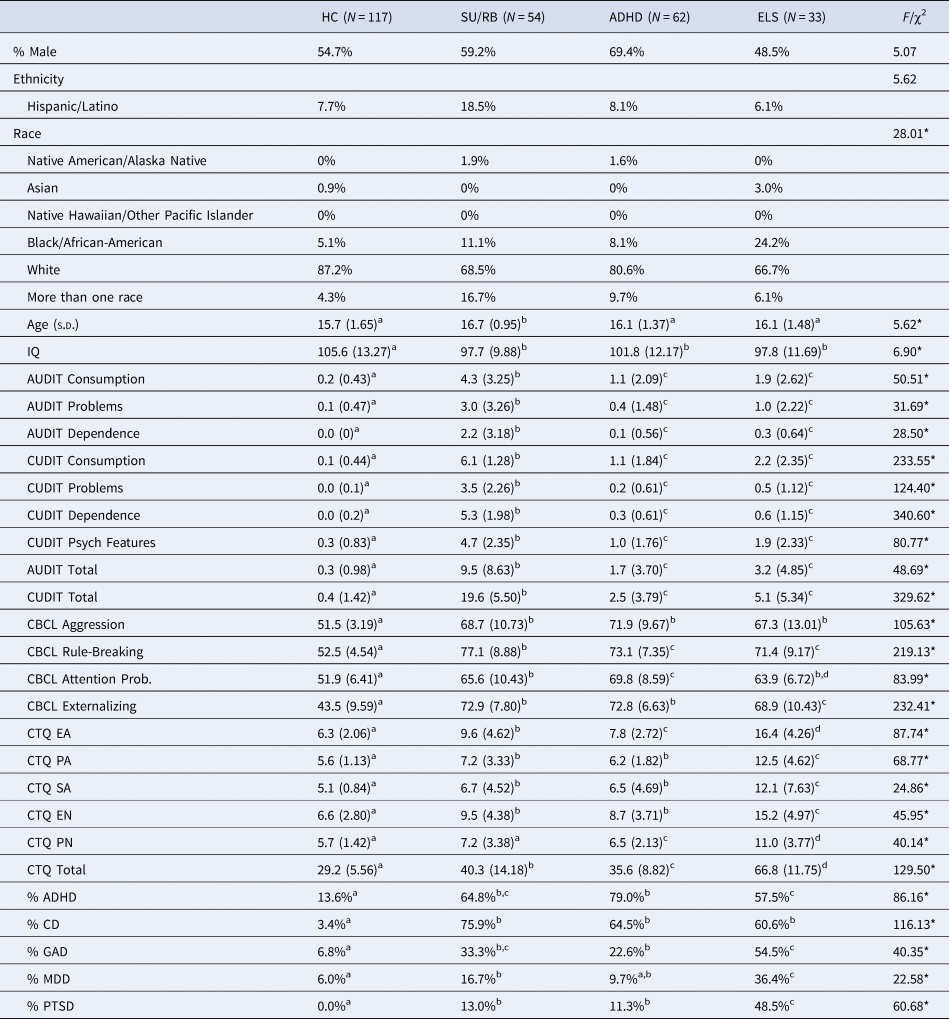
Data were drawn from a large study of youth from clinical and community settings. For study 1, participants included 266 youths aged 13–18 (M = 16.05, s.d. = 1.49; 41.7% female, 58.3% male) from a Midwestern residential treatment facility and the surrounding community. The Boys Town National Research Hospital institutional review board approved this study. Informed consent and assent were obtained from youth and their parents. Table 1 provides demographics by profile. Regarding overall ethnicity, 9.8% of youth identified as Hispanic/Latino. Regarding overall race, approximately 0.8% identified as Native American/Alaska Native; 0.8% as Asian; 9.4% as Black/African American; 0% as Native Hawaiian/Other Pacific Islander; and 79.3% as White; 8.3% as more than one race; 1.5% did not report race. Clinical characterization was completed through psychiatric interviews by licensed, board-certified psychiatrists with youths and parents.
Demographic information and clinical variables for LPA (N = 266)

ADHD, attention-deficit hyperactivity disorder profile; AUDIT, Alcohol-Use Disorder Identification Test; CBCL, Child Behavior Checklist; CBCL attention prob., CBCL attention problems; CD, conduct disorder; CTQ, Childhood Trauma Questionnaire; CUDIT, Cannabis-Use Disorders Identification Test; CUDIT Psych, Cannabis psychological features; EA, emotional abuse; ELS, early life stress profile; EN, emotional neglect; GAD, generalized anxiety disorder; HC, healthy comparison profile; MDD, major depressive disorder; PA, physical abuse; PN, physical neglect; PTSD, posttraumatic stress disorder; SA, sexual abuse; s.d., standard deviation; SU/RB, Substance-Use/Rule-Breaking Profile.
* indicates significant differences at p < 0.05. Within rows, values with different superscript letters are significantly different.
Exclusion criteria included IQ < 75 assessed with the Wechsler Abbreviated Scale of Intelligence (Wechsler, Reference Wechsler2011), current pregnancy, non-psychiatric medical conditions requiring use of medication that may have psychotropic effects (e.g. beta blockers, steroids), current psychosis, pervasive developmental disorders, Tourette's disorder, neurological disorders, metallic objects in the body (e.g. metal plates, pacemakers), and claustrophobia.
Study 1: psychiatric symptomatology and ELS exposure assessments
Youths completed the Alcohol Use-Disorder Identification Test (AUDIT) (Bush, Kivlahan, McDonell, Fihn, & Bradley, Reference Bush, Kivlahan, McDonell, Fihn and Bradley1998) and Cannabis-Use Disorder Identification Test (CUDIT) (Adamson & Sellman, Reference Adamson and Sellman2003). These scales assess overall alcohol/cannabis consumption over the past year as well as symptoms of alcohol/cannabis abuse and dependence. Youth report on the Childhood Trauma Questionnaire (CTQ) (Bernstein et al., Reference Bernstein, Stein, Newcomb, Walker, Pogge, Ahluvalia and Desmond2003) was used to assess ELS (abuse and neglect) exposure. The rule-breaking behaviors, aggressive behaviors, and attention problems subscales of the parent-report Childhood Behavior Checklist (CBCL) were used to assess externalizing symptoms (Achenbach & Rescorla, Reference Achenbach and Rescorla2001).
Study 1: latent profile analysis
LPA was conducted using the R package tidyLPA (Rosenberg, Beymer, Anderson, Van Lissa, & Schmidt, Reference Rosenberg, Beymer, Anderson, Van Lissa and Schmidt2019). The subscales entered into the LPA included: AUDIT Alcohol Consumption, Alcohol-related Problems, Alcohol Dependence; CUDIT Cannabis Consumption, Cannabis-related Problems, Cannabis Dependence, Cannabis Psychological Features; CBCL Rule-breaking Behaviors, Aggressive Behaviors, Attention Problems; CTQ Emotional Abuse, Physical Abuse, Sexual Abuse, Emotional Neglect, and Physical Neglect. One- to four-profile solutions were evaluated within tidyLPA using Bayesian information criterion (BIC), entropy, and bootstrapped-likelihood ratio test indices. Profile classifications of participants in the chosen solution were entered as a categorical factor in neuroimaging group analyses, as described below.
Study 2
Study 2: participants
Study 2 consisted of a subset of participants from study 1. Of the 266 youths who participated in study 1, 211 completed the Passive Avoidance learning task during functional magnetic resonance imaging (fMRI) scanning. Of these participants, 37 were excluded due to motion/data quality issues, resulting in a final sample of N = 174 participants for study 2. Exclusion criteria, IRB approval, consent/assent, and psychiatric symptomatology assessments were identical to study 1.
Study 2: PA task
The Passive Avoidance task (White et al., Reference White, Pope, Sinclair, Fowler, Brislin, Williams and Blair2013) is a paradigm where one of four shapes is presented to participants on each trial (online Supplementary Fig. S2). On each trial, participants must decide whether to respond by button press to the shape. If the participant responds to the shape, they will receive either reward or punishment, thereby learning to respond to stimuli that result in reward, or refrain (i.e. passively avoid) stimuli that result in punishment. Two of the shapes are associated with an 80% probability of winning $1 or $5 and a 20% probability of losing $1 or $5. The other two shapes are associated with an 80% probability of losing $1 or $5 and a 20% probability of winning $1 or $5. If the participant does not respond to the shape, they receive no reinforcement/punishment. Each trial involves: (i) presentation of one of the four shapes (1500 ms), (ii) a jittered fixation interval (1000–4000 ms), (iii) reward/punishment feedback (1500 ms), and (iv) a second jittered fixation cross interval (1000–4000 ms). Shapes are presented in random order. There were 27 trials for each shape (i.e. 108 trials in total).
Study 2: scanning parameters
Whole-brain blood oxygen level dependent (BOLD) data were acquired using a 3.0 Tesla Siemens Skyra Magnetic Resonance Scanner. A total of 313 functional images were taken over the course of one run with a T2*-weighted gradient echo planar imaging (EPI) sequence (repetition time = 2500 ms; echo time = 27 ms; 94 × 94 matrix; 90° flip angle; 240 mm field of view). Whole-brain coverage was obtained with 43 axial slices (thickness = 2.5 mm; voxel size = 2.6 × 2.6 × 2.5 mm3). A high-resolution T1 anatomical scan (MP-RAGE, repetition time = 2200 ms; echo time = 2.48 ms; 230 mm field of view; 8° flip angle; 256 × 208 matrix) was acquired in register with the EPI dataset. Whole-brain coverage was obtained with 176 axial slices (thickness = 1 mm; voxel size = 0.9 × 0.9 × 1 mm3).
Study 2: fMRI analysis: data preprocessing and individual level analysis
fMRI data were preprocessed and analyzed using Analysis of Functional NeuroImages (AFNI) software (Cox, Reference Cox1996). The first four volumes in each scan were discarded. The anatomical scan for each participant was registered with the Talairach and Tournoux atlas (Talairach & Tournoux, Reference Talairach and Tournoux1988) using the TT_N27 template. Each participant's functional EPI data were registered to their Talairach anatomical scan using AFNI. Functional images were motion corrected and spatially smoothed with a 6-mm full-width-at-half-maximum Gaussian kernel. The data then underwent time series normalization by dividing the signal intensity of a voxel at each time-point by the mean signal intensity of that voxel for each run and multiplying by 100. The resultant regression coefficients represent percent signal change from the mean.
Afterward, regressors were generated by convolving the train of stimulus events with a gamma variate hemodynamic response function to account for the hemodynamic response rate. The four regressors were: (i) cue phase, approach; (ii) cue phase, avoid; (iii) feedback phase, reward; and (iv) feedback phase, punishment. Generalized linear model (GLM) fitting was performed with these four regressors, six motion regressors, and a regressor modeling baseline drift (-polort 4). This procedure produced a β -coefficient and an associated t statistic for each voxel and regressor.
Study 2: behavioral data analysis
A four (profile: HC, SU/RB, ADHD, ELS)-by-two (error type: Commission, Omission) repeated-measures analysis of variance (ANOVA) was conducted. Commission errors occurred when participants responded to stimuli that were probabilistically associated with punishment while omission errors occurred when participants did not respond to stimuli that were probabilistically associated with reward.
Study 2: movement data
A one-way (profile: HC, SU/RB, ADHD, ELS) multivariate ANOVA was conducted on movement variables (number of censored TRs, average motion per TR, maximum displacement during the task).
Study 2: BOLD response data: striatal region of interest (ROI) analysis
For the ROI analysis, a multivariate analysis of covariance (ANCOVA) was conducted on the Reward–Punishment contrast values within four striatal ROIs based on prior findings with the Passive Avoidance task (Aloi et al., Reference Aloi, Blair, Crum, Bashford-Largo, Zhang, Lukoff and Blair2020; Blair et al., Reference Blair, Aloi, Bashford-Largo, Zhang, Elowsky, Lukoff and Blair2022; Zhang et al., Reference Zhang, Aloi, Bajaj, Bashford-Largo, Lukoff, Schwartz and Blair2021): left caudate, right caudate, left nucleus accumbens, and right nucleus accumbens. These ROIs were defined as voxels labeled as left caudate, right caudate, left accumbens area, and right accumbens area, respectively, within the Desai Maximum Probability atlas in AFNI (Destrieux, Fischl, Dale, & Halgren, Reference Destrieux, Fischl, Dale and Halgren2010). Since the profiles differed on IQ (online Supplementary Table S1), IQ scores were included as a covariate in this analysis.
Study 2: BOLD response data: whole-brain analysis
For the whole-brain analysis, an ANCOVA was conducted on the BOLD response within all voxels contained within a gray-matter mask. Since profiles differed on IQ, IQ scores were included as a covariate in this analysis. Post-hoc analyses were conducted on the percent signal change taken from all significant voxels within each cluster generated by AFNI to examine significant main effects and interactions with planned follow-up testing within SPSS 25.0. Effect sizes for all clusters are reported to facilitate future meta-analytic work.
The AFNI 3dClustSim program – which uses the autocorrelation function (-acf) – was used to establish a cluster-wise family-wise error correction for multiple comparisons for the whole-brain analysis (Cox, Chen, Glen, Reynolds, & Taylor, Reference Cox, Chen, Glen, Reynolds and Taylor2017). Spatial autocorrelation was estimated from residuals from the individual-level GLMs. The whole-brain analysis yielded a threshold of 16 voxels at an initial threshold of p = 0.001.
Results
Study 1
Study 1: latent profile analysis (LPA)
LPA identified four latent profiles. See Table 1 for demographic and clinical characteristics of the profiles. See Table 2 for fit statistics for 1-to 4-profile solutions. Scree plots of fit indices for potential profile solutions were visually inspected for incremental change. The solution with four profiles yielded the best overall fit, as evidenced by the lowest BIC, high entropy, and high classification accuracy. The 4-profile solution also mapped most closely to the indicator variable constructs. See the online Supplementary materials for further details on choosing the optimal profile solution. Figure 1 plots the average standardized scale/subscale means across these four latent profiles.
LPA model, fit, and indicators by profile. Panel (a) is a visualization of the study 1 analytical model. Indicator measures are shown with associated error terms. The 4-profile solution yielded HC, SU/RB, primarily ADHD (ADHD), and primarily ELS profiles. Panel (b) shows average standardized scale/subscale means across the four latent profiles; error bars represent standard error of the mean. Panel (c) plots Bayesian information criterion values across the 1-to-4-profile solutions. AUDIT, Alcohol-Use Disorder Identification Test; CBCL, Child Behavior Checklist; CBCL Attention Probs = CBCL Attention Problems subscale; CTQ, Childhood Trauma Questionnaire; CUDIT, Cannabis-Use Disorder Identification Test; AUDIT/CUDIT Problems, Alcohol/Cannabis-Related Problems subscale; AUDIT/CUDIT Dep, Alcohol/Cannabis Dependence subscale; AUDIT/CUDIT Use, Alcohol/Cannabis Consumption subscale; CUDIT Psych, Cannabis Psychological Features subscale; EA, emotional abuse; EN, emotional neglect; PA, physical abuse; PN, physical neglect; SA, sexual abuse.

LPA fit statistics (N = 266)

BIC, Bayesian information criterion.
Entropy, mean probability, minimum N, and bootstrapped-likelihood ratio are not applicable to a 1-profile solution.
Most youths (N = 117) were classified into profile 1 (healthy comparison, ‘HC’); 54 youths were classified into profile 2 (substance use/rule breaking, ‘SU/RB’); 62 youths were classified into profile 3 (primarily attention-deficit hyperactivity disorder, ‘ADHD’); and 33 youths were classified into profile 4 (primarily early life stress, ‘ELS’). There were significant differences in prevalence of ADHD, CD, generalized anxiety disorder, major depressive disorder (MDD), and posttraumatic stress disorder (PTSD) diagnoses across all profiles (χ2s = 22.58, ps < 0.05); see Table 1.
Across the AUDIT, CUDIT, CBCL, and CTQ, a one-way ANOVA showed significant differences across profiles (Fs = 28.50–232.41, ps < 0.001). The SU/RB profile had the highest scores on both the substance-use measures and the rule-breaking subscale of the CBCL relative to all other profiles (ts = 2.60–34.28, ps < 0.005). The ADHD and ELS profiles had significantly higher scores on the substance-use and rule-breaking measures than the HC profile (ts = 2.09–23.15, ps < 0.04). The ADHD profile showed the highest scores on the attention problems subscale of the CBCL compared to all other profiles (ts = 2.33–15.74, ps < 0.05). The ELS profile had the highest scores on the maltreatment exposure measures compared to all other profiles (ts = 4.12–25.24, ps < 0.001); see Table 1.
Regarding demographic data, there were no significant differences between profiles on sex (χ2 = 5.07) or ethnicity (χ2(3) = 5.62), ps > 0.05. However, there were significant differences in IQ [F (3,261) = 6.90, p < 0.001; youth in the HC profile had higher IQs than the SU/RB or ELS profiles (ts = 3.04–3.90, ps < 0.005)], in age [F (3,262) = 5.62, p = 0.001; youth in the HC profile were younger than the SU/RB profile (t(169) = 4.04, p < 0.001)], and in race [χ2(15) = 28.01, p < 0.05]; youth identifying as White were more likely to be classified in the HC, SU/RB, and ELS profiles than youth identifying as other races.
Study 2
Study 2: demographics
Of the 266 youths from study 1, N = 174 had available/useable fMRI scans on the Passive Avoidance task. Of these 174 youths, N = 77 had been classified into the HC profile, N = 34 into the SU/RB profile, N = 43 into the ADHD profile, and N = 20 into the ELS profile. Regarding demographic data, ANOVAs revealed significant differences across profiles on IQ [F (3,169)] = 3.75], but not on age [F (3,169) = 2.28], sex (χ2 = 2.66), ethnicity [χ2(3) = 5.03], or race [χ2(15) = 14.06], ps > 0.05. Therefore, IQ is included as a covariate in the Passive Avoidance task behavioral and fMRI analyses. Profile differences were largely maintained within this subsample. For full demographic and clinical data on the study 2 subsample, see online Supplementary Table S1.
Study 2: behavioral results
A four (profile: HC, SU/RB, ADHD, ELS) by two (error type: Omission, Commission) ANCOVA was run on proportion of errors with IQ as a covariate. This analysis revealed no main effect of profile on number of errors [F (3,169) = 0.49] or profile-by-error type interaction [F (3,169) = 0.25], ps > 0.05.
Movement data
A multivariate ANOVA was run on the number of censored volumes, average motion per volume, and maximum displacement with profile (HC, SU/RB, ADHD, ELS) as a between-subjects variable. There were no differences in movement parameters across profiles [F (9,510) = 1.69, p > 0.05].
fMRI results: striatal ROI analysis
Based on our LPA results, we ran a multivariate ANCOVA on the difference scores for the reward–punishment contrast within left/right caudate and nucleus accumbens. Profile (HC, SU/RB, ADHD, ELS) was the between-subjects variable of interest with IQ as a covariate.
Profile-by-feedback interaction: There was a main effect of profile in reward–punishment contrast scores [F (3,169) = 3.18, p < 0.05]. Individuals in the SU/RB profile showed reduced striatal responsivity to reward v. punishment outcomes compared to all other profiles (ts = −3.92 to 2.71, ps < 0.01). See Fig. 2.
Profile-by-feedback interactions within the (a) striatum, (b) dlPFC, (c) precuneus, (d) PCC. HC, healthy comparison profile; SU/RB, substance-use/rule-breaking profile; ADHD, primarily ADHD profile; ELS, primary ELS profile. Error bars represent standard error of the mean.

fMRI results: whole-brain analysis
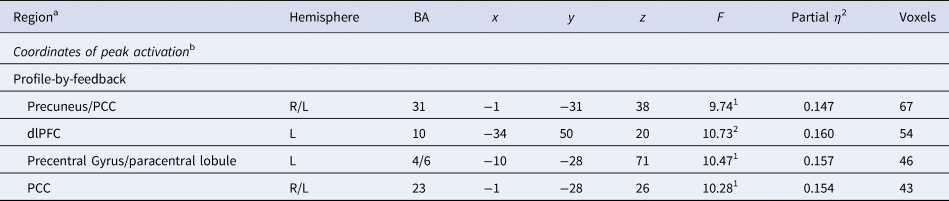
We ran a 4 (profile: HC, SU/RB, ADHD, ELS)-by-2 (feedback: Reward, Punishment) repeated-measures ANCOVA on the BOLD response data within a whole-brain mask. IQ was included as a covariate. Clusters were considered significant if they exceeded an extent threshold of k = 16 voxels at an initial threshold of p = 0.001. The ANCOVA revealed the following key interactions (Table 3):
Brain regions demonstrating significant profile-by-feedback interaction effects (N = 174)

BA, Brodmann's area; dlPFC, dorsolateral prefrontal cortex; PCC, posterior cingulate cortex.
a According to the Talairach Daemon Atlas (http://www.nitrc.org/projects/tal-daemon/).
b Based on the Tournoux and Talairach standard brain template.
Superscript numbers indicate specific significance patterns among groups: 1Healthy controls (HC) = ADHD, HC = early life stress (ELS), ADHD = ELS, and HC, ADHD, and ELS > substance-use/rule-breaking (SU/RB); 2HC = ELS, ADHD > HC, and ADHD, HC, and ELS > SU/RB.
Profile-by-feedback interaction: There were significant profile-by-feedback interaction effects within dorsolateral prefrontal cortex (dlPFC), precuneus, and PCC. Within dlPFC, the interaction was primarily driven by both reduced responsiveness to reward relative to punishment within the SU/RB profile compared to HC [t(109) = 4.34, p < 0.001] and increased responsiveness to reward relative to punishment within the ADHD profile compared to HC [t(118) = 2.00, p < 0.05]. Within precuneus and PCC, effects were primarily driven by reduced responsiveness to reward relative to punishment within the SU/RB profile compared to all other profiles [ts = 2.73–5.21, ps < 0.01]. See Fig. 2.
Discussion
Two studies were conducted to determine the (i) nature of any externalizing and ELS profiles revealed by LPA in the current sample; and (ii) extent of differential and/or common reward processing dysfunctions across these profiles. In study 1, LPA identified four profiles in our sample: (i) healthy comparison youth (HC), (ii) youth showing substance-use and rule-breaking behaviors (SU/RB), (iii) youth showing primarily ADHD symptoms (ADHD), and (iv) youth exposed to significant ELS who were more likely to be diagnosed with an internalizing disorder. In study 2, the SU/RB profile was associated with reduced responsiveness to reward feedback within striatum, dlPFC, precuneus, and PCC while the ADHD profile was associated with increased responsiveness to reward within dlPFC.
The largest profile identified by LPA included relatively neurotypically developing youth who showed the lowest levels of psychiatric diagnoses and psychiatric problem scores. LPA also identified three profiles that were defined by specific clinical features. Externalizing problems represented an area of overlap across profiles; all clinical profiles showed elevated externalizing behaviors compared to the HC profile. However, there were nuanced differences in patterns of other forms of externalizing behavior. Youth in the ADHD profile showed the highest attention problems as indexed by the CBCL relative to other profiles. Youth in the SU/RB profile showed the highest rule-breaking behaviors and SUD relative to other profiles. Prior epidemiological work has shown that externalizing disorders are associated with substance use (Carliner et al., Reference Carliner, Keyes, McLaughlin, Meyers, Dunn and Martins2016, Reference Carliner, Gary, McLaughlin and Keyes2017; Moss & Lynch, Reference Moss and Lynch2001; Rodgers et al., Reference Rodgers, Müller, Rössler, Castelao, Preisig and Ajdacic-Gross2015). Furthermore, a prior LCA has shown that CD, but not necessarily ADHD or Oppositional Defiant Disorder (ODD), was associated with a latent class underlying the greatest levels of substance use in adolescents (Rodgers et al., Reference Rodgers, Müller, Rössler, Castelao, Preisig and Ajdacic-Gross2015). Moreover, while ADHD predicts the onset of SUDs by age 18, its predictive power is very significantly reduced if CD (a strong predictor of SUD onset) is included in the model (Elkins, McGue, & Iacono, Reference Elkins, McGue and Iacono2007). Youth in the ELS profile had higher levels of prior ELS exposure and were more likely than other profiles to be diagnosed with MDD and PTSD. This is consistent with previous reports of ELS being associated with higher rates of depression and anxiety, even among adolescents with externalizing disorders (Wasserman et al., Reference Wasserman, Wimmer, Hill-Kapturczak, Karns-Wright, Mathias and Dougherty2020). In summary, our LPA revealed a total of four underlying profiles, three of which were associated with clinically significant psychopathology. Although all three had clinically significant externalizing behaviors, one was particularly associated with SUD and rule-breaking problems, one was particularly associated with ADHD symptom levels, and one was particularly associated with ELS and internalizing diagnoses of MDD and PTSD.
In study 2, youth in the SU/RB profile showed reduced responsiveness to reward v. punishment outcomes within striatum, dlPFC, precuneus, and PCC. The role of striatum in processing reinforcement information is clear (Averbeck & O'Doherty, Reference Averbeck and O'Doherty2022). dlPFC, precuneus, and PCC have roles in several neurocognitive functions but are particularly associated with attention (Katsuki & Constantinidis, Reference Katsuki and Constantinidis2012). An enhanced attentional response to salient reinforcement information is critical in many models of instrumental learning (Niv, Reference Niv2019). Previous work has reported that adolescents with greater levels of SUD symptoms show reduced responsiveness to reward across a number of behavioral paradigms (Aloi et al., Reference Aloi, Meffert, White, Hwang, Tyler, Thornton and Blair2019, Reference Aloi, Blair, Crum, Bashford-Largo, Zhang, Lukoff and Blair2020, Reference Aloi, Crum, Blair, Zhang, Bashford-Largo, Bajaj and Blair2021; Crowley et al., Reference Crowley, Dalwani, Mikulich-Gilbertson, Du, Lejuez, Raymond and Banich2010), although some work has suggested that adults with CUD show increased frontostriatal responsiveness to reward (Filbey, Dunlop, & Myers, Reference Filbey, Dunlop and Myers2013). Findings are consistent with prior reports in adolescents and suggest not only a reduced differential striatal response to reward v. punishment feedback, but also potentially reduced attentional responsiveness to this information. Interestingly, prior work has shown that reduced responsiveness of the striatum to reward stimuli is specifically associated with AUD symptoms (see online Supplementary materials) (Aloi et al., Reference Aloi, Meffert, White, Hwang, Tyler, Thornton and Blair2019, Reference Aloi, Blair, Crum, Bashford-Largo, Zhang, Lukoff and Blair2020, Reference Aloi, Crum, Blair, Zhang, Bashford-Largo, Bajaj and Blair2021).
Reduced reward responsiveness has been observed in a variety of psychiatric conditions including both internalizing conditions such as MDD (Pizzagalli et al., Reference Pizzagalli, Holmes, Dillon, Goetz, Birk, Bogdan and Fava2009), and externalizing conditions such as CD (Cohn et al., Reference Cohn, Veltman, Pape, van Lith, Vermeiren, van den Brink and Popma2015; Hawes et al., Reference Hawes, Waller, Byrd, Bjork, Dick, Sutherland and Laird2021; Zhang et al., Reference Zhang, Aloi, Bajaj, Bashford-Largo, Lukoff, Schwartz and Blair2021) and ADHD (Grimm et al., Reference Grimm, van Rooij, Hoogman, Klein, Buitelaar, Frank and Plichta2021). MDD was relatively uncommonly diagnosed in the clinical profile groups (it was highest in the ELS profile but only in 36.4% of cases) and so conclusions are difficult to draw with respect to MDD. However, ADHD symptoms, as indexed by the CBCL, were significantly greater in participants in the ADHD profile than in any other profiles in study 1. Yet, adolescents in the ADHD profile showed no indication of reduced reward–punishment differential responsiveness in striatum and even greater reward–punishment differential responsiveness within dlPFC. Some prior work has found that ADHD is associated with increased reward responsiveness (Rubia et al., Reference Rubia, Smith, Halari, Matsukura, Mohammad, Taylor and Brammer2009). However, the majority shows that ADHD is associated with reduced responsiveness to reward stimuli (Carmona et al., Reference Carmona, Hoekzema, Ramos-Quiroga, Richarte, Canals, Bosch and Tobeña2012; Grimm et al., Reference Grimm, van Rooij, Hoogman, Klein, Buitelaar, Frank and Plichta2021). Notably, however, prior work has typically found that reward anticipatory signaling is disrupted in ADHD rather than responsiveness to received reward (Grimm et al., Reference Grimm, van Rooij, Hoogman, Klein, Buitelaar, Frank and Plichta2021). Absence of a response to received reward in the current study may reflect previous literature with respect to reward receipt. It is also worth noting that most prior work examining reward processing in ADHD has used tasks that do not involve instrumental learning (e.g. the monetary incentive delay task) (Carmona et al., Reference Carmona, Hoekzema, Ramos-Quiroga, Richarte, Canals, Bosch and Tobeña2012). It is possible that dysfunctional reinforcement processing in individuals with ADHD is reduced in instrumental contexts.
CD was a relatively common diagnosis across profiles except for the HC profile. Yet, while reduced sensitivity to reinforcement information has frequently been reported in patients with CD (Hawes et al., Reference Hawes, Waller, Byrd, Bjork, Dick, Sutherland and Laird2021; Rubia et al., Reference Rubia, Smith, Halari, Matsukura, Mohammad, Taylor and Brammer2009; White et al., Reference White, Pope, Sinclair, Fowler, Brislin, Williams and Blair2013; Zhang et al., Reference Zhang, Aloi, Bajaj, Bashford-Largo, Lukoff, Schwartz and Blair2021), only the SU/RB profile showed reduced differential reward v. punishment responsiveness. It is unclear the extent to which the current results are incompatible with previous literature. Some recent work has suggested, similar to findings with ADHD, that reduced reward responsiveness in CD is particularly marked for reward anticipation and indeed may even be heightened for reward receipt (Hawes et al., Reference Hawes, Waller, Byrd, Bjork, Dick, Sutherland and Laird2021). However, other work has indicated reduced reward receipt responsiveness in patients with CD (Rubia et al., Reference Rubia, Smith, Halari, Matsukura, Mohammad, Taylor and Brammer2009; White et al., Reference White, Pope, Sinclair, Fowler, Brislin, Williams and Blair2013; Zhang et al., Reference Zhang, Aloi, Bajaj, Bashford-Largo, Lukoff, Schwartz and Blair2021). It should also be noted that adolescents in the SU/RB profile showed higher levels of CD and externalizing behaviors relative to the other two clinical groups even if comparisons were only statistically significant for RB. Overall, it is clear that co-occurring SU needs to be carefully considered in future work examining reward responsiveness in psychiatric disorders.
Youth in the ADHD profile showed increased responsiveness to reward feedback within dlPFC compared to the HC and SU/RB profiles, but similar striatal responsiveness to reward. A few prior studies have shown that adolescents with ADHD show increased responsiveness to reward (Rubia et al., Reference Rubia, Smith, Halari, Matsukura, Mohammad, Taylor and Brammer2009). However, the majority indicates that ADHD is associated with reduced responsiveness to reward (Carmona et al., Reference Carmona, Hoekzema, Ramos-Quiroga, Richarte, Canals, Bosch and Tobeña2012; Grimm et al., Reference Grimm, van Rooij, Hoogman, Klein, Buitelaar, Frank and Plichta2021). Future work is needed to disentangle whether there are certain reward-related circumstances in which individuals with ADHD show increased recruitment of frontal regions implicated in attention.
Findings should be interpreted considering several limitations. First, substance-use initiation may affect reward system development across adolescence. Urine/breathalyzer testing for substance use was not conducted at the time of scanning. However, all but two participants with significant alcohol and/or cannabis use histories were residents of a residential treatment program that utilized random drug testing for at least 4 weeks prior to scanning. Nevertheless, specific information regarding length of abstinence and current craving/withdrawal level was not assessed. Regarding ELS, timing and exposure type may influence ELS-related sequelae (Marshall, Reference Marshall2016). Future work should examine features of ELS exposure in greater depth, especially given the nuanced differences in ELS exposure in the SU/RB group compared to other profiles (i.e. elevated emotional and physical abuse, but comparable levels of other maltreatment types). Relatedly, longitudinal work is required to examine how trajectories unfold across time. Third, given the group design of this study, it is difficult to disentangle whether substance-use or rule-breaking behaviors are the predominant dimension defining the SU/RB profile. However, given the neurochemistry of SUDs (e.g. reduced dopaminergic signaling within frontostriatal regions to non-substance reward stimuli) (Volkow, Koob, & McLellan, Reference Volkow, Koob and McLellan2016), it seems likely that the predominant dimension is substance use. Moreover, rule-breaking behaviors are only one dimension of conduct problems (the other being aggressive behaviors) (Achenbach & Rescorla, Reference Achenbach and Rescorla2001). Fourth, the SU/RB, ADHD, and ELS profiles had greater proportions of individuals who were prescribed psychotropic medications (antipsychotics, stimulants, and/or antidepressants). However, excluding these youth (see online Supplementary Table S4) did not significantly impact results. Finally, although the 4-profile solution had the lowest BIC, fit statistics were also favorable for the 3-profile solution. We repeated analyses using the 3-profile solution (see online Supplementary Tables S5 and S6). LPA identified HC and SU/RB profiles similar to the main analysis, but the third profile reflected more general psychopathology as opposed to differentiating between attention- and ELS-related profiles. fMRI results replicated the main analyses, although several additional clusters were significant in the whole-brain analysis (see online Supplementary materials).
In summary, individuals in the current study belonged to one of four latent profiles: (i) HC youth with low levels of psychopathology, (ii) adolescents showing particularly high levels of SU/RB, (iii) adolescents showing particularly high levels of ADHD symptoms, and (iv) adolescents showing particularly high levels of ELS and MDD/PTSD. Only the SU/RB profile was associated with atypically reduced reward responsiveness within the striatum and attentional structures to receipt of reward relative to punishment. In contrast, only the ADHD profile was associated with increased reward responsiveness within dlPFC to receipt of reward relative to punishment. Substance use may compromise responsiveness to reward v. punishment beyond any independent associations with particular psychiatric diagnoses.
Supplementary material
The supplementary material for this article can be found at https://doi.org/10.1017/S0033291723000971
Acknowledgments
We would like to thank Ron Copsey, Kim VanHorn, Michael Wright, Mark Timm, and Rhonda Tuel for their contributions to data collection. We would also like to thank all participants and their families for their participation.
Financial support
This work was supported by Boys Town National Research Hospital. KSB was supported by P20-GM109023, RJB was supported by K22-MH109558 and R34-DA050286, KIC was supported by T32-MH018869 and U54-DA016511, FMF was supported by R01-DA042490 and R21-DA044465, and SH was supported by U01-MH120155. The funders had no role in study design, data collection, data analysis, decision to publish, or manuscript preparation.
Conflict of interest
All authors report no biomedical financial interests or potential conflict of interest.
Ethical standards
The authors assert that all procedures contributing to this work comply with the ethical standards of the relevant national and institutional committees on human experimentation and with the Helsinki Declaration of 1975, as revised in 2008.