Introduction
The association between sleep disturbances and reduced cognitive functioning has been shown across normal sleeping and cognitively healthy older adults, as well as in older adults with insomnia, sleep-disordered breathing and dementia (Dzierzewski et al., Reference Dzierzewski, Dautovich and Ravyts2018). In Alzheimer’s disease, the development of neuronal loss leads to reduced production of melatonin, causing difficulty in falling asleep, disrupted sleep and difficulty staying awake in the daytime (van Someren et al., Reference Van Someren1996). Sleep disturbances are therefore of major concern in dementia.
A recent review describes sleep disturbances in people with dementia to be negatively associated with quality of life, in addition to poorer physical function, shorter survival and increased behavioral symptoms (Petrovsky et al., Reference Petrovsky, Mcphillips, Li, Brody, Caffeé and Hodgson2018). Sleep disturbances in people with dementia are consistently associated with factors such as behavioral symptoms of agitation, anxiety and depression, in addition to medical comorbidities (Peter-Derex et al., Reference Peter-Derex, Yammine, Bastuji and Croisile2015). Another behavioral symptom, apathy, as reduced goal-directed behavior, is associated with lower daytime motor activity and inactivity in dementia (David et al., Reference David2012). Apathy could therefore increase daytime sleeping, napping and dozing, factors that lead to night awakenings (Vitiello and Borson, Reference Vitiello and Borson2001) and contribute to sleep disturbances in this patient group.
According to a recent Lancet Commission on dementia, there is a lack of robust and systematic evidence on improving sleep disturbances, due to small studies and methodological weaknesses (Livingston et al., Reference Livingston2017). In WHO’s (2017) global action plan on dementia, access to meaningful activities for people with dementia to enhance capacity and functional ability is highlighted. Suitable interventions aiming to stimulate nursing home (NH) residents through meaningful activities might contribute to the enhancement of their sleep quality.
Background
In normal conditions, sleep–wake patterns are associated with circadian fluctuations of other bodily functions that, during nighttime, generate physiological states compatible with sleep (e.g. low temperature and heart rate), while, during daytime, generate physiological states compatible with alertness and action. Such time-dependent mechanisms are regulated intrinsically in the organism via a complex circadian ‘pacemaker’, which is kept in tune with external synchronizers, such as light–darkness periodicity (Dijk and Lockley, Reference Dijk and Lockley2002).
It is recommended that older adults sleep 7–8 hours/day (Hirshkowitz et al., Reference Hirshkowitz2015) preferably during night hours (Dijk and Lockley, Reference Dijk and Lockley2002; Calogiuri et al., Reference Calogiuri, Weydahl and Carandente2013). However, impairment in the described circadian mechanisms leads many older people to experience sleep disturbances, due to significant changes in sleep structure at both the macro-level architecture (e.g. shorter overall sleep duration and time spent in the different sleep stages) and the micro-level architecture (e.g. modified quantity and quality of sleep oscillations) (Mander et al., Reference Mander, Winer and Walker2017). In particular, older people often have a harder time falling and staying asleep and spend less time in deep stages of the sleep cycle (Mander et al., Reference Mander, Winer and Walker2017; Gulia and Kumar, Reference Gulia and Kumar2018). Moreover, their circadian entrainment becomes less efficient, and their sleep–wake rhythm tends to shift backward, leading to an earlier anticipated onset of sleep (earlier bedtime and wake-up time) that can in turn undermine sleep quality (Gulia and Kumar, Reference Gulia and Kumar2018).
Sleep disturbances are described in 25–55% of people with neurodegenerative dementia (Livingston et al., Reference Livingston2017; Wilfling et al., Reference Wilfling, Dichter, Trutschel and Kopke2019). Sleep disturbances are complex and caused by several factors, as described above. In addition, there might be damages to the central regulators of the circadian entrainment in the brain from dementia (Malhotra, Reference Malhotra2018). In line with the development of dementia, a loss of brain neurons will decrease levels of the hormone melatonin, which in turn affects sleep onset and awakenings during sleep and leads to increased daytime tiredness (Livingston et al., Reference Livingston2017). Based on the severity of dementia in association with NH admission, sleep disturbances in this patient group are therefore common (Neikrug and Ancoli-Israel, Reference Neikrug and Ancoli-Israel2010; Fetveit and Bjorvatn, Reference Fetveit and Bjorvatn2002).
In particular, sleep efficiency, defined as the percentage of time in bed and actually asleep, is severely impaired among people with dementia and is characterized by frequent night awakenings and complicated nocturnal restlessness (Cole and Richards, Reference Cole and Richards2005). The diminished ability of sustaining night sleep in this group could most likely be influenced by prolonged time in bed (Fetveit and Bjorvatn, Reference Fetveit and Bjorvatn2002). Several studies describe most NH residents as spending up to 17 hours in bed each day (Bates-Jensen et al., Reference Bates-Jensen2004). In addition, a high occurrence of inactivity, sedentary behavior and apathy among people with dementia in NH (Bates-Jensen et al., Reference Bates-Jensen2004) results in residents participating in few activities and being unoccupied much of the day (Smit et al., Reference Smit, De Lange, Willemse, Twisk and Pot2016), which also contributes to reduced sleep during nighttime.
There is no evidence regarding medication to improve sleep problems in people with dementia. A Cochrane study found no evidence that melatonin improved any sleep outcome or reduced daytime sleep in dementia, and the authors describe a lack of evidence to guide drug treatment of sleep problems (McCleery et al., Reference McCleery, Cohen and Sharpley2016). One review found positive effects from non-pharmacological interventions based on physical activity, mind–body practices and acupressure to improve sleep (Shang et al., Reference Shang2019). Another review found promising results with increased daytime light exposure and acupressure (Capezuti et al., Reference Capezuti, Sagha Zadeh, Pain, Basara, Jiang and Krieger2018), while another Cochrane study reported no significant effect of bright-light therapy on sleep disorders in people with dementia (Forbes et al., Reference Forbes, Blake, Thiessen, Peacock and Hawranik2014). The Lancet Commission on dementia recommends a combination of light therapy and improved sleep rhythm to treat sleep problems (Livingston et al., Reference Livingston2017). A recent review describes multicomponent interventions (combinations of different [interacting] components with different characteristics) as having promising effects on sleep, although such interventions are difficult to compare (Wilfling et al., Reference Wilfling2020).
For people with dementia, performance of activities that are considered meaningful, such as interventions based on social stimulation, could improve negative behaviors (Trahan et al., Reference Trahan, Kuo, Carlson and Gitlin2014). However, few intervention studies using social stimulation to improve sleep in the target group have been conducted. One RCT on individualized social activity interventions found an effect in the intervention group on sleep onset, in addition to improved sleep for the participants with poor sleep, but no effect on sleep efficiency (Richards et al., Reference Richards, Beck, O’sullivan and Shue2005). A pilot study on individualized social activities described increased nocturnal sleep (Richards et al., Reference Richards, Sullivan, Phillips, Beck and Overton-Mccoy2001). Another type of intervention involving social stimulation includes human–animal activities or human–robotic animal activities. A three-armed RCT comparing dog visitation vs. activity with a robotic animal (the seal robot Paro) vs. a plush toy (Thodberg et al., Reference Thodberg2015) found no effect on sleep efficiency. No findings were shown in a recent three-armed cluster RCT comparing activity with Paro vs. a plush toy or usual care (Moyle et al., Reference Moyle2018). This study only described an effect on reduced nocturnal step counts (motor activity). More knowledge is needed to explore the potential of social interventions in order to improve sleep (Capezuti et al., Reference Capezuti, Sagha Zadeh, Pain, Basara, Jiang and Krieger2018; Shang et al., Reference Shang2019; Wilfling et al., Reference Wilfling2020). In addition, rigorous scientific inquiry in order to produce stronger evidence is required (Brown et al., Reference Brown, Berry, Tan, Khoshia, Turlapati and Swedlove2013; Wilfling et al., Reference Wilfling2020).
Behavioral symptoms and reduced quality of life are associated with sleep disturbances. Previously, we found intervention with Paro to show effects on decreased symptoms of agitation and depression (Jøranson et al., Reference Jøranson, Pedersen, Rokstad and Ihlebæk2015) and on sustained quality of life in participants with severe dementia (Jøranson et al., Reference Jøranson, Pedersen, Rokstad and Ihlebæk2016b). This paper presents results on sleep patterns, as secondary outcomes from the same intervention.
The aim of the study was to investigate effects on sleep from group activity with a robot-assisted intervention in the target group. We sought to objectively measure if robot-assisted group activity could improve sleep among participants with dementia in NH compared with a control group.
Methods
Design
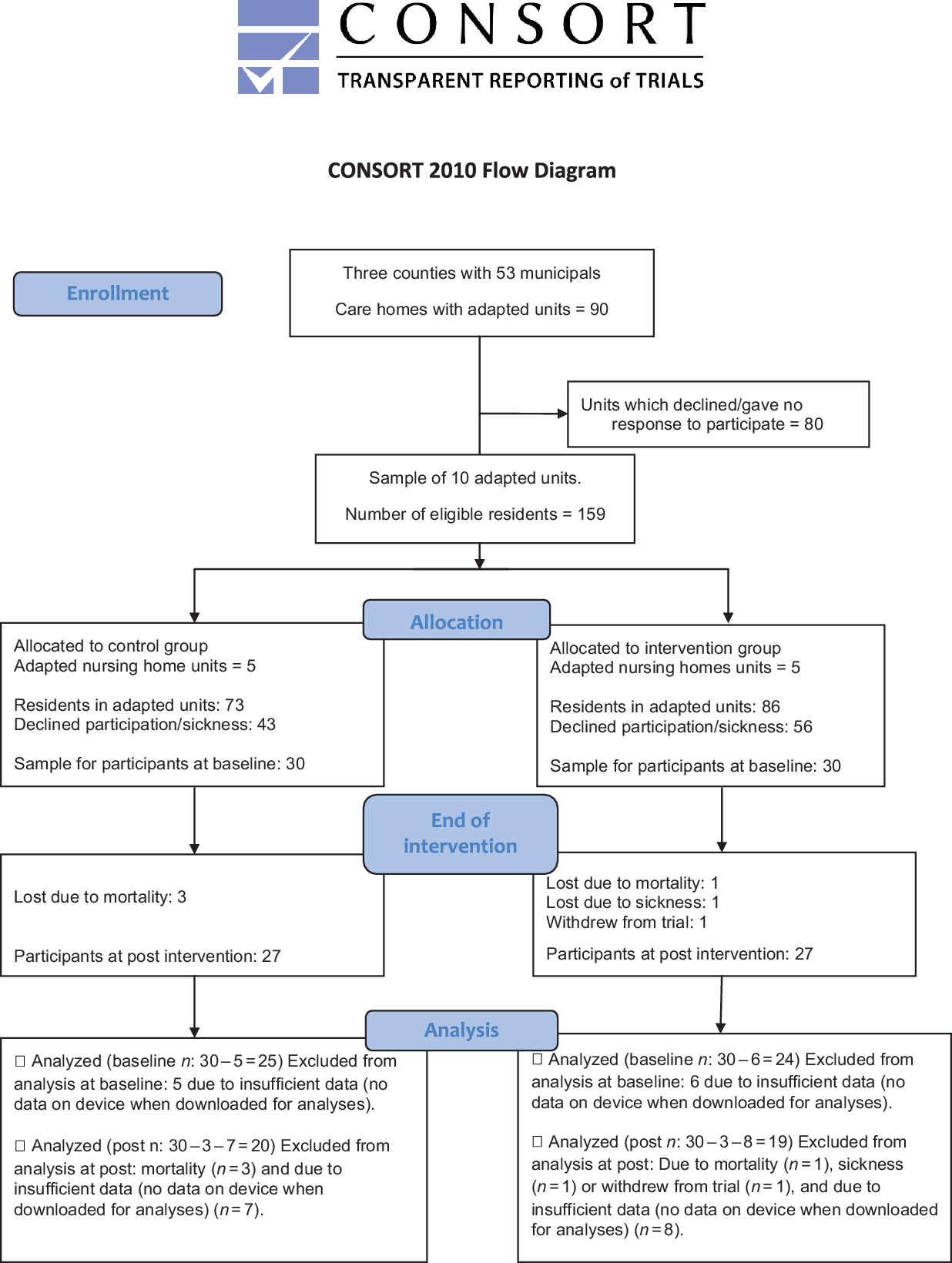
The study was a prospective and cluster randomized multicenter trial of a group intervention over 12 weeks with Paro activity. The control group received treatment as usual. Each NH unit was treated as a cluster and allocated to one of the groups (Figure 1). External researchers blinded to the name and location of the NH performed the random allocation. Data were collected at baseline before the intervention started (T0) and at completion of the intervention after 12 weeks (T1). The three-month intervention was conducted over three periods during 2013 and 2014 in order to include all participating NHs. For further description of the cluster RCT, see Jøranson et al. (Reference Jøranson, Pedersen, Rokstad and Ihlebæk2015).
CONSORT flow diagram.

Participants
A total of 10 NHs with special care units were recruited by the Centre for Development of Institutional and Home Care Services from three counties in Eastern Norway. A convenience sample of 60 participants was recruited (65.4% women, age range 62–95 years) after external randomization of the NH units. A maximum of six residents from each unit were invited to participate by the units’ nurses and formed either a Paro group or a control group. Inclusion criteria were aged over 65 years having a dementia diagnosis or meeting the criteria for cognitive impairment as described in the Norwegian version of the Mini-Mental State Examination (Folstein et al., Reference Folstein, Folstein and Mchugh1975) with a score lower than 25/30. In addition, participants had to show an interest in Paro during the recruitment process. The number of recruited participants was in compliance with the power calculation on the primary outcome measure, the Brief Agitation Rating Scale (Finkel et al., Reference Finkel, Lyons and Anderson1993).
Paro and the intervention design
The robotic seal Paro was developed for people with dementia. It has a swivelling head, legs and tail, in addition to several speakers that produce the sounds of an authentic baby harp seal. It is a highly advanced and adaptive robot with artificial intelligence software (Shibata et al., Reference Shibata, Wada, Saito and Tanie2004). Paro can recognize voices, and it responds to repeated words. The artificial fur has several sensors that create the interaction between users and the robot which occurs when Paro responds to, for example, stroking of its fur or patting of its head.
Each NH formed a Paro group of six participants to attend the sessions. The 30-minute intervention with Paro activity was conducted preferably during daytime. The sessions were conducted twice a week for 12 weeks, in addition to the regular activities in the special care unit. Sessions of 30 minutes were considered suitable due to the decreased ability to maintain concentration of those with severe dementia (Engedal and Haugen, Reference Engedal, Haugen, Engedal and Haugen2018). The intervention design was selected on the basis of clinical experience, practical issues and previous findings (Friedmann et al., Reference Friedmann, Galik, Thomas, Hall, Chung and Mccune2015; Cohen-Mansfield et al., Reference Cohen-Mansfield, Marx, Dakheel-Ali, Regier and Thein2010).
All sessions were conducted in a quiet, separate room in line with the protocol. The participants had regular seats during all sessions to ensure predictability when arriving at each activity session. They sat close together on chairs placed in a half circle, with the activity leader facing them. Each participant had Paro placed in their lap for an equal period of time, with two rounds to reduce waiting time for the participants. This was a facilitated activity to stimulate naturally occurring activities in each participant during interaction with Paro. The intervention was intended to produce activity between the participants and Paro, between the participants and/or between the participants and the activity leader, including petting, talking to and about, smiling to and singing for Paro. If participants wanted to leave the activity, an additional staff member was always present in the background to assist.
Several nurses in each NH were attached to the project and were trained as Paro activity leaders, in line with the protocol developed in advance of the intervention. All activity sessions were led by one of the local activity leaders who switched to lead the activity. The activity leaders were initially supervised by one member of the project group in order to make sessions as similar as possible for comparison.
Data collection
A questionnaire was developed by the project team to obtain demographic data for each participant, and the information was collected by NH personnel. The Clinical Dementia Rating (CDR) scale was used to assess the level of dementia. CDR includes six domains of cognitive and functional performance scored on a 5-point scale (Hughes et al., Reference Hughes, Berg, Danziger, Coben and Martin1982), where a CDR of 0 points indicates no cognitive impairment, while 0.5 = very mild dementia, 1 = mild, 2 = moderate and 3 = severe dementia (Hughes et al., Reference Hughes, Berg, Danziger, Coben and Martin1982). The CDR scale, including the Norwegian version, has been found to be valid and reliable for staging dementia (Waite et al., Reference Waite1999), and to have a high level of agreement with a clinical dementia diagnosis (Nygaard and Ruths, Reference Nygaard and Ruths2003; Selbaek et al., Reference Selbaek, Kirkevold and Engedal2007).
The nocturnal sleep patterns were assessed by ActiSleep+ (Actigraph, Pensacola, US). The ActiSleep+ is a device with the size and weight of a wristwatch that contains a three-axial accelerometer, which allows it to measure and record an individual’s movements through continuous monitoring.
Although the validity of wrist actigraphy has been questioned (Sadeh, Reference Sadeh2011; Conley et al., Reference Conley2019; Smith et al., Reference Smith2018), it is still considered a cost-effective method to objectively assess sleep in ecological conditions (Calogiuri et al., Reference Calogiuri, Weydahl and Carandente2013; van de Water et al., Reference Van De Water, Holmes and Hurley2011), with a number of benefits for the patients being assessed (Smith et al., Reference Smith2018). Studies have shown that actigraphy can detect intervention effects in groups of people with sleep disturbances (Sadeh, Reference Sadeh2011). However, actigraphy-based sleep measurements must be interpreted with caution, as actigraphy generally tends to overestimate sleep (van de Water et al., Reference Van De Water, Holmes and Hurley2011), especially among populations suffering from chronic conditions (Conley et al., Reference Conley2019).
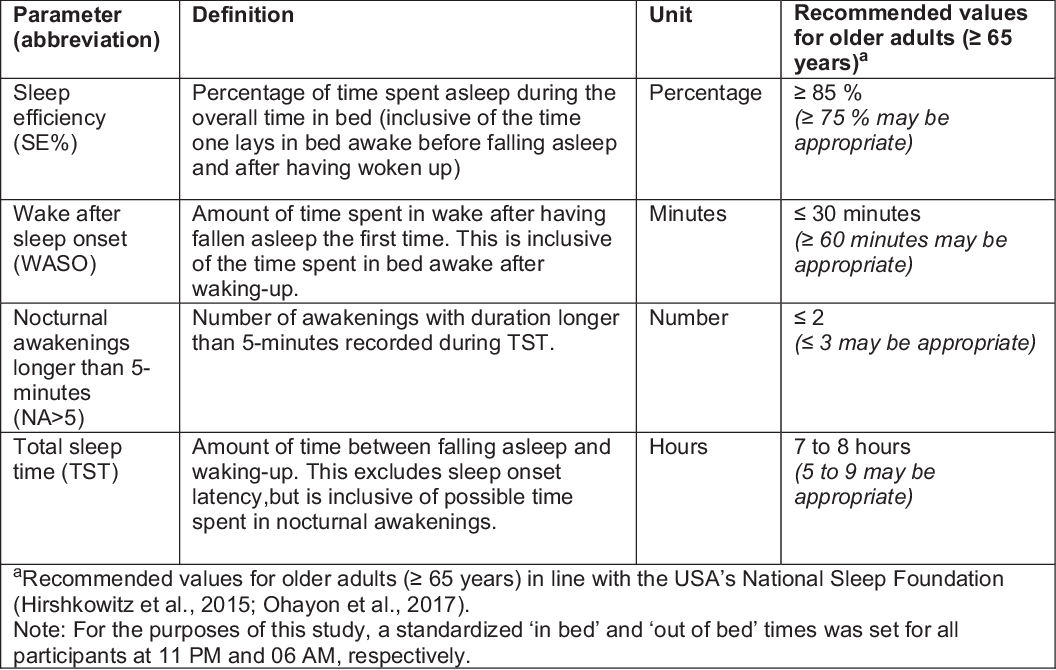
Both at T0 and T1, each resident underwent 1 week of continuous monitoring, with the accelerometer placed on their left wrist (sampling rate: 30 Hz). The actigraphs were preset by the researchers; the project nurses then placed the devices on the residents’ wrists and ensured that they were not removed. Upon completion of the monitoring, the actigraphs were returned to the researchers. A set of parameters are produced from the actigraphic data that can be used to evaluate an individual’s quantity and quality of sleep, in addition to their activity pattern. Three of these parameters are widely recognized by clinicians and researchers as particularly robust indicators of good sleep quality across the life span: sleep efficiency (SE%), wake after sleep onset (WASO) and number of awakenings longer than 5 minutes (NA > 5) (Ohayon et al., Reference Ohayon2017). Additionally, the parameter ‘total sleep time’ (TST) provides information about the overall duration of sleep (Hirshkowitz et al., Reference Hirshkowitz2015). An overview of these parameters, with definitions and corresponding recommended values for older adults, is provided in Figure 2.
Definition and reference values for actigraphic sleep parameters.

Preliminary analysis and processing of the actigraphy raw data
After downloading the actigraphy data into the Actilife-6 software (Actigraph, Pensacola, US), the data were visually screened to examine the actograms (i.e. graphical representations of the actigraphy data on the monitoring’s timeline), in order to identify large abnormalities indicative of obvious non-recording or non-wear periods (e.g. a ‘flat line’ in the graphs). A total of 31 nights containing such abnormalities for extensive periods (e.g. most of or the entire nocturnal time) were excluded from further analysis. In line with recommendations by Ancoli-Israel et al. (Reference Ancoli-Israel, Clopton, Klauber, Fell and Mason1997), for residents with more than four nights missing, the entire week was considered missing. No imputation method was used. This procedure was performed by one researcher (GC), to avoid issues of inter-rater reliability.
Subsequently, the data were run in the ‘sleep analysis’ function, which returned the values for the sleep parameters. The Cole-Kripke algorithm (Sadeh et al., Reference Sadeh, Sharkey and Carskadon1994) was applied. As we did not have reliable information from staff regarding the participants’ in-bed and out-of-bed time, standardized timings were set at 11:00 p.m. and 6 a.m., respectively. This also ensured a higher intra-rater and inter-rater reliability in the application of the sleep analysis, which was performed with the help of research assistants. Moreover, this time period is meaningful with respect to the purposes of the study, as this period corresponds to the circadian time in which it would be desirable for the residents to be asleep. Finally, averages of the overall pre- and post-monitoring period were calculated for further analyses.
Statistical analysis
All analyses were computed using statistical software (IBM SPSS Statistics Version 24.0). The level of statistical significance was set at 0.05. Possible differences between the intervention and control groups at baseline were investigated by one-way ANOVA and chi-square analyses.
Differences between the intervention group and the control group over time were analyzed using a mixed model (West, Reference West2009). Mixed models are appropriate when the data set contains missing data due to dropout (see Figure 1), since this analysis makes use of all available data. The dependent variables were sleep parameters obtained from ActiSleep+. Type of intervention was set as fixed effect. The control group was set as the reference group. Time was modeled as a repeated variable, and an autoregressive covariance structure was used. The reference point for time was T0. An interaction between the group (intervention and control) and points of time (T0, T1) was included in the model since difference in change over time was the effect of interest in this study.
Ethics
The project was approved by the Regional Committees for Medical and Health Research Ethics in Norway and conforms to the standards of the Declaration of Helsinki. The nurses were attached to the project in each participating NH recruited participants, and they provided oral and written information adapted for NH residents with dementia. They assessed whether the residents were able to provide informed consent for participation. Nurses provided oral consent from the participants, and written informed consent was provided from next of kin. Participants could withdraw from the study at any time. Privacy of participants was assured, and their identity was protected. The ActiSleep+ does not collect information regarding the location of the user, and it is thus considered un-invasive. The trial was registered in ClinicalTrials (ClinicalTrials.gov: NCT01998490).
Results
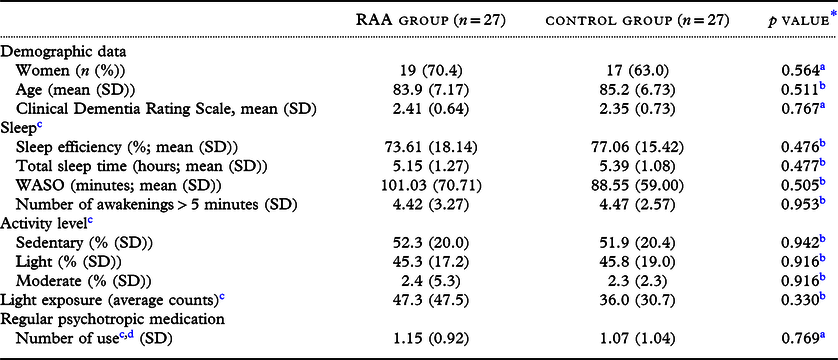
Of the 60 included participants, only 49 had valid data at baseline due to no data on device for the rest of the participants. The 11 participants with missing data at baseline were not considered as dropouts from the study and were also eligible for post measurements. As a result, this study includes 34 participants with both baseline and post data, 15 with baseline data only and 5 with post data only. A total of 54 participants were included in the analyses (see Figure 1). At baseline, the two groups consisted of 27 in the intervention group (70.4% women) and 27 in the control group (63% women) (Table 1). Age and level of dementia were quite similar in the groups. There were no significant differences between the groups at baseline in the level of dementia, sleep patterns, activity patterns, light exposure or use of psychotropic medication. Fifty-two percentage of the participants attended 22–24 sessions, while 22% attended 20–21 sessions. Twenty-six percentage attended 10–19 sessions.
Demographic data, sleep and activity level at start of intervention for robot-assisted activity group (RAA) and control group a,b

a Dichotomous variables tested with chi-square tests
b Continous variables tested with one-way ANOVA
c n = 24 (RAA) and n = 25 (control) for sleep, activity level and light exposure
d Psychotropic medication in accordance with the ATC system on the second level N (antipsychotics, anxiolytics, hypnotics/sedatives and antidepressants)
* p < 0.05 (level of significance)
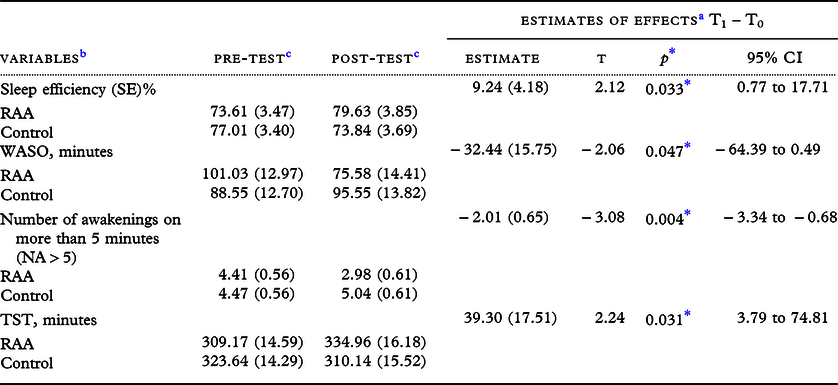
SE% showed an increase in mean values in the intervention group from T0: 73.61% to T1: 79.63%, whereas the control group decreased from 77.01% to 73.84%. The mixed model (see Table 2) showed a significant effect estimate of 9.24 (p = 0.033) when comparing development in the intervention group with the control group. WASO was reduced in the intervention group from T0: 101.03 minutes to T1: 75.58 minutes, while in the control group, it showed an opposite development from T0: 88.55 minutes to T1: 95.55. When comparing the development in the two groups, we found a significant effect estimate of −32·44 (p = 0.047). For the variable NA > 5, we found a clear decrease in number of awakenings in the intervention group from T0: 4.11 to T1: 2.98, whereas the control group showed an increase from T0: 4.47 to T1: 5.04. NA > 5 also showed a significant effect estimate of −2.06 (p = 0.004) when comparing the intervention group with the control group from T0 to T1. Finally, mean TST increased in the intervention group from T0: 309.17 minutes (5.15 hours) to T1: 334.96 (5.58 hours), while the control group changed from T0: 323.64 minutes (5.39 hours) to T1: 310.14 (5.17 hours), resulting in a significant effect estimate of 39.30 (p = 0.031).
Sleep efficiency, total sleep time (TST), wake after sleep onset (WASO) and number of awakenings for robot-assisted activity group (RAA) and control group, and estimates of effects

a A mixed model was used to estimate time trends between the groups
b Dependent variables: sleep efficiency, TST, WASO and number of awakenings > 5 min
c Estimated marginal mean (SE)
*Significance level 0.05
Discussion
The Paro intervention had a significant effect on all outcome measures central to describing sleep quality in the target group. More specifically, systematic group activity with Paro was found to increase SE% and TST measured during nocturnal hours, while simultaneously reducing NA > 5 and WASO. Altogether, these findings indicate that the Paro intervention may have affected the participants’ quantity and quality of sleep.
Improved sleep efficiency
The values of SE%, as defined by the US National Sleep Foundation (see Figure 2), are recommended to be higher than 85% for older adults, although over 75% may be acceptable (Hirshkowitz et al., Reference Hirshkowitz2015; Ohayon et al., Reference Ohayon2017). Our participants showed an increase in SE% from below 75% at baseline to almost 80% post-intervention. Even though the intervention group was below the recommended value of 85% for older adults, we consider this finding to represent an important clinical effect regarding treating sleep disorders among people with dementia. Since SE% is often severely impaired in this patient group, as described previously (Cole and Richards, Reference Cole and Richards2005), our findings from the Paro intervention are important, especially when considering the contrasting development of the control group. Furthermore, effects on SE% have not been described from prior interventions with robotic animals. The only comparable study to ours is the RCT from Moyle et al. (Reference Moyle2018) exploring change in sleep patterns after an intervention using Paro compared to a plush toy or control group (usual care). However, the authors only found an effect on reduced nocturnal step counts from Paro activity compared to activity with a plush toy. Reviews describe several non-pharmacological interventions that included SE% as an outcome measure, although most of these interventions are non-comparable to our type of intervention (Capezuti et al., Reference Capezuti, Sagha Zadeh, Pain, Basara, Jiang and Krieger2018; Shang et al., Reference Shang2019; Wilfling et al., Reference Wilfling2020). However, an effect on SE% has been reported for social interventions—for example, an intervention with social and physical activity was found to improve SE% in the intervention group (Richards et al., Reference Richards2011).
Reduced nocturnal awakenings
We also found a significant difference in the number of NA > 5 when comparing the intervention group with the control group. The US National Sleep Foundation recommends that the number of awakenings be less than two, although up to three might be acceptable for older people (see Figure 2) (Hirshkowitz et al., Reference Hirshkowitz2015; Ohayon et al., Reference Ohayon2017). The Paro group in our study is in line with this recommendation, showing a clinically significant result. A similar pattern was found for WASO, as the intervention group reduced WASO from 101 to 75 minutes—a reduction of 26 minutes. Such reduction is important, though it is still above the recommended WASO for healthy older people, where up to 1 hour is acceptable (Hirshkowitz et al., Reference Hirshkowitz2015; Ohayon et al., Reference Ohayon2017).
To our knowledge, there are no prior reports on how social robots or similar social interventions affect awakening patterns in this patient group. However, studies that have investigated effects of other social activities combined with physical activity have reported no effect (Kuck et al., Reference Kuck, Pantke and Flick2014; Eggermont et al., Reference Eggermont, Blankevoort and Scherder2010).
Improved total sleep time
When considering the results from the Paro group with the recommendations on TST from the US National Sleep Foundation (Hirshkowitz et al., Reference Hirshkowitz2015; Ohayon et al., Reference Ohayon2017), our participants were in the lower accepted TST for older people. However, we found the intervention group to show an increase of almost half an hour, as opposed to the control group, which showed a slight decline at T1.
This finding must be regarded in light of the above-mentioned studies on NH residents who spend almost half of the day in bed and are inactive or nap several times when out of bed. Such behaviors will in turn diminish their ability to sustain nocturnal sleep (Fetveit and Bjorvatn, Reference Fetveit and Bjorvatn2002). Several interventions targeting long times in bed have been conducted, with varying results. One RCT used staff members to keep residents out of bed longer during the daytime and described positive findings on objective measures of rest/activity rhythm (Martin et al., Reference Martin, Marler, Harker, Josephson and Alessi2007), while similar interventions showed no findings, as described in a systematic review (Shang et al., Reference Shang2019).
The reduced awakenings, both in terms of NA > 5 and WASO values, are closely linked with the improvements in SE% and TST. When considering all our findings on sleep from the Paro intervention, the intervention seems to have had a positive effect in terms of improving sleep in the target group. As described earlier, sleep disturbances in dementia are complex and difficult to treat and are also connected to behavioral symptoms, such as agitation and depression (Livingston et al., Reference Livingston2017; Peter-Derex et al., Reference Peter-Derex, Yammine, Bastuji and Croisile2015). Additional findings from this Paro intervention published elsewhere describe positive effects on reducing symptoms of agitation and depression and on sustained quality of life (Jøranson et al., Reference Jøranson, Pedersen, Rokstad and Ihlebæk2016b, Reference Jøranson, Pedersen, Rokstad and Ihlebæk2015). Furthermore, we found the Paro intervention to create engagement during the course of the intervention (Jøranson et al., Reference Jøranson, Pedersen, Rokstad, Aamodt, Olsen and Ihlebæk2016a). Such findings could underpin the importance of reducing inactivity and apathy (David et al., Reference David2012) in order to reduce daytime sleep by offering meaningful and socially stimulating activities in this target group, as described previously. This could in turn contribute to improving sleep in people with moderate to severe dementia.
Limitations
The study has several limitations. In general, research on and including NH residents with dementia is challenging due to poor health and behavioral problems, in addition to side effects from medication that we were not able to control for. It is also a limitation that many NH chose to decline or to not respond to our invitation to study participation, and as a result, it could be questioned whether the sample of NH is representative. However, baseline measures revealed no statistical differences according to demographic data or any of the outcome measures between the groups. In addition, our baseline data were in line with descriptions from other studies investigating the same population.
Due to a small sample size and missing data, it was not possible to control for a possible NH effect. This is a major limitation, since the differences in sleep parameters could be related to different attitudes toward sleep habits in the participating NH.
Following the development of the sleep parameters during the intervention would give a more accurate picture of the participants’ sleep quality. The pre- and post-design was chosen due to a limited number of devices and could represent a further limitation in the study.
Another limitation is the design’s use of treatment as usual as a control, as this could increase the risk of novelty effects. However, the project was conducted to explore possible effects from activity with Paro in a group, not to compare the Paro activities with other intervention activities. Furthermore, the group setting also included social interactions with the activity leader and the other participants, and the reported effects therefore cannot be attributed exclusively to Paro. Rather, Paro could be a catalyst for social interactions in the group setting, and the totality of the intervention is what produced the effects.
Blinding assessors or participants is not possible in trials with activities and must be regarded as a limitation when considering the use of RCT design in effect studies on psychosocial interventions. On the other hand, assessments on outcome measures on sleep patterns using actigraphy have produced objective measures, which strengthen our findings compared with studies on observations of sleep with standardized forms (Ancoli-Israel et al., Reference Ancoli-Israel, Clopton, Klauber, Fell and Mason1997; Blytt et al., Reference Blytt, Bjorvatn, Husebo and Flo2017).
Meta analyses have shown that sleep logs can add new (and different) information to actigraphy data (Smith et al., Reference Smith2018). The standardized ‘in-bed’ and ‘out-of-bed’ times applied to perform the sleep analysis are likely to have influenced the values of the sleep parameters in absolute terms. While based on our knowledge of the NH routines, we can assume that all residents were in bed during the given time window, although this approach might have led to some underestimation of time in bed. The sleep parameters presented in this paper should therefore be interpreted as an evaluation of the quality of the nocturnal sleep and a reflection of the stability of the resident’s circadian structure.
Ethical issues must be considered when using Paro with people with severe dementia, although is outside the scope of this article.
Conclusion
Social stimulation through engaging group activity may contribute to improving sleep in people with dementia. Increased sleep efficiency and total sleep time, in addition to fewer night awakenings, are described as affecting central indicators of good sleep quality across the life span. In the future, researchers should investigate effects from several engaging activities showing benefits for people with dementia, in order to improve sleep and develop knowledge on such an important challenge.
Considering sleep problems in dementia as complex, in addition to the lack of evidence on beneficial treatment, such interventions should be regarded as useful in NHs by health care staff. We believe group activity with Paro to be an accessible and feasible non-pharmacological treatment for those who enjoy Paro. Addressing challenges on sleep problems in dementia should be of paramount importance for health care personnel.
Conflict of interest
None.
Funding
The project was funded by grant number 217516 by Regionale forskningsfond Oslofjordfondet.
Description of authors’ roles
NJ formulated the research questions, carried out the study, collected data and wrote the article. CO designed the study, and collected and participated in data analyses. GC participated in designing the study, supervised in the data analyses and assisted with writing the article. CI designed the study, supervised the data collection and was responsible for the study. IP designed the study, supervised the data collection, carried out the statistical analysis and assisted with writing the article. All authors assisted in revising and accepting the final version of the article.
Acknowledgements
The authors are grateful to participants and NH staff for their important contributions to the Paro project. We would also like to thank the Centre for Development of Institutional and Home Care Services, to consultant Eva Nyhus (Vestfold County), R & D manager Elisabeth Østensvik (Østfold County) and project manager Kari Anette Os (Akershus County) for recruiting NH. Thanks also to Nina Heileman (RO) for conducting Paro courses and lending us the second Paro.