Introduction
The vestibular system is responsible for maintaining stability of the head and body posture.Reference Suarez, Angeli, Suarez, Rosales, Carrera and Alonso1–Reference Oda and Ganança3 Gross motor development requires vestibular function; therefore, individuals with vestibular dysfunction may have progressive developmental delay and postural instability.Reference Suarez, Angeli, Suarez, Rosales, Carrera and Alonso1,Reference Verbecque, Marijnissen, De Belder, Van Rompaey, Boudewyns and Van de Heyning4 Given their anatomical vicinity and similar microstructure, vestibular defects are frequently associated with cochlear pathologies, especially in patients with sensorineural hearing loss (SNHL). Vestibular dysfunction occurs in 20–85 per cent of children with hearing loss.Reference Verbecque, Marijnissen, De Belder, Van Rompaey, Boudewyns and Van de Heyning4 Up to 20 per cent of patients with SNHL show inner-ear anomalies in imaging studies.Reference Daneshi, Farhadi, Ajalloueyan, Rajati, Hashemi and Ghasemi5,Reference Farhood, Nguyen, Miller, Holcomb, Meyer and Rizk6
A new classification for inner-ear anomalies has been proposed by Sennaroglu and Saatci, which categorises inner-ear malformation into multiple groups and subgroups, including: Michel deformity, cochlear aplasia, common cavity, hypoplastic cochlea, incomplete partition, enlarged vestibule aqueduct and labyrinthine malformation.Reference Sennaroglu and Saatci7 The presence of inner-ear malformations increases the probability of vestibular disturbances.
Before the 1990s, clinicians considered inner-ear dysplasia as a contraindication for implantation. Later studies showed that cochlear implantation could be beneficial despite the presence of mild-to-moderate inner-ear dysplasia.Reference Pakdaman, Herrmann, Curtin, Van Beek-King and Lee8,Reference Hosseinzadeh, Asghari, Moradi-Lakeh, Farhadi, Daneshi and Mohseni9 Cochlear implantation is generally considered a safe procedure with minimal complications; however, it can lead to vestibular damage and vertigo.Reference Pakdaman, Herrmann, Curtin, Van Beek-King and Lee8,Reference Thierry, Blanchard, Leboulanger, Parodi, Wiener-Vacher and Garabedian10–Reference Melvin, Della Santina, Carey and Migliaccio12 Recently, Yong and colleagues reported that patients who undergo cochlear implantation have decreased vestibular-evoked myogenic potential and caloric responses.Reference Yong, Young, Lea, Foggin, Zaia and Kozak13 However, they emphasised that previous studies did not evaluate the causes of hearing loss, such as anomalous cochleovestibular anatomy.
Intra-operative cerebrospinal fluid (CSF) leak, which is more common in patients with inner-ear anomalies, might be responsible for post-operative vestibular dysfunction.Reference Yong, Young, Lea, Foggin, Zaia and Kozak13 The authors of some studies postulated that direct trauma to the adjacent vestibular structure and scala tympani during electrode insertion, intra-operative perilymph loss, foreign body reaction and labyrinthitis, endolymphatic hydrops, acute serous labyrinthitis resulting from cochleostomy, and implant electrical stimulation are responsible for more vestibular dysfunction after cochlear implantation.Reference Katsiari, Balatsouras, Sengas, Riga, Korres and Xenelis14,Reference Krause, Louza, Hempel, Wechtenbruch, Rader and Gurkov15 Most studies have focused on vestibular function after cochlear implantation and not their underlying pathology and inner-ear anomaly.
This study aimed to evaluate the effect of cochlear implantation and inner-ear malformation on the vestibular system in patients with bilateral symmetrical severe-to-profound hearing loss who had undergone unilateral cochlear implantation, and compare them with patients with profound SNHL with normal inner ears. This study might highlight the need for special care in these patients during cochlear implantation. The surgeon needs to decide whether cochlear implantation, and its auditory benefits, is appropriate given the cost of vestibular damage in patients with inner-ear anomalies. They should also consider the patient's need for pre- and post-operative vestibular rehabilitation.
Materials and methods
This cross-sectional study was performed on patients who had undergone cochlear implantation in the past 15 years. Fifty patients were enrolled in the study: 22 patients with inner-ear anomalies and 28 patients with normal inner ears. All of these patients had bilateral symmetrical congenital or progressive profound hearing loss, and unilateral cochlear implantation had been performed in a tertiary referral hospital.
All patients gave signed informed consent for use of their data in the current study; in patients aged under 18 years, the parent or legal guardian of the child provided signed informed consent on behalf of the child. The study protocol was approved by the institutional review board and ethics committee of Iran University of Medical Sciences (approval code: IR.IUMS.FMD.REC.1397.167), and the study was carried out according to the tenets of the Declaration of Helsinki.
Cochlear implantation was indicated in all patients because of bilateral profound SNHL. Exclusion criteria were history of meningitis, cochlear ossification, unilateral and asymmetric inner-ear anomalies, Michel's syndrome, cerebellar disorders (documented both clinically and through brain imaging), and equilibrium system diseases. Patients with a first implant that failed or malfunctioned underwent re-operation on the same side.
All patients underwent high-resolution computed tomography (CT) to evaluate temporal bone abnormalities and symmetrical inner-ear anomalies. All high-resolution CT scans were assessed by a radiologist experienced in head and neck imaging and an experienced otologist; the findings were documented by consensus.
All patients were categorised using the Sennaroglu and Saatci classification for inner-ear anomalies, which has been described previously.Reference Sennaroglu and Saatci7 All patients received similar surgical techniques. The implanted devices in the incomplete partition, common cavity and hypoplastic cochlea patients included Nucleus® and Med-El cochlear implant systems.
Otolithic and horizontal canal function were evaluated by vestibular-evoked myogenic potential and bithermal caloric tests. In order to assess the impact of cochlear implantation on the vestibular system of the patients with inner-ear anomalies, we compared vestibular-evoked myogenic potential and caloric tests in implanted versus non-implanted sides of inner-ear anomaly cases. Then, we compared the results with the normal inner-ear patients by performing the same tests in implanted versus non-implanted sides.
All vestibular-evoked myogenic potential tests were performed using an Interacoustics Eclipse EP25 clinical device (Middelfart, Denmark). Tone bursts of 500 Hz with a duration of 8 ms were administered at a rate of 5.1 per second. The stimuli were delivered to the participant's ear using TDH39 headphones with an intensity of 95 dB nHL. During the recording, participants remained in a sitting position with maximum head rotation to the contralateral side of the stimulated ear, to ensure constant and strong contraction of the sternocleidomastoid muscle. Muscle activation was monitored via a feedback method. The active electrode was placed over the middle portion of the ipsilateral sternocleidomastoid muscle body, and the reference and ground electrodes were placed on the upper sternum and midline forehead, respectively.
The vestibular-evoked myogenic potential test parameters included peak-to-peak amplitude of the p13–n23 waves (measured in μV). The amplitude differences between sides were expressed as an amplitude ratio (‘AR’), calculated using the following formula: AR = (Al − As) / (Al + As), where ‘Al’ and ‘As’ are the larger and smaller amplitudes, respectively, obtained by stimulating each ear. Criteria for abnormality included the absence of vestibular-evoked myogenic potentials or an asymmetry ratio of 0.21 calculated from both absolute cervical vestibular-evoked myogenic potential amplitudes.
Ice water caloric testing was not tolerable to our children. Therefore, bithermal irrigation was most often used, but sometimes monothermal irrigation was employed. In the caloric test, cold and warm water were irrigated to each ear. We evaluate slow phase velocity of induced nystagmus in each ear. If the sum of slow phase velocity with cold water and slow phase velocity with warm water in the right ear was less than 10 degrees per second, the vestibular function in that ear was considered as weak, indicating unilateral weakness. It is known that warm water stimulates and cold water suppresses the response. Sometimes, after observing very weak nystagmus caused by warm water, cold water was not used, and the results were interpreted based on other tests, such as the vestibular-evoked myogenic potential test. In bithermal irrigation, the criterion for weakness was defined as 22 per cent.Reference Myers16 Our device was a Difra Instrumentation Airstar/Coolstar caloric irrigator (Eupen, Belgium).
The chi-square test and unadjusted odds ratio with a 95 per cent confidence interval (CI) and McNemar test were used to compare: abnormal vestibular-evoked myogenic potential and caloric responses between the implanted and non-implanted sides, and inner-ear anomaly patients with the normal group. Multivariate logistic regression analyses were performed that considered the effects of sex, age, age at cochlear implantation, presence of intra-operative CSF leak, internal auditory canal narrowing, type of SNHL, and type of cochlear implantation device. All statistical analyses were conducted using SPSS version 25 software (IBM, Chicago, Illinois, USA). A p-value of < 0.05 was considered significant for all tests.
Results
Demographic and baseline data
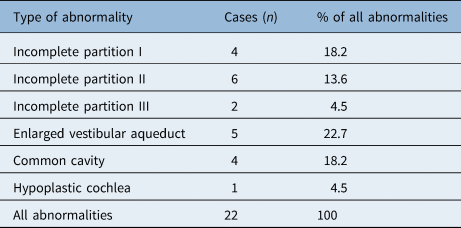
Fifty cochlear implantation patients, 22 patients with inner-ear anomalies and 28 cases with normal anatomy, were enrolled. Their mean age was 16.8 ± 7.4 years (3–48 years). The mean age at cochlear implantation was 5.9 ± 4.8 years (2–25 years). Twenty-five patients were female (50 per cent). The device was inserted in the right ear in 41 patients (82 per cent). A total of 22 patients showed some type of inner-ear anomaly on CT (44 per cent); all were bilateral and symmetrical (Table 1). A total of eight patients showed an intra-operative CSF leak during cochlear implantation surgery (16 per cent). Internal auditory canal narrowing was found in four patients (8 per cent). Sensorineural hearing loss was congenital in 40 patients (80 per cent) and progressive in 10 patients (20 per cent).
Distribution and subtypes of inner-ear anomalies

Between-group comparisons
Vestibular-evoked myogenic potential test
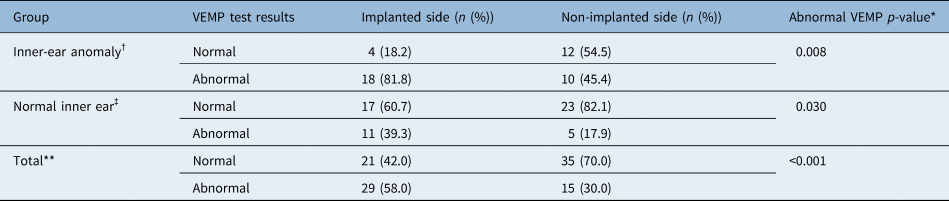
Comparison of vestibular-evoked myogenic potential responses between implanted and non-implanted sides among all cases revealed more abnormal vestibular-evoked myogenic potential function in the implanted sides (all p < 0.05) (Table 2). When comparing vestibular-evoked myogenic potential responses in inner-ear anomaly patients with those in normal inner-ear cases, on the implanted side, the patients with inner-ear anomalies showed more abnormal vestibular-evoked myogenic potentials (81.8 per cent; 18 out of 22) in comparison with normal inner ears (39.3 per cent; 11 out of 28) (p = 0.002, odds ratio = 7.0, 95 per cent CI = 1.9–26.1). Similarly, on the non-implanted side, the patients with inner-ear anomalies revealed worse vestibular-evoked myogenic potential responses (45.5 per cent; 10 out of 22) in comparison to normal inner ears (17.9 per cent; 5 out of 28) (p = 0.035, odds ratio = 3.8, 95 per cent CI = 1.1–13.8).
Comparison of VEMP test results between implanted and non-implanted sides among inner-ear anomaly and normal inner-ear cases

*Implanted versus non-implanted sides. †n = 22; ‡n = 28; **n = 50. VEMP = vestibular-evoked myogenic potential
We assessed the effects of potentially important factors (including sex, age, age at cochlear implantation, internal auditory canal narrowing, type of SNHL, type of cochlear implantation device) on vestibular-evoked myogenic potential abnormality rates in implanted and non-implanted ears, separately. None of the factors had a statistically significant effect on vestibular-evoked myogenic potential abnormality. Intra-operative CSF leak during cochlear implantation was also not associated with more vestibular abnormality (p = 0.055).
Caloric test
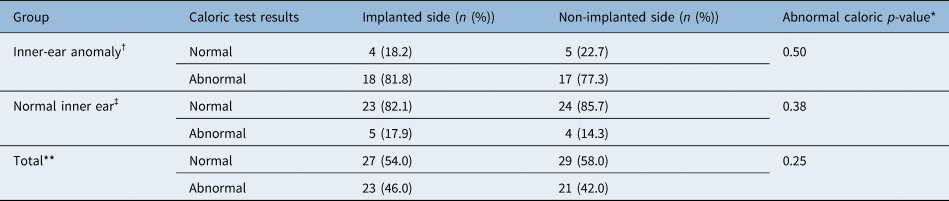
Weakness and absence in caloric responses were recorded as abnormal caloric test results. Comparison of caloric responses between implanted and non-implanted sides among all cases revealed no statistically significant differences (p = 0.25) (Table 3). Patients with inner-ear anomalies showed significantly worse caloric dysfunction (81.8 per cent; 18 out of 22) than those with normal inner ears (17.9 per cent; 5 out of 28) (p < 0.001, odds ratio = 20.7, 95 per cent CI = 4.8–88.4). In addition, on the non-implanted side, patients with inner-ear anomalies revealed a significantly worse caloric result (77.3 per cent; 17 out of 22) versus those with normal inner ears (14.3 per cent; 4 out of 28) (p < 0.001, odds ratio = 20.4, 95 per cent CI = 4.8–87.3).
Comparison of caloric test results between implanted and non-implanted sides among inner-ear anomaly and normal inner-ear cases

*Implanted versus non-implanted sides. †n = 22; ‡n = 28; **n = 50
We also assessed the effects of potentially important factors on the pattern of caloric abnormality, as described above for vestibular-evoked myogenic potentials, in implanted and non-implanted ears separately. The findings revealed that none of the variables had a statistically significant effect (p > 0.05).
Discussion
Various studies have shown the effect of cochlear implantation on balance function. Its clinical significance is controversial and requires more extensive investigations;Reference Buchman, Joy, Hodges, Telischi and Balkany11,Reference Yong, Young, Lea, Foggin, Zaia and Kozak13,Reference Pérez-Martín, Artaso and Díez17 debates regarding patients with cochleovestibular anomalies are still ongoing.
The current study assessed the effects of cochlear implantation and inner-ear anomalies on vestibular function using vestibular-evoked myogenic potential and caloric tests. Documentation of pre-operative vestibular function was limited by difficulties in testing the children at the age of cochlear implantation. Hence, we decided to assess the effect of cochlear implantation on vestibular-evoked myogenic potential and caloric responses by comparing the implanted ears with contralateral non-implanted sides.
We observed worse vestibular-evoked myogenic potential responses in the implanted ears in all patients. However, vestibular-evoked myogenic potentials were worst in implanted ears with inner-ear anomalies, and were least affected in normal inner ears without implants. Both inner-ear anomaly and implantation affected the vestibular-evoked myogenic potential test results. Here, in fact, the synergistic effects of implantation and inner-ear anomaly were combined, and vestibular-evoked myogenic potentials were worse in ears with both an anomaly and an implant. The highest rate of caloric abnormality was seen in patients with inner-ear anomalies, and the lowest rate was found in those with normal inner ears. Regarding the effect of cochlear implantation on caloric responses, implantation showed no association with worse caloric test results, but these tend to be abnormal in patients with inner-ear anomalies.
Compared with the caloric test, the greater sensitivity of the vestibular-evoked myogenic potential test to cochlear implantation could be caused by their different anatomical locations. As vestibular-evoked myogenic potentials are related to saccular impairments in the part of the vestibule nearest to the cochlea, a greater degree of vestibular-evoked myogenic potential impairment can be expected with implantation. In contrast, the caloric test is related to the horizontal semicircular canal;Reference Wuyts, Furman, Vanspauwen and Van de Heyning18 therefore, it was not affected by implantation, but it was sensitive to inner-ear anomalies.
A review of other studies on vestibular assessment after cochlear implantation revealed a wide range of abnormal vestibular symptoms reported following cochlear implantation (47–74 per cent); however, some authors reported symptom alleviation in the long term.Reference Steenerson, Cronin and Gary19,Reference Ito20 Otolith function deterioration assessed by vestibular-evoked myogenic potential tests has been reported in 21–100 per cent of patients, and the saccule is the vestibular organ that is most commonly damaged by implantation. In addition, it has been reported that 19–93 per cent of cochlear implantation patients showed vestibular impairments after cochlear implantation when assessed by caloric test.Reference Thierry, Blanchard, Leboulanger, Parodi, Wiener-Vacher and Garabedian10,Reference Basta, Todt, Goepel and Ernst21–Reference Filipo, Patrizi, La Gamma, D'Elia, La Rosa and Barbara23
Recently, Yong and colleagues reported that patients who undergo cochlear implantation have decreased vestibular-evoked myogenic potential and caloric responses, with widely variable vestibular symptoms.Reference Yong, Young, Lea, Foggin, Zaia and Kozak13 However, in this meta-analysis, they emphasised that previous studies did not evaluate the causes of hearing loss, such as anomalous cochleovestibular anatomy and intra-operative CSF leaks, which are more common in patients with inner-ear anomalies and which may be responsible for post-operative vestibular dysfunction.Reference Yong, Young, Lea, Foggin, Zaia and Kozak13,Reference Hülse, Hörmann, Servais, Hülse and Wenzel24
In our study, the frequency of abnormal vestibular-evoked myogenic potential and caloric test results in normal inner ears was similar to the abnormality rate reported in the literature (in both implanted and non-implanted ears). This is important because the underlying pathology and inner-ear anomalies in patients with SNHL affect the pattern of vestibular impairment. This could be one reason for such a different range reported among the various studies. In addition, our data showed that an intra-operative CSF leak was not associated with more vestibular dysfunction.
• Vestibular function abnormalities in cochlear implantation patients are novel challenges for most clinicians
• This study assessed the impact of cochlear implantation on the vestibular system of inner-ear anomaly patients
• It compared vestibular-evoked myogenic potential and caloric responses in implanted versus non-implanted sides of inner-ear anomaly cases
• These cases were then compared with cochlear implantation patients who had normal inner-ear anatomy
• Inner-ear anomaly and implantation were both associated with more vestibular-evoked myogenic potential abnormalities
• Implantation was not associated with caloric abnormality
Eliciting vestibular reflexes and conducting assessments requires expert technicians, especially in children, who may not co-operate, leading to sub-optimal measurements. Different tests are used to assess the vestibular system, and each test assesses a particular part; in addition, the probability of damage to different vestibular components differs after cochlear implantation, especially in patients with inner-ear anomalies. All these factors could explain the variability in vestibular system impairment after cochlear implantation.
One of the important limitations of this study was the lack of vestibular-evoked myogenic potential and caloric test results prior to implantation and the lack of a test of high-frequency horizontal canal function (i.e. the video head impulse test). Comparing the same ears before and after implantation would provide more precise results. A greater sample size to consider vestibular function in different subgroups of inner-ear anomalies would also give us valuable data.
Based on the current data, we recommend early vestibular evaluation (and rehabilitation if necessary). In order to minimise the risk of injury, surgeons should be aware of the increased rate of labyrinth injury during cochlear implantation in patients with inner-ear anomalies, and they should give more attention to patients who require re-implantation. Finally, cochlear implant electrode technology should be improved, to reduce the risk of injury.
Conclusion
Both inner-ear anomaly and implantation were associated with abnormal vestibular-evoked myogenic potential responses; when combined, there was a positive interaction, leading to an increased rate of vestibular-evoked myogenic potential abnormality. In contrast, caloric test abnormality was primarily dependent on the presence of an inner-ear anomaly and was not associated with implantation.
Acknowledgement
The authors acknowledge the ENT and Head and Neck Research Center, Iran University of Medical Sciences (Tehran, Iran), for financial support.
Data availability statement
Please contact the corresponding author for data requests.
Competing interests
None declared