Significant outcomes
-
Meditation with yoga is feasible and acceptable for clinically stable participants – persons with schizophrenia.
-
Meditation can improve participants’ quality of life and clinical symptoms. There were modest cognitive benefits for participants.
-
No psychotic or any other side effects were reported.
Limitations
-
Due to missingness, the sample size was smaller in some domains, particularly for attention and spatial ability. Effect sizes of imputed and non-imputed data of all groups after 3 weeks and 3 months were in similar direction suggesting no change due to missingness.
-
Participants could not complete two specific tests – the N-back (a test of attention and working memory), and line orientation (a test of spatial ability). Out of three difficulty levels of N-back, many of the participants completed the 0-back and 1-back but could not complete the 2-back.
-
Another limitation was the difficulty for rating the level and state of meditation as it is an internal subjective experience.
Introduction
Antipsychotic drugs improve positive symptoms in schizophrenia (SZ) (Lin et al., Reference Lin, Chan, Lee, Chang, Tse, Su, Sham, Hui, Joe, Chan, Khong, So, Honer and Chen2015) but show little or no effect on cognitive dysfunction or negative symptoms (Leucht et al., Reference Leucht, Arbter, Engel, Kissling and Davis2009), thus motivating searches for alternative or additional treatments. Adjunctive yoga can improve both positive and negative symptoms and significantly improve quality of life (QOL) when compared with exercise or wait list control groups in SZ (Visceglia & Lewis, Reference Visceglia and Lewis2011; Vancampfort et al., Reference Vancampfort, Vansteelandt, Scheewe, Probst, Knapen, De Herdt and De Hert2012). Mindfulness-based practices are also moderately beneficial for negative symptoms (meta-analysis by Khoury et al., Reference Khoury, Lecomte, Gaudiano and Paquin2013) and for attention, concentration and memory through meditation (Khoury et al., Reference Khoury, Lecomte, Gaudiano and Paquin2013). Meditation improves cognition in older persons with age-related cognitive decline (Gard et al., Reference Gard, Hölzel and Lazar2014).
Yoga is practicable and cost-effective with few if any adverse effects and a promising approach for improving cognitive dysfunction in persons diagnosed with SZ (Deshpande et al., Reference Deshpande, Bhatia, Mohandas and Nimgaonkar2016). A meta-analysis to study the effects of yoga training (YT) on cognition in SZ indicated moderate short- and long-term benefits of yoga practice on attention, processing speed and executive functioning (Cramer et al., Reference Cramer, Lauche, Klose, Langhorst and Dobos2013; Gothe et al., Reference Gothe, Pontifex, Hillman and Mcauley2013). Yoga was deemed to be better than standard care for improving cognition among patients with SZ, but there was significant heterogeneity among the three analysed studies (Broderick & Vancampfort, Reference Broderick and Vancampfort2017).
Following a 21-day yoga protocol for cognition among persons diagnosed with SZ, there was significant improvement in attention measures compared to treatment as usual (TAU) with improvement being sustained at 2-month follow-up (Bhatia et al., Reference Bhatia, Agarwal, Shah, Wood, Richard, Gur, Gur, Nimgaonkar, Mazumdar and Deshpande2012, Reference Bhatia, Mazumdar, Mishra, Gur, Gur, Nimgaonkar and Deshpande2014, Reference Bhatia, Mazumdar, Wood, He, Gur, Gur, Nimgaonkar and Deshpande2017). When supervised YT was compared with supervised physical exercise (PE) in persons with SZ (Bhatia et al., Reference Bhatia, Mazumdar, Wood, He, Gur, Gur, Nimgaonkar and Deshpande2017), the speed index of the cognitive domain of attention was significantly superior for YT when compared to PE at 6-month follow-up. Women participants with early psychosis showed improvements in working memory after yoga and aerobic exercises (Lin et al., Reference Lin, Chan, Lee, Chang, Tse, Su, Sham, Hui, Joe, Chan, Khong, So, Honer and Chen2015). The benefits of yoga are found regardless of age, sex, socio-economic status, educational status, duration or severity of illness (Bhatia et al., Reference Bhatia, Gujral, Sharma, Kumari, Wood, Wesesky, Jones, Davis, Iyenger, Haas, Nimgaonkar and Deshpande2021).
Meditation is a set of attentional practices leading to an altered state of consciousness characterised by expanded awareness, greater presence and a more integrated sense of self (Davis et al., Reference Davis, Gold, Hackman, Stern and Gershwin1998). It can be incorporated into regular yoga practices (Krisanaprakornkit et al., Reference Krisanaprakornkit, Krisanaprakornkit, Piyavhatkul and Laopaiboon2006). It focuses on being present with oneself and one’s emotions in the moment. Meditation focuses the practitioner’s attention on one specific activity (e.g. breathing or chanting ‘mantras’) and/or to notice and observe external and internal sensations without judgement (Uthaman & Uthaman, Reference Uthaman and Uthaman2017). The most widely used types of meditation are concentration, mindfulness and their combinations (Shapiro, Reference Shapiro1980). Sudarshan Kriya Yoga is a type of meditation practice that includes both asanas and meditation that can be a potentially beneficial, low-risk adjunct for the treatment of stress, anxiety, post-traumatic stress disorder (PTSD), depression, stress-related medical illnesses and substance abuse (Brown & Gerbarg, Reference Brown and Gerbarg2005). Meditation is also reported to enhance cognition in other mental disorders (May et al., Reference May, Burgard, Mena, Abbasi, Bernhardt, Clemens, Curtis, Daggett, Hauch, Housh, Janz, Lindstrum, Luttropp and Williamson2011; Keshavan et al., Reference Keshavan, Vinogradov, Rumsey, Sherrill and Wagner2014).
Some yoga experts were concerned that meditation practices could precipitate or worsen psychosis (Lu & Pierre, Reference Lu and Pierre2007). Indeed, a few case reports suggested that meditation acted as a stressor in vulnerable patients, who could develop a transient psychosis (Kuijpers et al., Reference Kuijpers, Van Der Heijden, Tuinier and Verhoeven2007). A review reported that despite beneficial effects of meditation, negative effects can sometimes be observed such as depersonalisation, altered reality testing and the appearance of previously repressed, highly charged memories and conflicts (Chan-Ob & Boonyanaruthee, Reference Chan-Ob and Boonyanaruthee1999; Dyga & Stupak, Reference Dyga and Stupak2015). Some studies reported a temporal relationship between meditation and onset of psychiatric symptoms. They suggested that meditation was contraindicated for psychotic patients (Shapiro, Reference Shapiro1994; Kiene et al., Reference Kiene, Hamre and Kienle2013). The risks and benefits of meditation should be carefully considered before offering such therapies (Sharma et al., Reference Sharma, Mahapatra and Gupta2019).
Aims of the study
The present study was conducted to systematically investigate whether persons with SZ could adequately and safely participate in meditation and YT, whether they accept it, and whether meditation could augment the reported beneficial effects of YT on their cognitive performance.
Materials and methods
Ethics approval
The study protocol and consent forms were approved by the Institutional Ethics Committee: see letter number 156(25/2016)/IEC/PGIMER/RMLH) dated 3.10.2016. Written Informed consent was obtained from all participants before participation in the study.
Study design
The study was designed to test whether meditation augments or detracts from the beneficial effects of YT on cognitive functions in patients diagnosed with SZ. Three groups were included: TAU; TAU with YT and TAU with YT and meditation training (MYT). We conducted two types of analyses: (i) within-group analysis, wherein individual variables were compared at the 3-week and 3-month time points with baseline values for that group (TAU, YT and MYT) and (ii) between-group comparisons at these time points.
Recruitment
Patients at a tertiary care, public government teaching hospital with a clinical diagnosis of SZ or schizoaffective (SZA) disorder, who fulfilled inclusion criteria, were referred to the research team, written informed consent was obtained and consenting patients were enrolled into the study.
Sample
Participants were recruited from the Department of Psychiatry at a tertiary care government hospital in New Delhi, India. All were accompanied by relatives at the time of recruitment, and all participants provided written informed consent.
Inclusion criteria
Eligibility criteria included outpatients who were clinically stable and had no changes in medications for the prior 8 weeks, aged between 18 and 60 years, with a Diagnostic and Statistical Manual of Mental Disorders, Fifth Edition (DSM V) diagnosis of SZ or SZA, with total scores on the Positive and Negative Syndrome Scale (PANSS) less than 70, scores on individual ‘positive symptoms’ equal to or less than 4, and with Clinical Global Impression (CGI) Severity scores moderate or better.
Exclusion criteria
The following groups were excluded: those unable to provide written informed consent; those with co-morbid psychiatric or medical disorder that could confound diagnosis, for example, alcohol or illicit substance abuse in the past month, and/or dependence in past 6 months; those who participated in cognitive enhancement trials in the past 12 months; those with intellectual disability severe enough to impact understanding of YT; and those with any physical disability or illness which made the participant unfit for YT or meditation.
Randomisation and assessment
Stratified block randomisation was implemented for allocation of consenting participants to TAU, YT or MYT groups with an online tool (randomisation.com). The sample was stratified by age, with two groups: ‘up to 30 years of age’ and ‘more than 30 years of age’, similar to our earlier study (Bhatia et al., Reference Bhatia, Mazumdar, Wood, He, Gur, Gur, Nimgaonkar and Deshpande2017).
Participants in all three groups were assessed at study entry, at the end of 3 weeks and at 3 months after completing supplementation. The raters were blind to the treatment group. Evaluations were performed with breaks as requested by the participant.
Clinical assessment
Diagnosis
All participants completed a diagnostic evaluation using the Hindi version of the Diagnostic Interview for Genetic Studies (DIGS) (Nurnberger et al., Reference Nurnberger, Blehar, Kaufmann, York-Cooler, Simpson, Harkavy-Friedman, Severe, Malaspina and Reich1994; Deshpande et al., Reference Deshpande, Mathur, Das, Bhatia, Sharma and Nimgaonkar1998), supplemented by their medical records. Consensus diagnoses were established using DSM V criteria (Bhatia et al., Reference Bhatia, Mazumdar, Wood, He, Gur, Gur, Nimgaonkar and Deshpande2017).
Positive and Negative Syndrome Scale (PANSS)
The PANSS, a 7-point rating scale for 30 psychopathological items based on interviews or reports, was used to quantify current symptoms (Kay et al., Reference Kay, Fiszbein and Opler1987). Three features were assessed: positive, negative and general psychopathology. Administration time: 20–25 min.
Clinical Global Impression – Severity (CGI-S)
The Clinical Global Impression – Severity (CGI-S) (Busner and Targum, Reference Busner and Targum2007) is a 7-point scale that rates the severity of the patient’s illness at the time of assessment. Administration time: 5 min.
Global Assessment of Functioning scale
Global Assessment of Functioning scale (Endicott et al. Reference Endicott, Spitzer, Fleiss and Cohen1976) as included in the DIGS was used to measure the overall functioning of participants. It was scored after consensus with a board-certified psychiatrist.
Social functioning
Form B of the UCSD Performance-based Skills Assessment (UPSA Form B) (Patterson et al., Reference Patterson, Goldman, Mckibbin, Hughs and Jeste2001; Twamley et al., Reference Twamley, Jeste and Bellack2003), a comprehensive, validated measure of functional living skills that correlates well with cognitive variables in SZ (Green et al., Reference Green, Nuechterlein, Gold, Barch, Cohen, Essock, Fenton, Frese, Goldberg, Heaton, Keefe, Kern, Kraemer, Stover, Weinberger, Zalcman and Marder2004, Reference Green, Schooler, Kern, Frese, Granberry, Harvey, Karson, Peters, Stewart, Seidman, Sonnenberg, Stone Ws, Stover and Marder2011), was used. The UPSA-B assesses financial and communication skills; combined highest score is 11 in financial skills and 9 in communication skills. Administration time: 30 min.
QOL scale
QLS (Heinrichs et al., Reference Heinrichs, Hanlon and Carpenter1984) is a 21-item, 7-point clinician-rated validated and semi-structured interview instrument, designed to objectively evaluate the current functioning levels of outpatients affected with SZ. Higher scores (5 and 6) reflect normal or unimpaired functioning, and low scores (0 and 1) reflect severe impairment of the function in question. The scale items belong to the following four categories: (1) intrapsychic foundations; (2) interpersonal relations; (3) instrumental role; and (4) common objects and activities. The intrapsychic foundations items (13–17, 20 and 21) elicit clinical judgements about intrapsychic elements for cognition, conation and affectivity (core SZ deficits). Defects in the areas of patient’s sense of purpose, motivation, curiosity, empathy, ability to experience pleasure and emotional interaction are expected to be reflected in impairments in the other three categories. The second category, interpersonal relations (items 1–8), relates to various aspects of interpersonal and social experience. The instrumental role category (items 9–12) focuses on occupational role. The final category, common objects and activities (items 18 and 19), assumes that robust participation in the community is reflected in the possession of common objects and the engagement in a range of regular activities. Administration time: 40 min.
Anchored visual analogue scale (VAS) scale for assessing expectations/satisfaction/motivation
We designed an anchored visual analogue scale (aVAS) to assess these variables in relation to YT/MYT at baseline and post-treatment satisfaction from all participants immediately after YT/MYT (Hardy & Rejeski, Reference Hardy and Rejeski1989). Open-ended questions regarding satisfaction and problems with the training were also asked. Administration time: 15 min.
Physiological variables
(i) Resting heart rate, (ii) blood pressure in the supine/standing position using standard procedures (Heinrichs et al., Reference Heinrichs, Hanlon and Carpenter1984; Pickering, Reference Pickering1994), (iii) weight, (iii) waist-to-hip ratio and (iv) body mass index were measured. Time: 15 min.
Cognitive assessment
Computerised Neurocognitive Battery (CNB)
The key cognitive assessment was based on an efficient, validated computerised neurocognitive battery (CNB) (Gur et al., Reference Gur, Ragland, Moberg, Bilker, Kohler, Siegel and Gur2001) following our previous protocol (Bhatia et al., Reference Bhatia, Agarwal, Shah, Wood, Richard, Gur, Gur, Nimgaonkar, Mazumdar and Deshpande2012) and paper-and-pencil Trail Making Test (TMT) (Horton, Reference Horton1979). Eight domains from the CNB – abstraction and mental flexibility, attention, face memory, spatial memory, spatial processing, working memory, sensorimotor dexterity and emotion processing were assessed with two summary indices namely accuracy and speed (Bhatia et al., Reference Bhatia, Mazumdar, Mishra, Gur, Gur, Nimgaonkar and Deshpande2014, Reference Bhatia, Mazumdar, Wood, He, Gur, Gur, Nimgaonkar and Deshpande2017). Administration time: 20–25 min.
Trail Making Test (TMT)
The TMT is a brief paper-and-pencil neuropsychological test used for screening cognitive impairment (Horton & Roberts, Reference Horton and Roberts2001). Our group has established and published norms for the TMT on Indian subjects (Bhatia et al., Reference Bhatia, Shriharsh, Adlakha, Bisht, Garg and Deshpande2007). Administration time: 10–15 min.
All scales were administered by qualified study psychologists/psychiatric social workers. There were regular reliability meetings to assess all scales among investigators and raters. Raters were blind to the group assigned to the participant.
Interventions
The three groups were assessed after 3 weeks and after 3 months: YT, MYT and TAU. Clinical treatment, including pharmacotherapy, was continued as usual, avoiding dose changes as far as possible, in all three groups by their respective treating psychiatrists who were blind to their patient’s group. Only five participants required a change of medication from one type of antipsychotic to another, and for six participants, brands of the medicines were changed. All participants were on antipsychotics (80% on atypical, 17% both typical and atypical antipsychotic medications, 2% only on typical antipsychotics and 7% on antidepressants as well).
YT protocol
The yoga protocol required 1-h daily practice for 3 weeks, excluding Sundays and national holidays. It consisted of deep breathing, Om chanting, Sukshma Vyayama (subtle exercises), warm-up exercises, asanas in different positions, Pranayama (breathing exercises) and Shanti Mantra (a prayer) for 6 days a week (Bhatia et al., Reference Bhatia, Agarwal, Shah, Wood, Richard, Gur, Gur, Nimgaonkar, Mazumdar and Deshpande2012). YT was undertaken at a designated Departmental Yoga Centre. On Saturdays, Kriya practices involving jalneti, that is, cleansing and moisturising of nasal channel was carried out along with YT/MYT as assigned.
MYT meditation protocol
Two steps were included: ‘Anapana’ and ‘Yoga Nidra’.
Mini Anapana: After an extensive review of meditation practices, Vipassana practice (described by Vipassana Research Institute as an observational self-exploratory journey realised through disciplined attention to the physical sensations) was used. Anapana is the first step in practicing Vipassana and consists of observing one’s own natural normal breathing, inspiration and expiration. It is easy, simple yet objective and claims to improve concentration (Deo et al., Reference Deo, Itagi, Thaiyar and Kuldeep2015). We used the Mini Anapana practice (10 min duration) developed by S. N. Goenka, a renowned teacher of Vipassana Meditation in which participants must concentrate on their natural breathing, avoiding outside stimuli and living in the present (Deo et al., Reference Deo, Itagi, Thaiyar and Kuldeep2015). This method is believed to improve attention, thoughts, mental peace and decision-making.
Yoga Nidra: The second step is Yoga Nidra, or yogic sleep followed by Anapana, one of the easiest yogic practices to develop and maintain. While the person rests comfortably in Shavasana (relaxed supine posture), this systematic technique takes one through the Panchakosha (five layers of self), leaving the person with a sense of wholeness (Bhagat, Reference Bhagat2018). Yoga Nidra promotes deep rest and relaxation. During ‘Yoga Nidra’, participants lay in a relaxed posture (Shavasana) and were asked to undertake a ‘body scan’, without falling asleep thus producing a state of relaxed awareness of the body. The Yoga Nidra technique of the Bihar School of Yoga was used (Parker et al., Reference Parker, Bharati and Fernandez2013).
Yoga therapist was blind to the assessments at each stage. During intervention, for about 50% of participants, family caregiver accompanied the participant to the hospital at least on some days.
Procedure
Yoga training (YT)
YT and MYT participants followed the same protocol for yoga asanas as described above, administered by trained yoga therapist who delivered the protocol uniformly. The YT/MYT group had between one and five participants at a time so that therapist could observe all participants.
Meditation (MYT)
After completing Yogasana and Pranayama, MYT participants sat in a comfortable cross-legged posture with eyes closed (Sukhasana with Dhyana Mudra). Uniform instructions, written in Hindi, were read out daily to all the participants by a trained yoga therapist. A quietened ‘Yoga Hall’ was used for meditation. The participants were asked to listen to instructions carefully and attentively. All participants sat in similar asana and mudra with minimal movement for the duration of the meditation session. They were asked to control their mind and avoid unnecessary thoughts and emotions. The stillness and stability in the participants were taken as indicators of their involvement in meditation. Their expressions had to be calm, and this improved with practice. Their posture, breathing and facial expressions were constantly observed by the therapist as these were indicative whether instructions were being followed and assessed their ability to meditate. The relatively small number of participants (1–5) in a group enabled the yoga instructor to observe each individual and assess whether they were meditating properly or not.
Treatment as usual (TAU)
The participants received standard TAU and completed all evaluations listed above. We made sure that TAU group did not participate in any yoga programme even outside this research project.
Follow-up and continuation of training
All participants who underwent YT or MYT were retested immediately after the last yoga session and 3 months later. All YT and MYT participants were asked to continue unsupervised YT or MYT, respectively, after they completed the study and mark their practice dates and time on a specially designed compliance chart with evaluation carried out irrespective of compliance. TAU participants were also evaluated similar to intervention groups at every time point.
Sample size estimation
Sample size was calculated using online software G × Power (Faul et al., Reference Faul, Erdfelder, Lang and Buchner2007). The lowest significant effect size in our prior YT study was 0.30; hence, we selected an effect size of 0.25 for the present study (Bhatia et al. Reference Bhatia, Mazumdar, Mishra, Gur, Gur, Nimgaonkar and Deshpande2014). We included three groups and three-time repeated factor levels. Correlations between repeated measures in our preliminary study were 0.3 to 0.5 (Bhatia et al., Reference Bhatia, Mazumdar, Wood, He, Gur, Gur, Nimgaonkar and Deshpande2017). The correlation used for present calculations were 0.3. We used ANOVA repeated measures between factors. Based on sample size calculations, we enrolled a sample size of N = 120, with 40 in each group. With this sample size, we expected to obtain approximately 85% power with medium effect size (0.25) at 0.05 alpha level. Considering a 20% attrition rate, the final sample size selected was 48 in each group (total N = 144).
Data analysis
CNB data were downloaded online from the Penn CNB website. Other data were entered using Microsoft Access software specially designed for this project and were retrieved for analysis. All data were double-checked and corrected, and outliers were removed. Descriptive statistics were computed for sociodemographic, clinical, physical and cognitive variables.
To study within-group changes, the effect size (Cohen’s d) was separately calculated for change in acceptability, clinical, social and cognitive functions outcomes. The Wilcoxon signed-rank test was used to evaluate the level of significance of effect sizes. The paired t-test was also used to analyse within-group change.
For between-group analyses, we used a mixed model repeated measures model, using three time points: baseline, 3 weeks and 3 months, both after completion of intervention. The model included group (YT, MYT and TAU), time (baseline, 3 weeks and 3 months), time × group interaction, gender, age and head of household (HOH) occupation (a proxy for socio-economic status taken from the DIGS). We used SAS ® software PROC MIXED (36). All hypotheses were tested using the ESTIMATE statement in PROC MIXED.
Results
Sample
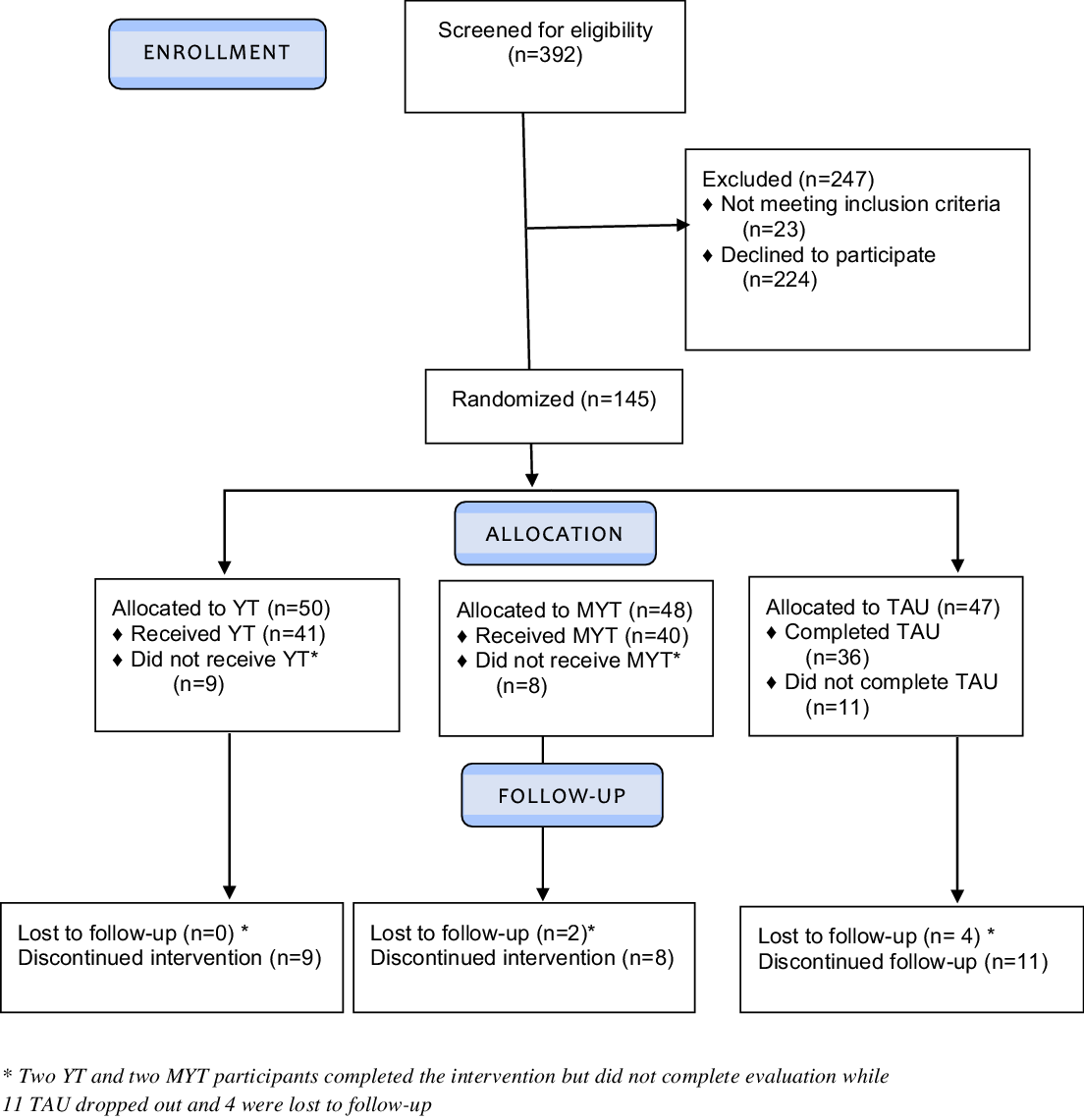
We screened 392 patients between 2017 and 2019 (Fig. 1), of whom 23 did not meet the inclusion criteria, and 224 declined to participate. The main reasons for denying to participate was inability of the patients and their caregivers to come to the hospital to attend YT sessions. Around 20% were working and could not take leave, and many were housewives and could not attend as they had to take care of the children and other household chores. Some could not come to the hospital alone, but their family members were busy with their jobs and could not escort them. These reasons held true even when we willingly adjusted timings of our yoga classes.
Flowchart of recruitment and design.

The remaining 145 patients provided written informed consent and were randomised to three groups (YT 50, MYT 48 and TAU 47). A total of 41 YT and 40 MYT participants completed the intervention and were assessed at 3 weeks along with 36 TAU participants. Participants who discontinued the intervention or were lost to follow-up included YT (N = 9), MYT (N = 8) and TAU (N = 11) participants. Reasons for dropout included commuting difficulties, staying at far-off places and relatives’ non-availability to accompany participant for training sessions.
Of nine YT and eight MYT participants who did not complete intervention after baseline evaluation, seven YT and six MYT participants dropped out after completing 2–8 sessions. Reasons given among the YT group were difficulty to perform asanas, inability to attend regularly or lack of confidence. Participants from the MYT group also expressed difficulty in performing some asanas, lack of motivation and relative could not accompany the participant for her/his sessions. None of them found the meditation protocol difficult. Two YT and two MYT participants completed 18-day sessions but did not return for evaluation after completion. The remaining dropped out after baseline evaluation only. Thus, 82% YT, 83% MYT and 76.6% of TAU participants completed their intervention successfully. Dropouts did not differ significantly among groups in terms of gender ratio and age. None of YT and MYT participants reported any side effects. Among TAU, 4 were lost to follow-up and 11 did not complete the follow-up. There was no significant gender and age differences among study dropouts. Overall, the study dropout rates were 23% in TAU, 17% in MYT and 18% in the YT group. We did not note any relapse of psychosis after meditation. None of the participants reported any aggravation of psychotic symptoms or any other side effects.
Demographic and clinical comparisons between groups
There was no significant difference among the three groups with regard to age, school years, distribution by gender, marital status and occupation (Supplementary Table 1). The majority of participants were young adult male patients, educated up to high school and were married. As the hospital recruitment site caters to middle- and low-socio-economic class, a majority of heads of the household were in either service occupations or lower categories. A majority of participants were unemployed in all three groups. Clinical variables like age at onset, past month Global Assessment of Functioning (GAF) (means between 43.82 and 40.31) and Clinical Global Impression (CGI) scores (means between 4 and 4.30) were also similar in all three groups.
Acceptability of MYT in comparison with YT and TAU
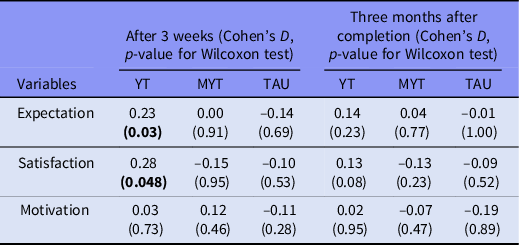
The aVAS was completed by 37 YT, 41 MYT and 27 TAU participants. We calculated Cohen’s d and the p-value for Wilcoxon’s z-test for expectation, satisfaction and motivation. In the YT group expectation (d = 0.23, Wilcoxon p = 0.03) and satisfaction (d = 0.28, Wilcoxon p = 0.048) increased significantly from baseline to post-intervention. There was no significant difference among MYT and TAU groups on expectation, satisfaction and motivation at baseline, nor after intervention and at follow-up (Table 1). However, effect sizes became smaller from YT to MYT to TAU.
Within-group changes in acceptability (expectation, satisfaction and motivation) after 3 weeks of intervention or TAU and after 3 months follow-up (effect sizes and p-value for Wilcoxon test)

Compliance after completion of intervention at home
All YT and MYT participants were asked to carry on YT/MYT at home after completion of training. They were given a compliance chart for 3 months (90 days) after completing 3 weeks of training – 50.6% of YT and 49.4% of MYT participants returned the compliance chart.
The average duration of practice was as follows (mean ± SD): YT group participants: 57.04 ± 35.37/90 days and MYT group participants – 55.66 ± 33.94/90 days (not significantly different). The participants practiced more in the first month and least in the third month. If we add the participants who did not return their compliance forms and assume that they did not do any yoga at all, the YT and MYT means were 36.17 ± 39.44 and 45.92 ± 37.17 days, respectively, also not significantly different.
Clinical variables
Within-group comparisons
Clinical changes – Baseline versus 3 weeks versus 3 months after YT/MYT
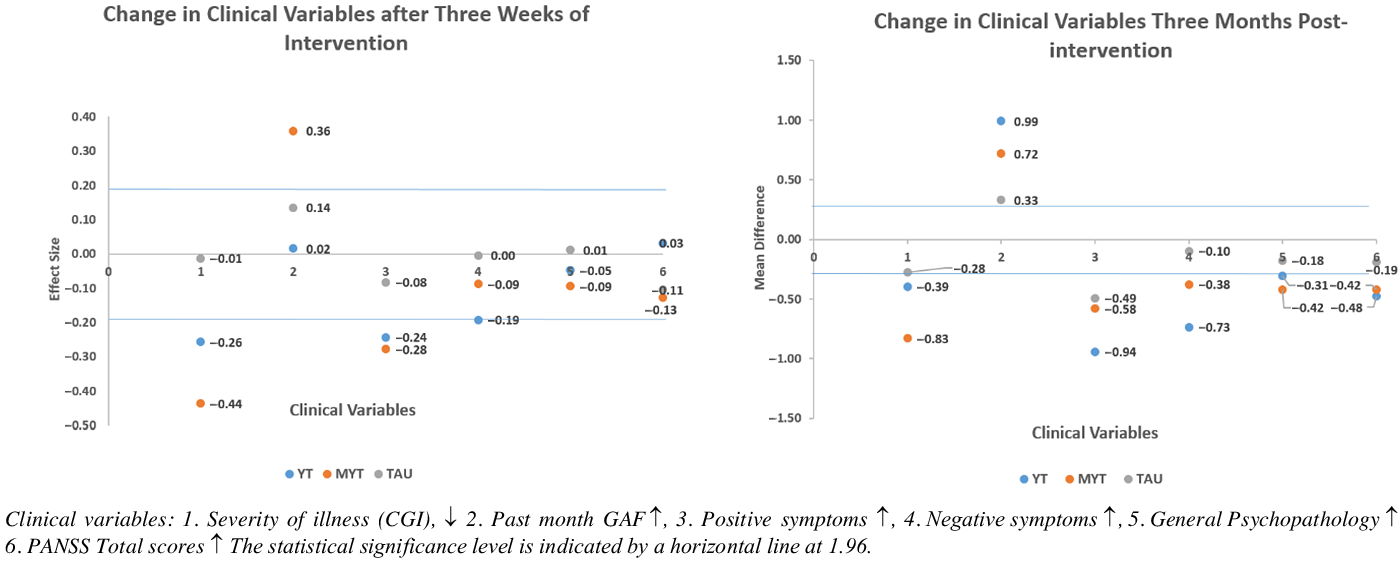
The following clinical variables were assessed: 1. severity of illness (CGI), 2. past month GAF, 3. positive symptoms, 4. negative symptoms, 5. general psychopathology and 6. PANSS total scores (Supplementary Table 2; Fig. 2 ). For all six clinical variables, the direction of changes was in the desired direction for the MYT group, and the effect sizes were greater in the MYT group compared with the TAU group after 3 weeks and 3 months of intervention. For the YT group, the direction of changes was in the desired direction for five variables – with the exception of the PANSS total scores – after 3 weeks of training, and the effect sizes were greater in the MYT group compared with the TAU group for the same variables. At 3-month post-intervention, the direction and the magnitude of changes were greater in the YT group compared with the TAU group for all six clinical variables. The statistical significance level for the observed differences compared with baseline values are as follows.
Change in baseline values for clinical variables after 3 weeks of intervention and after 3 months after intervention (effect sizes).

YT group
Significant change was observed after YT on PANSS positive symptoms after 3 weeks with effect size (−0.24, p = 0.04). After 3 months, there were significant improvement in clinical parameters as well: severity of illness (CGI) (−0.39, p = 0.04), positive symptoms (−0.94, p = 0.02), negative symptoms (−0.73, p = 0.003), general psychopathology (−0.31, p = 0.05) and PANSS total (−0.48, p = 0.01). Past month GAF (0.99, p = 0.00004) also improved significantly.
MYT group
There was significant improvement in the past month only in severity of illness (CGI) (0.44, p = 0.004), GAF (0.359, p = 0.02) and in PANSS positive symptoms (−0.278, p = 0.04) after 3 weeks. After 3 months, the MYT group showed improvement in severity of illness (−0.83, p = 0.002), past month GAF (0.72, p = 0.005), positive symptoms (−0.58, p = 0.002), negative symptoms (−0.38, p = 0.02), general psychopathology (−0.42, p = 0.04) and PANSS total (−0.42, p = 0.002).
TAU group
There was no significant improvement in any of the clinical parameters in TAU group after 3 weeks. After 3 months, there was nominally significant improvement in past month GAF (0.33, p = 0.02), PANSS positive symptoms (−0.49, p = 0.02) and negative symptoms (−0.097, p = 0.027) in the TAU group. None of the other parameters changed.
Between-group changes on clinical variables
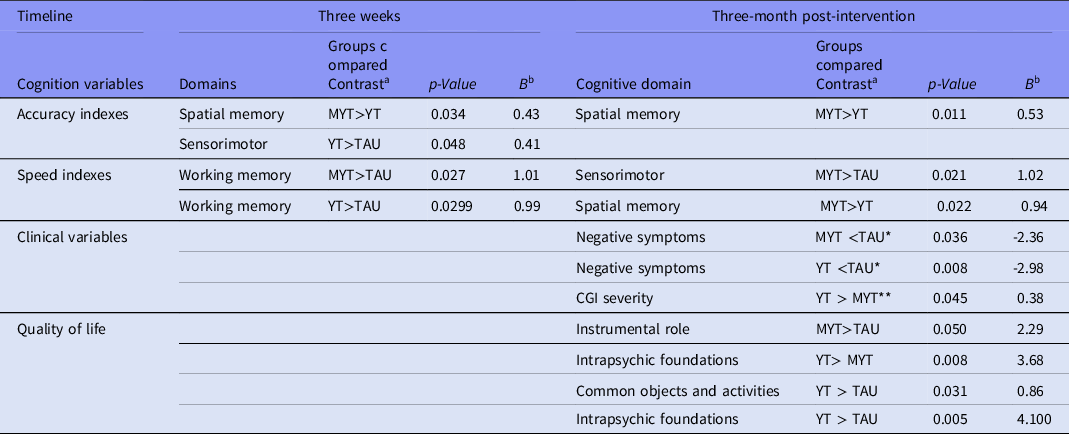
Using repeated measures test on our three groups for changes in clinical variables, moderate change was observed after follow-up as follows: MYT (−2.36, p = 0.03) and YT (−2.98, p = 0.008) both improved more than TAU on PANSS negative symptoms. CGI severity decreased more significantly for MYT than YT (−0.38, p = 0.045) at 3-month post-intervention.
Social function variables
Within-group comparisons of social function variables (Supplementary Table 2)
Quality of life (QOL)
No significant change was observed in any of the three group after 3 weeks of intervention. However, at 3-month post-intervention, there was significant improvement in intrapsychic foundation (0.85, p = 0.00002), interpersonal relations (0.23, p = 0.043) and instrument (0.52, p = 0.018) domains of QOL in YT group. In MYT group also, significant change was observed in intrapsychic foundations (0.45, p = 0.005), interpersonal relations (0.27, p = 0.043) and instrument domains (0.43, p = 0.002)) of the scale after 3 months. Change was also observed in TAU group in intrapsychic foundation domain (0.29, p = 0.022).
Functioning (UPSA B)
There was significant change after 3 weeks of intervention in MYT group on financial skills test of UPSA B (0.12, p = 0.031), and the same group also showed improvement after 3 months of intervention in both financial skills (0.25, p = 0.02) and total UPSA B score (0.001). YT group also showed significant change in communication (0.22, p = 0.006) and UPSA B total score (0.31, p = 0.001) after 3 months. TAU also showed significant changes in financial skills (0.23, p = 0.02) and total UPSA B score (0.23, p = 0.036).
Between-group changes on social variables
Significant improvement was reported in YT and MYT groups while comparing the three groups on QOL domains using repeated measures test. These improvements were not significant at 3 weeks, but after 3 months MYT showed significantly more improvement than YT on instrumental role (2.288, p = 0.05), while YT showed significant advantage over MYT (3.685, p = 0.008) and TAU (4.1, p = 0.005) on intrapsychic functions. Common objects and activities domain improved more in YT than TAU after 3 months (0.863, p = 0.031) (Table 3).
Physiological variables
No statistically significant change was observed in physiological variables both after 3 weeks and 3 months in any of the three groups (data not shown).
Cognitive domains
Within-group changes in TMT
The TMT was administered to all participants at all three assessment points. There was significant improvement (in terms of less time taken to complete the task) in case of Task A in both YT and MYT groups both after 3 weeks of yoga and 3 months after completion of intervention. For Task B, the effect size for YT group was moderate (D = −0.328) but was not statistically significant; for TAU group, the Task B values decreased in time taken to complete the test (D = −0.419, p = 0.03). Three months after completion of intervention, there was no significant change in any of the three groups both for Task A and Task B (Supplementary Table 2).
Within-group changes in CNB domain scores
Baseline cognitive domain scores
The CNB data were normalised with Indian controls’ dataset, and the normalised scores were used for statistical analyses. There was no significant difference on any of the cognitive domains tested among the groups at baseline (data available with authors). We tested participants at three time points (baseline – t1, after 3 weeks intervention – t2 and 3 months later – t3) on two indices – speed and accuracy of eight domains: abstraction and mental flexibility, attention, face memory, spatial memory, spatial processing, working memory, sensorimotor dexterity, and emotion processing.
Comparison between baseline and after intervention within groups
The mean and standard deviation scores of all groups on all domains before (mean of time point 1) (M ± SD) and after 3 weeks of yoga (mean of time point 2) (M ± SD) were obtained. The effect sizes were calculated for all three groups at baseline versus assessment after intervention to evaluate the change in cognitive domains. Similarly, the effect sizes were calculated for all three groups at baseline versus assessment after 3 months of intervention to evaluate the change in cognitive domains. We also used the Wilcoxon signed-rank test between baseline and 3 months after intervention (Supplementary Table 2) and the paired t-test (results of paired t-test are illustrated in Supplementary Table 3).
Changes in the accuracy index
YT group
Using the Wilcoxon signed-rank test on pre- and post-data, we found significant improvement in accuracy index of attention (0.252, p = 0.003) and sensorimotor domains (0.438, p = 0.0001). After 3 months, we found significant improvement in spatial ability (0.309, p = 0.29) and sensorimotor (0.490, p = 0.0002) (Supplementary Table 2).
MYT group
After 3 weeks, improvement was found in accuracy indexes of attention (0.521, p = 0.004), spatial memory (0.336, p = 0.007) and sensorimotor domains. After 3 months, improvement was observed in accuracy and mental flexibility (0.379, p = 0.005) and attention (0.432, p = 0.14) (Supplementary Table 2).
TAU group
Face memory (accuracy) (0.331, p = 0.02) showed a slight increase at 3 weeks. The Wilcoxon test did not show any significant differences after 3 months (Supplementary Table 2).
Changes in the speed index
YT group
Using Wilcoxon signed-rank test on pre- and post-data, we found no significant change in speed parameters after YT alone (Supplementary Table 2). After 3 months, we observed significant improvement in speed index of abstraction and mental flexibility domain (0.406, p = 0.046) (Supplementary Table 2).
MYT group
After 3 weeks, improvement was found in speed indices of spatial memory (0.243, p = 0.005) and sensorimotor (0.142, p = 0.02) domains. After 3 months, we observed significant improvement in speed index of abstraction and mental flexibility (0.325, p = 0.044), spatial memory (0.339, p = 0.002) and sensorimotor (0.261, p = 0.014) (Supplementary Table 2).
TAU group
Working memory speed decreased at 3 weeks (Supplementary Table 2).
Comparison of three groups on mean difference of CNB domain scores
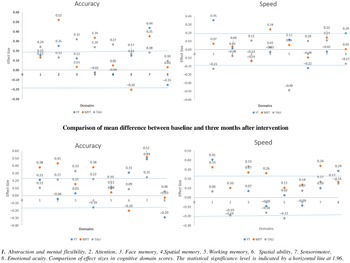
Figure 3 depicts mean differences at all three time points across all three groups. The scatterplot shows for the speed index, and YT improved most in abstraction and mental flexibility and sensorimotor domains, while MYT improved most in sensorimotor domain 3 months after intervention. For the accuracy index, MYT improved most in attention and spatial memory domains, while YT group improved most in sensorimotor domains after 3 weeks of intervention.
Comparison of effect size between baseline and after intervention.

Comparisons between YT and MYT together versus TAU group
We combined YT and MYT groups at 3 weeks and 3 months and compared them to the TAU groups (Supplementary Figs. 1 and 2). In case of the clinical variables, the severity of illness and the positive symptoms decreased significantly more in MYT + YT than the TAU group after 3 weeks of intervention, while in case of 3 months after intervention, severity of illness, positive symptoms and negative symptoms decreased significantly, while GAF improved significantly more than TAU (Supplementary Fig. 1).
In case of QOL, intrapsychic foundations and instrumental role improved in YT + MYT group more than TAU 3 months after intervention (Supplementary Fig. 1).
In speed index, working memory domain decreased significantly in TAU group (Supplementary Fig. 2). There was significant improvement in accuracy index of attention and sensorimotor domains in YT + MYT group as compared to TAU group, while the accuracy index of face memory and working memory improved in TAU group after 3 weeks.
Between-group comparison between baseline and after intervention
Repeated measures test was carried out to compare different groups on changes in cognitive domains across evaluation time points. For accuracy index, MYT performed better than YT on spatial memory (p = 0.03) and YT performed better than TAU on sensorimotor domain (p = 0.048) after 3-week intervention. In case of speed index, both MYT (0.027) and YT (0.29) performed better than TAU on working memory domain.
After 3 months, improvement in MYT was more than TAU on speed (p = 0.022) and accuracy (p = 0.011) indices of spatial memory and speed index of sensorimotor (p = 0.021) (Table 2).
Statistically significant contrasts a between baseline and post-training assessments among the three groups (repeated measures test)

* MYT/YT groups had lower score of negative symptoms than TAU 3-month post-intervention.
** YT group had more severe symptoms 3-month post-intervention compared to MYT.
a Contrasts were calculated from mixed model analysis with group (YT, MYT and TAU), time (baseline, 3 weeks and 3 months), time*group interaction, gender, age and HOH occupation. The p-values represent contrast significance levels.
b Standardised regression coefficients of the contrast-specific dummy group variables from linear regressions were used as measures of effect sizes. The dependent variables were the changes of follow-up scores from the baseline scores and age, gender and HOH occupation as covariates.
Missing data analysis in domains of CNB
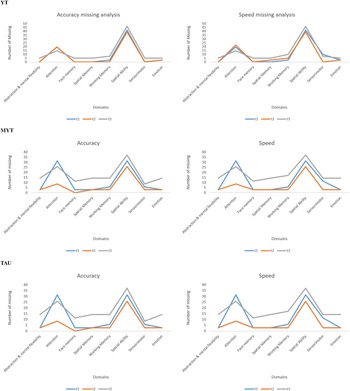
We compared the missingness of all groups across time points (Fig. 3). In YT group, in face memory, spatial memory and working memory domains, missing data rates were higher at 3 months after intervention. In MYT, missing data were greater at baseline than at 3 weeks and 3 months after intervention. Similarly, in all three groups, attention and spatial memory domains had more missingness at all time points, and this may be because of difficulty in performing the tests. We used imputation for all cognitive domains to calculate the effect sizes at various time points. The effect sizes of imputed data were compared with effect sizes without imputation (Supplementary Table 4). The missingness is graphically represented in Fig. 4 separately for YT, MYT and TAU. Missingness was similar on all three time points in YT. In case of MYT, it was more at time point 3, while the it was more at both time points 2 and 3 for TAU.
Graphical representation of missing data among cognitive domains in YT, MYT and TAU across all time points.

Discussion
This study reports feasibility, acceptability and response to MYT among persons with SZ as compared to YT and TAU. To our knowledge, this is the first such head-to-head trial. No significant group-wise differences were noted at baseline for any of the variables between the three comparison groups. We also had no significant gender and age differences among study dropouts, indicating that both YT and MYT were acceptable to all age groups as well as both genders. A relatively high rate of attendance and retention until the end of the intervention suggested that the combination of yoga and meditation was successful in attracting and engaging the participants.
Our results are consistent with prior studies. In a study on mindfulness, there were no side effects or exacerbation of psychotic symptoms in any of the participants (Granholm et al., Reference Granholm, Mcquaid, Mcclure, Auslander, Perivoliotis, Pedrelli, Patterson and Jeste2005, Tabak & Granholm, Reference Tabak and Granholm2014), though a Cochrane review noted that results were inconclusive due to high dropouts in studies comparing meditation with relaxation therapies for anxiety disorders (Krisanaprakornkit et al., Reference Krisanaprakornkit, Krisanaprakornkit, Piyavhatkul and Laopaiboon2006). Reported barriers to yoga practice included lack of concentration, miscellaneous reports of pain/discomfort, illness and lack of motivation (Mensah & Anderson, Reference Mensah and Anderson2015). Only one of our participants dropped out due to ‘lack of motivation’. Symptoms such as those of depression, anxiety, dissociative symptoms, psychotic symptoms and suicidal ideation have been described after meditation (Middleton et al., Reference Middleton, Magaña López, Haaz Moonaz, Tataw-Ayuketah, Ward and Wallen2017) perhaps because of sensory deprivation, loss of sleep and fasting (Sharma et al., Reference Sharma, Mahapatra and Gupta2019). In our study, no side effects or serious adverse events were reported. In sum, yoga is adaptable for most ages (Gothe et al., Reference Gothe, Khan, Hayes, Erlenbach and Damoiseaux2019).
We considered PANSS total scores as also positive symptoms scores as inclusion criteria. Thus, negative symptoms were indirectly included. Also, we followed DSM V criteria, wherein the core symptoms for diagnosis are positive symptoms. During the information process for the study, patients and caregivers were both present. Thus, only presence of negative symptoms may not have determined their participation or non-participation. Both YT and MYT groups improved significantly on PANSS negative symptoms as compared to TAU. Our effect sizes indicated significant improvement of almost all clinical symptoms, albeit with small to medium effect sizes. Others reported improvement of negative symptoms in SZ after meditation and yoga (Visceglia and Lewis, Reference Visceglia and Lewis2011b). These authors found significant improvement in both positive and negative symptoms as well as general psychopathology of SZ after 8 weeks of YT. Behere and colleagues noted that YT could be a useful add-on treatment to improve psychopathology and socio-occupational functioning in antipsychotic-stabilised patients with SZ (Behere et al., Reference Behere, Arasappa, Jagannathan, Varambally, Venkatasubramanian, Thirthalli, Subbakrishna, Nagendra and Gangadhar2011). YT as an add-on treatment in outpatients with SZ showed significant improvement in PANSS and total PANSS scores as well as in the social functioning (Varambally et al., Reference Varambally, Gangadhar, Thirthalli, Jagannathan, Kumar, Venkatasubramanian, Muralidhar, Subbakrishna and Nagendra2012). Another group also reported reduction of psychopathology after YT (Paikkatt et al., Reference Paikkatt, Singh, Singh, Jahan and Ranjan2015).
We found improvements in certain dimensions of the QOL scale after YT as well as MYT and TAU, though results were statistically significant after 3 months. Kizhakkeveettil et al. systematically reviewed randomised controlled trials, and five out of seven studies showed significant benefit of yoga on QOL (Kizhakkeveettil et al., Reference Kizhakkeveettil, Whedon, Schmalzl and El2019). Similarly, in another study, YT improved QOL of patients diagnosed with SZ (Visceglia & Lewis, Reference Visceglia and Lewis2011a). MYT was associated with greater improvement than TAU on the instrumental role domain of QOL, while YT was better on activities indicating community participation, reflected by common objects and the engagement in a range of regular activities. YT improved more than MYT and TAU on intrapsychic foundations that are related to cognitive functions in SZ, a domain derived from SZ deficit in motivation (Lecardeur, Reference Lecardeur2015). Improvement in cognition and positive and negative symptoms in SZ improves QOL (Savilla et al., Reference Savilla, Kettler and Galletly2008; Yamauchi et al., Reference Yamauchi, Aki, Tomotake, Iga, Numata, Motoki, Izaki, Tayoshi, Kinouchi, Sumitani, Takikawa, Kaneda, Taniguchi, Ishimoto, Ueno and Ohmori2008). MYT and YT improved both negative symptoms and cognition in our study; hence, our training probably positively influenced the participants’ QOL.
Meditation can augment various cognitive functions, including attention, memory and executive function (Jha et al., Reference Jha, Krompinger and Baime2007; Tang et al., Reference Tang, Ma, Wang, Fan, Feng, Lu, Yu, Sui, Rothbart, Fan and Posner2007; Jha et al., Reference Jha, Stanley, Kiyonaga, Wong and Gelfand2010; Zeidan et al., Reference Zeidan, Johnson, Diamond, David and Goolkasian2010). It positively affects brain function and structure relevant to cognition (Brefczynski-Lewis et al., Reference Brefczynski-Lewis, Lutz, Schaefer, Levinson and Davidson2007). Our earlier studies reported enhancement in cognition after yoga, but meditation was not tested (Bhatia et al., Reference Bhatia, Agarwal, Shah, Wood, Richard, Gur, Gur, Nimgaonkar, Mazumdar and Deshpande2012; Gothe et al., Reference Gothe, Pontifex, Hillman and Mcauley2013; Bhatia et al., Reference Bhatia, Mazumdar, Mishra, Gur, Gur, Nimgaonkar and Deshpande2014, Reference Bhatia, Mazumdar, Wood, He, Gur, Gur, Nimgaonkar and Deshpande2017). We found significant effect sizes suggesting moderate enhancement in some cognitive domains both after YT and MYT immediately after intervention. However, on using multivariate analysis, MYT showed greater improvement than YT on spatial memory domain. Thus, adding meditation to yoga may have augmented this positive change.
Yoga improves sensory input through the primary tactile, vestibular and proprioceptive neurological pathways, as it involves motor skills for the poses (Campbell, Reference Campbell2017). These sensory systems are fundamental to sensory integration to develop the higher functions of balance, coordination, motor planning, attention, emotional stability and visual perception with the by-products of concentration, self-control and academic learning (Campbell, Reference Campbell2017). This may explain the sensorimotor changes in YT and MYT in our study.
Other studies have also reported that meditation enhances cognition. Brief mindfulness training significantly improved visuospatial processing, working memory and executive functioning (Zeidan et al., Reference Zeidan, Johnson, Diamond, David and Goolkasian2010). Among children, yoga practice including physical postures, yoga breathing, meditation and guided relaxation improved delayed recall of spatial information (Manjunath et al., Reference Manjunath, Varambally, Thirthalli, Basavaraddi and Gangadhar2013). Improvement in spatial memory scores following yoga could be related to reduction in anxiety and resulting improvement in tasks requiring learning and memory (Saltz, Reference Saltz1970); the anxiety-reducing effects of meditation are well known (Platania-Solazzo et al., Reference Platania-Solazzo, Field, Blank, Seligman, Kuhn, Schanberg and Saab1992). Yoga needs focused attention in completing the pose, controlling the body and steady breathing (Gothe et al., Reference Gothe, Khan, Hayes, Erlenbach and Damoiseaux2019). Pranayama (steady breathing) and meditation practice calms and focuses the mind, and the two are practiced to calm and focus the mind and develop greater self-awareness (Morone & Greco, Reference Morone and Greco2007). This focused effort and attentional practice of yoga could generalise to conventionally assessed cognitive functions, including attention, memory and higher-order executive functions (Gothe et al., Reference Gothe, Pontifex, Hillman and Mcauley2013). We found that spatial memory improved better in MYT than YT in both accuracy (both after 3 weeks and 3 months after completion of training) and speed (improved 3 months after completion of training). In a study of school children comparing yoga and fine arts intervention on spatial memory, Manjunath and Telles reported that the yoga group demonstrated a significant increase of 43% in spatial memory scores than the fine arts group (Manjunath & Telles, Reference Manjunath and Telles2004).
Significant enhancement in our study was not observed on all cognitive domains. Further, in our prior study (N = 286), attention domain improved significantly in YT group than in TAU and PE groups (Bhatia et al., Reference Bhatia, Mazumdar, Wood, He, Gur, Gur, Nimgaonkar and Deshpande2017). In the current study (N = 145), there was no significant difference among YT, MYT and TAU on improvement in attention domain. This may be due to relatively smaller samples in the present study and to study dropouts. According to Thomas and Cohen, more meaningful results can be obtained by incorporating multiple domains including the cultural setting (‘the place’), the life situation of the meditator (‘the person’), details of the particular meditation practice (‘the practice’) and the state of consciousness of the meditator (‘the phenomenology’) (Thomas & Cohen, Reference Thomas and Cohen2014). Inclusion of variables from all these domains could improve the ability to predict psychophysiological variables (‘the psychophysiology’) associated with specific meditation states and thus explore the mysteries of human consciousness (Thomas & Cohen, Reference Thomas and Cohen2014). Meditation practices need to be more closely examined, and traditional instructions need to be demonstrated in cognitive psychology language (Ott, Reference Ott2001; Thomas & Cohen, Reference Thomas and Cohen2014). It was difficult to rate the level of meditation in our participants as it is an internal subjective experience and very difficult to rate (Kasamatsu & Hirai, Reference Kasamatsu and Hirai1966).
Conclusion
Yoga and adjunctive meditation are acceptable and feasible for clinically stable patients diagnosed with SZ and may prove beneficial with regard to some clinical, social function and cognitive domains. Many improvements were sustained over 3 months, and some variables showed increments over and above the 3-week assessments. Longer-term studies are warranted to evaluate more durable improvement.
Supplementary material
To view supplementary material for this article, please visit https://doi.org/10.1017/neu.2022.14
Acknowledgement
We thank our participants without whom this manuscript was not possible. We also are thankful to Dr. Rajesh Nagpal for reviewing all case histories for consensus diagnosis. We thank Dr Shipra Somvanshi, Dr. Mina Chandra, Dr. R.K.Srivastava and all other psychiatrists at Department of Psychiatry, ABVIMS-Dr. Ram Manohar Lohia Hospital for referring patients. We are thankful to our research staff for their hard work in completing the study.
Authors’ contributions
Triptish Bhatia: design, drafting the article, and analysis and interpretation of data; Nupur Kumari: acquisition of data and review of literature; Ashok Yadav: acquisition of data and making yoga protocol and review; Ram Pratap Beniwal: concept, design and drafting of the article; Gyandeepak Shah: reviewing and data cleaning and analysis; Joel Wood: design, and analysis and interpretation of data; Jacquelynn R. Jones: reviewing and revising the manuscript; Satish Iyenger: consultation and reviewing statistical analysis and interpretation of data; Vishwajit L. Nimgaonkar: concept, design, reviewing and final approval of the manuscript; Smita N Deshpande: concept, design, and reviewing and revising the manuscript.
Financial support
The work was partially supported by the grants ‘Yoga and meditation as cognitive enhancement therapy for persons with schizophrenia: a randomised controlled trial’ SR/SATYAM/312/2015(G) dated 12/09/2016 to S.N.D. funded by Department of Science and Technology, Government of India; ‘Cross Fertilized Research Training for new investigators in India and Egypt’ (D43 TW009114) and ‘Psychiatric research infrastructure for intervention and implementation in India’ (PRIIIA) (2D43TW009114-06) to V.L.N. and S.N.D funded by Fogarty International Center, NIH and ‘National Coordination Unit’ 5/4/-4/151/M/2017/NCD-1 dated 31/07/2018 to S.N.D funded by the Indian Council of Medical Research, New Delhi. The content is solely the responsibility of the authors and does not necessarily represent the official views of any funding agency. All funding agencies had no role in the design and writing of this manuscript, or approval of the manuscript, and decision to submit the manuscript for publication.
Conflict of interest
None.
Ethical standards
The authors assert that all procedures contributing to this work comply with the ethical standards of Dr. R.M.L., Institutional Ethics Committee and Indian Council of Medical Research and with the Helsinki Declaration of 1975, as revised in 2008.