Set fire to the library shelves! Turn aside the canals to flood the museums! . . . Oh, the joy of seeing the glorious old canvases bobbing adrift on those waters, discoloured and shredded! . . . Take up your pickaxes, your axes and hammers and wreck, wreck the venerable cities, pitilessly!
F. T. Marinetti, 1909
In the days before the British Library introduced computerised ordering, readers requested books by filling out a paper slip. If a requested book were unavailable, library staff would return the slip to the disappointed reader, who could discern the reason for non-delivery by looking at the reverse side of the form. On it were printed a list of possible reasons for the book not appearing, among which was the following statement: ‘It is regretted that . . . this work was destroyed by bombing in the war; we have not been able to acquire a replacement.’ A cynic might surmise that such an explanation would provide a convenient excuse for any item that could not be found, but the truth is that the Second World War exacted a heavy toll on the written word.
In addition to injuring and killing vast numbers of people, bombs annihilated historic buildings and works of art, and they destroyed vast numbers of books and historical documents throughout Europe. In Germany, one historian estimates that Allied bombing burned eight million books on the shelves of academic libraries and incinerated fifty million others in the publishers’ warehouses of Leipzig.Footnote 1 Although far fewer tons of bombs fell on Great Britain than on Germany, the United Kingdom nonetheless experienced enormous destruction from the air. Bombs caused substantial damage to the British Museum Library in Bloomsbury and demolished much of the newspaper library at Colindale in north London. By the autumn of 1941, one year after Germany and Great Britain began to attack each other's cities, bombing had consumed an estimated twenty million books in Great Britain and an untold number of unpublished documents.Footnote 2 Although the Public Record Office in Chancery Lane emerged from the war relatively unscathed, bombs and rockets destroyed vast numbers of irreplaceable documents held at the War Office, the Treasury and in numerous local archives, businesses and homes across Great Britain.Footnote 3
Yet military action was not the only thing that threatened historical documents in wartime. Large numbers of books, as well as business correspondence, personal papers and government records, disappeared in British ‘waste-paper’ drives between 1939 and 1945. The historical documents at greatest risk of being recycled were not those held in archives, but rather ones in houses, businesses and government offices. In 1943 alone, Britons contributed 600 million books for recycling – thirty times as many volumes as the Luftwaffe destroyed during its most intensive year of raids against Britain.Footnote 4 This article examines how the British people paradoxically destroyed parts of their nation's cultural heritage in the course of fighting to save their civilisation. Wartime paper recycling, although promoted as an embodiment of thrift and efficiency, functioned as a form of unsustainable consumption that left indelible scars.
Through an escalating process of exhortation and compulsion, government officials worked hard to promote ‘salvage’, and for the most part they succeeded. Never before had the British people recycled materials with so much zeal or thoroughness and no comparable recycling effort has taken place in the United Kingdom since then. In their attempt to maximise the use of domestic raw materials in the war effort, Britain's leaders sought to redefine all ‘unnecessary’ items as devoid of value. Once deemed useless, these ‘wastes’ could be recycled into weapons or other necessities. Using a form of doublespeak that would later become familiar to readers of Orwell's 1984, the British government portrayed the destruction of objects as the saving of materials – and it suggested that to preserve them was to waste them. Attentive to this ambiguity, the archivist Hilary Jenkinson observed in 1944 that ‘the word salvage . . . has in current usage the initial disadvantage of two exactly opposite meanings: that of “salving” for the national need papers of all sorts, from omnibus tickets (literally) to records, which are presumed to be valueless; and that of saving papers which are not valueless from “salvage”’.Footnote 5
Although some contemporaries considered the extraordinary reach of wartime salvage efforts as a regrettable necessity, others welcomed it, as Futurists like Marinetti would have done, as an opportunity to liberate Britain from the burden of its past by destroying old books and documents. Some contemporaries hinted that the urge to destroy came from the same irrationality and violence that had sparked – and been unleashed by – the war itself. As an unsigned article in The Times put it in 1940, a
demon of destructiveness . . . lurks within every one of us . . . The mildest of paper-throwers will sooner or later find this noble rage attack him. In that moment everything will go into one gorgeous heap on the floor – old manuscripts, over which treasures of painstaking were once spent; old newspaper cuttings once deemed, goodness knows how erroneously, to have been of interest; old executorship accounts of uncles and aunts long since wound up.
The thrill of throwing things into the salvage collection was not limited to paper. According to this observer, people could experience ‘the same fierce joy’ in ‘hurling away saucepans and bedsteads, in uprooting railings, in dismembering bicycles’.Footnote 6
Scholarly perspectives on recycling
Although the word recycling did not enter widespread use until the 1960s, human beings have been turning old materials to new uses for centuries. Prior to the emergence of the modern environmental movement, the primary impetus for recycling came not from a desire to conserve non-renewable resources or prevent pollution caused by burning or burying rubbish, but rather from an effort to find inexpensive sources of raw materials.Footnote 7 An additional motive operated in time of war, when recycling allowed resources to be derived domestically that would otherwise have been imported at great risk and expense. The first historians to devote significant attention to recycling in wartime were Angus Calder and Norman Longmate, whose panoramic histories of the British ‘home front’ appeared in the years immediately before and after the first celebration of Earth Day in 1970. Despite their detailed discussion of the subject, these studies approach salvage almost entirely from the perspective of its role in mobilising civilians of both genders and all ages into the war effort.Footnote 8
Only recently has the history of British recycling in the twentieth century emerged as a subject in its own right. Influenced by ground-breaking studies that appeared in the 1980s and 1990s by Martin Melosi and Susan Strasser on the history of waste disposal in the United States, researchers have begun to explore these topics in the UK.Footnote 9 War occupies a central role in this new scholarship, as indeed it does in studies of recycling in other national contexts.Footnote 10 Environmental historian Tim Cooper and historical geographer Mark Riley note that the demands of total war led the British government to promote recycling as part of its overall strategy for victory.Footnote 11 According to Cooper, the two world wars caused a ‘rediscovery of recycling’ in Britain. He demonstrates that the exigencies of war led experts to study the composition of municipal waste and seek ways to extract value from something they had previously considered worthless. The notion of ‘“waste” as a physical material with its own characteristics and potential uses’, argues Cooper, ‘was a wartime discovery’.Footnote 12 In his article on recycling in the UK during the Second World War, Riley likewise suggests that practices of waste disposal must be seen as ‘socially imbued’. In contrast to Cooper's focus on the role that public cleansing officials played in developing wartime recycling policies, Riley examines changes in popular attitudes towards waste disposal during the war.Footnote 13
Riley and Cooper maintain that in wartime many Britons abandoned – at least temporarily – the idea that waste was worthless and instead considered it a source of valuable materials. This observation is extremely significant, but the revaluing of waste was not the only conceptual change that facilitated Britain's wartime salvage programme. Equally important was a revolution in the definition of waste. Riley and Cooper imply that all the items the British recycled were broken or at the end of their useful life, but this was hardly the case. The paper recycled during the war consisted not only of ‘waste’ paper, such as recently published newspapers and magazines, but also rare books and manuscripts whose value, many believed, was far greater than the paper on which they were written.Footnote 14
From laissez-faire to government control
In the summer of 1939, with the prospect of war looming, Chamberlain's government established the Ministry of Supply, a department that had the authority to control the import, export, sale and use of virtually all materials of economic significance.Footnote 15 This proactive stance was in sharp contrast to the laissez-faire ideology that prevailed during the first years of the First World War. Embracing a policy of ‘business as usual’, British government officials in 1914 resisted the introduction of price controls, rationing and compulsory recycling. Only towards the end of that war, as Britain faced significant shortages of many raw materials, did the government call on people to recycle for the war effort. By the 1930s, however, many believed that victory in any future war would require extensive intervention in the economy, including control over the use and disposal of vital materials.Footnote 16
During the inter-war period, imported fibres such as wood pulp and esparto grass constituted the primary ingredients in British paper. As long as these materials remained plentiful and inexpensive, few saw any reason to manufacture paper from recycled materials. On the eve of the Second World War, at a time when the UK consumed well over 3 million tons of paper annually, its towns and cities salvaged little more than 50,000 tons of waste paper each year.Footnote 17 A number of towns operated recycling programmes, but then as now, the market for reclaimed materials was highly volatile and many civic leaders doubted that the proceeds from the sale of recyclables would be sufficient to finance the costs of collecting them. These fears proved particularly salient during the Great Depression. As late as January 1939, demand for waste paper was so weak that ‘hundreds and hundreds of tons of stock had to be thrown away’.Footnote 18 Instead of encouraging people to recycle waste paper, many towns in inter-war Britain advised residents to burn it and thereby reduce the amount of rubbish that dustmen would have to collect. The situation was very different in Germany. Nearly two years before the start of the Second World War, the British press reported that Nazi officials required all Germans to salvage waste paper and animal bones and noted that members of the Hitler Youth were scouring the countryside of the Reich for litter that could be recycled.Footnote 19
When war broke out, British officials considered it a top priority to lessen their nation's dependence on imported raw materials, both to reduce the vulnerability of the supply chain and to avoid an unsustainable foreign trade deficit. Experts believed that it was essential to reduce non-essential consumption to a minimum and to expand domestic supplies of raw materials. Throughout the war, paper would constitute one of the most strategically important materials in the UK. Although its importance to the war effort was not as obvious as that of steel, rubber or petroleum, paper was a major ingredient in such varied products as propaganda posters, bullet cartridges, shipping containers and radio components.Footnote 20
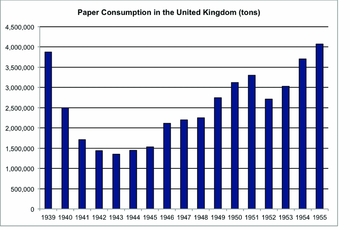
To reduce the consumption of paper, the Ministry of Supply quickly restricted the amount of paper that publishers of books, magazines and newspapers could use, the length of their publications, the number of copies they could produce and even the amount of space devoted to page margins.Footnote 21 Shopkeepers had to reduce the amount of paper for wrapping customers’ purchases and many people began to reuse old envelopes and write on the back of previously used paper. Paper consumption fell sharply, declining from 3.9 million tons in 1939 to 2.5 million tons in 1940 (Figure 1). The following year saw a further sharp reduction, and between 1941 and 1945, paper consumption in the UK averaged just 1.5 million tons a year.Footnote 22
Paper Consumption in the United Kingdom (tons). Paper consumption fell sharply as wartime scarcity and government controls affected producers and consumers alike. This decline led to a sharp reduction, in the amount of paper available for recycling in municipal waste.
Source: Waste Paper Recovery Association, Ltd., 1955 Annual Report (London, 1956).

Municipal salvage
In November 1939 Minister of Supply Leslie Burgin established a Salvage Department and appointed H. G. Judd to lead it.Footnote 23 Judd, a partner in the accounting firm of Mann, Judd, Gordon and Co., had worked during the 1914–1918 war in the contracts department of the Ministry of Munitions.Footnote 24 He promised a comprehensive approach to salvage, one that would include wastes from the military, industry and households.Footnote 25 Because industry was already recycling considerable quantities of its own wastes and because members of the armed forces could be forced to recycle, salvage officials directed most of their energies towards encouraging salvage from the nation's houses and offices. The central government clearly lacked the resources necessary to run a nationwide recycling programme on its own, so the Salvage Department expressed the hope that municipal rubbish collectors would add recyclables to the list of materials that they hauled away from residences. Salvage collection put a severe strain on dustmen, whose job had already been made more difficult when many of their colleagues joined the armed forces. Some communities eventually collected rubbish and salvage on alternate weeks, and during special salvage drives intervals of three weeks between rubbish collections were not unheard of.
During the early part of the war, the British press frequently pointed out that Britain's salvage efforts lagged behind Germany's. In February 1940 The Times quoted an unnamed workman: ‘Believe me, Sir, to be a loyal, true, and faithful British subject, but I mention one good point re that swine Hitler – he is no waster’.Footnote 26 While some people in Britain hoped that their government would follow Germany's example and recycle everything that could be used in the war effort, others worried that wartime demands for paper might imperil historical documents. In the words of Wilfrid Greene, president of the British Records Association:
During the last War the urgent need for waste paper led to the indiscriminate destruction of many records of great importance for the study of social, industrial, and political history. Accumulations of old papers . . . were handed over all the more readily because they were not in current use. But it was precisely among papers of this kind that valuable material was hidden and the loss to historical research occasioned by its destruction is deplorable.Footnote 27
As Chad Denton shows elsewhere in this issue, similar concerns arose in France during the Second World War.Footnote 28 To help avoid further destruction of historically significant documents, Greene offered the free assistance of his organisation to help owners decide which of their papers should be spared from wartime salvage. Greene promised that doing so would not have a detrimental impact on efforts to stimulate paper recycling, because only a small fraction of documents was worth saving.Footnote 29
On 30 November 1939 the Soviet Union attacked Finland, beginning the Winter War.Footnote 30 This crisis prompted the Ministry of Supply to announce that
the difficulty of obtaining wood pulp . . . is now giving rise to serious difficulties . . . Fortunately, clean waste paper is an adequate substitute for wood pulp, and some 15,000 tons of this material, which must now be regarded as an important war material, are being wasted in the dustbins of the country each week. At least 5,000 tons per week must be made available to the industries concerned.Footnote 31
Leslie Burgin, the first person to serve as Minister of Supply, proved much more willing to impose restrictions on consumption than to make recycling compulsory. Not surprisingly, Burgin's pleas to increase the amount of paper recycled brought meagre results.Footnote 32
In January 1940 the controller of salvage, Harold Judd, wrote to Lady Denman, the head of the National Federation of Women's Institutes. In his letter Judd told her that his Salvage Department hoped to ‘stimulat[e] the recovery of waste material and its conversion into productive material for war purposes’. He expected local authorities to organise efforts to collect, sort and transport recyclables in towns and cities, but officials in rural areas lacked the resources to do so effectively. To achieve the necessary results, Judd explained, the government needed the help of voluntary groups. The Salvage Department had already been in contact with the Boy Scouts and the Women's Voluntary Services (WVS), and Judd now sought the co-operation of the Women's Institutes.Footnote 33 Lady Denman quickly replied, promising the help of the Women's Institutes throughout England and Wales to collect salvage from villages.Footnote 34
On 9 April 1940 German forces invaded Norway, thereby blocking British access to Swedish iron ore. The German occupation also prevented the UK from acquiring wood pulp from Norway, its single largest source. A Ministry of Supply circular on 11 April noted:
The War developments of the past few days have thrown into dramatic relief the vital importance of salvaging waste paper, cardboard and rags, to take the place of wood pulp from Scandinavian countries. The saving and collection of these materials for repulping at the mills is now not merely a matter of desirability but one of national duty. Every bundle not salved is an irretrievable loss of essential material.Footnote 35
Despite this strong rhetoric, the Ministry of Supply merely urged (but did not require) local authorities to recycle items that could be made into new paper.Footnote 36 In addition to promoting salvage, the government announced new restrictions on consumption, which reduced the size of a penny daily newspaper to eight pages.Footnote 37 Over the following year, most newspapers were limited to just four pages.Footnote 38
The subsequent occupation of France and the Low Countries shocked the people of Britain with the realisation that only the English Channel separated their country from German forces. So dire was the situation that the journal Nature, which rarely discussed politics or foreign affairs, published the following words shortly after the British evacuation from Dunkirk: ‘Every resource must be used to resist the advance of the aggressor. There is no room for half-measures; the War is the concern of every one of us.’ To prevail against Nazi Germany, the author argued, Britain would have to mobilise every scrap of material at its disposal. ‘Waste household products which in peace-time were rightly consigned to the flames, the rubbish heap, or the attic, become, in these days of war, essential parts of the national economy. Their usefulness must not be judged by ordinary economic standards; the national need is the determining factor.’Footnote 39 One month later, in a leading article that called on everyone to recycle, the editors of The Times made the same point, insisting that ‘what has been classed as rubbish is no longer rubbish’.Footnote 40 The interest of these and other publications in promoting the recycling of paper was not solely patriotic; it was also necessary to keep them in business.
Compulsion
In the aftermath of the German invasion of France and of Churchill's becoming prime minister, the energetic Herbert Morrison replaced the unimpressive Leslie Burgin as Minister of Supply. Morrison launched a personal appeal in which he called on his fellow citizens to transform useless or no-longer-wanted articles into weapons. ‘Even old love letters’, he asserted, ‘can be turned into cartridge wads, meat bones into explosives, tin cans into tanks, and garden tools into guns.’Footnote 41 To increase the amount of material that was recycled, Morrison required communities of more than ten thousand people to establish programmes to collect paper, metal and animal bones from all households. Despite imposing this mandate on local government, the Ministry of Supply postponed requiring individuals to separate recyclable items from their rubbish, as it feared that doing so before local authorities had established efficient systems of collection and dispersal would result in chaos.Footnote 42 At the same time that the government sought to uncover sources of recyclable paper in people's attics and bookcases, it looked to government agencies as another rich source.
On 1 July 1940 the Ministry of Health sent a notice to local authorities emphasising the ‘paramount importance of releasing for repulping papers and books which it is no longer necessary to retain’. The directive urged officials to preserve documents that ‘possess historical importance’, were still in use or which might be needed for administrative or judicial purposes in the future. Everything else was to be donated to the war effort.Footnote 43 Others went much further. Praising British efforts to emulate the assumed efficiency of German recycling efforts, one observer quipped, ‘Hitler once held a great book-burning fiesta in the Reich. It was an extravagant and futile effort of Nazi savages to extinguish the culture of Europe. Today we are also destroying books, but they are being turned into munitions to blast Hitler out of occupied Europe.’Footnote 44 Referring to ‘the vast accumulation of ancient files of papers’ held by government departments, Sir William Davison, MP, suggested in July 1941 that the wartime need for waste paper provided ‘a golden opportunity to get rid of all this valueless clutter’.Footnote 45 Moralists similarly observed that the need for waste paper made possible ‘a thorough purge of the civic libraries, long overdue’. This would remove ‘large numbers of trashy, not to say nasty, novels’ and allow libraries to ‘serve some really useful purpose, instead of corrupting the minds of youthful readers’.Footnote 46
In September 1941 the Ministry of Supply's publicity department gave local authorities a form letter to send to businesses within their jurisdiction. This letter, which the ministry hoped would appear to originate from the local council rather than from Whitehall, was to ‘be duplicated (if the number is too large to permit individual typing) on your Official paper and signed by the Lord Mayor, Mayor, Chairman of the Council or Salvage Officer’. Its wording was both frank and uncompromising:
War purposes have caused our consumption of paper to soar high above peace-time requirements in spite of severe restrictions. Practically every armament has a paper content, vast quantities are being used for food packages for the forces as well as for the ‘home-front’ and to import the pulp from across the Atlantic is an expensive matter, not only in shipping space and sterling, but also in seamen's lives and the only alternative is to re-pulp ALL the waste and used paper now in our offices and homes.
In contrast to the large amount of salvage publicity that targeted women, this letter called on ‘every business and professional man to play his part . . . by carefully combing his offices and handing over . . . every scrap of paper for which he has not a pressing, immediate use and I do most particularly ask for old ledgers, old correspondence, old books and old documents of every kind’. The letter said nothing about preserving records of historical significance. On the contrary, it added that ‘even though your papers may be of a confidential nature, you need have no hesitation whatever in parting with them. You have my assurance that, if packed in sacks, parcels or cartons, they will be despatched immediately to the mills for instant re-pulping.’Footnote 47
Competitive recycling
In 1941 the Ministry of Supply asked several major newspaper and magazine publishers, as well as the country's leading paper makers, to form a group called the Waste Paper Recovery Association.Footnote 48 These businesses responded with great enthusiasm, for their access to paper was continuing to diminish. To allay fears about the handing over of confidential documents for salvage, the Waste Paper Recovery Association publicised the fact that it had employed an illiterate man to process papers from law firms. The press reported that ‘the non-reader quickly got busy and collected more than five tons of confidential documents and ledgers’ from a single office, packing up ‘century-old papers, old statute books and legal testimonies’.Footnote 49 The most promising approach, in the view of many recycling proponents, was to use a novel technology, the paper shredder, to eliminate the information content of papers destined for recycling.Footnote 50 Although most people saw nothing wrong with such efforts, they ensured that all documents handed over for recycling would be destroyed, regardless of their historical significance.
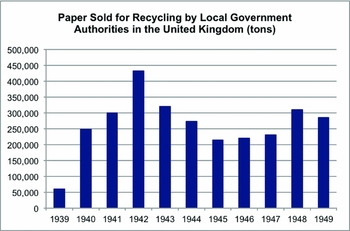
By 1942 Britain's newspapers had been forced to reduce their consumption of newsprint to just 20% of pre-war levels.Footnote 51 To stimulate greater public interest in recycling, these business executives came up with the idea of offering cash prizes to the communities that were able to collect the largest quantities of paper and books for the war effort. In January 1942 the Waste Paper Recovery Association launched a national salvage contest, which proved highly effective in generating fresh enthusiasm for salvage. The Times soon reported that ‘in many towns where great efforts are being made to secure a prize in the £20,000 competition a bundle of waste paper has become the ticket of admission to cinemas, football matches, and other pastimes’.Footnote 52 The month-long contest proved a resounding success from the organisers’ perspective. The amount of paper collected by local authorities in January 1942 reached 100,000 tons, 50% more than in any previous month of the war (see Figure 3).Footnote 53
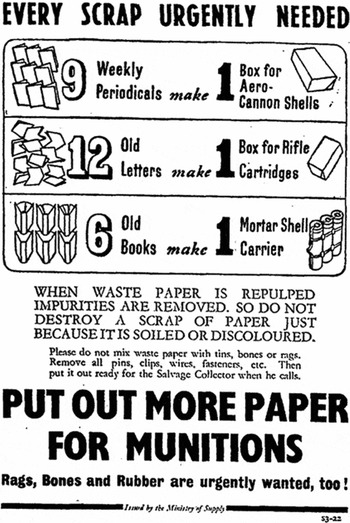
Throughout the Second World War, the Ministry of Supply used speeches, posters and print advertisements to emphasise the military potential that was latent in a wide variety of civilian objects. This advertisement appeared in The Times, 18 Sept. 1943, p. 2.

Paper Sold for Recycling by Local Government Authorities in the United Kingdom (tons). After a sharp rise during the first three years of the war, the quantity of paper that municipalities collected for recycling fell significantly as offices, bookshelves and file cabinets were emptied.
Source: Waste Paper Recovery Association, Ltd., 1955 Annual Report (London, 1956).

Dissent
W. C. Berwick Sayers of the Library Association warned in September 1941 that in their enthusiasm to contribute to the drive for waste paper, many people might unknowingly hand over for pulping valuable volumes that ought to be saved. ‘Unless there is discrimination, a famine in copies of quite important books may result.’Footnote 54 Disregarding such pleas, an advertisement published in November 1941 called on citizens to hand over ‘all your stored up paper. All the old forgotten books – all the old treasured programmes – the useless receipts – sentimental letters – historic newspapers . . .Turn them out in cold blood. Be sentimental about Russia – about Britain – about Freedom– but forget sentiment about yourself.’Footnote 55
By April 1942 so many books were being handed in for recycling that efforts to collect reading material for members of the armed forces were suffering.Footnote 56 Salvage mania also had other consequences, as the bookseller W. A. Foyle explained in a letter to The Times a month later:
Many priceless, rare, and irreplaceable books are being destroyed owing to the campaign for waste. Everyone, of course, wants to assist in giving waste paper and books to the Government, but there should be a sifting process to prevent many of our finest books being thrown away. Recently a perfect copy of von Gerning's ‘Tour Along the Rhine’, with colour plates by Ackermann was sent in to us as salvage together with other fine volumes. Luckily we can stop their going to the mills, but all over the country these books are being pulped.Footnote 57
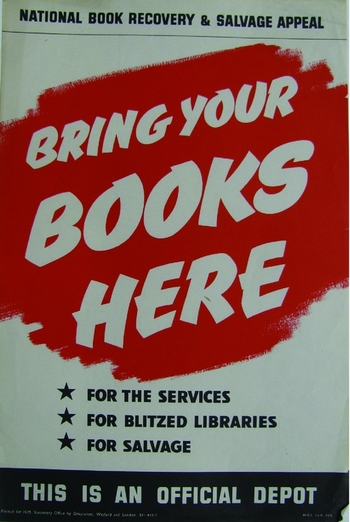
Responding to such criticism, when officials launched a fresh book drive in October 1942 they emphasised that worthwhile books would be preserved from pulping.Footnote 58 Praising the new ‘book recovery’ programme, The Times expressed admiration for:
the cunning choice of a name for the effort. It is part of a general salvage campaign; and salvage has come to mean scrapping, dissolution, adaptation that involves destruction. But this is the National Book Recovery Campaign. It comes not to destroy but to recover; and already it has recovered – has brought out of oblivion, neglect, or obscurity, has endowed with new power of service – more than thirty-one million volumes.Footnote 59
In a separate article on the subject, a correspondent reported: ‘book lovers have been reassured by the activities of the Scrutiny Committee, composed (in each centre) of the local librarian, booksellers, antiquarians, and others with bibliophile knowledge. The presence of such scrutineers, through whose hands every book given must pass, is a guarantee that no volume which is worthy of preservation will be sent to the pulping mills.’Footnote 60
Not everyone was satisfied, however. An anthropologist named Eric Dingwall complained that the promise of scrutiny was an empty panacea:
for the obvious reason that what is ‘valuable’ to the research student may be ‘valueless’ to the bookseller or erudite bibliophile. Thus tons of allegedly ‘valueless’, but nevertheless probably irreplaceable, sets of periodicals have already been sent to salvage by the Cambridge University Library; and I myself spotted a book at one salvage depôt which I urgently needed but was not allowed to take away, although two other books were offered in exchange for it. Rare first editions can sometimes be replaced, or at least be inspected elsewhere; early Victorian periodicals, trade journals, and such ephemeral publications can seldom be seen in complete sets, and their destruction is, therefore, all the more to be deplored.Footnote 61
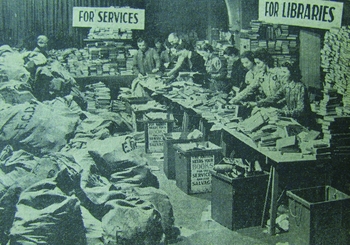
Charles Urie Peat, joint parliamentary secretary to the Ministry of Supply, offered little hope for the types of publications that Dingwall had championed. He defined the three categories that scrutiny committees were using to sort books: ‘those suitable for services’ reading; those suitable for restocking war-damaged libraries; and those which, having no entertainment or instructional value, were suitable for repulping to make munitions’ (see Figure 5).Footnote 62 And despite repeated government promises, as late as 1943 many communities lacked scrutiny committees that could remove valuable or historically significant publications from the mountain of printed material being sent for pulping (see Figure 6).Footnote 63
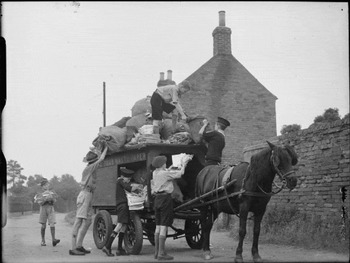
Boy Scouts load a wagon with paper in Balderton, Nottinghamshire, 1944. Photo © Imperial War Museum (D 21562). Use, copy or distribution of IWM material is not permitted without permission of the IWM.

This poster, issued by the Ministry of Information in 1943, was intended to reassure members of the public that they could donate books without fear that useful ones would be pulped. Courtesy of the National Archives, London, INF 13/288.

Volunteers in Edinburgh sort books into those that will be saved for reuse and those that will be pulped. Evening Dispatch (Edinburgh), 12 Feb. 1943. Reproduced by kind permission of The Scotsman Publications Ltd.

Although bibliophiles bemoaned the loss of valuable books during the war, they were comforted by the knowledge that at least one copy of most published works was likely to survive somewhere. No such hope existed for manuscripts and other unique documents. In contrast to the system of scrutiny that it recommended for books and magazines, the Ministry of Supply resisted similar safeguards for manuscripts. The information that it sent to local authorities in preparation for the national book recovery and salvage drive made no mention of what to do with unpublished material that passed through the hands of salvage collectors. When a subsequent circular mentioned the possibility of recovering substantial quantities of waste paper from attics as a result of fire safety inspections, it likewise failed to mention the fact that some of this material would possess historical significance.Footnote 64
When officials finally agreed that certain classes of unpublished papers ought to be preserved, the instructions that they issued condemned to the pulp mills vast swathes of materials that historians would later deem to be of great value, such as local government records and the personal correspondence of ordinary men and women. Even when people attempted to preserve papers that they deemed valuable, the sheer mass of materials donated for salvage made it inevitable that many important papers would fall through the cracks and be sent on to the mills.
The historian and archivist Joan Wake complained in 1940 that the British people ‘were destroying historical records with more than Teutonic thoroughness. “If English history does not matter,” she added facetiously, “all this destruction does not matter in the least, and the sooner we boil down the Domesday Book to make glue for aeroplanes the better.”’Footnote 65 Such warnings had limited effect. Most people insisted that the important thing was to win the war – by any means necessary. When, ‘in their enthusiasm to help the war effort’, officials in Aberdeen voted to recycle all the correspondence files of their education department that were over a decade old, they ‘decided to ignore any historical or other interest which these letters might have’.Footnote 66
In January 1942 six of Britain's leading historians and archivists called on local government officials and members of the public to exercise caution when selecting papers to be recycled. They were particularly concerned about the prospect that documents relating to economic and social history, such as poor law records and rate books, would be consigned to the mills. The signatories included Wilfrid Greene, president of the British Records Association; historian G. M. Trevelyan, Master of Trinity College, Cambridge; F. M. Powicke, Regius Professor of History at Oxford; A. W. Clapham, president of the Society of Antiquaries of London; F. M. Stenton, president of the Royal Historical Society; and John Forsdyke, director and principal librarian of the British Museum. Britain, they asserted, possessed a uniquely rich and continuous store of local, business and ecclesiastical records:
They are a national asset. We seem likely at present to destroy unnecessarily and in mere ignorance much of what our ancestors had preserved for us. There is a very real danger that historians and economists of the future may have to lament gaps in their evidence for the eighteenth and nineteenth centuries, and even for earlier periods, which need not have occurred and which nothing can fill.Footnote 67
In March 1944, the indefatigable historian and archivist Joan Wake, acting in her capacity as secretary of the Northamptonshire Archaeological Society, tried to persuade the Ministry of Health to save records held by urban and rural district councils. Wake also urged the Ministry of Health to permit volunteers to examine non-confidential papers collected in salvage drives so that valuable documents might be saved rather than recycled. An official who considered Wake's suggestions dismissed them with the curt comment that ‘no action is indicated at the moment’.Footnote 68
Accounting for what was lost
Local government officials, business firms, ordinary citizens and members of the royal family all responded enthusiastically to the call for waste paper. In November 1941 Surrey County Council proposed giving up most of its papers, books and documents that were more than three years old, including 150,000 files on persons who had received public assistance. The council estimated that the disposal of these files would contribute 15 to 20 tons of paper for the war effort and free up valuable shelf and floor space in the county hall.Footnote 69 Six months later the County Councils Association, the Association of Municipal Corporations and the London County Council called on local government bodies throughout the UK to recycle virtually all case files older than 1930 related to poverty relief. Although the letter recommended that ‘specimens’ be preserved for posterity, it implied that very few such records needed to be retained.Footnote 70
Most businesses similarly welcomed the government's exhortation to donate paper for the war effort, as it relieved them of the long-established expectation, in some cases required by law, that they store the voluminous records of their past activities for many years. ‘Legal firms’, noted one observer, ‘have found particularly rich stores of bygone correspondence and documents that are now out of date’.Footnote 71 Taking the salvage campaign to heart, in January 1941 The Times cleared 19 tons of ledgers and other business records from its own offices.Footnote 72 Less than a week later, the Aberdeen Press and Journal boasted that
all the old letter books, letter files, day books and ledgers and many old reference books belonging to the firm are being handed over to the paper mills. For years they have been lying in piles in a cellar. Now they will go to make new paper and to help to provide the many items of munitions for which paper is so necessary. They weigh fully two tons.Footnote 73
In 1942 The Times reported that ‘over a ton of old crime records and dossiers have been turned out as waste paper’ from the county police headquarters in Northamptonshire. The same article praised a boy in Plymouth for having ‘nobly surrendered his collection of cigarette cards’ and commended musicians for donating their old scores.Footnote 74 Not to be outdone, King George VI contributed more than a ton of ‘waste paper’, which consisted of ‘a large consignment of old books and manuscripts from the royal library’.Footnote 75 A month later the king's mother, Queen Mary, announced that she would donate papers from her residence, Marlborough House. Following the official line that emphasised the direct connection between paper salvage and munitions, the press reported that her ‘old letters, records, and files . . . are to be made into cartridge cases’.Footnote 76 In Sheffield, one woman handed in some 500 letters that her son had written to her during his fifteen years as a missionary in Canada. As Public Cleansing, the leading organ of the waste and scrap trades, reported, ‘It was always intended that they would make interesting reading when he came home. But in the national emergency Mrs. Jacklin has decided to send them for paper salvage.’Footnote 77
We will never know the identity of many of the historical documents ‘salvaged’ during the war. Most of what was recycled disappeared without any notice being taken in the press or in documents that have been preserved, but some traces remain. Among the records of a firm of solicitors from the southern English town of Battle is a small handwritten note indicating that the coronership records for the years 1868 to 1926 were handed over to be recycled on 6 March 1942.Footnote 78 A search of the Access to Archives database reveals dozens of references to documents that were ‘sent for salvage’ during the Second World War. Although they represent a tiny fraction of the tons of papers that disappeared, they provide a useful indication of the breadth of destruction that took place in the name of salvage: a large number of papers from Lord Halifax's estate in Yorkshire, eight volumes of admission records from the City of London Maternity Hospital dating back to 1769, records of the poor law guardians in Chichester, records from the asylums committee of the London County Council, records from the Suffolk quarter sessions, fourteen volumes of nineteenth-century court registers from Bolton, papers from the Maudsley Hospital and thirty-two volumes of correspondence belonging to the Stepney board of guardians.Footnote 79 The recycling of manuscripts and rare printed materials during the war no doubt constitutes an immense loss to the cultural and literary inheritance of the United Kingdom.
Conclusion
The Second World War killed, maimed and orphaned far more people than any other human-induced event in history. Compared to the incomprehensible suffering that the Second World War brought about, it may seem perverse to focus on any other aspect of that war than the physical and mental anguish of its human victims. Yet we will never obtain a full realisation of the wastefulness of war if we restrict our attention to its corporeal and psychic consequences. War destroys not only human bodies and minds, but also cultural artefacts, including historical documents. It is tempting to blame all the death, property damage and cultural destruction that comes with war on one's enemies, but succumbing to this urge perpetuates the binary thinking and half-truths that wars inevitably spawn. Whether we consider the treatment of dissenters and ethnic minorities, deaths caused by mistaking friend for foe or the melting down of historical artefacts, it is evident that some of the most long-suppressed wounds of the Second World War are those that were self-inflicted. The destruction, through ‘salvage’, of all manner of private and public records, and literary texts constituted yet another casualty of this war.
Some see the Second World War as a sort of golden age for recycling in Britain. Commenting on the decline in local waste paper collection during the final years of the war, Tim Cooper notes that ‘there was general pessimism about the ability to maintain the level of collections after the war’.Footnote 80 Implying that everything recycled during the war would have belonged to the waste stream under normal circumstances, Cooper treats wartime recycling statistics as representing an ideal that could and should have been maintained after the war. Mark Riley similarly posits that the rise and fall of recycling during the Second World War was a consequence of public enthusiasm during the early years of the conflict, followed by ‘waning interest . . . as the war progressed and an almost complete cessation as the war ended’.Footnote 81 Yet the decline in the quantity of household ‘waste’ recycled in Britain was influenced not only by popular attitudes, but also by the dwindling stock of recyclable items still remaining.
Recycling in wartime meant something quite different from recycling in peacetime. For despite its ostensible goal of conserving resources, the primary purpose of wartime salvage was to make weapons that caused destruction and waste. In wartime, salvage absorbed not only resources that were part of the normal waste stream, but also many materials of considerable cultural or economic value that few would have considered discarding in peacetime. As the Second World War came to an end, some of those who had been involved most closely with Britain's wartime salvage activities began to reflect on this paradox. A. L. Thomson, president of the Institute of Public Cleansing, observed in July 1945 that ‘warfare is the supreme waste producer; it is destruction scientifically organized’. Thomson noted that victory had come at an enormous cost. In order to help win the war, Britain had sacrificed vast quantities of money and raw materials, to say nothing of lives. To recover from these losses, he suggested that Britain would have to scrape and save for a long time to come. ‘We have been consuming our mineral wealth on a prodigious scale. It is irreplaceable. What we have been doing is living off our capital.’Footnote 82 What Thomson neglected to mention was that Britain had sacrificed not only blood, money and material resources in its war effort, but also countless pages of letters, diaries and other documents that illuminated its past. We have yet to grasp fully the multitude tragedies of this war.