


Major depression is an important public health issue, with a lifetime prevalence rate of approximately 15 % among adults in high-income countries worldwide( Reference Bromet, Andrade and Hwang 1 ) and projected to be ranked third among disorders contributing to the global burden of disease by 2030( Reference Mathers and Loncar 2 ). In Japan, the number of patients with depression has been increasing and the suicide rate is among the highest in the world over the past decade( 3 ). Accumulating epidemiological evidence supports the role of dietary factors in depression( Reference Murakami and Sasaki 4 ). Tea and coffee are the two most-consumed beverages worldwide after water( Reference McKay and Blumberg 5 , Reference Butt and Sultan 6 ), and green tea is a typical type in Asia. In Japan, consumption of green tea and coffee is popular, with respectively 53 % and 47 % of adults consuming on a daily basis( Reference Iso, Date and Wakai 7 ). Animal studies have shown that green tea catechins increase serum levels of noradrenaline and dopamine( Reference Chen, Zhao and Hou 8 ), which are posited to play a major role in depression( Reference Belmaker and Agam 9 ). Moreover, theanine, a major amino acid in green tea, is found to exert an antidepressant effect in human participants( Reference Kimura, Ozeki and Juneja 10 ). Coffee is a major source of caffeine, which has been suggested to modulate dopaminergic transmission and facilitate the release of serotonin( Reference Ferré 11 , Reference Ferré, Ciruela and Borycz 12 ). It is thus expected that consumption of green tea, coffee and caffeine may have beneficial effects against depression.
Epidemiological data on the association between these beverages and depressive symptoms are limited and/or inconsistent. A community-based study reported that Japanese elderly who consumed higher amounts of green tea had a lower prevalence of depressive symptoms( Reference Niu, Hozawa and Kuriyama 13 ). Another study among breast cancer survivors in China also showed an inverse association between tea consumption, mainly green tea, and depression( Reference Chen, Lu and Zheng 14 ). In an earlier Japanese study, higher green tea consumption was associated with decreased mental ill-health, although the association was not statistically significant( Reference Shimbo, Nakamura and Shi 15 ). Studies on coffee or caffeine consumption in relation to depression have yielded inconsistent results( Reference Niu, Hozawa and Kuriyama 13 , Reference Ruusunen, Lehto and Tolmunen 16 – Reference Hintikka, Tolmunen and Honkalampi 18 ). In Japan, no association with coffee was reported from the above-mentioned study among the elderly( Reference Niu, Hozawa and Kuriyama 13 ) who consumed less amount of coffee, and no data are available regarding the association with caffeine intake.
Green tea is a good source of folate( Reference Chen, Lui and Smith 19 ), which has been linked to decreased depressive symptoms( Reference Nanri, Hayabuchi and Ohta 20 ). It would thus be of interest to examine whether the green tea–depression association is mediated by folate. Of two previous studies that showed an inverse association between green tea consumption and depression( Reference Niu, Hozawa and Kuriyama 13 , Reference Chen, Lu and Zheng 14 ), only one( Reference Niu, Hozawa and Kuriyama 13 ) considered the influence of dietary folate intake. Thus in the present study we examined the association of consumption of green tea, coffee and caffeine with depressive symptoms in a Japanese working population, with consideration of the potential role of folate as a mediator.
Methods
Study procedure and participants
In July and November 2009, a health survey was conducted among municipal employees in two workplaces in north-eastern Kyushu, Japan. The overall objective of the survey was to examine the association of lifestyle including diet with mental and physical health. At the time of the routine health check-up, all full-time workers (n 605) except those who were on long-term sick or maternity leave were invited to participate. Of these, 567 (325 men and 242 women aged 20–68 years) consented (response rate 94 %). Participants were asked to fill out a survey questionnaire before the health check-up. The survey questionnaire was then checked by research staff for completeness and, where necessary, clarifications were made with the participant. We also obtained data that were routinely collected during the health examination, including anthropometric measurements and biochemical data, and information about medical history, smoking and alcohol drinking. We excluded participants who were pregnant (n 8) and those having missing data on confounding factors under study (n 22). After these exclusions, 537 individuals (319 men and 218 women) remained. The study was conducted according to the guidelines laid down in the Declaration of Helsinki and all procedures involving human subjects were approved by the Ethics Committee of the National Center for Global Health and Medicine, Japan. Written informed consent was obtained from all participants prior to the survey.
Ascertainment of depressive symptoms
Depressive symptoms were assessed with the Japanese version( Reference Shima, Shikano and Kitamura 21 ) of the Center for Epidemiologic Studies Depression (CES-D) scale( Reference Radloff 22 ). This scale comprises twenty questions addressing six symptoms of depression experienced by participants during the past week: depressed mood, feelings of guilt or worthlessness, helplessness or hopelessness, psychomotor retardation, loss of appetite and sleep disorders. Each question is scored on a scale of 0–3 according to the frequency of the symptom and the total score ranges from 0 to 60, with a higher score indicating worse depressive status. The criterion validity of the CES-D scale has been well established in both Western( Reference Radloff 22 ) and Japanese( Reference Shima, Shikano and Kitamura 21 ) subjects. The presence of depressive symptoms was defined as a CES-D score of 16 or higher. As a self-rating depression scale, CES-D was developed for epidemiological surveys among adults of all ages, whereas other instruments such as the Beck Depression Inventory, the Zung Self-Rating Depression Scale and the Geriatric Depression Scale were designed for clinical research or elderly populations( Reference McDowell 23 ).
Dietary assessment
Information about dietary intake during the preceding month was obtained using a validated brief self-administered diet history questionnaire (BDHQ)( Reference Kobayashi, Murakami and Sasaki 24 ), which ascertained consumption frequency of forty-six food and non-alcoholic beverage items, including vegetables, fruit, green tea and coffee. Consumptions of green tea and coffee were elicited by a closed-ended question, and the beverage consumption in terms of volume was estimated by assigning the following values (cups/week) to the frequency of consumption( Reference Kobayashi, Murakami and Sasaki 24 ): 0 = none; 0·5 = <1 cup/week; 1 = 1 cup/week; 2·5 = 2–3 cups/week; 5 = 4–6 cups/week; 7 = 1 cup/d; 17·5 = 2–3 cups/d; 28 = ≥4 cups/d. A cup size of green tea or coffee was assumed as 150 ml for women and 171 ml (150 ml × 1·14) for men( Reference Kobayashi, Murakami and Sasaki 24 ). Correlations between consumption of green tea and coffee according to the above-mentioned BDHQ and those from 16 d dietary records were high (Spearman's r = 0·74 and 0·73 for green tea consumption in men and women, respectively; the corresponding data for coffee consumption were 0·85 in men and 0·87 in women)( Reference Kobayashi, Murakami and Sasaki 24 ). Referring to the Food Composition Table in Japan( 25 ), we estimated daily caffeine consumption from green tea and coffee consumption, using respectively 20 and 60 mg of caffeine per 100 ml of each beverage.
Laboratory measurements
Blood samples were obtained at the time of health check-up. Venous blood (7 ml) was drawn into vacuum tubes and then transported in a cooler box to a laboratory. The blood was centrifuged for 10 min, and the separated serum was divided into a maximum of six tubes (0·5 ml each) and kept at −30°C during the survey for each workplace. One of these tubes was sent, immediately after the survey period, to an external laboratory (Mitsubishi Chemical Medience Corporation, Tokyo, Japan) for the measurement of high-sensitivity C-reactive protein (CRP) and folate using a latex agglutination nephelometry method and chemiluminescent immunoassay, respectively.
Other variables
Marital status, job position, living status, overtime work, alcohol and tobacco use, types of occupation, non-occupational physical activity and history of diseases (cancer, CVD, diabetes or chronic hepatitis) were elicited in the questionnaire. Occupational physical activity was classified as sedentary work (managerial and clerical jobs) and active work (childcare work, school lunch preparation and technical jobs). Questions on non-occupational physical activity ascertained the time spent (in minutes) walking or cycling to commute to/from work and on five recreational activities (walking, low-, moderate- and high-intensity activities and gardening). Non-occupational physical activity was estimated in metabolic equivalent (MET) values and expressed as the sum of MET multiplied by the time (in hours) spent performing each activity( Reference Ainsworth, Haskell and Whitt 26 ). Body height was measured to the nearest 0·1 cm with the participant standing without shoes. Body weight in light clothes was measured to the nearest 0·1 kg. BMI was calculated by dividing weight by the square of height (kg/m2).
Statistical analysis
The descriptive data are presented as means and standard deviations, medians and interquartile ranges, or percentages. Participants were divided into three groups: those consuming ≤1 cup, 2–3 cups and ≥4 cups of green tea daily; and those consuming <1 cup, 1 cup and ≥2 cups of coffee daily. Caffeine consumption was estimated from caffeine contents in green tea and coffee, and was categorized into quartiles (≤100 mg/d, 101–165 mg/d, 166–291 mg/d and >291 mg/d). Participants’ characteristics according to green tea and coffee consumption, treated as ordinal variables with ordinal values from 1 to 3 assigned to the three consumption levels, were evaluated by using linear regression analysis for continuous variables and the Mantel–Haenszel test of trend for categorical variables. Multiple logistic regression analysis was performed to calculate odds ratios and 95 % confidence intervals for prevalence of depressive symptoms according to the above-described categories of green tea, coffee and caffeine consumption. The base model (model 1) included age (year, continuous), sex and workplace (survey in July or November 2009). We added covariates accumulatively to model 1 in subsequent models: history of cancer, CVD, diabetes mellitus or chronic hepatitis (yes or no), marital status (married or unmarried), living status (alone or not alone), overtime work (none, <10 or ≥10 h/month), job position (low or middle and high), occupational physical activity (active or sedentary), non-occupational physical activity (<5 or ≥5 MET-h/week), current smoking (yes or no), alcohol drinking (yes or no), BMI (kg/m2, continuous), n-3 PUFA intake (percentage of energy, continuous), log-transformed red meat intake (g/d, continuous), log-transformed vegetable and fruit consumption (g/d, continuous) and coffee consumption (<1, 1 or ≥2 cups/d; when calculating the OR for consumption of green tea) or green tea (≤1, 2–3 or ≥4 cups/d; when calculating the ORs for consumption of coffee) for model 2; log-transformed serum CRP concentrations (mg/l, continuous) for model 3; and log-transformed serum folate concentration (ng/ml, continuous) for model 4. Neither green tea nor coffee consumption was included in the multivariate models when examining the association between caffeine consumption and depressive symptoms. Trend tests were performed using multiple logistic regression analysis with ordinal numbers assigned to the category of green tea, coffee and caffeine consumption. We also examined effect modification by sex on the association of green tea, coffee and caffeine consumption with depressive symptoms, using the likelihood ratio test. We repeated all the above analyses after excluding participants who reported a history of psychological problems (n 6). Two-sided P values of less than 0·05 were considered statistically significant. All analyses were performed using the statistical software package STATA version 12·1.
Results
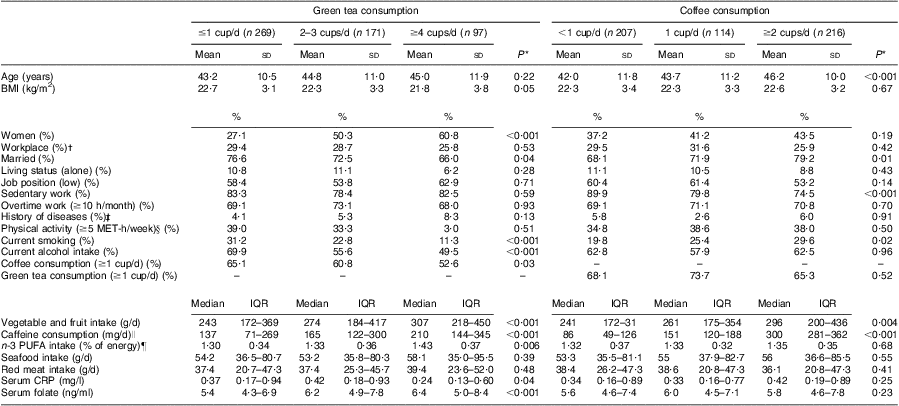
The participants’ characteristics according to green tea and coffee consumption are shown in Table 1. Participants with higher consumption of green tea were more likely to be female and less likely to be married. They were also less likely to be current smokers, alcohol drinkers and coffee drinkers. Those with higher green tea consumption tended to consume n-3 PUFA, vegetables and fruit more often. Green tea consumption was positively correlated with serum folate levels. Participants consuming coffee more often were older and more likely to be married. Those with a higher consumption of coffee were less likely to be engaged in sedentary work and tended to smoke cigarettes as well as consume vegetables and fruit more often.
Participants’ characteristics according to green tea and coffee consumption: men and women (n 537) aged 20–68 years from two workplaces in north-eastern Kyushu, Japan, 2009
MET-h, metabolic equivalent hours; CRP, C-reactive protein; IQR, interquartile range.
*P for trend was obtained from linear regression for continuous variables by assigning ordinal numbers 1–3 to categories of green tea or coffee consumption, or from the Mantel–Haenszel test of trend for categorical variables.
†Survey conducted in July 2009.
‡Including cancer, CVD, diabetes mellitus and chronic hepatitis.
§Leisure-time physical activities and commuting to/from work.
∥Calculated from green tea and coffee.
¶Values are mean and standard deviation.
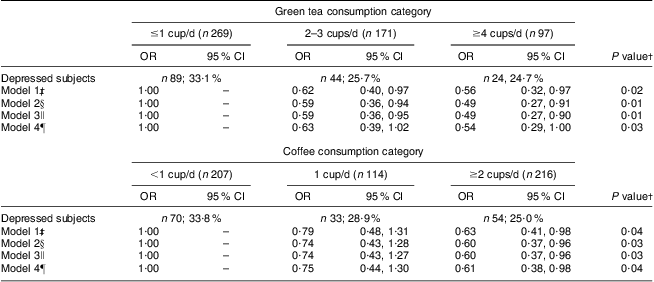
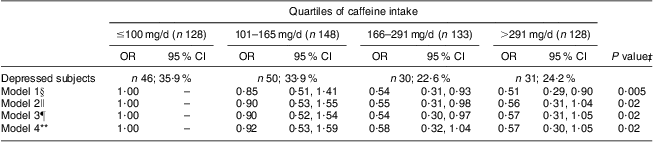
There were significant inverse associations between consumption of green tea and coffee and likelihood of depressive symptoms (Table 2). After adjustment for demographic and lifestyle factors (model 2), compared with participants consuming ≤1 cup green tea/d, those consuming 2–3 cups/d and ≥4 cups/d had a 41 % and 51 % significantly lower prevalence odds of depressive symptoms, respectively (P for trend = 0·01). Additional adjustment for CRP (model 3) did not materially alter the results. Further adjustment for serum folate (model 4) attenuated the association by about 7 % and 10 % in participants who consumed 2–3 cups green tea/d and ≥4 cups green tea/d, respectively, compared with those consuming ≤1 cup/d (P for trend = 0·03). As regards coffee, after adjusting for demographic and lifestyle factors (model 2), compared with participants consuming <1 cup coffee/d, those consuming 1 cup/d and ≥2 cups/d had a 26 % and 40 % lower prevalence odds of depressive symptoms, respectively (P for trend = 0·03). Additional adjustment for serum CRP (model 3) and folate (model 4) did not measurably change the estimates. Concerning caffeine consumption (Table 3), participants in the highest v. the lowest quartile of caffeine consumption had a 43 % lower odds of having depressive symptoms in a fully adjusted model (OR = 0·57; 95 % CI 0·30, 1·05; P for trend = 0·02).
Odds of depressive symptomsFootnote * according to consumption of green tea and coffee: men and women (n 537) aged 20–68 years from two workplaces in north-eastern Kyushu, Japan, 2009
MET-h, metabolic equivalent hours; CRP, C-reactive protein.
* Defined as a Center for Epidemiologic Studies Depression Scale score of ≥16.
†P for linear trend obtained from multiple logistic regression analysis with ordinal numbers 1–3 assigned to each category of green tea or coffee consumption.
‡Model 1: Adjusted for age (continuous), sex and workplace (survey in July or in November 2009).
§Model 2: Adjusted for factors in model 1 and history of cancer, CVD, diabetes mellitus or chronic hepatitis (yes or no), marital status (married or unmarried), living status (alone or not alone), overtime work (none, <10 or ≥10 h/month), job position (low or middle and high), occupational physical activity (active or sedentary), non-occupational physical activity (<5 or ≥5 MET-h/week), current smoking (yes or no), alcohol drinking (yes or no), BMI (kg/m2, continuous), n-3 PUFA intake (% of energy, continuous), log-transformed red meat intake (g/d, continuous), log-transformed vegetable and fruit consumption (g/d, continuous) and coffee consumption (<1 cup/d, 1 cup/d or ≥2 cups/d; when calculating the OR for green tea consumption) or green tea consumption (≤1 cup/d, 2–3 cups/d or ≥4 cups/d; when calculating the OR for coffee consumption).
∥Model 3: Adjusted for factors in model 2 and log-transformed serum CRP concentrations (mg/l, continuous).
¶Model 4: Adjusted for factors in model 3 and log-transformed serum folate concentration (ng/ml, continuous).
Odds of depressive symptomsFootnote * according to caffeine consumption†: men and women (n 537) aged 20–68 years from two workplaces in north-eastern Kyushu, Japan, 2009
MET-h, metabolic equivalent hours; CRP, C-reactive protein.
* *Defined as a Center for Epidemiologic Studies Depression Scale score of ≥16.
†Estimated from caffeine contents in green tea and coffee (20 mg and 60 mg of caffeine per 100 ml of green tea and coffee, respectively).
‡P for linear trend obtained from multiple logistic regression analysis with ordinal numbers 1–4 assigned to quartiles of caffeine consumption.
§Model 1: Adjusted for age (continuous), sex and workplace (survey in July or in November 2009).
∥Model 2: Adjusted for factors in model 1 and history of cancer, CVD, diabetes mellitus or chronic hepatitis (yes or no), marital status (married or unmarried), living status (alone or not alone), overtime work (none, <10 or ≥10 h/month), job position (low or middle and high), occupational physical activity (active or sedentary), non-occupational physical activity (<5 or ≥5 MET-h/week), current smoking (yes or no), alcohol drinking (yes or no), BMI (kg/m2, continuous), n-3 PUFA intake (% of energy, continuous), log-transformed red meat intake (g/d, continuous) and log-transformed vegetable and fruit consumption (g/d, continuous).
¶Model 3: Adjusted for factors in model 2 and log-transformed serum CRP concentrations (mg/l, continuous).
**Model 4: Adjusted for factors in model 3 and log-transformed serum folate concentration (ng/ml, continuous).
We observed a suggestive interaction between sex and green tea consumption for depressive symptoms (P for interaction = 0·09); the inverse association with green tea consumption was confined to men. The multivariate OR for depressive symptoms according to green tea consumption categories of ≤1 cup/d, 2–3 cups/d and ≥4 cups/d were 1·00 (reference), 0·53 (95 % CI 0·28, 1·03) and 0·23 (95 % CI 0·07, 0·73) in men (P for trend = 0·004), and 1·00 (reference), 0·91 (95 % CI 0·41, 2·02) and 1·08 (95 % CI 0·45, 2·59) in women (P for trend = 0·87). As for coffee consumption, the association was more pronounced in women than in men, although the interaction was not statistically significant (P for interaction = 0·49). The multivariate OR for depressive symptoms according to coffee consumption categories of <1 cup/d, 1 cup/d and ≥2 cups/d were 1·00 (reference), 0·48 (95 % CI 0·20, 1·16) and 0·37 (95 % CI 0·17, 0·81) in women (P for trend = 0·01), and 1·00 (reference), 0·84 (95 % CI 0·39, 1·80) and 0·74 (95 % CI 0·37, 1·42) in men (P for trend = 0·37). The association between caffeine consumption and depressive symptoms did not differ by sex (P for interaction = 0·82). The results were materially unchanged after excluding the participants with a history of psychological problems (data not shown).
Discussion
In the present study among a Japanese working population, we found an inverse association between consumption of green tea, coffee and caffeine and prevalence of depressive symptoms. The association with green tea was only slightly attenuated after adjustment for serum folate concentration. Our study is one of the few that have investigated the association between green tea and depressive symptoms, and is the first to report a significantly decreased prevalence of depressive symptoms among those with a higher intake of coffee or caffeine among Japanese.
Our finding of an inverse association between green tea intake and depressive symptoms is closely in agreement with the results of a Japanese study among the community-dwelling elderly( Reference Niu, Hozawa and Kuriyama 13 ), in which those who consumed ≥4 cups green tea/d had a 44 % lower prevalence of depressive symptoms (defined as Geriatric Depression Scale score ≥11 or use of antidepressant drug) compared with those consuming ≤1 cup/d. Another population-based study including adults aged 20–69 years in Japan( Reference Shimbo, Nakamura and Shi 15 ) showed a statistically non-significant reduction in odds of having mental ill-health, as assessed by the twelve-item General Health Questionnaire (score ≥4), in individuals with high green tea consumption; OR of having mental ill-health in those who consumed ≥5 cups/d compared with those consuming <1 cup/d was 0·78 and 0·77 for men and women, respectively. Likewise, a Chinese study among breast cancer survivors reported a 42 % lower prevalence odds of depressive symptoms (CES-D score ≥16) in patients who consumed >100 g of dried tea leaves per month (90 % of tea consumed is from green tea) compared with patients who did not drink tea regularly( Reference Chen, Lu and Zheng 14 ). The present data together with these previous observations suggest that higher green tea consumption may be protective against depression.
Because green tea contains folate, which has been suggested to confer protection against depression( Reference Nanri, Hayabuchi and Ohta 20 , Reference Gilbody, Lightfoot and Sheldon 27 ), the green tea–depression association may be mediated by folate status. In fact, participants with higher green tea consumption had a higher concentration of serum folate. However, adjustment for serum folate concentration attenuated the results only slightly, suggesting that the association observed between green tea and depressive symptoms may largely be attributed to green tea constituents other than folate.
The present study found a significantly lower prevalence of depressive symptoms among participants with higher consumption of coffee and caffeine. Our result aligns with a US study that reported a lower risk of depression among women who consumed higher amounts of caffeinated coffee and caffeine( Reference Lucas, Mirzaei and Pan 17 ). Similarly, a Finnish study showed a decreased risk of severe depression among light and heavy coffee drinkers as compared with coffee non-drinkers( Reference Ruusunen, Lehto and Tolmunen 16 ), although no significant risk reduction was observed among individuals with high caffeine consumption. Moreover, consumption of coffee and caffeine was inversely associated with risk of suicide( Reference Kawachi, Willett and Colditz 28 ), for which depression is an important predictor( Reference Hawton and van Heeringen 29 ). Conversely, a Japanese study( Reference Niu, Hozawa and Kuriyama 13 ) found no association between coffee consumption and depressive symptoms. The lack of an association in the Japanese study may be partly ascribed to infrequent consumption of coffee among the elderly, with only 13·2 % of the study participants consuming ≥2 cups coffee/d, as reported in an earlier study that included the same participants( Reference Kuriyama, Hozawa and Ohmori 30 ). A null finding has also been reported from a Finnish study( Reference Hintikka, Tolmunen and Honkalampi 18 ). In that study, coffee consumption was evaluated as a dichotomous variable, which may not be suitable to detect an association at a moderate coffee consumption. Our data corroborated previous observations suggesting that the consumption of coffee( Reference Ruusunen, Lehto and Tolmunen 16 , Reference Lucas, Mirzaei and Pan 17 , Reference Kawachi, Willett and Colditz 28 ) and caffeine( Reference Lucas, Mirzaei and Pan 17 , Reference Kawachi, Willett and Colditz 28 ) may have beneficial effects against depression. Further studies are needed to confirm the antidepressant effect of higher doses of caffeine.
We found an inverse association between green tea consumption and depressive symptoms in men but not in women, although the interaction by sex was not statistically significant. The null finding in women is inconsistent with previous data among Asians showing a protective association between green tea consumption and depression in elderly women( Reference Niu, Hozawa and Kuriyama 13 ) or in breast cancer survivors (mean age 53·7 years)( Reference Chen, Lu and Zheng 14 ). The discrepancy between our finding and prior ones may be ascribed to chance, but it could be related to the difference in age among studies; women in the present study were younger (mean age 42·7 years) than those in the previous ones( Reference Niu, Hozawa and Kuriyama 13 , Reference Chen, Lu and Zheng 14 ). It has been suggested that circulating oestrogen may increase vulnerability to depression in susceptible women( Reference Llaneza, García-Portilla and Llaneza-Suárez 31 ). Besides, habitual green tea consumption is associated with increased blood oestradiol concentrations, the predominant oestrogen during the reproductive age, in premenopausal women( Reference Schliep, Schisterman and Mumford 32 ). If so, green tea consumption may not afford protection against depression in premenopausal women. Further research is required to clarify whether the effect of green tea consumption on depression differs according to menopausal status.
The mechanisms underlying the favourable associations between consumption of green tea, coffee and caffeine and depression remain to be determined, but there are possible biological explanations. Green tea is rich in polyphenols, mainly catechins( Reference Liao, Kao and Hiipakka 33 ), which have recently been shown to exert antidepression-like effects in mouse models of depression and to decrease corticosterone (cortisol in man) and adrenocorticotropic hormone (corticotropin) in mice( Reference Zhu, Shi and Wei 34 ). Considerable evidence suggests that cortisol and corticotropin are involved in depression( Reference Belmaker and Agam 9 ). In rats, oral administration of epigallocatechin-3-gallate, one of the major green tea catechins, has been shown to prevent a reduction of brain dopamine concentration( Reference Levites, Weinreb and Maor 35 ), which plays a major role in the pathogenesis of depression( Reference Belmaker and Agam 9 ). Green tea is also rich in theanine, which accounts for about 50 % of the amino acid content in green tea( Reference Liao, Kao and Hiipakka 33 ), and animal studies have shown that theanine administration increases brain dopamine( Reference Yokogoshi, Kobayashi and Mochizuki 36 ) and serotonin( Reference Nathan, Lu and Gray 37 ). Moreover, green tea has potent antioxidant activities in vivo ( Reference Crespy and Williamson 38 ) and thus may confer protection against depression by decreasing oxidative stress, which is increased in depressed patients( Reference Stefanescu and Ciobica 39 , Reference Sarandol, Sarandol and Eker 40 ). Likewise, coffee is a rich source of phenolic compounds including chlorogenic acid and caffeic acid( Reference Higdon and Frei 41 ), which were found to exert antioxidant effects both in vitro ( Reference Scalbert and Williamson 42 ) and in vivo ( Reference Natella, Nardini and Giannetti 43 ). Finally, caffeine can increase excitatory neurotransmitters through modulating dopaminergic transmission( Reference Ferré 11 ) and facilitate the release of acetylcholine and serotonin( Reference Ferré, Ciruela and Borycz 12 ).
Major strengths of the present study include a high response rate (94 %), the use of a validated dietary questionnaire, and adjustment for known and putative risk factors for depressive symptoms. Several limitations need consideration. First, cross-sectional data do not allow us to conclude whether or not consumption of green tea or coffee decreases depressive symptoms. Participants with depressive symptoms may have refrained from drinking these beverages due to concerns about side-effects of caffeine. Nevertheless, prospective studies have shown a decreased risk of depression among individuals with higher consumption of coffee( Reference Ruusunen, Lehto and Tolmunen 16 , Reference Lucas, Mirzaei and Pan 17 ) or caffeine( Reference Lucas, Mirzaei and Pan 17 ). Second, the assessment of coffee and green tea consumption was based on a self-administered questionnaire. However, data on green tea and coffee obtained from the self-administered questionnaire and those from 16 d dietary records were shown to be highly correlated( Reference Kobayashi, Murakami and Sasaki 24 ). Moreover, intakes of specific foods or beverages that contain caffeine (except coffee and green tea) were not specifically asked in this dietary questionnaire. Nevertheless, in Japan, coffee and green tea are major contributors to caffeine consumption, with an estimated proportion of 47 % and 38 %, respectively( Reference Yamada, Sasaki and Murakami 44 ). Further, the questionnaire did not include questions about types, strengths or preparation methods of green tea and coffee, which might have resulted in imprecise estimates of caffeine consumption. A better method of corroborating beverage consumption could be the use of relevant biomarkers including caffeine and its metabolites( Reference Kempf, Herder and Erlund 45 ), coffee-derived chlorogenic acid and caffeic acid metabolites( Reference Kempf, Herder and Erlund 45 , Reference Farah, Monteiro and Donangelo 46 ) and green tea catechins( Reference Lee, Wang and Li 47 ) in blood as well as coffee-derived chlorogenic acid metabolites( Reference Farah, Monteiro and Donangelo 46 ) and green tea catechins( Reference Lee, Wang and Li 47 ) in urine. Third, because of the limited number of individuals consuming large amounts of coffee in our study population, we were unable to address the association of high consumption of coffee or caffeine with depressive symptoms. Fourth, we could not fully allow for a detailed history of depressive episodes and use of antidepressants because these data were not specifically inquired. However, given the nature of the study population (working population), the prevalence of these factors would be low and thus their impact, if present, on study results would be minimal. Fifth, despite adjustment for main potential confounders, the possibility of residual confounding cannot be ruled out. Finally, the present findings among a selected, working population might not represent non-working or elderly populations, which may include a higher proportion of patients with severe depression.
Conclusion
We found that higher consumption of green tea, coffee and caffeine was each associated with a lower prevalence of depressive symptoms in a Japanese working population. These findings add support for a protective role of green tea, coffee and caffeine against depression. Longitudinal studies including persons with a high intake of coffee and caffeine are required to confirm the present cross-sectional association.
Acknowledgements
Sources of funding: This study was supported by a Grant-in-Aid for Scientific Research (B) (21390213) from the Japan Society for the Promotion of Science; a Grant-in-Aid for Young Scientists (B) (21790598) from the Ministry of Education, Culture, Sports, Science and Technology; and a Grant of the National Center for Global Health and Medicine. Conflicts of interest: The authors declare no conflict of interest. Authors’ contributions: N.M.P. analysed the data and wrote the manuscript. A.N. planned and coordinated the field survey and contributed to the discussion. K. Kurotani contributed to data interpretation and discussion. K. Kuwahara contributed to data interpretation and discussion. A.K. contributed to data interpretation and discussion. M.S. planned and coordinated the field survey and contributed to the discussion. H.H. planned and coordinated the field survey and contributed to the discussion. T.M. edited the manuscript and is the Principal Investigator of the present study. Acknowledgment: The authors are grateful to the study participants for their cooperation and participation. They also thank Seiko Miyazaki and Yasutaka Horiuchi (Kyushu University); Emi Tanaka, Youko Tsuruda, Misaki Hirose, Meishu Sai, Miho Isayama, Midori Sasaki, Mie Shimomura and Azumi Uehara (Fukuka Women's University); Yaeko Nagano (retired nurse); and Yumi Matsushita, Akiko Hayashi, Yu Teruyama, Kae Saito, Kayoko Washizuka and Yuho Mizoue (National Center for Global Health and Medicine) for their help in data collection.



