Introduction
Post-traumatic stress disorder (PTSD) is a serious anxiety disorder with a lifetime prevalence of 7–12% (Resnick et al. Reference Resnick, Kilpatrick, Dansky, Saunders and Best1993; Kessler et al. Reference Kessler, Sonnega, Bromet, Hughes and Nelson1995). PTSD has a chronic nature and is associated with a high degree of co-morbidity with, for example, other anxiety disorders, depression and substance abuse, and also with suicide and impairments in family relationships and occupational functioning (Davidson et al. Reference Davidson, Hughes, Blazer and George1991; Zatzick et al. Reference Zatzick, Marmar, Weiss, Browner, Metzler, Golding, Stewart, Schlenger and Wells1997; Kessler, Reference Kessler2000; Creamer et al. Reference Creamer, Burgess and McFarlane2001). The prevalence of PTSD is particularly high in returning veterans who have served in a war because of the severe psychosocial pressure and stress experienced during war (Boscarino & Chang, Reference Boscarino and Chang1999).
The Iran–Iraq war was the longest war of the 20th century. The war was associated with massive economic damage and an enormous number of casualties, with between half a million and one million soldiers and civilians estimated to have died and many more being injured, wounded, taken prisoner or becoming refugees. A large percentage of Iranian veterans who participated in the Iran–Iraq war currently suffer from PTSD.
Selective serotonin reuptake inhibitors (SSRIs) have been used effectively in the treatment of PTSD (Brady et al. Reference Brady, Pearlstein, Asnis, Baker, Rothbaum, Sikes and Farfel2000; Davidson et al. Reference Davidson, Rothbaum, van der Kolk, Sikes and Farfel2001; Ursano et al. Reference Ursano, Bell, Eth, Friedman, Norwood, Pfefferbaum, Pynoos, Zatzick, Benedek, McIntyre, Charles, Altshuler, Cook, Cross, Mellman, Moench, Norquist, Twemlow, Woods and Yager2004). Among SSRIs, sertraline and paroxetine have been approved by the US Food and Drug Administration (FDA) for treatment of PTSD in the general population. Two large-scale, placebo-controlled studies have established the efficacy of sertraline as a treatment for PTSD in the general population (Brady et al. Reference Brady, Pearlstein, Asnis, Baker, Rothbaum, Sikes and Farfel2000; Davidson et al. Reference Davidson, Rothbaum, van der Kolk, Sikes and Farfel2001). Nevertheless, there have been few investigations concerning sertraline efficacy in combat-related PTSD (Dow & Kline, Reference Dow and Kline1997; Zohar et al. Reference Zohar, Amital, Miodownik, Kotler, Bleich, Lane and Austin2002; Chung et al. Reference Chung, Min, Jun, Kim, Kim and Jun2004; Friedman et al. Reference Friedman, Marmar, Baker, Sikes and Farfel2007). In a large placebo-controlled study conducted among Vietnam war veterans, sertraline had no more significant therapeutic effect than a placebo in any of the four efficacy measures that were evaluated (Friedman et al. Reference Friedman, Marmar, Baker, Sikes and Farfel2007). However, a small study in Israeli veterans showed some evidence for sertraline efficacy in the treatment of combat-related PTSD (Zohar et al. Reference Zohar, Amital, Miodownik, Kotler, Bleich, Lane and Austin2002). These inconsistent results suggest that, unlike in civilian PTSD, therapeutic effects of sertraline in the treatment of combat-related PTSD are not well established. These discrepancies are also present for other SSRIs. For instance, although there have been negative findings on the efficacy of fluoxetine in combat-related PTSD (Hertzberg et al. Reference Hertzberg, Feldman, Beckham, Kudler and Davidson2000), Martenyi and colleagues have indicated that treatment with this drug is associated with a greater improvement in disease-specific outcome measures compared to placebo (Martenyi et al. Reference Martenyi, Brown, Zhang, Koke and Prakash2002a, b; Martenyi & Soldatenkova, Reference Martenyi and Soldatenkova2006). Moreover, Iranian veterans have their own particular characteristics, such as ethnic and cultural differences, that might affect the treatment response.
The present study therefore aimed to evaluate the efficacy and safety of sertraline in the treatment of combat-related PTSD in Iranian veteran out-patients.
Method
Patient population
The subjects were male Iranian Iran–Iraq war veteran out-patients who had been referred to the neuropsychiatric clinic of Baqiyatallah Hospital (Tehran, Iran) and met DSM-IV-TR criteria for a primary diagnosis of PTSD. A duration of at least 6 months of illness and a Clinical Global Impression scale – Severity (CGI-S) score of ⩾4 were also required at the baseline visit for inclusion into the trial. Exclusion criteria included: (1) the presence of any axis I disorder other than PTSD (subjects with concurrent depression were included provided that their depression was secondary to PTSD and initiated after PTSD); (2) evidence of clinically significant hepatic or renal disorder or any other medical condition (in acute or unstable form) that might confound the procedure or the results of the trial; (3) alcohol or substance abuse or dependency within the preceding 6 months; (4) intolerance or hypersensitivity to sertraline; (5) concurrent use of any psychotropic medication (except for chloral hydrate or diazepam, taken as needed) with clinically significant psychotropic activity within 2 weeks of randomization (or 5 weeks for fluoxetine); (6) any cognitive-behavioral therapy during the trial; and (7) psychotherapy that was initiated or ended during the trial.
The study was approved by the institutional ethics committee. The benefits and risks of participation in the study were fully explained to each patient, and written informed consent was obtained.
Study design
The study was a 10-week, double-blind, randomized and placebo-controlled trial on the efficacy of flexibly dosed sertraline versus placebo for the treatment of PTSD. Seventy subjects were randomized, using computer-generated random numbers, to 10 weeks of double-blind and parallel treatment with either sertraline (n=35) or matched placebo (n=35). Sertraline and placebo were obtained from Razak Laboratories Co., Iran. Sertraline treatment was initiated at a daily dose of 50 mg. Patients were visited every 2 weeks by a psychiatrist and, based on the examinations, clinical response and adverse effects, drug dosage could be flexibly adjusted to a maximum dose of 200 mg/day.
Efficacy assessments consisted of the mean change in total score on the Impact of Event Scale – Revised (IES-R), which is a 22-item, patient-completed assessment instrument that rates the frequency and intensity of PTSD symptoms based on DSM-IV on separate five-point severity scales; the mean change in the CGI-S score; and the endpoint Clinical Global Impressions – Improvement (CGI-I) score. CGI-S and CGI-I data were collected by a single rater (blinded to the allocations) who was different from the psychiatrist who performed the patients' visits and from the statistician who analyzed the data. In addition to the total score, another set of analyses was performed examining the change from baseline in the three DSM-IV-TR-defined clusters of the IES-R: re-experiencing/intrusion, avoidance/numbing and hyperarousal subscales.
Data analysis
The data were analyzed using SPSS version 18 (SPSS Inc., USA). Values are expressed as mean±standard deviation or number (%). The mean values were compared between the two groups by an independent samples t test (in the case of normally distributed variables) or the Mann–Whitney U test (in the case of non-normally distributed variables). IES-R total and subscale scores were further analyzed by a two-way ANOVA with repeated measures (mixed model ANOVA) so as to have better control over potential sources of variability. Categorical variables were compared using Pearson's χ2 test or Fisher's exact test. A two-sided p value of <0.05 was considered to be statistically significant.
Analyses of outcome measures were performed using both per protocol (completer) and intention-to-treat (ITT) approaches. In the ITT analyses, missing post-trial values were estimated by two frequently used methods of imputation: (1) last value carried forward (LVCF) imputation and (2) group mean imputation (GMI). In the LVCF method, baseline data were imputed for the post-trial missing data. In the GMI method, the mean post-trial value computed for each outcome in patients allocated to the same treatment was imputed for the missing data.
For remission analysis, responder criteria were defined in three ways: by a ⩾30% reduction in the IES-R total score, by a CGI-I score of 1 (very much improved) or 2 (much improved), or by patients meeting both criteria. Comparison of responder rates between the groups was performed using Pearson's χ2 or Fisher's exact test.
Results
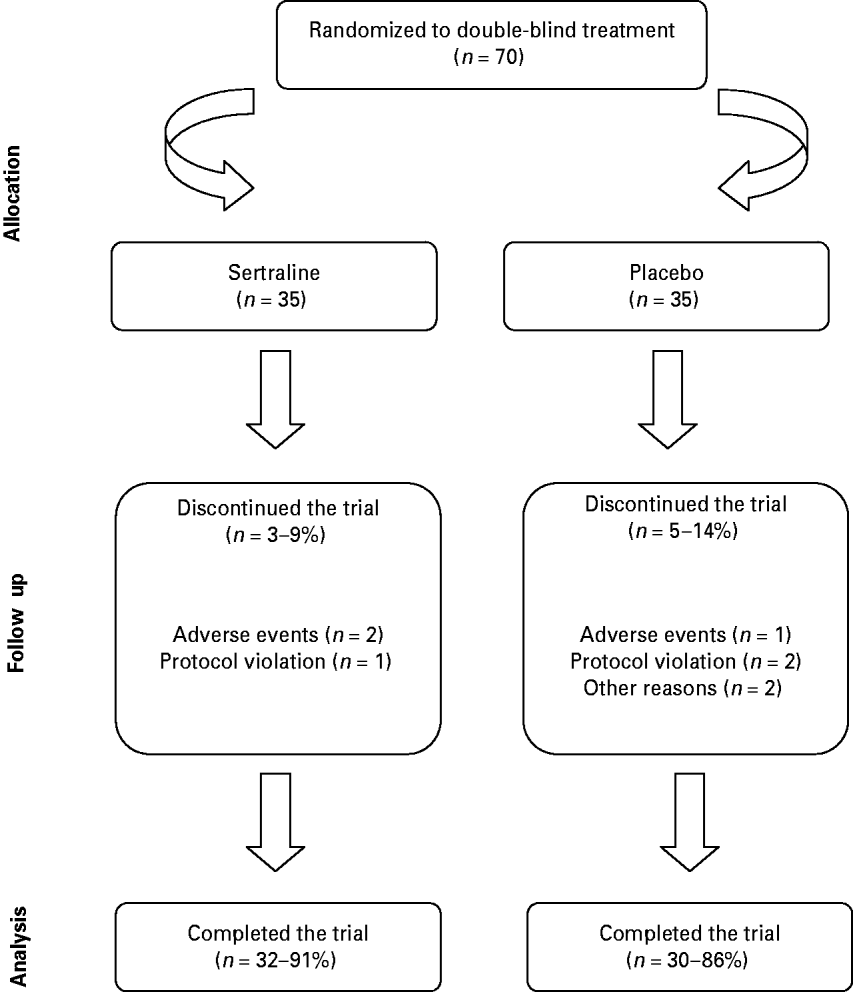
Of the 70 patients enrolled, 62 completed the study (n=32 and 30 in the sertraline and placebo groups, respectively) and were included in the analyses. Three patients discontinued study treatment in the sertraline group (two because of adverse events and one because of protocol violation) and five in the placebo group (two on their own accord, two because of protocol violation, and one because of adverse events) (Fig. 1). The difference in the drop-out rate was not significant between the groups (p>0.05).
Flowchart of the trial.

Baseline characteristics and dosage of medication
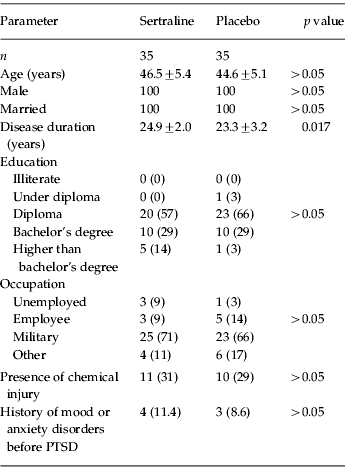
The groups were not significantly different in terms of age, occupation, education and the presence of chemical injury (p>0.05), nor was there any significant difference in the prevalence of mood or anxiety disorders between the groups at baseline (p>0.05, Table 1). However, the mean duration of PTSD was significantly higher in the sertraline group than in the placebo group (p=0.017).
Demographic characteristics of the sertraline and placebo groups

PTSD, Post-traumatic stress disorder.
Values are expressed as mean±standard deviation or number (%).
The mean final dose of sertraline taken in the study was 140±33 mg/day, and the mean milligram equivalent dose for patients on placebo was 131±29 mg/day. Sertraline was well tolerated, with only 6% of patients discontinuing as a result of adverse events.
Effect of sertraline on total and subscale IES-R score
There was no significant difference in IES-R total score between the groups at baseline (65.4±3.9 v. 65.1±5.0 for sertraline and placebo groups, respectively; t=0.3, p>0.05), nor was there any significant difference in the baseline scores of the IES-R subscales (intrusion: 23.7±2.1 v. 23.6±2.5, t=0.3; avoidance: 23.8±1.8 v. 23.8±2.3, t=0.1; hyperarousal: 17.9±1.6 v. 17.8±1.8, t=0.3; p>0.05). On the per protocol analysis (PPA), the mean reduction in IES-R total score was found to be significantly higher in the sertraline than in the placebo group (−24.8±2.0 v. −20.4±2.2; t=−8.3, p<0.001). There was also a similar trend for all three IES-R subscales: re-experiencing/intrusion (−9.1±1.3 v. −7.6±1.2; z=−4.4, p<0.001), avoidance/numbing (−8.8±1.1 v. −7.2±1.5, z=−4.0, p<0.001) and hyperarousal (−6.9±0.8 v. −5.6±0.7, z=−5.6, p<0.001) symptoms.
Based on the ITT analysis, the groups were comparable in their baseline IES-R total (65.3±3.8 v. 65.1±4.8 for sertraline and placebo groups, respectively; t=0.2, p>0.05) and also subscale scores: re-experiencing/intrusion 23.7±2.1 v. 23.4±2.4; t=0.6, p>0.05), avoidance/numbing (23.7±1.9 v. 24.0±2.3, t=−0.6, p>0.05) and hyperarousal (17.8±1.5 v. 17.6±1.7, t=0.4, p>0.05) symptoms.
In the LVCF method of imputation, treatment with sertraline was found to be associated with a greater reduction in the IES-R total score (−22.7±7.3 v. −17.5±7.5; z=−5.5, p<0.001) and its subscales: re-experiencing/intrusion (−8.3±2.9 v. −6.5±2.9; z=−4.0, p<0.001), avoidance/numbing (−8.1±2.7 v. −6.2±2.9, z=−3.7, p<0.001) and hyperarousal (−6.3±2.1 v. −4.8±2.1, z=−5.0, p<0.001) symptoms. Similarly, applying the GMI method of imputation showed that treatment with sertraline was associated with a greater reduction in the IES-R total score (−24.6±2.1 v. −20.4±2.4; t=−7.9, p<0.001) and its subscales: re-experiencing/intrusion (−9.1±1.3 v. −7.5±1.3; z=−4.7, p<0.001), avoidance/numbing (−8.7±1.3 v. −7.4±1.6, z=−3.5, p<0.001) and hyperarousal (−6.8±0.8 v. −5.5±0.9, z=−5.6, p<0.001) symptoms.
IES-R total and subscale scores were further analyzed using a two-way ANOVA with repeated measures. Using the LVCF data, there was a borderline significant treatment (between-subject) effect for the IES-R total score (p=0.058) and a significant effect for the avoidance/numbing subscale (p=0.03). There was no significant treatment effect for re-experiencing/intrusion and hyperarousal subscales. Similarly, no significant effect was observed for the duration of illness and presence of chemical injury when entered (either separately or concurrently) into the model as covariates (p>0.05).
When the GMI data were applied in the two-way repeated-measures analyses, there were significant group effects for IES-R total (p=0.04) and avoidance/numbing (p=0.03) but not for re-experiencing intrusion and hyperarousal scores (p>0.05). Again, there was no significant effect for the duration of illness and presence of chemical injury after their entry into the model as covariates (p>0.05).
Effect of sertraline on CGI-I and CGI-S scores
There was no significant difference between the groups in their baseline CGI-S score (5.2±0.7 v. 5.1±0.7 for sertraline and placebo groups, respectively; z=−0.5, p>0.05). Using PPA, the mean reduction in the CGI-S score by the end of the trial was found to be significantly greater in the sertraline than in the placebo group (−1.0±0.7 v. −0.5±0.7; z=−2.9, p=0.003). Similarly, treatment with sertraline was associated with a significantly lower CGI-I score at endpoint compared to placebo (2.7±0.7 v. 3.4±0.7, z=−3.4, p=0.001).
On the ITT analysis, there was again no significant difference in baseline CGI-S scores (5.2±0.7 v. 5.1±0.7 7 for sertraline and placebo groups, respectively; z=−0.5, p>0.05). With the PPA, a significantly greater reduction in the CGI-S score was observed in the sertraline group compared to the placebo group and this was observed in both LVCF (−0.9±0.7 v. −0.4±0.7; z=−3.1, p=0.002) and GMI (−0.1±0.7 v. −0.5±0.7; z=−3.2, p=0.001) approaches. As for the CGI-I score (using the GMI method), the sertraline group had significantly lower scores than the placebo group (2.7±0.7 v. 3.3±0.7; z=−3.7, p<0.001).
Responder rates
On the PPA, the number of patients who met the combined responder criteria (defined as a ⩾30% reduction in the IES-R total score plus obtaining a score of 1 or 2 on the CGI-I scale) was significantly higher in the sertraline (44%) than in the placebo (3%) group (p<0.001). Responder rates also turned out to be higher in the sertraline group when CGI-I (sertraline: 44%; placebo: 13%; p=0.008) and IES-R (sertraline: 100%; placebo: 80%; p=0.01) based criteria were applied alone.
On the ITT analysis (using the mean imputation method), the number of patients who met the combined responder criteria was significantly higher in the sertraline (40%) compared to the placebo (6%) group (p=0.001). The percentage of CGI-I (sertraline: 40%; placebo: 11%; p=0.006) and IES-R (sertraline: 100%; placebo: 80%; p=0.011) responders was also significantly higher in the sertraline group than in the placebo group.
Treatment-related adverse events
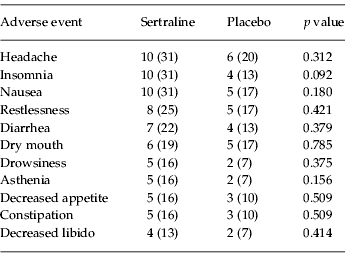
Predominant adverse events (occurring in at least 10% of patients) were: headache, insomnia, nausea, restlessness, diarrhea, dry mouth, drowsiness, asthenia, decreased appetite, constipation and decreased libido. The difference in the frequency of these adverse events did not reach statistical significance between the groups (p>0.05, Table 2).
Comparison of adverse events between the sertraline and placebo groups

Values are expressed as number (%).
Adverse events are those that occurred in at least 10% of patients.
Discussion
The results of the present study indicate a significant therapeutic efficacy for sertraline in all three efficacy measures assessed: the IES-R, CGI-I and CGI-S scales. Sertraline was also associated with a significantly greater reduction in the mean score of each of the DSM-IV-defined clusters of the IES-R subscales re-experiencing/intrusion, avoidance/numbing and hyperarousal symptoms. In addition, the proportion of patients meeting the responder criteria on the CGI-I scale was significantly higher in the sertraline group than in the placebo group.
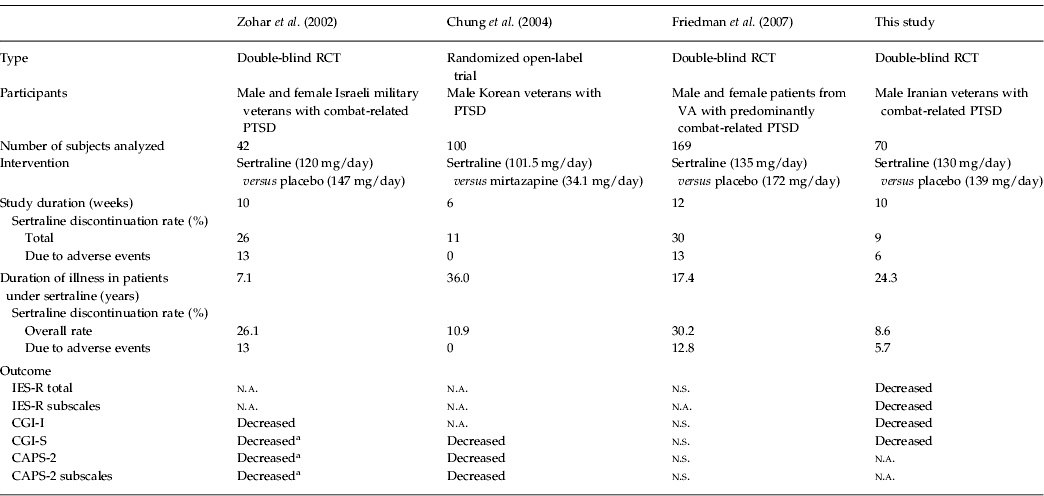
To our knowledge, there have been few studies on the efficacy of sertraline in combat-related PTSD (Table 3), with almost no published reports among Iranian veterans. One of the more recent reports pertains to a large-scale trial among 162 patients with predominantly combat-related PTSD in a Veteran Affairs (VA) setting, in which sertraline therapy for 12 weeks was not found to be efficacious against any of the primary efficacy measures evaluated (Friedman et al. Reference Friedman, Marmar, Baker, Sikes and Farfel2007). Nevertheless, as discussed in that report, the negative finding does not rule out the effectiveness of sertraline for any combat-related PTSD. One reason is that Vietnam veterans under long-term PTSD therapy may not be regarded as true representatives of military veterans with PTSD, but instead as patients with severely impaired, chronic and treatment-resistant PTSD (Friedman, Reference Friedman1997). The inconsistent results on the effectiveness of sertraline against combat-related PTSD could also be attribute to several factors such as differences in the traumatic conditions of wars, baseline clinical presentations of participants and accompanying co-morbidities, in addition to psychosocial, racial and religious differences.
A comparison of trials performed on the effectiveness of sertraline against combat-related PTSD

PTSD, Post-traumatic stress disorder; RCT, randomized controlled trial; VA, Veteran Affairs medical center; IES-R, Impact of Event Scale – Revised; CGI-I, Clinical Global Impression scale – Improvement; CGI-S, CGI scale – Severity; CAPS-2, Clinician-Administered PTSD Scale Part 2; n.a., not applicable; n.s., not significant.
a Numerical but not statistical decrease.
With respect to the adverse events, sertraline seemed to be well tolerated, with no significant differences in the rate of predominant adverse events (⩾10% incidence) compared to placebo. This is in accordance with previous studies that reported good tolerability and safety of sertraline in combat-related PTSD (Zohar et al. Reference Zohar, Amital, Miodownik, Kotler, Bleich, Lane and Austin2002; Chung et al. Reference Chung, Min, Jun, Kim, Kim and Jun2004; Friedman et al. Reference Friedman, Marmar, Baker, Sikes and Farfel2007). In addition, the number of patients who were qualified as responders on the CGI-I scale was significantly higher in the sertraline group than in the placebo group. In the study by Zohar et al. (Reference Zohar, Amital, Miodownik, Kotler, Bleich, Lane and Austin2002), the responder rates on the CGI-I and on the combined CGI-I and Clinician-Administered PTSD Scale Part 2 (CAPS-2) were reported to be numerically but not statistically higher in the sertraline than in the placebo group. This is probably due to the small patient population and pilot nature of the aforementioned trial. These findings are contrary to those obtained by Friedman et al. (Reference Friedman, Marmar, Baker, Sikes and Farfel2007), who reported no significant difference in responder rate on the CGI-I and CAPS-2. Again, this negative finding could be attributed to the nature of the participants, as discussed earlier.
With regard to other SSRIs, there are reports on the efficacy of paroxetine, fluvaxamine and fluoxetine against combat-related PTSD, although the results on fluoxetine and fluvaxamine have not been very consistent (De Boer et al. Reference De Boer, Op den Velde, Falger, Hovens, De Groen and Van Duijn1992; Marmar et al. Reference Marmar, Schoenfeld, Weiss, Metzler, Zatzick, Wu, Smiga, Tecott and Neylan1996; Hertzberg et al. Reference Hertzberg, Feldman, Beckham, Kudler and Davidson2000; Marshall et al. Reference Marshall, Beebe, Oldham and Zaninelli2001; Tucker et al. Reference Tucker, Zaninelli, Yehuda, Ruggiero, Dillingham and Pitts2001; Martenyi et al. Reference Martenyi, Brown, Zhang, Koke and Prakash2002a, Reference Martenyi, Brown, Zhang, Prakash and Kokeb; Martenyi & Soldatenkova, Reference Martenyi and Soldatenkova2006). Moreover, although there is evidence supporting the modest treatment response in combat-related compared to civilian PTSD (De Boer et al. Reference De Boer, Op den Velde, Falger, Hovens, De Groen and Van Duijn1992; Marmar et al. Reference Marmar, Schoenfeld, Weiss, Metzler, Zatzick, Wu, Smiga, Tecott and Neylan1996; Zohar et al. Reference Zohar, Amital, Miodownik, Kotler, Bleich, Lane and Austin2002), it has been shown that veterans from the general population, and not VA, achieve as much benefit from SSRI therapy as do non-veterans (Marshall et al. Reference Marshall, Beebe, Oldham and Zaninelli2001; Tucker et al. Reference Tucker, Zaninelli, Yehuda, Ruggiero, Dillingham and Pitts2001; Martenyi et al. Reference Martenyi, Brown, Zhang, Koke and Prakash2002a, Reference Martenyi, Brown, Zhang, Prakash and Kokeb). There is also evidence indicating that, aside from acute-phase PTSD, flexibly dosed fluoxetine is also effective in the maintenance phase of the disease by sustaining improvements and preventing relapses (Martenyi & Soldatenkova, Reference Martenyi and Soldatenkova2006). Therefore, the lower effect size observed for the combat-related PTSD may not be generalized to all veterans, and seems to be the case for specific populations such as those recruited from VA medical centers. This suggests that evaluation of treatment efficacy should be performed in combat-exposed populations specifically, taking into consideration different traumatic conditions of wars, co-morbidities, chronicity and many other psychosocial factors that could affect the therapeutic response. Of note, the participants in the present study constituted a homogeneous population as they were all Iranian veterans of the Iran–Iraq war and of the male gender. Moreover, there was no significant difference between the sertraline and placebo groups, either in the demographic parameters assessed or in the baseline severity of symptoms as evaluated by the CGI-S and IES-R scales.
In summary, the findings of the present study indicate that sertraline therapy is associated with improved control and decreased severity of symptoms in Iranian Iran–Iraq war veterans with combat-related PTSD. Furthermore, sertraline was found to be safe and well tolerated in this group of subjects. However, regarding psychosocial and traumatic differences, individual and/or multicenter trials are warranted to confirm the efficacy of sertraline in other populations with combat-related PTSD.
Acknowledgements
We gratefully acknowledge the financial support for this work that was provided by the Baqiyatallah University of Medical Sciences.
Declaration of Interest
None.