Introduction
Creativity, formally defined as the generation of novel and useful ideas in organizations (Amabile, Reference Amabile, Staw and Cummings1988), is critical for organizations to generate innovation and competitive advantage in today's complex and dynamic environment (Anderson, Potočnik, & Zhou, Reference Anderson, Potočnik and Zhou2014). Scholars and practitioners alike are increasingly intrigued by ways to foster creativity. In seeking the optimal management structure to stimulate creativity, many organizations have resorted to teams (Cohen & Bailey, Reference Cohen and Bailey1997; Ilgen, Hollenbeck, Johnson, & Jundt, Reference Ilgen, Hollenbeck, Johnson and Jundt2005), which are commonly considered an ideal setting and a fertile ground for kindling creativity (Shalley, Zhou, & Oldham, Reference Shalley, Zhou and Oldham2004). Further, organizations implement talent management (TM), which is defined as the activities and processes that assist the systematic identification of key positions and the development of high-performing and high-potential incumbents in the talent pool to fill these strategic positions (Collings, Scullion, & Vaiman, Reference Collings, Scullion and Vaiman2015); one goal of adopting TM practices is to stimulate the creativity of talents (Gallardo-Gallardo, Thunnissen, & Scullion, Reference Gallardo-Gallardo, Thunnissen and Scullion2019; Sparrow & Makram, Reference Sparrow and Makram2015). Previous research indicated that TM practices related to teamwork design and dynamics stimulate creativity-relevant outcomes such as learning (Oltra & Vivas-López, Reference Oltra and Vivas-López2013).
Prior research on teams and TM as related to creativity, however, has generated relatively separate bodies of research. One line of research focused on individual differences that contribute to creativity, such as openness to new experiences (Ma, Reference Ma2009), individual features (Hirst, van Knippenberg, & Zhou, Reference Hirst, van Knippenberg and Zhou2009), cognitive ability (Shin, Kim, Lee, & Bian, Reference Shin, Kim, Lee and Bian2012), personality traits (Zhang, Sun, Jiang, & Zhang, Reference Zhang, Sun, Jiang and Zhang2019), and proactive vitality management (Bakker, Petrou, Op den Kamp, & Tims, Reference Bakker, Petrou, Op de Kamp and Tims2020). A parallel line of research examined management practices such as high-commitment work systems (Chang, Jia, Takeuchi, & Cai, Reference Chang, Jia, Takeuchi and Cai2014; Kurtzberg & Amabile, Reference Kurtzberg and Amabile2001), organizational support (Aldabbas, Pinnington, & Lahrech, Reference Aldabbas, Pinnington and Lahrech2023), climate for innovation (Liu, Wang, & Zhu, Reference Liu, Wang and Zhu2020), and leadership (Jung, Reference Jung2001; Puccio et al., Reference Puccio, Burnett, Acar, Yudess, Holinger and Cabra2020) that promote creativity. Nonetheless, questions about the interplay between TM and individual/team dynamics on creativity remain unanswered.
To this end, we focus on team talent inducement, which refers to the sensemaking process of TM – ‘as employees interpret explicit and implicit cues from the HRM system, they construct a belief of the specific qualities and behaviors that constitute talent in the organization’ (Höglund, Reference Höglund2012: 29). As such, how leaders shape team members’ perceptions of desirable attitudes and behaviors based on talent-related criteria and how team members react to talent inducements are important for team management. Iles, Xin, and Preece (Reference Iles, Xin and Preece2010b) advanced a comprehensive model to depict the main perspectives of TM. Among them, the perspective of ‘inclusive-people’ maintains that all employees have their own particular talents and, thus, opportunities and resources should be invested equally in all employees (Collings et al., Reference Collings, Scullion and Vaiman2015). The perspective of ‘exclusive-people’, on the contrary, recommends investing scarce opportunities and resources in the most promising talent, which implies the concept of talent inducement (Kwon & Jang, Reference Kwon and Jang2021). As previous studies indicated, it is the employees’ perception of TM practice, rather than the practice itself, that is related closely to employee reactions (Gelens, Hofmans, Dries, & Pepermans, Reference Gelens, Hofmans, Dries and Pepermans2014). We, therefore, draw from signaling theory (Connelly, Certo, Ireland, & Reutzel, Reference Connelly, Certo, Ireland and Reutzel2011) to argue that talent inducement practices send important signals about how the organization appraises employees and identifies and rewards talents (Nijs, Dries, Vlasselaer, & Sels, Reference Nijs, Dries, Vlasselaer and Sels2022), which will shape employees’ expectations and influence employee behaviors (Van Beurden, Van De Voorde, & Van Veldhoven, Reference Van Beurden, Van De Voorde and Van Veldhoven2021).
Based on signaling theory, we argue that talent inducements are critical for creativity because they enhance employees’ work engagement (Gallardo-Gallardo, Nijs, Dries, & Gallo, Reference Gallardo-Gallardo, Nijs, Dries and Gallo2015; Sparrow & Makram, Reference Sparrow and Makram2015). Although some studies based on organizational justice theory argued that the ‘exclusive-people’ perspective might decrease cooperation and produce destructive internal competition (O'Connor & Crowley-Henry, Reference O'Connor and Crowley-Henry2019), other research based on workforce differentiation theory posited that talent inducements provide opportunities for high-performance or high-potential employees which can generate sustained development (Gallardo-Gallardo & Thunnissen, Reference Gallardo-Gallardo and Thunnissen2016). When employees receive the signal that high performance will be rewarded, they will engage more time and effort in creative processes, which will generate better and more creative solutions (Ling, Leilei, & Yanhong, Reference Ling, Leilei and Yanhong2018). Employees who have more vitality are more creative at work (Bakker et al., Reference Bakker, Petrou, Op de Kamp and Tims2020). Engaged employees are also more open to new ideas and generate more creative processes and critical thinking (Bakker et al., Reference Bakker, Petrou, Op de Kamp and Tims2020; Jiang & Yang, Reference Jiang and Yang2015). Despite the established relationship between work engagement and creativity, studies investigating how talent inducements can stimulate work engagement and creativity are few and far between.
In addition, there has been a dearth of research on the boundary conditions of talent inducements. According to signaling theory, how the receivers interpret the signal and respond to the signal (Connelly et al., Reference Connelly, Certo, Ireland and Reutzel2011) depends on individual characteristics (Connelly et al., Reference Connelly, Certo, Ireland and Reutzel2011), such as goal orientation. Dweck and Leggett (Reference Dweck and Leggett1988) defined goal orientation as members’ tendency to adopt and pursue goals in achievement contexts, which, according to the different standards that members use to evaluate competence, has three constituting dimensions: learning-approach orientation (LAPO), performance-approach orientation, and performance-avoidance orientation. Prior research has demonstrated the importance of goal orientation on work engagement (e.g., Jones, Davis, & Thomas, Reference Jones, Davis and Thomas2017). Nonetheless, members with different goal orientations may also be guided by different priorities and respond to team talent inducement practices differently, thereby exhibiting different levels of work engagement. We, therefore, suggest that individual goal orientation will play a moderating role in the relationship between team talent inducements and work engagement.
Lastly, although TM practices are often initiated at the organization level, given that team leaders often have the autonomy to implement intended organizational TM practices (Van Beurden et al., Reference Van Beurden, Van De Voorde and Van Veldhoven2021; Oltra & Vivas-López, Reference Oltra and Vivas-López2013), TM implementations also vary at the team level. First, the conceptualization of talent inducements as a sensemaking process essentially reflects a human capital resource emergence perspective (Ployhart & Moliterno, Reference Ployhart and Moliterno2011), whereby individual perception and interpretation of what constitutes talent in the organization converge through a ‘bottom-up’, concerted interaction process. Such homogeneity within teams captures the proper internal implementation of TM practices (Li, Wang, Van Jaarsveld, Lee, & Ma, Reference Li, Wang, Van Jaarsveld, Lee and Ma2018). Second, as teams are units composed of members with complementary skills and abilities (Taggar, Reference Taggar2002), talent inducement practices also have between-team heterogeneity. As such, unraveling how creativity is fostered is an inherently multi-level and multi-perspective process that requires insight into both the interplay between the individual and the team and a consideration of both TM practices and team processes.
Building upon the aforementioned research gaps, in this study, we examine the indirect effects of team-level talent inducements on individual and team creativity via work engagement as well as the boundary conditions (as illustrated in Figure 1). Specifically, we view talent inducements as the ‘exclusive-people’ perspective of TM to influence team member work engagement and, subsequently, creativity at the individual and team levels, which are then subject to the contingency of individual goal orientation. In doing so, we aim to make several contributions to the literature.
Conceptual model of the current study

First, synthesizing the literature on TM and teams, we propose a conceptual model that unravels the effects of TM on individual and team creativity. Specifically, we consider team-level talent inducement as the shared perception among team members regarding TM strategies, including identifying critical positions, training and development of competency, and reward that are designed to identify, acquire, and motivate talented members. Second, drawing on signaling theory (Connelly et al., Reference Connelly, Certo, Ireland and Reutzel2011), we suggest work engagement as a mechanism linking team-level talent inducement and creativity. This extends the knowledge of how work engagement operates between talent inducements and creativity. Third, we unveil individual-level characteristics as boundary conditions – specifically, how different individual goal orientations can strengthen or weaken the effects of team-level talent inducements on team members’ work engagement. Doing so advances understanding of talent inducements from a contingency perspective and sheds light on the intricate interplay between TM and individual characteristics. Fourth, we offer a multi-level perspective and a combinational approach to examine the influence process of team talent inducements across the team and individual levels. We focus on team-level talent inducements, which extend the HRM literature by bringing team-level TM systems from organization-level TM systems to the forefront of TM research (Oltra & Vivas-López, Reference Oltra and Vivas-López2013). Moreover, given the study's empirical context, how to create individual and team creativity is relevant not only to TM strategies in China but also to global organizations’ team TM practices. The effects of TM strategies such as pay for high-performance employees, however, may depend on individuals’ collectivistic orientation and other Chinese cultural values (e.g., power distance) (Rohlfer, Hassi, & Jebsen, Reference Rohlfer, Hassi and Jebsen2021; Zhang, He, Long, & Zhang, Reference Zhang, He, Long and Zhang2021). The current framework and empirical findings, therefore, fill the gap in TM literature in the Chinese cultural context and offer important insights into the global context.
Theoretical Background and Hypotheses Development
Conceptualizing TM at the Team Level
Despite extensive interest from scholars and practitioners (Ariss, Cascio, & Paauw, Reference Ariss, Cascio and Paauw2014), the conceptualization of TM and its aims and scope remain disputed with three different interpretations. The first refers to conventional HRM practices; the second alludes to succession-planning practices; and the third focuses on the management practices of high-potential and high-performing employees (Lewis & Heckman, Reference Lewis and Heckman2006). One key debate centers on whether the main targets of TM comprise all employees or only the high-potential/high-performing employees, i.e., the inclusive or exclusive (i.e., strengths-based) approach (Iles, Preece, & Chuai, Reference Iles, Preece and Chuai2010a). On the basis of viewing TM from different contexts and with different targets, Iles and colleagues (2010) further delineated the exclusive-people perspective, which advocates managing employees differentially according to the individuals’ added value to organizations.
The literature on TM also spans across multiple levels of analysis. While most studies considered TM as organizational practices, Sparrow and Makram (Reference Sparrow and Makram2015) suggested that TM could be understood as a talent philosophy driven by value. Their framework differs from previous TM studies that focused exclusively on human capital theory or organization practices; instead, it considers TM as a value-driven system or architecture. Some studies have contextualized TM and investigated its effects in business sectors (Festing, Schäfer, & Scullion, Reference Festing, Schäfer and Scullion2013) and in cross-organization partnerships (Sparrow, Hird, & Cooper, Reference Sparrow, Hird and Cooper2016). These studies show that context is paramount and that TM can be effective not only at the organizational level but also in more microscopic, value-driven systems, such as teams, sectors, and other small- and medium-sized enterprises (Gallardo-Gallardo et al., Reference Gallardo-Gallardo, Thunnissen and Scullion2019). Given that organizations continually rely on teams made up of various talents to spark creative ideas (Anderson et al., Reference Anderson, Potočnik and Zhou2014), teams have become a basic unit of value-driven systems that have the autonomy to develop or implement management practices (Jønsson & Jeppesen, Reference Jønsson and Jeppesen2013).
Although TM policies and practices are designed at the organizational level, team leaders implement TM practices through daily interactions with team members (Ehrnrooth, Björkman, Mäkelä, Smale, Sumelius & Taimitarha, Reference Ehrnrooth, Björkman, Mäkelä, Smale, Sumelius and Taimitarha2018); therefore, talent inducement can emerge at the team level. Firstly, team leaders play a critical role in conveying the organization's TM policy to team members and influencing the team members’ understanding of work-related issues. Given that team leaders are often empowered to implement intended organizational TM practices, the actual implementation is based on team contexts and leaders’ styles. Secondly, talent philosophies applied in teams are better understood by examining employees’ perceptions and reactions to talent inducement (Höglund, Reference Höglund2012). Team interactions and activities have a profound influence on team members’ shared perceptions of TM implemented in their teams.
Talent inducements, therefore, represent the extent to which individuals perceive that the team values a specified pool of employees who ‘rank at the top in terms of capability and performance’ (Ehrnrooth et al., Reference Ehrnrooth, Björkman, Mäkelä, Smale, Sumelius and Taimitarha2018; Höglund, Reference Höglund2012). When team members perceive that the team identifies, acquires, and motivates talented members to excel in critical positions (Identifying critical positions), or talented members receive more training opportunities to continuously improve their skills for current or future tasks (Competence training), or the team provides individualized feedback, as well as multiple career paths for talented members to cater to their developmental needs (Development), or talented members can receive more intrinsic and extrinsic rewards such as respect and self-esteem, interesting and challenging work, and generous compensation and benefits (Reward management), they will interpret such explicit and implicit cues as the team's philosophy as to how talents are specified and valued (Jayaraman, Talib, & Khan, Reference Jayaraman, Talib and Khan2018). Thus, team-level talent inducements can have more important impacts on member outcomes such as work engagement and creativity. This is consistent with previous research, which has shown that although HRM practices are orchestrated at the higher level of management, there were variations in how they were implemented across units as well as across individuals (Liao, Toya, Lepak, & Hong, Reference Liao, Toya, Lepak and Hong2009).
Using Talent Inducement to Facilitate Work Engagement and Creativity
Talent inducement and work engagement
Work engagement depicts a member's passion, enthusiasm, involvement, commitment, energy, and focused effort (Macey & Schneider, Reference Macey and Schneider2008). Saks (Reference Saks2006) defined work engagement as the degree to which employees are absorbed in their goals; it conveys an enhanced emotional and intellectual linkage that employees/members have for their work, which induces additional effort at work (Gibbons, Reference Gibbons2006). Engaged employees or members are proud to work for their teams or organizations and are motivated to contribute more to drive success. Prior research has shown that TM has a positive relationship with employee work engagement (Bhatnagar, Reference Bhatnagar2007).
Signaling theory suggests that team members use the signals sent by team leaders to interpret leaders’ intentions, which then affect their own emotions and behaviors (Connelly et al., Reference Connelly, Certo, Ireland and Reutzel2011). When team leaders implement talent inducements, they either identify members who have high potential to be effective in future work or assess and develop team members’ knowledge, skills, and abilities for contributing to the team (Silzer & Church, Reference Silzer and Church2009). The team leaders thus send the signal that the team invests in and compensate members who have high performance or high potential. The team invests sufficient job resources in critical talents’ competence training, personalized development, and extrinsic and intrinsic rewards, which directly stimulate their personal growth and development, facilitate goal achievement, and provide a buffer for physiological and psychological demands (Jayaraman et al., Reference Jayaraman, Talib and Khan2018; Li & Frenkel, Reference Li and Frenkel2016). When perceiving talent inducements based on leaders’ signals, team members identified as high-performance or high-potential will feel valued and some indication of exclusive treatment, whereas those who are not yet considered as high-performance or high-potential will feel encouraged to develop skills and ability to improve their performance (Sumelius, Smale, & Yamao, Reference Sumelius, Smale and Yamao2019). As such, team members, either in or outside of the talent pool, are likely to engender a high level of trust and a sense of obligation to reciprocate, which has an important influence on members’ vigor, dedication, and absorption at work (Guzzo & Noonan, Reference Guzzo and Noonan1994; Saks, Reference Saks2006).
Related, Gibbons' (Reference Gibbons2006) review indicates that among the top drivers of work engagement, career, opportunities, skill development, and team members play critical roles. These drivers are precisely the focus of talent inducements (Höglund, Reference Höglund2012; Kwon & Jang, Reference Kwon and Jang2021), suggesting that various talent inducements are naturally compelling in promoting members’ work engagement. Further, Hughes and Rog (Reference Hughes and Rog2008) have shown some evidence that effective talent inducements improved member work engagement.
Work engagement and creativity
Creativity, defined as the production of useful and novel ideas, is greatly influenced by the psychological contexts or work environment perceptions (Amabile, Conti, Coon, Lazenby, & Herron, Reference Amabile, Conti, Coon, Lazenby and Herron1996). Creativity requires flexible thinking and persistence, as well as considerable energetic, affective, and cognitive resources (Bakker et al., Reference Bakker, Petrou, Op de Kamp and Tims2020). The componential theory of creativity suggests that three conditions contribute to the realization of creativity: expertise, creative thinking, and intrinsic task motivation (Amabile, Reference Amabile, Staw and Cummings1988), among which creative thinking plays an important role in determining members’ creativity behaviors (Jiang & Yang, Reference Jiang and Yang2015). When members are engaged in their work, they become more open to new ideas (Bakker et al., Reference Bakker, Petrou, Op de Kamp and Tims2020). Work engagement is exemplified as the vigor, dedication, and absorption displayed at work (Schaufeli, Bakker, & Salanova, Reference Schaufeli, Bakker and Salanova2006), which inspires employees to come up with novel ideas (Christian, Garza, & Slaughter, Reference Christian, Garza and Slaughter2011) and engage in critical thinking and creative processes (Jiang & Yang, Reference Jiang and Yang2015) as well as creative solutions (Martinez, Reference Martinez2015).
As such, engaged members are more likely to be creative (Bakker & Demerouti, Reference Bakker and Demerouti2008). Engaged members have high levels of energy and resilience, are strongly involved in creative work with enthusiasm, and are fully concentrated on and engrossed at work (Bakker et al., Reference Bakker, Petrou, Op de Kamp and Tims2020); therefore, they will be more creative and are more open to new experiences (Demerouti & Cropanzano, Reference Demerouti, Cropanzano, Bakker and Leiter2010). Moreover, prior studies such as Bakker and Xanthopoulou (Reference Bakker and Xanthopoulou2013) have provided evidence that work engagement containing positive emotional orientations is linked to more creative activity. Thus, creativity will increase as members’ work engagement arises.
Multi-level processes
Multi-level theory suggests that individual attitudes, cognitions, and actions will aggregate into a higher-level holistic phenomenon through social interaction (Kozlowski & Klein, Reference Kozlowski, Klein, Klein and Kozlowski2000). Based on the human capital emergence perspective, through repeated social interactions among members, member work engagement will be aggregated and transformed into a valuable emergent affective state at the team level (Ployhart & Moliterno, Reference Ployhart and Moliterno2011). Related, according to emotional contagion theory (Barsade, Reference Barsade2002) and crossover of work engagement (Bakker, van Emmerik, & Euwema, Reference Bakker, van Emmerik and Euwema2006), interacting with others who speak and behave enthusiastically may elicit the same feelings and behaviors in the interaction partner. Team members’ interaction and shared experiences will therefore elicit team work engagement, which is a shared, positive, fulfilling, work-related psychological state characterized by high vigor, dedication, and absorption among team members (Tims, Bakker, Derks, & Van Rhenen, Reference Tims, Bakker, Derks and Van Rhenen2013). Bakker et al. (Reference Bakker, van Emmerik and Euwema2006) suggested that engagement is contagious and may permeate work teams; they also showed that individual team members’ work engagement manifesting as vigor, dedication, and absorption has a strong predictive power for team-level work engagement.
Similarly, multi-level theorizing about creativity has proposed that team creativity is built upon individual creativity (Drazin, Glynn, & Kazanjian, Reference Drazin, Glynn and Kazanjian1999). A multi-level study by Bakker et al. (Reference Bakker, van Emmerik and Euwema2006) showed that team members with strong work engagement demonstrated strong creativity – they would convey their expectations of creativity to teammates and inspire them to be more creative. Moreover, the creative actions of members naturally drew the attention of their teammates to the creative component of their work and inspired their creativity. Members’ individual creative acts, therefore, induce a shared perception of creativity expectation that emerges as a supportive climate for creativity (Ekvall, Reference Ekvall, Runco and Pritzker1999; Ma, Gong, Long, & Zhang, Reference Ma, Gong, Long and Zhang2021). According to West (Reference West, West and Farr1990), the supportive climate for creativity facilitates team members to develop new and improved work patterns and to exert more effort on new ideas and team creativity. Team members also interrelate creative ideas with each other, and this interaction of individual inputs will integrate to predict team creativity (Gong, Kim, Lee, & Zhu, Reference Gong, Kim, Lee and Zhu2012). We, therefore, expect that our hypotheses will hold at both the team and individual levels:
Hypothesis 1a (H1a): Talent inducement has a positive indirect relationship with individual creativity via member work engagement.
Hypothesis 1b (H1b): Talent inducement has a positive indirect relationship with team creativity via team average work engagement.
The Moderating Role of Goal Orientation
Member work engagement is a psychological state which pertains to attitudinal and behavioral motivation (Macey & Schneider, Reference Macey and Schneider2008). According to Saks (Reference Saks2006), work engagement is influenced by the interaction between work contexts and personal traits. Talent inducements are conducive work contexts for work engagement (Sopiah, Kurniawan, Nora, & Narmaditya, Reference Sopiah, Kurniawan, Nora and Narmaditya2020). However, some individuals respond to opportunities and challenges provided for talents positively, while others become stressed. As such, we draw from achievement motivation theory to understand goal orientation as a motivational orientation that influences how individuals approach, interpret, and respond to achievement situations (Dweck, Reference Dweck1986). Goal orientation theory helps to explain whether individuals can adapt to opportunities and challenges in achievement settings (Bakker et al., Reference Bakker, Petrou, Op de Kamp and Tims2020). Prior studies have distinguished among three types of goal orientations: learning goal orientation (focuses on competence development and task mastery), performance-approach goal orientation (emphasizes seeking positive evaluation and outperforming others), and performance-avoidance goal orientation (concerned with avoiding negative evaluations and mistakes) (Dweck & Leggett, Reference Dweck and Leggett1988). As goal orientations influence approach/avoidance motivation and openness to opportunities and challenges (Zhang, Law, & Lin, Reference Zhang, Law and Lin2016), they have important implications for how talent inducements relate to work engagement.
As learning goal orientation focuses on developing competence (De Dreu, Nijstad, & van Knippenberg, Reference De Dreu, Nijstad and van Knippenberg2008), members with high learning goal orientation have a strong desire to understand tasks and engage in learning (Gong & Fan, Reference Gong and Fan2006). These members tend to have an incremental mindset, i.e., they believe their ability can continuously be developed (Dweck, Reference Dweck1986). Moreover, learning goal orientation is related to intrinsic motivation (Hirst et al., Reference Hirst, van Knippenberg and Zhou2009). As achievement goal theory indicates, individuals who are oriented toward learning goals are focused on learning and self-improvement (Dweck, Reference Dweck1986; Hirst et al., Reference Hirst, van Knippenberg and Zhou2009). These individuals will perceive opportunities for individualized feedback, competence development, and customized career paths as extremely valuable for their learning, growth, and intrinsic motivation. These team members are more receptive to and will make better use of the extra resources that are induced in TM. They are also more likely to use information about talent inducements to advance their learning and undertake more challenging and interesting tasks to increase their intrinsic satisfaction. Therefore, the relationship between talent inducement and work engagement will be strengthened for members with high learning goal orientation.
Hypothesis 2 (H2): Individual learning goal orientation will positively moderate the relationship between team talent inducements and member work engagement, such that the relationship is stronger when individual learning goal orientation is stronger.
Performance-approach goal orientation reflects team members’ goal to demonstrate competence and receive favorable evaluations, which motivates team members to achieve high performance (Chen & Kanfer, Reference Chen and Kanfer2006). According to achievement goal theory, individuals with high-performance-approach goal orientation are motivated to ‘outperform’ others, and thus, they will perceive training and development opportunities offered to talents as precious facilitators of their performance. Moreover, these members are more likely to take advantage of talent inducement because of their tendency to establish high-quality exchanges with their team leaders (Janssen & Van Yperen, Reference Janssen and Van Yperen2004) – they are more likely to perceive training and development opportunities and resources for high-performance/high-potential members as a fair allocation of resources to engage members to achieve higher performance. Therefore, a team approach orientation can result in a stronger relationship between talent inducements and work engagement.
Hypothesis 3 (H3): Individual performance-approach orientation will positively moderate the relationship between talent inducements and member work engagement, such that the relationship is stronger when individual performance-approach orientation is stronger.
Performance-avoidance orientation emphasizes avoiding negative external evaluations. According to achievement goal theory, people with a high-performance-avoidance orientation seek to avoid demonstrating evidence of incapability (Dweck, Reference Dweck1986). When high-performance-avoidance individuals are judged or evaluated, they will experience anxiety (Adriaenssens, De Gucht, & Maes, Reference Adriaenssens, De Gucht and Maes2015). These members may shirk creative challenges and learning activities (Hirst et al., Reference Hirst, van Knippenberg and Zhou2009). Given that talent inducement involves the identification of high-performance and high-potential members, which is inherently an evaluation process (Höglund, Reference Höglund2012), it can be stressful for high-performance-avoidance members. Indeed, Janssen and Van Yperen (Reference Janssen and Van Yperen2004) found that high-performance-avoidance orientation individuals tend to reduce effort after encountering setbacks and difficulty and negatively respond to opportunities and resources provided by leaders. In addition, when performance-avoidance orientation is high, team members are not oriented toward achieving stretch goals and have a low intention to get help and support from each other (Ryan, Pintrich, & Midgley, Reference Ryan, Pintrich and Midgley2001). Performance-avoidance orientation also relates to more interpersonal conflict and less knowledge exchange between team members (Janssen & Van Yperen, Reference Janssen and Van Yperen2004). These members tend to perceive others as a threat (Adriaenssens et al., Reference Adriaenssens, De Gucht and Maes2015), which renders them to retain information and knowledge about team talent inducement activities, thus attenuating the potential of talent inducements to enhance work engagement. Furthermore, as Gelens et al. (Reference Gelens, Hofmans, Dries and Pepermans2014) suggest, although members identified as high-potential tend to react positively to talent inducements, those not identified as high-potential could be negatively impacted by talent inducements – such an effect could be more pronounced for members with a performance-avoidance orientation. Therefore, we hypothesize:
Hypothesis 4 (H4): Individual performance-avoidance orientation will negatively moderate the relationship between talent inducements and member work engagement, such that the relationship is weaker when individual performance-avoidance orientation is stronger.
The discussions above suggest that individual learning goal orientation and performance-approach orientation will augment the relationship between talent inducements and member work engagement. Stronger work engagement, in turn, is positively related to individual creativity, resulting in stronger indirect effects of talent inducements on creativity. On the contrary, high individual performance-avoidance orientation will diminish the relationship between talent inducements and member work engagement, leading to weaker indirect effects of talent inducements on individual creativity. We, therefore, develop the hypotheses of the moderated mediating effects below.
Hypothesis 5 (H5) Individual learning goal orientation will positively moderate the indirect relationship between talent inducement and individual creativity via work engagement, such that the indirect relationship is stronger when member learning goal orientation is stronger.
Hypothesis 6 (H6): Individual performance-approach orientation will positively moderate the indirect relationship between talent inducement and individual creativity via work engagement, such that the indirect relationship is stronger when member performance-approach orientation is stronger.
Hypothesis 7 (H7): Individual performance-avoidance orientation will negatively moderate the indirect relationship between talent inducement and individual creativity via work engagement, such that the indirect relationship is weaker when member learning approach orientation is stronger.
Methods
Sample and Procedure
Using a multi-source, multi-level design, we collected data from work teams in 14 companies of three industries in China, including real estate, mechanic manufacturing, and banking. We chose a variety of industries to maximize the generalizability of our findings. Specifically, through an alumni network of a business school in a major university in central China, we randomly selected 26 companies and made face-to-face contact with the company liaisons, of which the first author and two research assistants collectively identified 14 companies with established TM practices. These companies defined talent as high-performance individuals who show active support of the organizational strategy, values, and leadership behaviors at work; and high-potential individuals with high skills and capabilities and proactive initiative taking. These companies were then invited to identify teams that have invested in talent inducements to complete the survey. These identified teams must satisfy the following for inclusion – team leaders are empowered to implement intended organizational TM practices.
The first author distributed paper questionnaires on-site during working hours. Responses were voluntary, and the participants were assured of confidentiality. Members of participating teams represented functions including marketing, R&D, engineering, administrative support, customer service, finance, human resources, as well as top management teams. To minimize potential common method bias, we collected data from both team leaders and team members. Team members responded to questions about talent inducements, individual goal orientation, and work engagement, while team leaders rated their team's and members’ creativity. Unless described otherwise, all continuous variables were measured with a five-point Likert scale (1 = strongly disagree; 5 = strongly agree).
We distributed the leader-member paired surveys to 90 teams with a total of 583 members, of which 82 teams (91% response rate), including 504 team members (86% response rate), responded to the questionnaires. Six leader questionnaires and 89 member questionnaires were removed due to incomplete or overfilling information, and four leader questionnaires and 65 member questionnaires were unmatched and removed. After eliminating invalid questionnaires, we obtained useful data from 72 team leaders and 350 members. These teams geographically spanned across different regions of China (i.e., North [Beijing], South [Guangdong], East [Zhejiang], and Central [Hunan] China), with 18.3% of the sample from real estate, 31.7% from mechanic manufacturing, and 50.0% from banking. The average age of the organizations (i.e., the number of years the organization has been founded) was 8.5 years (SD = 1.11). The average age of the teams (i.e., the number of years the team has been founded) was 3.44 years (SD = 1.27). Of the team members, 53% were male, the average age was 36 years (SD = 2.03), and the average tenure in the team (i.e., number of years in the team) was 3.2 years (SD = 0.98). Of the team leaders, 80% were male, the average age was 41 years (SD = 1.03), and the average tenure in teams (i.e., number of years working in teams, including the present teamFootnote 1) was 8.1 years (SD = 0.86).
Measures
Following the back-translation procedure (Brislin, Reference Brislin1970), we first translated all original English measures into Chinese and then independently translated them back into English to guarantee equivalency of meaning. To ensure the content validity of our questionnaires, we recruited 40 MBA students and 8 PhD students to pilot test all questions. The final version of the surveys was based on their feedback and suggestions.
Team talent inducements
We adapted four items from Höglund's (Reference Höglund2012) talent inducement scale to measure team TM practices, which assess the extent to which the team values its members who rank at the top regarding capability and performance (Höglund, Reference Höglund2012). Since it is employees’ perception of TM practice rather than the practice itself that is closely related to employee reactions (Gelens et al., Reference Gelens, Hofmans, Dries and Pepermans2014), following previous studies such as Höglund (Reference Höglund2012), we asked the respondents to rate their perception of the talent inducements in the team. Example items include: ‘Our team provides high-performing members with career and promotion opportunities’; and ‘our team provides highly capable and skilled members with career and promotion opportunities’. The Cronbach's alpha for the scale was 0.83. Team members provided individual responses to the talent inducement scale, and then we aggregated their responses to the team level.
Work engagement
We measured work engagement using the 9-item scale from Schaufeli et al. (Reference Schaufeli, Bakker and Salanova2006), which reflects the extent to which team members display a persistent and pervasive affective-cognitive state without referring to any particular object, event, individual, or behavior. A sample item is ‘I am enthusiastic at my work’. The Cronbach's alpha was 0.91. As Bakker et al. (Reference Bakker, van Emmerik and Euwema2006) suggested, team members’ work engagement has a strong predictive power for team-level work engagement. Whereas member work engagement is a function of the job resources and demands the team provides, team work engagement reflects members’ shared motivational emergent state (Costa, Passos, & Bakker, Reference Costa, Passos and Bakker2014). Following the suggestions of Kahn (Reference Kahn1990), we used the mean value of individual-level work engagement to measure team-level work engagement.
Goal orientation
We used the 12-item scale by Vande Walle (Reference Vande Walle1997) to measure three constituting components of goal orientation (four items for each). Sample items include ‘I would rather choose a challenging work, so that I can learn a lot from it’ (LAPO); ‘I would like to show that I have done better than my colleagues’ (performance-approach orientation); and ‘If one task shows I am less competent than others, I will avoid it’ (performance-avoidance orientation). The Cronbach's alpha for the team learning approach orientation, performance-approach orientation, and performance-avoidance orientation was 0.82, 0.91, and 0.85, respectively.
Creativity
We measure team creativity using the six-item scale developed by Amabile et al. (Reference Amabile, Conti, Coon, Lazenby and Herron1996). Team leaders assessed the creativity of their teams, which is defined as the generation of novel and useful ideas by their teams. A sample item includes ‘Our team usually proposes creative and useful ideas’. The Cronbach's alpha was 0.92. Individual creativity was measured using a 13-item scale developed by Zhou and George (Reference Zhou and George2001), which includes items such as ‘He/she is not afraid to take risks’ and ‘He/she is a good source of creative ideas’. Team leaders again provided ratings for their team members on these items. The Cronbach's alpha was 0.94.
Control variables
Following prior studies, we included several individual-level and team-level control variables. In particular, because individual characteristics may influence the perception of talent inducement, consistent with Höglund (Reference Höglund2012), we controlled for age, gender, and education level at the individual level. As the size of a team can affect creativity in teams (Pearce & Herbik, Reference Pearce and Herbik2004), we controlled for team size. Finally, we controlled for the type of the teams – marketing teams comprise more than half of our sample (51.39%), whereas customer service teams comprise 15.28%, human resources teams comprise 9.72%, finance teams comprise 6.94%, administrative support teams and top management teams each comprise 5.56%, R&D teams comprise 4.17%, and engineering teams comprise 1.39%. The one-way analysis of variance (ANOVA) with team creativity with different team types (marketing teams excluded) produced an insignificant effect, F (1, 34) = 1.22, p > 0.05. We, therefore, created a dummy variable representing team type (marketing = 1, others = 0) at the team-level.
Analysis
As talent inducement and team creativity are team-level variables, while member goal orientation, work engagement, and individual creativity are individual-level variables, hierarchical linear modeling (HLM) was employed to test the relationships between these variables (McCoach, Reference McCoach, Hancock and Mueller2010). In addition, given that the film-level factors may have possible confounding effects on the tested relationship, we controlled for any unmeasured firm-level effects by analyzing an intercept-only model in the analysis. Firstly, we tested a null model with no predictors entered; Next, in step one, we introduced the individual-level variables (individual-level control variables, member work engagement, goal orientation, and creativity) and team-level variables (team-level control variables, talent inducements and team work engagement). In step two, we introduced cross-level interactions into the model. Third, we examined the level of within and between firm variance in team work engagement and team creativity; and we examined the level of within and between firm and group variance in member work engagement and individual creativity. We, therefore, used two-level models to test relationships with team creativity and three-level models to test relationships with individual creativity. We centered team-level study variables by their grand means and individual-level study variables by their group means before entering them into the models.
Data aggregation
Some team-level variables were collected at the individual level. We first aggregated team members’ individual ratings of talent inducements to the team level. To test the within-team homogeneity of team member perceptions, we used James, Demaree, and Wolf (Reference James, Demaree and Wolf1984) R wg (j) to estimate inter-rater reliability. The R wg (j) of talent inducement across the 72 teams was 0.87, which was greater than the minimum standard of 0.70 (George & Bettenhausen, Reference George and Bettenhausen1990). Furthermore, ICC(1) for talent inducement was 0.34, and ICC(2) was 0.76. In addition, for work engagement, R wg (j) was 0.83; ICC(1) and ICC(2) were 0.43 and 0.79, respectively. Together these results supported aggregation to the team level.
Discriminant validity
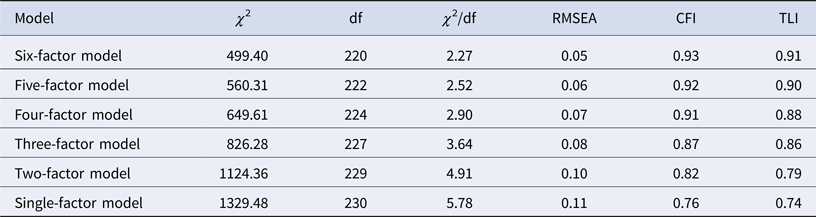
We conducted confirmatory factor analyses (CFAs) to examine the discriminant validity of measures of creativity, talent inducements, work engagement, and three goal orientation variables both at the team and individual levels. At the individual level, the six-factor model provided a superior fit to the data (χ 2/df = 2.27, TLI = 0.91, RMSEA = 0.05, CFI = 0.93) than the other models (see Table 1). At the team level, the three-factor model fits well to the data (χ 2/df = 2.85, TLI = 0.97, RMSEA = 0.04, CFI = 0.92), which is better than the two-factor model (χ 2/df = 2.93, TLI = 0.92, RMSEA = 0.07, CFI = 0.90) and single-factor model (χ 2/df = 2.90, TLI = 0.89, RMSEA = 0.06, CFI = 0.82). Overall, the CFA results suggested that the measures have discriminant validity.
CFA analysis

Notes: The five-factors model includes TI, MWE, IC, LAPO, PAPO & PAVO; the four-factors model includes TI, MWE, IC, LAPO & PAPO & PAVO; the three-factors model includes TI, MWE&IC, LAPO & PAPO & PAVO; the two factors model includes TI, MWE & IC & LAPO, PAPO & PAVO; the single-factor model includes TI & MWE & IC & LAPO & PAPO & PAVO. TI, talent inducement; MWE, member work engagement; IC, individual creativity; LAPO, learning-approach orientation; PAPO, performance-approach orientation; PAVO, performance-avoidance orientation.
Results
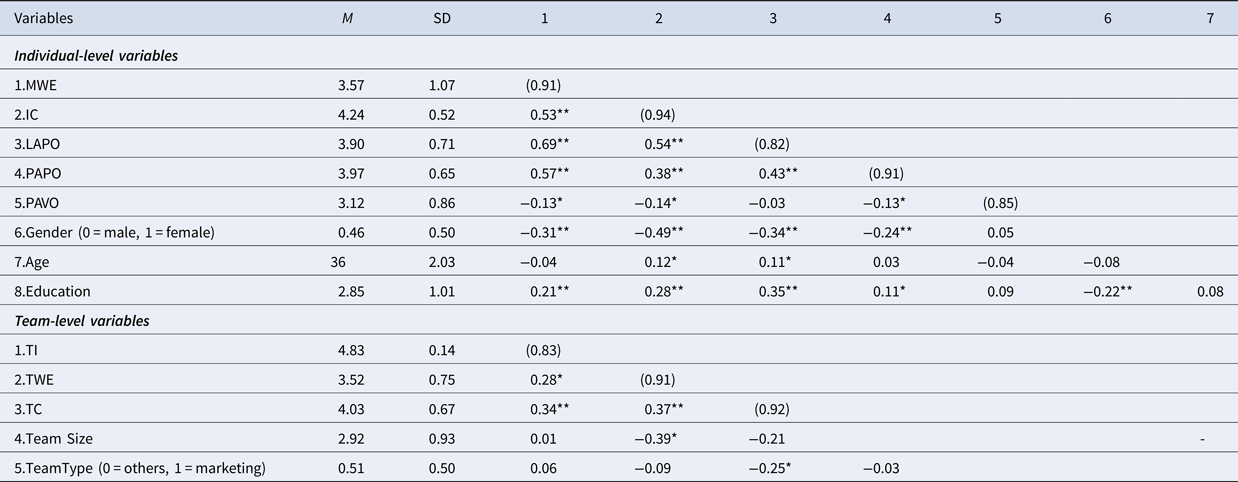
The descriptive statistics, reliability estimates, and correlations of the variables are illustrated in Table 2. The results of correlation analysis provided an initial examination of the hypotheses. As shown in Table 2, at the team level, talent inducement was positively related to team work engagement (r = 0.28, p < 0.05), which was positively related to team creativity (r = 0.37, p < 0.01). At the individual level, member work engagement was positively related to individual creativity (r = 0.53, p < 0.01); member learning orientation, performance-approach orientation, and performance-avoidance orientation were significantly correlated with member work engagement (r = 0.69, p < 0.01; r = 0.57, p < 0.01; r = −0.13, p < 0.05; respectively) and individual creativity (r = 0.54, p < 0.01; r = 0.38, p < 0.01; r = −0.14, p < 0.05; respectively). Because the correlations between member learning orientation, performance-approach orientation, and performance-avoidance orientation are a bit high, to validate the three-dimensional structure of the goal orientation measure, we rotated to check cross-loadings of items on factors. The results showed that the items had the highest loading on the originally assigned factor and very low cross-loadings. Furthermore, we conducted CFA to test the discriminant validity of the factor structure of the measure. The three-factor model fits the data better (χ2 = 99.96, df = 51, TLI = 0.91, RMSEA = 0.05, CFI = 0.92) than the one-factor model (χ2 = 122.04, df = 54, TLI = 0.88, RMSEA = 0.09, CFI = 0.73).
Descriptive statistics and correlations

Notes: N = 350 members in 72 teams. *p < 0.05; **p < 0.01; ***p < 0.001. TI, talent inducement; MWE, member work engagement; TWE, team work engagement; LAPO, learning-approach orientation; PAPO, performance-approach orientation; PAVO, performance-avoidance orientation; TC, team creativity.
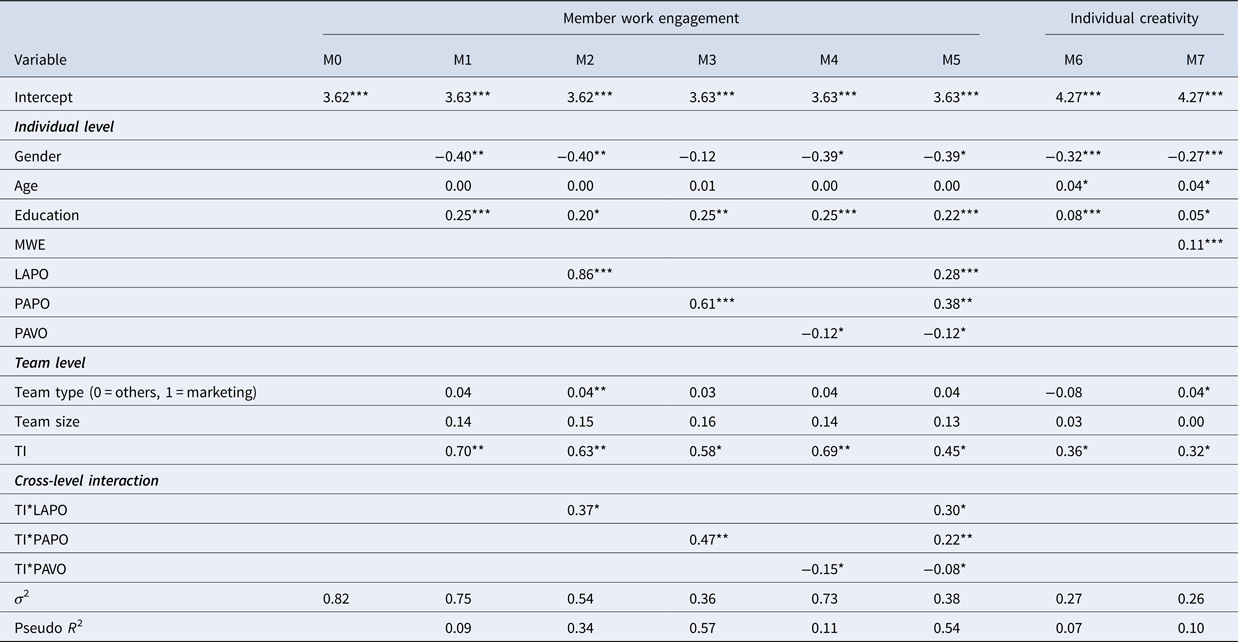
Hypothesis 1 predicted that team talent inducement would have an indirect positive relationship with team and individual creativity through work engagement. We first tested the mediational relationship at the individual level. The mediational relationship linking talent inducement to individual creativity was supported by results in Table 3. In particular, based on the null model (Model 0 of Table 3), we entered individual and team-level controls and talent inducement in predicting member work engagement (Model 1). Results showed that talent inducement was positively related to member work engagement (γ = 0.70, p < 0.01, Pseudo R2 = 0.09). Further, the ‘2-1-1’ mediation model (Zhang, Zyphur, & Preacher, Reference Zhang, Zyphur and Preacher2009) revealed that the effect size of talent inducement on individual creativity was reduced (from γ = 0.36, p < 0.05 to γ = 0.32, p < 0.05) when member work engagement was added to the model (Model 7 of Table 3). Although the magnitude of Pseudo R 2 change is small (from 0.07 to 0.10), it lies within the range of Pseudo R 2 change reported in previous research (Zhang, Waldman, & Wang, Reference Zhang, Waldman and Wang2012). Champoux and Peters (Reference Champoux and Peters1987) contended that studies in the social science literature typically report magnitudes of changes accounting for 1–3% of the variance. And variables that explain as little as 1% of the variance are still considered important. Some Pseudo R 2 changes are about 0.01 in some studies (e.g., Christie & Barling, Reference Christie and Barling2010). Thus, Hypothesis 1a was supported.
Hierarchical linear models for individual creativity and member work engagement

Notes: N = 350 members in 72 teams. *p < 0.05; **p < 0.01; ***p < 0.001. TI, talent inducement; MWE, member work engagement; TWE, team work engagement; LAPO, learning-approach orientation; PAPO, performance-approach orientation; PAVO, performance-avoidance orientation; TC, team creativity.
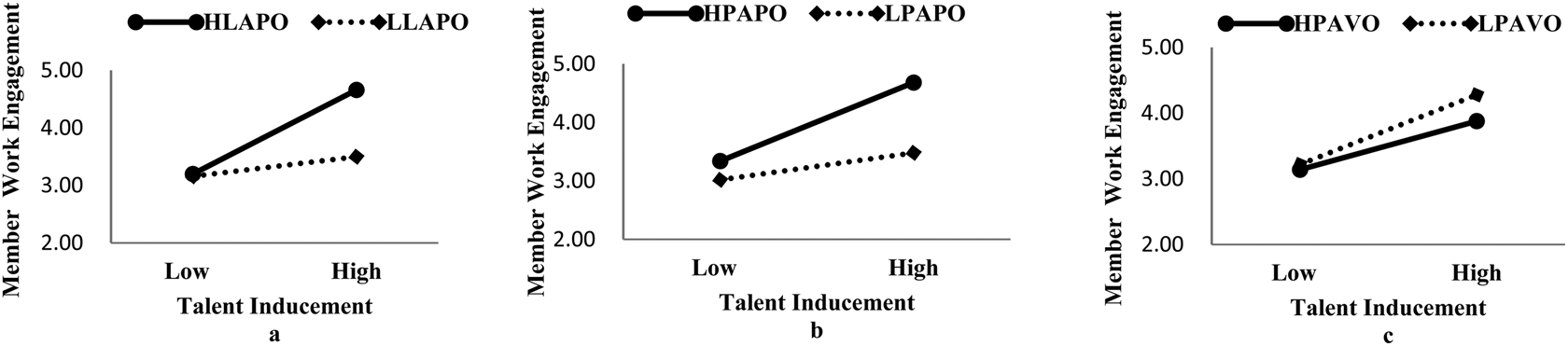
Hypotheses 2, 3, and 4 proposed three moderating effects of individual goal orientations on the individual-level relationship. We analyzed three separate models (Model 2, Model 3, and Model 4) and an integrated model (Model 5) to avoid possible interference effects between three moderating variables. As shown in Models 2, 3, and 4 of Table 3, in the separate model, we found significant interactions between talent inducement and individual learning orientation (γ = 0.37, p < 0.05, Pseudo R2 = 0.34), between talent inducement and member performance-approach orientation (γ = 0.47, p < 0.01, Pseudo R2 = 0.57), and between talent inducement and member performance-avoidance orientation (γ = −0.15, p < 0.05, Pseudo R2 = 0.11) in predicting individual work engagement. In the integrated model, the interactions were also significant (γ = 0.30, p < 0.05; γ = 0.22, p < 0.01; −0.08, p < 0.05, respectively, Pseudo R2 = 0.54). The plots of these relationships (Figure 2) in the integrated model based on the procedure suggested by Zhang et al. (Reference Zhang, Waldman and Wang2012) provide further evidence of the interaction effects. The simple slope for talent inducement in predicting member work engagement is more positive for team members with high learning orientation (b = 0.75, p < 0.05) than team members with low learning orientation (b = 0.15, p < 0.05; Figure 2a). Likewise, the simple slope for high-performance-approach orientation (b = 0.67, p < 0.01) is steeper than that for low-performance-approach orientation (b = 0.23, p < 0.01; Figure 2b). In Figure 2c, the slope for high-performance-avoidance orientation (b = 0.37, p < 0.05) is flatter than the slope for low-performance-avoidance orientation (b = 0.53, p < 0.05). Thus, Hypotheses 2, 3, and 4 were all supported.
Goal orientation as a moderator for talent inducements and member work engagement

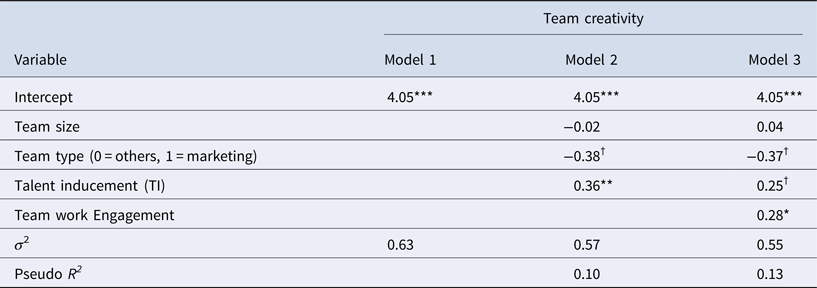
Table 4 illustrates the effect of team talent inducement on team work engagement. After estimating a null model without any predictors for team creativity (Model 1), we entered the control variables and talent inducement (Model 2). Results indicated that talent inducement significantly predicted team creativity (γ = 0.36, p < 0.01, Pseudo R 2 = 0.10). Such an effect was reduced (from γ = 0.36, p < 0.01 to γ = 0.25, p < 0.10) when team work engagement was entered into the model (Model 3 in Table 4), which was positively associated with creativity (γ = 0.28, p < 0.05, Pseudo R2 = 0.13). These results supported Hypothesis 1b.
Hierarchical linear models for team creativity

Notes: N = 72 teams. †p < 0.1; *p < 0.05; **p < 0.01; ***p < 0.001.
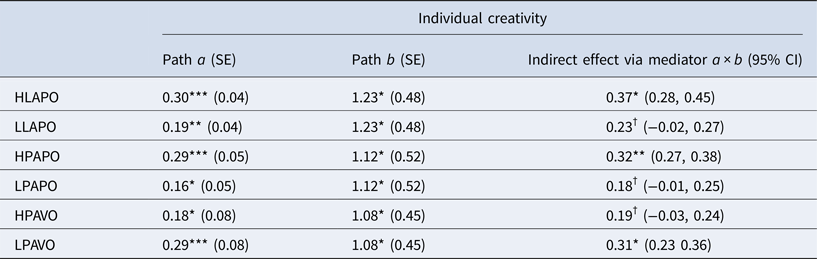
To provide further evidence for the moderating effects of individual goal orientation variables on the mediating models (Hypotheses 5, 6, and 7), we calculated the indirect effects via member work engagement at high and low levels of the moderators. Following Zhang, Zyphur, and Preacher (Reference Zhang, Zypher and Preacher2009), the product-of-coefficients method (operationalized as ab) was adopted to test the mediation effect of member work engagement. Table 5 shows results based on the grand-mean-centered HLM procedures for testing the indirect effects of talent inducement on individual creativity via work engagement. Specifically, we calculated the simple slopes and standard errors for talent inducements in predicting member work engagement (path a) under two conditions (i.e., member goal orientation is high (+1SD) versus low (-1SD)). The coefficients for the simple slopes of path a were then multiplied with the coefficient for the path b slope (i.e., member work engagement predicting individual creativity while controlling for talent inducements, goal orientation, and their interaction) to obtain the indirect effect estimates. 95% confidence intervals for these indirect effects were obtained by bootstrapping 5,000 replications. With regards to Hypothesis 5, consistent with our expectation, talent inducement was indirectly related to individual creativity (a × b = 0.37, p < 0.05; 95% CI = [0.28, 0.45]) via member work engagement when member learning orientation was high (+1 SD). When member learning orientation was low (−1 SD), the slopes for paths a and b were both significant, but the indirect effects were insignificant: The 95% confidence intervals included zero for individual creativity (a × b = 0.23, p < 0.10, 95% CI = [−0.02, 0.27]). The difference between these two conditional indirect effects is significant (difference = 0.14, 95% CI = [0.03, 0.17]). The overall results revealed that the indirect effects of talent inducement on individual creativity via member work engagement were significant and positive when member learning orientation was high rather than low, hence supporting Hypothesis 5. Similarly, under a high level of member performance-approach orientation (+1SD), talent inducement was indirectly related to individual creativity (a × b = 0.32, p < 0.01, 95% CI = [0.27, 0.38]) via member work engagement. However, when member performance-approach orientation is low (-1SD), the slope coefficients for path a and path b were both significant for individual creativity, but the indirect effect for individual creativity (a × b = 0.18, p < 0.10, 95% CI = [−0.01, 0.25]) was not significant. The difference between these two conditional indirect effects is significant (difference = 0.14, 95% CI = [0.41, 0.52]). Taken together, these results supported Hypothesis 6, illustrating a stronger indirect effect under higher levels of member performance-approach orientation.
Indirect effects of talent inducement on individual creativity via member work engagement at high and low levels of goal orientation

Notes: N = 350 members in 72 teams. †p < 0.1; *p < 0.05; **p < 0.01; ***p < 0.001. Bootstrapped confidence intervals were derived from 5000 replications. LAPO, learning-approach orientation; PAPO, performance-approach orientation; PAVO, performance-avoidance orientation. Path a refers to the path from talent inducement to work engagement. Path b refers to the path from work engagement to individual creativity while including talent inducement in the model. Low and high levels of the moderators are 1 SD above and below the means.
Lastly, also shown in Table 5, talent inducement was indirectly related to individual creativity (a × b = 0.31, p < 0.05, 95% CI = [0.23, 0.36]) when performance-avoidance orientation was low (−1SD). With a high level of performance-avoidance orientation (+1 SD), the slope coefficients for path a and path b were significant for individual creativity, but the indirect effect for individual creativity (a × b = 0.19, p < 0.10, 95% CI = [−0.03, 0.24]) was not significant. The difference between these two conditional indirect effects is also significant (difference = 0.12, 95% CI = [−0.52, −0.11]). Together, these results revealed that the indirect effects of talent inducement on individual creativity (via member work engagement) were stronger when member performance-avoidance orientation was low rather than high, thus supporting Hypothesis 7.
Discussion
Creativity has become an imperative for business success, which requires a multi-level, multi-perspective investigation to fully discern its enabling processes. This study is among the first to integrate the talent inducement literature with research on individual and team creativity. Our results showed that team talent inducements were positively related to both individual and team creativity via a key mediation mechanism – work engagement. Meanwhile, individual goal orientation played a moderating role: when member learning and performance-approach goal orientation was stronger, the indirect relationship between talent inducement and creativity (via work engagement) was stronger; nevertheless, when member performance-avoidance goal orientation was stronger, the indirect relationship was weaker.
Theoretical Implications
We make a few major theoretical contributions to the TM and creativity literature. Firstly, our study spells out the influence process of team talent inducements on creativity. Consistent with the proposition by Bhatnagar (Reference Bhatnagar2007) that TM predicts employee engagement, our results showed that talent inducements were positively related to team and member work engagement and, subsequently, creativity. Our results indicate that the use of TM from the perspective of ‘exclusive-people’ does have conducive effects on employees’ positive attitudes and behaviors in general (Iles et al., Reference Iles, Preece and Chuai2010a). We posit that this could be explained through signaling theory – when team leaders (signal sender) send the signals through talent inducement practices that high-performance or high-potential employees will get more opportunities for development and advancement, team members (signal receiver) will interpret the signal that high levels of enthusiasm, dedication, and creativity are encouraged (Connelly et al., Reference Connelly, Certo, Ireland and Reutzel2011). In addition, it could be elucidated through the lens of social exchange theory (Cropanzano & Mitchell, Reference Cropanzano and Mitchell2005), which suggests that when organizations invest disproportionally in top talents, they are likely to reciprocate in positive ways, including devoting themselves wholeheartedly to work. This sheds light on the process, the ‘black box’, through which team talent inducements stimulate creativity.
The gist of talent inducement in placing the high-performing and high-potential talents in the most strategic positions and providing them with additional opportunities and resources to develop and perform are fundamentally different from conventional HRM approaches, which provide equal treatment to all employees (Collings & Mellahi, Reference Collings and Mellahi2009). Albeit with its merit in motivating those who are considered high-potential talents, it also generates legitimate concerns as to whether those who are not identified as top talents may become demotivated, thus canceling out the value of talent inducements (Höglund, Reference Höglund2012). Although those who are not identified as top talents may not directly benefit from the extra resources offered by talent inducement, the possibility of attaining a talent status and the subsequent benefits may still motivate them to be extremely dedicated and vigorous at work.
Secondly, our study contributes to the emerging multi-level theories about TM and creativity. Complementing prior research on TM that focused on the organizational perspective and was conducted at the organizational level of analysis, this article considers talent inducement as the philosophy behind the team's TM practices as perceived by team members. As contended by Jiang, Lepak, Hu, and Baer (Reference Jiang, Lepak, Hu and Baer2012), HRM practices initiated by management need to be experienced by the members in order to exert an impact on their attitudes and behaviors. The results lend evidence to talent inducement as a team-level phenomenon and illustrate the value of assessing talent inducement from the employees’ perceptions, as well as the meaningful between-team variation in talent inducement in increasing employee engagement.
The results supporting the cross-level relationships between team talent inducements and team/member work engagement echo the multi-level perspective (Kozlowski & Klein, Reference Kozlowski, Klein, Klein and Kozlowski2000) and the human capital resource emergence perspective (Ployhart & Moliterno, Reference Ployhart and Moliterno2011), which suggest that individual perception and interpretation of what constitutes talent in the organization converge through a ‘bottom-up’, concerted interaction process to a holistic team-level phenomenon. We showed that such team talent inducement has a significant impact on work engagement at both the team level and the member level. The multi-level effect of work engagement was also in line with emotional contagion theory (Barsade, Reference Barsade2002) and bottom-up effects in team dynamics (Chen & Kanfer, Reference Chen and Kanfer2006), which proposed that team members’ work engagement is infectious within teams and represents an important way to predict team-level creativity. Overall, this contributes to the literature by uncovering the cross-level indirect effect of team talent inducements on creativity via work engagement.
Finally, we shed light on the role of individual goal orientation as an important boundary condition of team talent inducements. Unlike previous studies that considered the main effect of goal orientation on work engagement and creativity, our study explored the conditioning effect that it has on team TM practices. Goal orientation, a reflection of members’ tendency to be predisposed to certain outcomes, has important implications for how team members translate the management philosophy about talent into desirable outcomes. It illustrates that team talent inducements will have differential effects on different individuals. This informs future research to consider the meaningful, intricate relationship between TM and individual goal orientations, as well as to integrate HRM/TM with team dynamics, as to focus on one perspective alone would be an oversight of the big picture (Chuang, Jackson, & Jiang, Reference Chuang, Jackson and Jiang2016).
Managerial Implications
The present study sheds light on the ways that team leaders can stimulate creativity by promoting team members’ work engagement at both the team and individual levels. The organization should empower team leaders to differentially invest in high-performance and high-potential employees through team-level talent inducements. Differentiated opportunities and resources to top talents in teams convey the managerial philosophy of valuing top talent and encouraging them to be engaged at work. For example, training/development opportunities and variable rewards reflect differentiated recognition of special talents. This has important practical implications because it is often unrealistic for organizations to invest heavily in all employees (Collings & Mellahi, Reference Collings and Mellahi2009). Differentiating top talents ensures that the most critical talents are engaged at work and are armed with the necessary competence and opportunities to be creative. Such a motivating effect will also spill over to those who are not currently identified as high-performance/high-potential employees. In addition, the orchestration of talent inducement at the team level also raises the notion that TM becomes too critical to be left to HR managers in the organization alone; instead, it becomes the strategic task of all team leaders. To win the war for talent, HR managers need to effectively empower all team leaders to implement a talent inducement philosophy to best engage their team members and motivate them to be creative.
Team-level talent inducements also need to be implemented with individual characteristics, particularly goal orientation, being considered. In order to maximize the benefits of team inducement on talents, leaders should attach great importance to the cultivation of member learning and performance-approach goal orientations. Such goal orientations are often shaped by team leaders, the nature of assigned goals, and the design of the evaluation system. For example, leaders could advocate for a team learning climate to develop the members’ learning goal orientation. Alternatively, managers could establish an effective performance evaluation system to strengthen performance-approach goal orientation and to downplay a performance-avoidance goal orientation.
Limitations and Opportunities for Future Research
The limitations of the present study should be borne in mind in evaluating the study results. First, due to the cross-sectional design, the prediction of work engagement and creativity may not allow for a causal conclusion. Second, although we collected data through multiple sources, the independent and mediating variables were self-reported, which may contribute to common method biases (CMB). Although we have carefully designed our questionnaire and checked CMB through several tests, future studies should further explore the studied relationships with different study settings. However, the investigations of moderating effects are unlikely to be explained by CMB. Third, the sample used in the current study was teams in China and may not generalize to other cultural contexts. Nonetheless, it also provides supplemental evidence to the literature on TM and team creativity that was conducted mostly using Western samples. Moreover, the empirical findings indicated that gender was negatively correlated with individual work engagement, creativity, learning goal orientation, and performance-approach orientation. In fact, a recent study similarly found that females (vs. males) were more likely to have a high level of anxiety, which is negatively related to the theory of mind and mindfulness (Balaban & Bilici, Reference Balaban and Bilici2022). Female employees, therefore, may respond more negatively to TM practices which may create more uncertainties for employees. As such, individual work engagement, creativity, learning goal orientation, and performance-approach orientation may differ between genders. Although we controlled for gender in data analyses, future studies should build the effect of gender in the research design to decipher why and how gender plays a role.
Empirical studies on the effects of TM on employee attitudes and behaviors are surprisingly scarce (Höglund, Reference Höglund2012). This study focuses on the effect of talent inducements on work engagement and, subsequently, creativity. Research in HRM has demonstrated that HRM practices influence employee behaviors through the intermediate effect on their ability, motivation, and opportunities (Jiang et al., Reference Jiang, Lepak, Hu and Baer2012). Talent inducements provide talents with career and promotion opportunities (Höglund, Reference Höglund2012). Future research can examine how these practices have a positive impact on members’ creativity by promoting their motivation, opportunities, and abilities comprehensively. Further, although beyond the scope of the current research, future research can also examine how top talents are identified in teams, which can be an important condition for effective talent inducement, as well as other types of outcomes that are important to talent inducements, such as employee commitment and performance.
Another opportunity lies in extending the levels of analysis of the study's findings. The present study provides evidence that team-level talent inducements have positive effects on team and member work engagement. Nevertheless, how the effect of team-level talent inducements may generalize to organization-level TM warrants more research. Alternatively, the effects of team talent inducements may be influenced by the organizational context, such as organizational climate. In the future, researchers can investigate the influence of organizational climate on the effect of talent inducements. Last but not least, besides goal orientation, individual members with other different characteristics may perceive the same talent inducements differently. How this difference impacts their attitudes and behaviors is worthy of study.
Conclusion
Driven by the war for talent and the lack of coupling research between TM and team dynamics, this study investigated the indirect effects of team talent inducements on individual/team creativity via individual/team work engagement, as well as the moderating role of individual goal orientations. Results showed that team talent inducements were positively related to team and member work engagement, which were then positively associated with team and member creativity. In addition, these indirect effects were moderated by individual goal orientations, in that member learning and performance-approach goal orientations further amplified the indirect effect, while performance-avoidance orientation buffered the indirect effect. These results illuminate the cross-level influence process of talent inducements on creativity and shed light on its boundary conditions.
Acknowledgements
This research is funded by the National Social Science Foundation of China (Grant No. 22BGL049: Research on mechanism and realization of entrepreneurial ability enhancing in hometowns by digital empowering). The authors would like to thank the editors and three anonymous reviewers for their insightful comments that have been of great help.
Yanhong Tu (tuyanhong@hnu.edu.cn) is an Associate Professor of Business School in Hunan University of Technology. She received her PhD from Hunan University in 2018. Her research interests include team dynamics and effectiveness, entrepreneurship decision making and management, and innovation performance.
Ying Hong (yhong24@fordham.edu) is an associate professor at the Gabelli School of Business, Fordham University. She received her PhD in industrial relations/human resources from Rutgers University. She specializes in research on the strategic role of human-resource management. Her work has appeared in peer-reviewed journals such as the Academy of Management Journal and the Journal of Applied Psychology.
Yuan Jiang (yuanjiang@hit.edu.cn) received his PhD degree in industrial relations and human-resource management from the School of Management and Labor Relations, Rutgers University. He is an Associate Professor at the China Europe International Business School. His work has appeared in peer-reviewed journals such as Academy of Management Journal, Journal of International Business Studies, Journal of Management, and Human Resource Management.
Wei Zhang (hbue_wb@163.com) received his PhD degree in management science and engineering from Harbin Institute of Technology and was in the joint doctoral training program of University of Missouri, Kansas City. He is a Professor at the School of Public Administration, Sichuan University. His work has appeared in more than 70 peer-reviewed journals such as IEEE Transactions on Engineering Management, Journal of Knowledge Management, and Technological Forecasting and Social Change.