

Introduction
Throughout the twentieth century, an important number of calcined or vitrified stones have been documented in ramparts of protohistoric settlements in Europe. The phenomenon has been widely studied, given its extensive spread throughout Iron Age Europe. Causes and possible purposes have been a subject of debate, and often uncertain or inappropriate ideas are used to explain it; this has made it difficult to understand how and why these stones were altered (Youngblood et al., Reference Youngblood, Fredriksson, Kraut and Frediksson1978; Buchsenschutz & Ralston, Reference Buchsenschutz and Ralston1981; Kresten et al., Reference Kresten, Kero and Chyssler1993; Cook et al., Reference Cook, Watson, Cook, Erskine, Jacobsson, Miller and Stetkiewicz2016).
Although the first evidence of vitrified stones was recorded as early as the eighteenth century, the first scientific studies were those of Vere Gordon Childe and Wallace Thorneycroft, whose explanations related to a strong fire on timber-laced walls. They claimed that these fires had temperatures high enough to melt the stone, which would entail a violent destruction of these settlements (Childe & Thorneycroft, Reference Childe and Thorneycroft1938: 55).
This hypothesis was refuted by other researchers, who pointed out that the temperature needed to melt the stone could not be the result of a simple fire. Scandinavian researchers proposed that vitrification was instead related to building processes. Having analysed data from the Viking village of Broborg, they concluded that it would have been a gradual and intentional process intended to strengthen the ramparts (Kresten & Ambrosiani, Reference Kresten and Ambrosiani1992: 1; Sjöblom et al., Reference Sjöblom, Weaver, Peeler, McCloy, Kruger, Ogenhall and Hjärthner-Holdar2016).
In 1980, Professor Ian Ralston replicated the vitrification of a timber-laced wall near Aberdeen (Scotland, UK), and his results showed that this process would have caused the collapse of the walls, and hence would not have been an effective improvement in building techniques. Furthermore, it would be very difficult to produce and control such a fire. He concluded that this phenomenon must be related to a deliberate destruction of ramparts, alongside the abandonment of their settlement (Ralston, Reference Ralston1986; Reference Ralston2006). This explanation is a new approach, where vitrification is considered to be a ritual consequence, as has been suggested for Bernstorf in Bavaria (Germany) (Bähr et al., Reference Bähr, Krause and Gebhard2012; Röpke & Dietl Reference Röpke and Dietl2014).
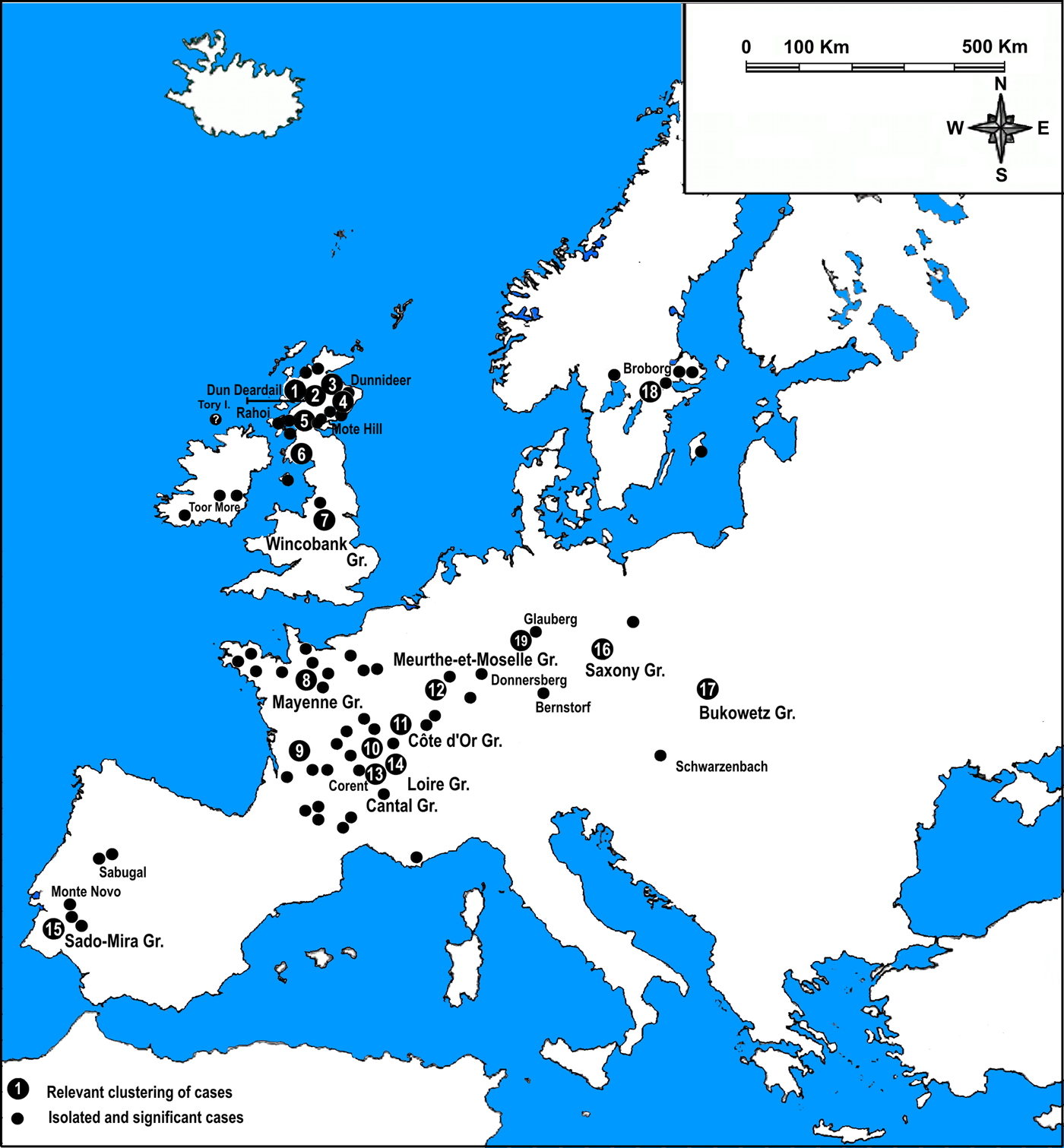
Since then, many cases of vitrified forts, dated from the Late Bronze Age to Early Medieval times have been recorded throughout western Europe (Figure 1).
Vitrified forts in Europe: burnt ramparts from Middle Bronze Age to the Early Middle Ages. Main groups and sites: 1: Moidart-Morar; 2: Lochaber; 3: Inverness; 4: Strathdon; 5: Clyde; 6: Dumfries and Galloway 7: Wincobank; 8: Mayenne; 9: Vienne; 10: Corrèze; 11: Côte d'Or; 12: Meurthe-et-Moselle; 13: Cantal; 14: Loire; 15: Sado-Mira; 16: Saxony; 17: Bukowetz; 18: Hjälmaren Lake; 19: Hesse (Baitinger & Kresten, Reference Baitinger and Kresten2012; Clark et al., Reference Clark, Kirby, Charnley and Dye2016; Comte, Reference Comte2015; Cook, Reference Cook20136; Friend et al., Reference Friend, Dye and Fowler2007; Grunwald, Reference Grunwald and Wolfhechel Jensen2012; Kresten & Ambrosiani, Reference Kresten and Ambrosiani1992; Marcille, Reference Marcille1999; O'Brien et al., Reference O'Brien, O'Driscoll, Hogan, Fernández-Götz and Roymans2018; Ralston, Reference Ralston1992, Reference Ralston2006; Vilhena & Golçalves, Reference Vilhena, Gonçalves and Jiménez Ávila2012; Wadsworth et al., 2015, Reference Wadsworth, Heap, Damby, Hess, Najorka and Vasseur2017).

Since it appears that these cases are similar events with different causes, we analysed several examples of vitrified, reddened or calcined stones from walls belonging to Late Bronze Age and Iron Age settlements of Iberia, with the aim of contributing to a better understanding of this process in protohistoric Europe.
The Iron Age in Western Iberia: Time for a Change
Until the end of the ninth century bc, the west of the Iberian Peninsula was a territory integrated into the so-called Atlantic Bronze System and flourishing exchange with the Mediterranean civilisations (Almagro-Gorbea, Reference Almagro-Gorbea2014). People in western Iberia shared customs, beliefs, and probably some kind of Indo-European language with a large part of the Atlantic façade, from northern Scotland to southern France. The war-like character of these people is attested by the best collection of warrior stelae that exist; they come from this region and this time of change. These stelae, and the contemporary early hillforts (such as Ratinhos or Passo Alto in eastern Portugal), show Atlantic societies that were opening progressively to Mediterranean taste: weapons, jewellery, and tools were changing from Atlantic and northern patterns to eastern Mediterranean models (Harrison, Reference Harrison2004). By the end of the eighth century bc, the first Phoenician colony at Gadir (Cádiz) bears witness to an indigenous western cultural complex known as the mythical Tartessian kingdom, whose influences soon grew in Atlantic Europe, more through commerce and exchange than invasions and conquest.
But such change did not take place suddenly, or peacefully. Stratigraphic records, like those of the hillfort of Ratinhos, show that the local warrior societies reacted to the new system (Berrocal-Rangel & Silva, Reference Berrocal-Rangel and Silva2010). They lived in small forts of less than a hectare, defended by simple sloping ramparts and ditches, and the households within them consisted of round houses. In relation to these ramparts, the first ‘vitrified’ walls in Iberia were recognized in a context of destruction and abandonment.
By around 500 bc, the Tartessian ‘kingdom’ was over and Celtic peoples from northern Spain invaded western Iberia on a massive scale (Berrocal-Rangel, Reference Berrocal-Rangel1992). Large, hierarchically organized hillforts emerged; some of them were called oppida, such as La Mesa de Miranda in the Sierra de Ávila in central Spain, thought to belong to the Vettones people (Álvarez-Sanchís, Reference Álvarez- Sanchís2000). Significantly, the Tartessian buildings were burnt before they were abandoned (Celestino & López-Ruiz, Reference Celestino and López-Ruiz2016: 235), although the use of mud bricks as a building material did not lead to vitrification.
In the later Iron Age, the vitrified ramparts reappeared on sites that were conquered by the Romans during the second century bc. When the Carthaginians were defeated in the Second Punic War (Curchin, Reference Curchin2014), Rome focused its imperial interests on the wealthy west of Iberia. The Romans advanced towards the Atlantic territory of Hispania, colliding with the Lusitanian people. This advance was the cause of the Lusitanian wars, a series of resistance conflicts between indigenous peoples and the Roman legions from 194 to 59 bc (Dobson, Reference Dobson2008).
These conflicts left archaeological traces in hillforts or oppida, but evidence of war in the middle of the first century bc in this territory may also be related to the Roman Civil wars, between 80 and 76 bc and 49 and 45 bc.
How advances in the building techniques used by the Tartessians changed the simple Late Bronze Age walls and how timber-laced construction was introduced during the Iron Age are questions that can be answered by analysing cases of vitrified walls.
Vitrified Walls in Celtic Iberia
The first vitrified wall to be identified in the Iberian Peninsula, at Castelos de Monte Novo in Portugal, was found by a British-Portuguese team of the Évora Archaeological Survey Project during the mid-1980s. Colin Burgess, Catriona Gibson, and Virgilio Correia recognized this surprising trait on the masonry wall of the Iron Age settlement of Castelos de Monte Novo in the Évora region, a Celtic territory during the Iron Age (Correia, Reference Correia, Cunliffe and Keay1995: 251–53). The discovery was later confirmed by Ian Ralston (Burgess et al., Reference Burgess, Gibson, Correira and Ralston1999).
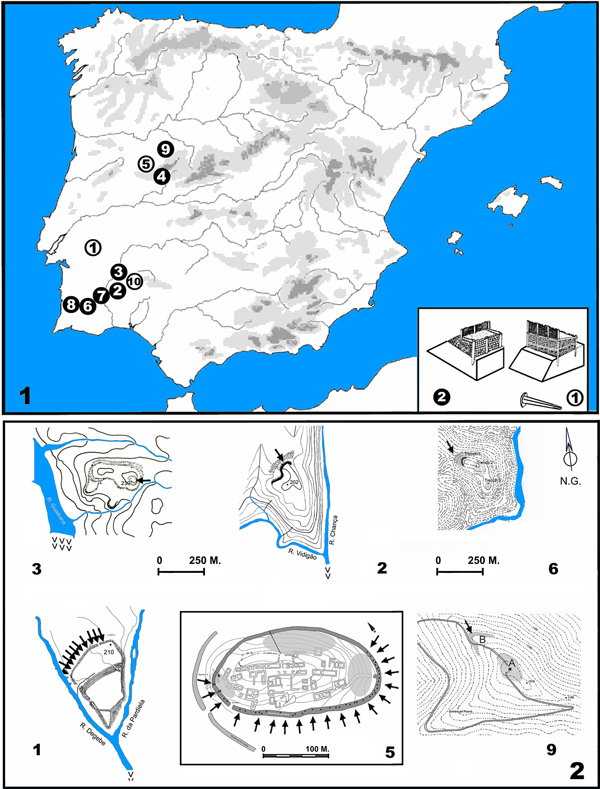
Some years later, a distinguished Portuguese archaeometrist, António Monge Soares, identified vitrified stones in a small hillfort near the Spanish-Portuguese border, at Passo Alto (Soares, Reference Soares1988; Soares et al., Reference Soares, Antunes, De Deus and Jiménez Ávila2012). Since then, several sites with similar evidence have been identified in central Spain and Portugal; they include the Castro de Ratinhos, excavated by the authors of this article, or the doubtful case of the Volcán del Gasco (Díaz-Martínez & Ormö, Reference Díaz-Martínez and Ormö2003)Footnote 1 in the Extremadura in western Spain, as well as Sabugal Velho and other settlements in the Odemira region in southern Portugal (Vilhena & Gonçalves, Reference Vilhena, Gonçalves and Jiménez Ávila2012). Although they do not form a very large group of sites, they are spread over a great area of the western side of the Iberian Peninsula (Figure 2, no. 1).
Archaeological sites with vitrified walls in the Iberian Peninsula. 1: Distribution (black circles: Late Bronze Age Early Iron Age; white circles: Late Iron Age). 2: Plans of the sites studied, at the same scale.

All sites are located between the lower basins of the Guadiana and Douro rivers, a land of plentiful oak forests. Although a substantial proportion of the material record comes from extensive surveys, stratigraphy and radiocarbon samples allow us to argue in favour of the proposed dates, i.e. from the Late Bronze Age to the first Roman presence in the area. Our findings belong to different historical contexts and different purposes, and this picture is becoming more complex as research progresses.
Fires at War: Vitrified Ramparts as a Testimony of Armed Conflicts?
None of the known cases is clearly related to an armed conflict, according to their remains. Testimonies of war are an exception in the archaeological record of Iberian protohistory. Weapons are usually found as offerings, funerary belongings, or without known context; hence, if we propose war-related causes for vitrification, we should look for other signs.
Ratinhos (Moura, Portugal) is the best-known example of possible armed conflicts (Figure 2, no. 3). The site is a fortified settlement occupied from the Late Bronze Age to the beginning of the Early Iron Age (Silva et al., Reference Silva, Berrocal-Rangel, Rodero Olivares, Krausz, Colin, Ralston and Dechezlepetre2013; Berrocal-Rangel & Silva, Reference Berrocal-Rangel and Silva2010: 420; Soares & Martins, Reference Soares, Martins, Berrocal-Rangel and Silva2010), located on a major hill on the banks of the Guadiana river, at an important natural crossroads. A Late Bronze Age complex system of walls and ditches was built from the twelfth to the ninth centuries bc, and a large area of the surrounding territory could be controlled visually from its summit. Probably because of that, Ratinhos was chosen as the site of the oldest oriental shrine known in Iberia (with close parallels in Syria and Jordan), dated to around the second half of the ninth century bc, at the same time as the first Phoenicians reached the Mediterranean shores. Along with the shrine, new ramparts were built, both with a timber-laced framework―a real innovation in this period. According to radiocarbon data and stratigraphy, this new phase at Ratinhos did not last very long. Around 760 bc, the shrine was abandoned, and the main entrance of the defensive wall shows signs of a fire, with vitrified stones and pieces of burnt clay (Silva et al., Reference Silva, Berrocal-Rangel, Rodero Olivares, Krausz, Colin, Ralston and Dechezlepetre2013).
The site of Passo Alto (Moura, Portugal) is more difficult to understand because of the limited extent of the excavations (Figure 2, no. 2). Nevertheless, António Monge Soares has been able to obtain good results in archaeometry, including geochemistry and radiocarbon dating (Soares, Reference Soares1988; Soares et al., Reference Soares, Antunes, De Deus and Jiménez Ávila2012). Passo Alto is a fortified site occupied from the Late Bronze Age to the Iron Age, well-known by its upright stone row defences (‘chevaux-de-frise’). Occupying a surface of three hectares, the settlement is naturally very well protected by the ravines of two small rivers, which converge in a fork under the southern slope. However, this type of settlement is usually characterized by having a very exposed access in the tongue of land between the ravines. Hence large defensive works were built in this area, and a wall, 3 m wide and 250 m long, blocked access on this side (Soares, Reference Soares1988: 90). There was a, yet unlocated, gate, even though a large quantity of vitrified masonry has been found. At first, Monge Soares related the remains of vitrification to smelting furnaces, but there was no evidence to support this, such as slag or crucibles. We therefore proposed an explanation in connection with vitrified walls, which was taken up by Monge Soares himself (Berrocal-Rangel, Reference Berrocal-Rangel and i Martínez2003: 216‒218; Soares et al., Reference Soares, Antunes, De Deus and Jiménez Ávila2012).
Thanks to his research, we also know of other examples. In Azenha da Misericordia (Serpa, Portugal), a good archaeometric analysis has been conducted on a stretch of a wall with vitrified stones (Catanzariti et al., Reference Catanzariti, Mcintosh, Soares, Díaz, Kresten and Osete2008). Again, this wall bars the easiest access route to the settlement. Although Soares related that fact to the presence of Bronze Age furnaces and metallurgical activities (Soares, Reference Soares1988; Catanzariti et al., Reference Catanzariti, Mcintosh, Soares, Díaz, Kresten and Osete2008: 1401), nothing proves that the unexcavated wall dates to prehistoric times. It is only the pottery collected on the surface that suggests a date ranging from the Late Bronze Age to the end of the Later Iron Age, while an archaeomagnetic analysis gave two possible dates, 842–652 bc and ad 725–1034 (Catanzariti et al., Reference Catanzariti, Mcintosh, Soares, Díaz, Kresten and Osete2008: 1405). Judging by the pottery, Catanzariti and colleagues took the first of these two periods as the more likely (Catanzariti et al., Reference Catanzariti, Mcintosh, Soares, Díaz, Kresten and Osete2008: 1506).
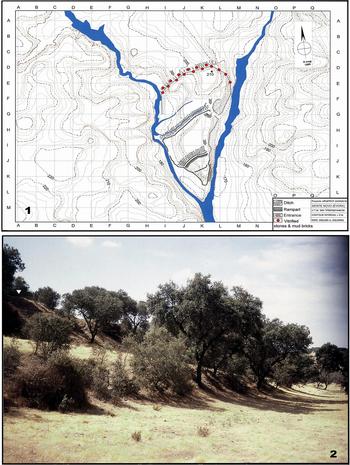
A similar situation existed at Castelos de Monte Novo (Évora, Portugal), the settlement where vitrification was found for the first time (Correia, Reference Correia, Cunliffe and Keay1995; Burgess et al., Reference Burgess, Gibson, Correira and Ralston1999). Much pottery was recovered on the surface at Castelos de Monte Novo, which dates the site to the Late Iron Age (Figure 2, no. 1). Deep and wide ditches are easily visible in front of a tall bank, which closes the only accessible side to the interior of the village, to the north. Vitrified stones of medium size were found over the bank, over a stretch of more than 300 m. In addition, mud bricks with clear signs of having been exposed to a fire were found. We therefore infer that the rampart was built with a masonry foundation and a mud brick and timber-laced wall, and that both were burnt (Berrocal-Rangel & Moret, Reference Berrocal-Rangel, Moret, Berrocal-Rangel and Moret2007: 24–26).
As we can see, Early Iron Age sites such as Ratinhos, Passo Alto, and perhaps Azenha have vitrified walls over a specific stretch, whereas sites of the Late Iron Age show vitrified stones over a long stretch of walling, if not over the whole rampart, as at Monte Novo, Sabugal Velho, and, probably, at the newly-identified site of Fraga de Romualdo (Osório & Pernadas, Reference Osório, Pernadas, Rodrigues, Lima and Santos2011; Pérez Macías, Reference Pérez Macías, del Valle Carrasco and Gómez2010: 282) (Figure 2, nos. 5 and 10). In both situations, an accidental or deliberate fire related to armed conflicts could be the most plausible explanation.
Fires Under Buildings: Vitrified Ramparts as a Technical Resource?
A recent article by Vilhena and Gonçalves (Reference Vilhena, Gonçalves and Jiménez Ávila2012) contributes new evidence from the region of Odemira in southern Portugal which includes a study of settlements where vitrification is probably related to possible foundation structures.
This is the case with Cerro das Alminhas (Odemira, Portugal), a small village of 0.5 ha, which yielded pottery sherds from the Bronze Age to the Iron Age and which, probably, had no defensive wall (Figure 2, no. 6). An artificial terrace was found, closing access to the whole settlement. This terrace was retained by local greywackes, some of them calcined, and it leads to some kind of floor and an undefined circular structure (Vilhena & Gonçalves, Reference Vilhena, Gonçalves and Jiménez Ávila2012: 532–33). The interpretation of these remains is uncertain, but the site plan seems to indicate that the vitrified remains form part of an access to the settlement (Vilhena & Gonçalves, Reference Vilhena, Gonçalves and Jiménez Ávila2012: fig. 12). As the vitrified stones appear to be regularly arranged, Vilhena & Gonçalves (Reference Vilhena, Gonçalves and Jiménez Ávila2012: 533–540) inferred that these remains are indicative of a deliberate building technique. Vitrification could be related to an unfinished wall, built to reinforce its foundations, because there is no charcoal or wood among the stones and they were burnt in a slow fire in a reducing atmosphere. Nevertheless, it seems that this explanation does not convince the authors, who prefer to follow the anthropologist Roland Comte and look for a symbolic purpose (Comte, Reference Comte2015). They speculate about the colours produced in the vitrification process, which vary between pink, green, blue, or violet, especially the ‘milky’ quartz, which is used for obtaining copper minerals (Vilhena & Gonçalves, Reference Vilhena, Gonçalves and Jiménez Ávila2012: 543). However, Comte's source is Jean Markale (Reference Markale1969: 180, 276) and his interpretations of the glass castles found in Arthurian romances. Anyway, scientific evidence that has provides other explanations, such as the addition of phosphorous-bearing material, for example in Scotland (Friend et al., Reference Friend, Dye and Fowler2007: 1701).
Ritual or aesthetic meanings may be attributed to examples from southern Portugal such as Castro de Garvâo (Ourique), a site with a spectacular votive deposit of the Later Iron Age (Figure 2. no. 8; Vilhena & Gonçalves, Reference Vilhena, Gonçalves and Jiménez Ávila2012: 526). A well-built structure with vitrified squared blocks was found on this site at a depth of two metres. Another nearby site, Nossa Senhora da Cola (Ourique), has strong ritual associations and a similar context: many vitrified greywackes were found in the centre of the fortified area, near the river Mira, where a splendid Late Bronze Age sword was found (Vilhena & Gonçalves, Reference Vilhena, Gonçalves and Jiménez Ávila2012: 526).
Fires in Nature: Vitrified Stones as Building Material?
There are other, less easily explained examples, such as the site of the so-called Volcán del Gasco (Las Hurdes, Extremadura, Spain). This geological site was discovered in the middle of the twentieth century, when it was identified as a little volcano (García de Figerola, Reference García de Figuerola1953). Fifty years later, it was redefined as the site of a meteorite impact, a theory that was rejected by the same authors some years later (Díaz-Martínez et al., Reference Díaz-Martínez, Sanz-Rubio, Fernández and Martínez-Frías2001). Recent research suggests that it was a vitrified fort (Díaz-Martínez & Ormö, Reference Díaz-Martínez and Ormö2003). In 2003, we identified some sherds as protohistoric pottery that these geologists had submitted to us but we do not know where these fragments were collected.
A few kilometres to the north, there is a ‘twin’ site, first thought to be the result of a meteorite impact and later identified as a vitrified hillfort by the same authors. This site is El Pico del Pozo de los Moros, near the small village of Villasrubias (Salamanca, Spain) (Figure 2, no. 9). It is located on a peak of 1218 m asl and overlooks an area extending over several kilometres. Slate outcrops delimit the elongated summit with a natural wall, leaving a narrow area for settlement. Recently, we carried out intensive surveys to confirm the archaeological character of the site and collected a substantial number of pottery fragments, vitrified slates and oral testimonies concerning the ruins that were destroyed in the 1950s, when a forest ranger station was built on the summit. Pottery is mainly hand-made, and appears to date to the Late Bronze Age and Early Iron Age. We did not find any traces of walls, and hence it is possible that the vitrified stones had a geological origin and were later used as building material.
We therefore decided to use geochemical analysis in combination with spatial studies, including LiDAR images, to achieve a better understanding of the site of Pozo de los Moros.
Pozo de los Moros (Villasrubias, Salamanca, Spain)
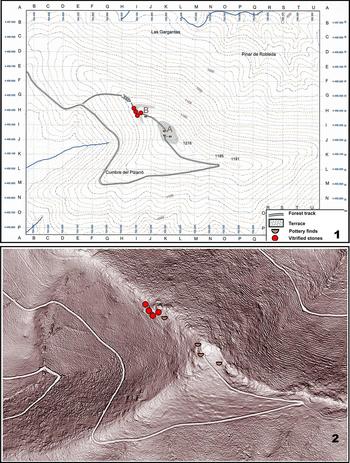
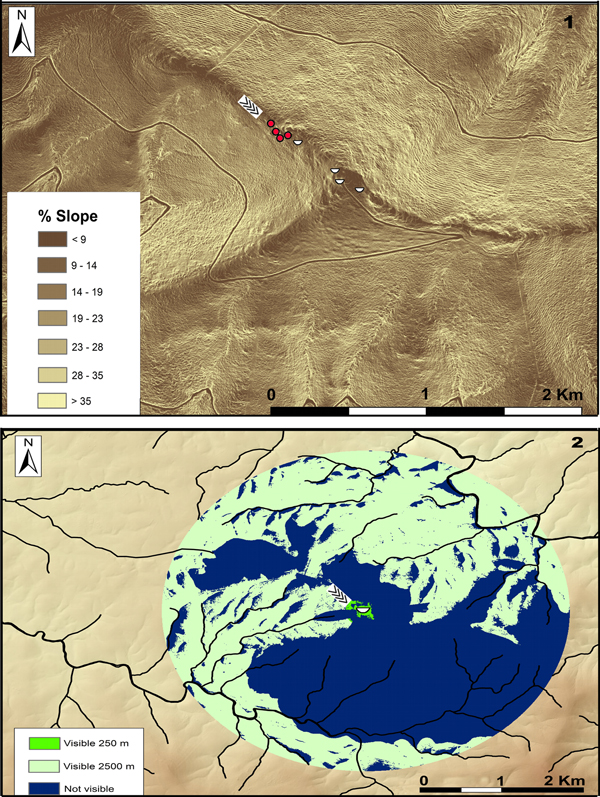
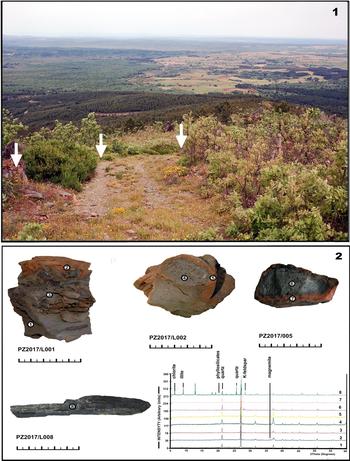
We collected twenty samples of vitrified slates from Pozo de los Moros, measuring between 10 and 25 cm each, some being conglomerates with earth and slates aligned in several bedding planes, showing different degrees of fire intensity. They were only found along the main access in the western corner of the site, where there is a short stretch of an old track for four-wheeled vehicles (Figure 3). Visibility and slope maps, using ArcGIS over a LiDAR Digital Terrain Model, show that this is the easiest access route (Figure 4). In addition, this area has a terraced shape, and large stones and slate outcrops suggest that they could belong to a wall or a bastion, and pottery fragments indicate that the site was occupied in protohistoric times.
Pozo de los Moros de Villasrubias (Salamanca, Spain). 1: Plan showing the location of vitrified stones and archaeological finds of pottery. 2: LiDAR image (Instituto Geográfico Nacional de España).

Pozo de los Moros de Villasrubias (Salamanca, Spain). 1: Slope map; the darkest tones correspond to slopes of less than 9 per cent. 2: Visual control from the top of the site, distance of 250 and 2500 m radius (both calculated with ESRI ArcGIS 10.2).

We identified the mineral composition of the samples by X-Ray Diffraction (XRD), using a SIEMENS D5000 instrument with a Cu anode, operating at 30 mA and 40 kV, using divergence and reception slices of 2 mm and 0.6 mm respectively (Figure 5). We used the powder method for the bulk samples and the oriented slides method for the <2 µm fraction. The XRD profiles were measured in 0.04 2θ goniometer steps for 3 seconds. The method consists of comparing a sample of slate from an outcrop on the summit without fire marks (sample PZ008) to vitrified samples from the outer edge of the terrace, looking for the presence or absence of minerals and using them as geothermometers. When the rock showed two different structures, usually with two different colours, we took samples from both zones. The vitrified earth between the rocks of sample PZ001 was also analysed.
Pozo de los Moros de Villasrubias (Salamanca, Spain): 1: Main entrance from the north-west. The arrows indicate where the vitrified stones were collected. 2: Vitrified stones and protolithic rock analysed with X-Ray Diffraction (XRD), with results shown in a diffractogram.

PZ008 is a protolith material from the eastern outcrop of the site with a silicate composition made of chlorite (14.05 Å), illite (8.90 Å), phyllosilicates (4,45 Å), quartz (3.33 Å), and K-feldspar (3.18 Å). By contrast, PZ001 has a grey core (sample 1) made of pumice, with a high vesicular textured glass, where only quartz was identified. This suggests that it was burnt at a temperature of over 1200° C. Its orange surface (sample 2) has a small quantity of maghmenite, but the absence of phyllosilicates and K-feldspars indicates a combustion temperature between 1000° C and 1100° C. The same results as sample 2 were obtained for the sample of earth (sample 3), and from the core (sample 4) and surface (sample 5) of the PZ002. As for PZ005, it retains K-feldspars, which indicates that fire exceeded 800° C but did not reach 1000° C. Therefore, as silicate rocks can become vitrified from 850° C (Nisbet, Reference Nisbet and Engle1982: 29), we deduce that all these rocks were vitrified and, given the slight presence of maghmenite, we can assume that combustion was reduced (Kresten & Ambrosiani, Reference Kresten and Ambrosiani1992: 3). It is important to remember that no traces of metals such as aluminium or copper were found, as is usual in melting furnaces (Friend et al., Reference Friend, Dye and Fowler2007: 1699).
The range of temperatures between 800° C to 1200° C could be related to an irregular (accidental or deliberate) fire, but not a controlled fire, as would be expected if stones were set on fire for a technical or ritual purpose (Clark et al., Reference Clark, Kirby, Charnley and Dye2016: 252). Therefore, in view of the location of the vitrified rocks and the range of temperatures at Pozo de los Moros, we suggest that a fire was lit over a timber construction, possibly the settlement's main gate. It is clear that these vitrified stones were not the product of a natural event, such as the impact of a meteorite, and that they were not used as vitrified raw material for building.
Castro dos Ratinhos (Moura, Southern Portugal)
Castro dos Ratinhos is one of the few excavated sites that has provided ‘vitrified’ stones in archaeological context.
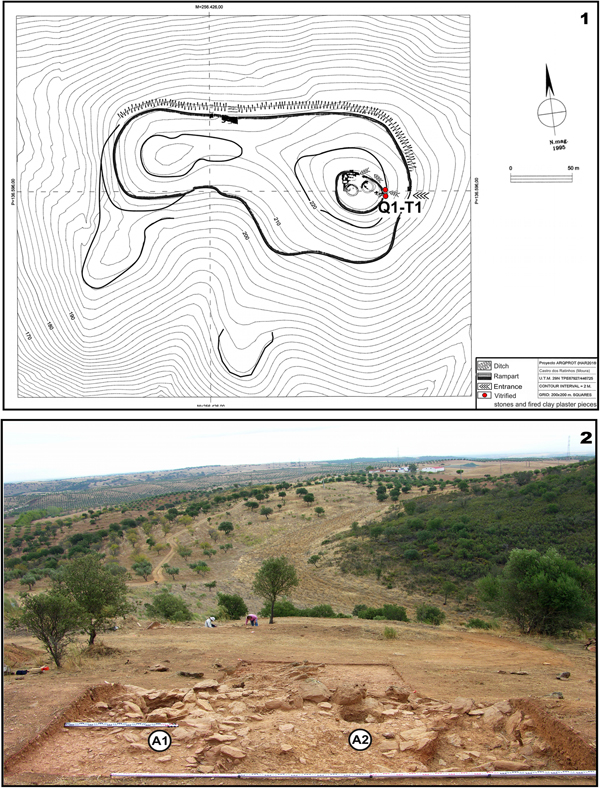
A transect, Q1–T1, was cut transversely to excavate the inner rampart (Figure 6). Innovative building techniques were found in this trench: a new outer masonry structure with flat stones laid on top, new foundations, and remains of a timber-laced framework.
Ratinhos (Moura, Portugal). 1: Plan with the location of reddened stones and fired clay pieces over the acropolis rampart (transect Q1-T1). 2: Photograph of the transect from the west, with postholes (A1-A2), during the 2007 excavation campaign.

Fire marks were discovered in thick and hard layers of reddish fired clay, ash, and charcoal, found deep and widely spread inside the foundation of the wall, which consisted of an irregular line of large slates and quartzite stones. Between them, two large postholes were found, containing small wedges of slate and charcoal flecks (Figure 6, no. 2, A1 and A2). Over and inside these layers we recovered ‘vitrified’ stones and pieces of fired clay, the latter retaining the shape of the joists, as clay was used as plaster for the timber framework (Figure 7). We deduce from this that the posts formed the central axis of an internal wooden framework, resembling that used in the shrine found on the same site both are techniques that were unknown before.
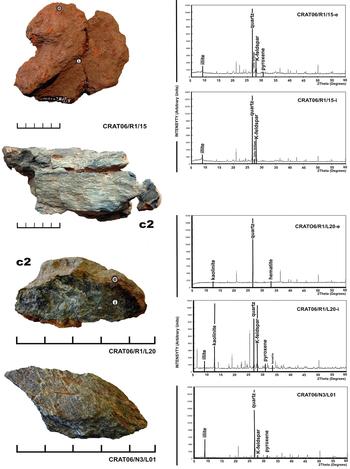
Ratinhos (Moura, Portugal). Samples of a fired clay piece, a reddened slate, and a fragment of the bedrock, with the main components according to X-Ray Diffraction (XRD).

The spread of the remains uncovered to the south-east of posthole A2 reflects the direction of the fall of the burnt post. Larger stones were found on the opposite side, over the outer slope; they had a glossy patina and a light reddish colour on the surface only, unlike the natural grey-greenish colour of the slates. This was, however, not a general event that affected the entire wall. The variety of effects, in the form of calcined, reddened and vitrified stones, together with the spread of ash and charcoal layers and the fired clay pieces, provides evidence of a single fire, located at the easiest point of access to the acropolis, perhaps where the main gate was located. In a nearby dwelling (or ‘hut’), P21, a burnt fragment of a white pine prismatic beam measuring 10 cm provided a date of 2490 ± 80 bp (S.A.C.2229; Soares & Martins, Reference Soares, Martins, Berrocal-Rangel and Silva2010), or 791–415 cal bcFootnote 2. This would suggest that the dwelling had been abandoned from the mid-eighth century bc and, as the entrance of this dwelling was built over the destroyed foundations of the wall, this abandonment gives a terminus post quem for the fire of the wall. At Ratinhos, we found slates with calcinated surfaces and others with a reddish colour that we can define as ‘reddened’ (Figure 7).
Sample CRAT06/N3/L01 is a protolithic sample from an outcrop located to the east of the site. It has a silicate composition, made of pyroxene, K and CaNa-feldspars, a significant quantity of illite and, mainly, quartz. The absence of kaolinite is noteworthy. By contrast, sample CRAT06/R1/L20 has a grey core and an orange-reddish surface. This sample is a small part of a larger stone, a piece of masonry from the fired wall; its surface has negative impressions of wood (Figure 7, C2).
The grey core of sample CRAT06/R1/L20 has a similar composition to the protolithic material: pyroxene, K-feldspars, illite, and quartz, but kaolinite and hematite are also present. This difference may be explained by the natural diversity of the lithic substratum (ferric slates). The absence of CaNa-feldspars and the presence of large amounts of K-feldspar are more significant; it may indicate that the core was less affected by fire, because K-feldspar survives at temperatures of between 800° C and 1000° C. The presence of kaolinite works in this way, since this mineral disappears over 600/650° C (Sayanam et al., Reference Sayanam, Kalsotra, Mehta, Singh and Mandal1989). K-feldspar had indeed disappeared in sample 2 of CRAT06/R1/L20 (from the reddish surface), which is clearly more affected by fire. This absence of phyllosilicates and K-feldspars could mean a combustion temperature between 1000 and 1100° C, but the presence of kaolinite suggests that temperatures did not exceed 650° C (Frías et al., Reference Frías, Vigil de la Villa, García, Sánchez de Rojas and Juan Valdés2013). Therefore, despite the differences in colours, the temperature was quite similar inside and outside the stone, between 600 and 650° C, which is not enough to vitrify it but sufficient to redden it. Similar results were obtained from the fired clay fragment R1/L15, a piece retaining the shape of three joists that was found beside the stone CRAT06/R1/L20 (Figure 7): its composition was silicate with a large quantity of quartz and a lesser presence of K-feldspars and illite. Therefore, it was affected by temperatures under 1000° C. The slight presence of CaNa-feldspar is also understood in that sense. In the sample from the interior of the fired clay fragment, a small quantity of pyroxene was detected, which is a natural component of the substratum that would disappear at temperatures of over 1000° C.
Sabugal Velho (Guarda, Northern Portugal)
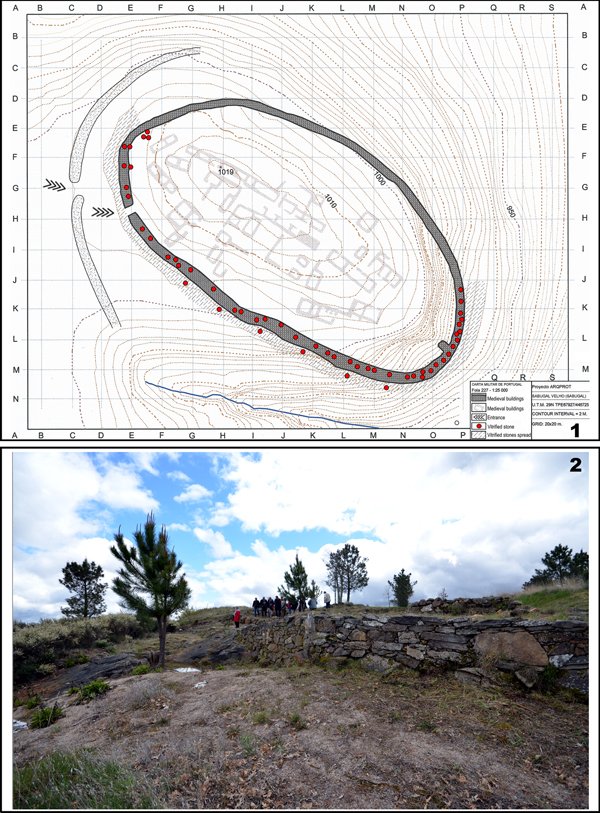
At Sabugal Velho, recent excavations have uncovered many vitrified stones, mainly outside a rampart (Osório & Pernadas, Reference Osório, Pernadas, Rodrigues, Lima and Santos2011). The site was occupied in the Late Iron Age (fourth to first century bc) and, after having been abandoned for several centuries, was reoccupied in the twelfth and thirteenth centuries ad (Osório & Pernadas, Reference Osório, Pernadas, Rodrigues, Lima and Santos2011: 227). A simple masonry wall was built following the plan of a previous one dated to the Late Iron Age (Figure 8).
Sabugal Velho (Guarda, Portugal). 1: Plan of the site and location of vitrified stones (after Osório & Pernadas, 2005). 2: View of the wall from the north in 2013.

A detailed study of medieval smelting furnaces allowed Marcos Osório to reject his initial explanation, which linked the vitrified stones to metallurgical activities. He was able to demonstrate that the vitrification was a protohistoric event, stratigraphically related to the Late Iron Age layers that spread along the south-western side of the perimeter wall, especially along its western corner, where the main entrance to the settlement was located (Osório & Pernadas, Reference Osório, Pernadas, Rodrigues, Lima and Santos2011: 228).
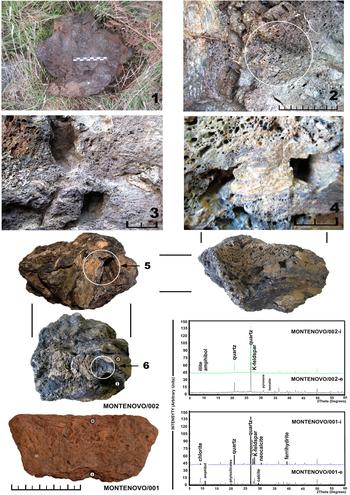
In this area, and towards the south, we photographed vitrified schists and slates that show negative impressions with angular and prismatic shapes, which may represent beam marks (Figure 10, nos. 1–2). Beside these, small twin holes with prismatic or pyramidal shapes were recorded, most of them measuring between 1 and 2 cm (Figure 10, no. 5). These marks are very similar to others found at the site of Castelos de Monte Novo.
Castelos de Monte Novo (Évora, Southern Portugal)
Castelos de Monte Novo is a Late Iron Age hillfort with three lines of defences, the central circuit being the most impressive, with a double line of ramparts built with masonry and mud bricks fronted by a broad ditch (Figure 9). But no excavations have been conducted there, and there is no reliable archaeological or topographical survey. In our visits to the site, we collected a series of elements, as the Évora Archaeological Survey Project team had done along the northern line of the wall (the exterior line of defence), and its western corner, identifying the presence of a ‘timber-laced stone wall’ over a distance of more than 300 m. The stones, a local schist, show ‘clearly the negative impressions of wood in the vitrified surfaces of the stone’ (Burgess et al., Reference Burgess, Gibson, Correira and Ralston1999: 143), as has been observed on other sites. The pottery that we have collected or studied dates the site to the Later Iron Age or later (Berrocal-Rangel, Reference Berrocal-Rangel1992: 115, 317).
Castelos de Monte Novo (Évora, Portugal). 1: Plan of the site and location of vitrified stones (after Burgess et al., Reference Burgess, Gibson, Correira and Ralston1999). 2: View of the ditch, bank, and outer wall from the north.

We have analysed one vitrified stone and a mud brick (Figure 10). The sample Montenovo/002 is a schist with vesicular surfaces (Figure 10, no. 4), fusion of separate rocks (Figure 10, no. 6), and possible impressions of former wooden elements and metal nails (Figure 10, nos. 4 and 5), all of them the products of vitrification. The X-Ray Diffraction (XRD) analysis enabled us to determine the mineral composition of a sample from the surface and of another taken from the core of the rock.
Samples of vitrified stones from Sabugal Velho (nos. 1–3) and Castelos de Monte Novo (nos. 4–6), and a burnt mud brick from the latter site. The diffractograms refer to no. 6 and the burnt mud brick.

The results show both samples to be silicates. The sample from the surface, brown in colour, shows illite (9.90 Å), amphibole (8.36 Å), quartz (3.33 Å), and K-feldspar (3.18 Å). On the other hand, the sample from the core, which was dark grey, contains quartz (3.33 Å), pyroxene (2.87 Å), and hematite (2.69 Å). These differences indicate that the brown surface was affected by a lower temperature, since the illite disappears at a temperature of over 900 or 1000° C. Amphibole and K-feldspars change around 1000° C, while the presence of pyroxene in the black core sample indicates a temperature higher that 1100 °C (García-Giménez et al., Reference García-Giménez, Vigil de la Villa Mecía, Rubio and Frías2016). We conclude that the whole rock was vitrified, reaching a temperature of 850° C, and, although temperatures were more regular than those at Pozos de los Moros, they can also be related to an irregular fire, accidental or deliberate, with an oxidizing atmosphere.
We analysed the mud brick Montenovo/01 using samples from its surface and core (as we did at Ratinhos). The results from the core emphasized its silicate composition, mainly quartz, and Ca-Na and K-feldspars. Chlorite, neocalcite, and ferrihydrite were also present. These elements, as in the sample from Ratinhos, suggest temperatures lower than 1000° C. The sample from the surface showed an absence of some components, such as the Ca-Na and K-feldspars, and an increase in chlorite, which is consistent with lower exposure to fire, as the structure groups OH disappears over a temperature of 600 or 700° C in the chloriteFootnote 3. Thus, as with the stone, the surface was less affected by fire and, although temperatures are considerably lower in the mud brick, both ranges are quite similar (600–850° C for the brick; 900–1100° C for the stone).
Conclusions
The purpose of this article is to draw attention to a growing body of evidence about the use of complex building techniques in late prehistoric Iberia, as well as to provide new data which we believe will help us achieve a better understanding of vitrification throughout Iron Age Europe.
Our preliminary conclusions are that this phenomenon was the result of a concurrence of circumstances with multiples causes: natural fires, attacks, building techniques, ritual or symbolic actions. Furthermore, different effects were observed: not only the vitrification of the stones, but also calcination (Ralston, Reference Ralston2006: 155) and reddening. Burnt ‘ramparts of earth’, like those found on Irish hillforts, should also be included (O'Brien et al., Reference O'Brien, O'Driscoll, Hogan, Fernández-Götz and Roymans2018).
This phenomenon has been identified in ramparts from the Middle and Late Bronze Age to early medieval times of western, northern and central Europe (Figure 1). Vitrification is not culture-specific, although there is a close relationship with the spread of timber-laced ‘Celtic’ ramparts, i.e. the various types of murus celticus (Fichtl, Reference Fichtl2010).
We have studied some Iberian cases and various different explanations. Vitrification as a technical device could be identified at Cerro das Alminhas, where the main entrance to the settlement includes a very hard burnt floor made of greywackes. This can be interpreted (in contrast to the interpretations offered by Brothwell et al., Reference Brothwell, Bishop and Woolley1974 or Kresten et al., Reference Kresten, Kero and Chyssler1993) as reflecting the use of a building method to reinforce the foundations. At Pozos de los Moros, despite the theories involving meteorites or volcano eruptions, the concentration of vitrified stones specifically at the only point of access to the settlement lead us to suspect the presence of a gatehouse made of timber and stones. The site of Ratinhos, where burning is associated with stratigraphic evidence of destruction, is a good example of a third cause, i.e. the burning of walls as evidence of attacks or violent events on settlements. Elsewhere in Europe we cannot identify the scale or nature of such violence (Cook, Reference Cook2013: 94).
The main result of our comparative study is that we have been able to differentiate between two main trends in the spread of ‘vitrification’. Most cases of vitrified stones in the main access areas of sites are found in Late Bronze Age/Early Iron Age hillforts, as dated by excavations or intensive surveys (e.g. Passo Alto, Ratinhos, Pozo de los Moros), whereas a small group of sites with vitrified remains along a substantial stretch of the walls date to the later Iron Age.
As a hypothesis, we propose that the first cases are evidence of the simplest kind of timber framework within the walls; they are located mainly on gates, not only because the leaves of gates were made of wood, but also because the gate itself had a timber framework. The incorporation of beams into the main gates was related to their symbolic importance and to overcome their defensive weakness. This explains the investment in technical innovations. From what we know about ancient rampart building in Andalucía (Moret, Reference Moret1996: 189, 194ff., 209; Escacena Carrasco, Reference Escacena Carrasco2002: 87ff.), it was the Phoenicians who brought these new techniques to the Iberian Peninsula.
A second concurrence of elements is visible in the after Iron Age, and we believe that it could be related to the Roman wars of conquest. At this time, the use of timber-laced walls around the entire settlements could be a regular feature, as Monte Novo, Sabugal Velho and Fraga do Romualdo show. Cases of such vitrified walls are quite infrequent because it is more difficult to burn a solid wall built with stones and mud bricks and probably crowned with defences (Ralston, Reference Ralston1986: 37; 2006: 130; Fichtl, Reference Fichtl2010).
It seems, on current evidence, that the phenomenon of vitrified walls is exclusive to the central and south-western Iberian Peninsula. In northern Iberia, cases of timber-laced ramparts are few and debateable (Moret, Reference Moret1996: 76.) The testimonies of Classical Greek and Latin writers tell us that throughout the Roman conquest of the Iberian Peninsula there were cases of walls built with wooden supports, as at Pallantia (Palencia, Spain)Footnote 4 in 74 bc. Before that, wooden structures were only used for specific elements such as gates, palisades, or floors (Moret, Reference Moret1996: 76), but new approaches and better archaeological techniques are radically changing this picture.
Acknowledgments
This work was supported by the Ministry of Economy, Industry and Competitiveness of Spain, under Project HAR2016-77739-P ‘Late Prehistory Architecture in the Western Spanish Plateau. Archaeotecture and Archaeometry about the built heritage of the Vettones hillforts’. We want to express our gratitude to Virgilio H. Correia, and to Catriona Gibson and Colin Burgess for their advice, dates, and visits to Castelos de Monte Novo. António Carlos Silva shared with us his recent research at Ratinhos, and Marcos Osório and António Monge Soares showed us materials and structures from Sabugal Velho and Passo Alto. We owe much to the lessons and master classes of Professor Ralston, who encouraged us to carry out this research.