INTRODUCTION
According to the fossil records, turtles divided into four families, of which two families, i.e. Cheloniidae and Dermochelidae still exist (Prichard, Reference Prichard1997). Seven species have been recorded within the Cheloniidae, i.e. Eretmochelys imbricata, Chelonia mydas, Caretta caretta, Lepidochelys olivacea, Lepidochelys kempii, Chelonia agassizii, Natator depressus, while Dermochelidae family contains only a single species, Dermochelys coriacea (Hays, Reference Hays2001; Bowen & Karl, Reference Bowen and Karl2007).
Among them, five species i.e. E. imbricata, C. mydas, C. caretta, L. olivacea and D. coriacea have been found in the Persian Gulf.
Eretmochelys imbricata and C. mydas nest in the Iranian Islands (Mobaraki & Elmi, Reference Mobaraki and Elmi2005; Tabib et al., Reference Tabib, Frootan and Askari Hesni2014). The E. imbricata populations are distributed mainly in central parts of the Atlantic, Indian and Pacific oceans (Marquez, Reference Marquez1990).
It is estimated that E. imbricata populations have been decreasing around the world during the recent years to the extent that more than 80% of the populations have declined (Beggs et al., Reference Beggs, Horrocks and Krueger2007; Liles et al., Reference Liles, Jandres, Lopez, Mariona, Hasbun and Seminoff2011). Therefore, E. imbricata is considered as a critically threatened species in the IUCN Red list (IUCN, 2015).
Eretmochelys imbricata migrate to the beach for breeding. The sandy shores are suitable environments for nesting of hawksbill turtles as these environments cannot be strongly affected by waves. However, these habitats are characterized by a low slope, suitable elevation, sand aggregation with sufficient humidity, temperature conditions and air exchange (Glen et al., Reference Glen, Broderick and Hays2003). These factors play an important role in incubation period and embryo growth (Mortimer, Reference Mortimer and Bjorndal2007).
Several islands are considered to be the main sites for nesting hawksbill turtles in Iranian islands in the northern Persian Gulf, i.e. Hormuz, Hengam, Faror, Sheedvar, Lavan, Kish, Nakhiloo, Tahmadon, Omolgorm, Khark, Kharkoo, and Hendourabi Islands (Valavi, Reference Valavi1993; Zolgharnein et al., Reference Zolgharnein, Salari-Aliabadi, Forougmand and Roshani2011; Pilcher et al., Reference Pilcher, Antonopoulou, Perry, Abdel-Moati, Al Abdessalaam, Albeldawi, Al Ansi, Al-Mohannadi, Al Zahlawi, Baldwin, Chikhi, Das, Hamza, Kerr, Al Kiyumi, Mobaraki, Al Suwaidi, Al Suweidi, Sawaf, Tourenq, Williams and Willson2014a, Reference Pilcher, Perry, Antonopoulou, Abdel-Moati, Al Abdessalaam, Albeldawi, Al Ansi, Al-Mohannadi, Baldwin, Chikhi, Das, Hamza, Kerr, Al Kiyumi, Mobaraki, Al Suwaidi, Al Suwaidi, Sawaf, Tourenq, Williams and Willsonb).
The first study on sea turtles of the Persian Gulf and Oman Sea was by Kinunen & Walczak (Reference Kinunen and Walczak1971). This study was performed on the coasts of Hormoz, Sheikholshoayb and Shidvar Islands in the Persian Gulf and also Bris beach from Oman sea coasts. There is little information on the nesting ecology and reproductive characteristics of the hawksbill turtles in the Persian Gulf. The aim of this study is to provide sufficient information on the nesting distribution, reproductive biology and life history of the hawksbill turtles in Kish Island. Also, this study presents the first information on the effects of ecological factors on hawksbill turtle breeding. The results of this study can be used to develop conservation strategies for the hawksbill turtle in Kish Island and the other islands in the Persian Gulf region.
MATERIALS AND METHODS
Kish Island is one of the Iranian ecotourism islands located in north of Persian Gulf (Figure 1). The coral reefs and hard bottom around the Kish Island occur at 5–20 m depths. The coasts in the southern parts of the island are beaches with fine sand and gentle slope. The beach length is rounded by a widespread sand system with a varying width ranging from 15 to 50 m comprising pebbles mixed with sand (Valavi, Reference Valavi1993). Reproductive biology and ecology of the hawksbill turtle as well as the environmental parameters were studied at the beginning of the nesting season (i.e. February–August) during 2009 to 2012. The nesting activities and biometric parameters were quantified and measured. Reproductive biology characters of hawksbill turtles were studied daily. The measured parameters are as follows: straight carapace length (SCL), curved carapace length (CCL), straight carapace width (SCW) and curved carapace width (CCW). In addition, some reproductive parameters i.e. the total number of eggs, normal and abnormal eggs were counted. Other characters were also studied such as egg weight and diameter as well as the hatchling length, width and weight. Clutch sizes were also measured by nests excavation after emergence. The numbers of hatched and unhatched eggs as well as the hatchlings were calculated. Hatching success was calculated by the number of hatched eggs divided to the total number of produced eggs.
Study sites – the monitoring areas along the coast of Kish Island are shown.

To study the biological characteristics of turtles, the Sea turtle Manual of Research and Conservation Techniques was used (Shanker et al., Reference Shanker, Pandav and Andrews2003). All nests (in situ) recorded by GPS recorder to protect eggs from natural predators’ enclosure around them.
Air temperature and humidity were measured during the incubation period and also after emergence from the nests. These factors were measured with a digital Multimeter with minimum and maximum rate. Moreover, the environment around the nests was controlled to avoid losses to predators and disorientation (Kamel & Delcroix, Reference Kamel and Delcroix2009; Liles et al., Reference Liles, Jandres, Lopez, Mariona, Hasbun and Seminoff2011). Types of soils were measured by riddle series for determination of sandy aggregation near all the nests.
All data met normality requirements transformed before analysis as appropriate. One-way ANOVA with Duncan's post-hoc test was used to test the significance of individual biometrics and also environmental variables. Regression and correlation analysis were used to test for relationships between size of turtle and clutch size. The statistical significance level was set at P < 0.05. Values are expressed as means (±SD). The data analysis was carried out using SPSS 21.0 and Microsoft Excel (2010).
RESULTS
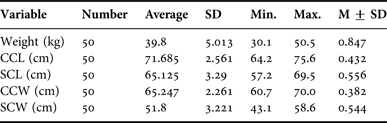
Fifty female hawksbill turtles were observed in the coasts of Kish Island during 2009 to 2012. Morphometric data are summarized in Table 1. The number of hawksbills observed nesting varied each year. The mean of weight, CCL, SCL, CCW and SCW of the females were 39.8 ± 0.847 kg, 71.685 ± 0.432 cm, 65.125 ± 0.556 cm, 65.247 ± 0.382 and 51.8 ± 0.544 cm, respectively.
Biometric data of the hawksbill turtles.

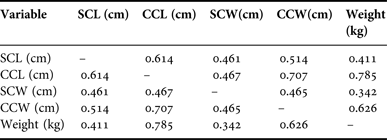
In this study, a correlation matrix was calculated between the biometric data of female turtles. The maximum correlation coefficient was observed between weight and curved carapace length (r = 0.785, P < 0.05) and the minimum was between weight and straight carapace width (r = 0.342, P < 0.05). The correlation coefficient between curved carapace width and weight was 0.626 (Table 2).
The Pearson correlation between biometric parameters.

According to the positive and significant correlation between carapace length and width with weight took the following exponential regression models:
 $$\hskip-1.1pc W = ({\rm 2}.{\rm 48184}).{\rm e}\,\,0.0{\rm 38} \times {\rm CCL}$$
 $$W = ({\rm 3}.{\rm 97}0{\rm 93}).{\rm e}\,\,0.0{\rm 3535} \times {\rm CCW}$$
In addition, a linear model was also provided as follows
 $$W = - {\rm 67} + {\rm 1}.{\rm 5}\,\,{\rm CCL}$$
After evaluation of exponential and linear models between curved carapace length and weight to predicted values and assumptions of independence, normality and randomness of the errors we find the exponential model fitted better performance in predicting weight hawksbill turtles by the Curved Carapace Length.
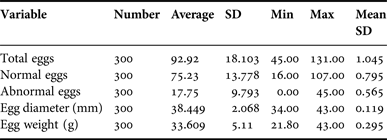
The biometric results of the eggs and hatchling turtles are summarized in Tables 3 and 4, respectively. The average number of total, normal and abnormal eggs by each female are 92.92 ± 1.045, 75.23 ± 0.795 and 17.75 ± 0.565, respectively. Diameter and weight of each egg measured 38.449 ± 0.119 mm and 33.609 ± 0.295 g (Table 3).
Statistical analysis of traits related to nesting hawksbill turtles.

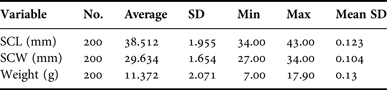
Statistical analysis of biometric traits of emerged hatchling hawksbill turtles in Kish Island.

Emerged hatchlings' biometric results show that mean of weight, SCL and SCW are 11.372 ± 0.13 g, 38.512 ± 0.123 mm and 29.634 ± 0.104 mm, respectively (Table 4).
Using data based on 300 samples, correlation rate between egg diameter and egg weight was 0.768. Because of this correlation, a linear regression equation was obtained as follows:
 $$W = - {\rm 46}.{\rm 6} + ({\rm 2}.0{\rm 5}) \times {\rm egg}\,\,{\rm diameter}$$
Also according to 200 hatchling turtles, correlation rate between hatchling weight and straight carapace length was 0.886. A linear regression equation was calculated as follows:
 $$W = - {\rm 18}.{\rm 8} + 0.{\rm 815} \times {\rm SCL}$$
Maximum, minimum and average incubation period in this study were 79, 47 and 60 days. Incubation period was 50–60 days in most nests (44% of all nests). Mean hatching and emergence success were high as average hatching success was calculated to be 75.86%.
Sand size in hawksbill turtles nests in Kish Island was between 0.063 to 4 mm; in the total area of nesting, an average particle size of 0.5 mm was the highest percentage (48.502%) and particle size of 0.063 was lowest.
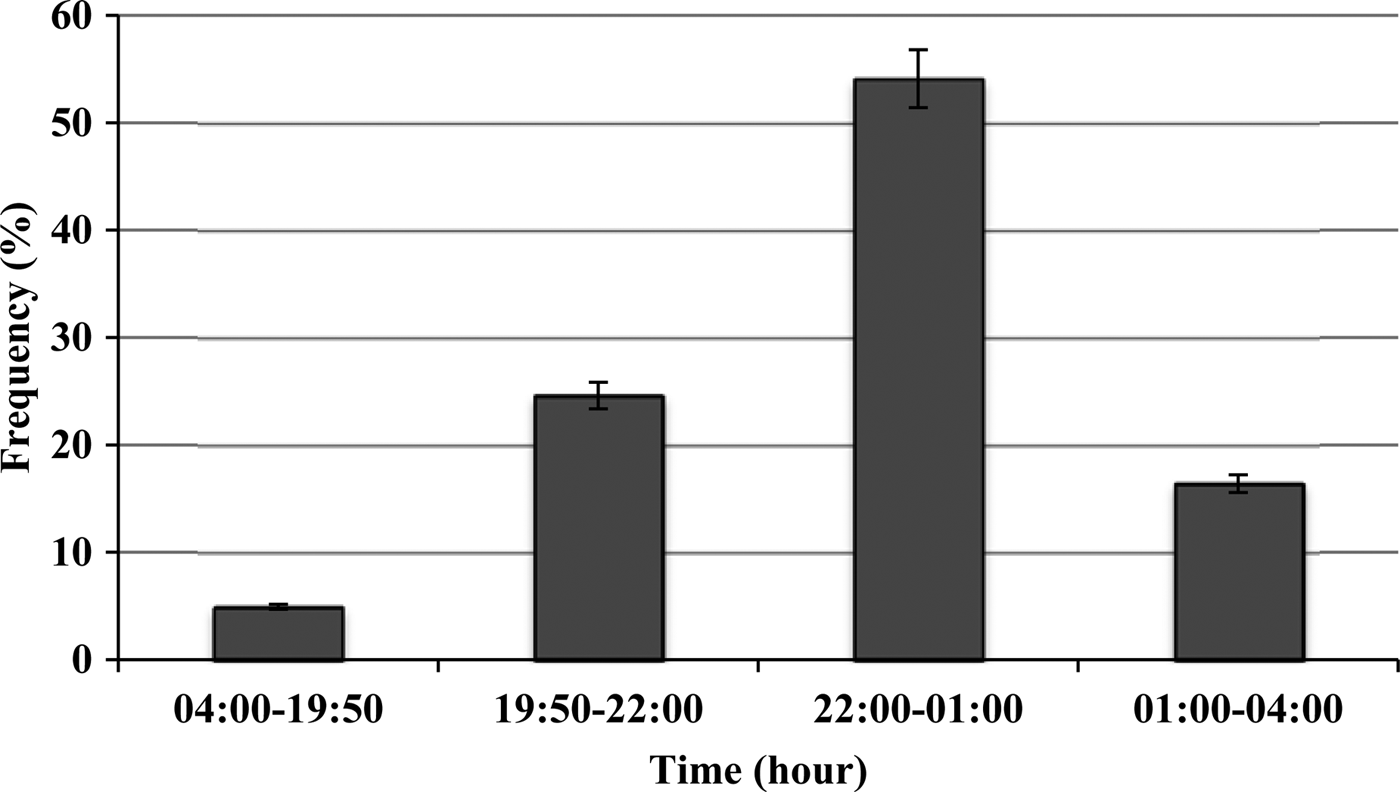
Turtles come ashore to lay eggs between the hours of 19:50 to 04:00, the highest rate being between the hours of 22:00 to 01:00. A significant difference was observed between the different hours (P < 0.05) (Figure 2).
Time and frequency of nesting hawksbill turtles.

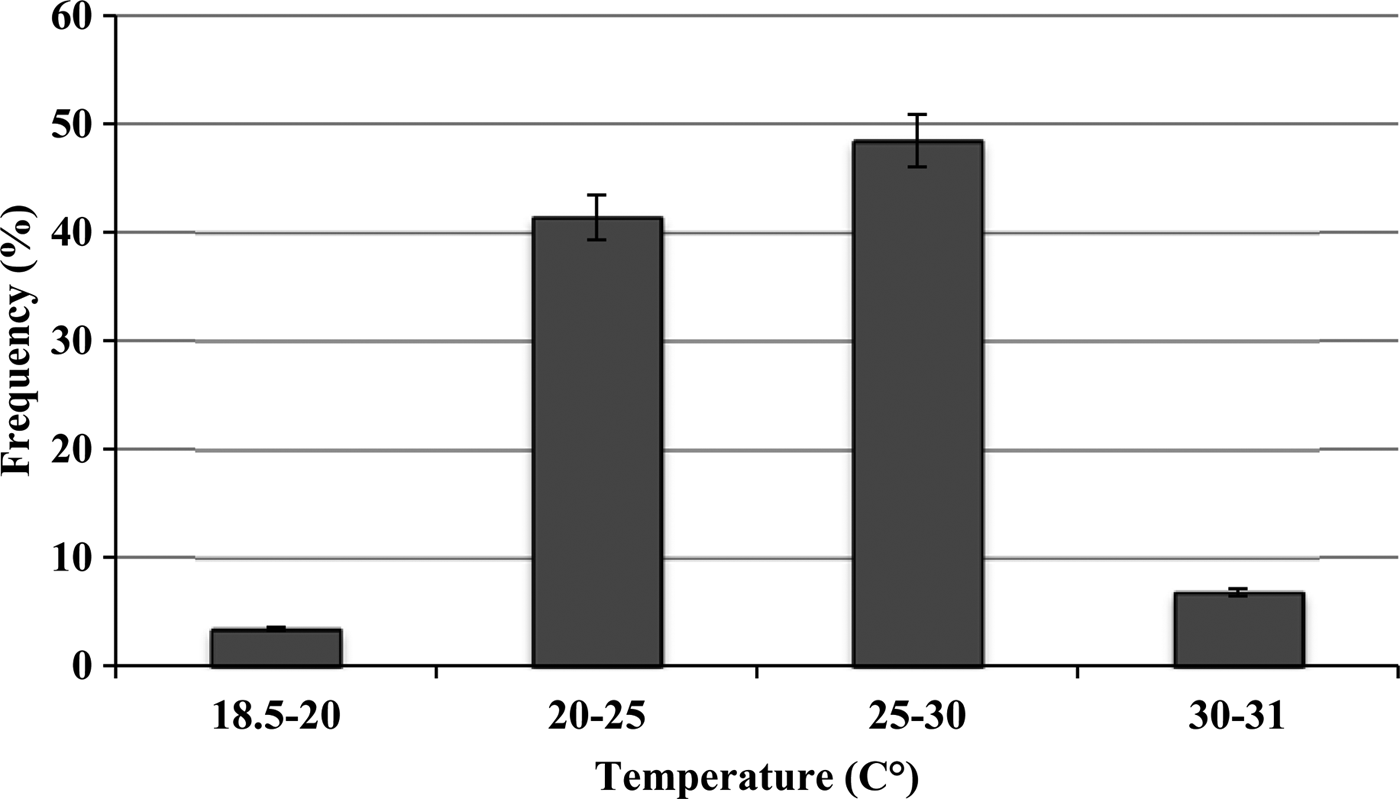
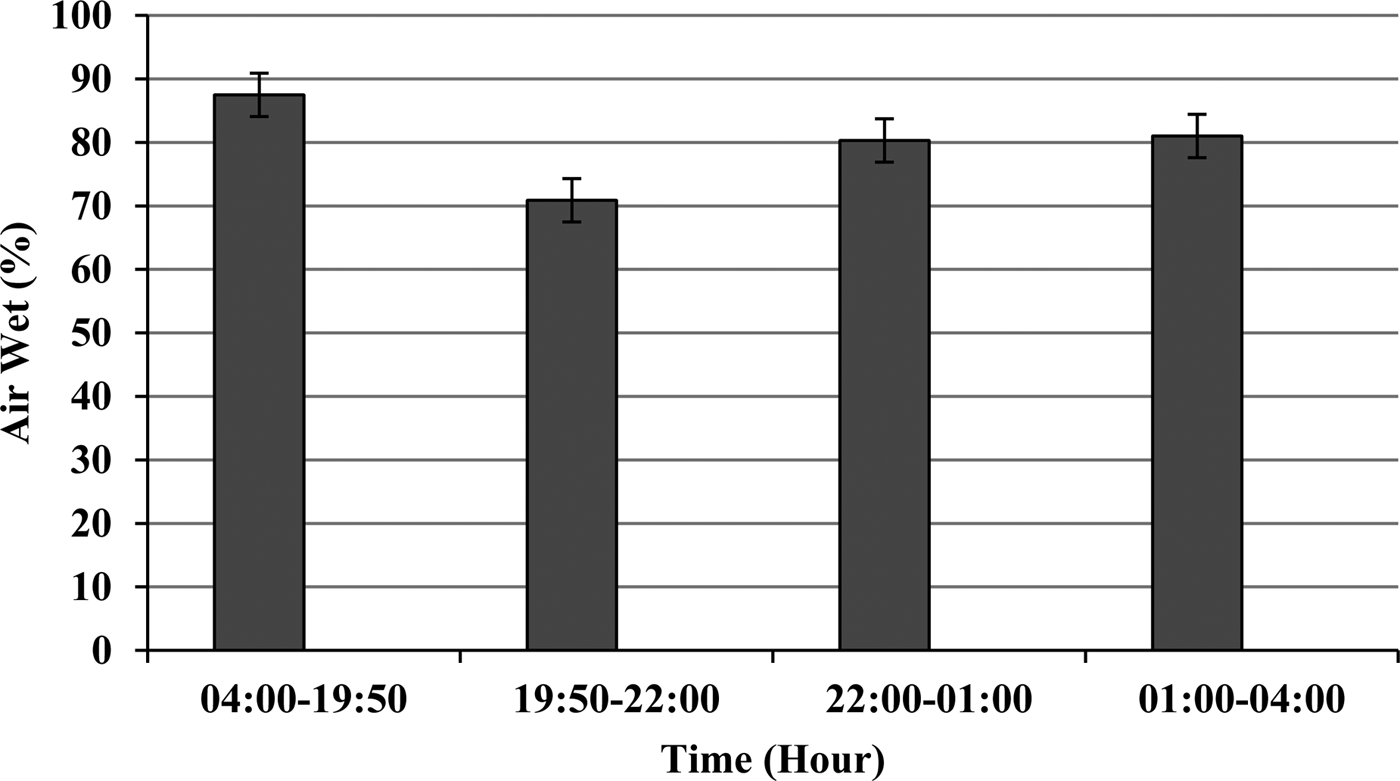
Hawksbill turtles were laid in temperatures of 18.5–31°C, with most of them (48.5%) observed at temperatures between 25 and 30°C. Significant differences were found between the range of temperature (P < 0.05) (Figure 3). With regard to humidity, the lowest air moisture content was between 19:50 to 22:00. It is significantly different between this time and the other times (P < 0.05). However, there were no significant differences between all times in diurnal apart from during 19:50 to 22:00 (P > 0.05) (Figure 4).
Effect of temperature on the egg laying of E. imbricata.

Air humidity variation in relation to nesting times of hawksbill turtles.

DISCUSSION
Eretmochelys imbricata is a migratory species of conservation concern. Adults travel hundreds or thousands of kilometres from foraging sites to the breeding regions (Van Dam et al., Reference Van Dam, Diez, Balazs, Colon, McMillan and Schroeder2008). Various studies have shown that only green and hawksbill turtles breed in the Persian Gulf coasts, while other species come to these coasts for feeding and grazing (Valavi, Reference Valavi1993; Saeedpour et al., Reference Saeedpour, Savari and Ahmadi2003; Mobaraki & Elmi, Reference Mobaraki and Elmi2005; Moghimi et al., Reference Moghimi, Naghash, Ale-Khorshid, Choy and Ghasemi2009; Tabib et al., Reference Tabib, Zolgharnein, Mohammadi, Salari-Aliabadi, Qasemi, Roshani, Rajabi-Maham and Frootan2011). Eretmochelys imbricata is the only species which was observed laying eggs in the Kish Island coast.
Since the females lay the eggs without any protection, if they come to shore during the day to lay eggs they may encounter predatory animals (e.g. foxes and mongooses) or other potential dangers such as humans, therefore in most cases it is during the night that this species comes to the coast to lay eggs (Hays et al., Reference Hays, Adams and Speakman1993).
In this study turtles came to the beach for nesting between 19:50 to 04:00, with most of them (54.098%) observed on the beach between 22:00 to 01:00 (Figure 2). During these hours humidity rate was higher than at other times (Figure 4).
In this study, the average CCL calculated was 71.685 ± 0.432 cm, there is no significant difference with other Iranian islands in the north of the Persian Gulf (P > 0.05), as CCL was 71.35 and 75.95 cm in Hormoz and Hengam Islands, respectively (Saeedpour et al., Reference Saeedpour, Savari and Ahmadi2003) and 71.70 cm in Nakhilo Island (Moghimi et al., Reference Moghimi, Naghash, Ale-Khorshid, Choy and Ghasemi2009). Also there is no significant difference between these islands with other countries near the Persian Gulf (P > 0.05), such as Oman where coastal turtles are on average 76.8 cm (Ross, Reference Ross1981). Some investigations show that Persian Gulf and Oman sea hawksbill turtles are smaller than Indo-Pacific hawksbill turtles; as hawksbill turtles reported in the Indo-Pacific and Malaysia have an average CCL of 82.3 cm (Chan & Liew, Reference Chan and Liew1999), Australian 81.6 cm (Dobbs et al., Reference Dobbs, Miller, Limpus and Landry1999), El Salvador 81.6 cm (Liles et al., Reference Liles, Jandres, Lopez, Mariona, Hasbun and Seminoff2011), Seychelles 85 cm (Hitchins et al., Reference Hitchins, Bourquin and Piper2004) and Ascension Island in the South Atlantic Ocean from 33.5 to 85 (mean = 48.8 cm) (Weber et al., Reference Weber, Weber, Godley, Pelembe, Stroud, Williams and Broderick2014). Indo-Pacific hawksbill turtles are smaller than some others, for example hawksbill turtles of the Caribbeanin Costa Rica, with average CCL 88.8 cm (Bjorndal et al., Reference Bjorndal, Carr, Meylan and Mortimer1985), Brazil, 97.4 cm (Marcovaldi & Laurent, Reference Marcovaldi and Laurent1996), Mexico, 99.4 cm (Garduno-Andrade, Reference Garduno-Andrade1999), Virgin Island in America, 87.6 cm (Hillis, Reference Hillis, Richardson, Richardson and Donnelly1990) and Guadeloupe turtles with 87.9 cm (Kamel & Delcroix, Reference Kamel and Delcroix2009). In conclusion, these studies show hawksbill turtles in the Persian Gulf and Oman Sea are smaller than elsewhere. Average straight carapace length and weight were 65.125 ± 0.556 cm and 39.8 ± 0.847 kg; compared with other Iranian Islands in Persian Gulf there is little difference (P > 0.05) as SCL and weight were variable in Island of Hormuz with average 66.32 cm and 42 kg (Dehghani et al., Reference Dehghani, Keshavarz, Kamrani, Mehvari and Asadi2012), Nakhilo Island 65.22 cm and 44.46 kg (Moghimi et al., Reference Moghimi, Naghash, Ale-Khorshid, Choy and Ghasemi2009) Hengam Island 65.31 cm and 42.46 kg (Saeedpour et al., Reference Saeedpour, Savari and Ahmadi2003) and Shidvar Island with 65 cm and 37.7 kg (Mobaraki, Reference Mobaraki2004). Globally the hawksbill turtle is on average SCL 82 cm and 55 kg (Fischer & Bianchi, Reference Fischer and Bianchi1984), so it can concluded that the size of hawksbill turtle in Persian Gulf of Iranian Islands is smaller than the global average.
Average number of hawksbill turtle eggs in Kish Island was 92.92 ± 1.045, in comparison to other Iranian islands of the Persian Gulf such as Hengam with average 97 (Saeedpour et al., Reference Saeedpour, Savari and Ahmadi2003), Hormoz Island, 93.38 (Dehghani et al., Reference Dehghani, Keshavarz, Kamrani, Mehvari and Asadi2012), Nakhilo Island, 91 (Moghimi et al., Reference Moghimi, Naghash, Ale-Khorshid, Choy and Ghasemi2009) Omolgorm Island, 85 (Moghimi, Reference Moghimi2001) and Shidvar Island with 92.6 (Zare et al., Reference Zare, Nabavi, Fadakar and Eftekhar-Vaghefi2009) there is no significant difference (P > 0.05). Hawksbill turtle egg numbers in Kish Island were higher than in other countries around the Persian Gulf such as Qatar with 78 (Tayab & Quiton, Reference Tayab and Quiton2003) Saudi Arabia, 68.6 (Chaloupka & Musick, Reference Chaloupka, Musick, Lutz and Musick1997), United Arab Emirates, 58.6 (Al-Ghais, Reference Al-Ghais2006) and region of Oman with 70–90 (Eckert et al., Reference Eckert, Bjorndal, AbreuGrobois and Donnelly1999). In comparison to other parts of the world such as Cousin Island with average 176.7 (Horrocks & Scott, Reference Horrocks and Scott1991) Cuba, 135.2 (Moncada & Nodarse, Reference Moncada and Nodarse1994), Bahama Island in Brazil, 140 (Marcovaldi & Laurent, Reference Marcovaldi and Laurent1996) hawksbill turtle egg numbers express lower average numbers in the Iranian islands and other islands of Persian Gulf.
According to correlation between CCL and weight in hawksbill turtle of Kish Island, as well as the Kish Island hawksbill turtle being smaller than in other parts of world, it can be concluded their egg numbers are lower than turtle egg number in other parts of the world. This result is similar to the Garnett (Reference Garnett1978) study which done on hawksbill turtles in Cousin Island, Seychelles.
Average egg diameter and weight in Kish Island were 38.449 ± 0.119 mm and 33.609 ± 0.295 g, respectively; in comparison to other northern islands of the Persian Gulf such as Shidvar Island with 38.49 mm and 32.94 g (Zare et al., Reference Zare, Nabavi, Fadakar and Eftekhar-Vaghefi2009), Hengam and Larak Islands with 39.2 mm and 32.4 g (Saeedpour et al., Reference Saeedpour, Savari and Ahmadi2003) and Hormoz Island with 37.2 mm and 30.5 g (Loghmani et al., Reference Loghmani, Savari, Mobaraki and Sadegi2011) there is no significant difference (P > 0.05). In comparison with the south coast of the Persian Gulf, Yemen with 40 mm and 32.1 g, United Arab Emirates (UAE), 38.6 mm (Al-Ghais, Reference Al-Ghais2006) and Qatar, 39.1 mm and 28 g (U.A.E. Fish & Wildfire, 2001) there is again no significant difference (P > 0.05). But in comparison to other parts of the world such as Mexico with 36.2 mm and 30.8 g, Australia, 36.4 mm and 26.4 g, egg sizes of Kish Island and north Persian Gulf islands are bigger. Increasing egg numbers cause low weight and diameter of eggs (Redford & Cannon, Reference Redford and Cannon1996). The number of hawksbill turtle eggs in Kish Island and other Persian Gulf islands is lower than the other parts of the world, so egg diameter and weight in this area are bigger.
Straight carapace length of hatchlings was calculated to be 38.512 ± 0.123 mm which in comparison to other Iranian islands of the Persian gulf such as Hormoz Island with 36.62 mm (Loghmani et al., Reference Loghmani, Savari, Mobaraki and Sadegi2011) and Shidvar Island with 40.73 mm (Zare et al., Reference Zare, Nabavi, Fadakar and Eftekhar-Vaghefi2009) did not show a significant difference (P > 0.05). Some investigations including Turks and Caicos Islands, 27.9 mm (Henderson & Nash, Reference Henderson and Nash2013), Cousin, 39.2 mm, Mexico, 41.1 mm, Costa Rica, 40 mm, Australia, 41.1 mm and global with 36–46 mm (Eckert et al., Reference Eckert, Bjorndal, AbreuGrobois and Donnelly1999) show that there is no difference between straight carapace length in Kish Island and other parts of the world (P > 0.05).
Results of this study are the same as the conclusions of other Iranian islands of the Persian Gulf such as Hengam and Hormoz (Saeedpour et al., Reference Saeedpour, Savari and Ahmadi2003), Nakhilo (Moghimi et al., Reference Moghimi, Naghash, Ale-Khorshid, Choy and Ghasemi2009), Hormoz (Loghmani et al., Reference Loghmani, Savari, Mobaraki and Sadegi2011) and Shidvar (Zare et al., Reference Zare, Nabavi, Fadakar and Eftekhar-Vaghefi2009).
Coastal aggregation has an effect on nesting and survival of turtle hatchlings (Frazer, Reference Frazer1986). Hawksbill turtles nest in beaches with different aggregations in which these shores may be soft, have big sand particles and pieces of shells and corals. Aggregation influences sand humidity and air exchange which are important for turtle growth and survival (Wood & Bjorndal, Reference Wood and Bjorndal2001). In this study average hatching success in Kish Island was calculated to be 75.86%, which was higher than other Iranian islands of the Persian Gulf such as Hormoz Island with average hatching success 73% (Loghmani et al., Reference Loghmani, Savari, Mobaraki and Sadegi2011) and Shidvar Island, 73.6% (Zare et al., Reference Zare, Nabavi, Fadakar and Eftekhar-Vaghefi2009), but lower than Qatar with 83% (Tayab & Quiton, Reference Tayab and Quiton2003). In comparison to other regions of the world including Cousin and Caribbean with 86 and 89.5%, respectively (Horrocks & Scott, Reference Horrocks and Scott1991), Guadeloupe, French West Indies, 85.6 and 82.4% respectively (Kamel & Delcroix, Reference Kamel and Delcroix2009), eastern Pacific Ocean, 76.8% (Liles et al., Reference Liles, Jandres, Lopez, Mariona, Hasbun and Seminoff2011), showed lower hatching success for Kish Island and Persian Gulf turtles, but higher than Jumby Bay, Antigua, West Indies with 72.6% (Mcintosh et al., Reference McIntosh, Goodman and Parrish-Ballentine2003). Lower hatching success in the Persian Gulf region can be related to aggregation of shores and oil (Pilcher et al., Reference Pilcher, Antonopoulou, Perry, Abdel-Moati, Al Abdessalaam, Albeldawi, Al Ansi, Al-Mohannadi, Al Zahlawi, Baldwin, Chikhi, Das, Hamza, Kerr, Al Kiyumi, Mobaraki, Al Suwaidi, Al Suweidi, Sawaf, Tourenq, Williams and Willson2014a), fungi and bacterial pollution (Zare et al., Reference Zare, Nabavi, Fadakar and Eftekhar-Vaghefi2009). Important factors threatening nests in Kish Island are proximity of nesting sites to roads, island tourism, existence of pollution in shores and destruction of coral reefs ecosystems and also natural predators such as crabs. Since the Kish Free Organization and Environment Organization have enabled suitable protection to save Eretmochelys imbricata, this species comes to nest every year in the coasts of Kish Island.
ACKNOWLEDGEMENTS
We thank Kish Free Zone environment staff and researchers especially Ms Mohammadi for their cooperation in all studies and field samples.