

Introduction
An individual's spiritual dimension is now universally accepted as an important aspect within health care. Some scholars argue that research in this area is well established and considered ‘mainstream’ (Cohen et al. Reference Cohen, Holley, Wengel and Katzman2012). Others, however, suggest it is still in its infancy (Moberg Reference Moberg2008). It is clear that research in the area of spirituality has burgeoned since 1980, as shown by an exploration of abstracts using the PsycINFO and AgeLine databases from 1944 to 2003 that reveal the first article on spirituality was published in 1944 and the second in 1980 (Ribaudo and Takahashi Reference Ribaudo and Takahashi2008). The total number of research studies has subsequently increased from an average of 14.9 per year during the 1980s to 209.5 per year by the early 2000s (Ribaudo and Takahashi Reference Ribaudo and Takahashi2008). The number of articles published from 2006 to 2011 increased by over 25 per cent compared to the previous six-year period, 2000–2005 (Koenig Reference Koenig2013).
Past research has identified the importance of spiritual wellbeing (Moberg Reference Moberg1979) and recognition of ‘spiritual distress’ (Gordon Reference Gordon1985). Consequently, an area that was once the domain of theology is now being addressed and discussed by nursing, medicine and mental health practitioners, as an area for both research and practice (Brennan and Heiser Reference Brennan, Heiser, Brennan and Heiser2012; Harrington Reference Harrington2012). According to Puchalski (Reference Puchalski2010), spirituality is increasingly recognised as an essential element of health and a growing body of literature documents the positive effects of both religiousness and spirituality on human health (Brennan and Heiser Reference Brennan, Heiser, Brennan and Heiser2012; Daaleman, Cobb and Frey Reference Daaleman, Cobb and Frey2001). Research by Baldacchino et al. (Reference Baldacchino, Borg, Muscat and Sturgeon2012) posits that a positive relationship exists between spirituality and wellbeing, even in times of distress and suffering (Baldacchino et al. Reference Baldacchino, Borg, Muscat and Sturgeon2012: 820). These positive effects provide ‘buffers’ to life's stress during times of chronic or terminal illness, mental illness, care-giver burden, substance abuse and social disruption resulting from war (Brennan and Heiser Reference Brennan, Heiser, Brennan and Heiser2012). Also as a resource for wellbeing; assisting individuals to transcend suffering, pain and despair; and coping with illness (Chiu et al. Reference Chiu, Emblem, Van Hofwegen, Sawatzky and Meyerhoff2004; Harrington Reference Harrington2006; Picot et al. Reference Picot, Debanne, Namazi and Wykle1997).
Within the practice of palliative care, the spiritual dimension is considered a central component of care, together with physical, psychological and social support (World Health Organization (WHO) 2013b). In palliative care, standards and/or guidelines have been developed to assist in care provision (McLean Heitkemper et al. Reference McLean Heitkemper, Ross Staats, Harrington, Hegarty, Brown and Edwards2012). Research has shown that once patients are diagnosed with a life-limiting illness, a spiritual journey begins (Harrington Reference Harrington2004). Given the increase in the ageing population, a media release from Palliative Care Australia (8 August 2011) noted that ‘palliative care should be the core business of aged care’. Examination of aged and palliative care literature has, however, shown that the terms ‘spiritual care’, ‘spirituality’ and ‘spiritual assessment’ still lack clarity.
The interpretation of the term spirituality varies across disciplines, as raised within a recent paper by social scientist David Moberg where he claims ‘even a casual survey of popular and professional literature reveals a wide range of labels … and types of spirituality’ (2011: 6). He cites some 19 categories ranging from: active spirituality, embodied spirituality to Buddhist, Chinese religiosity/spirituality and Christian spirituality (Moberg Reference Moberg2011: 6–9). He states that the study of spirituality is rife with verbal definitions, commenting that even when scholars use the ‘same spirituality-related words [they] frequently have diverse interpretations and assumptions about their meanings’ (Moberg Reference Moberg2011: 3).
Within the discipline of nursing there is limited agreement about the concept of spirituality, including its definition, and there have been few empirical studies of spiritual interventions published (Kreitzer Reference Kreitzer2012). Tuck (Reference Tuck2012: 713) argues that there is an ‘overreliance on documenting religious preferences and faith practices’ rather than the implementation of spiritual care. A similar view has been raised within the discipline of medicine, with Koenig (Reference Koenig2007: 5) claiming approximately 10 per cent of physicians ‘often’ or ‘always’ take a spiritual history and nearly 50 per cent ‘never take one’. Puchalski (Reference Puchalski2010: 51) reported on surveys showing patients ‘want their doctor to be sensitive to their spiritual needs and to integrate it in their treatment’.
The importance of spiritual care is now reflected within government policies, particularly in regard to the care of older adults. Hodge et al. (Reference Hodge, Horvath, Larkin and Curl2012) argue that within the United States of America (USA), the Joint Commission (formerly known as the Joint Commission on Accreditation of Healthcare Organisations) requires spiritual assessments to be undertaken in hospitals as well as other health-care organisations where services to older adults exist. In Australia, the Aged Care Standards and Accreditation Agency has recognised the importance of spiritual care for older people through its Standard 3.8 Culture and Spiritual Life, highlighting that ‘Individual interests, customs, beliefs and cultural and ethnical backgrounds are valued and fostered’ (2013: 2). The United Kingdom (UK) has been a pioneer in the implementation of spiritual care as the remit of palliative care, since the work of Cecily Saunders in the 1960s (Thompson Reference Thompson2010). Ellis and Lloyd-Williams contend that spiritual care in the UK takes a ‘common humanity approach’ (Reference Ellis, Lloyd-Williams, Cobb, Puchalski and Rumbold2012: 259) such as having hope, time to think, dealing with unresolved issues, preparing for death. This approach differs from those within the USA, ‘where studies tend to describe spiritual needs in more religious terms’ (2012: 259). However, spiritual care services in the UK have become highly contested (Swinton and Pattison Reference Swinton and Pattison2010), with recent debate on the cost of care through chaplaincy services among the National Health Service trusts (National Secular Society 2011).
Set against this argument of cost is Kelvern (Reference Kelvern2012), who posits that spiritual beliefs among the population of the West have grown increasingly eclectic. Consequently, spirituality can be constructed in different ways depending on religious traditions, belief systems, cultures and contexts (Swinton and Pattison Reference Swinton and Pattison2010). This increased secularisation does not negate the need for spiritual care ‘even treated as a cultural construct, it clearly has a role to play in patient care’ (Kelvern Reference Kelvern2012: 988). Further, Mowat (Reference Mowat2014: 29) found chaplaincy services in aged care beneficial, enabling older people to find meaning in ageing. The most recent study of Cowlishaw et al. (Reference Cowlishaw, Niele, Teshuva, Browning and Kendig2014) established that spirituality was a component of wellbeing in old age and was associated with positive psychological outcomes. They conclude that in terms of beneficial impacts on older adults, ‘spiritual support services may be justified … and should remain’ (Cowlishaw 2014: 16).
Given the link between spirituality and health, the variety of ‘spiritualties’ and their place within government policy, Hodge (Reference Hodge2005) contends that it is increasingly recognised that a spiritual assessment should be conducted by health-care providers as part of their service provision. Some confusion remains, however, in what is meant by spiritual assessment, and it should be noted that the terms ‘spiritual’ and ‘religion’ have often been used interchangeably, and some would argue that they overlap (Hodge Reference Hodge2005; Miller and Thoresen Reference Miller and Thoresen2003). In addition, Hodge et al. (Reference Hodge, Horvath, Larkin and Curl2012) highlight that many gerontological practitioners have received little training in identifying spiritual needs; tools to assist with the assessment of spiritual needs are therefore warranted.
In consideration of the need to clarify these concepts, this paper will:
• address the overlap between the terms ‘spirituality’ and ‘religion’;
• discuss the concepts of spiritual wellbeing, spiritual distress and spiritual assessment; and
• offer conceptual models that can be used to assess an individual's spirituality as a guide to the practitioner in the determination of the administration of spiritual care.
Spirituality and religion
In spite of the burgeoning literature in the area of spirituality, Kreitzer has stated that ‘there is limited agreement regarding the concept and definition of spirituality and few empirical studies of spiritual interventions have been published’ (2012: 709). While recognising that research in this area should continue, there are some common areas of agreement regarding the definitions of the key concepts in the research literature. Spirituality and religion are multi-dimensional constructs but they defy easy definition and quantitative assessment due to their subjectivity (Brennan and Heiser Reference Brennan, Heiser, Brennan and Heiser2012). Burkhart and Hogan (Reference Burkhart and Hogan2008: 928) argue that although the terms spirituality and religion are often used interchangeably, the majority of the literature differentiates spirituality from religiosity.
Hodge (Reference Hodge2005) asserts that although the two terms overlap, they are distinct. Spirituality in its broadest sense reveals a predilection towards metaphysical concerns, where components include a sense of transcendence, inter-integration, connectedness to others, and purpose and meaning in life (Brennan and Heiser Reference Brennan, Heiser, Brennan and Heiser2012; Burkhart and Hogan Reference Burkhart and Hogan2008; Harrington Reference Harrington2006; Pargament Reference Pargament1997; MacKinlay Reference MacKinlay2006). Components of religion include adherence to a set of ideological beliefs, rituals and practices associated with particular creeds or denominations (Brennan and Heiser Reference Brennan, Heiser, Brennan and Heiser2012). For some individuals, spirituality is expressed through religiousness. In particular, Hodge argues ‘religion can be seen as flowing from spirituality’, with expression demonstrated in particular beliefs, forms and practices that have been developed in community with other individuals who share similar understandings (2005: 343). Furthermore, Brennan and Heiser contend that ‘religiousness is typically the outward manifestation of the inner spiritual life, spirituality can exist in the absence of religious affiliation, whereas religiousness in and of itself does not guarantee a developed spirituality’ (2012: 4).
Spiritual assessments can therefore clarify issues surrounding religion and spirituality and are designed to help identify those who need assistance in expression of their spirituality. Such assessments may also identify those whose spiritual wellbeing may be at risk (Brennan and Heiser Reference Brennan, Heiser, Brennan and Heiser2012).
Spiritual wellbeing
It has been shown that an individual's spiritual wellbeing becomes more important when physical and psychological decline occurs, as in the ageing processor when a life-limiting illness has been diagnosed (Harrington Reference Harrington and MacKinlay2010). For the health-care provider, such decline can be evident when individuals are admitted to a hospital, hospice or long-term care facility. MacKinlay (Reference MacKinlay2006) states that what is central to an individual's life-meaning is critical to their sense of wellbeing, hope and a will to live that can flow out of this core.
The origins of ‘spiritual wellbeing’ emerged from the ‘social indicators or quality of life movement’ in the USA (Ellison Reference Ellison1983: 330). Following the 1971 White House Conference of Aging, a seminal text on spirituality was published entitled Spiritual Well-being: Sociological Perspectives (Moberg Reference Moberg1979). Within this text, spiritual wellbeing was identified as the ‘totality of the inner resources of people … the meaning-giving center of human life’ (Moberg Reference Moberg1979: 2). Since these early beginnings, spirituality is now being included as an important component to consider in any assessment. Moberg's (Reference Moberg1979) paper offered a two-faceted model that considered both the horizontal axis (sense of purpose and life satisfaction) and vertical axis (sense of wellbeing in relation to God) (Ellison Reference Ellison1983: 331).
However, before the above conference, the National Interfaith Coalition on Aging was formed in the USA and included the pioneering work of Don Clingan, Tom Cook and Roger Carstensen (Ellor and Kimble Reference Ellor and Kimble2004). These three men posed questions to various leaders of denominations ‘as to the need for a National Interfaith group that would involve more directly the variously religious traditions and their work with older adults’ (Ellor and Kimble Reference Ellor and Kimble2004: 146). Until 1971, the White House Conferences on Aging had alluded to a ‘religious section’ of the conference; following Clingan, Cook and Carstensen's landmark work, the title ‘spiritual well-being’ became more prominent (Ellor and Kimble Reference Ellor and Kimble2004: 147). This shift in title triggered some early differentiations of the term ‘spiritual’ from ‘religion’. Nevertheless, in its definition of health (which has not been amended since 1948), the WHO (2013a) identifies ‘social’ wellbeing but does not include spiritual wellbeing as a distinct component. Brennan and Heiser (Reference Brennan, Heiser, Brennan and Heiser2012) suggest that the traditional Western perspective of health does not follow a holistic approach. They claim that this finding is in contrast to an Eastern world-view that considers spirituality an important constituent of a model of care that ‘integrates body, mind and spirit’ (Brennan and Heiser Reference Brennan, Heiser, Brennan and Heiser2012: 4).
It could be argued that the definition of health generated by the WHO in 1948 and prior to the Quality of Life movement of 1971 has continued to maintain this Western world-view. Nevertheless, Goodloe and Arreola contend that the WHO definition in 1948 ‘laid the foundation for this [spiritual] understanding by expanding its definition of health … to include the mental, physical and social dimensions’ (Reference Goodloe and Arreola1992: 221). The WHO thus considered ‘health’ as ‘not merely the absence of disease or infirmity’ (WHO 2013a). This expanded view of the definition of health is further supported by Banks, Poehler and Russell, who believe that ‘spiritual interaction’ is a dimension of total health and suggest that it includes the ‘social well-being’ that was ‘introduced by the [WHO] as an expansion of the concept of health in 1948 (although this was never specifically defined)’ (1984: 16). These authors believe, however, that spiritual interaction goes beyond mere social interaction and includes interaction between and among persons, God and nature (Banks, Poehler and Russell Reference Banks, Poehler and Russell1984: 16). Spiritual wellbeing is also discussed in the literature with the concept of spiritual distress, which will now be explored.
Spiritual distress
One of the first articles on spiritual distress appeared in the North American Nursing Diagnosis Association's handbook of diagnostic categories (Gordon Reference Gordon1985). At this time, spiritual distress was defined as ‘a disruption in the life principle which pervades a person's entire being and which integrates and transcends biopsychosocial nature’ (Gordon Reference Gordon1985: 262). Over time this definition has been modified and is now more reflective of common definitions of spirituality, recently defined as an ‘Impaired ability to experience and integrate meaning and purpose in life through connectedness with self, others, art, music, literature, nature and/or a power greater than oneself’ (Carpenito Reference Carpenito2013: 666).
Puchalski (Reference Puchalski2010) suggests that spiritual distress can be manifested in different ways, for example, an inability to find meaning and purpose in life that leads to depression and anxiety. She argues that people find meaning and purpose throughout their lives through their jobs, relationships, accomplishments and financial success, all of which may be transient. She proposes that ‘the challenge for all people is to find meaning and purpose even in the midst of failed jobs, relationships, accomplishment and unattained success’ (Puchalski Reference Puchalski2010: 52). At times of life's challenges, spiritual and religious beliefs pay a significant role in how people transcend their suffering and try to find such ultimate meaning (Puchalski Reference Puchalski2010).
In offering a tool to measure spiritual distress in hospitalised elderly persons, Monod et al. claim that ‘religious struggle, defined as negative feelings toward God, feeling punished by God … has been associated with increased mortality in elderly patients’ (Reference Monod, Rochat, Bula, Jobin, Martin and Spencer2010: 1). These authors further highlight that spiritual distress might have a harmful effect on a patients’ quality of life and hence a spiritual assessment is an important step to determine spiritual wellbeing and spiritual distress.
Spiritual assessment
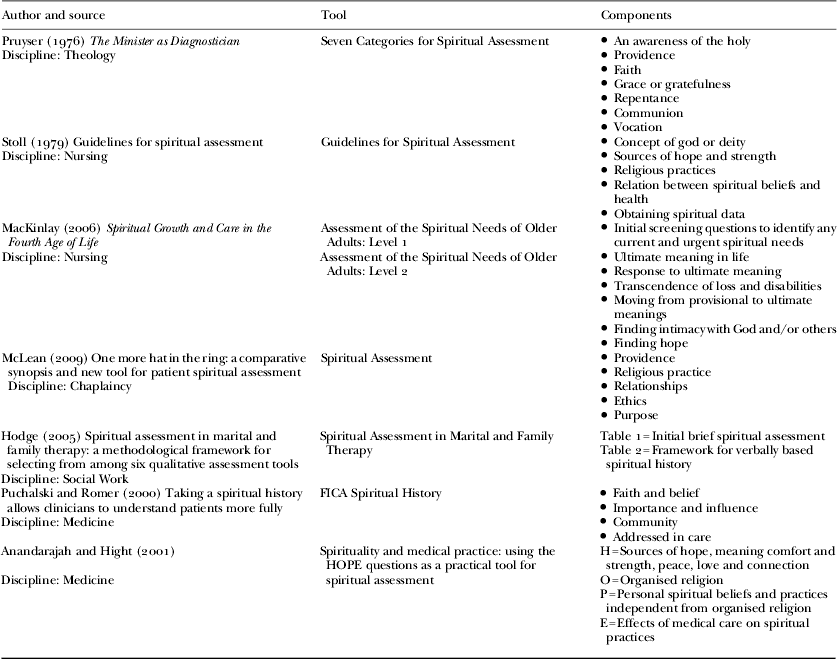
A review of the literature reveals that the term ‘spiritual assessment’ has been used in a variety of ways. Puchalski includes three aspects, namely a ‘spiritual history, screening or assessment’ (2010: 54). In her view, a screening is a triage or a quick determination of whether a person is experiencing a serious spiritual crisis, indicating that a referral to a chaplain should immediately follow. She argues that the spiritual history is the process of interviewing a patient and asking questions with a view to understanding their needs and resources. The goal of the spiritual history is to allow the health-care provider (her term used is ‘clinician’) to incorporate spiritual care into the patient's overall care plan. The information obtained from the history taking allows the clinician to understand how spiritual concerns could complement or complicate the patient's overall care (Puchalski Reference Puchalski2010: 54). For those conducting a spiritual history, Puchalski offers the FICA Spiritual History Tool.
Puchalski's (Reference Puchalski2010) final aspect, a spiritual assessment, involves a more extensive in-depth and ongoing process of active listening to a patient's story that should be undertaken by a professional chaplain who then summarises the patient's needs and this information should then be communicated to the treatment team. In this case, she argues, the major models are not built on a set of questions employed in an interview but rather via the use of ‘interpretive frameworks’ based on listening to the patient's story.
An alternative view from the discipline of social work under the rubric of ‘spiritual assessment in marital and family therapy’ aims to ‘acquaint therapists with a variety of assessment tools and how to select from among them’ (Hodge Reference Hodge2005: 342). He uses the term ‘spiritual assessment’ to describe five tools to help gather information regarding an individual's spiritual needs.
Firstly, Hodge offers spiritual histories where this method is ‘analogous to conducting a family history’ (2005: 344). Initially, a brief spiritual assessment is used to clarify issues of religion and/or spirituality, then he presents two question sets to guide the conversation and to provide some prompts to help clients tell their stories. His second tool is a spiritual lifemap, described as a ‘diagrammatic alternative to verbally based spiritual histories’ (Hodge Reference Hodge2005: 344). These are used to sketch significant life events on paper that identify the path travelled and to help to plan for the future. The third tool offered is spiritual genograms that illustrate the ‘flow of spiritual patterns across at least three generations’ (Hodge Reference Hodge2005: 346), used to designate which individuals have played major spiritual roles. Spiritual ecomaps are the fourth tool offered by Hodge, and these are similar to the former genograms but ‘focus on that portion of a family's spiritual story that exists in space (2005: 347). Hodge's fifth tool is identified as spiritual ecograms that depict the connections between past and present functioning; these ‘combine the assessment strengths of spiritual ecomaps and genograms in a single assessment approach’ (2005: 348).
Regardless of the tool used, the purpose of making a spiritual assessment is to recognise possible spiritual needs. According to Brennan and Heiser (Reference Brennan, Heiser, Brennan and Heiser2012), assessment tools may include a variety of modalities that obtain information about a person's spiritual wellbeing, history, crises or dilemmas. They also provide a base to assist in determining any spiritual distress. Such assessments are used to guide pastoral care and/or interventions and to determine whether or not spiritual beliefs may be enlisted as an additional personal resource for dealing with issues at hand (Brennan and Heiser Reference Brennan, Heiser, Brennan and Heiser2012). In addition, Higginbotham and Marcy suggest it ‘is the first step in addressing a patient's spiritual needs’ (2006: 171).
The literature on spiritual assessments can be drawn from the practice bases of psychology (Fowler Reference Fowler1981), social work (Hodge Reference Hodge2001), pharmacy (Higginbotham and Marcy Reference Higginbotham and Marcy2006), medicine (Puchalski and Romer Reference Puchalski and Romer2000), with one of the first articles coming from the discipline of nursing (Stoll Reference Stoll1979). Many of these research studies followed the publication of a landmark volume within theology (Pruyser Reference Pruyser1976). When used correctly, these tools should be followed by an integration of that information into the clinical care plan (Puchalski Reference Puchalski2010) and act as a guide to what is considered important to an individual.
McLean (Reference McLean2009) and Harrington (Reference Harrington2006) argue that when making a spiritual assessment it is crucial to take the cues from the patient and not impose one's own spiritual or religious values, regardless of either individual's religious tradition. This aspect should be considered important for health-care practitioners where a power differential between patients and providers often exists and it remains crucial to recognise ‘proselytizing is not ethical in the clinical encounter’ (Puchalski Reference Puchalski2010: 56). In this case, Brennan and Heiser caution against ‘spiritual abuse’ highlighting that:
Spiritual assessments are designed to help identify individuals who need assistance in the expression of spirituality or who are having issues related to spiritual well-being … they are not used to impose values, beliefs or practices on another, rather spiritual is very personal and may or may not be connected with religious expression. (2012: 7)
Conceptual models for spiritual assessment
Rather than creating new instruments for spiritual assessment, it is prudent to build on prior work (Cohen et al. Reference Cohen, Holley, Wengel and Katzman2012). The following represent tools drawn from the disciplines of theology, nursing, chaplaincy, social work and medicine – all are qualitative assessment tools in that they are based on interview. Examples of quantitative tools also exist and these measure spiritual wellbeing (Paloutzian and Ellison Reference Paloutzian, Ellison, Paplau and Perlman1982), spiritual beliefs (Holland et al. Reference Holland, Kash, Passik, Gronert, Sison, Lederberg and Fox1998), functional assessment of chronic illness therapy–spiritual wellbeing (Peterman et al. Reference Peterman, Fitchett, Brady, Hernandez and Cella2002), spiritual development (Hall and Edwards, Reference Hall and Edwards2002) and spiritual needs (Sharma et al. Reference Sharma, Astrow, Texeira and Sulmasy2012).
In an argument for the use of qualitative assessment tools, Hodge claims ‘quantitative instruments presuppose a certain construction of reality and in the process leave little room for clients to negotiate a shared understanding of individual experience’ (2001: 204). McSherry (Reference McSherry2007), in his review of international studies into spirituality, located 36 studies that included original research, dissertations and theses. His review identified 23 international studies that used qualitative methodologies, ten that used quantitative approaches, with three using a mixed-method approach. In asking the question as to why there were more qualitative studies, he suggests:
Perhaps one explanation for this disparity in research methods, might stem from the deeply subjective and personal nature of spirituality, which means that some form of rapport needs to be established between the research and the participant. This can be hard to achieve in several forms of quantitative research: for example, survey methods that employ questionnaires. (McSherry Reference McSherry2007: 75)
A ‘one size fits all approach’ should not be considered for spiritual assessment as ‘some of the difficulties in applying a standardised approach to assessing spirituality include the idiosyncratic and personal nature of spirituality’ (Brennan and Heiser Reference Brennan, Heiser, Brennan and Heiser2012: 5). Further, the majority of spiritual assessment tools available are based on a dialogue between health-care providers and patients. In the case of those unable to communicate (as in the case of palliative care patients at the end of life) or older adults with cognitive deficits, these tools have some limitations. They do, however, provide guidance for the novice (Harrington Reference Harrington and MacKinlay2010). It is therefore of benefit that the health-care providers locate a tool that can be used in their particular setting.
A simple search of an electronic database using the words ‘spiritual assessment’ retrieved many tools. Given the variety of published tools, the following are by no means exhaustive and represent a small sample of those that can be used in practice. Table 1 offers only a brief synopsis of the entire assessment tool. The reader is encouraged to retrieve the citation in full to view the questions that are used in each tool.
Spiritual assessment tools

Once a spiritual assessment has been made using a designated tool, ‘spiritual interventions’ (also known as spiritual care) can be offered. These interventions can comprise any programmes, policies, procedures or protocols that address the spiritual needs of the individual. They can be described as any ‘activities that strengthen, reinforce or promote the spiritual and religious resources of individuals, or that utilise existing spiritual resources present in the individual to address wellbeing and needs regarding spirituality’ (Brennan and Heiser Reference Brennan, Heiser, Brennan and Heiser2012: 4).
Allowing consumers and patients to communicate their spiritual concerns could be seen as a spiritual intervention (Brennan and Heiser Reference Brennan, Heiser, Brennan and Heiser2012), but this may also have a therapeutic effect (Harrington Reference Harrington2012). Spiritual care within any setting can include giving the patient/consumer the opportunity to make their concerns known and these may be particularly evident prior to or following surgery, after the delivery of a poor diagnosis, whenever fear or discouragement appear, or when specifically requested (Brennan and Heiser Reference Brennan, Heiser, Brennan and Heiser2012). The challenge for the health-care provider is to be alert to these cues.
Conclusion
It has been argued here that there is a growing body of literature highlighting the positive effects of religiousness and spirituality on human health. Government policy acknowledges this connection, as has palliative care, particularly when caring for older adults, and this acknowledgement directs health professionals to undertake a spiritual assessment. However, the professional literature of numerous disciplines is rife with verbal definitions surrounding the area of spirituality that may lead to confusion when considering a spiritual assessment.
This paper clarifies a number of terms presented in the literature and argues for the need to undertake a spiritual assessment. A variety of tools from various disciplines is offered to assist in this task and the use of these tools will assist health-care providers in their mandate to provide holistic care to all age groups.