Introduction
Recently, pine wilt disease (PWD), caused by the pinewood nematode (PWN) Bursaphelenchus xylophilus (Steiner and Buhrer) Nickle, has become a major threat to the European forests, with an estimated mortality risk of 50%. In Portugal, PWN was first detected in 1999 (Mota et al., Reference Mota, Braasch, Bravo, Penas, Burgermeister, Metge and Sousa1999), and in 2008, the entire continental Portugal was demarcated as PWN-infested. Its insect vector is Monochamus galloprovincialis and, once infected, most plants cease resin production and show the symptoms of needle chlorosis. Infection usually becomes a fatal condition in just a few months (Fukuda, Reference Fukuda1997). However, it is not known how the involved genes are regulated in trees with differential disease resistance after attack by nematodes with varying degrees of virulence (Kosaka et al., Reference Kosaka, Aikawa, Ogura, Tabata and Kiyohara2001; Kuroda et al., Reference Kuroda2004). Thus, a targeted gene expression approach was taken in order to investigate the infection mechanisms in commercially important pine species, namely P. sylvestris, which is the most threatened species in northern/central Europe, P. nigra and P. pinaster, that are being affected in the central/southern areas and P. pinea that is thought to be resistant to the infection (OEPP/EPPO, 2001). Symptoms of infection with a virulent strain of PWN (HF, isolated from Setúbal, Portugal) and with an avirulent strain (C14-5, described by Takehushi et al., Reference Takehushi, Kanzaki and Futai2006) were also monitored and evaluated.
Materials and methods
Seeds of P. pinaster, P. pinea, P. sylvestris and P. nigra were sterilized, germinated in 1% water agar (Agar no. 1, Lab M) and incubated for 2 weeks at 25°C, with a photoperiod of 8 h light–16 h dark. Once germinated, seedlings were individually incubated vertically for 4 months under the same conditions described earlier and supplied with 10 ml of nutritive solution Murashige and Skoog basal medium (Sigma).
B. xylophilus strains were grown on barley seeds with Botrytis cinerea at 26°C, in the dark, and extracted using the Baermann funnel technique. A total of 20 seedlings of each pine species were inoculated with 500 avirulent or virulent nematodes in a 100 μl sterile water suspension (Asai and Futai, Reference Asai and Futai2002).
To evaluate the genetic expression, samples were taken at 0, 10 and 20 d after inoculation and stored at − 80°C. Total RNA was extracted according to Le Provost et al. (Reference Le Provost, Herrera, Paiva, Chaumeil, Salin and Plomion2007) and purified with Turbo DNA-free kit (Applied Biosystems, Foster city, CA, USA), according to the manufacturer's instructions. Gene expression was determined using 100 ng of RNA, with the conditions and program presented in Supplementary Table S1 (available online only at http://journals.cambridge.org), using an MJ Mini Gradient Thermal Cycler (Bio-Rad Laboratories, PA, USA). The gene 18S was used as internal control.
Scanning electron microscope was used to examine the morphology of P. pinea and P. pinaster stems. Thin, manual cuts were made with a scalpel. Each sample was attached to a support with double-sided duct tape and placed in a desiccator until the samples were dehydrated. Samples were analysed following the user manual of SEM JSM5600LV, operating at 20 kV.
Results and discussion
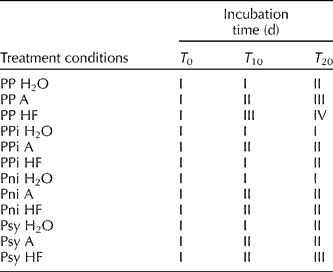
Symptoms of disease were only detected 10 d after inoculation. P. pinea and P. nigra seem less susceptible to the infection since their symptoms did not develop beyond stage II; P. pinaster appears to be the most susceptible species, as some seedlings died 20 d after the inoculation. Also, inoculation with the avirulent nematode resulted in seedlings with some degree of needle discolouration. (Table 1) These differences of infection may be due to the blocking of the vascular system with resin produced by cells from radial parenchyma, which are damaged by the nematode, resulting in needle chlorosis and plant death some time after infection (Jones et al., Reference Jones, Moens, Mota, Li and Kikuchi2008).
Development of symptoms in P. pinaster (PP), P. pinea (PPi), P. nigra (Pni), P. sylvestris (Psy), before (T 0), and 10 (T 10) and 20 d (T 20) after inoculation with sterile water (H2O), avirulent strain (A) and virulent strain (HF)

I, Healthy plant; II, partial needle discolouration; III, partial needle discolouration, necrosis and reduction in the resin production; IV, total discolouration, necrosis and seedling death.
Anatomical differences among genotypes might be on the basis of differential resistance to PWN, therefore P. pinaster and P. pinea were examined with scanning electron microscope (SEM). Visual inspection of the resulting photographs (Fig. 1) indicates that the round shape of the stem is better maintained in P. pinea than in P. pinaster after manual cross-sectioning. This may be due to higher lignin content in P. pinea and may be related to increased resistance to PWD in this species. Lignin has a recognized role in plant defence, and constitutive lignin has already been related with defensive mechanisms against nematodes in other species (Fogain and Gowen, Reference Fogain and Gowen1996). Experiments regarding lignin quantification are ongoing. Furthermore, the diameter in cortical resin ducts seems larger in P. pinaster stem. This may contribute to the susceptibility of this genotype to PWD, since PWNs progress inside the plant through resin ducts (Fukuda, Reference Fukuda1997). Increased number and diameter of resin ducts have already been associated with PWD susceptibility (Kawaguchi, Reference Kawaguchi2006).
SEM imaging of P. Pinea (a) and P. pinaster (b) stem cross-sections showing morphological differences between the two species. E, epidermis; C, cortex; RD, resin duct; PH, phloem; X, xylem; P, pith.

Biotic and abiotic factors stimulate the plant's defence response, diminishing the negative impacts of the pathogenic attack. The genes of interest tested in this work were found to be associated to osmotic stress, oxireductive processes and cell death, among others, which are important in the defence response of P. densiflora (Japanese Red Pine) against the nematode (Shin et al., Reference Shin, Lee, Woo, Noh, Koo and Lee2009).
Pathogenesis-related proteins 4 expression was detected in all treatments (Supplementary Figs. S1–S4, available online only at http://journals.cambridge.org). PR proteins are induced as response to pathogen attacks (Osmond et al., Reference Osmond, Hrmova, Fontaine, Imberty and Fincher2001) and can be factors of hypersensitive response to nematode infection (Meins and Ahl, Reference Meins and Ahl1989; Shin et al., Reference Shin, Lee, Woo, Noh, Koo and Lee2009). ATTRX1, a protective gene against oxidative stress, was also expressed in all treatments and pine tree species (Supplementary Figs. S1–S4, available online only at http://journals.cambridge.org), suggesting that different types of defences may be activated. There is a reported relationship between metallothionein being expressed in the presence of intensive oxidative stress (Mir et al., Reference Mir, Demenech, Huguet, Guo, Goldsbrough, Atrian and Molinas2004).
Ethylene is an important component of conifer response against pathogens (Miller et al., Reference Miller, Madilao, Ralph and Bohlmann2005), hence it can induce cell defence. In P. pinaster (Supplementary Fig. S1, available online only at http://journals.cambridge.org), the expression of MAT2/SAM2 (ethylene production) was only detected at the end of 20 d, which in the case of virulent B. xylophilus treatment corresponded to plant death; in P. pinea (Supplementary Fig. S2, available online only at http://journals.cambridge.org), the inoculations with both avirulent and virulent nematodes originated the same type of response as water-inoculated plants (control). On the other hand, in seedlings of P. nigra (Supplementary Fig. S3, available online only at http://journals.cambridge.org), MAT2/SAM2 and SHEPERD (water reduction) gene expression was only verified in nematode-inoculated plants. This can be explained by the increasing release of volatile compound production, which alters water transportation (Jones et al., Reference Jones, Moens, Mota, Li and Kikuchi2008). Finally, P. sylvestris seedlings (Supplementary Fig. S4, available online only at http://journals.cambridge.org) demonstrated that virulent strains of B. xylophilus did not cause any MAT2/SAM2 gene expression.
It must be noted that some of the primers used (Supplementary Table S2, available online only at http://journals.cambridge.org) were not specifically designed for the species in question. Thus, it could explain the absence of genes that normally would be expressed. Also, plant mechanisms vary during the time of a day, so the time when the sampling was made may also have influenced the results.
This is the first report of inoculations with virulent and avirulent B. xylophilus strains in various pine species, and though infection mechanisms of both PWN were not clear, this study suggests that inoculation with virulent nematode can trigger a phased systemic response that differs from the avirulent strain. However, it is necessary to identify other factors that may be responsible for the plant defence when it is attacked by the different pathogens.
Acknowledgements
The authors would like to thank the help of Dr. Manuel Mota (Universidade de Évora, Portugal) for providing the HF nematode strain, and Dr. Hajime Kosaka (Kyushu Research Center Forestry and Forest Products Research Institute, Kumamoto, Japan) and Dr. Mitsutera Aikida (Forestry and Forest Products Research Institute, Tsukuba, Japan) for providing the C14-5 nematode strain.