


%20--%3e%3c!DOCTYPE%20svg%20PUBLIC%20'-//W3C//DTD%20SVG%201.0//EN'%20'http://www.w3.org/TR/2001/REC-SVG-20010904/DTD/svg10.dtd'%3e%3csvg%20version='1.0'%20id='Layer_1'%20xmlns='http://www.w3.org/2000/svg'%20xmlns:xlink='http://www.w3.org/1999/xlink'%20x='0px'%20y='0px'%20width='64px'%20height='64px'%20viewBox='5.5%20-3.5%2064%2064'%20enable-background='new%205.5%20-3.5%2064%2064'%20xml:space='preserve'%3e%3cg%3e%3ccircle%20fill='%23FFFFFF'%20fill-opacity='0'%20cx='37.785'%20cy='28.501'%20r='28.836'/%3e%3cpath%20fill='%23595959'%20d='M37.441-3.5c8.951,0,16.572,3.125,22.857,9.372c3.008,3.009,5.295,6.448,6.857,10.314%20c1.561,3.867,2.344,7.971,2.344,12.314c0,4.381-0.773,8.486-2.314,12.313c-1.543,3.828-3.82,7.21-6.828,10.143%20c-3.123,3.085-6.666,5.448-10.629,7.086c-3.961,1.638-8.057,2.457-12.285,2.457s-8.276-0.808-12.143-2.429%20c-3.866-1.618-7.333-3.961-10.4-7.027c-3.067-3.066-5.4-6.524-7-10.372S5.5,32.767,5.5,28.5c0-4.229,0.809-8.295,2.428-12.2%20c1.619-3.905,3.972-7.4,7.057-10.486C21.08-0.394,28.565-3.5,37.441-3.5z%20M37.557,2.272c-7.314,0-13.467,2.553-18.458,7.657%20c-2.515,2.553-4.448,5.419-5.8,8.6c-1.354,3.181-2.029,6.505-2.029,9.972c0,3.429,0.675,6.734,2.029,9.913%20c1.353,3.183,3.285,6.021,5.8,8.516c2.514,2.496,5.351,4.399,8.515,5.715c3.161,1.314,6.476,1.971,9.943,1.971%20c3.428,0,6.75-0.665,9.973-1.999c3.219-1.335,6.121-3.257,8.713-5.771c4.99-4.876,7.484-10.99,7.484-18.344%20c0-3.543-0.648-6.895-1.943-10.057c-1.293-3.162-3.18-5.98-5.654-8.458C50.984,4.844,44.795,2.272,37.557,2.272z%20M37.156,23.187%20l-4.287,2.229c-0.458-0.951-1.019-1.619-1.685-2c-0.667-0.38-1.286-0.571-1.858-0.571c-2.856,0-4.286,1.885-4.286,5.657%20c0,1.714,0.362,3.084,1.085,4.113c0.724,1.029,1.791,1.544,3.201,1.544c1.867,0,3.181-0.915,3.944-2.743l3.942,2%20c-0.838,1.563-2,2.791-3.486,3.686c-1.484,0.896-3.123,1.343-4.914,1.343c-2.857,0-5.163-0.875-6.915-2.629%20c-1.752-1.752-2.628-4.19-2.628-7.313c0-3.048,0.886-5.466,2.657-7.257c1.771-1.79,4.009-2.686,6.715-2.686%20C32.604,18.558,35.441,20.101,37.156,23.187z%20M55.613,23.187l-4.229,2.229c-0.457-0.951-1.02-1.619-1.686-2%20c-0.668-0.38-1.307-0.571-1.914-0.571c-2.857,0-4.287,1.885-4.287,5.657c0,1.714,0.363,3.084,1.086,4.113%20c0.723,1.029,1.789,1.544,3.201,1.544c1.865,0,3.18-0.915,3.941-2.743l4,2c-0.875,1.563-2.057,2.791-3.541,3.686%20c-1.486,0.896-3.105,1.343-4.857,1.343c-2.896,0-5.209-0.875-6.941-2.629c-1.736-1.752-2.602-4.19-2.602-7.313%20c0-3.048,0.885-5.466,2.658-7.257c1.77-1.79,4.008-2.686,6.713-2.686C51.117,18.558,53.938,20.101,55.613,23.187z'/%3e%3c/g%3e%3c/svg%3e)
%20--%3e%3c!DOCTYPE%20svg%20PUBLIC%20'-//W3C//DTD%20SVG%201.0//EN'%20'http://www.w3.org/TR/2001/REC-SVG-20010904/DTD/svg10.dtd'%3e%3csvg%20version='1.0'%20id='Layer_1'%20xmlns='http://www.w3.org/2000/svg'%20xmlns:xlink='http://www.w3.org/1999/xlink'%20x='0px'%20y='0px'%20width='64px'%20height='64px'%20viewBox='5.5%20-3.5%2064%2064'%20enable-background='new%205.5%20-3.5%2064%2064'%20xml:space='preserve'%3e%3cg%3e%3ccircle%20fill='%23FFFFFF'%20fill-opacity='0'%20cx='37.637'%20cy='28.806'%20r='28.276'/%3e%3cg%3e%3cpath%20fill='%23595959'%20d='M37.443-3.5c8.988,0,16.57,3.085,22.742,9.257C66.393,11.967,69.5,19.548,69.5,28.5c0,8.991-3.049,16.476-9.145,22.456%20C53.879,57.319,46.242,60.5,37.443,60.5c-8.649,0-16.153-3.144-22.514-9.43C8.644,44.784,5.5,37.262,5.5,28.5%20c0-8.761,3.144-16.342,9.429-22.742C21.101-0.415,28.604-3.5,37.443-3.5z%20M37.557,2.272c-7.276,0-13.428,2.553-18.457,7.657%20c-5.22,5.334-7.829,11.525-7.829,18.572c0,7.086,2.59,13.22,7.77,18.398c5.181,5.182,11.352,7.771,18.514,7.771%20c7.123,0,13.334-2.607,18.629-7.828c5.029-4.838,7.543-10.952,7.543-18.343c0-7.276-2.553-13.465-7.656-18.571%20C50.967,4.824,44.795,2.272,37.557,2.272z%20M46.129,20.557v13.085h-3.656v15.542h-9.944V33.643h-3.656V20.557%20c0-0.572,0.2-1.057,0.599-1.457c0.401-0.399,0.887-0.6,1.457-0.6h13.144c0.533,0,1.01,0.2,1.428,0.6%20C45.918,19.5,46.129,19.986,46.129,20.557z%20M33.042,12.329c0-3.008,1.485-4.514,4.458-4.514s4.457,1.504,4.457,4.514%20c0,2.971-1.486,4.457-4.457,4.457S33.042,15.3,33.042,12.329z'/%3e%3c/g%3e%3c/g%3e%3c/svg%3e)
Introduction
Antimicrobial resistance (AMR) has emerged as one of the most pressing global public health threats, with bacterial AMR directly responsible for 1.27 million deaths globally in 2019. 1 In response, Antimicrobial Stewardship (AMS) has become a critical strategy to promote responsible antimicrobial use and preserve therapeutic effectiveness for future generations.
The concept of stewardship emerged in the 1990s when AMR levels in hospitals became impossible to ignore. Reference McGowan and Gerding2,Reference Charani and Holmes3 Formal establishment occurred with published guidelines from the Society for Healthcare Epidemiology of America and Infectious Diseases Society of America. Reference Charani and Holmes3,Reference David, Dale and Joseph4 These guidelines set the foundation for global adoption of AMS principles, now guided by frameworks such as the World Health Organization’s (WHO) Global Action Plan on AMR. 5
In New Zealand (NZ), while AMR rates are lower compared to regions such as South-East Asia, 6 elevated antimicrobial consumption remains concerning. Between 2005 and 2012, annual per capita antimicrobial consumption increased by 43% in community-based patients, with NZ demonstrating one of the highest community antibiotic use rates globally by 2015. Reference Thomas, Smith and Tilyard7,Reference Thomas8 Community antibiotic consumption comprises 95% of all antibiotic use in NZ. Reference Duffy, Ritchie, Metcalfe, Van Bakel and Thomas9
The NZ Antimicrobial Resistance Action Plan was released in 2017, followed by AMS guidelines developed by the Best Practice Advocacy Centre (bpacnz). 10,Reference Bpac11 While AMS pharmacists are well-established in hospital settings, with Antimicrobial Stewardship committees operating in NZ District Health Boards, Reference Gardiner, Pryer and Duffy12 dedicated outpatient or community-based stewardship pharmacist roles are not formally established in NZ. Unlike hospital settings where AMS pharmacists have defined positions within multidisciplinary teams, community pharmacists currently integrate AMS activities informally within their routine practice without specific role delineation or dedicated time allocation. The role of community pharmacists in AMS efforts remains largely unexplored in local literature.
The NZ community pharmacy landscape comprises approximately 1,100 pharmacies nationwide serving a population of 5.3 million. 13,Reference Stats14 The community pharmacy sector comprises predominantly independent pharmacies or those owned by small enterprises (57%), franchise-based chains (approximately 30%), and an expanding supermarket-based segment (13%). 15 Regardless of ownership model, all community pharmacies operate under the same regulatory framework and professional standards, with pharmacists maintaining a consistent scope of practice across settings. However, access to patient health records varies by ownership model and IT infrastructure, with corporate chains often having more integrated systems while independent pharmacies may face greater barriers to electronic health record access.
Community pharmacists, being the most accessible healthcare professionals, are strategically positioned to contribute to AMS through prescription screening, patient education, and collaboration with prescribers. Reference Williamson, Roberts, Ritchie, Coombs, Fraser and Heffernan16 International studies demonstrate varied knowledge, perceptions, and practices among community pharmacists regarding AMS, Reference Saha, Kong, Thursky and Mazza17–Reference Inayat Ur, Malik and Allah25,Reference Akande-Sholabi, Oyesiji and Adebisi26–Reference Lee and Bradley34 but no research has investigated this specifically in the NZ context. Common barriers identified internationally include a lack of access to patient records, limited collaboration with prescribers, time constraints, and inadequate training. Reference Saha, Kong, Thursky and Mazza17–Reference Rizvi, Thompson, Williams and Zaidi20,Reference Atif, Asghar, Mushtaq and Malik24,Reference Al-Shami, Abubakar, Hussein, Hussin and Al-Shami27–Reference Jones, Owens and Sallis30,Reference Lee and Bradley34
This study aimed to fill the information gap by investigating NZ community pharmacists’ knowledge of AMR and appropriate antimicrobial use, their attitudes toward AMS, and their role in combating AMR, current AMS practices, and barriers to effective implementation.
Methods
Study design and participants
This quantitative research employed a cross-sectional survey design using a self-administered questionnaire distributed to community pharmacists nationwide between January 30 and March 27, 2025. Inclusion criteria required participants to be NZ-registered community pharmacists.
Survey design
The questionnaire was developed through international literature review Reference Rizvi, Thompson, Williams and Zaidi19,Reference Akande-Sholabi, Oyesiji and Adebisi26,Reference Al-Shami, Abubakar, Hussein, Hussin and Al-Shami27,Reference Pawluk, Black and El-Awaisi31,Reference Darwish, Baqain, Aladwan, Salamah, Madi and Masri33,Reference Lee and Bradley34,Reference Khan, Hassali, Ahmad, Elkalmi, Zaidi and Dhingra36,Reference Hafez, Rakab and Elshehaby39–Reference Abubakar and Tangiisuran41 and piloted with School of Pharmacy Professional Practice Fellows (n = 2) and three community pharmacists. The final survey consisted of 40 questions across five sections:
-
1. Demographics (7 items)
-
2. Knowledge of AMR and antibiotic use (8 items, 3-point Likert scale: always, sometimes, never)
-
3. Attitudes and perceptions toward AMS and AMR (7 items, 5-point Likert scale: strongly disagree to strongly agree)
-
4. AMS practices (8 items, 5-point Likert scale: never to always)
-
5. Barriers to AMS implementation (11 items: 10 structured questions with Yes/Maybe/No responses, plus one open-ended question)
Ethics approval
The study received ethics approval from the University of Otago Human Ethics Committee (Ref: 24/0700).
Data collection and recruitment
Following ethics approval, a list of registered pharmacist emails was obtained from the Pharmacy Council. The survey link was distributed via email and social media platforms. Reminder emails were sent fortnightly. An information sheet and poster with QR code were included. Participants could enter a draw to win a $150 Prezzy Card as an incentive.
Data analysis
Data were analysed using SPSS Version 22. Descriptive analyses (frequencies and percentages) were performed for perceptions and practices. For knowledge assessment, correct responses scored “1” and incorrect responses “0.” Total knowledge scores were calculated, with median scores and quartiles determined.
Inferential statistics (Mann-Whitney U and Kruskal-Wallis tests) compared knowledge, perceptions, and practices across demographic groups (gender, education level, years of experience, age range), accounting for non-normal data distribution. Statistical significance was set at P < .05.
The Relative Importance Index (RII) was calculated for barriers using the formula: RII = ΣW / (A × N), where W equals the weighting (1 = No, 2 = Maybe, 3 = Yes), A is the highest weight (3), and N is the total number of participants.
Content analysis was conducted on written responses, with themes identified and frequencies reported.
Results
Response rate and demographics
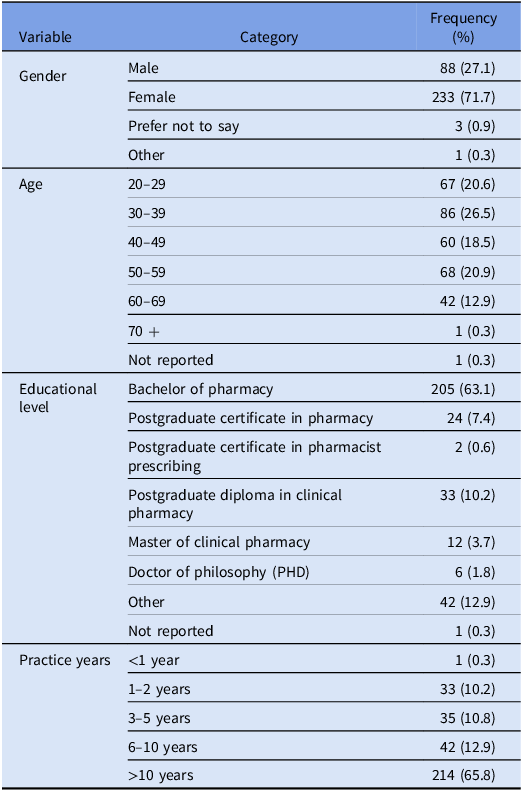
Of 3,226 pharmacists contacted, 412 responded. After excluding incomplete surveys (<90% completion), non-consenting respondents, and non-community pharmacists, 325 responses remained (response rate ∼ 10%). Demographics of the participants are presented in Table 1.
Demographic characteristics of surveyed community pharmacists

Knowledge
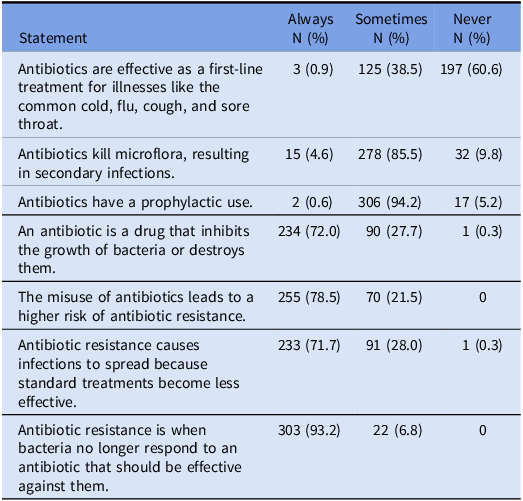
Almost all respondents (99.4%) had heard of AMR. The median knowledge score was 5 out of a maximum 7 points. The most common score was 6 (35.4% of respondents), with an interquartile range of 1 (Q1 = 5, Q3 = 6), indicating tightly clustered scores.
While most statements showed high correct response rates, notable gaps appeared for “Antibiotics are effective as a first-line treatment for illnesses like the common cold, flu, cough, and sore throat” where only 60.6% correctly answered “never” (Table 2).
Community pharmacists’ knowledge of AMR and antibiotic use

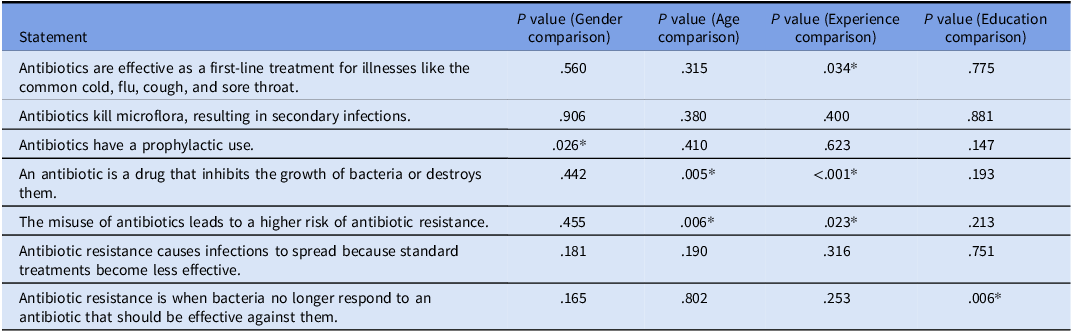
Significant differences emerged across demographic groups. Younger pharmacists (20–29 years) demonstrated higher knowledge scores compared to older cohorts (40–49, 50–59, 60–69 years). Experience comparisons showed those with 3–5 years were more likely to answer correctly about antibiotics for viral illnesses (P = .034). Gender differences appeared for “Antibiotics have a prophylactic use” (P = .026), with females more likely to report “always.” Education level significantly affected responses to “Antibiotic resistance is when bacteria no longer respond to an antibiotic” (P = .006) (Table 3).
Comparison of knowledge across demographic groups

*Statistically significant.
Perceptions
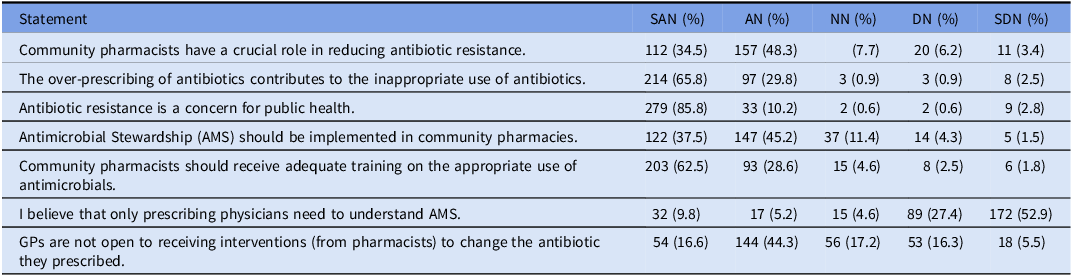
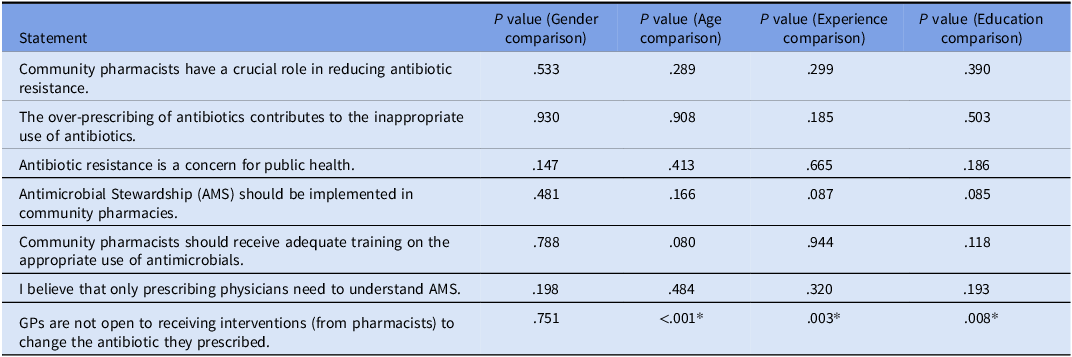
Strong positive perceptions were evident across most statements. The majority agreed that community pharmacists have a crucial role in reducing antibiotic resistance (82.8% somewhat/strongly agree), over-prescribing contributes to inappropriate use (95.6%), antibiotic resistance is a public health concern (96%), and AMS should be implemented in community pharmacies (82.7%). Most agreed (91.1%) that community pharmacists should receive adequate training on appropriate antimicrobial use (Table 4).
Community pharmacists’ perceptions of AMR and AMS

SA, strongly agree; A, agree; N, neutral; DA, disagree.
Few respondents (15%) believed only physicians need to understand AMS. However, 60.9% agreed that GPs are not open to receiving interventions from pharmacists. Significant variations across age groups (P < .001), experience (P = .003), and education (P = .008) indicated that older pharmacists, those with over 10 years experience, and those with postgraduate diplomas were more likely to disagree with this perception (Table 5).
Comparison of perceptions across demographic groups

*Statistically significant.
Practices
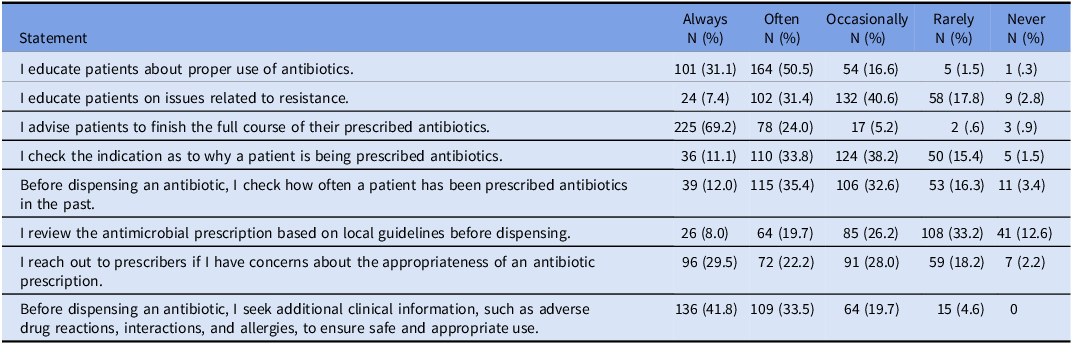
Patient education practices were generally strong. Most respondents (81.6%) always/often educated patients about proper antibiotic use, and 69.2% always advised finishing the full course. However, education on resistance issues was less consistent, with only 38.8% always/often doing so and 40.6% occasionally. Prescription review practices varied considerably. While 75.3% always/often sought additional clinical information before dispensing, only 44.9% always/often checked indications, and merely 27.7% always/often reviewed prescriptions against local guidelines. Before dispensing, 47.4% always/often checked past antibiotic prescribing frequency (Table 6).
Community pharmacists’ practices surrounding AMS

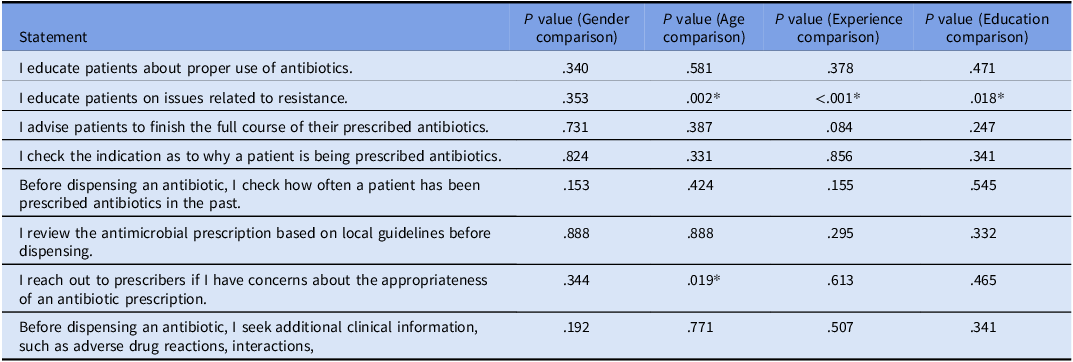
Significant age-related variation emerged (P = .019), with 60–69 year-olds less likely to contact prescribers compared to younger cohorts. Significant differences appeared for patient education on resistance. Younger pharmacists (20–29 years) rarely performed this compared to those aged 50–59 (P = .002). Those with over 10 years experience more often educated on resistance compared to those with 1–2 years (P < .001). Bachelor of Pharmacy holders were less likely to implement this practice compared to those with other qualifications (P = .018) (Table 7).
Comparison of perceptions across demographic groups

*Statistically significant.
Barriers
The Relative Importance Index ranked barriers. The top five barriers were:
-
1. Lack of time to appropriately implement AMS (RII = 0.866; 66.5% yes)
-
2. Lack of support and leadership from higher authorities (RII = 0.862; 64.3% yes)
-
3. Lack of staff numbers (RII = 0.831; 61.5% yes)
-
4. Lack of access to patient records (RII = 0.795; 54.2% yes)
-
5. Lack of financial incentives (RII = 0.777; 53.2% yes)
The lowest-ranked barriers were lack of pharmacist interest (RII = 0.533; 48.6% no) and lack of knowledge about AMS (RII = 0.645; 53.8% maybe).
Content analysis of 47 written responses identified key themes. Access to patient information emerged most frequently (14 responses), followed by patient knowledge and expectations (11), limited time and resources (11), and prescriber practices (11). Other themes included collaboration issues (7), guidelines (6), communication barriers (5), external factors (4), staffing issues (3), community versus hospital systems (2), and financial incentives (2).
Discussion
This study represents the first investigation of community pharmacists’ knowledge, perceptions, practices, and barriers regarding AMS implementation in NZ. The findings reveal that while community pharmacists possess strong knowledge and positive attitudes toward AMS, translation into consistent practice is hindered by structural and system-level barriers.
Community pharmacists demonstrated a solid knowledge foundation, with median scores in the mid-to-high range and a tight interquartile range, suggesting a consistent understanding of AMR and appropriate antibiotic use. These findings align with international studies showing generally good knowledge among community pharmacists. Reference Waseem, Ali and Sarwar23,Reference Atif, Asghar, Mushtaq and Malik24,Reference Akande-Sholabi, Oyesiji and Adebisi26,Reference Durand, Chappuis and Douriez29,Reference Darwish, Baqain, Aladwan, Salamah, Madi and Masri33,Reference Gillani, Shahwan and Szollosi38
However, confusion persisted regarding antibiotic effectiveness for conditions like colds, flu, cough, and sore throat, with only 60.6% providing correct responses. Similar results appeared in a Jordanian study where 56.1% correctly identified antibiotics as never treating viral respiratory infections. Reference Darwish, Baqain, Aladwan, Salamah, Madi and Masri33 This knowledge gap may stem from the ambiguity of sore throat, which can be bacterial (requiring antibiotics) or viral (not requiring antibiotics), particularly when listed alongside purely viral illnesses.
Younger pharmacists consistently achieved higher knowledge scores than older cohorts, likely reflecting more recent education exposure. This pattern appeared across multiple comparisons: 20–29 year-olds versus 50–59 year-olds for antibiotic definition (P = .005) and misuse leading to resistance (P = .006). Similarly, less experienced pharmacists (1–2 years, 6–10 years) outperformed those with over 10 years experience on several items. These findings suggest the current Bachelor of Pharmacy curriculum adequately addresses AMR and antibiotic use, but highlight the need for continuing education to maintain knowledge throughout pharmacists’ careers.
Strong positive perceptions emerged across the cohort. The overwhelming majority recognized community pharmacists’ crucial role in reducing antibiotic resistance (82.8%), the link between over-prescribing and inappropriate use (95.6%), AMR as a public health concern (96%), and the need for AMS implementation in community pharmacies (82.7%). These findings mirror international research demonstrating community pharmacists’ awareness of their potential AMS contributions. Reference Rizvi, Thompson, Williams and Zaidi19,Reference Rizvi, Thompson, Williams and Zaidi20,Reference Atif, Asghar, Mushtaq and Malik24,Reference Al-Shami, Abubakar, Hussein, Hussin and Al-Shami27–Reference Jones, Owens and Sallis30,Reference Saleh, Abu-Farha, Mukattash, Barakat and Alefishat32,Reference Haseeb, Essam Elrggal and Saeed Bawazir35–Reference Gillani, Shahwan and Szollosi38 However, a notable concern emerged: 60.9% believed GPs are not open to pharmacist interventions on antibiotic prescriptions. This perception varied significantly across groups, with late-career and middle-aged pharmacists more likely to disagree, possibly reflecting established professional relationships. Similar findings in Australian studies Reference Saha, Kong, Thursky and Mazza18–Reference Rizvi, Thompson, Williams and Zaidi20 suggest this barrier transcends national boundaries.
The perception of limited GP cooperation may significantly impact practice. If pharmacists anticipate rejection, they may avoid challenging questionable prescriptions, undermining AMS implementation. This barrier appears more attitudinal than structural, suggesting targeted interventions could improve collaboration.
A disconnect emerged between knowledge/perceptions and practices. While patient education on proper use (81.6% always/often) and finishing courses (69.2% always) was strong, education on resistance issues lagged (38.8% always/often, 40.6% occasionally). This contrasts with Jordanian findings where 59.7% always educated on both antibiotic use and AMR. Reference Darwish, Baqain, Aladwan, Salamah, Madi and Masri33 The NZ pattern suggests education focuses more on adherence than awareness.
Significant variations appeared across demographics. Younger and less experienced pharmacists were less likely to educate on resistance, despite higher knowledge scores. This paradox may reflect lower confidence in newer practitioners. Conversely, Bachelor of Pharmacy holders were less likely to provide resistance education compared to those with other qualifications, possibly indicating stronger AMS emphasis in postgraduate programs.
Prescription review practices showed considerable inconsistency. While 75.3% always/often checked clinical information, only 27.7% always/often reviewed prescriptions against local guidelines. Similar low guideline adherence appears internationally. Reference Netthong, Donsamak, John, Kane and Armani22,Reference Hafez, Rakab and Elshehaby39 Time constraints and limited patient record access likely contribute to this gap.
Prescriber communication varied widely (responses spread from always to rarely), with older pharmacists (60–69) less likely to always contact prescribers compared to younger cohorts (P = .019). This finding, juxtaposed with younger pharmacists perceiving less GP openness, suggests generational differences in confidence and approach. Australian research Reference Rizvi, Thompson, Williams and Zaidi20 found pharmacists more readily contacted GPs about interactions, allergies, and doses than appropriateness, while Jordanian pharmacists Reference Darwish, Baqain, Aladwan, Salamah, Madi and Masri33 more frequently questioned antibiotic choice, indicating varying confidence levels across settings.
Structural and system-level barriers, rather than knowledge deficits, emerged as the primary obstacles. Time constraints ranked highest (RII = 0.866), consistent with international findings, Reference Saha, Kong, Thursky and Mazza18,Reference Essilini, Pierre and Bocquier28,Reference Jones, Owens and Sallis30,Reference Saleh, Abu-Farha, Mukattash, Barakat and Alefishat32,Reference Lee and Bradley34 though contrasting with some Australian studies. Reference Rizvi, Thompson, Williams and Zaidi19,Reference Rizvi, Thompson, Williams and Zaidi20 This reflects the time-constrained nature of community pharmacy, where dispensing demands limit AMS engagement. Notably, lack of pharmacist interest ranked lowest (RII = 0.533), confirming motivation exists, but structural limitations prevent action.
Lack of support from higher authorities ranked second (RII = 0.862), highlighting absent guidance, mentorship, and AMS-specific community pharmacy guidelines. This mirrors international findings Reference Saleh, Abu-Farha, Mukattash, Barakat and Alefishat32,Reference Lee and Bradley34 and emphasizes that effective AMS implementation requires top-down policy support, not just individual pharmacist effort.
Limited patient record access ranked fourth (RII = 0.795) but dominated written responses (14 mentions), reflecting its practical impact despite moderate ranking. Unlike the complete lack of access reported internationally, Reference Saha, Kong, Thursky and Mazza18–Reference Rizvi, Thompson, Williams and Zaidi20,Reference Atif, Asghar, Mushtaq and Malik24,Reference Al-Shami, Abubakar, Hussein, Hussin and Al-Shami27–Reference Jones, Owens and Sallis30,Reference Lee and Bradley34 NZ pharmacists have some access, but systems are time-consuming, and information remains limited. This barrier directly connects to inconsistent prescription review practices.
Collaboration issues with prescribers, while not top-ranked, appeared frequently in written comments, aligning with international findings. Reference Saha, Kong, Thursky and Mazza18–Reference Rizvi, Thompson, Williams and Zaidi20,Reference Atif, Asghar, Mushtaq and Malik24,Reference Al-Shami, Abubakar, Hussein, Hussin and Al-Shami27–Reference Jones, Owens and Sallis30 Notably, written responses highlighted problematic prescriber practices—particularly prescribing antibiotics for viral infections due to patient demands. This theme, linked to patient knowledge and expectations, underscores the need for public education and the unique position of community pharmacists to monitor prescription appropriateness.
Financial incentives ranked fifth (RII = 0.777), though less emphasized than in some international contexts Reference Netthong, Donsamak, John, Kane and Armani22,Reference Saleh, Abu-Farha, Mukattash, Barakat and Alefishat32,Reference Hafez, Rakab and Elshehaby39 where pharmacy profits from antibiotic sales drive over-dispensing. The moderate ranking in NZ suggests financial concerns exist but are not primary drivers.
Knowledge and training deficits ranked lowest (RII = 0.645 and 0.761 respectively), contrasting sharply with findings from Libya Reference Al-Shami, Abubakar, Hussein, Hussin and Al-Shami27 and Qatar Reference Pawluk, Black and El-Awaisi31 where knowledge gaps were considered major barriers. This confirms NZ community pharmacists are well-educated and confident in their knowledge, with barriers lying elsewhere.
Implications and recommendations
Three key recommendations emerge:
Annual e-learning refresher courses: Given knowledge score differences across age and experience groups, mandatory yearly modules covering current policies, guidelines, and local AMR patterns would maintain knowledge throughout careers. This addresses knowledge decay in experienced pharmacists while keeping all practitioners current as AMS evolves.
Joint AMS training with prescribers: To address collaboration barriers and perceived GP resistance, annual interprofessional training sessions could include collaborative case reviews, discussions on prescribing/dispensing practices, and strategies for teamwork. This would strengthen professional relationships between pharmacists and prescribers, potentially increasing pharmacist confidence in interventions and prescriber receptiveness to collaboration.
Community pharmacy-specific AMS guidelines: The absence of tailored guidelines creates ambiguity about pharmacists’ AMS roles and may signal low priority. Developing clear, community-pharmacy-specific AMS guidelines would clarify expectations, support prescription review practices, provide legitimacy for pharmacist interventions, and demonstrate leadership support. Implementation requires top-down commitment but would address the second-ranked barrier directly.
Community pharmacists in NZ demonstrated strong knowledge of AMR and appropriate antibiotic use, coupled with positive perceptions of their role in AMS. However, translation into consistent practice is hindered by structural and system-level barriers rather than knowledge deficits. The primary obstacles—time constraints, lack of organizational support, staffing shortages, and limited patient record access—prevent motivated, knowledgeable pharmacists from fully implementing AMS activities.
These findings emphasize that improving AMS in community pharmacy requires addressing systemic issues through policy changes, resource allocation, and interprofessional collaboration. Development of community pharmacy-specific AMS guidelines, joint training programs with prescribers, and continuing education modules could substantially enhance AMS implementation. Community pharmacists are well-positioned and motivated to combat AMR; they require structural support to fulfil this potential.
Acknowledgements
The authors thank all community pharmacists who participated in this study.
Author contributions
Vachrisa Stevenson—Data collection, data analysis, manuscript preparation. Hasan Izzat Abdel Rahman—Manuscript preparation, manuscript review. Mudassir Anwar—Study conception, design, supervision of study process, manuscript review.
Financial support
The research did not receive financial support from profit or non-profit organizations.
Competing interests
All authors report no conflicts of interest relevant to this article.

 Open access

