Real-time language processing studies allow investigators to examine the unconscious mental representations and operations that are automatically invoked during the course of comprehension and the interaction of perceptual and linguistic processes (e.g., Tyler, Reference Trueswell and Tanenhaus1992). In this sense, native language proficiency requires an implicit, detailed understanding of the grammar of the language, including lexically specific knowledge about how words combine semantically and syntactically, all of which may be accessed during word recognition. Within psycholinguistic theorizing, it is assumed that a language user's implicit knowledge of lexical semantics, especially the knowledge of verbs, plays a central role in allowing for the rapid real-time interpretation of sentences. For instance, many theories of sentence processing assume that the recognition of a verb includes rapid activation of the semantic and syntactic specifications of the verb, including detailed semantic information associated with each argument (e.g., Carlson & Tanenhaus, Reference Carlson, Tanenhaus and Wilkins1988; MacDonald, Pearlmutter, & Seidenberg, Reference MacDonald, Pearlmutter and Seidenberg1994; Mauner & Koenig, Reference Mauner and Koenig2000; Trueswell & Tanenhaus, Reference Trueswell, Sekerina, Hill and Logrip1994). Such an assumption offers a straightforward way of explaining how listeners can, for example, anticipate upcoming referents in a sentence from verb information (e.g., anticipating reference to edible objects upon hearing eat in The boy will eat . . . , Altmann & Kamide, Reference Altmann and Kamide1999; Boland, Reference Boland2005) and rapidly resolve temporary syntactic ambiguities, based on verb specific semantic and syntactic knowledge (e.g., The man accepted/insisted the prize was . . .; Now tap/choose the doll with the . . .; Garnsey, Pearlmutter, Myers, & Lotocky, Reference Garnsey, Pearlmutter, Myers and Lotocky1997; Snedeker & Trueswell, Reference Sheng and McGregor2004). Particularly relevant to the current paper, even young children ages 3–5 years possess these sentence processing skills (see Trueswell & Gleitman, Reference Trueswell, Sekerina, Fernández and Clahsen2004, Reference Trueswell, Gleitman and Gaskell2007), such that children can use their knowledge of verb-specific semantic restrictions to anticipate upcoming referents (Fernald, Reference Fernald2004, as reported in Fernald, Zangl, Thorpe, Hurtado, & Williams, Reference Fernald, Zangl, Thorpe, Hurtado and Williams2006; Nation, Marshall, & Altmann, Reference Nation, Marshall and Altmann2003).
In this paper, we explore in some detail the verb-based anticipatory comprehension skills of children who have been diagnosed with specific language impairment (SLI). The question we ask is quite simple: when children with SLI hear active sentences, such as The boy will eat the cake, will they be able to access the meaning of the verb eat rapidly enough so as to anticipate possible themes of this verb? Typically developing children show such abilities, as evidenced by anticipatory eye movements to edible objects depicted on a computer display—eye movements that occur even before hearing the word cake (e.g., Fernald, Zangl, Portillo, & Marchman, Reference Fernald, Zangl, Portillo, Marchman, Sekerina, Fernandez and Clahsen2008). As we discuss below, hypotheses about the underlying cause of SLI make different predictions about the outcome of this test.
LINGUISTIC DEFICITS IN CHILDREN WITH SLI AND HYPOTHESES ABOUT THESE DEFICITS
Children with SLI exhibit significant language acquisition deficits while simultaneously showing normal abilities in other measures of cognition, such as nonverbal IQ (for a review, see Leonard & Deevy, Reference Leonard, Deevy, Traxler and Gernsbacher2006). Children with SLI characteristically produce syntactically simpler sentences, show deficits in their use and understanding of inflectional morphology such as verb tense and agreement, and show significant delays in lexical acquisition, especially verbs, relative to age-matched peers (e.g., Bishop, Reference Bishop1997; Leonard, Reference Leonard1998; Leonard & Deevy, Reference Leonard, Deevy, Traxler and Gernsbacher2006). These deficits are especially pronounced in younger children (ages 3–8 years) but are known to persist, sometimes quite severely, into adulthood (Clegg, Hollis, Mawhood, & Rutter, Reference Clegg, Hollis, Mawhood and Rutter2005).
Although there is a general consensus on the linguistic profile of SLI, there is considerable debate regarding the underlying cause or causes for these deficits. Broadly speaking, two classes of explanations exist in the literature. In one, language deficits of children with SLI stem from underlying processing deficits, either from a general slowing of mental computations or from more specific processing deficits associated with speech perception (e.g., Gathercole & Baddeley, Reference Gathercole and Baddeley1990; Joanisse & Seidenberg, Reference Joanisse and Seidenberg1998; Kail, Reference Kail1994; Miller, Kail, Leonard, & Tomblin, Reference Miller, Kail, Leonard and Tomblin2001). In contrast, other accounts of SLI assert the deficit is representational in nature, in that it stems from a malfunctioning of a hypothesized grammatical acquisition device, such that the grammatical representational system never fully matures to a state of recognizing obligatory aspects of tense or syntactic relations (e.g., Rice, Wexler, & Cleave, Reference Rice, Wexler and Cleave1995; van der Lely, Reference van der Lely1998, Reference van der Lely2005). From this view, the extended optional infinitive account (Rice & Wexler, Reference Rice and Wexler1996) and its last version, the extended unique checking constraint (UCC) account (Wexler, Reference Wexler1999) suggests that the locus of the deficit in children with SLI relates to an extended period of time optionally marking finiteness. On the other hand, van der Lely (Reference van der Lely1998) proposed the representation deficit for dependent relationships (van der Lely, Reference van der Lely1998) reformulated later in the computational grammatical complexity account (van der Lely, Reference van der Lely2005) to account for deficits in a subgroup of children with SLI, children with so-called grammatical SLI (G-SLI). According to these accounts, children with G-SLI have a deficit in the linguistic computational system such that they prefer more economic linguistic structures.
It is unlikely that a single root cause of SLI will be identified given the heterogeneity of SLI symptoms. Indeed, even leading figures in the study of SLI now acknowledge that none of the current theories of SLI adequately account for the deficit patterns (Leonard & Deevy, Reference Leonard, Deevy, Traxler and Gernsbacher2006). For instance, Kail (Reference Kail1994) and Miller et al. (Reference Miller, Kail, Leonard and Tomblin2001) provide compelling evidence that SLI children's button-pressing reaction times, are slowed compared to typically developing control children in a range of nonverbal and verbal tasks, lending some support to the generalized slowing hypothesis (Kail, Reference Kail1994). Under this view, a deficit in overall processing speed has cascading effects on speech perception, word learning, and language acquisition. Yet, this general account, or even a specific phonological processing account (Joanisse & Seidenberg, Reference Joanisse and Seidenberg1998), has difficulty explaining some of the systematic morphological deficits seen in SLI, such as the tendency in English for deficits of morphology to be linked more to verbs than to nouns. Likewise, representational theories are similarly challenged by the overall patterns of SLI. For instance, it is difficult for these accounts to explain the frequent comorbidity of phonological processing deficits in SLI that have been identified even in tasks that do not require extensive syntactic or semantic processing, such as nonword repetition (e.g., Coady & Evans, Reference Coady and Evans2008; Graf Estes, Evans, & Else-Quest, Reference Graf Estes, Evans and Else Quest2007; although see van der Lely, Reference van der Lely2005).
Attempts have been made to understand the relationship between processing and representational deficits in SLI by correlating individual differences in SLI processing abilities with their language deficits (e.g., Lahey, Edwards, & Munson, Reference Lahey, Edwards and Munson2001; Montomery & Windsor, Reference Montgomery and Windsor2007). For instance, in one of the largest individual differences studies, using 200 participants, Leonard et al. (Reference Leonard, Weismer, Miller, Francis, Tomblin and Kail2007) found that general processing speed and verbal working memory were separable factors across individuals, both of which contributed to predicting composite language test scores. However, this class of work provides only a coarse-grain picture of SLI language processing, because it relies on off-line measures of language use.
REAL-TIME PROCESSING APPROACH TO UNDERSTANDING SLI
The use of real-time measures of spoken language processing, particularly the so-called “visual world paradigm” (Tanenhaus, Spivey-Knowlton, Eberhard, & Sedivy, Reference Tanenhaus, Spivey-Knowlton, Eberhard and Sedivy1995), may offer a better picture of the linguistic processing abilities of children with SLI. With the advent of head-mounted and remote eye-tracking systems, it is now relatively easy to obtain a moment by moment record of where children and adults are looking as they hear sentences that describe their visual referent world (Trueswell, Reference Thordardottir and Ellis Weismer2008). Research using eye movements in this manner are now quite extensive (see the edited volumes by Ferreira & Henderson, Reference Ferreira, Henderson, Henderson and Ferreira2004; Trueswell & Tanenhaus, Reference Trueswell, Tanenhaus, Clifton, Frazier and Rayner2005; plus reviews by Tanenhaus & Trueswell, Reference Tanenhaus, Spivey-Knowlton, Eberhard and Sedivy2006; Trueswell & Gleitman, Reference Trueswell, Gleitman, Henderson and Ferreira2007; and references therein). This work has provided significant progress in understanding how humans dynamically process and represent language at multiple levels, including subphonemically (e.g., Dahan, Magnuson, Tanenhaus, & Hogan, Reference Dahan, Magnuson, Tanenhaus and Hogan2001; McMurray, Tanenhaus, & Aslin, Reference McMurray, Tanenhaus and Aslin2002; Salverda, Dahan, & McQueen, Reference Salverda, Dahan and McQueen2003), phonemically and lexically (e.g., Allopenna, Magnuson, & Tanenhaus, Reference Allopenna, Magnuson and Tanenhaus1998; Swingley, Reference Swingley2009), syntactically (e.g., Snedeker & Trueswell, Reference Snedeker and Trueswell2004; Spivey, Tanenhaus, Eberhard, & Sedivy, Reference Spivey, Tanenhaus, Eberhard and Sedivy2002; Trueswell, Sekerina, Hill, & Logrip, Reference Trueswell, Gleitman and Gaskell1999), and semantically and referentially (e.g., Altmann & Kamide, Reference Altmann and Kamide1999; Arnold, Brown-Schmidt, & Trueswell, Reference Arnold, Brown-Schmidt and Trueswell2007; Grodner, Klein, Carbary, & Tanenhaus, Reference Grodner, Klein, Carbary and Tanenhaus2010; Huang & Snedeker, Reference Huang and Snedeker2009).
Parallel studies of SLI real-time processing abilities could be quite illuminating; not only could direct comparisons be made between typical and atypical language processing development, but also the results could be evaluated within the sometimes highly articulated processing theories that exist in this literature. To date, however, relatively few behavioral studies have used real-time measures to investigate children with SLI (e.g., Ellis Weismer, Evans, & Hesketh, Reference Ellis Weismer, Evans and Hesketh1999; Marinis & van der Lely, Reference Marinis and van der Lely2007; Marshall & van der Lely, Reference Marshall and van der Lely2006, Reference Marshall and van der Lely2008; Montgomery, Reference Montgomery2000, Reference Montgomery2002; Montgomery & Leonard, Reference Leonard1998; Montgomery, Scudder, & Moore, Reference Montgomery, Scudder and Moore1990; Sabisch, Hahne, Glass, von Suchodoletz, & Friederici, Reference Sabisch, Hahne, Glass, von Suchodoletz and Friederici2006; Stark & Montgomery, Reference Spivey, Tanenhaus, Eberhard and Sedivy1995; van der Lely, Reference van der Lely2005) and only one has used the visual-world paradigm (i.e., a study of adolescents with SLI; McMurray, Samelson, Lee, & Tomblin, Reference McMurray, Samelson, Lee and Tomblin2010, discussed further below).
Of particular interest here are studies examining the ability of children with SLI to recognize words embedded within sentences. For instance, using a word-monitoring paradigm, Montgomery et al. (Reference Montgomery, Scudder and Moore1990), Stark and Montgomery (Reference Stark and Montgomery1995), and Montgomery, (Reference Montgomery2000, Reference Montgomery2002) have found that children with SLI (mean age approximately 8 years) are slower than their typically developing age-matched peers at recognizing words embedded in a sentence, suggesting that they have less efficient lexical retrieval abilities. In contrast, van der Lely and colleagues have found that, at least for those children with SLI with grammatical deficits (G-SLI), lexical retrieval is not slowed (Marinis & van de Lely, Reference Marinis and van der Lely2007). Using a cross-modal picture priming task, they found that children with G-SLI (10 years, 2 months [10;2]–17;2), when hearing filler-gap dependencies, reactivated filler antecedents upon hearing a verb, but failed to do so at the location of the syntactic gap. Although these data implicate syntactic deficits in SLI (although see also Hestvik, Schwartz, & Tornyova, Reference Hestvik, Schwartz and Tornyova2010), the findings also indicate that rapid retrieval of semantic information associated with a verb was unimpaired, thereby being inconsistent with the generalized slowing hypothesis. Using a gated word-recognition paradigm in which participants hear increasingly longer portions of a spoken word, Marshall and van der Lely (Reference Marshall and van der Lely2008) found that early aspects of verb recognition were not impaired in G-SLI children, although some differences were observed in later gate positions, which interacted with verb morphology.
These studies, although important and useful for the emerging picture of SLI processing, have some important limitations. In particular, these tasks require subjects to make overt responses, such as button-box responses, and reflect linguistic judgments that are not typical of real-time interpretation. In addition, these studies sometimes present subjects with discontinuous words, such as the snippets of linguistic input used in lexical gating tasks. These task properties could mask or even exaggerate SLI processing difficulties. The visual world eye tracking method offers some improvements, especially for the study of children with developmental disorders; spoken sentences can be used along with a near-continuous measure of a natural behavior (look at what is being talked about). The lack of an overt button-box response may be especially advantageous for the study of SLI, given findings from Schul, Stiles, Wulfeck, and Townsend (Reference Schul, Stiles, Wulfeck and Townsend2004), who report a dissociation in children with SLI between visual–motor responses, which are generally slowed, and visual–attentional shifting, which appears to be unimpaired. This finding draws into question the notion that all processing is slowed in SLI; it also leaves open the possibility that eye movement measures of SLI's spoken language processing abilities may not show the same sort of slowing and may instead provide a clearer picture of linguistic processing.
EXPERIMENTAL PROSPECTUS
Below we present three visual world eye tracking experiments that explore children with SLI's processing of spoken sentences in Spanish. The experiments focus on the ability to recognize verbs embedded in spoken sentences, as measured by children's use of verb information to predict upcoming constituents. Experiment 1 looked at the processing of simple transitive sentences containing a verb followed by a typical patient/theme (e.g., El niño recorta con cuidado el papel, The boy trims carefully the paper) in the presence of four depicted objects, only one of which satisfies the semantic restrictions of the verb recorta (e.g., paper, clock, fox, and dinosaur). In all cases an adverb intervened between the verb and the direct object to allow for an opportunity to see possible processing delays uncontaminated by the recognition of the direct object itself. Experiments 2 and 3 examined anticipatory processing when the patient/theme is atypical but still meets the semantic restrictions of the verb, for example, La niña peina siempre al gato (The girl always combs the cat.).
Past work shows that normal adults are able to use verb information to anticipate both typical and atypical verb constituents (Altmann & Kamide, Reference Altmann and Kamide1999; Boland, Reference Boland2005). For instance, Altmann and Kamide found that upon hearing The boy will eat . . ., participants were more likely to begin fixating a picture of a cake compared to other objects, all of which were inedible (e.g., a toy train and a ball). Boland (Reference Boland2005) found similar anticipatory processing even when the referent was atypical (e.g., following the Altmann & Kamide example, consider The boy will eat the broccoli in the presence of otherwise inedible objects). This latter finding rules out the possibility that the eye movements reflect simple word-association or lexical co-occurrence (eat-cake). Indeed, because Boland (Reference Boland2005) offered participants only 330 ms visual preview of the pictures prior to hearing the sentence, it is also unlikely that the results reflect a simple matching of the word (e.g., “eat”) to the restricted set of depicted referents. Instead, the findings suggest that when adults recognize a verb, the verb-specific semantic properties of its arguments (e.g., food/edible) are also activated and are used to guide a search for entities that satisfy these criteria (for how verb semantics can combine with situation-specific information to guide anticipatory processing, see also Kamide, Altmann, & Haywood, Reference Kamide, Altmann and Haywood2003).
Visual-world studies of children's verb-based anticipatory processing abilities have yielded similar results for 3-year-olds (Fernald et al., Reference Fernald, Zangl, Thorpe, Hurtado and Williams2006) and 11-year-olds (Nation et al., Reference Nation, Marshall and Altmann2003). Nation et al. (Reference Nation, Marshall and Altmann2003) found similar patterns for both skilled and less-skilled comprehenders, as assessed by measures of reading and vocabulary. However, these studies did not manipulate the typicality of the predicted constituents and used at least one second or more visual preview prior to hearing each utterance. This leaves open the possibility that children's performance might rely on factors other than verb-specific semantic restrictions, such as word association/lexical co-occurrence, rather than anticipatory semantic processing. Nevertheless, as we report below, typically developing children, as young as 3.5 years, show anticipatory processing remarkably similar to adults even for atypical patient/themes and even under conditions of no visual preview (which was the case for the present experiments). Thus, we strongly suspect that verb-based anticipatory processing is essentially adultlike in typically developing children in this age range.
Predictions for children with SLI are difficult to derive from existing theoretical accounts. Nevertheless, some general expectations from these accounts can be hypothesized. The generalized slowing hypothesis (Kail, Reference Kail1994) predicts that SLI children's anticipatory eye movements should, at the very least, be slowed relative to age-matched controls. For instance, the characteristic rise in proportion of looks to a target referent (e.g., the paper when hearing El niño recorta . . .) should be offset temporally compared to age-matched controls. Such a view may even predict very few anticipatory eye movements for children with SLI; in particular, the accumulation of several words in a spoken sentence may have a detrimental effect on semantic processing.
In contrast, representational accounts of SLI either make no predictions, or predict no slowing of anticipatory processing in children with SLI. The UCC account (Wexler, Reference Wexler1999) provides an explanation for the protracted tense marking omission in children with SLI in terms of UCC, a principle developed by Wexler within the minimalist program. As this theory's focus is on explaining the extended period of use of infinitive in SLI language production, it is difficult to use it to derive predictions about sentence comprehension. Based on the account, we might expect children with SLI to have difficulty understanding inflectional verb morphology. However, in the studies below, all critical stimuli used simple present-tense verbs in the third person singular, which can be considered as root infinitive in Spanish (see Sanz-Torrent, Serrat, Andreu, & Serra, Reference Sanz-Torrent, Badia, Serra, Pérez-Vidal, Juan-Garau and Bel2008). As such, difficulty understanding verb morphology would not be expected. The computational grammatical complexity account (van der Lely, Reference van der Lely2005) predicts that children with SLI have more difficulty in sentences that use complex word order. For instance, children with SLI are known to have difficulty comprehending sentences with noncanonical word order such as The boy is pointed at by the man compared to those with canonical word order such as The man is pointing at the boy (van der Lely, Reference Tyler1994, 1996; van der Lely & Harris, Reference van der Lely and Harris1990). Van der Lely suggests that sentence comprehension deficits in SLI is grounded in an underlying syntactic deficit that is only evident when children with SLI must employ knowledge of syntactic constraints and cannot depend on semantics or pragmatics. Because we use only canonical sentence–verb–object sentences in the present work, such an account would expect no slowing of anticipatory processing in children with SLI, but may expect children with SLI to show sensitivity to semantic typicality.
It is important to note, however, that some advocates of representational accounts have suggested that morphosyntactic/syntactic deficits may impact negatively and indirectly on the learning of verbs (van der Lely, Reference Tyler1994), because the syntactic environment of verbs is an important facilitator of verb learning (also known as syntactic bootstrapping; Gleitman, Reference Gleitman1990; Gillette, Gleitman, Gleitman, & Lederer, Reference Gillette, Gleitman, Gleitman and Lederer1999). There is some evidence that verb learning of this sort is impaired in children with SLI (Johnson & de Villiers, Reference Johnson and de Villiers2009; O'Hara & Johnston, Reference O'Hara and Johnston1997; van der Lely, Reference Tyler1994) and that children with SLI have “degraded” representations of verb argument structure (Thordardottir & Ellis Weismer, Reference Tanenhaus, Trueswell, Traxler and Gernsbacher2002). If this is the case, we might expect more pronounced deficits in children with SLI for the anticipation of atypical patients/themes, because detailed verb information rather than word association likely supports such an ability. In addition, under this account, SLI children's performance may be more like linguistically matched control children (i.e., mean length of utterance [MLU] matched) rather than age-matched controls.
Finally, as mentioned above, we know of only one other visual world eye tracking study of SLI (McMurray et al., Reference McMurray, Samelson, Lee and Tomblin2010). McMurray et al. (Reference McMurray, Samelson, Lee and Tomblin2010) examined adolescents diagnosed with SLI (average age 17 years) and focused on their phonological processing of nouns in isolation (out of sentence context). In an elegant use of the TRACE model of word recognition (McClelland & Elman, Reference McClelland and Elman1986), it was concluded that SLI adoles cents show specific deficits in lexical decay, without any deficit in the initial activation of lexical information. In particular, early looks to target referents were similar to controls, but later looks were atypical and more distributed among phonological competitors. Such an account should predict that children with SLI in the present study will show a similar time course of early anticipatory processing, followed by degraded performance. We return to this issue in the General Discussion Section.
EXPERIMENT 1
The basic paradigm used by Altmann and Kamide (Reference Altmann and Kamide1999) was adopted here. Experiment 1 was designed to replicate their results in adults and to explore the effects in children with typical development of language and children with SLI, focusing especially on how knowledge of a verb's semantics influences the assignment of thematic roles before the point in the linguistic input at which that assignment is unambiguously signaled.
Method
Participants
All participants were native Spanish speakersFootnote 1 and did not need eye glasses to see the computer screen (as glasses sometimes interfere with eye tracking). Four groups took part in this study. The first one consisted of 31 adults that were students or junior faculty at various universities in the Barcelona area. The second group consisted of 25 children (18 boys, 7 girls) with SLI, with age ranging from 5;3 to 8;2. The third group consisted of 25 children matched on age, sex, and mother tongue with the children with SLI (18 boys, 7 girls) ranging in age from 5;3 to 8;2. The fourth group consisted of 25 children (18 boys, 7 girls) matched on mean length of utterance in words (MLUw), sex, and mother tongue with the children with SLI (18 boys, 7 girls) and ranging in age from 3;3 to 7;1. Parents of children and adults participants gave their written informed consent for their participation in this study.
The children with SLI were selected according to standard criteria for diagnosing SLI (Leonard, Reference Leonard1998; Stark & Tallal, Reference Stark and Tallal1981; Watkins, Reference Watkins, Watkins and Rice1994). Specifically, children with SLI were tested to assess their nonverbal intelligence and level of language development. Tests included the Wechsler Intelligence Scale for Children, Spanish version (Wechsler, Cordero, & de la Cruz; TEA Editions, Reference Wechsler, Cordero and de la Cruz1993) or the Kaufman Brief Intelligence Test, Spanish version (Kaufman & Kaufman, 1997). Every child with SLI attained a nonverbal IQ standard score above 85. Language ability was assessed by language profiles following the Spanish protocol for evaluation of language delay (Pérez & Serra, Reference Pérez and Serra1998), the Spanish version of the Peabody Picture Vocabulary Test III (Dunn, Dunn, & Arribas, Reference Dunn, Dunn and Arribas2006), and the Evaluación del Lenguaje Infantil (ELI) child language scale (Saborit & Julián, Reference Saborit and Julián2005). The ELI test includes several subtests for phonetics, lexical reception, lexical production, and pragmatics. Children with SLI had scores of at least −1.25 SD below the mean in the Peabody Picture Vocabulary Test III or some subtest of ELI. Language profiles based on transcripts of spontaneous conversations provided information about the characteristics of the language production of the children, from which it was found that they showed a delay of at least 1 year (see Bishop, Reference Bishop1997). We also calculated the MLU value in words of each child. Each child passed a hearing screening at for each ear (25 dB at 500, 1000, 2000, and 4000 Hz). Children that showed some difficulty in hearing one pure tone were not included in the study. With respect to neurological dysfunctions, the case histories of all of the children were seen by an educational psychologist to rule out any evidence of cerebral palsy or brain damage. With respect to oral structure and motor function, speech and language therapists examined the children to assess the shape, size, and motor function of the speech organs, both active (tongue, lips, and jaw) and passive (buccal cavity, palate, and teeth), as well as respiratory dynamics, exhalation, and rhythm. Motor function was assessed according to a protocol that used different practical exercises to verify that mobility was normal. With respect to physical and social interactions, the educational psychologists drew up a report containing information about each child's family background and aspects of his/her personality such as self-esteem, sense of self-confidence and confidence in others, level of socialization, social abilities, degree of anxiety, and so forth. This information was used to verify that each child had no symptoms of impaired reciprocal social interaction or any restriction of activities. In addition, all the children selected for the study had been diagnosed with SLI by speech and language therapists of the school educational psychology services and were receiving language intervention.
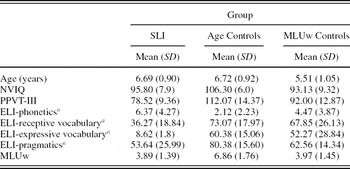
The age control group was equivalent in age (same year and ±2 months) and mother tongue (Spanish) to their counterparts in the SLI group. Teachers were asked if the control subjects’ language development was normal for their age. Children were not selected if they had a history of speech and language therapy or psychological therapy. Moreover, teachers were asked to select children with normal academic performance. All of the children selected came from state schools in Catalonia and Valencia. With respect to the MLUw control group, each child in the study group were paired with another child according to their linguistic level, measured from the MLUw (±0.6 words), sex, and mother tongue. In addition, nonverbal intelligence and language ability was assessed of all children in both the age control and MLU groups using the same tests and protocols as were used for the children with SLI group. A summary of descriptive data for the three groups of children is presented in Table 1.
Group age, cognitive measures, and performance on language

Note: SLI, specific language impairment; MLUw, mean length of utterance in words; Age, chronological age; NVIQ, nonverbal intelligence quotient, standard score; PPVT-III, Peabody Picture Vocabulary Test III, Spanish version, standard score; ELI, Evaluación del Lenguaje Infantil; ELI-phonetics, mean number of errors; ELI-receptive vocabulary, ELI-expressive vocabulary, and ELI-pragmatics, percentiles.
aValues only calculated with children younger than 6 years old.
Stimuli
Twelve simple sentences were constructed. All contained the same structure: noun phrase (NP) + verb + adverb + NP/prepositional phrase (PP), which always corresponded to agent + verb + adverb + theme/patient. We selected as a target NP/PP only themes and patients because they are mandatory arguments of the verb and their natural position in Spanish is after an active verb. All sentences began with one of four possible agents: the woman, the man, the girl, or the boy. These were randomly assigned to sentences, and six were male and six female. Twelve different verbs were used. There were 10 adverbs denoting the manner of the action (quickly [3], slowly [2], strongly [2], carefully [3]) and 2 denoting the frequency of the action (sometimes [2]).
All sentences were selected by eight language experts from the Department of Basic Psychology of the University of Barcelona. The requirement was that the verbs, nouns, and their combination would be familiar to children. The experimental sentences for Experiment 1 are given in Appendix A.
Sentences were recorded by a male native Spanish speaker and sampled at 44,100 Hz. A digital audio editor was used to adjust each sentence so that the agent NP, the verb, and the adverb each occurred for 1 s (words + silence was 1000 ms). Utterances sounded natural and unedited to adult native speakers. This facilitated the subsequent analysis of data without having any effect on auditory stimuli.
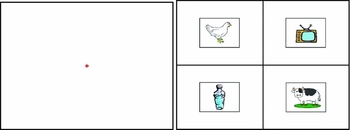
Visual images were constructed and paired with each sentence. Each image consisted of four pictures located in the center of four quadrants on the screen. The background was white and two black lines, one vertical, one horizontal, were used to divide the four quadrants. The pictures were clip art images, which were sometimes altered using an image editing software package. For every trial, there was one target picture depicting the target theme/patient and three distracters pictures that were not semantically possible themes/patients of the verb (see Figure 1). The position of the target picture in each quadrant was randomized. The audio and the visual image for each item were merged together in a video file lasting 5000 ms, using VirtualDubMod software. In each video, the onset of the spoken sentence coincided with the onset of the visual stimuli.
Stimuli example: El hombre ordeña con cuidado la vaca (The man milks carefully the cow). (Target: vaca [cow]; distracters: gallina [chicken]/botella [bottle]/televisión [television]). [A color version of this figure can be viewed online at journals.cambridge.org/aps]

For some trials, the most likely names of some of the distracter images had a gender that was different from the target noun, and thus could in principle be excluded from consideration upon hearing a gender-marked determiner. However, the critical measure of anticipatory processing is taken just prior to hearing this determiner, and thus could not be affected by participants hearing gender information.
Procedure
Participants were seated approximately 22 in. in front of a Tobii T120 eyetracker with an integrated 17-in. TFT monitor. Tobii Studio software was used to present the stimuli, and collect the eye tracking data. Stimuli videos were made by images of 800×600 pixels that were presented on the screen set to 1024×768 pixels. The visual angle of each object subtended approximately 13 degrees, well above the 0.5-degree accuracy of the eye tracker. The sounds of stimuli were presented to participants via a mono channel split to two loudspeakers positioned on either side of the viewing monitor. Eye position was sampled at 120 Hz (~8-ms intervals).
A 9-point calibration was carried out at the beginning of the experiment. The Tobii Studio software automatically validates calibrations and the experimenter could, if required, repeat the calibration process if validation was poor. Calibration took approximately 20 s. Participants were instructed to listen to the sentences and to inspect the images, and to try to understand both sentences and depicted scenes. There was no other task. There were four practice trails before the experimental task to acquaint the participant with the flow of events. The test videos were presented in random order in two blocks. All the participants were given both blocks. Between each trial, participants were first presented for approximately 2000 ms with a crosshair (which they had been instructed to fixate) so that the direction of gaze on each trial would start from the same point (the center of the screen that corresponded with the intersection of the two lines that divided the four quadrants).
Analysis
The horizontal and vertical eye position data obtained from the Tobii Studio Software were used to assess eye position. A value of 1 was given to every eye-tracking sample that fell within a region of interest (as defined by a rectangle surrounding each image); otherwise, it was given a 0. From this we calculated the proportion of looks made by the participants to the target picture and the distracters. We rejected trials where there was more than 33% loss of track of eye position data. After exclusion of these trials, subjects who did not have at least 50% of the trials for each condition were removed. The mean percent of track loss in adults was 3.77%, resulting in the need to drop three trials. The age control group presented with 8.48% track loss and 15 dropped trials. The MLU control group had 7.63% track loss, with 7 trials dropped. The SLI group had 10.32% track loss, with one subject and 11 trials being dropped.
Results
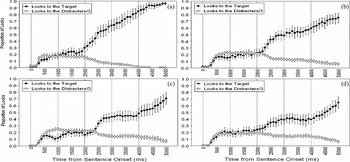
Figure 2 presents the proportion of looks over time to the target referent compared to the average proportion of looks to the three distracter objects. The most remarkable aspect of these results is that all groups, including the children with SLI, showed anticipatory processing of the target. While hearing the adverb that followed the verb, all groups showed a rise in looks to the target referent compared to looks to the distracter objects. This rise occurred prior to hearing the target NP/PP. Adults (Figure 2a) show the earliest and sharpest rise, but all three groups of children, including children with SLI, show an equally early divergence between target looks and distracter looks (Figure 2b–d). Children's later looks to the target are lower than adults, and SLI children's patterns look most like MLU controls.
The proportion of looks to the target and distracter objects over time from sentence onset for Experiment 1 for (a) adults, (b) age-matched control children, (c) mean length of utterance (MLU)-matched control children, and (d) children with specific language impairment (SLI). The averages of the subject means are plotted. Error bars indicate 95% confidence intervals. Vertical dotted lines indicate the exact onset of subject noun phrase (NP), verb, adverb, and object NP/prepositional phrase (PP).

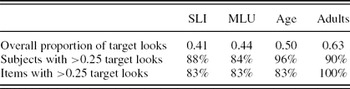
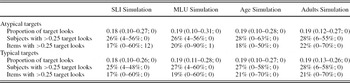
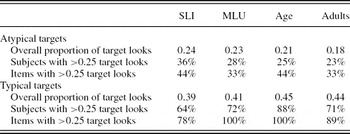
As an estimate of the degree of anticipatory eye movements, each trial for each subject was given a binary code (1 = target look, 0 = otherwise) based on the eye position just prior to hearing the target NP (3000 ms). Table 2 summarizes these binary values in terms of proportions. Consistent with what is graphed at 3000 ms in Figure 2, all groups of participants showed ample signs of anticipatory processing; for each group, greater than 85% of the participants and greater than 75% of the items had an average proportion of target looks greater than a conservative estimate of chance of 0.25 (one out of four objects). As can be seen in the table, adults showed the highest proportion of target looks. The three groups of children behaved similarly, with children with SLI showing the lowest proportion of target looks.
Anticipatory processing: Looks to target referent just prior to target noun phrase/prepositional phrase in Experiment 1

Note: SLI, specific language impairment; MLU, mean length of utterance; Age, children matched on age.
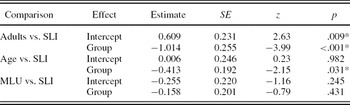
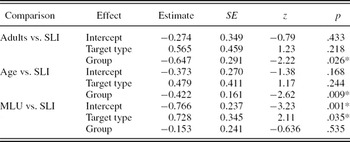
Statistical tests of these data at 3000 ms (Table 3) showed that the anticipatory target looks of children with SLI differed significantly from adults and from age-matched controls, but not MLU-matched controls. Because of the binary nature of the data (1 = look to target; 0 = otherwise), multilevel logistic models with crossed-random effects were used to estimate and test effects (Barr, Reference Barr2008; Jaeger, Reference Jaeger2008; see note in Table 3 for details).Footnote 2 Parameter estimates for each effect of group indicates a change in log-likelihood of looking at the target; negative values indicate children with SLI were doing less anticipatory looking than the corresponding comparison group.
Multilevel logit models with crossed random effects comparing children with SLI to each participant group in Experiment 1

Note: Three models each comparing specific language impairment (SLI) to a different participant group. Models were done using R programming language running the lmer function. R-code took the form of TargetLook ~ 1+Group + (1+Group|Subject) + (1+Group|Item), family = binomial. Adult vs. SLI and age vs. SLI models were significant improvements of fit from the null model, whereas mean length of utterance (MLU) vs. SLI was not.
*p < .05.
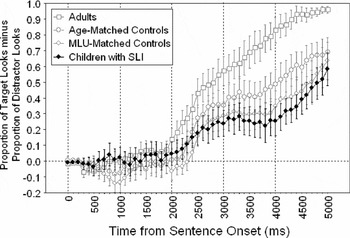
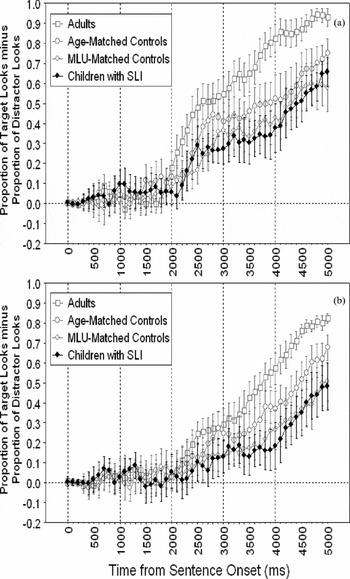
Finally, Figure 3 illustrates these group differences over time, by plotting the difference between the proportion of target looks and the proportion of distracter looks (divided by 3), known as target advantage scores. Elevations above zero indicate anticipatory processing. Initial rises above zero are quite similar for all three groups of children (see 1500 to 2500 ms). However, MLU and SLI children soon show lower target advantage scores than age-matched controls. Thus, consistent with our statistical tests, the MLU and SLI groups are behaving quite similarly; both groups show a rise in anticipatory processing that is like the age-matched control group, yet both groups never reach asymptote performance that is comparable to the age-matched children.
The proportion of target looks minus the proportion of distracter/3 looks over time from sentence onset for Experiment 1. The averages of the subject means are plotted. Error bars indicate 95% confidence intervals. Vertical dotted lines indicate the exact onset of subject noun phrase (NP), verb, adverb, and object NP/prepositional phrase (PP).

Discussion
Children with SLI were able to use verb-specific semantic information rapidly enough during spoken sentence comprehension to anticipate upcoming referents, just like other groups of subjects. Although anticipatory looks to the target were significantly lower for SLI compared to age-matched controls and adults, children with SLI showed a looking pattern that was indistinguishable from MLU-matched controls.
As discussed in the predictions section above, the pattern we observed here is inconsistent with the generalized slowing hypotheses of SLI (e.g., Kail, Reference Kail1994). For children with SLI, we do not observe a general rightward shift in the curve plotting anticipatory processing (e.g., Figure 3), which would be expected under such an account. Instead, the initial rise for all child groups is similar; then, children with SLI and MLU-matched controls show fewer anticipatory looks compared to age-matched controls. It is also difficult to attribute the SLI pattern to impaired phonological processing (e.g., Joanisse & Seidenberg, Reference Joanisse and Seidenberg1998), as one would be forced to assume that MLU-matched controls have similar phonological deficits. Rather, the effects appear to be most consistent with hypotheses that SLI children's verb vocabulary is limited or they have difficulties in lexical–semantic organization (Sheng & McGregor, Reference Sebastián, Martí, Carreiras and Cuetos2010) of some verbs; linguistically matched younger children, who likely have smaller vocabularies than the age-matched control group, but likely have no processing deficits, behave similarly to children with SLI.
Given this pattern, it seems important that we attempt to replicate these findings with a new set of linguistic materials. It is also important to investigate what sort of linguistic knowledge is being employed by these groups of subjects to achieve anticipatory processing. Verb–theme pairs in the present experiment included items such as milk–cow, open–door, and break–bread. Thus, success could in principle be based on simple lexical co-occurence, rather than knowledge of verb-specific semantic restrictions. Experiment 2 addresses this issue.
EXPERIMENT 2
Experiment 2 was designed to investigate if there are differences among adults, children with typical development, and children with SLI concerning which sorts of linguistic knowledge may be used to accomplish anticipatory processing. It is possible that the child groups’ successful performance in Experiment 1 in launching anticipatory eye movements to typical patients/themes may not reflect fast use of verb-specific semantic restrictions but rather reflect knowledge of simple lexical co-occurrences (milk–cow).
To address this issue, the present experiment compared anticipatory eye movements for both typical and atypical patient/theme relationships. On some trials, participants heard a typical patient/theme relationship such as The man closes quickly the door while viewing a door among a set of “unclosable” objects (e.g., a cloud, a tree, a stamp). On other trials, they heard an atypical patient/theme relationship such as The man pushes suddenly the flower pot while viewing a flower pot among “unpushable” objects (e.g., a house, a street lamp, and a road). Here, “push” and “flower pot” tend not to co-occur in the language, and are clearly not word associates, yet the flower pot is the most likely thing to be pushed in this visual context. Past studies with adults have shown that anticipatory eye movements occur to both atypical and typical arguments (Boland, Reference Boland2005; Kamide et al., Reference Kamide, Altmann and Haywood2003).
Only Boland (Reference Boland2005) has conducted an experiment like the current one in which typical and atypical arguments were not present on the screen at the same time, but instead were compared across different trials (exp. 1 in Boland, Reference Boland2005). With such a design, Boland (Reference Boland2005) observed that adults had equally strong anticipatory processing for typical and atypical arguments, suggesting that participants launched eye movements to the sole object on the screen that satisfied the verb's semantic constraints (independent of the typicality of the object for that role). When both the typical and atypical objects are present on the screen simultaneously, anticipatory processing is much greater for typical objects than atypical ones (exp. 2 in Boland, Reference Boland2005; exps. 1 and 2 in Kamide et al., Reference Kamide, Altmann and Haywood2003).
Given these past findings, we expect adults in the present experiment to show anticipatory processing for both typical and atypical patient/theme referents, with perhaps equal degree of anticipatory processing for both types of objects, as observed by Boland (Reference Boland2005). Of interest here is the performance of the children with SLI and the typically developing controls. If children with SLI are achieving anticipatory processing purely based on lexical co-occurrence/word association, they should show anticipatory effects only for typical (more associative) relationships such as close–door and not for atypical relationships such as push–flower pot. However, if children with SLI possess and rapidly use knowledge about verb-specific semantic restrictions, they should also show anticipatory eye movements to atypical objects. Finally, to the extent that the SLI group continues to perform like MLU-matched controls (i.e., equally early anticipatory processing accompanied by lower asymptotic performance compared to other children), we can be more confident that the effects are not necessarily the result of phonological and/or processing deficits but simply more limited vocabularies.
Method
Participants
The same participants took part in this experiment as in Experiment 1.
Stimuli
Twenty simple sentences were constructed. All contained the same structure: NP + verb + adverb + NP/PP, which always corresponded to agent + verb + adverb + theme/patient. Ten sentences ended with a typical theme/patient for the verb and ten sentences ended with an atypical theme/patient for the verb. All sentences began with one of four possible agents: the woman, the man, the girl, or the boy. These were randomly assigned to sentences and for every condition there were five male and five female agents. Twenty different verbs were used. Adverbs were the same across the two conditions with five denoting the manner of the action (quickly, slowly, suddenly [2], and carefully) and five denoting temporal properties of the action (always [2], everyday, and sometimes [2]).
Typical and atypical themes/patients were selected by eight language experts from the Department of Basic Psychology of the University of Barcelona. For each verb, each expert chose a typical and atypical theme/patient. Those for which there was more agreement among the experts were then taken as stimuli. The experimental sentences for Experiment 2 are given in Appendix B. The verbs in the two conditions had similar frequencies, as assessed in the LEXESP corpus (Sebastián, Martí, Carreiras, & Cuetos, Reference Sebastián, Martí, Carreiras and Cuetos2000) of written Spanish (typical condition = 49.20 mean frequency, range = 10.18–101.04; atypical condition = 21.62, range = 1.61–87.14) in a two-tailed t test (p = .12). However, the patient/theme nouns (typical condition = 75.36 mean frequency, range 5.89–278.04; and atypical condition = 9.80, range 1.43–37.68) were significantly different in a two-tailed t test (p < .05).
Sentences were recorded by a male native Spanish speaker and sampled at 44,100 Hz. A digital audio editor was used to adjust each sentence so that the agent NP, the verb, and the adverb each lasted 1 s.
Visual images were constructed and paired with each sentence. In every image, there was one target picture depicting the target theme/patient and three distracters pictures that were not semantically possible themes/patients of the verb. The position of the target picture in each quadrant was randomized (five times in each quadrant). The audio and the visual image for each item were merged together in a video file lasting 5000 ms, using VirtualDubMod software. In each video, the onset of the spoken sentence coincided with the onset of the visual stimuli.
Procedure
The same procedure as Experiment 1 was used in the present experiment.
Analyses
The same analysis as Experiment 1 was used in the present experiment. Trials with more than 33% track loss were excluded. After exclusion of these trials, subjects who did not have at least 50% of the trials for each condition were removed. The mean percent of track loss in adults was 3.77%, resulting in the need to drop 1 trial. The age control group presented 8.48% track loss with one subject and 17 dropped trials. The MLU control group had 7.63% track loss, with 26 trials dropped. The SLI group had 10.32% track loss, and 15 trials were dropped.
Results
Figure 4 presents the proportion of looks over time to the target referent compared to the average proportion of looks to the three distracter objects, as split by condition (typical vs. atypical target). As in Experiment 1, the most striking aspect of the results is the similarity across all groups of subjects. Children with SLI and all other groups showed sizable anticipatory processing for both typical and atypical referents, with greater anticipatory effects for typical referents. While hearing the adverb and prior to hearing the target NP/PP, all groups showed a rise in looks to the target referent compared to looks to distracter objects, with typical targets showing the sharper rises. Children with SLI showed slightly less anticipatory processing overall compared with age-matched controls and adults, but they appear nearly identical to MLU-matched controls.
The proportion of looks to the target and distracter objects over time from sentence onset for Experiment 2 for (a) adults, (b) age-matched control children, (c) mean length of utterance (MLU)-matched control children, and (d) children with specific language impairment (SLI). The averages of the subject means are plotted. Error bars indicate 95% confidence intervals. Vertical dotted lines indicate exact onset of subject noun phrase (NP), verb, adverb, and object NP/prepositional phrase (PP).

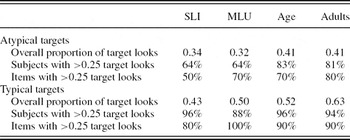
Like Experiment 1, the degree of anticipatory eye movements was estimated by examining the proportion of target looks based on the eye position just prior to hearing the target NP (3000 ms; see Table 4). Consistent with what is graphed in Figure 4, all groups show ample evidence of anticipatory eye movements when the target was typical, replicating Experiment 1 using these new materials. For instance, for each group, greater than 85% of the participants and greater than 80% of the items had an average proportion of target looks larger than a conservative estimate of chance of 0.25 (one out of four objects).
Anticipatory processing: Looks to target referent just prior to onset of the target noun phrase/prepositional phrase in Experiment 2

Note: SLI, specific language impairment; MLU, mean length of utterance; Age, children matched on age.
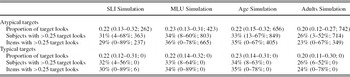
Anticipatory eye movements for atypical targets were numerically lower than for typical targets. It is unclear whether certain groups of participants were looking at these targets more than would be expected by chance. For instance, although 64% of the SLI subjects exceeded the criterion of 0.25, only 50% of the items in the SLI group met this criterion. Is this enough to say that children with SLI as a group show anticipatory processing? In order to answer this question, we must estimate the range of possible experimental outcomes if eye movements to the four possible pictures had indeed been random. To this end, a set of 1000 simulations were performed to generate this distribution, and were compared to the actual results (see Table 5). The simulations were performed as follows. First, for each group of participants, we estimated the average probability that a participant in this group would be looking at one of the four possible objects at the critical time of 3000 ms (this value was approximately 0.80 to 0.90 in all groups). Then, for each simulated trial of a simulated subject, we used this probability to determine if an eye movement had occurred on that trial. If so, one of the four objects was randomly selected for fixation (target, distracter 1, distracter 2, distracter 3). Each simulated experiment had the same number of “subjects” and “items” as the real experiment. The results of these simulations (Table 5) tell us we can be confident that all groups were reliably above chance when it came to anticipatory looks to atypical targets. As can be seen in the table, none of the simulated experiments generated an average proportion of target looks that exceeded our observed values, and none of these simulations generated a higher percentage of subjects with >0.25 target looks than our observed percentages. For the percentage of items with >0.25 target looks, only very rarely did a simulated experiment generate numbers that exceeded an observed value. For instance, for the SLI group, only 12 of the 1000 simulated experiments exceeded the observed value (i.e., only 12 simulations had 50% or more of its items with means >0.25). What this means is that there is a 0.012 probability that this particular finding occurred by chance, where chance was estimated by our model of random eye movements. If more than 50 simulations had obtained this value or higher, one would conclude the effect is not significant with a p value of >.05. It is perhaps not surprising that none of the 1000 random simulations for typical targets exceeded what was actually observed, showing highly reliable effects for typical targets. (Simulations of Experiment 1 data, not reported here, generated equally reliable effects.)
Average results (range; number of simulations) of 1,000 simulated experiments using random gaze shifts in Experiment 2

Note: The number of simulations that equaled or exceeded actual observed values reported in Table 4. SLI, specific language impairment; MLU, mean length of utterance; Age, children matched on age. If 50 or more simulations are equal to or greater than observed value from real participants (Table 4), then the observed value is not significant at p < .05.
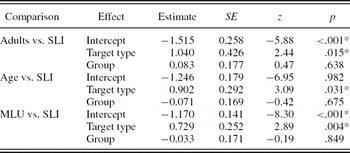
Although all groups showed reliable anticipatory processing, some groups showed greater anticipatory processing than others. In order to assess if there were reliable differences among the groups in the degree of anticipatory looking at 3000 ms, we ran multilevel logit models comparable to those run in Experiment 1. The results (Table 6) at 3000 ms revealed reliably more anticipatory processing for typical targets compared to atypical ones in all participant groups. In addition, independent of target type, children with SLI showed fewer anticipatory looks than adults and age-matched controls, but not MLU controls, who behaved similarly.Footnote 3
Multilevel logit models with crossed random effects comparing children with SLI to each participant group in Experiment 2

Note: For each of the three models, adding an interaction term (Target Type×Group) did not significantly improve the model fit, nor did the resulting model have a significant interaction term. In the case of Adults vs. specific language impairment (SLI) and the case of Age vs. SLI, the simplest best fitting model was one that had Group as a factor (whose coefficient was significant). In the case of mean length of utterance (MLU) vs. SLI, the simplest best fitting model was one that just included Target Type (whose coefficient was significant). We included Target Type here for ease of reading. Models were done using the R programming language running the lmer function. R-code took the form of TargetLook ~ 1 + TargetType + Group + (1+TargetType+Group|Subject) + (1+TargetType+Group|Item), family = binomial. Adult vs. SLI and Age vs. SLI models were significant improvements of fit from the model that included TargetType, whereas MLU vs. SLI was not.
*p < .05.
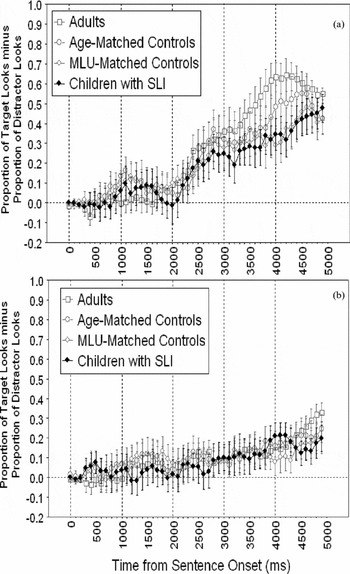
Figure 5 illustrates these group differences over time, by plotting target advantage scores. Initial rises above zero are quite similar for all three groups of children. However, MLU and children with SLI soon show fewer looks than age-matched controls. This pattern is like that observed in Experiment 1, and occurs here for both typical (Figure 5a) and atypical (Figure 5b) targets.
The proportion of target looks minus the proportion of distracter/3 looks over time from sentence onset for Experiment 2 for (a) typical targets and (b) atypical targets. The averages of the subject means are plotted. Error bars indicate 95% confidence intervals. Vertical dotted lines indicate exact onset of subject noun phrase (NP), verb, adverb, and object NP/prepositional phrase (PP).

In sum, all groups, including children with SLI, made reliably more anticipatory eye movements to the target, for both typical and atypical targets. The SLI group's degree of anticipatory processing did not differ from MLU-matched controls but did differ from age-matched controls and adults.
Discussion
All groups of subjects showed reliable signs of anticipatory processing for both typical and atypical targets. This pattern suggests that more than simple word association/lexical co-occurrence is behind the performance of children with SLI (and the other groups of participants). Even with items for which the upcoming NP/PP was not lexically predictable but was likely given the alternatives in the scene (i.e., an atypical target referent in the presence of objects that were not possible patients/themes), children with SLI behaved like other children and generated anticipatory eye movements to the atypical target.
In addition, the SLI group's degree of anticipatory processing did not differ from MLU-matched controls but did differ from age-matched controls and adults. In particular, the initial divergence of targets (typical or atypical) from distracters was similar in all groups, and only slightly later did age-matched controls and adults outpace performance of children with SLI and MLU-matched controls. Like the pattern in Experiment 1, this pattern is inconsistent with the generalized slowing hypothesis and may be best explained as arising from slightly more limited vocabularies in children with SLI and MLU-matched controls.
Finally, all groups of children and adults appear to be sensitive to typicality; the more typical the object is as the patient/theme, the greater the anticipatory processing. This pattern replicates the adult findings of Kamide et al. (Reference Kamide, Altmann and Haywood2003, Experiments 1 and 2) and Boland (Reference Boland2005, Experiment 2) where effects of typicality on anticipatory processing were observed. It is interesting that Boland reports a complete lack of typicality effects when the typical and atypical objects are not co-present on the screen (Boland, Reference Boland2005, Experiment 1), a situation identical to the present experiment. Boland found instead that typical and atypical targets generated the same high degree of anticipatory processing. In contrast, our results show that both typical and atypical targets generate anticipatory eye movements when displayed on their own, but typical objects receive slightly more anticipatory looks. It is unclear why our results differ in this small way from Boland (Reference Boland2005, exp. 1). Boland (Reference Boland2005, exp. 1) controlled the co-occurrence frequency and the acceptability with the application of a norming study using a scale from 1 (very awkward) to 7 (very natural), whereas Kamide et al. (Reference Kamide, Altmann and Haywood2003, exps. 1 and 2) did not control any of these aspects. One possibility is that the differences between our results and Boland's (Reference Boland2005, exp. 1) are due to factors such as a frequency effect between the patient/theme nouns target in the typical and atypical conditions, to differences in the frequency of co-occurrence, or to different values of typicality. Nevertheless, for the present purposes, the most important aspect of the result is that all subject groups (even children with SLI) showed this pattern.
EXPERIMENT 3
Given the effects observed in Experiment 2, a third experiment was conducted to ascertain if similar findings could be observed when two semantically possible entities (the typical and the atypical target objects) were present simultaneously in the image among two objects that were not possible patients/themes. Presenting both the typical and atypical targets on every trial should increase the competition between the possible referents. As such, one should observe temporary consideration of both the typical and atypical targets, followed by a rapid “dampening down” of looks to the atypical target and increased consideration of the typical target (as was observed in exp. 2 in Boland, Reference Boland2005).
Notably, it has been proposed that children with SLI may suffer from deficits in linguistic competition and cognitive control (Lum & Bavin, Reference Lum and Bavin2007). For instance, children with SLI have been reported to have difficulty ignoring irrelevant alternatives in list recall tasks (Ellis Weismer et al., Reference Ellis Weismer, Evans and Hesketh1999; Marton & Schwartz, Reference Marton and Schwartz2003). If such difficulties extend to natural language processing tasks, one would expect children with SLI in the present experiment to show unusually prolonged visual consideration of both possible referents (typical and atypical objects) compared to the other participant groups. If, on the other hand, deficits are not related to competition, at least for materials of this sort, then we would expect children with SLI to pattern like typically developing children.
Method
Participants
The same participants from Experiment 1 took part in this experiment.
Stimuli
Ten sentences with the same structure as those in Experiment 1 were selected (5 ending with a typical patient/theme and 5 ending with an atypical patient/theme). The experimental sentences for Experiment 3 are given in Appendix C. The visual stimuli were similar to those used in Experiment 2 except that in every image there was both the picture depicting a typical theme/patient and an atypical one. The other two pictures were two distracters that could not be semantically possible themes/patients of the verb. The position of the target picture and the competitor on every quadrant was randomized.
All verbs and nouns were different from those used in Experiment 2. Both the typical and atypical patient/theme nouns had similar frequencies, as assessed in the LEXESP corpus (Sebastián et al., Reference Schul, Stiles, Wulfeck and Townsend2000) of written Spanish (typical nouns = 47.54 mean frequency, range = 16.96–84.29; and atypical nouns = 35.64, range = 4.11–146.79) in a two-tailed t test (p = .37). Moreover, a norming study was conducted to evaluate the typicality of the target, competitor, and the two distracters. Eighteen adults who did not take part in the experiment completed a questionnaire. The questionnaire consisted of four sentences per stimulus item. These four sentences were written versions of the experimental sentences, except ending with the typical theme, atypical theme, distracter 1, or distracter 2. For example, La mujer sube despacio las escaleras/la montaña/el plátano/la camiseta)[The woman climbs slowly the stairs/the mountain/the banana/the shirt]. Participants had to rate each sentence from 1 (very atypical) to 7 (very typical). Mean ratings for typical items (M = 5.78) were significantly different from atypical items (M = 3.82) in a two-tailed t test (p < .001). Both types were in turn significantly different (ps < .001) from the mean of the distracters (M = 1.52).
Procedure
The same procedure as Experiment 1 was used in the present experiment.
Analysis
We calculated the proportion of looks made by the participants to the atypical target, the typical target, and the distracters for each condition. Trials with more than 33% track loss were excluded, and subjects that did not have at least 50% of the trials for each condition were removed. Mean track loss in adults was 5.54% and seven trials were dropped. The age control group presented 10.49% track loss, and 10 trials were eliminated and one subject was dropped. The MLU group had 8.45% track loss and 11 trials were dropped. Children with SLI had 6.26% track loss and 7 trials were dropped.
Results
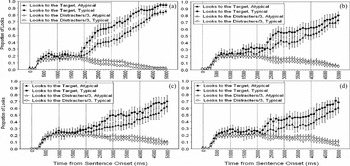
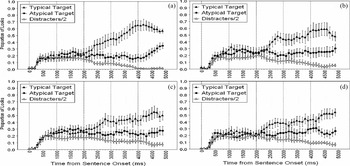
Figure 6 presents the proportion of looks over time to the typical and atypical targets and the average of the two distracter objects. Again, the most striking aspect of the results is the similarity across all groups of participants. At 3000 ms (just prior to hearing the NP/PP) children with SLI (Figure 6d) and all other groups (Figure 6a–c) showed signs of anticipatory processing for both typical and atypical targets, with greater anticipatory effects for typical targets. Children with SLI showed a pattern most like MLU-matched controls in that both showed somewhat fewer looks to typical targets compared to age-matched controls and adults. Compared with Experiment 2, anticipatory processing of atypical targets was substantially reduced, suggesting rapid exclusion of the atypical target from processing in all groups. Adults showed greater divergence between typical and atypical targets, but all three groups of children, including children with SLI, performed similarly.
The proportion of looks to the target and distracter objects over time from sentence onset for Experiment 3 for (a) adults, (b) age-matched control children, (c) mean length of utterance (MLU)-matched control children, and (d) children with specific language impairment (SLI). The averages of the subject means are plotted. Error bars indicate 95% confidence intervals. Vertical dotted lines indicate exact onset of subject noun phrase (NP), verb, adverb, and object NP/prepositional phrase (PP).

Note that looks to atypical targets increase upon hearing the final NP/PP of the sentence, whereas looks to typical targets decrease. This is to be expected because half the time the final NP/PP referred to the atypical target and half the time the typical target. The asymmetry in this later time window (with typical > atypical) reflects the fact that typicality plays a role in processing the noun itself, as well as in any earlier anticipatory processing. Because this is not of interest to the present study, we have collapsed together trials on which the sentence final noun referred to the atypical or typical target.
Table 7 shows the proportion of looks to the target referent at 3000 ms just prior to hearing the final NP/PP. For children, looks to the atypical target were near the “simple” estimate of chance (0.25, one out of four objects), whereas adults were, if anything, below chance at 18%. The lower value for adults suggests they were particularly successful at excluding consideration of the atypical target in favor of the typical one. Indeed, looks to typical objects (also in Table 7) were especially high for adults. Overall, the pattern appears to be one in which adults and age-matched controls were best at promoting looks to the typical target, whereas children with SLI and MLU-matched controls were less successful.
Anticipatory processing: Looks to target referent just prior to target noun phrase/prepositional phrase in Experiment 3

Note: SLI, specific language impairment; MLU, mean length of utterance; Age, children matched on age.
However, using the same simulation methods as were used previously, we find that looks to atypical targets are well within chance at 3000 ms for all age groups (including adults) whereas looks to the typical target are well above chance for all age groups (see Table 8). That is, all age groups successfully excluded atypical targets from consideration. Moreover, logit modeling of these data (Table 9) revealed that the small differences in target looks between the groups of participants were not statistically significant. Children with SLI were not significantly different than MLU-matched controls, age-matched controls, or even adults (i.e., no effects of group in any of these analyses). In each case, the only reliable effect was that of target type, which did not interact with group: typical targets received more anticipatory processing than atypical targets for all participant groups.
Average results (range; number of simulations) of 1,000 simulated experiments using random gaze shifts in Experiment 3

Note: The number of simulations that equaled or exceeded actual observed values reported in Table 7. SLI, specific language impairment; MLU, mean length of utterance; Age, children matched on age. If 50 or more simulations are equal to or greater than observed value from real participants (Table 7), then the observed value is not significant at p < .05.
Multilevel logit models with crossed random effects comparing children with SLI to each participant group in Experiment 3

Note: All three models were reliably different from a null model. For each of the three models, adding an interaction term (Target Type×Group) did not significantly improve the model fit, nor did the resulting model have a significant interaction term. The simplest best fitting model in each case was one that did not include Group as a factor, with Target Type always showing a reliable effect. We included Group here for ease of reading. Models were done using the R programming language running the lmer function. R-code took the form of TargetLook ~ 1 + TargetType + Group + (1+TargetType+Group|Subject) + (1+TargetType+Group|Item), family = binomial. Adult vs. specific language impairment (SLI) and Age vs. SLI models were significant improvements of fit from the model that included just TargetType whereas mean length of utterance (MLU) vs. SLI was not.
Figure 7 illustrates these observed effects using target advantage scores. For typical targets (Figure 7a), all participant groups showed strikingly similar anticipatory processing at 3000 ms. It is only much later (around 4000 ms) that adults outperformed children. Children with SLI remain identical to MLU-matched controls throughout.Footnote 4
The proportion of target looks minus the proportion of distracter/2 looks over time from sentence onset for Experiment 3 for (a) typical targets and (b) atypical targets. The averages of the subject means are plotted. Error bars indicate 95% confidence intervals. Vertical dotted lines indicate the exact onset of noun phrase (NP), verb, adverb, and object NP/prepositional phrase (PP).

Discussion
The pattern observed for adults in this experiment largely replicates the pattern observed in past experiments (Boland, Reference Boland2005; Kamide et al., Reference Kamide, Altmann and Haywood2003). Specifically, when two objects are visually co-present and both can serve as the possible argument of a verb, anticipatory processing to each of these objects is a function of typicality. Typical objects receive much more anticipatory eye movements than atypical ones. In addition, in contrast to Experiment 2 where the atypical and typical objects never appeared on the screen together, the co-presence of a typical object appeared to drive down looks to the atypical theme object. This difference across experiments is similar to what was observed by Boland (Reference Boland2005, exp. 1 vs. exp. 2), with the only difference being that Boland (Reference Boland2005) observed equal degrees of anticipatory processing for atypical and typical objects when they were presented on separate trials.
Although these patterns are of interest, they are not central to the current paper. Rather of interest here is that children with SLI, age-matched, and MLU-matched control children all behaved very similarly to adults. Such a pattern suggests that young children, including those with SLI, access verb information, and integrate it with knowledge about the world in a manner much like adults. Although statistical tests showed little difference among the groups, the numerical values of children with SLI and their overall looking patterns (Figure 7a and b) were most like those of MLU-matched controls. For instance, MLU-matched controls and children with SLI both showed fewer looks to typical referents late in the utterances compared to age-matched controls (Figure 7a).
GENERAL DISCUSSION
The purpose of the current study was to investigate the real-time auditory sentence comprehension abilities of Spanish-speaking children with SLI. To accomplish this we used the visual world paradigm to examine whether children with SLI could use the meaning of a verb to anticipate an upcoming semantically appropriate referent. Results showed that children with SLI could perform anticipatory processing of this sort. In slightly later measures of processing, children with SLI did differ somewhat from age-matched controls, but no differences were found with respect to the MLU-matched group.
Despite their linguistic deficits, children with SLI performed quite well in this real-time spoken language comprehension task that required linking perceived speech to a visual referent world. These children were able to use knowledge about the semantic requirements of transitive verbs to compute likely referents for upcoming direct objects before these constituents were even spoken aloud. This was possible for both typical theme relationships (milk–cow) and atypical ones (push–flower pot) when the alternative depicted objects that could not fill this role (Experiment 2). Thus, these children, and typically developing children, were able to use in a dynamic fashion both verb-specific semantic knowledge and contextually specific information from the scene to anticipate likely referents. When both typical and atypical referents were visually co-present (Experiment 3), children with SLI were able to exclude consideration of the atypical referent, just like other groups of subjects.
Despite their success, children with SLI were somewhat less successful than their age-matched peers. As shown in Figures 3, 5, and 7 (Experiments 1, 2, and 3, respectively), children with SLI show initial rises in anticipatory looking that are strikingly similar to age-matched controls; however soon after that, age-matched controls out-paced children with SLI. It is very important to note that this pattern (i.e., similar early rises followed by later differences) is quite like the eye movement patterns reported by McMurray et al. (Reference McMurray, Samelson, Lee and Tomblin2010) for adolescents with SLI hearing spoken nouns. Using variants of the TRACE model of spoken word recognition, they demonstrated that such a pattern is inconsistent with the generalized slowing hypothesis of SLI (Kail, Reference Kail1994) and inconsistent with degraded phonological representations. In the present study, the generalized slowing hypothesis (Kail, Reference Kail1994) predicts very few anticipatory eye movements for children with SLI and slowed anticipatory eye movements relative to age-matched controls. However, these differences were not found, suggesting that the lexical recognition of verbs is not strongly impaired in children with SLI. Our work further suggests that there is also no impairment in computing the semantic implications of these lexical items: like adults and other children, children with SLI can anticipate upcoming referents based on verb information.
Our results differ in part from previous real-time sentence processing studies in children with SLI. Montgomery, Scudder, and Moore (Reference Montgomery, Scudder and Moore1990), using a word-monitoring task, found that children with SLI were sensitive to syntactic, semantic, and real-world information but they were slower than their age-matched controls (for similar findings, see also Montgomery, Reference Montgomery2000). In the present work, we do not find evidence for slowed processing, contra these previous results. As we noted in the introductory section, the word-monitoring task requires subjects to make overt responses (press a button-box) that could mask or even exaggerate SLI processing difficulties. This work, using the visual world eye tracking method, did not show the same sort of slowing and suggests that children with SLI can rapidly integrate different types of information (e.g., syntactic, semantic, pragmatics) during sentence comprehension. Moreover, our results suggest the possibility that previous studies about sentence comprehension based on offline methodologies, which are typically based on the analysis of responses to questions posed after the sentence is presented, not only tapped sentence comprehension abilities but also other factors such as working memory limitations or visual–motor response limitations.
Although our experiments were not designed to be a strong test of representational accounts of SLI, such as the extended UCC account (Wexler, Reference Wexler1999) and the computational grammatical complexity account (van der Lely, Reference van der Lely2005), the present findings are at least consistent with these accounts. Given that our stimuli were simple canonical sentences containing verbs in a form analogous to the Spanish root infinitive, representational accounts would expect children with SLI to be able to achieve anticipatory processing, perhaps with children with SLI showing sensitivity to typicality. The present findings line up with these expectations.
Children with SLI were not entirely perfect in their performance, however. For our measures of slightly later eye movements, children with SLI exhibited a developmental delay, in that their proportion of looks to target referents were substantially lower than age-matched controls and very similar to (younger) MLU-matched controls. Our suspicion is that this difference between children with SLI and age-matched controls reflects a delay in linguistic knowledge. One likely candidate is that children with SLI (and MLU-matched controls) have slightly smaller verb lexicons or are less certain of the semantics of some verbs compared to age-matched controls. This explanation would predict the pattern observed here, in which there is a similar time course of processing accompanied with different asymptotic performance (for discussion in terms of speed accuracy trade-off, see McElree, Pylkkänen, Pickering, & Traxler, Reference McElree, Pylkkänen, Pickering and Traxler2006); there are simply fewer trials on which children with SLI and MLU-matched controls perform accurately compared to age-matched controls. On the occasions when children with SLI and MLU-matched controls have the requisite verb knowledge, they use it as quickly as other children.
As discussed in the introductory section, there is some evidence that verb learning is delayed in children with SLI (Johnson & de Villiers, Reference Johnson and de Villiers2009; O'Hara & Johnston, Reference O'Hara and Johnston1997; Sanz-Torrent et al., Reference Salverda, Dahan and McQueen2008, van der Lely, Reference Tyler1994) perhaps due to syntactic deficits (van der Lely, Reference Tyler1994). Because simple transitive sentences were used in the present experiment we would not expect to see syntactic processing deficits in children with SLI. However, if these children are less certain about the meanings of some of the verbs used in the study (and have an understanding similar to MLU-matched controls), the observed pattern can be explained.
These findings are also consistent with recent results from gated lexical identification tasks (Mainela-Arnold, Evans, & Coady, Reference Mainela-Arnold, Evans and Coady2008), in which children with SLI as a group do not appear to show large deficits in the speed of lexical identification. Marshall and van der Lely (Reference Marshall and van der Lely2008) draw similar conclusions about a subclass of children with SLI (G-SLI children, who have particular trouble with morphology). In that study, gated lexical identification was done with verbs, and is in many ways analogous to the processing of verb information tested here. Yet, because our study uses continuous uninterrupted speech, we can draw the additional conclusion that speed of lexical uptake as measured by interpretation-consistent eye movements is quite similar to what we observed for typically developing children. Thus, reported deficits in the general speed of processing in children with SLI (Joanisse & Seidenberg, Reference Joanisse and Seidenberg1998; Kail, Reference Kail1994; Leonard, Reference Leonard1998) do not appear to impact in a significant manner lexical identification within sentences.
Of course, the measure used here allows one to draw additional conclusions beyond mere lexical identification. Semantic retrieval and the computation of referential implications appear to be quite normal for children with SLI, at least when hearing simple transitive sentences of the sort used here. In particular, the anticipatory eye movements, especially as observed for atypical patient/theme relationships, indicate that children with SLI can (a) retrieve verb-specific semantic restrictions when hearing a verb, (b) use this information to search for referents that satisfy these restrictions, and (c) do this quickly enough to anticipate the referent prior to actually hearing it mentioned in the speech stream.
These findings may suggest that observed semantic and/or executive function abilities as seen in word-list memory tasks (Ellis Weismer et al., Reference Ellis Weismer, Evans and Hesketh1999; Lum & Bavin, Reference Lum and Bavin2007; Marton & Schwartz, Reference Marton and Schwartz2003) have little impact on the real-time interpretation of speech when it is supported by a referential context. Although some deficits were observed in Experiment 1 and 2 relative to age-matched controls, these deficits did not prevent rapid linking of speech to the referent world in an anticipatory manner. However, caution should be offered when drawing this conclusion, as it would be best to test this hypothesis with linguistic stimuli that are believed to require substantial executive function abilities to interpret, such as garden-path sentences (see, e.g., Novick, Trueswell, & Thompson-Schill, Reference Novick, Trueswell and Thompson-Schill2005).
In sum, the visual world eye tracking method was found to be a very effective method for assessing the language processing abilities of children with SLI. Inconsistent with the generalized slowing hypothesis of SLI, children with SLI were able to recognize verbs and compute their semantic implications as quickly as age-matched controls. Comparisons with MLU-matched controls suggested that the small deficits that do exist in children with SLI are limited to lexical knowledge, at least when processing simple active sentences. This work sets the stage for further sentence processing studies of children with SLI, focusing on real-time syntactic and morphosyntactic processing.
APPENDIX A
The 12 sentences used in Experiment 1 are as follows:
1. La mujer abre de prisa la puerta (TARGET: puerta, DISTRACTERS: lápiz, gato, elefante).
1. The woman opens quickly the door (TARGET: door, DISTRACTERS: pencil, cat, elephant).
2. El niño recorta con cuidado el papel (T: papel, D: despertador, zorro, dinosaurio).
2. The boy trims carefully the paper (T: paper, D: clock, fox, dinosaur).
3. El hombre parte con fuerza la barra de pan (T: pan, D: luna, pato, hipopótamo)
3. The man breaks forcefully the loaf of bread (T: bread, D: moon, duck, hippo)
4. El hombre construye despacio un castillo (T: castillo, D: libro, león, cabra)
4. The man builds slowly a castle (T: castle, D: book, lion, goat)
5. El hombre ordeña con cuidado a la vaca (T: vaca, D: gallina, botella, televisión)
5. The man milks carefully the cow (T: cow, D: chicken, bottle, television)
6. La mujer abraza a veces a su padre (T: padre, D: serpiente, radio, clip)
6. The woman hugs sometimes her father (T: father, D: snake, radio, paperclip)
7. La mujer conduce deprisa la ambulancia (T: ambulancia, D: espada, arena, mantequilla)
7. The woman drives fast the ambulance (T: ambulance, D: sword, sand, butter)
8. El niño cierra con cuidado los cajones (T: cajones, D: goma, sal, gente)
8. The boy closes carefully the drawers (T: drawers, D: eraser, salt, people)
9. La niña ordena a veces los libros (T: libros, D: balcones, azúcar, agua)
9. The girl organizes sometimes the books (T: books, D: balconies, sugar, water)
10. La niña derrama con fuerza la sal (T: sal, D: viento, gafas, mochila)
10. The girl spills forcefully the salt (T: salt, D: wind, glasses, backpack)
11. La niña lee despacio un cuento (T: cuento, D: coche, bandada de pájaros, flota)
11. The girl reads slowly a children's story (T: story, D: car, flock of birds, floats)
12. El hombre reúne deprisa al ejercito (T: ejercito, D: bosque, guitarra, pan)
12. The man gathers quickly the army (T: Army, D: forest, guitar, pan)
APPENDIX B
The 20 experimental sentences used in Experiment 2 are as follows:
TYPICAL TARGET
Block 1
1. El niño rompe de repente un vaso (TARGET: vaso, DISTRACTERS: cohete, moneda, casa)
1. The boy breaks suddenly a glass (T: glass, D: rocket, coin, house)
2. El hombre cierra deprisa la puerta (T: puerta, D: nube, árbol, sello)
2. The man closes quickly the door (T: door, D: cloud, tree, stamp)
3. El niño quiere siempre un regalo (T: regalo, D: sol, tejado, calle)
3. The boy wants always a gift (T: gift, D: sun, roof, street)
4. La niña cuida cada día al perro (T: perro, D: ojo, antena, chimenea)
4. The girl cares each day for the dog (T: dog, D: eye, antenna, chimney)
5. La mujer cura con cuidado la herida (T: herida, D: nube, plancha, reloj)
5. The woman disinfects carefully the wound (T: wound, D: cloud, iron, clock)
Block 2
6. El niño encuentra de repente una moneda (T: moneda, D: relámpago, planeta, desierto)
6. The boy finds suddenly a coin (T: coin, D: lightning, planet, desert)
7. La mujer escucha siempre la radio (T: radio, D: mesa, manzana, zapatos)
7. The woman listens always to the radio (T: radio, D: table, apple, shoes)
8. La niña abre a veces la ventana (T: ventana, D: escoba, planta, percha)
8. The girl opens sometimes the window (T: window, D: broom, plant, hanger)
9. El hombre conduce deprisa el coche (T: coche, D: calcetín, silla, puerta)
9. The man drives fast the car (T: car, D: sock, chair, door)
10. La mujer compra a veces patatas (T: patatas, D: iglú, helicóptero, cocodrilo)
10. The woman buys sometimes potatoes (T: potatoes, D: igloo, helicopter, crocodile)
ATYPICAL TARGET
Block 1
1. La mujer lava con cuidado la corbata (T: corbata, D: flor, estrella, enchufe)
1. The woman washes carefully the tie (T: tie, D: flower, star, plug)
2. La niña peina siempre al gato (T: gato, D: corazón, lápiz, sofá)
2. The girl combs always the cat (T: cat, D: heart, pencil, sofa)
3. El niño empuja de repente la maceta (T: maceta, D: casa, farola, carretera)
3. The boy pushes suddenly the flower pot (T: flower pot, D: house, street lamp, road)
4. La niña grita siempre a la tortuga (T: tortuga, D: árbol, tejado, sofá)
4. The girl yells always at the turtle (T: turtle, D: tree, roof, sofa)
5. El hombre mastica despacio la hierba (T: hierba, D: rueda, guitarra, banco)
5. The man chews slowly grass (T: grass, D: wheel, guitar, bank)
Block 2
6. El hombre pesca de repente la bota (T: bota, D: espejo, bombilla, luna)
6. The man fishes out suddenly the boot (T: boot, D: mirror, lamp, moon)
7. El niño pela cada día la piña (T: piña, D: teléfono, zapato, escoba)
7. The boy peels each day the pineapple (T: pineapple, D: phone, shoe, broom)
8. El hombre escribe a veces la partitura (T: partitura, D: cámara de fotos, nariz, ratón)
8. The man writes sometimes the music score (T: music score, D: camera, nose, mouse)
9. La mujer come despacio el jabalí (T: jabalí, D: maleta, ordenador, carpeta)
9. The woman eats slowly the boar (T: boar, D: bag, computer, folder)
10. La niña sopla a veces el saxo (T: el saxo, D: bolígrafo, fresas, pie)
10. The girl blows sometimes the sax (T: sax, D: pen, strawberry, foot)
APPENDIX C
The 10 sets of experimental sentences used in Experiment 3 are as follows. Item number 9 was presented to participants, but omitted from data analysis for a homophone effect found.
SENTENCE ENDING WITH TYPICAL THEME
1. La mujer sube despacio las escaleras, (TARGET: escaleras, COMPETITOR: montaña, DISTRACTERS: plátano, camiseta)
1. The woman climbs slowly the stairs (TARGET: stairs, COMPETITOR: mountain, DISTRACTERS: banana, shirt)
2. El hombre baña con cuidado al bebé (T: bebé, C: hámster, D: raqueta, espejo)
2. The man bathes carefully the baby (T: baby, C: hamster, D: racket, mirror)
3. El hombre envía a veces una carta (T: carta, C: caja, D: casa, avión)
3. The man sends sometimes a letter (T: letter, C: box, D: house, plane)
4. El niño molesta siempre al perro (T: perro, C: oca, D: silla, coche)
4. The child bothers always the dog (T: dog, C: goose, D: chair, car)
5. La niña espanta deprisa al gato (T: gato, C: caballo, D: cielo, calcetines)
5. The girl scares quickly the cat (T: cat, C: horse, D: sky, socks)
SENTENCE ENDING WITH ATYPICAL THEME
6. La mujer abre deprisa el baúl (T: baúl, C: armario, D: vaso, silla)
6. The woman opens quickly the trunk (T: trunk, C: wardrobe, D: glass, chair)
7. El niño estira con fuerza la bufanda (T: bufanda, C: cuerda, D: queso, tenedor)
7. The child stretches/pulls forcefully the scarf (T: scarf, C: string, D: cheese, fork)
8. La niña lleva siempre las maracas (T: maracas, C: mochila, D: grifo, luna)
8. The girl carries always the maracas (T: maracas, C: backpack, D: tap, moon)
9. La niña lanza siempre la flecha (T: flecha, C: pelota, D: pájaro, jersey)
9. The girl throws always the arrow (T: arrow, C ball, D: bird, jumper)
10. El hombre tira de repente la tele (T: la tele, C: taza, D: la casa, elefante)
10. The man throws suddenly the TV (T: TV, C: cup, D: the house, the elephant)
ACKNOWLEDGMENTS
This paper was partially financed by Grant 2006ARIE1004 from the Generalitat de Catalunya and Grant SEJ2007-62743 from the Ministry of Science and Innovation of the Government of Spain. We appreciate the help received from CREDA Narcís Massó of Girona, the School Educational Psychology Services (SPE) of the Castelló area and their speech and language therapists, and the primary school CEIP Els Pins (Barcelona) for their help and collaboration. Thanks also to Vincenç Berga, Lucía Buil, and Alon Hafri for their help with certain aspects of the analysis and computation and the anonymous reviewers for their assistance in improving the paper.