Introduction
Traditionally, landholding in the late medieval rural world has been considered an all-male affair.Footnote 1 Throughout western Europe, women cultivating land independently were a minority. Although there was some local and temporal variation, J. Whittle has stated that 12 to 20 per cent of peasant tenants in English manors before the Black Death were female. By the early sixteenth century, this proportion had fallen to 10 per cent or less.Footnote 2 J. Bennett emphasised that women struggled to get tenure of even a tiny bit of land.Footnote 3 S. Bardsley, on the other hand, denied that women benefited from the outcome of the plague, finding themselves inheriting land that would otherwise have been passed through the male line. She showed the remarkable continuity in English female customary holding before and after the Black Death.Footnote 4 These scholars have pointed to the importance of cultural attitudes, influencing inheritance practices, which were hostile to the idea of women cultivating land independently. Consequently, despite demographic shocks and fundamental economic changes between the thirteenth and sixteenth centuries, stability on a very low level in female landholding was the norm in the English countryside. Furthermore, most historians have emphasised the role of widows in controlling and transferring land.Footnote 5
However, during the late Middle Ages, the exploitation of land underwent drastic changes, in which the emergence and spread of leaseholding plays a pivotal role. In response to the classic thesis of R. Brenner, who considered the rise of leasehold as a key element in the emergence of agrarian capitalism,Footnote 6 B. van Bavel has stated that the consequences of the lease system depended on its exact arrangement and particularly on the economic and social context in which it emerged. Consequently, its impact varied greatly from region to region.Footnote 7 Despite paying ample attention to leasing, historians have never really addressed the impact of this new type of landholding on women. Hence, my purpose is to introduce a gender perspective into an area of rural history that until hitherto has rather been considered genderless and neutral.Footnote 8 Two possible causes for this situation are the great variety in leases (for example, beneficial leases, commercial leases, lord-tenant leases, inter-peasant leases, subleases, differences according to the length of the contract and the acreage, etc.) and the difficulties concerning the preserved source material. In England, the data surrounding leaseholding seem to be more various, less systematic and less abundant than customary holding.Footnote 9 Some historians have assumed that, as the old forms of tenures eroded in favour of leasehold, widows’ access to land decreased all over England.Footnote 10 Nevertheless, in pre-plague England, women were seen as active members of the lease market, mostly as lessors. In fourteenth-century Suffolk, no less than 22.7 per cent of the lessors on the inter-peasant lease market were single women.Footnote 11 Widows especially were considered as important lessors.Footnote 12 They were likely to be in a position where they might wish to diminish their arable acreages due to want of labour power, especially when younger children were as yet unable to contribute sufficiently to the tilling of the land, but still unwilling to alienate their land permanently.Footnote 13
However, there is much more information to be found by focusing on the lessees. Whenever a tenant was using the land of a landowner for a limited period of time, in exchange for an annual contribution in kind or in money, he or she was in fact the person making a living by cultivating the land. It was this person who decided when to plough the land and harvest the crops. He or she paid the rent and negotiated with the landlord. This stands in contrast with customary land and freehold land, which were often sublet and subleased, at least from the fourteenth century onwards.Footnote 14 Moreover, since short-term and commercial leasehold was, at least in theory, not influenced by inheritance regimes, this type of landholding allows to assess women’s actual degree of access to land.
In this article, I show that, while women initially had great access to leasehold land in Flanders, their participation on the lease market decreased markedly during the late Middle Ages, despite advantageous customs. In this dynamic, densely populated and highly commercialised county, leasehold developed at an early stage. By the middle of the sixteenth century, despite some regional differences, at least half of the land was leased for a short period of time under competitive conditions by landlords.Footnote 15 Consequently, leasehold was many rural dwellers’ only chance of gaining access to land. In the following pages, I will show that Flemish women’s ability to enter the lease market gradually became determined by their marital status: by the beginning of the fifteenth century, only widows who continued their husband’s tenancies could hold land. Nevertheless, I also argue that these widows remained far from passive on the lease market. Finally, I will show that size mattered: the size of the holding had a marked influence on female presence and possibilities. The regional scope of this article enables me to thoroughly understand women’s experiences within the regional rural economy and society. It also allows me to compare Flemish rural women’s opportunities with those of their urban counterparts, who have been studied amply, and with respect to which historians agree that they exercised economic activities, including property management, at a large scale.
To assess women’s opportunities on the Flemish lease market, I confront the legal framework (section I) with the legal acts that were written down in lease contracts (section II). Since there is a world of difference between theory and practice, I will turn to the day-to-day administration of landlords (section III). In contrast to legal documents, these sources of actual practice, such as registers, manuals, serial accounts and running accounts, have been all but neglected by historians using a gender perspective. In these sources, the different identification patterns will reveal an array of information on women’s capabilities and activities (section IV).
Despite the growing importance of paid wage labour, land remained the foremost source of income for rural dwellers in late medieval northwestern Europe. Lives were profoundly shaped by the availability and exploitation of land. Access to land, however, was increasingly regulated by temporary, competitive leases. By illuminating women’s positions on the lease market in one of the most dynamic regions of northwestern Europe, I introduce a new perspective in the debate on women’s economic opportunities, which has hitherto chiefly been considered from the perspective of wage labour.
I. Women in late medieval Flanders: lucky people?
Flemish women enjoyed more fundamental legal and inheritance rights than women in other regions of northwestern Europe. With the exception of feudal land, daughters received the same proportion of their parent’s inheritance as sons.Footnote 16 Because of this fully partible inheritance, women usually did not have dowries.Footnote 17 Unmarried women older than 25 had full competence to act.Footnote 18 Marital property custom divided the couple’s assets into joint property, owned by both spouses and controlled by the husband, and personal property, owned by each spouse separately. Generally, moveable property and property acquired during marriage were considered to be joint property, while property acquired before marriage, mostly through inheritance, was considered individual.Footnote 19 When one spouse died, the survivor retained strong rights over the joint property, regardless of their sex. In the rural district of Bruges for instance, the surviving spouse inherited half of the joint property, while the heirs received the other half.Footnote 20 Despite these local differences, the surviving spouse also received a lifetime usufruct of parts of the inheritance of the heirs, again regardless of their sex.Footnote 21 Widows and widowers had the same rights and responsibilities, with regard to property, but also concerning minor children. Consequently, according to customary law, widows could act freely, without guardians.Footnote 22 Because of these favourable inheritance rights and marital property customs, women exercised economic and commercial activities at a large scale in Flemish flourishing cities such as Bruges, Ghent and Ypres. Historians have abundantly shown how urban women were active as market sellers, engaging in trade, investing, borrowing and lending money, were also heavily involved in the management of their property, without relying on male representatives.Footnote 23 Hence, the question arises whether this was the case for rural women as well.
Up until now, the economic activities of women in the late medieval Flemish countryside, and by extension the pre-industrial Low Countries, have been somewhat neglected.Footnote 24 Despite the advantageous inheritance system, women had only a marginal position as landholders in the area around Bruges in the fifteenth and sixteenth centuries.Footnote 25 However, from the second half of the thirteenth century onwards, an increasing part of the land in this area was given in lease in the form of small separate plots of land. By the middle of the sixteenth century, approximately 90 per cent of the land was leased out. In the sandy, inland parts of Flanders, the proportion of leasehold remained at approximately 50 per cent during the late Middle Ages and the sixteenth century. Yet, in both parts of Flanders, most large holdings were leased out from the middle of the fourteenth century.Footnote 26
Leasehold was regulated by customary rules. Between the middle of the sixteenth century and the beginning of the seventeenth century, these rules were recorded and codified for the different rural districts of Flanders. There were no explicit restrictions for women to lease land in codified customary law from the rural districts around Bruges, Ghent, Veurne and Ypres.Footnote 27 For the rural district of Bruges, however, it was mentioned explicitly that the widow and the heirs of a deceased tenant had the right to continue the agreed contract. The successors were not allowed to split up the land.Footnote 28 In the rural district around Ghent, when the male tenant died before the term expired, the rights to the land were split in half between the widow and the heirs. However, only one tenant was permitted to cultivate the land.Footnote 29 In the duchy of Brabant, on the other hand, the land was returned to the owner immediately after the death of the tenant.Footnote 30 Evidently, the main question for us here is to what degree Flemish widows used their rights on the land of their late husband? However, before we can answer this question, we first need to take a closer look at prescriptive stipulations in lease contracts.
II. Legal matters: lease contracts
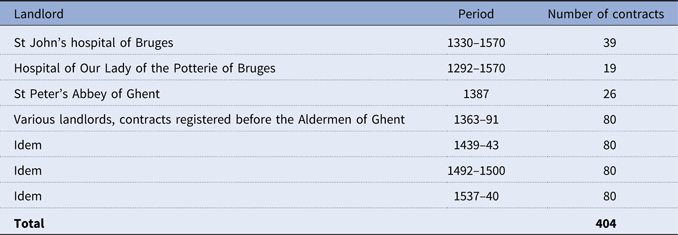
Agreements between landowners and lessees were defined in lease contracts, which mentioned the name of the tenant(s), a description of the land, the term and the price, and the conditions. Most of these contracts have not been preserved since they lost their function when the term expired. In medieval Flanders, private contracts such as transfers of property, loans, and marriage agreements were authorised and sealed by the local aldermen. Lease contracts as well, especially those from lay landlords, were validated by local magistrates. The most extended collection of lease contracts can be found in the registers of the aldermen of the city of Ghent. For the period between 1339 and 1679, more than 3,000 lease agreements have been preserved, involving parts of land and farms situated in the wide area around Ghent. Thanks to an edited index of all lease contracts, I was able to create a number of samples in order to assess the presence of women in these legal acts.Footnote 31 In addition to the extensive collection from Ghent, I also examined the contracts of three major landowning institutions. St John’s hospital and the hospital of Our Lady of the Potterie, both large hospitals in Bruges, owned several large farms in the countryside around Bruges.Footnote 32 St Peter’s Abbey in Ghent owned land in several parts of the Low Countries and in France. My focus here will be on the former.Footnote 33 In doing so, I include both the most important and a variety of different types of landowners, for example, ecclesiastical institutions, urban charitable institutions, noble families, rich urban merchants and craftsmen, in my analysis (Table 1).
Corpus of examined lease contracts for Flanders (1292–1570).

Remarkably, women did appear in late medieval Flemish lease contracts. Around one in every six written agreements under consideration mentioned a woman as tenant (67 out of 404; 17 per cent). The number of contracts concluded with a widow was limited (8 cases). Apparently, although widows were legally capable to enter contracts, few did. In most cases, women appeared together with their husbands (58 cases), as it was the couple that was registered as tenant. For instance, Jan Alaert and Katelijne sPoorters leased a farm of approximately twenty hectares from St Peter’s Abbey in 1440. As this example shows, the identity of the wife did matter. All of these women were mentioned in person. Moreover, half of them were mentioned by their maiden name. Pieter Goethals and Margriet Yde, for example, leased a farm from a citizen from Ghent in 1499. Some women were identified even more thoroughly, by means of their father’s name, or by an additional surname. In 1538, a large farm was rented by Jan van den Houvere and Mergriete sHamers, ‘daughter of Marten’. Women’s names appear after their husbands’ names consistently throughout the act, with no signs of subordination. Since husbands controlled and managed the joint property of a married couple, this is quite remarkable. It shows that, just as their fourteenth-century counterparts from Ghent, married rural women were legally capable.Footnote 34 Moreover, it suggests that these wives were officially considered as economic partners of their husbands in managing and cultivating the land.
However, the most striking feature of the contracts in this corpus is the connection between women’s presence and the type of leased object. Women appeared mainly in contracts when farms with a vast amount of land were rented (64 of 67 cases with farms; 96 per cent). Contracts dealing with separate and smaller plots of land, only functioning as a component of a holding, seldom mentioned women. However, this collection of lease contracts is biased: only contracts involving a minimum 5.35 hectares of land were included in the Ghent index.Footnote 35 Moreover, agreements on the smallest parcels of land were supposedly made orally. Hence, tiny plots of land are underrepresented in the body of preserved contracts. Nonetheless, the agreements concluded by the two charitable institutions from Bruges, for which the entire collection of contracts has been analysed, including small plots and large holdings, point to the same conclusion: not one contract considering a small plot of land or a limited amount of land was concluded with a couple or a widow. It looks as if wives were only mentioned when a lot of capital was involved, both in terms of the rent and in terms of the value of the leased objects, which included the stables, the barns, the house and the orchard. By registering both husband and wife, the landlord increased his chance of secure payment. In case of failure, the landowner could address both husband and wife. When the farmer suddenly died, it was quite clear who could take over the farm, since custom allowed widows to continue the agreed term. In all likelihood, widows were sometimes even obliged to take over the farm. In the rural district of Bruges before 1564, according to custom, widows could not renounce the debts and burden made by their husbands.Footnote 36 Since arriving tenants took over the manure, seeds and other things inherent to the farmland, most leaseholders owed the landlord compensation when they left.Footnote 37 Hence, it was important to mention the wives’ names. Moreover, by constantly labelling these women as lawful wives (wettelike wive) of the male tenant, the administrators of St John’s indicate that she was the one who had to be addressed when the male tenant was absent. Moreover, as I will discuss in section IV, the tenant’s wife performed another central role that made it important to record her name.
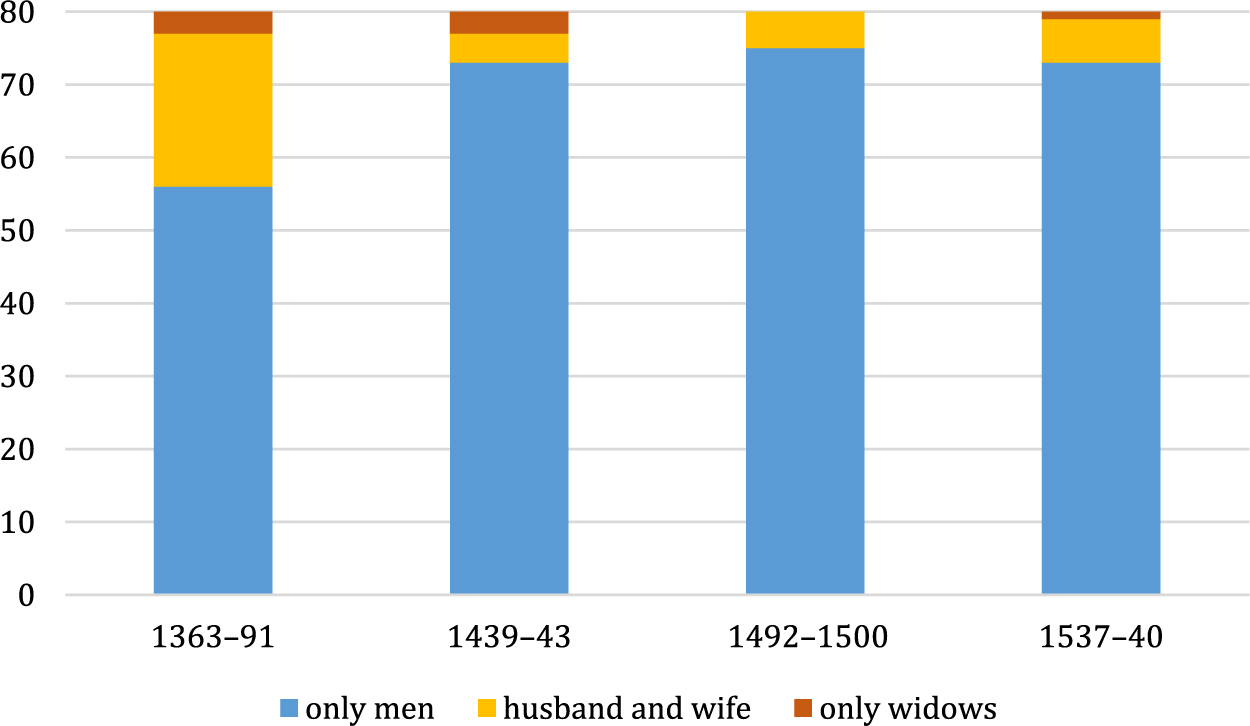
The presence of women in studied legal agreements was not related to geographical differences or specific (types of) landlords. On the other hand, their appearance was clearly time bound (Figure 1). Most contracts mentioning women date from the fourteenth century (24 out of 80 for the period from 1363 to 1391). In the fifteenth century, only a limited number of agreements included women, while in the middle of the sixteenth century, the percentage again increased slightly (7 out of 80 for the period from 1537 to 1540).Footnote 38 However, there is still the question of whether this evolution corresponds to actual practice, as revealed in the day-to-day administration of landlords.
Women appearing in the lease contracts of the Ghent registers, according to marital status (1363–1540): number of contracts.

III. Who is paying the rent?
Just as the legal framework, lease contracts are prescriptive.Footnote 39 To reveal the actual participation of women in the lease market, we need to turn to sources of practice, in particular to rentals and accounts, even running accounts, of landlords. Rentals have been used extensively to explore women’s activities on the land market, especially for England and the south of France.Footnote 40 Registers administering leasehold land, on the other hand, have seldom been used by scholars using a gendered perspective. While several landlords in late medieval Flanders kept extensive records on estate management, there is one that stands out in particular: St John’s hospital of Bruges. From the end of the twelfth century onwards, St John’s was the most important charitable institution in the metropolis Bruges. The hospital, run by Augustinian friars, welcomed approximately 150 patients, who were looked after by Augustinian nurses.Footnote 41 Owning vast amounts of land in the Bruges countryside, St John’s was one of Flanders’ largest landowners. Since its management was strictly supervised by the government of Bruges, the friars compiled annual detailed accounts and regularly drew up extensive land registers. Fortunately, nearly all of these documents, which date back to the end of the thirteenth century, have been preserved. Over the course of time, leasing land became the most important source of revenue for the hospital. From around 1300 onwards, all lessees were enumerated in extensive land registers, assembled roughly every twenty years. At the beginning of the fifteenth century, all tenants who paid rent were included in the annual accounts. At this moment of time, St John’s leased land to no less than 520 tenants, who mostly had to enter new contracts and discuss the rent every nine years.Footnote 42
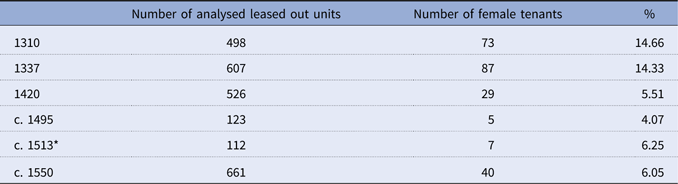
If we rely on the preserved contracts, it looks as though St John’s never leased land to women when separate, small plots of land were involved. Conversely, most tenants of large farms were accompanied by their wives in the acts. Based on these prescriptive sources, one could be tempted to think that women did not pay the rent, since husbands controlled and managed the communal estates. However, an analysis of the registers and accounts reveals that St John’s did accept rent from women’s hands. Nearly 10 per cent of all leaseholders between the beginning of the fourteenth and the middle of the sixteenth centuries was a woman (241 out of 2,527 analysed leased units).Footnote 43 This shows that, in practice, women participated on the lease market, just as customary law of the Bruges rural district allowed them to. Still, the number of female tenants decreased remarkably (Table 2). At the beginning of the fourteenth century, approximately 15 per cent of all leased out units of St John’s had a woman as tenant. This proportion decreased to 5 per cent by the beginning of the fifteenth century, and 4 per cent at the end. By the beginning of the sixteenth century, the number of female tenants increased again, but only to about 6 per cent. Despite the fact that we cannot really compare these two kinds of data, this trend is strikingly similar to the figures provided by the analysis of lease contracts.
Presence of female tenants on the estates of St John’s hospital of Bruges (1310–c. 1550).

Note: *For the snapshot of 1495 and of 1513, only a part of the estates could be considered.
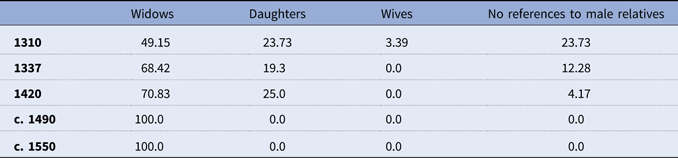
However, the participation differed according to the women’s described marital status. At the time when the proportion of female tenants decreased, their marital status changed as well (Table 3). Apparently, in the first half of the fourteenth century, every woman, regardless of her marital status, could lease land from St John’s. In the registers of 1310 and 1337, women were described as widows, daughters and wives. Several women, such as Adelice Clais or Katelijne Scoucherens, for example, lacked references to male relatives. Although historians have stressed that not every daughter or every woman without reference to a husband or a father was necessarily a single woman,Footnote 44 this is indeed an assumption I will make in the case of St John’s. In contrast to the results of, for instance, S. Hutton and A. Bardyn,Footnote 45 daughters and unrelated women are only a minority within my sample. Moreover, there were some cases in which it became clear that these women were the former tenant’s daughters. In 1310, Weitin filius Weitin Da[mma]nds leased a plot of 0.32 hectares in the village of Houtave. In 1337, the very same plot was leased by Margriete, filia Weitin Dammands. Weitkin filius Maes, tenant of a plot of 0.47 hectares in 1310 in the village of Koolkerke, was succeeded by his daughter Griele. In 1337, Griele was still registered as the tenant of that same plot, without reference to a husband and, moreover, as paying a higher rent. Finally, an analysis of a tax list of the village of Zuienkerke from 1425, where St John’s owned an abundance of land, shows that several single women did indeed live on their own, and in all likelihood rented a tiny house and/or plot of land to make a living.Footnote 46 The number of possibilities for unmarried women clearly diminished from the middle of the fourteenth century onwards. In the records of the late fifteenth and sixteenth centuries, we encounter only widows. Moreover, in this later period, widows, such as the widow Lambrecht Camsins for example, were only identified by their husband’s name. By contrast, in the fourtheenth and the beginning of the fifteenth centuries, widows were frequently labelled by their forename, followed by the relation to their deceased husband, such as Heilzoete, widow of Godevaert filius Jan, for example.
Categories of marital status of land leasing women on the estates of St John’s hospital of Bruges (1310 –c. 1550): percentages.

The sudden decline in the number of women’s activities in St John’s estates in the second half of the fourteenth century and beginning of the fifteenth century contradicts the assumption that the plague resorted advantageous economic effects for women. In St John’s estates at the north of Bruges, for which various successive registers were compiled, the number of female lessees decreased markedly shortly after the middle of the fourteenth century.Footnote 47 The most likely explanation for this trend is an economic one: as in recent eras, women especially suffered from vulnerability during economic crises. The Flemish coastal area, where St John’s possessions were situated, fundamentally changed during the late Middle Ages. The region evolved from a peasant society into a society dominated by large, commercially oriented leasehold farms. Gradually, smallholders who only leased one plot of land were replaced by farmers who accumulated different small parcels in order to create new large tenant holdings.Footnote 48 This implied a shift in the nature of tenants, from rather poor smallholders to quite wealthy and settled farmers. In the fourteenth century, the lease market in the Flemish coastal area could be described as mobile, open and competitive. Rents were continually on the rise. The mobility rate among tenants was high: approximately 70 per cent of all tenants was succeeded by another tenant after one term of nine years. In the sixteenth century, the lease market transformed into a rather closed and inert market. Fathers were frequently succeeded by their sons as farmers.Footnote 49 In the fierce competition of the second half of the fourteenth and the beginning of the fifteenth century, single women soon lost out. That women indeed had an inferior position among the tenants of St John’s becomes clear through the relationship between sex and the surface area of the leased land. Compared to men, women mostly rented the smallest parcels of land, encompassing no more than 0.50 hectares (Table 4). In 1310, 63 per cent of female tenants leased plots smaller than 0.50 hectares, compared to 51 per cent of male tenants. Also, in England before the plague, most female customary tenants held only small cottages or crofts, or were smallholders, while the size of tenancies varied widely.Footnote 50
Relation between sex and leased surface area on the estates of St John’s hospital of Bruges, 1310: percentages of tenants, according to sex, holding land from different sizes

There is a striking correspondence between the disappearance of women, especially single and married women, as leaseholders in the rural district around Bruges and the trends in the large cities of the southern Low Countries. Aside from increasingly losing access to the guild-dominated labour market, women were gradually banned from the management of real estate.Footnote 51 St John’s data is a perfect match with the chronology that was determined for Ghent, with respect to which S. Hutton noticed that the participation of women in economic activities such as transfers of property and lending/borrowing money shrank between the middle of the fourteenth century and the 1420s. Moreover, the proportion of widows among active women doubled during this period, just as it did in the rural area around Bruges.Footnote 52 To explain these changes, M. Howell and S. Hutton have pointed to the changing economic situation in the Flemish commercial hubs. The fourteenth century was marked by economic dislocations and a series of serious short-term crises. The all-important cloth industry became leaner and less profitable. As the economy contracted and transformed, women lost access to middling economic niches.Footnote 53 However, legal and cultural factors were also at stake. M. Howell and S. Hutton have indicated the growing importance of feudal law. In it, property was envisioned as patrimony, and should therefore remain within the direct male line. In contrast to customary law, daughters’ inheritances were limited to dowries, and those of widows to usufruct in order to preserve property for the patrilineal family or agnatic lineage. Urban elite groups, seeking office in the growing bureaucracy of the Burgundian state and marrying into noble families, adopted noble behaviour and lifestyles. Their patrimonial discourse questioned women’s competence in economic matters and emphasised the importance of male control over households. Consequently, men often acted on behalf of women to manage property, and married women did not perform any legal economic activities without explicit permission from their husbands. In late medieval Ghent, single women living outside male-headed households were the ones who lost most ground. Widows were allowed to carry out a wide range of activities, often under guardianship, under the assumption that they were preserving their late husbands’ businesses for future generations.Footnote 54 According to M. Howell, this shift changed women from ‘creators of property to carriers of property’.Footnote 55 These ideas percolated down into customary law, culminating in the introduction of marital power in the sixteenth century, when married women officially lost their legal capability.Footnote 56
Undoubtedly, these shifts in legal and cultural ideas in the Flemish cities had an impact on the rural lease market. Elite groups from the large cities were closely related to rural noble families.Footnote 57 A large amount of land in the Flemish polders was owned by urban dwellers.Footnote 58 It is possible that St John’s administrators became convinced that leasing land should be the privilege of male household heads. Although the presence and the impact of such ideas is difficult to attest, the changing way in which female tenants were labelled, that is, the omission of their proper names, demonstrates that the legal shifts affected St John’s administrators.
Nevertheless, this evolution only applies to the leasing out of separate, small plots of land. For large, complex farms the only women registered as tenants in St John’s administration were widows. Unmarried women were considered unacceptable as tenants of large farms. Widows, however, could run a farm. The question now arises whether all these widows we encountered were just completing the term started by their deceased husband, as was allowed by customary law. If this is indeed the case, this means that they were forced to leave the land at the end of the term in order to be replaced by another tenant. If she was succeeded by her son, the widow would act, in M. Howell’s words, as carrier of property, with property meaning the ability to access leasehold land belonging to St John’s. This would resemble the patterns that were discovered in Flemish urban economies. However, the evidence of St John’s suggests that widows played a more far-reaching role than custom and stipulations in lease contracts suggest.
IV. The agency of widows
In order to assess the activities of widows as tenants, I will stick to the same landlord, but apply a different methodology. Thanks to St John’s detailed bookkeeping, it is possible to follow the succession of tenants for each farm and for each plot of land year after year.Footnote 59 Combining this data with fragments from the landlords’ running accounts and manuals, the career and activities of named individual tenants could be reconstructed.
Meticulously analysing the length of tenants’ presence reveals that widows habitually completed the term agreed by their deceased husband. It was almost impossible for them to enter a contract as an ‘unknown’ widow: access to the lease market was obtained through husbands. However, after the term that was started by their husbands was finished, widows frequently renegotiated new agreements with St John’s. In 1337, for example, the widow of Jan Rochen leased a parcel of 0.60 ha, paying 252 groten Vlaams. In 1352, she was still the tenant of that same plot, but now payed 288 groten Vlaams. In 1443, Lisbette, the widow of Jan Weester leased a small plot in the village of Schoondijke. In 1462, she was still registered as the tenant of that plot, while the conditions had changed. There are numerous examples of widows who stayed at the same plot of land for decades. While customary law prescribed a passive role to women (they were just supposed to complete the term), St John’s administration shows a more far-reaching role: former tenants’ widows entered into new agreements with the landlord. Apparently, the friars of St John’s hospital did not see any harm in widows as tenants. According to custom, bereaved women were capable of leasing land and managing the joint property, such as cattle and instruments, which were necessary to run a farm or smallholding.
The question arises whether these widows started new terms to help their underage children as potential tenants in the future. By remaining on the land, they could hope for a better chance for their children to enter the lease market, which was dominated by St John’s. However, only a very limited number of widows were succeeded by their sons (for the same plot of land or for land of St John’s in the same village). Apparently, widows primarily leased land, not to create prospects for their heirs, but to make a living for themselves and their family.
However, there are clear differences according to the object of the lease agreement. Indeed, all of the examples above are about separate plots of land, and not about large farms. Small parcels of lands especially remained in the hands of widows. This stands in contrast to pre-plague England, where the size of the holding seems to have had little influence on the ability of widows to succeed as customary tenants.Footnote 60 On the large farms of St John’s, those that encompassed approximately 15 to 100 ha of land, widows seem to have disappeared rapidly as tenants. On average, they stayed there for a maximum of one to two years before a new tenant arrived. In 1553 for instance, the widow of Mathieu Houfnaghele paid the rent for the farm Ter Elst in Oostkamp, which during the four previous years had been paid by her husband. Already in 1554, a new tenant was registered. For early modern Zeeland Flanders, P. van Cruyningen also noticed that farmers’ widows rarely continued as the single head of the farm.Footnote 61 Still, the bereaved women seldom left the farms. Most of them remarried fairly quickly. After the marriage, the women’s second husband was registered as St John’s new tenant. The new tenant of the above-mentioned farm Ter Elst in 1554 was the new husband of his predecessors’ wife. Jan filius Pieter Wittinc, for instance, was the farmer of Meeste Goed ter Donk in Maldegem, from 1529 to 1540. His widow remarried to Mathijs Heregheers, who became the new tenant until at least 1548. The woman also lost her second husband, after which she controlled the farm for several years, until her son from her first marriage, Pieter Wittinc, took over. Unfortunately, Pieter died early, and his widow brought in the new tenant, Dand Thiers, by remarrying. In some cases, the new husband took over immediately. For example, Anthuenis filius Christiaen Arnouts was the tenant of Nieuwenhove farm in Zuienkerke between 1502 and 1515. His successor, Jan filius Pieters Heindricx, who paid the rent in 1516, was the second husband of Anthuenis’ wife. Thanks to this fortunate marriage, Jan filius Pieters became a successful farmer,Footnote 62 who in his turn was succeeded by his son in 1544. Marrying a tenant-widow also proved to be a successful strategy to achieve upward social mobility for the farmers of early modern Zeeland Flanders.Footnote 63 An eighteenth-century economic journal from Bruges stated that, in the polders north of Bruges, young men were obliged to marry old farmwives if they wanted to become independent and settled farmers.Footnote 64 From the perspective of the landlord, women safeguarded the continuity of the holding by bringing in a new, solvent tenant-farmer through remarriage. This frequently occurring practice also explains why St John’s always explicitly mentioned the name of the wives in the acts. One important question here is how free these women were in choosing their next marriage partner. A fifteenth-century regulation of the Abbey of Boudelo in the nearby rural district of Hulst in Zeeland Flanders suggests little freedom: widows had to ask special permission to remarry from the abbot if they did not want to lose their rights to the farm.Footnote 65
However, some widows never remarried at all, and remained the single head of the farm. In doing so, they played an active role in the negotiations and transfers with the landlord. When the widow of Ryckaert Potshoofd of the Snellegem farm took over the lease in 1477, in the running accounts of the subsequent years, deliveries of products and the payment of coins were always attributed to ‘she’ instead of ‘he’.Footnote 66 In the same running account, lease conditions used female nouns and forms when the widow of Wouter Rijcx took over at Stalhille farm.Footnote 67 Just as their delayed husbands, widows were frequently reimbursed for reparations done at farm buildings. The widow of Robrecht Doublet, who between 1540 and 1547 managed Mariemoens farm in Zuienkerke, cultivated vast areas of wheat and fodder crops.Footnote 68 The widow of Mathijs Heregheer, head of the Meeste Goed ter Donk, sold large quantities of timber and firewood to St John’s. Just as her deceased husband, the widow of Jacob Rijcx of the farm in Oostkerke sold large quantities of butter, cheese and oats to St John’s each year.Footnote 69 Sixteenth-century large ecclesiastical households in England also had female suppliers, mostly widows. However, the volume and/or financial value of these transactions was significantly lower than those of their male counterparts.Footnote 70 Still, the widow of Jacob Rijcx was able to deliver the same quantity to St John’s as her husband had done in the decades before.Footnote 71 Clearly, St John’s hospital accepted widows as economic partners.
Nevertheless, most tenant-widows of large farms remarried fairly soon. The question remains why they chose to do so, especially when compared to the tenant-widows of separate and small plots of land, who usually remained in charge for a longer time. Unfortunately, we do not know the age of these women and the number of their (minor) children, which were factors that highly influenced their prospects of remarriage.Footnote 72 Both categories of widows were attractive marriage-partners, since they had access to land, which was increasingly dominated by rich landlords and their wealthy tenant families in the region.Footnote 73 The tenants of St John’s farms belonged to the wealthiest families of the local communities.Footnote 74 Their widows were undoubtedly very attractive marriage-partners. The higher demand for farmland, in contrast to small plots of land, from the 1540s onwards, could have stimulated faster remarriages among farmwives. Apart from differences in demand and the availability of both types of holdings, there were also differences in managing and workload. According to van Cruyningen, early modern farmwives of Zeeland Flanders were capable managers of holdings, as they had acquired the necessary knowledge and experience during childhood and marriage.Footnote 75 That some widows maintained themselves for decades as independent and successful managers of St John’s farms supports this assumption. In all likelihood, the main problem was the gathering and commanding of the necessary workforce, especially during the harvest season. Considering the general shortage of labour in the Flemish polder area, it might not always have been possible to hire a sufficient number of day labourers. The changing labour legislation in the coastal area is a sign of growing tensions between employers and employees.Footnote 76 Once hired, male labourers might not respect the widow, or refuse to carry out her orders. In this light, it is significant that, at the farm directly managed by St John’s, positions of supervision, such as the work of the harvest, were always in male hands.Footnote 77 Unable to punish disobedient labourers physically, the widow would be hard-pressed to maintain her authority.Footnote 78 Apart from this, living-in male servants who were not relatives may have given rise to gossip, and to a situation that was probably socially unacceptable.Footnote 79 On the other hand, the tenants of small, separate plots of land probably cultivated less land than the large farmers of St John’s. Hence, the labour of the own family usually sufficed, and even if it didn’t, the widow could still appeal to nearby-living relatives or neighbours to help.Footnote 80 Hence, these widows probably felt less need to remarry.
Yet, the performance of widows, regardless the size of the holding, suggests these women were actively involved in farm management during their marriage. Just as in late medieval Flemish cities, wives were economic partners of their husbands. They performed an array of tasks on the farm, from milking cows, making butter, raising poultry, selling eggs on the market to making hay and harvesting wheat.Footnote 81 In all likelihood, decisions about land and farm management were taken by agreement. However, as long as the husbands were alive, all activities considering the land were registered under their name.
Concluding remarks
Regarding the late medieval period, historians have mostly focused on opportunities for women on the labour market. The post-plague labour shortage is thought to have increased the participation of women in the labour market, and even to have led to a greater wage equality between the sexes. Other historians have cast doubt on these claims, arguing that, because of patriarchal prejudices towards women, the work they did was inevitably low-skilled, low-status and low-paid. However, this debate has overlooked the importance of land. Despite its growing importance, women’s paid work in the late medieval rural world was irregular, in accordance with the seasons, and piecemeal, according to the specific nature of the tasks that needed to be done. Land remained the primary source of income. Access to land was regulated by a whole spectrum of local customary laws and inheritance regimes. However, from the middle of the thirteenth century onwards, a new way of gaining access to land emerged and spread: leasehold. Up until now, historians have seldom questioned the impact of this new type of landholding on women. In Flanders, where short-term and competitive leasehold spread early and widely, women’s opportunities to lease land clearly decreased between c. 1300 and the middle of the sixteenth century. This is not just clear from the declining number of participating women, but also from their marital status. Initially, all women, regardless of marital status, could lease a plot of land independently, but by the beginning of the fifteenth century only widows were paying rents. This evolution requires us to rethink the assumption of (single) women’s growing participation in the labour market that has been formulated with regard to post-Black Death Europe. The growing intolerance to women, especially to single women, as independent cultivators of land could have forced them to turn increasingly to paid labour. More in-depth research, combining data on various sources of income, for example, land and labour, for the same localities or regions, is necessary to verify this hypothesis.
In contrast to what custom suggests, widows remained far from passive on the Flemish lease market. They frequently renegotiated conditions with the landlord, and often stayed for decades on the land that was once rented by their husbands. Clearly, landlords considered tenant-widows to be capable land managers. Still, the marked difference between widows according to the size of the holding suggests that the capacity of women as supervisors and commanders of large groups of workers was doubted. Apart from marital status, the size of the holding appears to have determined women’s opportunities on the Flemish lease market.
Since the arrangement and importance of leasehold varied regionally, future research bringing a gender perspective into this aspect of landholding should expand to regions where leasehold followed another trajectory. Since estate management varied from landlord to landlord, future research should also consider the management strategy of the landlord. A comparison between different regions and different landlords in the changing world of late medieval rural northwestern Europe could reveal the determining factors for women’s access to land, offered on the emerging lease market. Since land remained the foremost source of income far into the pre-industrial era, the importance of access to land for half of the population cannot be underestimated.
Acknowledgements
I would like to thank the participants of the workshop ‘Women’s Fortunes’ in Louvain (2016), the participants of the session ‘Management and Transfers of Real Estate by Women in the pre-Industrial Period (1300–1800)’ at the European Social Science History Conference in Belfast (2018), and Thijs Lambrecht and Thérèse de Hemptinne for their suggestions and comments on earlier drafts or parts of this article.