


“The Central Bank has adopted and will continue to adopt pro-market policies and will ensure price stability. This is essential . . . to believe in a country that enjoys annual remittances of six billion dollars, the highest per capita in the world. Our markets have shown resiliency in difficult times.”
—Governor Riad T. Salameh, Central Bank of Lebanon, 2008Footnote 1Governments in developing countries have long realized that migrant remittances are a significant source of external finance. Remittances—which arise when migrants send money back home to their families—are not only an important lifeline for some of the poorest countries in the world, but also constitute a sizable share of gross domestic product (GDP) for emerging market countries. In countries such as El Salvador, Haiti, Honduras, and Jordan, inflows of remittances exceed 15% of GDP. In 2004, a total of 42 developing countries had inflows of remittances greater than 5% of GDP.Footnote 2 The World Bank estimates that total recorded flows of remittances reached $318 billion in 2007; this is a staggering sum that dwarfs other external financial sources, such as official development assistance, bank lending, and private investment. Annual flows of remittances even exceed foreign direct investment (FDI) for the majority of developing countries. Central bankers, such as Governor Salameh of the Central Bank of Lebanon (quoted previously), have certainly taken notice and are deeply aware of the impact of remittances on their economies.Footnote 3
Remittances pose a challenge to our understanding of the influence of global finance on national policy choices in the developing world. Indeed, as a form of capital inflow, remittances have many unusual characteristics. Most strikingly, they are “unrequited”: they do not result in claims on assets, debt service obligations, or other contractual obligations (Brown Reference Brown2006; Kapur Reference Kapur, Maimbo and Ratha2005). In contrast to purchases of financial or productive assets, which can be liquidated and repatriated, remittances cannot be withdrawn from a country ex post. They therefore cannot be lumped together with other capital flows that arguably cause household insecurity or income volatility, such as FDI and portfolio flows (e.g., Ahlquist Reference Ahlquist2006; Garrett Reference Garrett1998; Scheve and Slaughter Reference Scheve and Slaughter2004), or with financial capital that can be withdrawn by investors in reaction to unfriendly government policies (Jensen Reference Jensen2006; Li and Resnick Reference Li and Resnick2003; Mosley Reference Mosley2000, Reference Mosley2003). Moreover, migrants tend to increase their remittances when their countries of origin experience economic difficulties. As a result, remittances smooth the incomes of families and shield policy makers from the vagaries of the global economy. In short, financial transfers from migrants are a form of insurance for developing countries against exogenous shocks (Kapur Reference Kapur, Maimbo and Ratha2005; Lopez-Cordova and Olmedo Reference Lopez-Cordova and Olmedo2006; Lucas and Stark Reference Lucas and Stark1985; Rapoport and Docquier Reference Rapoport and Docquier2005; Yang and Choi Reference Yang and Choi2007).
What are the implications for national policy making when cross-border financial transfers within families emerge as a prominent force in the global economy? The prominence of remittances has potentially profound implications for a variety of national policy choices.Footnote 4 This article focuses on exchange rate policy, which is arguably the most important macroeconomic policy domain for governments in developing countries (Cooper Reference Cooper1999).Footnote 5 Indeed, the exchange rate is the most important price in an open economy, because it affects the prices of all other goods and services. As with most economic policy choices, exchange rate policy entails important trade-offs (Bernhard and Leblang Reference Bernhard and Leblang1999; Broz Reference Broz2002; Cohen Reference Cohen, Higgott, Leaver and Ravenhill1993; Frieden Reference Frieden1991; Leblang Reference Leblang1999; Walter Reference Walter2008). Policy makers choose fixed rates to facilitate international trade and investment and provide an anchor for monetary policy, but they lose the ability to adjust monetary policy to changing domestic circumstances—an ability commonly dubbed “domestic monetary policy autonomy.” Policy makers select floating rates to retain the ability to adjust interest rates in reaction to exogenous shocks or economic downturns, but they incur costs in terms of increased uncertainty in international economic relationships and greater difficulty in anchoring expectations about inflation.
This article argues that remittances are an important influence on exchange rate policy making in the developing world, along with political institutions, interest groups, and other political economy considerations. Remittances mitigate the political costs of lost monetary policy autonomy because they react countercyclically to economic downturns and otherwise insulate policy makers from economic volatility. In essence, remittances have the capacity to substitute (albeit imperfectly) for domestic monetary policy autonomy in the developing world. Therefore, I expect inflows of remittances to be positively associated with the implementation of fixed exchange rates. I develop this argument using conventional macroeconomic models in unconventional ways. Using Robert Mundell's (Reference Mundell1961) optimum currency area framework, I argue that migrant remittances serve a function similar to that of cross-border government transfers (or other supraregional risk-sharing mechanisms) in allowing the domestic economy to adjust to a fixed exchange rate.
I begin with an overview of remittances in the global economy, including trends, causes, and consequences. I also summarize the ample evidence of the countercyclicality of remittance flows. I then provide an empirical test of the hypothesis that remittances, along with interest group pressures, political institutions, and macroeconomic conditions, are important determinants of exchange rate regimes in the developing world. Using newly available World Bank data on annual remittances from 1982–2006 for up to 74 developing countries, I demonstrate that countries for which remittances constitute a substantial share of GDP are more likely to adopt fixed exchange rates. This finding is of particular significance given the recent ideological shift against fixed rates: it appears that remittances encourage policy makers to go against the tide. The findings are robust to multiple model specifications, including de facto and de jure measures of exchange rate policy. I also account for possible endogeneity by using migrant flows to wealthy countries as an instrumental variable for remittances. The article concludes with a discussion of the broader implications of remittances for the political economy of national policy making in a global economy.
REMITTANCES: DEFINITIONS, TRENDS, AND CONSEQUENCES
International financial transfers from migrants to family members in their home countries are known as remittances. A typical remittance transaction contains two parts: (1) the migrant contracts with an agent—a money service business such as Western Union, a bank, or an informal agent—and transmits the money to the agent via cash, check, credit card, or other debit instruction; and (2) the agent instructs its own affiliate in the receiving country to deliver the remittance to the beneficiary (Ratha Reference Ratha2005a).
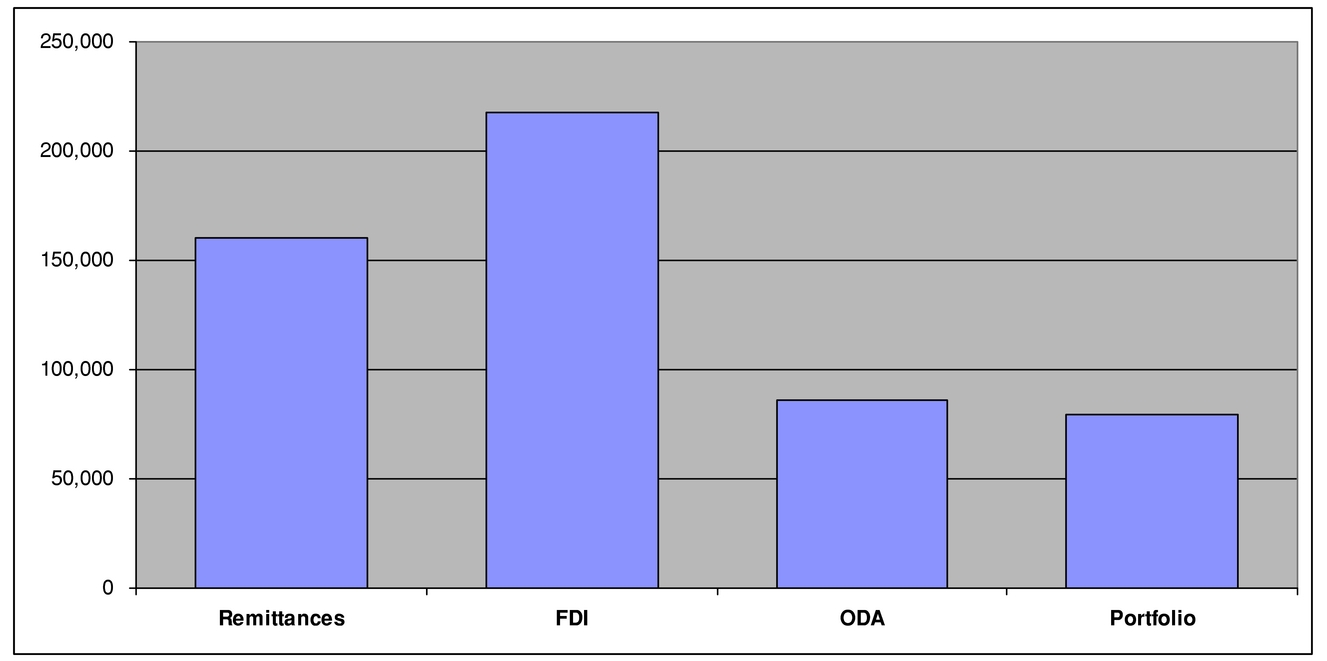
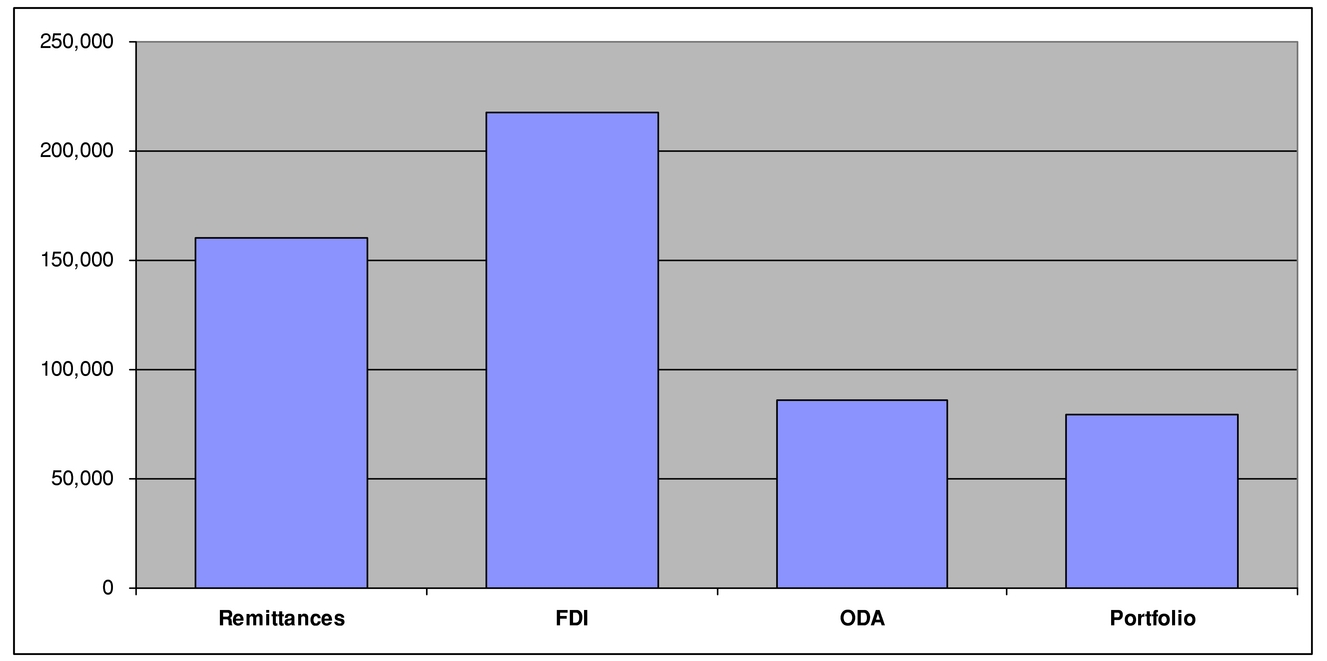
Remittances have experienced strong growth over the past two decades. Recorded remittances to developing countries increased from $31.2 billion in 1990 to $160 billion in 2004, and to more than $300 billion in 2007. The rate of growth was highest for “lower middle income countries” (with approximate GDP per capita between $1,000 and $3,500), a category that includes countries such as El Salvador, Indonesia, and Tunisia. The growth in remittances is particularly striking in comparison to portfolio investment (private debt and equity), which declined by 20% between 1995 and 2004, and official development assistance, which increased by a modest 34% over the same period. The result of these trends is that remittances are second only to FDI as a source of external capital flows in the developing world (Figure 1). Indeed, remittances were larger than the total of all public and private capital inflows—including FDI, foreign aid, and private debt and equity investment—for 36 countries in 2004. Even in Mexico, which is known for attracting investment from U.S. corporations, inflows of remittances have been nearly equal to FDI inflows since 2003.Footnote 6
Capital Inflows ($Millions) to Developing Countries, 2004
Migrants in the United States remitted nearly $39 billion to their countries of origin in 2004, making it the largest source country for remittances (World Bank 2006). The other significant source countries include many of the large continental European economies (Germany, France, Switzerland, and Italy) as well as the countries of the Gulf, including Saudi Arabia, Kuwait, and Oman.
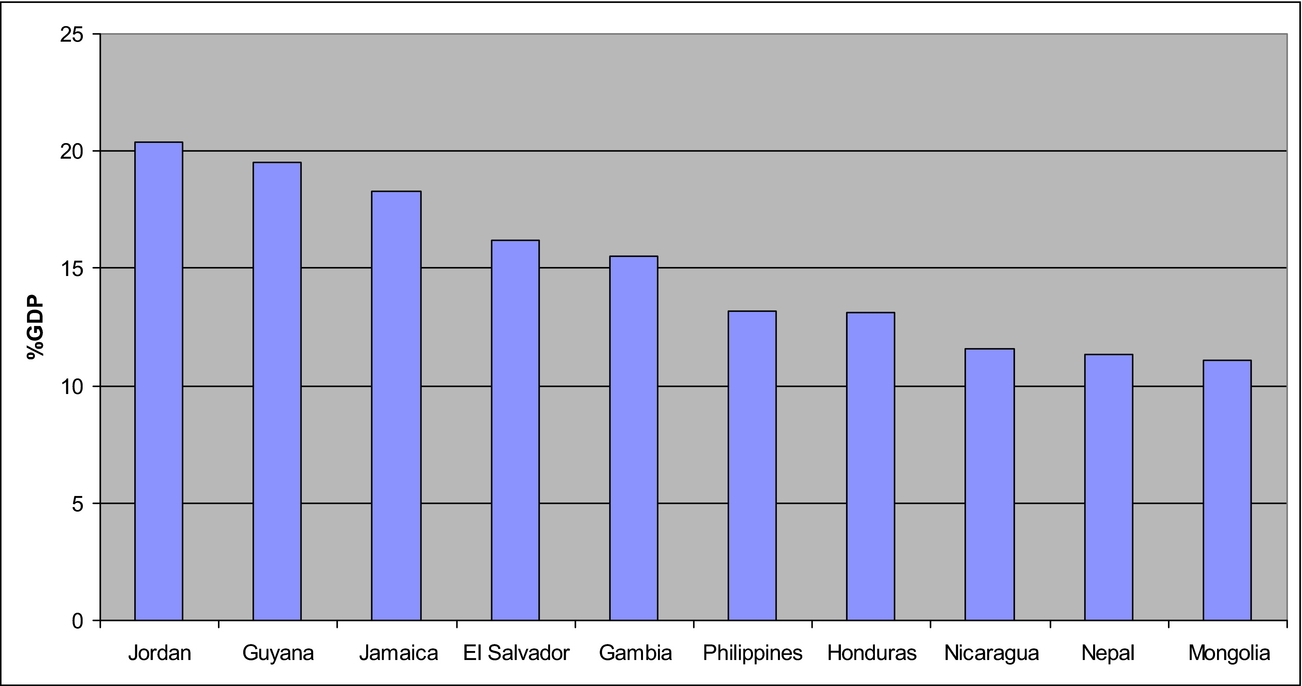
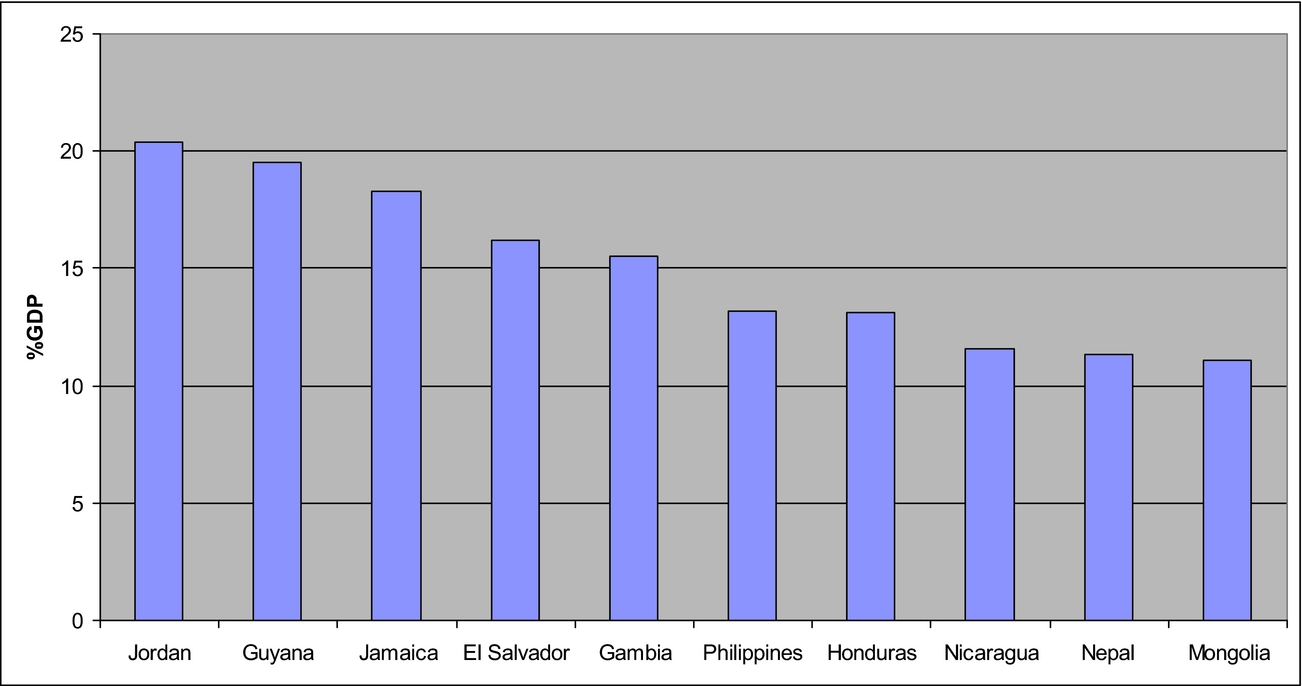
It is a misconception that remittances flow only to very poor countries. Perhaps surprisingly, in 2004, France, Spain, and Belgium were among the 10 largest recipients of remittances. Among developing countries, more than 70% of total remittances accrue to those in the “middle income” bracket, including China, Honduras, and Peru. Nevertheless, for poor countries such as Mongolia, Nepal, and the Gambia, remittances frequently constitute more than 10% of GDP and thus are a critical lifeline for the resident population (Figure 2).
Remittance Inflows (%GDP), to Selected Countries, 2004
Causes and Consequences
Remittances are the international financial consequence of immigration, which has been steadily increasing in recent times. The total stock of migrants—estimated at 175 million in 2000—increases by approximately six million annually, which is appreciably faster than the growth of world population (International Labor Organization 2004). Between 1970 and 2000, the number of migrants in North America increased from 13 million to 41 million, or approximately 3.7% annually; for Europe, the number of migrants increased from 19 million to 33 million over the same period. Approximately 50% of all migrants are considered economically active—that is, they are gainfully employed in the host country—whereas the other half consist of students studying abroad, those accompanying economically active family members, and refugees [International Organization of Migration (IOM) 2005]. Although migration has been increasing steadily, it is certainly not a new phenomenon, and it alone cannot explain the steady increase in the flow of remittances. Other factors, such as technological developments in financial infrastructure, have reduced the costs of transmitting funds between countries. Money transfer businesses—especially Western Union—have experienced tremendous growth: there are now more than seven times as many Western Union agents worldwide (more than 400,000 locations in 200 countries) than McDonalds and Starbucks locations combined.Footnote 7 Capital account liberalization, including the relaxation of restrictions on foreign exchange deposits, has no doubt facilitated the international reach of these businesses [International Monetary Fund (IMF) 2005]. Domestic financial institutions have also matured as countries have liberalized capital flows and embraced (in varying degrees) the global economy. Banks throughout the developing world have adopted modern risk management techniques and improved their lending portfolios, and in the process they have reeled in many more citizens as customers. Kapur (Reference Kapur, Maimbo and Ratha2005) notes that banks in developed countries also facilitate the flow of remittances by competing with money transfer agents for migrants’ business. Migrants in developed and emerging market countries now have several options for sending money back home. The transaction costs of remitting funds will continue to decline as developing country financial infrastructure improves and new transfer agents enter the market.
To understand the consequences of remittances, it is helpful first to understand the motivation of remitters. Rapoport and Docquier (2005, 10) note that migration should be viewed as “an informal familial arrangement, with benefits in the realms of risk diversification, consumption smoothing, and intergenerational financing of investments.” This definition captures both altruistic and self-interested motivations for remittances.Footnote 8 Altruism within the context of family relationships is perhaps the most obvious motivation: migrants want to support their family members who remain behind, and their transfers of funds do not lead to promises of future compensation. Family members use remittances primarily to finance consumption, including food, shelter, health care, and basic utilities (Adida and Girod n.d.; Brown Reference Brown2006; Chami, Fullenkamp, and Jahjah Reference Chami, Fullenkamp and Jahjah2005; Durand and Massey Reference Durand and Massey1992; Glytsos Reference Glytsos1993).Footnote 9 Migrants might also send money home for self-interested reasons, such as to maintain or expand existing investments (businesses, land, etc.) that they left behind, or to repay loans. Some scholars have argued that ostensibly self-interested motivations can be subsumed under the rubrics of “enlightened selfishness” or “impure altruism” because remittances are transmitted between individuals with strong familial (i.e., nonfinancial) ties (Andreoni Reference Andreoni1989; Lucas and Stark Reference Lucas and Stark1985).
There is a substantial literature on the poverty-reducing impact of remittances, which is largely beyond the scope of this article.Footnote 10 However, the “multiplier effects” of remittances deserve special mention here. Inflows of remittances generally contribute more than their initial value to the receiving economy (Orozco Reference Orozco2004; Ratha Reference Ratha, Maimbo and Ratha2005b). One study of the Mexican economy found that each remitted dollar generates $4 in demand for goods and services (Durand, Parrado, and Massey Reference Durand, Parrado and Massey1996). An important implication of the multiplier effect is that households that do not receive remittances still benefit indirectly from remittances to other households. For example, construction workers, timber producers, and day laborers benefit if remittances are used for home building (Choucri Reference Choucri1986). Even remittances to rural and remote areas have a broader economic impact, because the secondary beneficiaries of these capital inflows include goods and labor markets in urban areas (Zarate-Hoyos Reference Zarate-Hoyos2004).
Countercyclical Remittance Inflows
Remittances are transfers between families that tend to flow countercyclically relative to the recipient country's economy (Frankel Reference Frankel2009; World Bank 2006). Migrants send more money home when their families experience economic difficulties. Moreover, adverse circumstances often trigger more migration, which then results in greater remittance inflows. As Brown (Reference Brown2006, 60) notes, remittances serve as “transnational intra-family or intra-community safety nets, cushioning societies from the disruption attending more volatile financial flows.” If the receiving household experiences economic hardship, the migrant can increase her remittances by a relatively modest amount—say, 5% or 10%—without causing him- or herself inordinate financial harm. Yet, even an unchanging flow of remittances in response to economic adversity provides a powerful stabilizing influence. In the aggregate, such financial flows offer a powerful buffer against economic contractions in the receiving country, especially compared to other capital flows (with the exception of foreign aid), which are likely to decline in response to downturns or shocks.Footnote 11
Several empirical studies, including Chami, Fullenkamp, and Jahjah (2005), Frankel (Reference Frankel2009), IMF (2005), and Kapur (Reference Kapur, Maimbo and Ratha2005), find a strong relationship between economic contractions and subsequent increases in remittances for developing countries. Indeed, Kapur (Reference Kapur, Maimbo and Ratha2005) finds that the average share of remittances in private consumption for 14 developing countries more than tripled in the three years after an economic downturn.Footnote 12 An IMF (2005) study reports that countries such as Mexico, Indonesia, and Thailand experienced a significant increase in remittances in the two years immediately after their respective financial crises in the 1990s; similarly, Bangladesh, the Dominican Republic, Haiti, and Honduras experienced increases after natural disasters.Footnote 13 More recently, the Philippines central bank reported that remittances increased by 11% in November 2009 compared to a year earlier, largely as a result of migrants sending more funds home in the wake of two devastating typhoons.Footnote 14
Among the most compelling studies of the countercyclicality of remittances are Yang (Reference Yang2008) and Yang and Choi (Reference Yang and Choi2007). Yang (Reference Yang2008) finds that remittances increase substantially in the wake of hurricanes in a panel of more than 70 developing countries between 1970 and 2002. Clarke and Wallsten (Reference Clarke and Wallsten2003) find similar results for the responsiveness of remittances to Hurricane Gilbert in Jamaica in 1988. Given these articles’ focus on natural disasters as the trigger for remittances, there is no concern over endogeneity. Yang and Choi (Reference Yang and Choi2007) are also sensitive to endogeneity in examining how remittances respond to household income shocks in the Philippines. Using rainfall shocks as an instrumental variable, they find that 60% of household income contractions are replaced by remittance inflows.
Remittances are unusual in their tendency to mitigate economic volatility (Frankel Reference Frankel2009). A large sample study conducted by the IMF (2005) found that remittances substantially reduce the volatility of output, consumption, and investment. Even in periods of stable economic growth, remittances are far less volatile than other capital flows; even foreign aid was more volatile than remittances from 1980 to 2003 (IMF 2005). Moreover, notwithstanding current reports of a temporary downturn in remittances from the U.S. to Mexico, a recent IMF study demonstrates that remittances to Latin America are relatively insensitive to the U.S. business cycle, thereby underlining their role as a stable source of external finance (Roache and Gradzka 2007). It is therefore becoming increasingly common for scholars to emphasize the “insurance” function of remittances for the developing world (Kapur Reference Kapur, Maimbo and Ratha2005; Kapur and McHale Reference Kapur and McHale2005; Lopez-Cordova and Olmedo Reference Lopez-Cordova and Olmedo2006; Yang and Choi Reference Yang and Choi2007).
Many scholars believe that countries require some form of insulation from global financial markets, such as welfare state spending, a larger government, or some other form of redistribution (Garrett Reference Garrett1998; Katzenstein Reference Katzenstein1985; Rodrik Reference Rodrik1998; Ruggie Reference Ruggie1982; Scheve and Slaughter Reference Scheve and Slaughter2007).Footnote 15 If, however, remittances can serve as a form of insulation rather than a source of insecurity or volatility, then political economy models should pay careful attention to the unique influences of remittances on policy making.Footnote 16
THE POLITICAL ECONOMY OF EXCHANGE RATE REGIMES
The analytical heart of the literature on the political economy of exchange rates is the Mundell-Fleming model and its famous implication that countries must choose to forgo one of three policy goals: exchange rate stability, full capital mobility, or domestic monetary policy autonomy (Fleming Reference Fleming1962; Mundell Reference Mundell1960). In today's world of highly integrated financial markets, a discrepancy between the domestic and world interest rates causes capital to flow in the direction of the higher return. If the exchange rate is allowed to float, it will adjust accordingly—appreciating with capital inflows and depreciating with capital outflows. However, if the exchange rate is fixed, then the interest rate differential is quickly arbitraged away by the capital flows. The result is that the combination of mobile capital and a fixed exchange rate renders monetary policy ineffective as a policy tool.
The Mundell-Fleming conditions imply that governments face a trade-off between credibility and flexibility (Bearce Reference Bearce2007; Bernhard, Broz, and Clark Reference Bernhard, Broz and Clark2002; Frankel Reference Frankel1999). Credibility arises from the fixed exchange rate, which decreases transaction costs for investors, traders, and other groups with ties to the global economy (Frieden Reference Frieden2002). Reducing or eliminating exchange rate volatility can facilitate international borrowing and stabilize the real value of debts denominated in foreign currencies (Calvo and Reinhart Reference Calvo and Reinhart2002; Walter Reference Walter2008). A fixed rate also leads to monetary stability by tying the hands of monetary policy makers (Giavazzi and Pagano Reference Giavazzi and Pagano1988). Businesses and the public at large moderate their wage and price expectations because they believe the primary goal of monetary policy is to maintain exchange rate parity (Canavan and Tommasi Reference Canavan and Tommasi1997; Keefer and Stasavage Reference Keefer and Stasavage2002). Countries with high inflation are therefore especially interested in the credibility-enhancing features of a fixed exchange rate. However, at the most fundamental level, a fixed exchange rate requires the government to subordinate domestic concerns—whether political or economic—in favor of international concerns (Frieden Reference Frieden2006; Simmons Reference Simmons1994). Often this implies that the government must sacrifice short-term economic growth and employment levels to preserve the exchange rate. Moreover, rigidly fixed exchange rates may be prone to speculative attack, thereby undermining the currency stability they were designed to provide.Footnote 17
In contrast, flexibility is associated with floating exchange rates, which provide monetary policy makers with the capacity to adjust interest rates to changing domestic economic circumstances. Under flexible rates, policy makers can ease monetary policy to offset an economic downturn, thereby stabilizing employment and output. Moreover, the exchange rate can adjust to counteract current account imbalances. This flexibility comes at the cost of lower monetary policy credibility, because in the absence of a transparent target for the exchange rate, the public is unsure of policy makers’ commitments to maintaining stable prices.
A political economy model of exchange rate regime determination can be assembled largely around these trade-offs. The basic model starts with the presumption that political leaders respond to domestic (and sometimes international) political pressures from interest groups, and that these pressures are broadly mediated through and constrained by political institutions. Because actual lobbying efforts in favor of or against exchange rate policy are rare, I follow existing work in asserting a link between sectoral size (or the magnitude of a particular economic activity such as exports) and political influence over economic policy outcomes (e.g., Brooks Reference Brooks2004; Chwieroth Reference Chwieroth2007; Copelovitch n.d.; Frieden, Ghezzi, and Stein 2001).Footnote 18
The institutional influences on exchange rate policy can be culled from the emerging literature on exchange rate regime determination. Existing scholarship argues that the degree of democracy is positively associated with floating exchange rates because leaders in democratic countries face pressures from constituents to use monetary policy for domestic adjustment purposes (Bernhard and Leblang Reference Bernhard and Leblang1999; Leblang Reference Leblang1999). Broz (Reference Broz2002) further argues that democracies, which benefit from greater political transparency than non-democracies, can guard the credibility of their monetary policy-making process without tying their hands with a fixed exchange rate. Other scholars examine the relative political costs of enduring the often painful domestic adjustments required to maintain a fixed exchange rate, which are arguably lower in stable governments and those with small numbers of veto players (Edwards Reference Edwards, Ito and Krueger1999; Keefer and Stasavage Reference Keefer and Stasavage2002; Simmons Reference Simmons1994). Finally, focusing on developed democracies, studies such as those by Clark (Reference Clark2002), Clark and Hallerberg (Reference Clark and Hallerberg2000), and Hallerberg (Reference Hallerberg2002) examine the trade-off between fiscal and monetary policy discretion within the Mundell-Fleming framework. They note that fixed exchange rates enhance the power of fiscal policy when capital is fully mobile. Governments are therefore more likely to adopt fixed exchange rates when fiscal policy, rather than monetary policy, is the more effective tool for electoral gain, as in Organization for Economic Co-operation and Development (OECD) multiparty coalition states where targeted spending can be rewarded by voters (Hallerberg Reference Hallerberg2002).
Groups in society that benefit from stable currency relations with other countries, such as exporters and certain investors, can be expected to use their political influence to press for exchange rate stability (Frieden Reference Frieden1991). However, a clear mapping of sectoral interests is not always possible for a large sample of countries. Frieden and his colleagues argue that exporters and import-competers both value currency depreciation and therefore oppose a rigidly fixed exchange rate, whereas foreign investors and creditors value the stability of a fixed rate (Blomberg, Frieden, and Stein Reference Blomberg, Frieden and Stein2005; Frieden Reference Frieden2002; Frieden, Ghezzi, and Stein 2001). However, when international trade occurs between developing countries with limited capacities to hedge exchange risk, manufacturers and other exporters might prefer the currency stability and lower transaction costs afforded by a fixed exchange rate. Likewise, there are no clear partisan divides over exchange rate policy in a contemporary cross-national context. Although right governments have traditionally been in favor of price stability and the interests of the financial community, whereas left governments have favored full employment and income equality, today the mapping of those interests onto exchange rate policy is not straightforward. Left governments, for example, might be torn between an autonomous monetary policy to respond to economic downturns (under a floating exchange rate) and a possible expansion of export sector employment (under a fixed exchange rate). Likewise, right governments might prefer floating exchange rates if alternative mechanisms are available for ensuring stable prices, or if there are additional benefits to financial interests that result from a floating currency.Footnote 19
REMITTANCES AND EXCHANGE RATE REGIME CHOICE
An important consideration in the political economy of exchange rate regimes is the influence of capital mobility.Footnote 20 The disparate studies discussed previously conceive of capital mobility as the sensitivity of capital flows to domestic rates of return (e.g., Goodman and Pauly Reference Goodman and Pauly1993). Scholars generally measure capital mobility as a policy choice: if governments impose no restrictions on capital flows, then capital is assumed to be responsive to differential rates of return (e.g., Oatley Reference Oatley1999). In empirical studies of exchange rate regimes, an index of financial policy openness from Quinn (Reference Quinn1997) or Chinn and Ito (Reference Chinn and Ito2006), or a simple dichotomous variable based on IMF surveys of capital controls, is frequently the only included measure of a country's relationship with international financial markets.Footnote 21 The standard argument is that financial closure allows governments to reap the benefits of fixed exchange rates without sacrificing domestic monetary policy autonomy (Bernhard and Leblang Reference Bernhard and Leblang1999; Broz Reference Broz2002; Leblang Reference Leblang1997, Reference Leblang1999). Financial openness, in contrast, makes the adoption of fixed exchange rates less attractive and therefore less likely.Footnote 22
For developing countries, the international financial consequences of immigration must also enter the equation. Introducing remittances into the political economy model of exchange rates does not imply an abandonment of the Mundell-Fleming conditions. Indeed, mobile capital will respond to differential rates of return, even in countries that are heavily dependent on remittances. However, I argue that such countries will be less concerned about forgoing domestic monetary policy autonomy. Consider the impact of an increase in remittances during a recession in the receiving country. Households use the funds to bolster their consumption of food and basic necessities, and to maintain existing small businesses and other investments. Such spending and investment has a multiplier effect on the economy, triggering additional investment and consumer spending. In short, remittances—when sufficiently large in relation to the economy—constitute an automatic stabilizer that performs a function similar to that of countercyclical monetary policy. As such, remittances stand apart from other capital flows in that they do not exacerbate the trade-off between fixed exchange rates and domestic monetary policy autonomy. To be clear, remittances are not a panacea for economic instability: they are unlikely to prevent recessions or to respond with enough force to allow a country to sustain a fixed rate in the face of a massive speculative attack. The argument is simply that remittance inflows make it less costly for countries to adopt fixed rates.
Robert Mundell's (Reference Mundell1960, Reference Mundell1961) analyses of optimum currency areas (OCAs) provide a useful perspective on the importance of remittances in the determination of exchange rate policy. The OCA framework, elaborated by McKinnon (Reference McKinnon1963) and others, argues that countries that choose to share a common currency should respond similarly to economic shocks, such as sudden changes in the prices of commodities. The logic is straightforward: a single currency implies a single monetary policy. The same logic applies to countries with fixed exchange rates: a country that fixes its currency to the U.S. dollar essentially imports U.S. monetary policy. If economic conditions vary substantially across different regions of the currency area, a single monetary policy will prove woefully inadequate in stabilizing the economy. However, because asymmetric shocks are always possible, even in the most economically homogeneous of currency unions, countries must somehow adjust their own domestic economies to fit the prevailing monetary policy. The OCA literature has focused on two adjustment mechanisms: (1) labor mobility within the union should be high enough to allow workers in adversely affected regions to relocate to more favorable employment environments; and (2) the currency union itself should have a system of “risk sharing”—usually defined as public transfers from a supraregional authority—to respond to local shocks, just as the U.S. federal government sends emergency funds to states in times of crisis.
The OCA criteria are rarely realized in practice, especially for developing countries that anchor their currencies to the Euro, the U.S. dollar, or other developed country currencies. Shocks to developed and developing economies are likely to be asymmetric, and labor mobility is rarely high enough to be an effective short-term stabilizer. On the issue of risk sharing, however, many developing countries depend on remittances to offset economic downturns. Remittances are not fiscal transfers per se, because no central government has the power to direct them to countries in need. Yet, they do enable countries to cede some of the risks of forgone monetary policy autonomy to migrants, who in turn remit funds to their families in countercyclical fashion.Footnote 23
The previous discussion sets the stage for an empirical analysis of exchange rate policy in the developing world. The existing literature has emphasized the political and economic factors that determine how policy makers reconcile the trade-off between credibility and flexibility, but has neglected the role of remittances in tilting the balance in favor of fixed exchange rates. To be clear, remittances are not dispositive for policy makers: they ease the political costs of tying their hands with a fixed rate, but other political economy factors will weigh heavily in a policy maker's decision calculus. A complete political economy model must therefore incorporate not only a range of political and institutional variables that determine how policy makers address the trade-offs of exchange rate regime choice, but also the role of remittances as a determinant of the severity of those trade-offs.
EMPIRICAL ANALYSIS
To assess the political economy of exchange rate regimes in the developing world, I assembled a time-series cross-sectional data set with annual observations on up to 74 developing countries from 1982 to 2006.Footnote 24 The hypothesis to be tested is that remittance inflows increase the probability that a country will choose to fix its exchange rate, controlling for a variety of political, economic, and institutional mechanisms. The dependent variable is the de facto exchange rate regime, coded as a four-category ordinal variable based on data from Reinhart and Rogoff (Reference Reinhart and Rogoff2004). Higher values indicate greater degrees of exchange rate flexibility.Footnote 25 Unlike de jure classifications based on official government policy, these de facto measures of exchange rate regimes are derived from a combination of foreign reserve activity, parallel market exchange rates, and extensive country chronologies (Reinhart and Rogoff Reference Reinhart and Rogoff2004). They therefore capture the actual operation of the exchange rate regime over time. In the robustness section, I employ an alternative measure of the dependent variable based on the IMF's de jure classification.
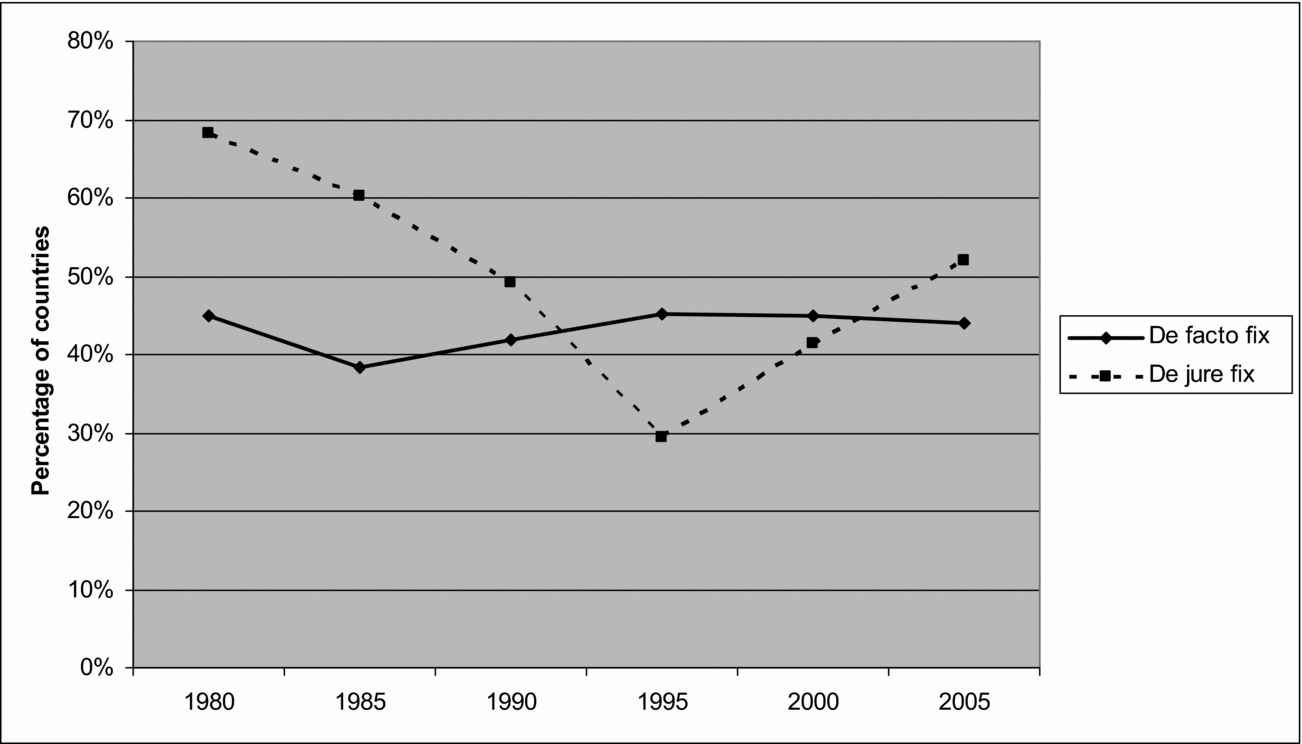
The percentage of countries in the world with de facto fixed exchange rates has remained relatively stable since 1980, hovering around 45%. However, there has been a steady decline in the number of countries with de jure fixed exchange rates, arguably reflecting a shifting “climate of ideas” in favor of floating exchange rates in the developing world (Collins Reference Collins1996).Footnote 26 Between 1980 and 1995, the percentage of countries with fixed exchange rates fell dramatically from 70% to less than 30% (Figure 3). The adoption of the Euro starting in 1999 reversed the overall trend, but for developing countries fixed rates remain far less popular today than in the 1970s and 1980s. This downward trend is addressed in the empirical analysis of de jure policy in the “Robustness” section.
Trends in de facto and de jure Fixed Exchange Rates, 1980–2005

Data on the key explanatory variable, inward remittances as a share of GDP, are newly available from the World Bank's World Development Indicators (various years).Footnote 27 I use these data with a degree of caution. World Bank researchers are able to estimate only the officially recorded inward remittances for each country-year, not the flows through unofficial channels, such as the hawala system and other informal value transfer systems. As discussed previously, recorded flows have risen substantially in recent times, and a portion of this increase may be attributable to a shift from unofficial to official transmission channels, rather than an increase in remittances per se. The World Bank attempts to mitigate this problem by using estimates from its own country desks or from national central banks when official balance-of-payments statistics are missing or of questionable construction. Nevertheless, unofficial flows remain outside the scope of the data set. I return to this issue in the “Robustness” section.
A cursory overview of the data suggests that remittances are highly correlated with exchange rate regime outcomes. Using the sample in Model 1 (described as follows), the mean level of remittances for countries with fixed exchange rates is 7.9% of GDP, whereas the mean for countries with floating rates is 3.5% of GDP.Footnote 28
I first construct a model (Model 1) that adds remittances along with key policy indicators, macroeconomic conditions, and national institutional characteristics. The size of the economy (GDP, logged) and exports as a share of GDP (lagged one period) capture the conventional argument that smaller and more open economies are more likely to benefit from a fixed exchange rate. Exports are also an interest group indicator with the expectation that firms that are dependent on external demand for their revenues are likely to prefer the stability of a fixed rate. Based on prior scholarship, capital account openness should be negatively associated with the adoption of fixed rates. However, the OCA framework suggests that countries with more open capital accounts should be more likely to adopt fixed exchange rates because high levels of financial integration can generate strong domestic support for stable cross-border financial relationships. The model includes the “KAOPEN” index of capital account openness from Chinn and Ito (Reference Chinn and Ito2006). It is based on the binary coding of restrictions in the IMF's Annual Report on Exchange Arrangements and Exchange Restrictions and focuses on four dimensions of restrictions: the existence of multiple exchange rates, restrictions on the current and capital accounts (where the latter are measured as the proportion of the past five years without controls), and requirements to surrender export proceeds.Footnote 29 The index has a mean of zero and ranges from −2.66 (full capital controls) to 2.66 (complete liberalization).
Model 1 includes a measure of democracy based on the Polity IV database (Marshall and Jaggers Reference Marshall and Jaggers2007). The variable ranges from -10 (most autocratic) to 10 (most democratic). Following Broz (Reference Broz2002) and Leblang (Reference Leblang1999), I expect this variable to be positively associated with floating. The rate of inflation (lagged one period) is included with the expectation that high inflation countries choose a fixed rate as an anchor for monetary policy.Footnote 30 The level of foreign currency reserves (as a ratio of months of imports) reflects the resources available to the central bank to intervene in foreign exchange markets.Footnote 31 Also included are the current account balance as a share of GDP and terms-of-trade volatility.Footnote 32 Policy makers in countries with current account imbalances and volatile trading patterns face incentives to allow the currency to float. Finally, the model includes the level of economic development (GDP per capita) and a dummy variable that takes a value of 1 after 1998 for any country that has joined the European Union (EU) during the sample period. This coding scheme accounts for the external pressure to maintain a stable parity with the Euro as a prerequisite to joining the EU and ultimately the Eurozone.Footnote 33
Model 2 adds more refined interest group and institutional indicators. First, it includes Henisz's (Reference Henisz2002) political constraints measure. The construction of this variable begins by identifying the number of effective branches of government—including the executive, the legislative body or bodies, the judiciary, and any other subnational units—with veto power over policy change. This initial measure is modified to reflect whether these veto points are controlled by different political parties, and the degree of preference heterogeneity within each branch. Higher values represent “stronger,” or less constrained, governments. The theoretical expectation for the impact of political constraints is ambiguous (von Hagen and Zhou 2006). Weak governments might choose a fixed rate to fend off political pressures for expansionary monetary policy; however, the maintenance of a fixed rate might require a strong (i.e., relatively unconstrained) government to subordinate domestic concerns in favor of stable monetary relations with other countries.
Also included in Model 2 are a measure of government instability and the share of manufacturing output in GDP. Government instability is measured as the percentage of the previous five years in which the country experienced an “adverse shift in the pattern of governance,” including a major shift toward authoritarianism, a revolution in the political elite, contested dissolution of federal states, or the collapse of central authority [Political Instability Task Force (PITF), various years].Footnote 34 It provides another indicator of the ability of the government to maintain a fixed exchange rate. However, as Edwards (Reference Edwards1996) notes, greater instability increases the costs of abandoning a peg and therefore reduces the ex ante probability that a peg will be chosen, whereas instability makes decision makers less concerned about the costs of reneging on an exchange rate commitment in the future. The manufacturing indicator provides a more fine-grained interest group indicator alongside the more general measure of a country's export dependence. Frieden, Ghezzi, and Stein (2001) find that large manufacturing sectors are associated with floating exchange rates, but it is possible that this finding is limited to the high inflation Latin American countries in which fixed exchange rates were historically associated with an anticompetitive appreciation of the real exchange rate.
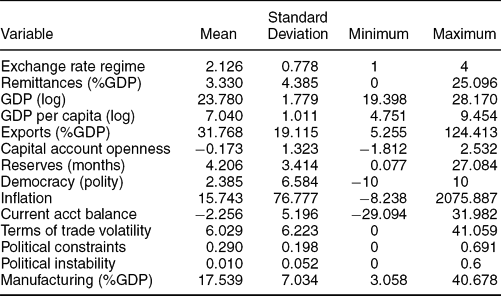
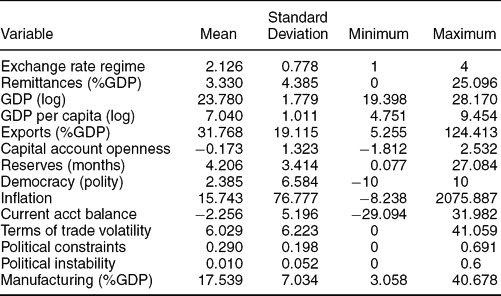
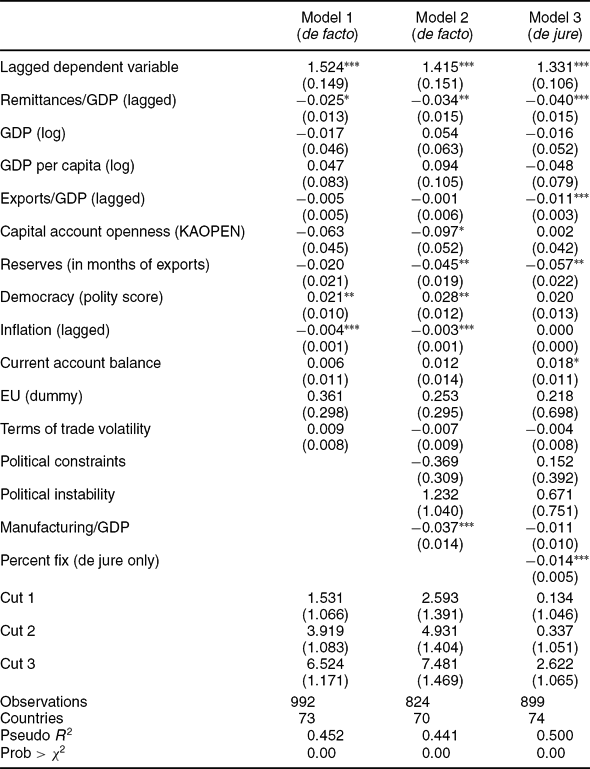
Given the ordinal nature of the dependent variable, I estimate the models using ordered probit with standard errors clustered on country. A lagged dependent variable is included to account for the temporal sluggishness of exchange rate policy.Footnote 35 Summary statistics for all variables are presented in Table 1. Table 2 presents the regression results. The sample for Model 1 consists of 992 country-year observations with 73 developing countries; the sample size is reduced to 824 observations and 70 countries for Model 2 due to the limited availability of the additional covariates.Footnote 36
Summary Data
Ordered Probit Results (de facto and de jure Exchange Rate Regimes)
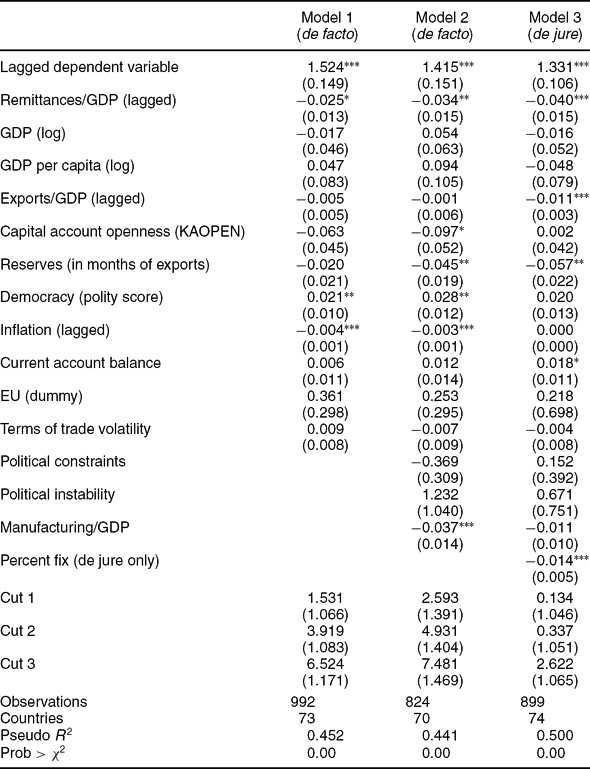
Note: Ordered probit coefficients; standard errors (clustered on country) in parentheses.
*p ≤ .10; **p ≤ .05; ***p ≤ .01.
The results from Models 1 and 2 support the hypothesis that inward remittances are associated with fixed exchange rate regimes in developing countries. The coefficient for remittances is negative and statistically significant. (Recall that lower values of the dependent variable imply greater degrees of exchange rate fixity.) This result is robust to the inclusion of political, institutional, and OCA-related macroeconomic variables. In both models, inflation is negatively signed and significant, reflecting policy makers’ desires to provide a nominal anchor for monetary policy when the domestic price level is unstable. In addition, the coefficient for democracy is positive and significant, which supports the idea that democratically elected leaders are vulnerable to popular pressures to conduct an autonomous monetary policy under a floating exchange rate. Not surprisingly, the lagged dependent variable is highly significant, reflecting the temporal sluggishness of exchange rate policy.
The results from Model 2, which contains additional covariates to capture a range of economic and institutional determinants of exchange rate policy, demonstrate that remittances are an important influence on policy making. Note that this is a global analysis of 70 developing countries from 1982 to 2006. In addition to providing evidence of the impact of remittances on exchange rate politics, the findings support certain existing arguments in the literature and challenge others. Capital account openness is negatively signed and significant, indicating an association between financial openness and fixed exchange rates. This is largely in line with Mundell-Fleming expectations; however, simpler measures of capital controls have been shown to be positively associated with floating exchange rates in prior scholarship (Broz Reference Broz2002; Leblang Reference Leblang1999). Although exports as a share of GDP is not significant, manufacturing production is significant and negatively signed. This finding is not consistent with Frieden, Ghezzi, and Stein's (2001) findings for Latin America, but it is theoretically consistent with the notion that manufacturers in the developing world desire stable currency relations with their foreign consumers. The level of reserves is also significant in Model 2, indicating an association between fixed exchange rates and ample supplies of foreign currency. The remaining covariates, including political constraints and government instability, are not significant.
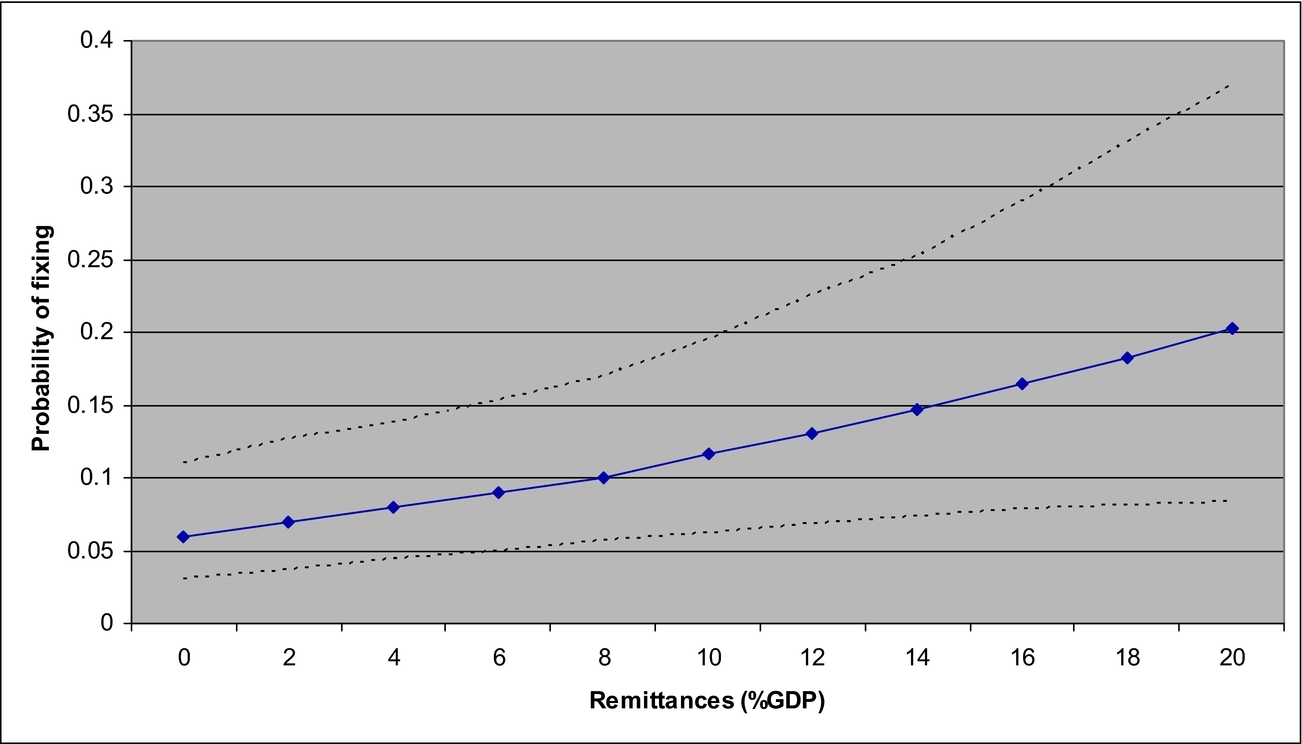
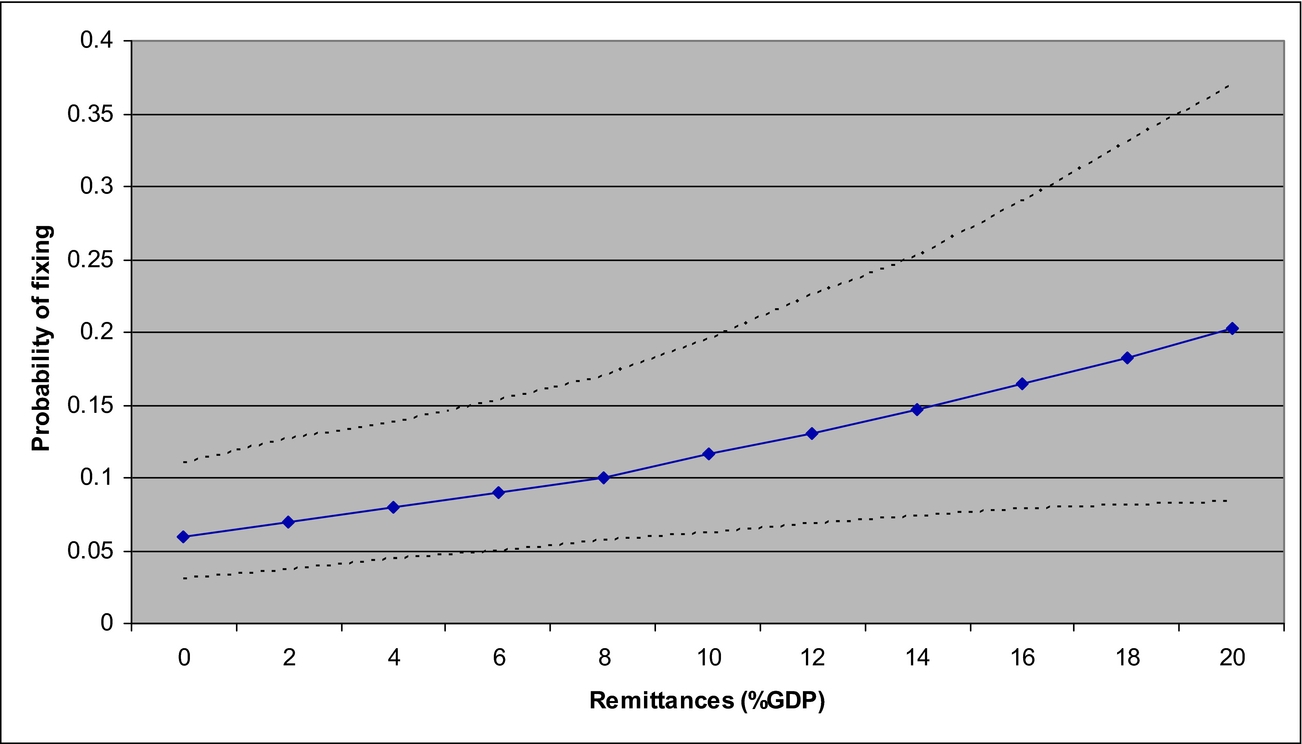
Because the substantive interpretation of ordered probit coefficients is not straightforward, I provide simulations in Figure 4 using estimates from Model 2.Footnote 37 The solid line demonstrates how the probability of fixing the exchange rate changes as remittances increase while the other variables are held at their means. The dotted lines represent 95% confidence intervals. I limit the range of remittances (the X axis) to 0% to 20%, although a few countries in the sample have remittances in excess of this level.Footnote 38 When remittances increase from 0% to 10% of GDP, the probability of fixing the exchange rate increases from 6% to 12%. For countries with remittances at the high end of the sample range, the probability of fixing exceeds 20%. These findings are substantial, especially considering that the model includes a lagged dependent variable that may suppress the impact of the other independent variables (Achen Reference Achen2000).
Predicted Probability of Fixing the Exchange Rate by Level of Remittances
Robustness
There are a number of additional variables whose inclusion in the model could be theoretically justified. The following variables were added to Model 2 as robustness checks; none altered the statistical significance of remittances.Footnote 39 As expected, a measure of partisanship (coded as a left or center-right dummy variable) was not significant.Footnote 40 The inclusion of a measure of central bank independence reduced the sample size to just 35 countries, but it was in fact significant and negative.Footnote 41 It is possible that policy makers in developing countries are more likely to adopt fixed rates to “tie the hands” of central bankers who might not share their monetary policy preferences (O'Mahony Reference O'Mahony2007). It is also possible that central bank independence and fixed rates are imperfectly credible institutions with the same goal, and therefore may complement each other (Bodea n.d.). Some scholars argue that countries that want to stabilize the real value of their foreign debt service payments will prefer fixed exchange rates (e.g., Shambaugh Reference Shambaugh2004; von Hagen and Zhou Reference von Hagen and Zhou2006; Walter Reference Walter2008). A measure of total external debt, however, was not significant. Finally, foreign aid could condition the choice of exchange rate regime if policy makers believed that it was a reliable source of foreign exchange, especially in times of economic downturn. To test this hypothesis, I included a measure of foreign aid as a percentage of GDP. Not surprisingly, it was not significant. Foreign aid is not a reliable capital inflow for most countries, and it is frequently tied to policy adjustments and other conditions. It is therefore not surprising that it does not have the same impact on exchange rate regime choices as remittances.
In addition, I tested the robustness of the findings by using the IMF's de jure exchange rate regime classification as the dependent variable.Footnote 42 Since the end of the Bretton Woods monetary system, the IMF has required member countries to make official announcements of their exchange rate regimes. Article IV, Section 2 of the IMF's Articles of Agreement grants the IMF the responsibility for exercising “firm surveillance” over the exchange rate policies of members, which it has used to publish its Annual Report on Exchange Rate Arrangements and Exchange Restrictions. If remittances mitigated the opportunity costs of fixing the exchange rate, then they might also affect government pronouncements about exchange rate regimes.Footnote 43 The results are included in Table 2, Model 3. This model includes an annual measure of the percentage of countries in the world under fixed rates as a way of capturing the “climate of ideas” regarding exchange rate policy (Collins Reference Collins1996; see also Broz Reference Broz2002, Frieden, Ghezzi, and Stein Reference Frieden, Ghezzi, Stein, Frieden and Stein2001, and Simmons Reference Simmons1994). This measure also captures the trend away from de jure fixed exchange rates for developing countries (Figure 3). As shown in Table 2, Model 3, the coefficient for remittances remains statistically significant and negatively signed.
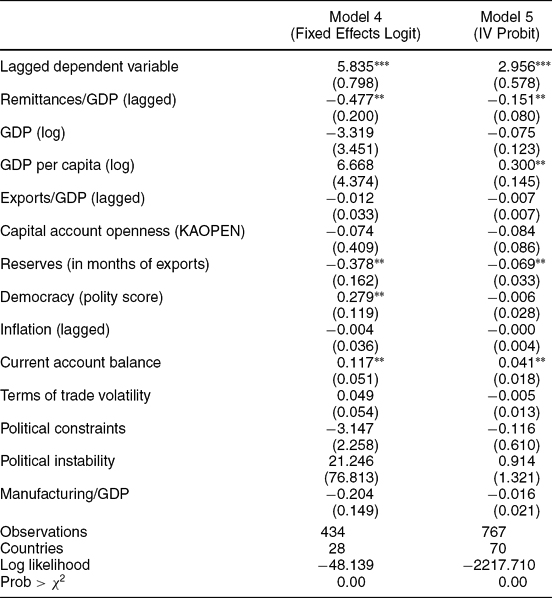
Because the ordered probit model is limited in its ability to account for cross-country heterogeneity,Footnote 44 I transformed the dependent variable into a binary measure and estimated a logit model with country fixed effects.Footnote 45 This conditional logit model accounts for unobserved cross-country variation, including inter alia the degree of correlation between the economic cycles of the remitting and receiving countries, the cultural motivations for remitting, and other time-invariant characteristics of countries.Footnote 46 It should be noted that exchange rate regimes and remittance levels as a share of GDP are relatively slow to change over time for many countries, and therefore, the fixed effects model provides a particularly strenuous test. Nevertheless, the coefficient for remittances remains negative and significant, although the sample size is reduced to 28 countries (434 observations) because of the fixed effects estimator.Footnote 47 Results are included in Table 3, Model 4.Footnote 48
Conditional Logit and Instrumental Variable Probit Results
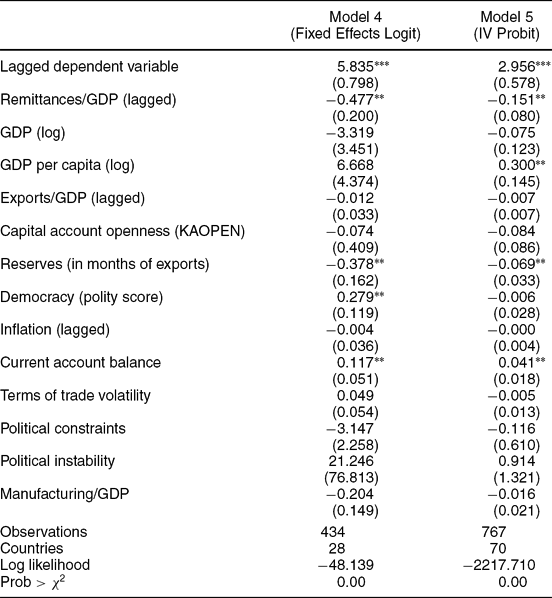
Note: Dependent variables exchange rate regime 0 = fixed; 1 = floating. Standard errors (clustered on country) in parentheses. Model 4 contains country fixed effects. Model 5 uses a measure of annual emigration to 15 advanced countries as an instrument for remittances; second stage results shown.
**p ≤ .05; ***p ≤ .01.
Finally, as mentioned previously, it is not controversial to state that remittances data suffer from measurement error. The goal of the empirical models discussed is to subject the data to rigorous analysis and ensure that any inherent biases in favor of the argument are adequately addressed. Nevertheless, it is important to acknowledge the limitations of the analyses because the remittances data only reflect the information that governments are able to record. This prompts the question: is a country's ability to track and record remittances associated with its exchange rate policy?
It is highly unlikely that better recording capacity is associated with the adoption of fixed exchange rates. Indeed, the opposite case is more likely to hold. A floating exchange rate requires that the central bank conduct an independent monetary policy, which is a highly information-intensive process. Under a floating exchange rate, central banks require detailed models of the economy, frequent financial updates from financial institutions, reliable indicators of the domestic price level and money supply, and sufficient expertise (by way of governors, economists, and financial analysts) to make appropriate decisions about monetary policy. These are the types of characteristics that are likely to be associated with the ability to track inflows of remittances through the banking sector and through less formal channels. If this is true, the measurement error in the preceding analyses should make finding a positive association between fixed exchange rates and remittance inflows less likely, rather than more likely.
Instrumental Variable Analysis
If migrants take exchange rate instability into account when deciding whether to remit, then the models presented previously may be biased due to endogeneity. To be clear, there is little reason to expect that fixed exchange rates themselves cause a greater inflow of remittances as a share of GDP. Nevertheless, to address the possibility of endogeneity, I employ an instrumental variable analysis using the five-year rolling average annual emigration to 15 advanced industrial countries, scaled by the sending country's population.Footnote 49 This variable is a suitable instrument because it is clearly correlated with remittances (one would expect that countries with high levels of emigration to wealthy countries would experience high levels of remittances), but it plausibly satisfies the exclusion restriction—namely, that there is no theoretical reason for it to be causally related to the country's exchange rate regime.Footnote 50 Results from an instrumental variable probit model—with the same dichotomous dependent variable as in Model 4—are included in Table 3, Model 5.Footnote 51 Similar results are obtained by using a linear two-stage least squares model using the original ordered (1–4) dependent variable.Footnote 52 The coefficient for remittances in Model 5 is negative and statistically significant; also significant are foreign exchange reserves and the current account balance, in line with expectations. GDP per capita is also significant, possibly reflecting the connection between the availability of human and financial resources and the ability of a government to run an autonomous monetary policy. The polity score and capital account openness, however, are not significant as in the previous models, and the other covariates are also not significant.
CONCLUSION
The rise of remittances has profound implications for the study of international financial relations. As families extend beyond national boundaries through migration, the resulting flow of funds is changing the character of financial market influence on government policy making. Indeed, the evolution of financial globalization is taking an interesting turn in the developing world. While their developed country counterparts react to the increasing integration of asset markets and the spread of the multinational corporation, developing countries are also adapting to the international financial consequences of immigration. Remittances from overseas migrants constitute a major source of capital for the majority of developing countries, and some countries rely almost exclusively on remittances for foreign exchange. Unlike nearly all other types of capital flows, remittances respond primarily to the needs of families and not the profit-seeking motives of investors. This study demonstrates that remittances not only transform the financial status of the receiving household, but also have a systematic influence on how governments choose macroeconomic policies.
This article introduced the flow of remittances into the study of the political economy of exchange rate regimes and challenged the notion of financial market openness as an undifferentiated influence on economic policy making. Prior scholarship views the free movement of capital as a constraint on policy makers that decreases the probability of selecting a fixed exchange rate. In contrast, this article argued that remittances mitigate the costs of forgone domestic monetary policy autonomy and therefore increase the probability of choosing to fix the exchange rate. Several large n empirical analyses presented in this article support this conclusion. As noted previously, the newly available data on remittances from the World Bank have many drawbacks, most notably the fact that they only account for recorded flows. One should therefore assume that the empirical tests in this article are tentative, pending the availability of more accurate and comprehensive data on remittances.
The introductory section of this article alluded to the many policy areas in which remittances could have an important influence. For example, remittances could substitute for welfare state spending by lessening the need for governmental subsidization of health care or government-sponsored employment programs. Governments that would otherwise feel compelled to insulate their citizens from the forces of the global economy—for example, by increasing the size of the government in line with Garrett (Reference Garrett1998) and Rodrik (Reference Rodrik1998)—might scale back their spending priorities in response to remittance inflows.Footnote 53 The implications of this effect need not be negative; as Pfutze (Reference Pfutze2009) argues, remittances might lessen household reliance on clientelistic networks and enhance political competition, thereby facilitating the process of democratization.Footnote 54 In addition, to the extent that remittances help stave off balance-of-payments difficulties, developing countries with substantial remittance inflows might be less likely to require assistance from the IMF and the World Bank.Footnote 55 These speculations should form the basis for future research.
As a final note, this article contributes to a growing literature that seeks to unpack the components of financial globalization and gauge their varying (and often contradictory) effects on economic policy making. The literature contains several careful studies that isolate the political and institutional determinants of specific types of capital flows, including FDI (e.g., Jensen Reference Jensen2003, Reference Jensen2006; Li and Resnick Reference Li and Resnick2003), sovereign bonds (e.g., Mosley Reference Mosley2000, Reference Mosley2003; Sobel Reference Sobel1999), foreign exchange (Bernhard and Leblang Reference Bernhard and Leblang2002; Freeman, Hays, and Stix Reference Freeman, Hays and Stix2000; Moore and Mukherjee Reference Moore and Mukherjee2006), and equity investment (Ahlquist Reference Ahlquist2006; Bernhard and Leblang Reference Bernhard and Leblang2006; Mosley and Singer Reference Mosley and Singer2008). The disparate findings in these studies should encourage future scholarship to avoid generalizations about the impact of global finance on economic policy making. The popular metaphor of global finance as a “golden straitjacket” (Friedman Reference Friedman2000) might be more appropriately revised as a tug of war with various capital flows pulling policy makers in different directions.



Comments
No Comments have been published for this article.