Dedication
The central argument that runs through this paper was developed by Ken in the autumn of 2015 following a keynote speech he delivered at Lancaster University in October of the same year. During the symposium Ken focused on the importance of creating a leadership legacy and the role personal values play within this. It is therefore an immense privilege for us as the authors of this paper to articulate his argument more fully, it now being part of Ken's own leadership legacy.
We have titled this paper ‘Won't get fooled again’ in recognition of Ken's love of The Who track released in 1971. Ken routinely played this track during his lectures and focused on the line ‘Meet the new boss; same as the old boss’ from a leadership development perspective. Ken was encouraging students to both recognize this situation and also to be mindful of not getting fooled again: in particular, to not ‘turn a blind eye’ to wrongdoing and to continually strive to ‘do the right thing.’ Both of these expressions to not ‘turn a blind eye’ to wrongdoing and to continually strive to ‘do the right thing’ were used by Ken frequently.
In this paper we seek to outline the relationship between personal values and leadership purpose, behavior and legacy. We bring this relationship to life through a series of interviews with managers from the financial services industry utilizing three core themes, ‘turning a blind eye’; ‘somewhere to hide’ and ‘no-where to hide’ with regards to ethical dilemmas and decision making.
Whilst much has been documented about the construction of an individual's personal values set (e.g., Sosik, Reference Sosik2005), very little attention has been paid to the explanation of how personal values impact upon leadership purpose, behavioral actions and legacy from both a manager and follower perspective. It is the leadership perspective that we will explore in this paper.
Parry's (Reference Parry1998) seminal paper ‘Grounded Theory and Social Process: A New Direction for Leadership Research’ opened up the possibilities to understand the formal and informal connection (role) and interaction (process) that exists between leaders and followers, through a process of social influence.
Personal values form one component of leadership. A manager's personal values become vital in coloring the relationships, knowledge and communication interactions between themselves and their followers. Personal values reflect a silent power that impacts what we are drawn toward and driven away from, the choices people make and the people we trust.
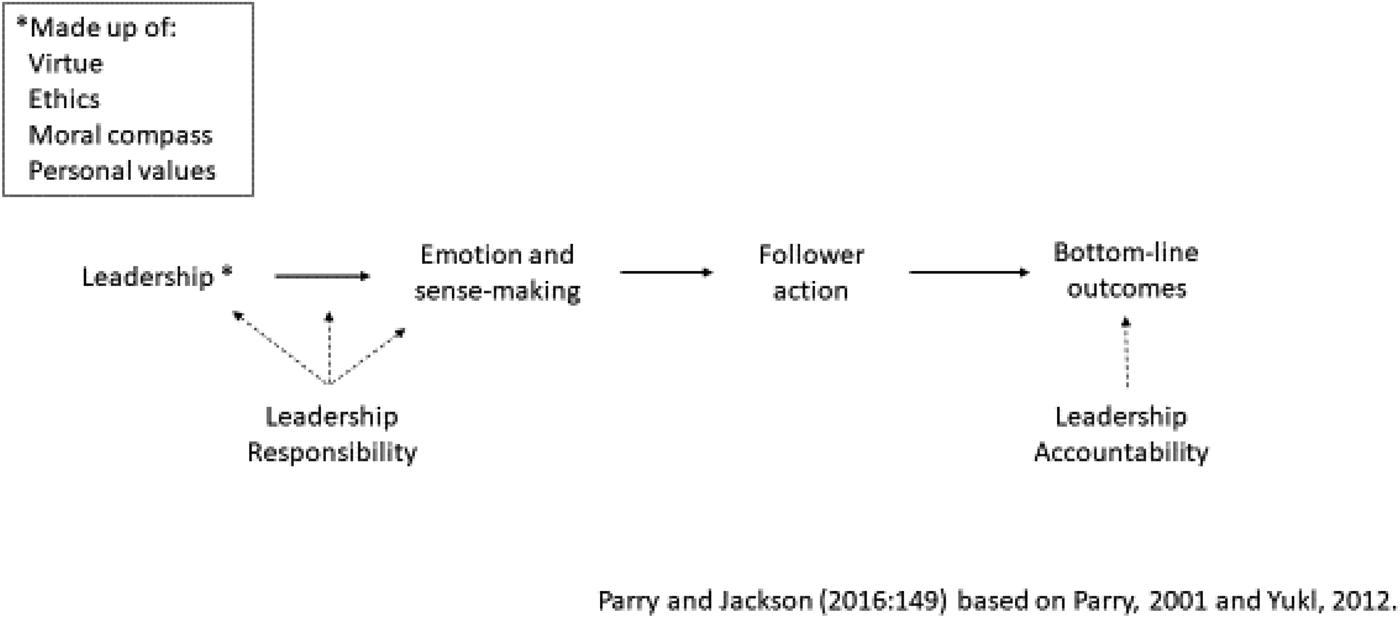
Parry & Jackson (Reference Parry, Jackson, Kempster and Carroll2016) called for a greater emphasis from managers to develop social influence through responsible leadership actions. Crucially, for Parry & Jackson (Reference Parry, Jackson, Kempster and Carroll2016) there was a need for managers to consider through their endeavors, the impact they have upon the emotion (hearts) and sense-making (minds) of their followers. This leads to shared sense-making with followers, who they themselves are then enabled to take responsibility for their own actions. This further leads to the achievement of an organization's bottom line outcomes or leadership accountability as the output. It is argued that by taking a responsible, long-term view more than financial profitability will be achieved, with community and societal outcomes being addressed over time (Parry, Reference Parry2015; Parry & Jackson, Reference Parry, Jackson, Kempster and Carroll2016; Kempster, Maak, & Parry, Reference Kempster, Maak and Parry2019). Parry highlighted the dilemma of a short-term focus, which drives actions and behavior purely toward economic targets and key performance indicators, or what a manager is accountable for. An emphasis on leadership accountability is often at the detriment of follower emotion and sense-making. A greater focus should therefore be placed upon the various responsibilities of leadership (Parry, Reference Parry2015). The various aspects described above are helpfully represented in Figure 1.
Leadership responsibility and accountability.

To elaborate on these arguments more fully we have chosen to examine a series of case histories in this paper to illustrate how personal values manifest themselves in both our leadership actions and in our career choices. McKenzie & Aitken (Reference McKenzie and Aitken2012) described some of the ‘dis-ease’ caused by personal and organizational culture conflicts. The extent to which a manger or individual has their personal values activated, nourished and supported, perhaps gives insight as to how motivated they are to make significant contributions to the organizations they work for, or alternatively, may signal a change in organization, to identify new opportunities where their needs and values are more closely aligned.
Research challenge
There is a considerable extant literature about ‘values’ (Allport, Reference Allport1961; Rokeach, Reference Rokeach and Rokeach1979; Schwartz, Reference Schwartz1994; Rohan, Reference Rohan2000; Hiltin & Piliavin, Reference Hiltin and Piliavin2004). Much of this work is linked in with the literature about leadership (Burns, Reference Burns2003; Aitken, Reference Aitken2004; Sosik, Reference Sosik2005; Brown & Trevino, Reference Brown and Trevino2006; Byrne & Bradley, Reference Byrne and Bradley2007; Chang & Lin, Reference Chang and Lin2008; Illies & Reiter-Palmon, Reference Illies and Reiter-Palmon2008; Sosik, Jung, & Dinger, Reference Sosik, Jung and Dinger2009). The challenge that we seek to address is that the particular types of values that have been neglected is the personal values of people in leadership positions. We are not so interested in organizational values (e.g., O'Reilly, Chatman, & Caldwell, Reference O'Reilly, Chatman and Caldwell1991) or corporate values (e.g., Klemm, Sanderson, & Luffman, Reference Klemm, Sanderson and Luffman1991) or some of the other adjectives that are popular precursors of the discussions about values. We are seeking to understand more about personal values, and the relationship between personal values and leadership. Our research question was therefore:
How do personal values shape leadership responsibilities and what then are the implications of this from a leadership perspective?
Our suggested contribution with this paper is two-fold. Firstly, we propose a model to help explore the notion of personal values in the context of other leadership components. Secondly, we explore the significant role personal values play in guiding leadership decisions in the workplace through a series of senior manager's perspectives via a longitudinal research study.
The work of Lichtenstein, Aitken, & Parry (Reference Lichtenstein, Aitken and Parry2015) gave attention to the importance of understanding personal values in order to enrich our understanding of leadership. If we can identify linkages between different components and variables, we may be able to better predict, mitigate and reflect upon the likely outcomes and legacies of leaders having very different strongly held personal values (Aitken, Reference Aitken2004). Increasing our understanding of our own personal values provides us with the most powerful internal compass for navigating the opportunities, challenges and dilemmas in our world today.
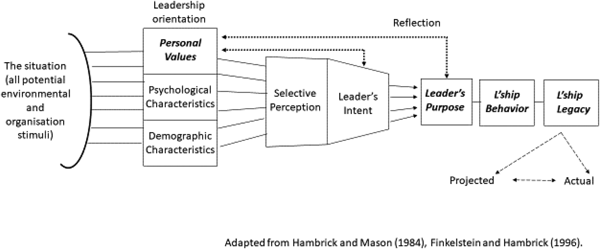
Leadership orientation can be influenced by psychological characteristics, cognitive biases (Finkelstein, Hambrick, & Cannella, Reference Finkelstein, Hambrick and Cannella2009), personality (Felfe & Schyns, Reference Felfe and Schyns2010) and demographic characteristics such as the age, sex and social class of an individual (Thomas & Ramaswamy, Reference Thomas and Ramaswamy1996). The literature acknowledges that personal values act as ‘perceptual screens’ (England, Reference England1967; Hambrick & Brandon, Reference Hambrick, Brandon and Hambrick1988). An individual's pluralistic outlook is ‘bounded’ by their personal values, which filters out information and focuses priorities. Hambrick & Brandon (Reference Hambrick, Brandon and Hambrick1988) argue that personal values can act in two ways: (i) directly in terms of channeling behavior and (ii) indirectly in terms of perceptual screening. Considering this further from a leadership perspective, Lichtenstein, Aitken, & Parry (Reference Lichtenstein, Aitken and Parry2015) proposed that in a managerial context, enacted leadership behavior is shaped by a managers' personal values, purpose and ultimately legacy. A managers' personal values act as a the ‘perceptual screens’ for how he or she observes the external environment; how information is selected and funneled and thereby shaping a manager's purpose, behavior, the common good and other leadership outcomes.
The role of personal values in leadership is yet to be fully understood. As Burns (Reference Burns2003) stated, ‘Leaders embrace values; values grip leaders,’ Russell (Reference Russell2001, p. 95) asserted, ‘Every enterprise is driven by its leaders’ individual and collective values, whether those values are understood or unconsciously influential, spoken or unspoken, written or unrecorded.’ Adapted from England & Lee (Reference England and Lee1974), we see at least seven ways in which a manager's often unconscious personal values have an impact upon sense-making and sense-giving. Personal values: (i) influence managers' perceptions of situations; (ii) affect the solutions they generate; (iii) impact the quantity and quality of interpersonal relationships; (iv) influence perceptions of individual and organizational success; (v) provide a basis for determining ethical behavior; (vi) affect the extent to which managers accept or reject particular organizational pressures and goals and (vii) focus and shape managerial performance. Moreover, the extant literature (e.g., Russell, Reference Russell2001) indicates the critical importance for a manager having personal values sensitivity. This is an ability to tune into all interests, beliefs and motivational drivers present in important communication and interaction, starting with one's own (McKenzie & Aitken, Reference McKenzie and Aitken2012).
In his key note address Ken encouraged the audience to start critiquing their own leadership, by asking a series of personal value guided questions:
• ‘Did I live a life which reflected and nourished my deeply held motivational drivers?’
• ‘How long has it been since you reflected on your (personal) leadership values?’
• ‘How different are your practiced values from your aspirational values? Why and how?’ (Parry, Reference Parry2015).
We will return to some further questions that focus in particular on leadership legacy, posed by Ken during his keynote, further in this paper.
Personal Values-Led Leadership
Having explored the personal values dimension we would like to at this point examine three aspects of leadership outputs namely, purpose, behavior and legacy. To help realize this we have adapted a version of the Upper Echelon Theory model (Hambrick & Mason, Reference Hambrick and Mason1984; Finkelstein, Hambrick, & Cannella, Reference Finkelstein, Hambrick and Cannella2009), as shown in Figure 2.
Personal values and leadership purpose, behavior and legacy model.

Hambrick and Mason's Upper Echelon Theory proposed that an organization's effectiveness could be determined by the ‘reflections of the values and cognitive bases of powerful actors of the organization’ (1984, p. 193) with powerful actors being the senior management team. We have built upon the original model so that personal values-led leadership can be considered in a similar way.
Leadership purpose
To date, there has been limited consideration of purpose both within organizations and the correlation that exists between leadership and purpose (Kempster, Jackson, & Conroy, Reference Kempster, Jackson and Conroy2011). Further, Kempster, Jackson, & Conroy (Reference Kempster, Jackson and Conroy2011) noted the significance for followers of an organization achieving a balance between what they describe as internal and external goods. Internal goods are societal purposes, while external goods are monetary or similar employee benefits (corporate purposes). For many followers internal goods are of paramount importance, why they are making a difference to society through the work that they do. Central to this argument of external goods is the idea of follower engagement through emotion (hearts) and sense-making (minds), mentioned earlier and illustrated in Figure 1. Leadership plays a crucial role in creating both emotion and sense-making. As Pye (Reference Pye2005) observed sense-making is the essence of leadership.
It is likely a manager's purpose and behavior will be influenced by his or her personal values. Whilst there are a variety of ways to understand the diverse purposes that managers have, Lichtenstein, Aitken, & Parry (Reference Lichtenstein, Aitken and Parry2015) explored the link between managers' personal values and their varied leadership purposesFootnote 1.
Surprisingly, the 2015 analysis did not reveal any conceptual congruence to Schwartz's (Reference Schwartz and Zanna1992) values model. Rather, six meta-value systems emerged from the senior team manager data that were explained by three higher-order types of purposes termed ‘Self,’ ‘Business’ and ‘Society.’ The conclusion was that a high percentage (54%) of respondents were pursuing a societal leadership purpose, this figure reflected the composition of the sample which was predominately made up of public sector senior team leaders. Our assertion is therefore that managers undertaking learning and development should be encouraged to more deeply reflect on their purpose as well as the personal values, which underpin them (Watton & Lichtenstein, Reference Watton, Lichtenstein, Koonce, Robinson and Vogel2017) in order to be able to create an increased level of sense-making, particularly around societal purposes with their followers.
Leadership behavior
Leadership behavior within organizations is a multifaceted, intricate ecosystem. Previous studies have found personal values are either motivators or inhibitors of ethical or unethical behavior (Feldman, Chao, Farh, & Bardi, Reference Feldman, Chao, Farh and Bardi2015). Personal values are relevant for ethics and morality as they guide one's identity and help shape one's reference to others (Hiltin & Piliavin, Reference Hiltin and Piliavin2004). Further, research highlights the significance of personal and organizational value congruence and the correlation this has with commitment, retention, work satisfaction, work attitudes, pro-social behavior and work performance (e.g., Posner, Kouzes, & Schmidt, Reference Posner, Kouzes and Schmidt1985; McDonald & Gandz, Reference McDonald and Gandz1991). There is frequently a tension between personal values and organizational expectations particularly when managers are faced with decisions or actions associated with moral dilemmas.
Hewlin (Reference Hewlin2009) highlighted that actual values congruence and apparent personal-organizational values congruence are neither the same thing nor permanent. She further described the phenomenon of an employee suppressing his/her personal values in conjunction with the pretense of expressing values that one does not hold as ‘Facades of Conformity’ (Hewlin, Reference Hewlin2003, Reference Hewlin2009). Employees are capable of masking their true personal values, e.g., meaning in life, and in falsely displaying values they perceive to be organizationally desirable. ‘Faking it’ won't be an issue to someone who espouses ‘conformity’ values as they will strive to ‘fit in’ (Hewlin, Reference Hewlin2009). The psychological distress caused by values incongruence and ‘faking it,’ sometimes misidentified as ‘burnout,’ should not be underestimated (Hewlin, Reference Hewlin2003; Stormer & Devine, Reference Stormer and Devine2008). The ability for an individual to separate out their work and personal identities is likely to determine the level of discomfort they feel toward values incongruence (Hewlin, Reference Hewlin2003). Hewlin (Reference Hewlin2003) noted that individuals who can compartmentalize their lives more effectively are likely to incur less psychological distress and associated adverse outcomes.
In the literature, job status and/or influence relates to meaningfulness that has an impact upon affective or emotional commitment and job retention. Kahn's (Reference Kahn1990) studies on engagement or disengagement at work, found that psychological meaningfulness as well as psychological safety and psychological availability were preconditions to engagement and by extension, retention. Expanding on these three terms, psychological meaningfulness is when an employee feels valued such that they believe their work contributions make a difference. Psychological safety is when levels of trust are sufficiently high that an employee can portray themselves authentically in the workplace. Psychological availability is when a follower can achieve physical and emotional robustness to enable them to participate fully in all aspects of work (Kahn, Reference Kahn1990).
Leadership legacy
Shirey (Reference Shirey2014) observes that a manager's leadership legacy is typically only fully assessed once they have stepped down from their position. Legacy assessment could be made by the manager's followers or the exiting manager's own personal reflections as to how effective or ineffective they had been in their leadership role. Brooks, Stark, & Caverhill (Reference Brooks, Stark and Caverhill2010) define leadership legacy as ‘the sum of the difference you make in people's lives, directly and indirectly, formally and informally; it is the way you behave in your day-to-day life that defines your legacy’ (2010, p. xi). An individual's leadership legacy can be viewed as positive or negative (Shirey, Reference Shirey2014). More research is needed to understand leadership legacy as an outcome; critically, the relationship between personal values and leadership legacy is worthy of further investigation.
Leadership legacy is both projected and actual. Managers may want to project a legacy to those they wish to impress and want to influence. However, the actual legacy or imprint that is left behind, may be different from the projected. Similarly, a follower will undoubtedly have an impression of the same manager's legacy, this may also be different! Reflecting upon this at an individual level may provoke some interesting questions. Is there a gap between the projected and actual legacy? Have we compromised? If so why?
Returning to Ken's keynote address and the series of questions Ken posed to the audience, with respect to legacy Ken asked the delegates:
• ‘What will be your leadership legacy?’
• ‘What will be your legacy when you move on?’
• ‘If you were to attend a job interview tomorrow, and you were asked what your leadership legacy will be when you leave this proposed position, what would you say?’ (Parry, Reference Parry2015).
While virtue and personal values are complementary, they offer different types of personal reflections (Parry, Reference Parry2015). Personal values are the motivational states, whereas virtues are part of the legacy we leave behind, i.e., how we are remembered for the decisions we took, how these were actioned and what we upheld.
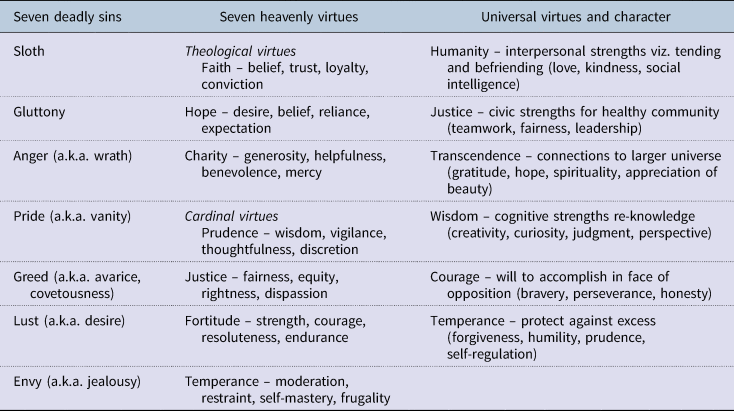
Table 1 illustrates the deadly sins and heavenly virtues our actual leadership legacies could be assessed against (Parry, Reference Parry2015).

Ken highlighted that certain values, if pursued in an aberrational way, may lead to an individual being remembered for more sinful acts such as greed, envy, pride or slothfulness. In business, and the through the discourse typically taught in business schools, Parry & Jackson (Reference Parry, Jackson, Kempster and Carroll2016) suggested managers may sometimes leave a legacy of sinfulness rather than one of virtue. This then links back to our earlier discussion when there is a behavioral focus on the bottom-line outcomes as opposed to the responsibilities of leadership. Advocating critical discourse analysis, Parry (Reference Parry2014, Reference Parry2015) supported not just listening to what people say, rather to focus on the meaning behind the words used. These afford clues as to whether a person's legacy is one of sin or virtue. We may have virtuous values, but if we solely focus on what we are accountable for, the words that we use, the decision's that we take and how we implement them, may leave others to conclude we have left a legacy of sinfulness rather than one of virtue. By virtue we mean the extent to which our legacy to areas such as societal realms for the common good, community well-being, stewardship of the environment and economic infrastructure for future generations are developed.
The research data in The Study section illustrate the challenges managers often face in pursuing personal values-led leadership in the context of pressure for bottom-line outcomes and where ‘turning a blind eye’ is often normalized.
The Study
To explore and illuminate the notions of this paper in greater depth we will use data from a series of interviews with senior managers. The focus of the study was six semi-structured interviews from a cross-section of senior managers from a range of financial services industry backgrounds from around the world. The interviews were originally completed in 2012. Follow-up interviews were carried out in 2016 to see what had happened in the intervening period.
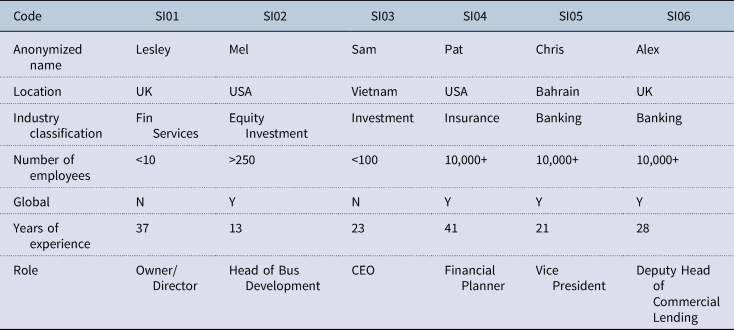
The respondents, male and female, were chosen to represent a range of roles across varying lengths of time spent working in the industry. Names have been changed and gender neutral names utilized, gender was not considered in the analysis. Table 2 illustrates the demographics of the participants.
Participants background data in 2012

The subjects had an average of 27 years' experience in positions of formal authority and had high levels of job status including: CEO of an SME; Head of Business Development of a medium-sized business and Vice President of a corporate.
The number of cases was selected as a purposive sample group as it addressed the requirement of a breadth of recognized industry classifications (super sector classification drawn from the Industry Classification Benchmark table, http://www.ftse.com) including banks, insurance and financial services. The study aims to provide a diversity of insight rather than to be representative.
Data analysis
Interviews were transcribed and interviewees reviewed the transcriptions for accuracy and for the contribution of additional ‘upon-reflection’ insights. Interview data were open-coded in accordance with Parry's (Reference Parry1998) suggestion to use the grounded theory method to research leadership. A series of questions were formulated to capture both the respondents as managers themselves and also as followers in their organizations. A funnel approach was used with a combination of open and closed questions.
The interview responses were interpreted using a phenomenological analysis approach. Both Hycner's (Reference Hycner1985) guidelines for a step by step process of phenomenological analysis and Kempster's (Reference Kempster2006) description of this method were drawn upon comprehensively.
Results
Organization size ranged from small family businesses up to large multi-national organizations. There seemed to be an association between the increasing size of the organization and the propensity of management to ‘turn a blind eye’ to ethical dilemmas.
When these managers were faced with ethical dilemmas three themes were identified through the open-coding process: to ‘turn a blind eye’ often knowing that there was ‘somewhere to hide’ due to there being safety in employee numbers within larger organizations or doing the right thing as within some organization there was a culture of ‘no-where to hide.’
Theme 1: ‘Turning a blind eye’
Two interviewees, Chris and Alex confided about their inability to speak out or whistle blow to senior managers in their organizations about inappropriate or unethical behaviors that they had witnessed. Both indicated that their roles and job retention would have been in jeopardy if they had taken this course of action. Further, they explained that they would have found it difficult to find a similar role within the industry as a result of speaking out. Their psychological safety was challenged. Both Chris and Alex have since moved to new organizations.
The reluctance to whistle blow by Chris and Alex affords an insight into the leadership practice within their organizations.
Chris: ‘Now, if you are going to speak about the standards, the policies, sticking to policies, procedures, doing things for the book you cannot survive … if it doesn't harm the business they will do it, if it harms the business they cannot do it because they will be held responsible. In this part of the world they don't even care about that … It's a challenge with yourself, every day you challenge your own principles.’
Research by Somers & Casel (Reference Somers and Casel2011) suggests that an employee makes a decision to whistle blow because they are faced with a situation that they find morally wrong and have expectations that a resolution will be found. Whistle blowing is more likely to take place in organizations where there is a democratic supportive structure. Conversely therefore, we suggest that if there is no democratic supportive structure, people will turn a blind eye and join in with the unethical practices that they see happening. In effect, they probably have no choice.
We considered risk-taking linked to ‘turning a blind eye,’ as this had historically been one of the most dominant leadership practices occurring within the financial services industry. The idiom of ‘turning a blind eye’ resonated with some of the examples shared during the research. The phrase has been attributed to Lord Nelson who during the Battle of Copenhagen in 1801 chose to ignore the order of his superior officer by putting his telescope to his blind eye to ‘observe’ the signal of flags and therefore claiming not to have received the command. It is a concept that is now used frequently in our everyday language. Often, we have opportunities to turn a blind eye to moral dilemmas. An understanding of the notion of the blind eye allows an examination of how people in leadership positions can reflect upon their personal values and thus be sinful or virtuous with their leadership work through the lens of personal values and ‘turning a blind eye.’
Theme 2: ‘Somewhere to hide’
Three of the interviewees worked in multi-national organizations that employed more than 10,000 staff. There were several examples of managers relying on there being safety in numbers with regards to the behaviors that occurred. Working in large organizations gave people ‘somewhere to hide’ when it came to ethical dilemmas, while the interviewees themselves were not behaving inappropriately, they were aware of a level of discomfort connected to their personal values by the overarching culture within their organizations. Pat gave an example of the industry coming out on top irrespective of what was happening to the economy. Pat spoke of the ‘blood sucking’ ruthlessness of the industry wherein they still made money but still did not have to be ethical:
Pat: ‘But to be honest with you working for a company the size of [name of organization] and in the industry, it doesn't really matter whether the economy is good or bad … it sounds a bit blood sucking but whichever way the economy is going we tend to do o.k. through it. One economy we sell that product and in the other economy we sell that product.’
When the follow-up interview was carried out Pat had changed organizations and now works for an independent financial broker, an SME-sized business. One of the reasons Pat left was the size and ‘corporate-ness’ of his/her previous organization.
Alex spoke about his/her discomfort around the wholesale selling of Personal Protection Insurance (PPI) while attending an Area Manager's meeting in his/her previous role:
Alex: ‘I can remember being repeatedly beaten over the head on PPI by saying we are not achieving the top bank assurer… So the elephant was in the room and nobody, nobody had the, and it wasn't the guts, it's not a question, because it's suicide, if I had been the only area manager in the region that had said I'm not putting my people through this workshop because I don't consider it to be ethical, would have meant that I would effectively been moved out of the role at the earliest opportunity.’
Theme 3: ‘No-where to hide’
The two interviewees who were in organizations with the smallest number of staff both had several examples of the organizational culture being one of ‘no-where to hide.’ One of the respondents spoke about controlling risk in the family business that s/he is the owner/director of:
Lesley: Yeah, it's down to me basically…Risks for financial services business is the advice you are providing and if you are not providing it correctly you've got inherent risk problems within the business. So we try to minimize risk as much as we possibly can. That's the worry going forward alright you have got your professional indemnity insurance which will take care of any claims but that's not really the point. You don't want to be faced with those situations arising.’
The second interviewee, a CEO spoke about the trust s/he has in the sales staff within the organization to do the right thing for the long term rather than short-term financial gain:
Sam: ‘They do not try to squeeze their customers for their own benefit and forego the long term customer relationship.’
Within the smaller organizations (both had fewer than 100 staff) a culture had been developed where there was no-where to hide when it came to ethical choices. Close communication and strong relationships within teams suggested that there was an augmentation between the values of the organizations and the personal values of the individuals themselves.
Follow-up interviews
Four years later we approached all of the interviewees for a second interview, three were conducted and the role and organizational outcomes have been established for all of the interviewees. The participants were asked to capture their personal values and to find out what responses and actions they had taken since 2012. Again the interviews were recorded, transcribed and analyzed as described above.
Schwartz's (Reference Schwartz and Zanna1992) SVS 57 item questionnaire was adapted for ease of understanding by respondents who were asked to allocate out of 100% the number that represented the strength of the espousal of their personal values to pre-classified groupings of single values. All of their top values priority corresponded to Schwartz's value system of ‘self-direction’ that includes the top three values of: meaning in life, choosing own goals and self-respect. All of their least value priority allocation corresponded to Schwartz's value system of self-approval that includes the top three personal values of: material wealth, control over others and preserving ‘face’ and status. To help understand these aspects we highlight below the ‘no-where to hide’ theme for their responses.
Second round of interviews: Theme 3: ‘No-where to hide’ expansion
Drawing on the three in depth follow-up interviews that were carried out it is possible to explore in particular the ‘no-where to hide’ theme in more detail. Sam had remained in post as the CEO of an Investment Bank in Vietnam with less than 100 employees. Sam's organizational culture remained as one of ‘no-where to hide.’ Sam spoke about the change in perception from the boards initial expectation of an accountability focus driven by short-term results compared to his/her long-term approach centered on the responsibilities of leadership:
Sam: ‘The norm in the industry is for people to drive their organizations to very high growth … I see a lot of cases like that. But for me personally, I don't want to be like them and I don't want the staff under me to be under that much pressure … At first the board did not like my approach, they wanted immediate results and big profits but now 8 years on, they support me and my strategy. We have had steady growth year on year. Not many of the other CEO's in the industry can say the same thing, many have left and some of the organizations have been taken over.’
Mel spoke about his/her decision to leave his/her senior position within a medium-sized business and for establishing and becoming the Director of a not for profit venture which h/she considers more fulfilling:
Mel: ‘[Name of company] is good for my soul … I turned my back on a stellar career and I decided I don't want this anymore. There were many reasons why, including searching for self-fulfillment and giving something back but, I also disliked a lot of what I saw in the industry: a lack of honesty, a lack of integrity, a lack of transparency. I was asking myself “Is this what life is all about?” “Is this what I should be doing?” and I didn't want to do that.’
Similarly, Pat spoke about his/her rationale for leaving a large corporate organization and joining an SME-sized business where there is a greater emphasis on fulfilment:
Pat: ‘I was at the [name of organization] for 3 years. They are very much corporate America, which I don't particularly like … Organizations like [name of company] often don't do what is best for the client, it is based on what gave the biggest fee. So I am now working for an independent, there are 35 of us in the company. Being an independent means we are not affiliated with anybody. We can say hand on heart we've looked at all the different companies and this is the best one for you, in your situation.’
Creating a supportive environment for followers was extremely important to Sam and this has been his/her focus for the last eight years in his/her leadership capacity as CEO.
Sam: ‘Employees need to feel the organization is providing an environment where they can work comfortably; one where they want to come to work…where they can grow, where they can confide in us if there is a problem.’
Sam went on to acknowledge the impact this had on employee high retention levels within the organization compared to higher turnover levels in the financial services industry more broadly.
The organizational shifts that had taken place for Mel and Pat meant that they were both now working in organizations with fewer than 250 employees. Sam had remained in the original organization with fewer than 100 employees. Personal values and organizational values congruence within these smaller-sized organizations seemed to have been achieved and there were less concerns with regards to ethical dilemmas.
For all three of the interviewees the society dimension of their personal values was prominent, in particular an emphasis on community. Clearly for Mel he/she had chosen to devote large amounts of time and energy into a social enterprise and business start-up mentoring. Pat and Sam were involved with initiatives such as holding formal roles in their local Business Chambers and doing University guest lecture sessions.
Sam: ‘In terms of society, I always go back to, how can I add value, how can I make a difference from the traditional way of learning or doing business?’
All of the respondents acknowledged the prevalence of individuals in the financial services industry who have high levels of self-approval personal values; in contrast to it being the least important area for the three interviewees.
Sam: ‘In the financial services industry these people thrive.’
Pat: ‘There's a lot of people that think because you are in finance you have to be ruthless, well you don't.’
Mel: ‘Just the other day I tweeted a line I'd picked up from someone else which was “some people are so poor, all they have is money” which describes so many people you can just think about off the cuff.’
This shows an example of values incompatibility where individuals who value honesty and integrity over profit by any means feel levels of discomfort in an industry where this is widespread (Flaherty, Dahlstrom, & Skinner, Reference Flaherty, Dahlstrom and Skinner1999).
Discussion
We would now like to consider personal values, purpose, leadership behaviors and leadership legacy in light of the results from the interviews.
Personal values
The original interviews, and in particular the follow-up interviews, illustrate the complexity of the values dynamic between industry and organizational cultures and the participants' personal values. When managers feel there are inconsistencies between their personal values and the organizational values there is a risk of staff choosing to seek roles elsewhere. Indeed, the values of the financial institutions themselves have been questioned, Mark Carney (Reference Carney2013) while Governor of the Bank of Canada, commented in 2013:
‘To restore trust in banks and in the financial system, global financial institutions need to rediscover their values… employees need a sense of broader purpose, grounded in strong connections to their clients and their communities.’
Four out of the six managers had new roles in smaller organizations in the intervening four year period. The two that remained were already in small to medium-sized enterprises. Ethical dilemmas appeared to exacerbate subjective perceptions of person-organization fit. Pat's discussion of ‘blood sucking ruthlessness’ illustrates this values clash. We suggest that if people find an incompatibility between their personal values and the leadership culture of the organization, they are likely to leave and move to an organization where that incompatibility does not exist. From our study, it seems that in smaller organizations, there is a higher propensity of a ‘no-where to hide’ culture when it comes to personal and organizational values.
This research illustrates that those with high-status jobs have more control over their work experience and a sense of meaningfulness. The respondents' personal values priority of meaning in life bears this out. If those with high-job status do not feel they are getting meaning out of their work life (internal goods from a purpose prospective) this key motivational value will not be satisfied which impacts upon their engagement at work. This may lead to challenges from a retention of staff perspective.
Regarding psychological safety, Kahn (Reference Kahn1990) found that if employees can't be open due to fear of negative consequences to image, status and/or career, personal engagement becomes too risky. Ethical dilemmas create unclear and unpredictable situations where participants may have felt unsafe to formally raise concerns. Chris and Alex's cases of ‘turning a blind eye’ where speaking out would threaten their psychological safety with dismissal is a clear illustration of this. This situation can be contrasted with Sam's environment where he/she wanted employees to feel safe to speak out if there was a problem.
Leadership purpose
There was a clear sense of purpose amongst the three follow-up interviewees in particular. In their role of CEO both Mel and Sam spoke about the importance of demonstrating high levels of honesty and integrity with their employees; to role model the types of behaviors they wanted to see in their organizations. Nemeth & Staw (Reference Nemeth, Staw and Berkowitz1989) allude to values congruence between an employee and a manger with employees mirroring the values and beliefs of managers where a suitably comfortable environment exists. Through these interview insights we have a sense of the formal and informal connection (role) and interaction (process) of social influence occurring (Parry, Reference Parry1998). With self-direction and community (societal purpose) being the highest ranked values by all three interviewees, which incorporate aspects of meaning in life and self-respect, we can expect these values to be salient to the leaders and followers within these organizations. This lies at the very heart of leadership purpose and an increased desire for individuals to feel they are making a difference to the societies and communities where they are based (Kempster, Jackson, & Conroy, Reference Kempster, Jackson and Conroy2011).
Leadership behaviors
From a leadership behaviors and responsible leadership perspective, Sam's desire to pursue a long-term strategy of sustainable growth has proven to be effective and has bucked the trend in comparison with other similar organizations in the Asia Pacific region. This aligns with the arguments of achieving community and societal benefits in the long term (Parry, Reference Parry2015; Parry & Jackson, Reference Parry, Jackson, Kempster and Carroll2016; Kempster, Maak, & Parry, Reference Kempster, Maak and Parry2019). For Sam, creating a conducive and comfortable working environment is part of his/her responsibilities of leadership. This has led to a highly engaged and committed workforce with minimal staff turnover (Posner, Kouzes, & Schmidt, Reference Posner, Kouzes and Schmidt1985; McDonald & Gandz, Reference McDonald and Gandz1991). Sam was very explicitly investing more time into leadership responsibility including emotion and sense-making which in turn has led to follower action and the achievement of sustainable bottom line outcomes as illustrated in Figure 1 (Parry & Jackson, Reference Parry, Jackson, Kempster and Carroll2016).
Leadership legacy
Returning to critical discourse analysis (Parry, Reference Parry2014, Reference Parry2015), the extracts from the interviews expose the organizational discourse that the interviewees perceived either in the industry or from their original organizations from a leadership legacy perspective. For Pat and Mel their previous organizations had a sinful legacy with statements such as ‘a lack of honesty, a lack of integrity, a lack of transparency.’ For Sam the industry norm has a sinful legacy ‘to drive their organizations to very high growth.’ In comparison with the interviewees with new roles, in the case of Pat and Mel, the situation is now more virtuous, and in particular for Mel who has positively chosen to ‘give something back’ to their community, thereby actively creating a more virtuous and impactful leadership legacy and with a clear sense of organizational and societal purposes (Kempster, Jackson, & Conroy, Reference Kempster, Jackson and Conroy2011; Watton & Lichtenstein, Reference Watton, Lichtenstein, Koonce, Robinson and Vogel2017).
Implications for organizations and managers
For organizations and managers there are a number of implications. From an organization's perspective, previous studies have found self-enhancement/approval values to be the strongest motivators of unethicality (Feldman et al., Reference Feldman, Chao, Farh and Bardi2015). This is the prevailing values-based discourse in the financial services industry and therefore people with this values orientation as their dominant personal value are heavily overrepresented. There is nothing inherently wrong with self-approval values: we all have them and get them fulfilled in a variety of ways. However, when people in a change role have self-approval as their dominant value, without a diversity of other values to act as checks and balances, there is a higher risk those values will be achieved in disempowering and harmful ways.
Managers who can cultivate sensitivity to their personal values and those around them will be more adaptable in their communication and relationships when faced with ethical dilemmas. Developing skills such as emotional intelligence (Salovey & Mayer, Reference Salovey and Mayer1990) and critical reflection (Reynolds, Reference Reynolds1998) will improve the chances of noticing ethical challenges and be better prepared to not only initiate dialog around it, but avoid becoming complicit with unethical behavior (Carsten & Uhl-Bien, Reference Carsten and Uhl-Bien2013). Creating a more flexible environment with more subjective reward mechanisms is likely to offer greater value congruence between an individual and an organization (Ouchi, Reference Ouchi1980).
Creating a culture of participatory leadership through diversity will create psychological safety for employees to engage and confront ethical dilemmas rather than embark on a facade of conformity or in ‘turning a blind eye.’ Creating a leadership culture where ‘turning a blind eye’ is challenged and there is ‘no-where to hide’ when it comes to ethical choices would send a key message to followers and guide employees to make better decisions when faced with ethical dilemmas. Gentile (Reference Gentile2017) has highlighted the role management education has to play in business ethics through her work on ‘giving voice to values.’ This approach enables individuals through a process of re-framing to instinctively know what the right thing to do is and to actively challenge unethical behavior.
Conclusion
We started this paper with our research question: How do personal values shape leadership responsibilities and what then are the implications of this from a leadership perspective? We hope exploration of the personal values-led leadership model, together with examples of this in practice, has illustrated the importance of a leader's purpose, behavior and legacy. These areas are highly significant from not only an individual manager's perspective but from an organizational culture perspective. By managers aligning their personal and organizational values more closely and prioritizing an emphasis on follower emotions and sense-making, followers will feel more connected and committed to an organization's aims and objectives, particularly when purposes are for the greater good. This will then create a sustainable achievement of bottom-line outcomes.
We acknowledge that this is a small scale study and therefore the findings are not generalizable. Further interviews and interviews outside of the financial services sector would be beneficial as a future opportunity. Additional research into the impact between personal values and leadership variables by Ken's dedicated followers would deepen our understanding of this important dynamic.
This paper is drawn from Ken's leadership legacy. He forged our collaboration, guided our focus and stretched our scholarship to reach for the ‘so here's the thing.’ In particular, he encouraged us to build on Paul's pioneering leadership values work and go beyond the extant literature that treats personal values as an independent variable in a model amongst a variety of other variables. Instead, Ken's vision was to voice personal values-led leadership and deepen our understanding to perceive personal values as a perceptual lens in relationship to other related leadership components including purpose, behavior and legacy as illustrated in the model we have introduced. Moreover, Ken's keynote speech ignited Emma to both re-analyze her original data and collect additional data through a personal values-led leadership lens. This produced a descriptive vein of longitudinal data we have used to expose the personal values-workplace dynamic in relation to the decisions managers take.
Reflecting on aspects of the personal values-led leadership dynamic and from hearing industry insights from the interviewees who have chosen to not get fooled again, we can return to The Who track to conclude:
As great as Ken's leadership legacy is to us, it is ‘academic’ compared to his legacy as a partner, friend, colleague, mentor, coach – and a whole lot more – that touched not only the three of us but so many of us around the world.