Clostridium difficile is an important cause of healthcare-associated diarrhea. Case ascertainment using patient information has been recognized as the standard for C. difficile infection (CDI) surveillanceReference McDonald, Coignard, Dubberke, Song and Horan 1 ; however, administrative data, such as the International Classification of Diseases, Ninth Revision (ICD-9) codes, have shown utility in case identification.Reference Dubberke, Reske, McDonald and Fraser 2 Although the use of ICD-9 codes may provide an adequate measure of overall CDI burden, they do not denote CDI timing, thus codes alone do not enable distinction between hospital-onset (HO) and community-onset (CO) CDI.
In 2008, as part of its Acute Inpatient Prospective Payment System, the Centers for Medicare and Medicaid Services mandated reporting of which diagnoses were present on admission (POA). 3 This mandate affords an opportunity to use administrative data in identifying HO- and CO-CDI. Administrative POA data are already being used in studies that assess CDI burdenReference Jiang, Viner-Brown and Baier 4 and could be useful in tracking HO-CDI trends and evaluating risk acquisition across different institutions. The study aim was to compare the performance of ICD-9 code data incorporating the POA indicator with a method whereby HO- and CO-CDI case ascertainment was determined by information from medical record review.
Methods
Administrative data from Virginia Commonwealth University Medical Center (VCUMC) inpatient hospitalizations were obtained from the University HealthSystem Consortium Clinical Database Resource Manager. From this database, data were obtained on adult inpatients (≥18 years old) discharged from VCUMC with any CDI ICD-9 diagnosis code (008.45), including the POA indicator for each diagnosis, from January 1, 2010, through September 30, 2011. Patient data were obtained from VCUMC’s electronic medical records, including a list of all adult inpatients, with no restriction on length of stay, discharged within the same period with a positive C. difficile laboratory result (C. difficile Premier Toxins A and B assay; Meridian Bioscience).
The HO-CDI definition based on medical record review required documented diarrhea on hospitalization day 4 or laterReference Dubberke, Carling and Carrico 5 and a positive C. difficile laboratory result. If the patient had documented diarrhea on day 3 or earlier and a positive C. difficile result, including CDI diagnosis occurring at an outside hospital, it was considered community-onset CDI (CO-CDI), whether it was community-onset healthcare facility–associated, or community-associated.Reference McDonald, Coignard, Dubberke, Song and Horan 1
Cases with a CDI ICD-9 code and POA indicator=“N” (no) were considered HO-CDI (POA-HO-CDI); cases with a POA indicator=“Y” (yes) were considered CO-CDI (POA-CO-CDI). Cases with a POA indicator of “U,” unknown, or “W,” clinically undetermined, were excluded.
The sensitivity, specificity, and positive predictive values (PPVs) and their 95% CIs were calculated for the POA definitions, using definitions for HO- and CO-CDI obtained from medical record review as the gold standard. A 3×3 table was constructed to account for cases in which there was an ICD-9 code but no CDI identified by medical record review and conversely for cases in which CDI was ascertained per the medical record with no corresponding ICD-9 code. Records of discordant cases were reviewed to determine reasons for occurrence. Case ascertainment was determined by one author (J.A.P.) and verified by a medical expert (M.B.E.). Statistical software Stata, version 11 (StataCorp), was used for analysis. The study was approved by the VCUMC Institutional Review Board.
Results
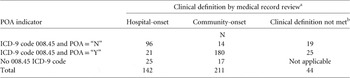
There were 47,465 discharges during the study period; 353 met the definition of CDI by medical record review, representing 330 unique patients. Of these, 15 met the definition by diagnostic imaging vs positive laboratory identification. There were a total of 355 discharges identified from administrative data; one case was excluded because the POA designation was “W.” Table 1 displays the comparison of medical record review and POA-HO-CDI and POA-CO-CDI definitions, respectively. Of the 353 discharges,142 (40%) were classified as HO and 211 (60%) as CO.
Clostridium difficile Infection ICD-9 Code / POA Status by Clinical Definition by Medical Record Review

NOTE. ICD-9, International Classification of Diseases, Ninth Revision; POA, present on admission.
a Clinical definition by medical record review was considered the gold standard.
b ICD-9 code 008.45, but either no diarrhea (n=4) or no positive laboratory finding (n=40).
For the 21 cases designated as HO-CDI, but a POA=Y designation, there was no clear reason for miscoding for the majority of these cases; 8 cases were transfer patients who experienced diarrhea on or after day 4. For the 14 cases with CO-CDI, but with a POA=N designation, there was also no clear reason for miscoding; the first C. difficile test for these patients was commonly negative (n=5) or delayed (n=2).
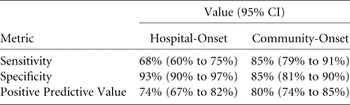
Table 2 shows measures of sensitivity, specificity, and PPV for HO-CDI and CO-CDI. For HO-CDI the sensitivity, specificity, and PPV were 68%, 93%, and 74% respectively, and for CO-CDI both the sensitivity and specificity were 85% and the PPV was 80%.
Sensitivity, Specificity, and Positive Predictive Value of ICD-9 Code 008.45 and POA Indicator to Identify Community-Onset and Hospital-Onset Clostridium difficile Infection

NOTE. ICD-9, International Classification of Diseases, Ninth Revision; POA, present on admission.
Discussion
We evaluated the extent to which POA indicators can be used to identify cases of HO-CDI and CO-CDI. With respect to HO-CDI, the results of this study showed moderate sensitivity (68%) and high specificity (93%). The PPV was 74% for HO-CDI. For CO-CDI, both the sensitivity (85%) and specificity (85%) were high; the PPV was 80%.
Previous studies have evaluated the use of ICD-9 codes to identify HO-CDI. The performance of a definition to identify HO-CDI that combined drug therapy data specific for CDI with the ICD-9 code in the same study hospital (VCUMC) had a sensitivity value ranging from 71% to 85.5% and a specificity value of 99.7%–100%, depending on the CDI definition used.Reference Schmiedeskamp, Harpe, Polk, Oinonen and Pakyz 6 For example, the definition of “ICD-9 code plus ≥3 days of CDI therapy plus therapy started on or after day 5 of hospitalization” had a PPV of 80% and a sensitivity value of 71%; PPVs ranged from 45.3% to 80%. The use of a secondary ICD-9 code vs a primary designation to ascertain HO-CDI resulted in a sensitivity of 45% in another study.Reference Dubberke, Butler and Yokoe 7
Limitations of this study include that it is a single-center study conducted in a large, academic health center and the results may not be representative of other hospital types. Furthermore, coding practices may vary across hospitals in terms of the amount of medical record CDI-related documentation. CDI cases may be missed by medical coders if the date of positive laboratory findings occurred around the time of patient discharge.Reference Dubberke, Reske, McDonald and Fraser 2 Finally, cases may have been misclassified on the basis of the type of CDI testing used, because no tests are both 100% sensitive and 100% specific. The results may not be generalized to hospitals in which a molecular CDI test, such as nucleic acid amplification, was used because this test is more sensitive but potentially less specific.Reference Wilcox 8
In conclusion, the POA indicator offers advantages over the use of secondary diagnosis specifications for HO-CDI and performs in a similar fashion to a HO-CDI definition that utilizes ICD-9 code information plus CDI drug treatment data. Furthermore, the POA definition performed better for CO-CDI vs HO-CDI in terms of sensitivity and PPV, but not specificity. Further study is needed in a larger hospital sample size, especially regarding the accuracy of POA coding among different hospitals, and regarding the performance of administrative data using the POA indicator compared with the laboratory-identified event reporting method used to identify HO-CDI by the National Healthcare Safety Network.
Acknowledgments
Financial support: Agency for Healthcare Research and Quality (grant K08HS018578 to A.L.P.).
Potential conflicts of interest: A.L.P. reports that she participates in an advisory board for Cubist Pharmaceuticals. K.L.L. reports that she received research funding from Cubist Pharmaceuticals. All other authors report no conflicts of interest relevant to this article.