1. Introduction
At the beginning of the current study, I will try to highlight how historical analysis and economic theory explain, via institutions, the early signs of ‘modern economic development’.1 Ultimately, ‘growth is a form of change. Change implies innovation’Reference Rosenberg and Birdzell2 implicitly in the field of ‘development economics’, a general approach that economists use in order to explain economic progress and the evolution of human society.
In the history of economic thought, the phenomenon of development was regarded for a long time as problematic, and was studied mostly from the angle of wealth accumulation, and not as a theory in itself. Actually, a crystallisation of an economic development theory in the modern conceptual sense can only be noticed in the immediate aftermath of the Second World War. I will concentrate on the theoretical progress that is made in explaining economic development, with an emphasis on the contributions that various schools of economic thought have had concerning the coherent identification of development triggers. It is interesting to note a certain tendency of circularity regarding the subject.
The history of development economics begins with Adam Smith.Reference Smith3 In The Wealth of Nations, which is considered to be the first comprehensive act of economic theory, Smith aimed at identifying those factors that are critical for wealth creation and, in consequence, for ensuring economic development.4 Regarding the ‘paternity’ of the economic growth issue, Mark BlaugReference Blaug5 writes:
That economic development is in fact the principal subject of Smith’s book is evident from its full title, An Inquiry into the Nature and Causes of the Wealth of Nations. It is evident also from his distinction between productive and unproductive labour, from his admittedly confused analysis of what we have called the ‘hierarchy of productivity of industries’, from his emphasis on saving, from his treatment of the role of capital, from his strange approach to the theory of value […] and, most of all, from his discussions of economic policies in terms of their impact upon economic growth in the past as well as upon economic development in different countries in his own day and age.
The development economics of the last century distinguished itself by its attempt to radically change this classical view of economic development, which came to be considered traditional, and hence obsolete. In fact, the significance of the institutional framework – implicitly but systematically invoked throughout the work of Adam Smith – is considered by many economists to be marginal, if not completely irrelevant, given the current social complexity. Perhaps the only great achievement of the economists of the last 50 years, the one that brings unity in the diversity of development economics, was to come to understand that economic development is possible, but not inevitable.
2. Economic Development and Development Economics
‘Why are some countries richer than others?’ is the crucial question to which almost all economists have wanted to find the answer. From the eighteenth century on, many theories and models of economic development have been advanced, with different consequences for real economic processes, and even now there is still much debate over what is regarded as the determining source of economic development. This was considered to be the division of labour for Adam Smith, capital accumulation for Karl Marx (who erroneously anticipates the tendency to reduce the rate of profits), innovation for Joseph Schumpeter, saving and investment rates for Roy Harrod and E. Domar. Robert Solow’s neoclassical model explains development disparities through differences in the effectiveness of combining the production factors. Recently, J. StiglitzReference Stiglitz6 sees as the root of economic development ‘the efficiency ratio’ between the functioning of the public and private sector, a case in which the market and the state are put, inadequately, in the position of mutual optimality.
The second half of the twentieth century has been almost entirely dominated by the quantitative mirage embedded in the mathematical functions of the famous Solow model. As David Romer has shown, the Solow model formed the basis for all modern developments of the theory of economic growth. In essence, as shown by the empirical economists, Solow’s model is important because it shows that, regardless of the starting point on a growth path, a balanced growth exists. But, balanced or not, the economic reality systematically defeated the ‘growth’ prescribed by the famous model. In fact, regarding its potential of coherently explaining the international differences in economic development, this model reached its limits relatively fast.7
Another explanation offered for the degree of economic development, which seems to combine various neoclassical arguments, focuses on geographical factors. For instance, Jeffrey SachsReference Sachs8 has developed the idea that geography and location are the major determinants of the differences in the rate of growth or the level of income that exists between countries. He highlighted the importance of three main factors: tropical climate, access to an ocean port and the distance to the major commercial centres of the world (such as Rotterdam, New York or Tokyo). Thus, tropical climate would be a prohibitive factor because of the danger represented by different diseases and the negative effect that a warm and wet atmosphere has on labour productivity.Reference Gwartney, Holcombe and Lawson9 The lack of access to an ocean port involves higher transaction costs and an underdeveloped trade with an important part of the world economies. A location far away from the main international markets implies additional barriers to trade. Consequently, earnings from the division of labour, specialisation and economies of scale will be reduced.
But to invoke geographical factors as determinative in explaining disparities in economic development is to deny the very essence of development, that is to say: the systematic human effort of improving living conditions. Geographical location, along with natural resources, can explain economic development, in the best case, only up to a certain, and in fact quite modest, point, as economic life shows us. The abundance of natural resources is neither a necessary nor a sufficient condition for economic progress. If this were indeed the case, Japan and Hong Kong would be poor, while Venezuela and Argentina would be rich.10
After the Second World War, economic development became the key concept of economic theory. The underdevelopment of the newly independent countries that emerged from the dissolution of the colonial system in Africa, Asia and Latin America, raised the need of elaborating a development theory – development economics.
Many contemporary economists have tried to identify the essential sources of development: P.T. Bauer, C. Clark, A. Hirschman, W.A. Lewis, G. Myrdal, R. Prebish, H.W. Singer, J. Tinbergen, and so on. The economic difficulties that most of the world’s population is facing nowadays show that ‘the recipe of development’ has not yet been found, or that it has failed to spur sufficient confidence and interest with policy makers to consistently implement it. For example, the alleged ‘recipe of development’ relentlessly recommended by international organisations – macroeconomic stabilisation, statist management of financial balances, and increased external financial assistance for poor countries – has generated adverse results in many countries in which it was implemented.
In essence, development economics seeks to answer the question of which ‘forces’ lie behind the economic development differences between countries. Developed, industrialised countries differ significantly from developing countries in much more than simply the level of capital, even the existing human capital. Developed and developing countries are defined by different ‘production functions’ and a different economic organisation. Increasingly, then, economic development these days tends to be considered less as a process of capital accumulation than as a process of changing the arrangement of economic development.
With regard to capital accumulation, economic theory shows that more capital can be useful, but it has to be understood that financial assistance is not an equivalent for ‘capital transfer’ and that it does not solve the problem of economic development.11 Moreover, the fact that redistribution does not solve poverty, but may even enhance it, is the main argument in the logic of economic science, unequivocally proven by the history of international financial assistance.
The traditional view on economic development assumed that the Third World is poor because of lack of capital. Thus, the solution would be to transfer money from the developed countries to the underdeveloped ones. But, as Peter Bauer has shown,Reference Bauer12 ‘having money is the result of economic achievement, not its precondition’. In the second half of the last century, the World Bank alone provided financial assistance of hundreds of billions of dollars to the developing countries. But over 50 years of international transfers to the so-called Third World have not yielded the expected benefits. Foreign aid of billions of dollars, generously offered to the African countries by international financial organisations, has had only a modest effect, or even suffered stinging failures in reducing poverty (India, some countries from Latin America and Africa).
Understanding the essential truth that prosperity is based on wealth creation and not on wealth redistribution underscores the necessity of revaluating the financial assistance argument in the area of development economics. Research has shown that external financial assistance neither creates nor correlates, in itself, with the critical factors of prosperity.Reference Lal13 In fact, redistributive practices alter the structure of incentives and constraints that guides productive effort, initiative, and entrepreneurial activity.
The sustained economic growth of the West began with the emergence of certain market economic structures characterised by autonomy from political and religious control. Relaxing political control over the economic sphere led to trade expansion in the context of a price system that was gradually freed from the intervention of political authorities. Commercial development was possible when traders were free to decide when and at what prices they should buy and sell. Trade gradually grew stronger as the numerous restrictions prevalent in the feudal society started to disappear (including the rejection of the principle that trade has to take place only at a ‘fair’ price).
In Adam Smith’s terms, this evolution corresponds to the fact that ‘the division of labour is limited by the extent of the market’.Reference Smith3 The qualitative change, more important than the quantitative one, is the result of a complex process of institutional evolution.Reference Rosenberg14 This meant renouncing almost completely existing commercial practices and feudal beliefs.15 The course of trade in the Middle Ages shows that the market and the price system represented institutions incompatible with medieval values, with the exception of some commercial centres that for jurisdictional reasons diverged from the general medieval political structure.Reference Rosenberg and Birdzell2
In response to the expansion of trade, the legal structure changed, commercial courts appeared, and commercial law developed. The (European) West inherited from Roman law a juridical, formal and logical reasoning, without discretionary, ritualistic or religious determinants. The advantage of the Western law system is precisely that it developed on the premise of rational calculation. According to Weber,Reference Weber16
in China it may happen that a man who has sold a house to another may later come to him and ask to be taken in because in the meantime he has been impoverished. If the purchaser refuses to heed the ancient Chinese command to help a brother, the spirits will be disturbed; hence the impoverished seller comes into the house as a renter who pays no rent. Capitalism cannot operate on the basis of a law so constituted. What it requires is law which can be counted upon, like a machine; ritualistic-religious and magical considerations must be excluded.
Many economists consider the Industrial Revolution the starting point for modern industrial society and, in consequence, for economic prosperity. But this is an erroneous historical interpretation. The manifestation of ‘economic growth’ is, in fact, prior to the Industrial Revolution, as the technological revolution is just a manifestation of economic growth, its main sign and not its trigger.
Coming to the fore for the first time in the seventeenth century, the phenomenon of economic growth did not manifest itself primarily in England, the cradle of the Industrial Revolution, but in the Netherlands: for the first time in human history two countries were offering, in a sustainable manner, a higher standard of living to a growing population.Reference Lepage17 This was happening almost a century before the first real signs of the Industrial Revolution emerged, a revolution that would then go on to produce England’s unprecedented prosperity.
Why the Netherlands and England? Why not France or Spain? Because, as Douglass North explained:Reference North and Thomas18
A structure of property rights had developed in the Netherlands and England which provided the incentives necessary for sustained growth. These included the inducements required to encourage innovation and the consequent industrialization. The industrial revolution was not the source of modern economic growth. It was the outcome of raising the private rate of return on developing new techniques and applying them to the production process.
Therefore, contrary to orthodox considerations, the history of modern economic development does not identify itself with the history of technological progress, but with the history of ‘rights’, conceived as a technology of organising human interactions. This evolution is inseparable from the genesis of capitalism and of the modern system of property rights. Exchange opportunities have always existed, but the prerequisite for unleashing these economic opportunities was to extend the degree of economic freedom against the arbitrary exercise of political power.
The notion of ‘property rights’ is here used in an economic sense: it is the set of rules, laws and customs that contribute to the establishment of everyone’s rights regarding the appropriation, usage and transfer of goods. Taxation and custom duties are, for instance, institutions that give the state a ‘property right’ on the results of residents’ economic activity; they materialise in requiring a person to share the results of his or her personal efforts with a third party, which means limiting his property rights to the ‘fruit’ of his own labour. Also, when the state gives a person or a company a commercial (legal) right, it ‘privileges’ some people and creates damage to other people, consumers or potential competitors, a fact that means ‘deprivation’ of property. Thus, any governmental intervention, any legislative act – whether it is an election law, a social security system or union protection, etc – means changing and creating new (property) rights, as the repartition of the newly created value directly or indirectly changes.19
But property rights make up only part of the institutional factor to be taken into consideration. The way the property rights ‘work’, de facto, is circumscribed by many other institutional variables, from the way the political power is structured within society to the ideologies and the cultural values that shape the conception and the functioning of economic policies. But before the institutional factor is ‘integrated’, methodically, into the theory of economic development, this paper analyses the place of institutions in economic science.
3. Institutions in Economic Science
I want to state from the very beginning that the modern scientific movement of integrating institutions into economic science is not connected in any way with American Institutionalism, an eclectic school of thought whose main representatives are Thorstein Veblen, John R. Commons, Wesley Mitchell and Clarence Ayres. American Institutionalism between – mainly – the two World Wars was, in a negative way, seized and diverted by the use of statistical tools, hence the empirical/positivistic nature of its approach.Reference Hodgson20
Despite the numerous terminological disputes and different research areas in the field of institutions, whose source ultimately lies in methodological conflicts, the recent developments in the economic analysis of institutions can be summarised under what nowadays is called Institutional Economics. Institutional economics concerns itself with the analysis of the impact of institutional arrangements, as a system of social rules, on the way people achieve their goals and, in consequence, on general economic performance.
The differences between neoclassical economic theory and institutional theory are not limited only to the fact that the former does not offer a consistent vision of institutions as a whole. Neoclassical theory treated institutions only as exogenous variables, with the aim of capturing the economic effects of certain given institutions, as a first step in trying to evaluate effectiveness and certain alternative institutional arrangements. In an attempt to pinpoint recent economic research preoccupations in the field of institutions, LangloisReference Langlois21 contends that ‘the problem with the Historical School and many of the early Institutionalists is that they wanted an economics with institutions but without theory; the problem with many neoclassicists is that they want economic theory without institutions…’.22
Over the last century, neoclassical (‘mainstream’) economic theory did not explicitly and systematically incorporate institutions as a specific area of analysis. The importance of institutions was strongly underestimated, mainly because of the restrictive assumptions that characterised the entire science of economics: ‘perfect knowledge’ and imprecise behavioural hypotheses such as ‘homo economicus’, the validation of the economist’s capacity – as analyst and external observer – to appreciate the (Paretian) economic optimum, the classical concept of a (general) economic equilibrium that ignores time, uncertainty and entrepreneurship activity.Reference Hülsmann23 Institutional economics, as a scientific area and a field of study, approaches the economy as an evolutionary complex system; therefore, the notion of equilibrium as a sustainable state or as a normative desirable condition is not, for methodological reasons, the proper element for amassing the right knowledge.
Nowadays, institutional economics follows an interdisciplinary approach that combines the arguments of economics with those of the juridical and political sciences, and even with those of sociology and anthropology, in order to understand how institutions really ‘work’ in real life. Contemporary institutional economics has its terminological origins in the work of Williamson.Reference Williamson24 It develops, however, as an independent scientific movement, basing itself on the work of CoaseReference Coase25 regarding business analysis, HayekReference Hayek26 in the field of knowledge economy, as well as on the contributions made by Davis and North,Reference Davis and North27 Alchian and Demsetz,Reference Alchain and Demsetz28 EggertssonReference Eggertsson29 and Pejovich.Reference Pejovich30
The expansion of economic analysis by the recent integration of institutions initially took place in the field of property rights and transaction costs. However, the agenda of economic research programmes in the field of institutions has undergone an intense development and diversification. The result is that, currently, the consensus of institutional analyses is just a seeming one. Still, a certain methodological and analytical convergence can be found in the approaches of Ronald Coase, Douglass North and Oliver Williamson, all of them founders of what today is called Neoinstitutional Economics.
Recently, methodological approaches and analytical techniques have gained a growing heterogeneity, a fact that has influenced the components of institutional economics: transaction costs, property rights and contracts, imperfect information, problems of principal-agent type, theory of the firm, and relevant aspects of game theory.
The institutional approach starts from accepting the fact that human action and its results must be fundamentally analysed in correspondence with the social and political rules that are governing interpersonal relations within society. Thus, the core of institutional economics is the problem of identifying an institutional optimum,Reference Eggertsson31 by recognising the obvious possibilities of normative comparative analysis between alternative institutional arrangements. Moreover, I consider that, since institutions represent the framework in which people pursue objectives and share different values and ideologies, institutional economics necessarily incorporates a normative dimension.Reference Marinescu32 By its normative content, institutions theory – the theory of social and political rules – makes a decisive contribution in the sphere of public policy.
The necessity of eliminating the fundamental shortcomings of classical economics (Smith, Ricardo) regarding the nature and the components of the theory of value, not favourable for the further development of economic thought,Reference Rothbard33 implied neglecting ‘the institutional’ from Adam Smith’s arguments. In addition, the integration of institutions into economic theory was prejudiced by ignoring or underestimating the theories advanced by the Austrian school (whose contributions have the merit of revising Ricardian and Marxist epistemology, centred more on social classes than on individuals, as well as the merit of solving ‘the paradox of value’). These developments made contemporary academia a ‘prisoner’ of the neoclassical paradigm, based on the postulate that the market mechanism works well by itself in any institutional conditions.
In his critique of the neoclassical perspective, Douglass NorthReference North34 remarks that:
By applying neoclassical theory to history economic historians were able to focus upon choices and constraints, which were certainly all to the good. […] The constraints, however, were not imposed by the limitations of human organization, but only those of technology and income. And even technology, at least in the neoclassical framework, was always an exogenous factor and thus never really fit into the theory. […] The exception was the work of Karl Marx, who attempted to integrate technological change with institutional change.
Stating that the structure of incentives in every society is incorporated into its institutional framework, NorthReference North35 acknowledges the failure of orthodox economic theory in solving problems related to economic growth:
Growth theory as it has evolved from neo-classical theory is equally unhelpful in explaining this historical and contemporary record. […] In fact, to put it bluntly, the growth theory stemming from neo-classical economics, old or new, suggests not only ignorance of the empirical evidence, historical or contemporary, but a failure to recognize that incentives matter – surely a remarkable position for economists whose theory is built around incentives.
Currently, the understanding that economic performance is dependent on the institutional framework of an economy gradually has gained entry with economists. However, the adequate understanding of the nature of institutions and how they evolve does not exist yet. Therefore, it is necessary to make the orthodox economic theory and the approach of institutions congruent, so that economic theory frees itself from ‘mechanisms’ that are independent of human behaviour and from the incentives affecting human action.
4. What Are Institutions and Why ‘Institutions Matter’…
All human actions follow from subjective perceptions of reality. Under these conditions, people develop institutions or ‘rules of the game’ in order to reduce the uncertainties arising from human interactions.Reference Buchanan36 Thus, institutions appear as a distinct class of phenomena, described by Adam Ferguson – defining for the Hayekian paradigm – as: human action, but not human designed.Reference Langlois37 In fact, this definition of the institutions has its origins in the Austrian School tradition,Reference von Mises38 according to which institutions are the social shaping of human behaviour in accordance with rules. This approach proved how the most important institutions of life within society (linguistic, economic, juridical and moral ones) emerged and evolved spontaneously,Reference Menger39 as a result of the social interactions that define the principle of ‘the invisible hand’.40
According to Douglass North’s model,Reference North34 ‘institutions are the rules of the game in a society’, that is: the set of incentives and constraints that shape human interactions, adopted by individuals according to how they manage to solve the problem of social cooperation. For Kasper and Streit,Reference Kasper and Streit41 institutions represent rules made by man (not physical, natural limits) that constrain arbitrary and opportunistic behaviours that can be adopted in social relations.
The establishment and functioning of institutions mean shifting from anarchy to order by introducing and obeying the rules that guide economic and social life. By the very nature of life in society, people are receptive to a system of general rules that structures and guides human behaviour in different ways. This is the prerequisite of forming a non-conflictual spontaneous order of human actions.Reference Rothbard42 From conventions, codes and norms of behaviour, to jurisprudence and customary law or contracts between individuals, institutions represent a very broad set of rules, norms and constraints.
Explaining the origins of institutions and their evolution over time is the necessary part in realising a taxonomy of institutions. A first classification criterion is how they are created and imposed upon the community by a third party with coercive power and a certain political authority or not. This criterion distinguishes between internal and external institutions. A second classification criterion takes into consideration the degree of formalisation of social rules, which allows us to distinguish between the informal institutions and the formal ones. Common elements of these typologies derive from the fact that external institutions necessarily have a formal part, while internal institutions are not mandatorily informal.
Internal institutions, whose existence is crucial for the success of human interactions at a higher level of integration, are not imposed by an external authority and, in general, are not the result of human will. They evolve from experience and incorporate those institutional solutions that best serve the goals of individuals.43
External institutions always involve a hierarchical structure, unlike internal rules whose manifestation is horizontal, between equals. Sanctions for violating external institutions are always formal and often applied by the use of force. Examples of external institutions are prohibitive codified rules, incorporated in civil, commercial, penal, and traffic codes. PejovichReference Pejovich30 states that:
formal rules are constitutions, statutes, common laws, and other governmental regulations which are externally enforced. They define the political system (the hierarchical structure, decision-making powers, the individual’s rights); the economic system (property rights in scarce resources, contracts); and the protection system (judiciary, police, military).
The fact that external institutions represent the result of political processes and government bodies does not imply that the political power has the discretionary capacity over these rules. The beginnings of the legislative process show that the powers of the state assume the role of codifying the (internal, informal) laws that were prior to them.44
In any society, internal/informal constraints are important in themselves, and the formal rules are not just a simple extension of informal institutions. NorthReference North34 shows that the adoption of the same constitutional arrangements by different societies has generated different effects, depending on the more or less favourable nature of internal/informal institutions.
Every approach starts with recognising certain fundamental properties of institutions. Richard EpsteinReference Epstein45 shows that simple rules tend to be much more easily known and understood than complicated ones, and stand a better chance of achieving their functions.46 The advantages of a set of fair, stable and credible rules lies in the fact that they offer individuals the incentives to exploit economic opportunities, regardless their temporal horizon.
Last but not least, institutional economics is based on a clear conceptual delimitation between the notion of ‘institution’ and that of ‘organisation’. In everyday language, the meaning of the term ‘institution’ differs from that used here in that there it is used in almost all cases as a synonym for ‘organisation’, be it an economic, political, or other one. The difference is similar to that operating between rules and players in the case of a game. Institutions are the rules and organisations are the players.Reference North35
5. Institutions and Development Economics
The neoclassical theory of economic growth is limited to identifying the indispensable conditions for increasing material production, such as capital accumulation and technical progress. But in order to explain ‘why’ people save, invest, learn and seek useful knowledge, we must pay special attention to the different institutional and value systems.
Economists’ attempts to thoroughly explain the sustained growth of labour productivity and material wealth require taking into consideration an increasing number of explanatory factors. During the 1940s and 1950s, economic theory emphasised the importance of capital (K) for long-term economic growth, by directly correlating economic progress with the process of capital accumulation (high investments sustained by a high rate of savings). In the late 1950s, explaining economic performance through capital accumulation becomes unsatisfactory. With vigorous economic growth after the war, economists turn to the notion of a national production function. This consists of a relationship that connects the inputs, such as capital, labour force (L) and technology (TEC), with the predictable outputs. The theories of the nineteenth century, according to which demographic growth is the key factor for economic development, were reactivated and linked to the growth in the labour force.
There was a new impetus for research in the 1960s, when analyses underlined the skills (SK) generated by education. Even if the idea of human capital had already surfaced with Adam Smith, neither Thomas Malthus nor later neoclassical studies had paid too much attention to it.Reference Marinescu47
The analysis of national productions points out that behind the phenomenon of economic growth, whose macro character ‘hides’ various microeconomic foundations of the market process, lie evolutionary (institutional) structures at a microeconomic level. It seems that economies characterised by a high degree of market structure flexibility and a high production factor mobility tend to be more efficient than economies characterised by structural rigidity.
Currently, the instruments of economic theory prove to be useful for assessing the intensity and the consequences of the bi-univocal relations between economic and political structures.Reference North48 As I have already mentioned, political processes can increase the rigidity of economic structures, both in less developed countries (where the rules are at the discretion of interest groups) and in developed countries, often quoted as democratic models, where the groups that aim at obtaining privileges capture the political processes in order to withstand structural changes. Therefore, rent-seeking behaviour becomes synonymous with arbitrary advantages.
Institutional constraints dictate the limits of human action and, in consequence, they make the interaction between the rules of the game and the behaviour of participant agents visible. If organisations – companies, corporations, political parties, financial organisms, etc – direct their efforts towards unproductive/redistributive activities, this is the result of certain rules, improper for economic performance. The incentives for these activities emanate from the sphere of institutions.Reference Williamson49
Such microeconomic directions of analysis perfectly fit the renewed and more sophisticated approach to the role of knowledge in society: how are they discovered, tested and applied? What structure of incentives motivates the actors of this process – the entrepreneurs – to mobilise production factors, to risk innovative uses of this knowledge and to try out certain structural modifications?
In the 1970s, economic theoreticians revived the lessons learned from work dating back to the first half of the twentieth century by Joseph Schumpeter and the most important representatives of the Austrian School, Ludwig von Mises and Friedrich von Hayek, and they conducted a deep analysis of the entrepreneurs’ role in economic progress. The furthering of knowledge and technological innovation are supported by people who take the risks of discovering information and making the desired adjustments in the production structure. But this process is subject to the existence of a system of material incentives that justifies and guides entrepreneurial activity.
For this reason, institutions influence and modify the entrepreneurial activity and the intensity of its manifestation.Reference Baumol50 The rules of the game that govern market relations in a society necessarily direct the efforts of the players. Today, few economists would deny that entrepreneurship is a vital ingredient of prosperity.Reference Sautet51 And for the entrepreneur and the entrepreneurial activity to hold a place in economic theory, a radical revision of the foundations of existing orthodox theory is needed.Reference Lydall52
Institutional Economics regards human activity and life as being coordinated by formal laws and property rights but, even in the most developed market systems, these are only a part of all the constraints that shape people’s actual choices. A closer analysis indicates the importance of informal constraints such as cultural heritage, preferences and values, which cannot be easily modified, not even as a reaction to the rapid and profound change of formal rules. The result is an understanding of development combining macroeconomic analysis with the microeconomics of structural changes, the analysis of micro foundations and institutional constraints, and various sociological factors such as preferences and value systems.
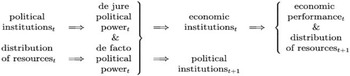
According to Acemoglu,Reference Acemoglu and Robinson53 as a first step in shaping institutions we should take into consideration the relationship between the following three institutional characteristics: (1) economic institutions; (2) political power; (3) political institutions. Economic institutions are, in essence, those that enhance economic progress, as they provide productive incentives for the economic actors within society. Economic institutions support capital accumulation, investment in physical and human capital, technological intensity and the organisation of production. Therefore, it is easy to understand that differences in the institutional arrangement will be associated not only with different degrees of economic performance, but also with a different distribution of income.Reference Rodrik and Subramanian54
The distribution of political power in society is significant in this respect, as shown by Figure 1, with AcemogluReference Acemoglu and Robinson53 conferring upon it an endogenous nature. The reasoning behind this is based on a distinction between de jure political power and de facto political power. The former refers to the political power that should emerge, by right, from the political institutions existing in society. Similar to economic institutions, they determine the constraints and incentives that affect political actors.
Distribution of political power.

Within the democratic political system, the collective decision is the result of the complex interactions between citizens, in their capacity as voters, consumers of public goods, and elected representatives and state officials, leaders and members of political parties. By definition, the democratic political process can lead to different electoral coalitions. In the scholarly literature – Public Choice Theory – their manifestation is indicated by specific concepts, such as rent-seeking, political lobby, interest groups, state capture.Reference Olson55 Within this analytical framework, it is obvious that the functioning of democratic political institutions, which involves transaction costs, influences by its very nature the success of reforms and institutional changes.
6. Institutional Change: Contemporary and European Challenges
In the European context, the crucial importance of institutions is illustrated by the (technical and empirical) approach of two major events that mark the recent history of European economy and society: the transition of the formerly socialist countries of Central and Eastern Europe to free-market democracies and the EU integration process. Although these processes evolved somehow interrelated, they can still be separated on the plane of solutions and institutional evolution.
The transition was the major event of the late twentieth century. This process began in 1989–1991 and involved 29 countries. Many economists show that the transition process contributed to the very change of economic analysis. Coase himself, in his Nobel Prize lecture, showed that ‘the value of including such institutional factors in the corpus of mainstream economics is made clear by recent events in Eastern Europe. These ex-communist countries are advised to move to a market economy, and their leaders wish to do so, but without the appropriate institutions no market economy of any significance is possible.’ The impact upon the economic literature was also significant.Reference Murell56
The transition of the socialist countries in Central and Eastern Europe to a free market economy went much deeper than the reforms in Western economies. In the case of the latter, we deal with marginal changes whose immediate success is favoured by a structure of human personality that is familiar with a market economy. The distinguishing factor of the transition is the systemic institutional transformation involved, meaning the fundamental change of the social rules that structure human behaviour and economic activities.
The collapse of the political institutions from the socialist system was compensated by the relatively rapid creation of the political institutions needed for a democratic order.57 This rapid change on the political plan had as a result a certain ‘institutional vacuum’ on the economic plan. As Jànos KornaiReference Kornai58 states, the abolition of central planning, and the reconsideration of the relations between state and companies, created a huge vacuum on the level of information as well as on that of organisational rules and mechanisms. Thus, imposed transaction costs previously existent in the relation state – companies spontaneously disappeared as a result of the liberalisation and decentralisation processes. The problem was that the decentralisation of decisions (through liberalisation) was not accompanied – or at least not until much later, as in the case of Romania – by the decentralisation of responsibilities (through privatisation). Therefore, perverse economic incentives were generated. Their best known manifestation was what has been called the ‘decapitalisation of state enterprises’, being the cruel reality of all the reforms that ignored the primordial and complementary nature of privatisation, compared with the measures of decentralisation and liberalisation.Reference Schmieding59
For ethical and economic reasons, I exclude the possibility of interpreting the decapitalisation of socialised property as the other side of capital formation needed for the development of a private sector that represents the side of spontaneous decentralisation.Reference Hoppe60 For ethical reasons because we should not remain indifferent regarding those that come to possess the socialised property, expropriated – at its origins – from its rightful owners, and for economic reasons because spontaneous decentralisation is generally not equivalent with the development of a private sector that will be autonomous from the state budget and policies.
The transition represented a favourable historical and structural context for the more or less transparent emergence of interest groups. From this point of view, both the process of transition and EU integration, as system transformation, bring up Mancur Olson’s argumentReference Olson61 regarding the relation between rent-seeking and economic performance. According to him, interest groups tend to reduce the efficiency of resource allocation, contributing to the polarisation of political life in various redistributive matrices. This applies not only to oligopolies or cartels, but also to unions or public sector bureaucracies. All these lead to the enlargement of the state’s sphere of actions, having regressive effects on economic performance and the productive potential of society.
In the approach advanced by Mancur Olson,Reference Olson61 political lobby and rent-seeking actions reflect, as opposed to economic profit-seeking behaviour, the organisation of interest groups that, in time, became the constants of modern society.62 Under these conditions, Olson uses the concept of ‘institutional sclerosis’ to describe the emergence and persistence of certain dysfunctional, inefficient institutions.Reference North63 Therefore, institutional fragility and the tendency to give more responsibilities to the state consolidated a hybrid system, where state bureaucracy plays an important role in resource allocation.
Current European integration is the equivalent of a common policies system, gradually negotiated and adopted by European governments. Economic integration is not achieved by abolishing the political restrictions of the economic system, as this system does not bear the definitive mark of free market and competition mechanisms, in spite of some important achievements to this effect. It is rather a political-bureaucratic option of what the European economic and social model should be, and this political norm is enshrined as an institutional arrangement, faithfully exported to all member countries.
For example, regarding the institutional convergence that is defining the process of European integration, various renowned studies accept the idea that ‘high-quality institutions can take a multitude of forms and that economic convergence need not necessarily entail convergence in institutional forms’,Reference Rodrik64 from which results that ‘even within Europe, there are large differences between the institutional arrangements […] with the greatest amount of convergence taking place probably in financial market practices and the least in labour market institutions’.Reference Rodrik64 Such a view would contradict the idea that development needs only one model that fits all the institutional and cultural systems.
From the perspective of the science of economics, it is not clear why the EU has to be a centralised institutional and political arrangement. The free market and competition could support Europeans’ prosperity without the need to regulate even the size, shape and thickness of fruits and vegetables, as happens in the case of European laws.65 Almost all economic and social policies are subject to ‘harmonisation’ at a pan-European level, and expansion based on a system of strict conditionality becomes a powerful tool of reducing diversity. Recent developments in Europe increasingly call into question the viability of the current social and economic model that defines the project of European construction. Over the last few decades, Europe has been dominated by the institutional arrangement of the welfare state, whose practices entailed education, health, security, jobs and prosperity for everybody. In order to achieve this goal, national governments have chosen to increase government spending to 50% of GDP or even more in some cases.66 Next to increasing public expenditure, the institutional arrangement of the welfare state was strengthened by numerous protectionist laws, from an extremely elaborate system of ‘labour rights’ to an enormous administrative apparatus in the area of social assistance and insurances.
The massive growth of public spending under the welfare state generated the permanent degradation of institutional and moral constraints that were favouring fiscal prudence. Gradually, governmental deficit and public debt became a systematic way of surviving for modern governments, an expression of the democratic process vices that stimulate a present-oriented attitude, so passing ‘the bill’ onto future generations.
Victorian fiscal morality, as a set of behavioural precepts that dictated a strict budgetary equilibrium, limited taxation and imposed strict moral constraints, had become obsolete.Reference Buchanan67 Thus, the economies of all the countries were subject to fiscal expansion and the permanent growth of debts. For instance, in the case of the Eurozone countries, fiscal expansion made the budget deficit permanent and amplified public debt to alarming levels during the last 50 years. (As an example, according to Eurostat, in 2011 the public debt in the Eurozone – as a percentage of GDP – reached unimaginable levels: Ireland – 108.2%; Greece – 165.3%; Italy – 120.1%; Portugal – 107.8%. And other EU countries are in the same situation regarding public debt and budget deficits.)
The institutional arrangement of Continental Europe over the past few decades, through its ‘paternalistic’ economic model promoted in almost all spheres of social life, is responsible for the international crisis and for the poor economic performances of Europe. Moreover, this model also explains the ample frictions that currently dominate the functioning of the labour market in the EU. The EU labour market ‘rigidity’ as well as its high unemployment rates are increasingly responsible for the social convulsions that blatantly contradict the pretentions of harmony and social cohesion of the European model.
However, depending on the influence of political processes and interest groups in society, theory and history show us that not every institutional change leads to a superior ethical and economic arrangement, and that not every kind of institutional stability reflects an ethical arrangement that is also efficient from an economic point of view.Reference Marinescu68
7. Conclusions
The neoclassical theory of economic growth is limited to identifying the conditions that are indispensable for the growth of material production, such as capital accumulation and technical progress. But in order to explain ‘why’ people save, invest, learn and search useful knowledge, we have to pay special attention to the different institutional and value systems.
Recent studies on economic performance show that the institutional factor is the first to be ‘responsible’ for development disparities between countries. The demonstration comes natural, against the backdrop of the evolutions in the system of economic sciences: from a methodological and applicative point of view, institutional economics studies have the capacity to shed light on numerous problems that orthodox (neoclassical) theory underestimates or relegates to the abstraction of econometric models that sometimes ended up complicating and diverting economic logic instead of simplifying it and providing solutions.
Recent scientific research on the institutional foundations of economic performance shows that, both a priori and a posteriori, institutions that protect property rights are decisive for economic development. But the way in which property rights ‘work’, de facto, is circumscribed to many other institutional variables, from the way that political power is structured within society to the ideologies and the cultural values that shape the conception and the functioning of economic policies.
Acknowledgements
This paper is supported by the Sectorial Operational Programme Human Resources Development (SOP HRD), financed from the European Social Fund and by the Romanian Government under the contract no. SOP HRD/89/1.5/S/62988 and is included in the research project ‘Transaction Costs and Economic Performance’.
Cosmin Marinescu is Associate Professor at the Department of Economics, Bucharest Academy of Economic Studies and economic policy Advisor to the Public Finance Minister of Romania. He has published on institutional economics and Austrian economics. He coordinated the volume Capitalism. The Logic of Liberty, about free market institutions and building the market economy in post-communist Romania, for the Center for Economics and Liberty – ECOL (www.ecol.ro).