Introduction
As the populations of dogs and cats increase, soil contamination with eggs of Toxocara spp. is increasing. Infective eggs of Toxocara spp. are detected in the soil in public and private locations of city backyards, playgrounds, streets, sandpits and so on, regardless of the season of the year (Mizgajska, Reference Mizgajska2001). A relationship between the prevalence of toxocariasis amongst children and the degree of soil contamination with Toxocara eggs was observed in Poland (Mizgajska, Reference Mizgajska2001; Mizgajska et al., Reference Mizgajska, Andrzejewska, Jarosz and Pawłowski2002; Pawłowski & Mizgajska, Reference Pawłowski and Mizgajska2002). Human toxocariasis is caused by either T. canis or T. cati and to date it has not been established which of the two species is more important in human infections, as there are no routine procedures for distinguishing the two species of nematode.
Furthermore, it is not known which of the species T. canis or T. cati is more frequently present in soil because the eggs are similar and their differentiation based on morphological features is not conclusive. The present study aims to explore a molecular method for identifying species of Toxocara in eggs isolated from soil based on the polymerase chain reaction (PCR) with specific primers constructed by Jacobs et al. (Reference Jacobs, Zhu, Gasser and Chilton1997). The microscopic observations undertaken during routine determination of the degree of soil contamination with geohelminth eggs were confirmed with molecular results. This approach provides an insight into whether or not both T. canis and T. cati are present in the soil. This method will therefore assist in targeting preventive measures to control Toxocara transmission and account for the differences in the behaviour of dogs and cats, the definitive hosts of Toxocara.
Materials and methods
Egg samples
Five soil samples with Toxocara eggs were analysed. Two of them were prepared by squeezing eggs from the final part of the uterus of mature worms of T. canis from dogs. Samples contained 430 and 10 eggs with blastomers, respectively. Eggs were kept in water for several days. Three other samples contained 1, 1 and 2 eggs with second larval (L2) stages and were isolated by flotation from contaminated soil samples (Mizgajska-Wiktor, Reference Mizgajska-Wiktor2005) Eggs were measured and identified by morphological features described by Mizgajska & Rejmenciak (Reference Mizgajska and Rejmenciak1997).
Releasing embryos from eggs
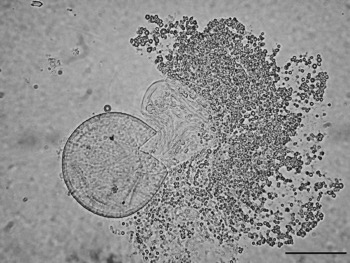
To obtain material for genetic analysis, eggs were crushed by applying pressure to a cover slip on a microscope slide with the fingers. Freed embryos from mechanically destroyed egg shells (fig. 1) were rinsed from the slide and cover slip with distilled water onto a nitrocellulose membrane (Millipore) (Graczyk et al., Reference Graczyk, Cranfield and Fayer1997) using a vacuum pump. The membrane was then placed in an Eppendorf tube, dissolved with acetone for 2 min, and the tube centrifuged twice for 20 min at 7000 rpm. The pellet was used for the isolation and purification of DNA.
The developing embryo released from the eggshell of Toxocara species (bar = 50 μm).

Isolation and purification of genomic DNA and PCR analyses
The isolation and purification was performed using QIAamp DNA Mini Kit (Qiagen). PCR was performed using specific primers for internal transcribed spacer (ITS-2) of the ribosomal DNA of species of T. canis and T. cati constructed by Jacobs et al. (Reference Jacobs, Zhu, Gasser and Chilton1997) namely:
Tcan (5′AGTATGATGGGCGCGCCAAT3′),
Tcat (5′GGAGAAGTAAGATCGTGGCACGCGT3′),
NC2 (5′TTAGTTTCTTTTCCTCCGCT3′).
For amplification of DNA the following reagents were used: DyNAzyme II Polymerase (Finnzymes) 1U per 25 μl, reaction buffer 1 × concentrated (10 mm Tris-HCL, pH 8.8, 1.5 mm MgCl2, 50 mm KCl, 0.1% Triton X-100), dNTP 200 μm, primers 1 μm. The reaction was carried out under the following conditions: 94°C, 5 min (denaturation), 55°C, 30 s, 72°C, 30 s, 94°C, 30 s, 55°C, 30 s, (annealing), 72°C, 7 min (extension) and for 30 cycles (Mastercycler Eppendorf).
As each of the two species possesses a pair of specific primers, i.e. T. canis hasTcan/NC2 and T. cati Tcat/NC2, each sample was analysed twice (Tcan/NC2 and Tcat/NC2) to identify the species. PCR products were separated on a 2% agarose gel and stained with ethidium bromide, transilluminated and photographed.
Sequencing of rDNA
Amplified DNA fragments in the PCR were cloned to the plasmid vector pGEM®-T Easy (according to the protocol) and then sequencing was performed commercially by the Institute of Biochemistry and Biophysics of Polish Academy of Science in Warsaw. Sequence alignments were performed using BLAST® (NCBI).
Results
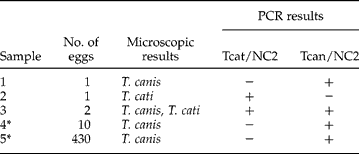
Of four Toxocara spp. eggs isolated from soil samples and morphologically identified, two eggs were recognized as T. canis and two as eggs of T. cati and this was confirmed by PCR analyses (table 1).
Microscopic and PCR determination of Toxocara species in soil samples.
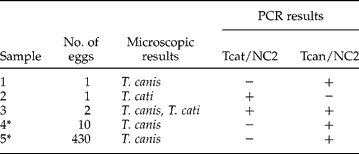
+, Band observed; − , band not observed; *samples from uterus.
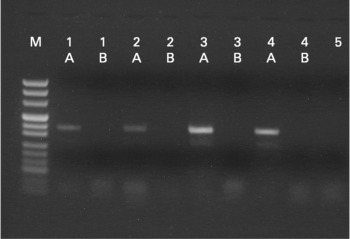
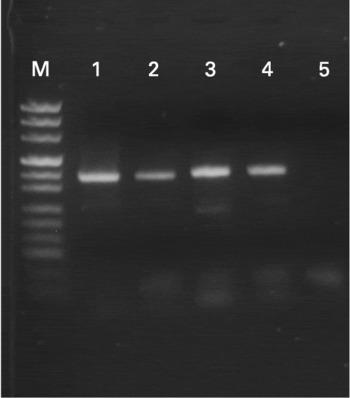
During the electrophoretic analysis of PCR products, bands were observed in the sample with the egg containing the L2 and in the sample with the embryonated egg at the blastula stage. Primers Tcan/NC2 amplified a PCR product of c. 380 bp from T. canis but not from T. cati and primers Tcat/NC2 amplified a product of c. 370 bp from T. cati but not from T. canis. The product for T. canis was present in three samples only (fig. 2, lanes 3, 5, 7), and the product for T. cati present in one sample (fig. 2, lane 1). There was only one sample with products for both T. canis and T. cati (fig. 3, lanes 1, 2 for T. canis and lanes 3, 4 for T. cati).
DNA amplification of eggs of Toxocara species by PCR on 2% agarose gel: lane M, pUC Mix Marker 8; lane 1, sample with 1 egg, A – Tcat/NC2 primers, B – Tcan/NC2 primers; lane 2, sample with 1 egg, A – Tcan/NC2 primers, B – Tcat/NC2 primers; lane 3, sample with 10 eggs, A – Tcan/NC2 primers, B – Tcat/NC2 primers; lane 4, sample with 430 eggs, A – Tcan/NC2 primers, B – Tcat/NC2 primers; lane 5, no-DNA control.

DNA amplification of one egg of each of T. canis, T. cati by PCR on 2% agarose gel: lane M, pUC Mix Marker 8; lanes 1 and 2, Tcan/NC2 primers; lanes 3 and 4, Tcat/NC2 primers; lane 5, no-DNA control.

Sequence data demonstrated a 100% correspondence of T. canis sequence to that described by Jacobs et al. (Reference Jacobs, Zhu, Gasser and Chilton1997) (Genebank accession number: Y09489) and Ishiwata et al. (Reference Ishiwata, Shinohara, Yagi, Horii, Tsuchiya and Nawa2004) (Genebank accession number: AB110034). There was a 99% correspondence of T. cati sequence to that described by Ishiwata et al. (Reference Ishiwata, Shinohara, Yagi, Horii, Tsuchiya and Nawa2004) (Genebank accession number: AB110033) and a 98% correspondence to the sequence reported by Zhu et al. (Reference Zhu, Jacobs, Chilton, Sani, Cheng and Gasser1998) (Genebank accession number: AJ002441).
Discussion
Molecular techniques are widely used for detecting pathogenic protozoans in the environment (Majewska & Sulima, Reference Majewska and Sulima1998; Da Silva et al., Reference Da Silva, Bornay-Llinare, Moura, Slemenda, Tuttle and Pieniążek1999; Wędrychowicz, Reference Wędrychowicz2000). These techniques have been applied in studies on ascaridoid life cycles, systematics and diagnosis (Zhu et al., Reference Zhu, Gasser, Chilton and Jacobs2001) but they have not been instrumental in determining the contamination of soil with geohelminth eggs. Traditional methods based on morphological features were deemed to be sufficient and the use of relatively expensive genetic methods did not appear to be necessary. But in the identification of species of Toxocara molecular techniques are particularly useful in determining the prevalence of T. canis or T. cati eggs in soil, which in turn will help to elucidate their relative roles in human toxocariasis.
Molecular studies on Toxocara have been undertaken over the past decade. Turcekova & Dubinsky (Reference Turcekova and Dubinsky1996) used restriction profiles not only to detect genetic, interspecific differences between T. canis and T. cati but also sexual differences. Wu et al. (Reference Wu, Nagano, Xu and Takahashi1997), using the PCR technique, located primers for the identification of members of the genus Toxocara, followed by Jacobs et al. (Reference Jacobs, Zhu, Gasser and Chilton1997) who identified species of Toxocara and other zoonotic ascaridoid nematodes by applying two PCR-based techniques, i.e. a two-step process PCR-linked restriction fragment length polymorphism (RFLP) and a more simple PCR using specific primers constructed for T. canis and T. cati. Zhu et al. (Reference Zhu, Jacobs, Chilton, Sani, Cheng and Gasser1998) applying the PCR–RFLP and also PCR–single stranded conformational polymorphism (SSCP) techniques, confirmed that a nematode previously identified morphologically as T. cati was in fact a distinct species. Borecka (Reference Borecka2004) used PCR-linked RFLP to identify one larva released from a soil-isolated Toxocara egg but this approach was not entirely useful for environmental studies.
The differentiation of T. canis and T. cati eggs on the basis of morphological features is difficult and inconclusive and reliable methods for identifying species of embryos from soil-isolated eggs during routine environmental studies are equally difficult or lacking. However, in the present study, by applying gentle pressure to a cover slip on a microscope slide, embryonic material was collected for genetic analyses independent not only of the developmental stage of the egg but also of the number of eggs. This is important, as in environmental studies for the detection of geohelminth eggs more than a hundred Toxocara eggs at various stages of development can be found in, for example, 40 g soil samples. Therefore this PCR method previously used only for worm tissues obtained from hosts (Jacobs et al., Reference Jacobs, Zhu, Gasser and Chilton1997) can be used on embryonic material from eggs for studies on environmental contamination.
It should be noted that in the present study, genetic analyses of embryos were carried out after the flotation process and the released material from the slide was rinsed with a large amount of water. This provides at least two advantages by, firstly, confirming morphological identification of eggs and secondly, washing eggs many times is important for the efficiency of DNA detection. The repeated washing of eggs in different fluids during the flotation method and rinsing the embryo with a large amount of water made the removal of soil inhibitors possible. It has also been shown that even with only one egg it is possible to obtain successful results for genetic analyses (fig. 2). This method is recommended as it is sensitive, efficient and confirms the results of microscopic observations undertaken during the routine examination of contaminated soil. With appropriate primers the method can also be adapted for the recovery from soil of geohelminth eggs of other parasite species.
Acknowledgements
This work was supported by the State Committee for Scientific Research (grant PO5 D11024). The authors thank Professor dr. Anna Goździcka-Józefiak for her valuable advice and for providing laboratory facilities.