Introduction
Interpreting is a task suitable for an effective investigation of how two languages in a bilingual speaker interact during language processing. Specifically, examining how the languages are activated in the interpreting task can be regarded as a critical test for existing theories of bilingualism and of interpreting itself.
The question of whether the target language (TL) is processed in parallel with source language (SL) comprehension in consecutive interpreting has been debated in several recent studies (Jin, Reference Jin2010; Macizo & Bajo, Reference Macizo and Bajo2004, Reference Macizo and Bajo2006; Ruiz, Paredes, Macizo & Bajo, Reference Ruiz, Paredes, Macizo and Bajo2008). The serial view and the parallel view were initially proposed as two opposing arguments about the temporal relation between language reformulation and SL comprehension. Language reformulation in interpreting refers to the process of using the TL to rephrase the SL. The serial view holds that language reformulation starts only after SL comprehension has been completed, whereas the parallel view postulates that language reformulation occurs simultaneously with SL comprehension, i.e., parallel processing of the TL during SL comprehension.
To observe whether the TL was activated during SL comprehension, the paradigm comparing reading for interpreting and reading for repetition was used (Jin, Reference Jin2010; Macizo & Bajo, Reference Macizo and Bajo2004, Reference Macizo and Bajo2006; Ruiz et al., Reference Ruiz, Paredes, Macizo and Bajo2008). In the tasks of self-paced reading, fluent bilinguals or professional interpreters were asked to read sentences in one language and then, either repeat them in the same language (i.e. the repetition task) or orally translate them into another language (i.e., the interpreting task). The two tasks differed only in the purpose of reading (reading for interpreting or reading for repetition), which participants had known before each task. Crucial manipulations of the experiments included cross-linguistic features (e.g., cognateness) or processing load of the sentences (e.g., working memory load). Reaction times (RTs) indicating cross-linguistic effects or load effects in SL reading (but not in reading for repetition) were considered as evidence for the parallel view, i.e., the TL was activated during SL reading. So far all the studies with this design have found, at some points of the sentence, evidence for TL parallel processing during SL reading.
Although evidence for parallel processing of the TL during SL comprehension has been found, it does not mean that the TL is always being processed during SL comprehension. In fact, among all the positions in a sentence that were monitored in the experiments (Jin, Reference Jin2010; Macizo & Bajo, Reference Macizo and Bajo2004, Reference Macizo and Bajo2006; Ruiz et al., Reference Ruiz, Paredes, Macizo and Bajo2008), only some of them showed TL parallel processing. There must be factors modulating when in the sentence TL parallel processing occurs, but this issue has not been investigated in the literature. In the present paper, we will investigate two critical factors that may affect parallel processing in interpreting and will report two experiments testing these two factors.
Possible factors modulating parallel processing of TL during SL comprehension
It has long been recognized that language processing (e.g., reading) is influenced by the efficiency of lexical access and the capacity of cognitive resources, which are generally tested in tasks of word processing, working memory (WM) and language proficiency. Christoffels, De Groot and Waldorp (Reference Christoffels, De Groot and Waldorp2003) carried out a wide range of tests on basic language and memory skills among Dutch–English bilinguals, and they found that L1–L2 word translation competence and L2 reading span can directly predict the performance on L2–L1 simultaneous interpreting. Consistent results were reported by Christoffels, De Groot and Kroll (Reference Christoffels, De Groot and Kroll2006). These studies indicate that efficiency in word translation and capacity in cognitive resources may affect interpreting processes.
From word translation to sentence interpreting: Link strength from SL to TL
The process of sentence interpreting could be analogous to isolated word translation in terms of how the interpreting process is constrained. In word translation, the link strength between an SL word and its TL counterpart could propel the activation of the TL word, as predicted by the Revised Hierarchical Model (RHM; Kroll & Stewart, Reference Kroll and Stewart1994). Correspondingly, in sentence interpreting, the link strength from SL to TL may modulate the degree of TL activation in parallel with SL comprehension. The RHM of Kroll and Stewart (Reference Kroll and Stewart1994) hypothesizes that there is a separate lexical representation for each language system and a shared conceptual representation in bilingual memory. The lexical link from L2 to L1 is stronger than the one from L1 to L2, so it is relatively easier for L2 words to activate their L1 counterparts than the reverse. Similarly, the lexical–conceptual link is stronger for L1word than the one for L2 word, resulting in easier mapping between form and meaning for L1 words than for L2 words (see evidence in Dong, Gui & MacWhinney, Reference Dong, Gui and MacWhinney2005; Kroll & Stewart, Reference Kroll and Stewart1994; Sholl, Sankaranarayanan & Kroll, Reference Sholl, Sankaranarayanan and Kroll1995).
Extending the RHM from isolated word translation to sentence interpreting, we postulate that it is the link strength between Ll and L2 that affects the degree or possibility of parallel processing of the two languages. In consecutive interpreting where two languages are involved, the bilinguals are put into a bilingual mode (Grosjean, Reference Grosjean and Nicol2001) and TL activation is likely to occur as early as the first input word to serve as a preparation strategy for later TL production. Furthermore, if the link strength from Ll to L2 and that from L2 to Ll are not equally strong, changing the interpreting direction may lead to different degrees of TL activation when the SL is being processed. When interpreting into Ll, the stronger lexical link from L2 to Ll may enable the Ll to be activated during L2 processing, whereas when interpreting in the reversed direction, the weaker link from Ll to L2 may result in less noticeable activation of L2. This is consistent with previous findings in bilingual studies: the processing of one language is more susceptible to the influence of a bilingual speaker's more proficient language (e.g., Dong et al., Reference Dong, Gui and MacWhinney2005; Elston-Gütler, Paulmann & Kotz, Reference Elston-Gütler, Paulmann and Kotz2005; Van Hell & Dijkstra, Reference Van Hell and Dijkstra2002). Taking into consideration the directionality in interpreting, we name the first factor “the link strength from SL to TL” – the L factor.
Cognitive resources for coordinating TL parallel processing
Since SL comprehension tasks have precedence over TL processing during the input phase in consecutive interpreting, TL processing must be constrained by the interpreter's remaining cognitive resources. As existing literature shows, TL co-activation does seem to take up cognitive resources (Macizo & Bajo, Reference Macizo and Bajo2006). We formulate this constraining factor of cognitive resources as the R factor. An improvement during interpreting training in any of the component skills in interpreting, such as language proficiency and working memory (WM), or an improvement in the coordination and combination of these skills may free more cognitive capacity for parallel processing. Identifying the sources for the R factor, however, is the task of future studies. The present paper focuses on the role of cognitive resources, which could be operationalized as a question of whether more training in interpreting would lead to more TL parallel processing in sentence positions that demand more cognitive resources in SL comprehension.
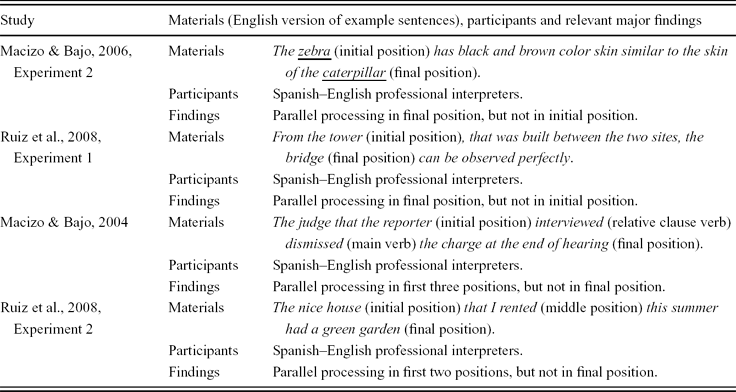
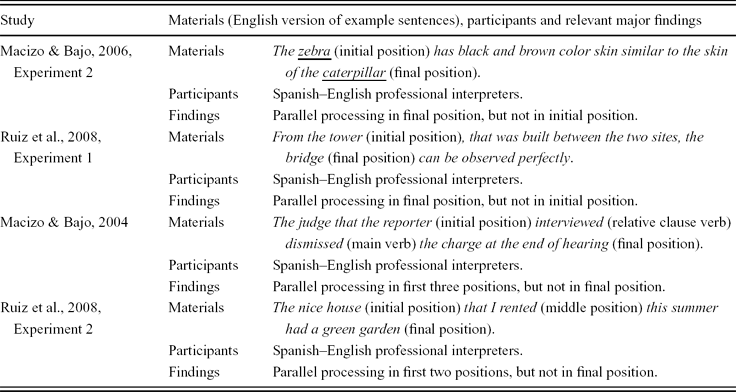
The R factor can account for why in the previous studies (Jin, Reference Jin2010; Macizo & Bajo, Reference Macizo and Bajo2004, Reference Macizo and Bajo2006; Ruiz et al., Reference Ruiz, Paredes, Macizo and Bajo2008) TL parallel processing showed only in some of the focused positions. This position effect, summarized in Table 1, was not explained in the literature. Table 1 indicates an obvious trend that TL parallel processing was found at the final part of the SL sentence when the sentence structure was relatively simple (i.e., the first two examples in Table 1), but at the initial or middle part when the sentence was relatively complex (i.e., the last two examples). The sentences in the first example were simple ones, with no subordinate clause, and those in the second were sentences with one subject relative clause, while the sentences in the last two examples were sentences with an object relative clause. There are studies in the literature indicating that in English, comprehension of object relative sentences demands more cognitive resources than subject relative sentences and simple sentences (Gibson, Reference Gibson1998; Just, Carpenter, Keller, Eddy & Thulborn, Reference Just, Carpenter, Keller, Eddy and Thulborn1996; King & Just, Reference King and Just1991). According to the hypothesis of the R factor, when SL sentences get more difficult, more resources are needed for comprehension and fewer resources are available to support TL parallel processing, leading to lower likelihood of TL parallel processing. Moreover, with more input coming in, more resources are needed to sustain comprehension itself at later positions in SL sentences, leaving still fewer resources for TL parallel processing. Taken together, the R factor would predict that it would be less likely to process the TL in parallel with SL comprehension at later positions of SL sentences, and especially so when SL materials are difficult to comprehend.
Summary of position effects in parallel processing in previous studies.
To test the R factor, a developmental approach may provide a solution. If the difference between two developmental stages in terms of interpreting skills is large enough, bilingual student interpreters of a later stage may have more cognitive resources to coordinate TL processing while still in SL comprehension.
Testing the two factors: The present study
To explore possible factors modulating TL parallel processing, a developmental approach testing unbalanced bilinguals in bidirectional interpreting tasks may provide a better solution, compared to testing only professional interpreters or fluent bilinguals in the previous studies. The present study examined two developmental stages of unbalanced Chinese–English bilinguals. They were undergraduates majoring in English with a training focus on translation and interpreting. For both stages the bilinguals were required to fulfill interpreting tasks in two directions (i.e., Chinese–English, English–Chinese). The two possible factors, the L factor (link strength from SL to TL) and the R factor (cognitive resources to coordinate TL parallel processing during SL comprehension) lead to the following hypotheses:
1 For unbalanced bilingual student interpreters, TL parallel processing would probably occur in L2–L1 interpreting but not in L1–L2 interpreting, because of the stronger lexical link from L2 to L1 (the L factor).
2 For unbalanced bilingual student interpreters in the task of reading L2 sentences for interpreting, TL parallel processing would probably start from the initial position of the sentence. With improved interpreting competency in a later stage, parallel processing is likely to occur in later sentence positions, because more cognitive resources are freed to coordinate TL parallel processing in addition to SL comprehension (the R factor).
In the following sections, we will report two experiments in which these hypotheses are tested. Experiment 1 tested the first developmental stage, when the participants had just started their interpreting training in their third academic year in college, and Experiment 2 tested the second stage, when they had finished almost two semesters of interpreting training.
Experiment 1
Method
Participants
Sixty-nine third-year English majors who had just started their interpreting training participated in the experiment. All of them had learned English at school for about ten years but they were generally considered unbalanced bilinguals because English was learned as a foreign language. Not long before this experiment, their English proficiency and WM span were tested. Their English proficiency was indicated by the Test for English Majors Band 4 (TEM4), which is administered annually to tens of thousands of intermediate English majors by the official National Advisory Commission on Foreign Language Teaching in Higher Education in China and is recognized nationwide as proof of English proficiency. All of our participants had passed this test (with a score over 60 out of a total of 100), and their average score was 71.52 (SD = 5.33), which was higher than the national average of 60.09 (with 58.6% of all the test takers passed). As to the WM span, Chinese and English listening span tests were used for measurement. These span tests were the listening version of the task that was originally developed by Daneman and Carpenter (Reference Daneman and Carpenter1980, Reference Daneman and Carpenter1983) for reading span tests. The participants’ average Chinese listening span was 46.70 out of 60 (SD = 6.48) and their corresponding English listening span was 38.88 (SD = 6.91) out of 60.
Design and materials
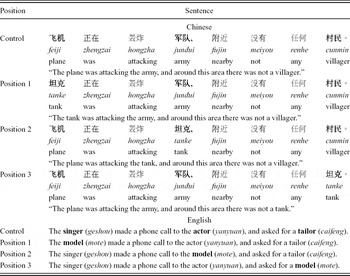
The experiment was conducted in a self-paced paradigm with a design of 2 (Interpreting direction: Chinese–English, English–Chinese) × 2 (Task type: reading for repetition, reading for interpreting) × 2 (Cognate status: cognates, non-cognates) × 3 (Position: sentence-initial position/Position 1, clause-final position/Position 2, sentence-final position/Position 3). Table 2 lists two sets of sample materials (one for Chinese and one for English) and provides a rough illustration of the experiment design.
Example sets of Chinese and English sentences that participants either read for repetition or read for interpreting.
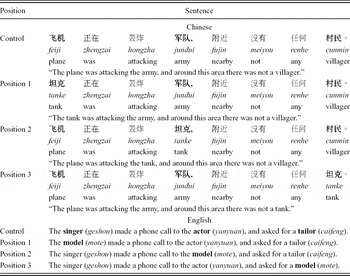
Note: In each of the examples, the three control words and the cognate word in the three critical positions are in bold, with the pinyin form in italics. Positions 1, 2, 3 refer to sentence-initial, clause-final, and sentence-final positions in the present paper.
Three sentence positions (see Table 2) were monitored to examine when TL parallel processing would occur in reading for interpreting, compared to reading for repetition. The cognate word at each position was to be compared with the non-cognate control in the corresponding position in the control sentence to see if cognates facilitated reading. There were, for the Chinese version, altogether 88 Chinese sentences with 22 cognates and 66 non-cognates. The same critical words were used for the English version but the 88 English sentences were different in meaning from their corresponding Chinese sentences so as to reduce possible interference.
The Chinese–English cognates (see appendix) were loan words or borrowed words such as 沙发 “shafa” and sofa, and the facilitative effect produced by these words in interpreting (when compared to their matching non-cognate controls) would be considered as evidence for TL parallel processing during SL comprehension. And yet, the Chinese–English cognates do not have as high phonological and orthographical resemblance as typical same-script cognates do (Dutch–English, Spanish–English, etc.). We therefore needed to make sure that they were also capable of producing a facilitative effect in cross-language lexical processing. It has long been recognized in the literature that the same-script cognates facilitate bilingual word processing (e.g., De Groot & Nas, Reference De Groot and Nas1991; Dijkstra, Grainger & Van Heuven, Reference Dijkstra, Grainger and Heuven1999; Van Hell & Dijkstra, Reference Van Hell and Dijkstra2002), and recent research has also found similar facilitative effect in different-script cognates (Hoshino & Kroll, Reference Hoshino and Kroll2008; Moon & Jiang, Reference Moon and Jiang2012). To ensure that our selected Chinese–English cognates satisfy this condition, we conducted a lexical norming test, i.e., a word translation recognition experiment, and the facilitative effect of the selected Chinese–English cognates was confirmed.Footnote 1
To guarantee that possible RT difference between the cognates and non-cognate controls in the task of reading for interpreting was due to the involvement of the TL, we collected baseline data to make sure that there was no significant RT difference between the cognates and the controls in general reading when only one language was involved. We believe that the matching of cognates and non-cognates based on baseline data is a more direct and rigid (although troublesome) measure than lexical frequency, word length, etc., which is especially helpful in studies concerned with participants’ L2. A lexical decision task was therefore conducted to collect RTs of the cognates and the controls. Twenty-three third-year undergraduate students, who came from the same population as the participants in the self-paced reading experiment, were required to decide whether the Chinese characters or the strings of English letters presented to them were words or non-words. The mean baseline RTs of the cognates and their corresponding controls at each of the three positions indicated in Table 2 were compared in the Chinese version and the English version respectively.
For the Chinese version, independent t-tests showed that the mean RT of the cognates (537 ms, SD = 33.92) was respectively equal to that of the non-cognate controls at Position 1 (525 ms, SD = 35.38, t(42) = 1.12, p = .269), Position 2 (525 ms, SD = 27.97, t(42) = 1.32, p = .195), and Position 3 (526 ms, SD = 27.86, t(42) = 1.15, p = .256). For the English version, the mean RT of cognates (620 ms, SD = 89.45) was respectively equal to that of the controls at Position 1 (624 ms, SD = 55.54, t(35) = –.180 p = .858), Position 2 (645 ms, SD = 125.41, t(42) = –.76, p = .455), and Position 3 (652 ms, SD = 106.97, t(42) = –1.07 p = .291). Given that the baseline RTs of the cognates and their non-cognate controls were equal in general reading, we would be able to attribute the possible shorter RTs of cognates in reading for interpreting to TL parallel processing during SL comprehension.
The 69 participants, compensated for their participation, were randomly assigned to different reading tasks. Thirty-six of them first performed Chinese reading for repetition and after a break, switched to the task of English reading for interpreting. Thirty-three of them first completed Chinese reading for interpreting and then after a break, switched to the task of English reading for repetition. For each task, participants were told in the instructions whether they would read for repetition or for interpreting. To avoid practice effect, each participant read only one sentence in the set of four sentences listed in Table 2 (i.e., the control sentence, and a sentence with the cognate word at Position 1, 2, or 3).
Apparatus and procedure
The experiment was conducted in Guangwai Brain and Language Lab, in which computers installed with E-prime and equipped with microphones were used to collect data. Each task consisted of two blocks. The first block, a practice block of five sentences, helped participants to get familiar with the procedure. The second block was the experimental block of 22 sentences, preceded by one additional sentence for practice. Within each block, the order of the experimental sentences was randomized for each participant. Experiments in both blocks progressed in the same procedure. Sentences were displayed in a self-paced reading paradigm, in which participants read each sentence one word at a time by left-clicking the mouse. Each trial began with several lines of dashes on the screen. With the first left click, the first dash would be replaced by the first word of the sentence. Each subsequent clicking would turn the previous word into a dash and at the same time, present the next word. If participants did not click the mouse within two seconds, the disappearance of one word and appearance of the next word would continue automatically. A sentence would proceed in this word-by-word manner until the end of the sentence, where a tone would prompt the participants to start repeating or interpreting within 30 seconds. The next trial would start with the press of spacebar.
Results
Data analysis consisted of two steps. First, we evaluated the participants’ repetition and interpreting outputs so as to rule out the participants’ data whose output quality was unacceptable. Second, we compared the RTs of the cognates and their non-cognate controls to see whether the TL was processed in parallel with SL comprehension.
Reading Chinese for repetition or for interpretingFootnote 2
The sentences repeated or interpreted by participants were evaluated according to the accuracy of both form and meaning, with reference to scoring systems in the previous studies (e.g., Macizo & Bajo, Reference Macizo and Bajo2004; Ruiz et al., Reference Ruiz, Paredes, Macizo and Bajo2008). Based on these criteria, a five-point scale was designed, in which 5 indicated the best performance and 1 the poorest performance. We ruled out RT data which corresponded to performances lower than three points. Three participants’ RT data were thus excluded, and for the remaining participants, the mean score of the repetition output was 4.51 (SD = 0.26), and that of the interpreting output was 3.78 (SD = 0.44).
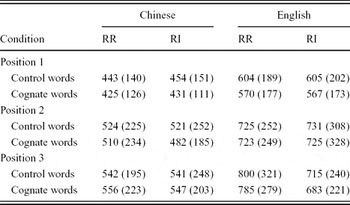
Next, for cognates and non-cognates at the critical positions, RTs that exceeded three standard deviations of the mean RT in each reading task were ruled out as outliers (1.93% of the data). Table 3 shows the mean RTs and standard deviations (SD) of the cognates and the non-cogntaes under each condition.
Mean reaction times (ms) and, in parentheses, SDs for Chinese reading and English reading in Experiment 1.
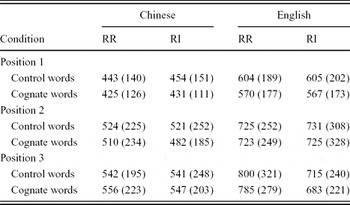
Note: RR = reading for repetition; RI = reading for interpreting
ANOVAs were performed on the RTs of the three variables, that is, Cognate status (cognates, non-cognates), Task type (reading for repetition, reading for interpreting) and Position (Position 1, Position 2, Position 3). Results showed that the three-way interaction among the variables was not significant (F1(2,63) < 1, p = .913, F2(2,20) < 1, p = .947), and nor was any of the two-way interactions (p > .17 for all cases).
The main effect of Cognate status was not significant (F1(1,64) = 1.06, p = .307; F2(1,21) = 1.00, p = .328), nor was Task type (F1(1,64) < 1, p = .926; F2(1,21) < 1, p = .948). This indicates that when the student interpreters read their L1 for interpreting, there was no parallel processing of their L2. The main effect of Position was reliable (F1(2,63) = 18.46, p < .001; F2(2,20) = 27.08, p < .001). Pairwise comparison indicated that RTs at Position 1 were reliably shorter than RTs at Position 2 (p < .001) and RTs at Position 2 were significantly shorter than RTs at Position 3 (p = .025). Their respective RTs were: 438 ms vs. 509 ms vs. 547 ms, which is evident that the three positions are different in terms of resources demand.
Reading English for repetition or for interpreting
The participants’ mean score of repetition outputs was 4.32 (SD = 0.41), and that of interpreting outputs was 4.19 (SD = 0.34). Individual mean scores of all the participants were above three points except for one participant, whose RT data was excluded. We followed the same data screening process (1.32% of the data excluded), and Table 3 shows the mean RTs of the critical words in each condition.
The three-way interaction, Cognate status × Task type × Position interaction, was not significant (F1(2,63) < 1, p = .963; F2(2,19) < 1, p = .991). For the two-way interactions, only Position × Task type was significant by item (F1(2,63) = 2.09, p = .132; F2(2,19) = 3.70, p = .044). The main effect of Task type was significant by item (F1(1,64) = .35, p = .554; F2(1,20) = 8.06, p = .010). Position had a highly significant effect on RTs (F1(2,63) = 27.11, p < .001; F2(2,19) = 34.21, p < .001). RTs were the shortest at Position 1 (589 ms, p < .001); RTs at Position 2 (719 ms) and Position 3 (736 ms) were not statistically different (p = .456).
The main effect of Cognate status was significant by item (F1(1,64) = 2.63, p = .110; F2(1,20) = 4.84, p = .040). In the task of reading for interpreting, paired t-tests indicates that the cognates marginally facilitated reading in Position 1 (t(33) = 1.86, p = .07), but not in Position 2 (t(33) = .20, p = .84) and Position 3 (t(33) = 1.11, p = .28). In reading for repetition, no position produced any such effect (for Positions 1, 2, and 3, ps = .18, .96, .68, respectively). This seems to indicate that there was some parallel processing for Position 1 only in reading for interpreting.
In short, Experiment 1 provided preliminary evidence for the first hypothesis, that there was a contrast between interpreting directions. The most prominent effect in Experiment 1 is the strong main effect of Position, here termed as the simple position effect so as to be distinguished from the position effect of TL parallel processing reviewed in Table 1. The simple position effect here refers to the fact that in both reading for repetition and in reading for interpreting, no matter whether it was in L1 or in L2, reading time for each critical word in the three focused positions became longer as more input came in. For example, when the input was L1, reading was fastest at the initial part of the sentence, slower at the clause boundary, and slowest at the final part of the sentence. This is consistent with the wrap-up effect in the literature of reading comprehension.Footnote 3 The simple position effect is therefore evidence for our assumption that the more input coming in, the more cognitive resources needed (when monitored at the typical three positions: sentence-initial, clause-final, sentence-final).
Experiment 2
Method
All the participants except one in the first experiment took part in Experiment 2. By the time of Experiment 2, they had received nearly two semesters of interpreting training, and their interpreting and other, related skills were supposed to have been improved. As stated earlier, the present study does not intend to find out the relationship between each of these skills and TL parallel processing, but the improvements of these skills generally indicate that the participants must be better at SL comprehension and therefore can free more resources to coordinate TL activation.
Two interpreting-related skills are WM and L2 proficiency, which had improved after the interpreting training. The WM span tasks used in Experiment 1 were adopted to re-test the participants. The average score was 50.54 (SD = 6.18) for Chinese listening, and 40.71 (SD = 7.11) for English listening. Results of paired t-test indicated that WM span had improved (for Chinese listening: t(65) = –7.60, p = .000; for English listening: t(63) = –2.93, p = .005). As to L2 proficiency, it was indicated by the participants’ scores on a nationwide English proficiency test, Test for English Majors Band 8 (TEM8), which all the participants took shortly after the experiment. TEM8 is administered each year by the same institution as TEM4 to fourth-year English majors in China, and those who pass TEM8 are generally considered advanced English learners. All our participants passed this test (with a score over 60 out of a total of 100), and their average score was 69.01 (SD = 5.75), which was higher than the national average of 56.06 (with 42.4% of all the test takers passed). What is more, the participants’ interpreting output turned out to be better than in Experiment 1 (for details, see the “Results” section below).
The design, materials, apparatus and procedure were identical to those used in Experiment 1. We were aware of the possibility that using the same materials in both experiments may induce practice effect. However, there are reasons for why we believe the possible practice effect could be neglected. First, the interval between the two experiments was almost two semesters, which was too long an interval for participants to remember details. Second, the participants had no motivation to remember Experiment 1 since they did not know while doing Experiment 1 that they would have the same test almost a year later. In fact, we interviewed some participants after Experiment 1 and according to their report, they did not know the real purpose of the experiments (i.e., comparing RTs for cognates and their controls) and what most of them did remember from Experiment 1 was that they were asked to read either for repetition or for interpreting, i.e., the requirements of the task itself.
Results
Reading Chinese for repetition or for interpreting
Two participants failed to follow the experimental procedure, so their data were eliminated from output evaluation and RT analysis. The mean score of repetition outputs was 4.56 (SD = 0.27) and that of interpreting outputs was 4.40 (SD = 0.26), out of a total of 5. Comparison with their corresponding data in Experiment 1 indicates that repetition did not improve (t(32) = 1.13, p = .268), although interpreting did improve (t(28) = 8.42, p = .000). This offers indirect evidence that Experiment 1 had little practice effect on Experiment 2.
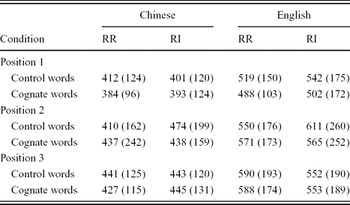
Again, we followed the same process of data screening (1.78% of the data excluded) as Experiment 1 and Table 4 is a descriptive summary of the data entered for further analysis.
Mean RTs (ms) and, in parentheses, SDs for Chinese reading and English reading in Experiment 2.

Note: RR = reading for repetition; RI = reading for interpreting
Results of ANOVA revealed that the three-way interaction of Cognate status × Task type × Position was not significant (F1(2,64) = 2.22, p = .116; F2(2,20) = 1.62, p = .224). And none of the two-way interactions was significant (ps > .16 for all cases). The main effect of Task type was significant by item (F1(1,65) < 1, p = .632; F2(1,21) = 4.50, p = .046). The main effect of Position was reliable (F1(2,64) = 4.74, p = .012; F2(2,20) = 11.24, p = .001). Pairwise comparison showed that reading was faster at Position 1 (397 ms) than at Position 2 (440 ms, p = .02) and at Position 3 (439 ms, p = .01), and that RTs at Positions 2 and 3 were similar. The main effect of Cognate status was not significant (F1(1,65) = 1.75, p = .191; F2(1,21) = 1.35, p = .259), the same as in Experiment 1. The results suggest that, as for TL parallel processing, Experiment 2 was not different from Experiment 1 when the input language was the participants’ first language.
Reading English for repetition or for interpreting
Two participants did not follow the instructions correctly and their data were excluded. The mean score of repetition quality was 4.22 (SD = 0.30) and that of interpreting quality was 4.47 (SD = 0.28), out of a total of 5. Comparison with Experiment 1 indicates that repetition failed to improve (t(25) = .0.34, p = .740), although interpreting did improve significantly (t(32) = 3.77, p = .001). This asymmetrical pattern of improvement is the same as that in the Chinese version of reading, which seems to indicate that the two semesters of interpreting training was effective in the bilingual task of interpreting (both directions) but not in the monolingual task of repetition (both languages).
The data screening process was the same as described above in the Chinese version. With 1.78% of the data excluded, Table 4 is a summary of the data.
ANOVA analysis indicates that the three-way interaction was not significant (F1(2,62) = 1.47, p = .238; F2(2,20) = 1.46, p = .256). As to the two-way interactions, only Task type × Position interaction was reliable by item (F1(2,62) = 1.83, p = .170; F2(2,20) = 8.69, p = .002). None of the remaining two-way interactions was significant (ps > .17 for all cases). The main effect of Task type was not significant (F1(1,63) < 1, p = .931; F2(1,21) < 1, p = .966). The main effect of Position was highly significant (F1(2,62) = 6.07, p = .004; F2(2,20) = 15.74, p = .000). RTs were the shortest at Position 1 (513 ms), but RTs at Position 2 (575 ms) and Position 3 (571 ms) were similar.
The main effect of Cognate status was marginally significant by subject (F1(1,63) = 3.31, p = .074; F2(1,21) = 1.29, p = .269). In the task of reading for interpreting, paired t-tests indicates cognate words facilitated reading at Position 1 (t(36) = 2.65, p = .01) and at Position 2 (t(36) = 2.43, p = .02), but not at Position 3 (t(36) = –.05, p = .96). In reading for repetition, no position produced any such effect (for Position 1, 2, and 3: p = .19, .28, .95). This result suggests that there was parallel processing at Position 1 and 2 but not at 3.
To sum up, as in Experiment 1, the prediction about the asymmetrical pattern of interpreting directions was verified. That is, only in L2–L1 interpreting did TL parallel processing occur. Although the participants had improved their L2 proficiency, they were still unbalanced bilinguals given that English was learned as a foreign language. Additional evidence for the bilinguals’ unbalanced proficiency between the two languages was the gap between English listening span and Chinese listening span (40.71 vs. 50.54 out of a total of 60), and the gap between reading English for repetition and reading Chinese for repetition (4.22 vs. 4.56 out of a total of 5). The most important finding in Experiment 2, however, is that the parallel processing of the TL (i.e., Chinese) in reading English for interpreting was observed not only at Position 1 (i.e., result from Experiment 1) but also at Position 2. This developmental change offers evidence for the prediction of the R factor. That is, for unbalanced bilingual student interpreters reading L2 for interpreting, TL parallel processing would probably start from the initial position and would become more likely to occur in later positions with better interpreting and interpreting-related skills.
Discussion
The present study did not aim to find more evidence for either the parallel view or the serial view since any evidence found for the parallel view would rule out the serial view. Instead, we are interested in the factors that may work together to account for the magnitude or probability of TL parallel processing during SL comprehension. The two factors implied a comparison between interpreting directions (the L factor) and between developmental stages in interpreting skills (the R factor). We name the interplay of the two factors simply as the LR model.
The LR model explains relevant findings in the literature as summarized in Table 1 above. For professional interpreters or fluent bilinguals, who are generally balanced bilinguals, the contrast between interpreting directions may be less strong, although previous research did point out some differences between interpreting directions for the professionals (Macizo & Bajo, Reference Macizo and Bajo2004). The contrast between specific items like cognates and non-cognates, and congruent and non-congruent structures as revealed in Table 1 can be accounted for by the L factor. For SL items that closely resembles their TL counterparts (e.g., cognates), reading them may automatically activate their TL equivalents while still comprehending SL input. The magnitude of TL co-activation depends, to a large extent, on the link strength from SL to TL (i.e., the L factor). Table 1 also reveals that for more complex sentences, the initial position in the input sentence activated the TL, but the final position did not (Macizo & Bajo, Reference Macizo and Bajo2006; Experiment 1 in Ruiz et al., Reference Ruiz, Paredes, Macizo and Bajo2008); whereas for less complex sentences, the final position did activate the TL (Macizo & Bajo, Reference Macizo and Bajo2004; Experiment 2 in Ruiz et al., Reference Ruiz, Paredes, Macizo and Bajo2008). This is most probably due to the R factor: As words in later positions of sentences generally demand more cognitive resources to process than earlier places (as revealed by the simple position effect in the present study), the resources left for TL parallel processing may decrease and so does the possibility of TL parallel processing.
A finding of the present study that is different from the findings in related studies (listed in Table 1) is that when the first focused position was a single content word (i.e. not a phrase or a clause), TL activation was obtained at this position in the present study (in L2–L1 interpreting) but not in previous studies (Macizo & Bajo, Reference Macizo and Bajo2006; Ruiz et al., Reference Ruiz, Paredes, Macizo and Bajo2008). Ruiz et al. (Reference Ruiz, Paredes, Macizo and Bajo2008) mentioned that their professional-interpreter participants had not started to translate at the first position when it was filled by a single word. To extend this explanation, we believe that this is an issue of what counts as a processing unit in interpreting for unbalanced bilingual student interpreters and for professional interpreters. Student interpreters may start to translate when they come across the first word in the task of reading for interpreting, but professional interpreters generally do not take the first word as a processing unit. Further studies may be needed to specify the issue of processing unit for interpreters of different levels.
The LR model that we propose here may shed new light on the general studies of language access because it specifies the constraints on the co-activation of the two languages in consecutive interpreting. In the literature on bilingual language access, factors modulating the co-activation of two languages have been discussed. In isolated word recognition, proficiency in the target language (Blumenfeld & Marian, Reference Blumenfeld and Marian2007; Van Hell & Dijkstra, Reference Van Hell and Dijkstra2002) and the features of tasks and materials (Blumenfeld & Marian, Reference Blumenfeld and Marian2007; Dijkstra, Miwa, Brummelhuis, Sappelli & Baayen, Reference Dijkstra, Miwa, Brummelhuis, Sappelli and Baayen2010; Marian & Spivey, Reference Marian and Spivey2003) are determining factors of language co-activation. In word recognition in sentential context, whether or not there is contextual information rich enough to restrict recognition to the input language is regarded as a major determinant of language selectivity (Libben & Titone, Reference Libben and Titone2009; Van Assche, Drieghe, Duyck, Welvaert & Hartsuiker, Reference Van Assche, Drieghe, Duyck, Welvaert and Hartsuiker2011; Van Hell & De Groot, Reference Van Hell and De Groot2008), whereas factors like the relative proficiency of a bilingual's two languages have received less attention (see Libben & Titone, Reference Libben and Titone2009, for a brief discussion on L2 proficiency and language co-activation). The LR model, derived from a comparison of bidirectional interpreting and stages of interpreting competence implies that the task of interpreting may provide a new perspective on studying language co-activation and that (apart from task demands) such factors as the relative proficiency of the bilingual's two languages may play a role in language co-activation.
Appendix Loans words used in present study
Chinese characters with their pronunciation in pinyin in brackets.