Introduction
Platynosomum fastosum (P. concinnum) is the fluke that inhabits the bile and pancreatic ducts of cats from tropical and subtropical regions (Stalker & Hayes, Reference Stalker, Hayes and Maxie2007; Bowman, Reference Bowman2009). This disease has been described in cats from several countries, including the south-eastern United States (Bowman et al., Reference Bowman, Hendrix, Lindsay and Barr2002; Haney et al., Reference Haney, Christianses and Toll2006; Bowman, Reference Bowman2009), Mexico (Rodriguez-Vivas et al., Reference Rodriguez-Vivas, Williams, Quijano-Novelo, Bolio and Torres-Acosta2004), Venezuela (Soto et al., Reference Soto, Villalobos, Alvarado and Chirinos1991), The Bahamas (Leam & Walker, Reference Leam and Walker1963), The Dutch Antilles (Rep, Reference Rep1975), Malaysia (Retnasabapathy & Prathap, Reference Retnasabapathy and Prathap1971), St. Kitts (Krecek et al., Reference Krecek, Moura, Lucas and Kelly2010) and Brazil (Xavier et al., Reference Xavier, Morato, Righi, Maiorka and Spinosa2007; Vieira et al., Reference Vieira, Ecco, Lima and Guedes2009). Infections have also been described in orang-utans from Indonesia (Warren et al., Reference Warren, Swan, Hobbs, Herlyanto, Kuhn and Heeney1998) and common marmosets (Callithrix jacchus) from Brazil (Sousa et al., Reference Sousa, Leão, Coutinho and Ramos2008).
The cestode, Spirometra mansonoides, is an intestinal parasite of cats, bobcats and dogs from the Americas, while S. mansoni affects dogs and cats from Asia (Meyer, Reference Meyer1970; Jones et al., Reference Jones, Hunt and King1997; Bowman et al., Reference Bowman, Hendrix, Lindsay and Barr2002; Bowman, Reference Bowman2009). Within the Caribbean Islands, cases have only been identified in the Dutch Antilles (Rep, Reference Rep1975). The presence of this parasite was not identified in a recent survey of stray cats in St. Kitts (Krecek et al., Reference Krecek, Moura, Lucas and Kelly2010), nor is there a description of this parasitic infection in animals from the Cayman Islands.
This report describes the pathological findings associated with P. fastosum and parasitism by Spirometra spp. in feral cats from Grand Cayman, Cayman Islands.
Materials and methods
Collection and examination of feral cats
A retrospective review of archival records was done to obtain biological data relative to the parasitism of P. fastosum and Spirometra spp. in cats submitted for necropsy at the Laboratory of Veterinary Pathology, School of Veterinary Medicine, St. Matthew's University (SVM/SMU), Grand Cayman during June 2009–May 2010. The cats used during this study were without known clinical history and obtained from the Veterinary Division, Department of Agriculture, Cayman Islands; routine necropsies were done at SVM/SMU. Data collected from archival records of SVM/SMU included breed, age and the sex of the affected animals and the description of pathological findings. The data obtained were reviewed and then tabulated.
Parasitological procedures
A cat was considered to be positive for active P. fastosum infection by the finding of bile duct hypertrophy associated with intraductal fluke as described in necropsy records. Hepatic tissues from all cats with bile duct hypertrophy were then analysed by histology for characteristic pathological changes that are consistent with this infection. Infection associated with Spirometra spp. was confirmed by description contained in the necropsy report. Examples of the hepatic flukes and tapeworms were collected and identified based on morphological characteristics. Hepatic and intestinal parasitism was determined as previously described (Bassani et al., Reference Bassani, Sangioni, Saut, Yamamura and Headley2006; Garcia et al., Reference Garcia, Guimarães, Headley, Bogado, Bugni, Ramalho and Souza2008) with modifications, being based on the gross and histological alterations which were subjectively classified as absent, 0; discrete, +; moderate ++; and severe, +++. For the intestinal parasitism, the presence of 1–2 examples was subjectively considered as discrete; 3–5, moderate; while the presence of more than 6 examples of Spirometra spp. was considered as severe.
Results
Biological data
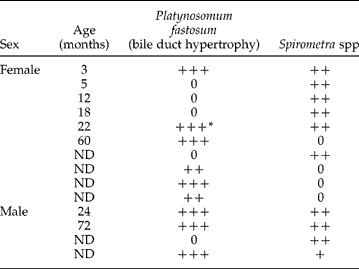
The biological data and the results of parasitism are summarized in table 1. During April 2009–May 2010, 55 feral cats were submitted for routine necropsy at the Laboratory of Veterinary Pathology, SVM/SMU; 25.45% (14/55) of these had parasitism by P. fastosum and/or Spirometra spp. All animals were of the domestic short-hair breed of cats. Females were super-represented, and contributed to 71.43% (10/14) of infected feral cats, 28.57% (4/14) of the infected cats were males. The ages of six cats were unknown; within the remaining animals (57.14%; 8/14) age varied from 3 months to 6 years.
Infection of domestic short-hair cats with Platynosomum fastosum and Spirometra spp., relative to host sex and age.
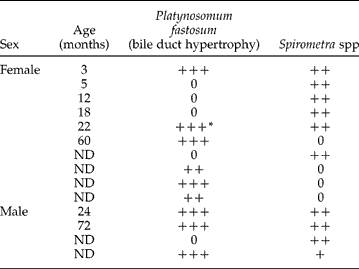
ND, not determined; bile duct hypertrophy/parasitism: 0, absent; +, discrete; ++, moderate; +++, severe; *, host with concomitant bile duct hypertrophy and intraductal trematodes.
Identification of parasites
The morphological characteristics of the collected trematodes were consistent with those of P. fastosum; the fluke presented oral and ventral suckers, ovary, testis, bilateral vitellaria and branching uterus. The tapeworms were flattened, pseudo-segmented, with lengths that varied from 12 to 27 cm and 1.2–1.5 mm wide; the mature proglottids were wider than longer, and there was a centrally located gentalia; some mature proglottids contained several golden-brown operculated eggs. The morphological features of the tapeworms were consistent with those of Spirometra spp.
Pathology
There were minimal differences in the gross alterations observed within the liver of affected feral cats. Grossly, the organs were described as being moderately enlarged and firm with hypertrophy of bile ducts when the sectioned surfaces were examined. However, in the fifth cat (table 1), most of the hypertrophic bile ducts contained numerous small 3–5 mm long flukes; this was not observed in the other animals. Intestinal alterations were restricted to the accumulations of several examples of tapeworms within the small intestine, varying degrees of congestion of intestinal mucosa, and hypertrophy of mesenteric lymph nodes.
Hepatic P. fastosum-induced histological alterations were predominantly portal due to a marked increase in fibrous connective tissue resulting in distinct visualization of the hepatic lobules. These lesions were classified as moderate to severe, chronic, multifocal, parasitic-induced intrahepatic cholangitis. Two patterns of parasitic infection were identified: one active with intraductal trematodes and the other resolving without intraductal parasites. Active manifestation of parasitic infection as observed in the one cat and was characterized by severe periductal fibrosis, with areas of bridging fibrosis, dilation of intrahepatic bile ducts and marked adenomatous proliferation of bile duct epithelium into the lumen associated with intraductal adult parasite. Chronic resolving P. fastosum-induced infection occurred in 14.55% (8/55) of cats, and was characterized by dilated intrahepatic bile ducts that were surrounded by moderate accumulations of lymphocytes and plasma cells with few eosinophils, while others were filled with tissue debris and revealed severe adenomatous proliferation of bile duct epithelium but without the intraductal parasite; this was also observed in the cat with intraductal trematodes. Additionally, discrete canalicular biliary stasis and hepatic lipidosis was observed in some animals.
Infection levels
Intestinal infection by Spirometra spp. was observed in 18.18% (10/55) of cats; of these 60% (6/10) were females and 40% (4/10) males (table 1). Active infection by P. fastosum occurred in 1.18% (1/55) of cats, and this cat had a concomitant infection with Spirometra spp. Chronic resolving P. fastosum-induced hepatic infestations, characterized by typical pathological lesions without corresponding intraductal parasites, occurred in 14.55% (8/55) of the feral cats evaluated, and was also observed in this cat. Chronic resolving periductal hepatitis was also over-represented in female cats (66.67%; 6/9) relative to their male (33.33; 3/9) counterparts. Additionally, 9.09% (5/55) of cats with chronic resolving fluke infestations had concomitant Spirometra spp. infection. Further, P. fastosum-induced parasitism varied from moderate to severe, whereas cats had discrete to moderate accumulations of intestinal tapeworms.
Discussion
The pathological and parasitological findings of the hepatic lesions observed in these cases are consistent with previous descriptions of the liver fluke, P. fastosum, of cats (Bowman et al., Reference Bowman, Hendrix, Lindsay and Barr2002; Haney et al., Reference Haney, Christianses and Toll2006; Stalker & Hayes, Reference Stalker, Hayes and Maxie2007; Bowman, Reference Bowman2009). Additionally, the morphological features of the intestinal tapeworm are consistent with those of Spirometra spp. (Buergelt et al., Reference Buergelt, Greiner and Senior1984; Lee et al., Reference Lee, We, Sohn, Hong and Chai1990; Bowman et al., Reference Bowman, Hendrix, Lindsay and Barr2002; Bowman, Reference Bowman2009). The intestinal cestodes observed in 18.18% (10/55) of feral cats during this study were considered as incidental necropsy findings, since these did not induce any significant pathological alteration to the host, but serve as an alert for human manifestations of this infection, since this is a zoonotic disease (Meyer, Reference Meyer1970; Walker & Zunt, Reference Walker and Zunt2005). Although the clinical history of these cats was unknown, the fact that they were roaming on the streets of Grand Cayman highly facilitates the ingestion of any of the intermediate hosts of the fluke and the tapeworm, and the maintenance of the life cycle of these parasites. Further, these hepatic and intestinal parasitic infections corroborate the theory that free-roaming animals are more susceptible to parasitic disease than those maintained indoors (Nakagawa et al., Reference Nakagawa, Bracarense, Reis, Yamamura and Headley2007).
This study has demonstrated that Spirometra spp. was present in 18.18% (10/55) of the feral cats, with parasitic disease associated with P. fastosum occurring in 16.36% (9/55) of the cats necropsied in Grand Cayman during the evaluation period. Although P. fastosum has been described within the Caribbean (Bowman et al., Reference Bowman, Hendrix, Lindsay and Barr2002), there are few studies indicating evidence of parasitism within the 30 island states localized within the Caribbean Sea. A recent study done in St. Kitts (Krecek et al., Reference Krecek, Moura, Lucas and Kelly2010) did not report the presence of Spirometra spp., while this tapeworm has been described in 2.4% (2/83) of cats from the Dutch Antilles (Rep, Reference Rep1975). A more elevated prevalence (81%) of Platynosomum spp. was described in cats from St. Kitts (Krecek et al., Reference Krecek, Moura, Lucas and Kelly2010), with only 2.4% (2/83) of cats from the Dutch Antilles having the trematode (Rep, Reference Rep1975). The occurrence of parasitism described herein might not be a true representation of the actual prevalence of these parasites in cats from Grand Cayman, since only feral cats were used and these are more likely to have manifestations of parasitic diseases because of their roaming habits (Nakagawa et al., Reference Nakagawa, Bracarense, Reis, Yamamura and Headley2007). Nevertheless, during this study female cats were more infected (71.43%; 10/14) than their male counterparts for both parasitic infections; these results are similar to those of a previous study that evaluated the sexual predominance of cats to infection by the liver fluke (Rodriguez-Vivas et al., Reference Rodriguez-Vivas, Williams, Quijano-Novelo, Bolio and Torres-Acosta2004), where female cats were considered to have an elevated risk of infection due to their maternal feeding habits of providing food for their kittens by hunting the intermediate host of this trematode.
Although no description of the first intermediate host (Subulina octona) of P. fastosum in Grand Cayman was found, this does not imply that the snail is not present on the island. Documented scientific information relative to infectious and parasitic diseases of domestic animals from the Cayman Islands is almost non-existent, which might contribute to the absence of information relative to S. octona in Grand Cayman. This makes the description of these parasitic diseases of paramount interest to the veterinary and medical community, being the first report of P. fastosum-induced disease and intestinal sparganosis originating from the Cayman Islands. Nevertheless, S. octona is a pantropical snail that is considered non-endemic to Jamaica, probably introduced by humans (Rosenberg & Muratov, Reference Rosenberg and Muratov2010), and might have gained entry to Grand Cayman by a similar method. The second intermediate hosts of P. fastosum include the Anolis species of lizards and the marine toad, Bufo marinis (Haney et al., Reference Haney, Christianses and Toll2006); these have been identified and are endemic/indigenous to Grand Cayman (Cayman Wildlife Connection, 2010). Potential sources of infection for this parasite include the contaminated ground gecko (Sphaerodactylus argivus argivus) and the curly tailed lizard (Leiocephalus carinatus varius). These animals are native to Grand Cayman (Cayman Wildlife Connection, 2010), and are constant prey of roaming cats.
The marked hypertrophy of the bile ducts observed grossly and the severe periductal biliary fibrosis with adenomatous epithelial proliferation and dilated bile ducts, seen by histology during this study, associated with intraductal adult parasites are characteristic features of P. fastosum infection in cats (Soto et al., Reference Soto, Villalobos, Alvarado and Chirinos1991; Haney et al., Reference Haney, Christianses and Toll2006; Stalker & Hayes, Reference Stalker, Hayes and Maxie2007; Vieira et al., Reference Vieira, Ecco, Lima and Guedes2009). However, in some cases, there is the characteristic histological alteration without the presence of the adult intraductal trematode (Taylor & Perri, Reference Taylor and Perri1977; Cullen, Reference Cullen, McGavin and Zachary2005); these features were observed in the bile ducts of 14.55% (8/55) of cats during this study. These characteristic lesions are more pronounced around bile ducts containing the fluke relative to those without, and the severity tends to be reduced with increasing distance of the unparasitized ducts from those that contain the trematode (Greve & Leonard, Reference Greve and Leonard1966); this was observed in one cat, which had both patterns of parasitism. Therefore, severe periductal fibrosis and adenomatous hyperplasia of biliary epithelium, as occurred in these cases, might represent the characteristic histopathological features associated with platynosomiasis in cats, irrespective of the presence or absence of the intraductal trematode, since it is very difficult to observe adult intraductal flukes or ova in affected animals during histopathological evaluation (Cullen, Reference Cullen, McGavin and Zachary2005). Consequently, an absence of intraductal flukes or ova, in cases where these histological features are prominent in cats from endemic regions, does not necessarily imply an absence of parasitism, but might suggest that the animal had previous contact with P. fastosum. The effects of tolerance and immunity to infection (Retnasabapathy & Prathap, Reference Retnasabapathy and Prathap1971) might be the key features to explain this phenomenon in this disease.
It is interesting to note that we have observed a similar histological phenomenon in the pancreas of cattle infected with the fluke, Eurytrema coelomaticium (Bassani et al., Reference Bassani, Sangioni, Saut, Yamamura and Headley2006; Headley et al., Reference Headley, Saut, Bassani, Sangioni, Birgel and Yamamura2009). The lesions associated with E. coelomaticium vary from early proliferative changes of epithelial cells of the pancreatic ducts to chronic multifocal interstitial pancreatitis, and we have demonstrated that gross evaluation of parasitism does not necessarily correlate with histological evidence of parasitic infection, since the pancreas without gross evidence of infection, i.e. the unparasitized pancreas, of cattle in endemic areas of bovine eurytrematosis, might have histological evidence of an early infection or previous contact with this fluke (Bassani et al., Reference Bassani, Sangioni, Saut, Yamamura and Headley2006; Headley et al., Reference Headley, Saut, Bassani, Sangioni, Birgel and Yamamura2009). This might also be the case in cats from endemic areas of platynosomiasis. Additionally, an experimental infection of cats during which exceedingly large amounts of liver flukes (125 and 1000 flukes per cat) were administered resulted in manifestation of characteristic histological alterations and recovery of ova (Taylor & Perri, Reference Taylor and Perri1977), but intraductal flukes were not described. This result further supports the theory that the parasite-induced hepatic lesion does not necessarily have to demonstrate the intraductal fluke grossly or during histological evaluations.
Nevertheless, the histological alterations induced by P. fastosum infection in cats are completely different and must be differentiated from those associated with the feline cholangiohepatitis complex (Zawie & Garvey, Reference Zawie and Garvey1984; Day, Reference Day1995). Platynosomiasis in cats was previously related to cystic hepatic disease (Robinson & Ehrenford, Reference Robinson and Ehrenford1962; Xavier et al., Reference Xavier, Morato, Righi, Maiorka and Spinosa2007), biliary obstruction (Soto et al., Reference Soto, Villalobos, Alvarado and Chirinos1991; Haney et al., Reference Haney, Christianses and Toll2006) and fibrosis (Soto et al., Reference Soto, Villalobos, Alvarado and Chirinos1991), resulting in hepatic insufficiency (Xavier et al., Reference Xavier, Morato, Righi, Maiorka and Spinosa2007) and possibly death (Stalker & Hayes, Reference Stalker, Hayes and Maxie2007) in severe cases. Alternatively, the associated clinical manifestations can also be easily confused with those induced by cholecystitis (Willard & Fossum, Reference Willard, Fossum, Ettinger and Feldman2005). Further, since there has been a description of this infection in an abnormal host (orang-utans) from Indonesia (Warren et al., Reference Warren, Swan, Hobbs, Herlyanto, Kuhn and Heeney1998), the possibility of infection occurring in wild animals within the Cayman Islands should not be overlooked.
Platynosomiasis has also been described in orang-utans (Warren et al., Reference Warren, Swan, Hobbs, Herlyanto, Kuhn and Heeney1998) and common marmosets (Sousa et al., Reference Sousa, Leão, Coutinho and Ramos2008). The gross alterations observed in these animals are quite similar to those observed in this study, except for the nodular appearance of the liver and the hypertrophy of the wall of the gall-bladder of the New World primate (Sousa et al., Reference Sousa, Leão, Coutinho and Ramos2008). There is also marked similarity relative to the histopathological features associated with Platynosomum spp. in orang-utans (Warren et al., Reference Warren, Swan, Hobbs, Herlyanto, Kuhn and Heeney1998) and common marmosets (Sousa et al., Reference Sousa, Leão, Coutinho and Ramos2008) and the features described in these cats. However, the marmosets infected with this fluke demonstrated cholestasis and neoformation of the walls of bile ducts (Sousa et al., Reference Sousa, Leão, Coutinho and Ramos2008); these histological findings were not observed in the present cases. In addition, platynosomiasis in orang-utans has been associated clinically with chronic wasting syndrome (Sousa et al., Reference Sousa, Leão, Coutinho and Ramos2008). Although there is no description of human cases of Platynosomum spp., contamination might occur if a person ingests a contaminated lizard (Bowman et al., Reference Bowman, Hendrix, Lindsay and Barr2002).
Sparganosis refers to infection by the larva (sparganum) of specific members of the Pseudophyllidea family of cestodes within the mammalian host (Jones et al., Reference Jones, Hunt and King1997). Within this family, members of the Spirometra and Diphyllobothrium genera are of significant veterinary importance (Bowman, Reference Bowman2009). However, during this study, it was not possible to characterize the species of the intestinal cestode. Nevertheless, since two members of the Spirometra genus (S. mansonoides and S. mansoni) are known to frequently infect the intestine of the domestic cat (Jones et al., Reference Jones, Hunt and King1997; Bowman, Reference Bowman2009), and each occurs in distinct geographical locations (S. mansonoides in the Americas; S. mansoni in Asia), it can be readily deduced that these cats were most likely infected by S. mansonoides. Further, cats can demonstrate an unusual and rare manifestation of proliferative sparganosis caused by the erratic migration of S. proliferum larvae, which results in ascites, hepatomegaly, splenomegaly, serosal thickening of abdominal organs, gastric ulceration and parasitic granulomas within parenchymatous organs (Buergelt et al., Reference Buergelt, Greiner and Senior1984). Alternatively, sparganosis in large wild felids has been associated with S. pretoriensis and S. theileri (Müller-Graf et al., Reference Müller-Graf, Woolhouse and Packer1999). Additionally, sparganosis is a zoonotic disease of humans (Meyer, Reference Meyer1970; Walker & Zunt, Reference Walker and Zunt2005), which frequently produces severe lesions in the eye (Yang et al., Reference Yang, Lee and Kang2007), subcutaneous tissue (Ali-Khan et al., Reference Ali-Khan, Irving, Wignall and Bowmer1973) and the brain (Meyer, Reference Meyer1970; Walker & Zunt, Reference Walker and Zunt2005).
The occurrence of Spirometra in feral cats underscores the public health significance and risk of human infection with this parasite. Grand Cayman is a complex heterogeneous mixture of humans originating from all continents, and many of these maintain specific cultural practices that are indigenous to each geographical location. With its rich wildlife fauna and ecosystem, the island has and maintains the intermediate and definitive hosts for Spirometra and provides an ideal setting for sporadic occurrences of human sparganosis.
Examples of P. fastosum and Spirometra spp. were identified in feral cats submitted to necropsy based on parasitological and pathological characteristics. Although the clinical history of the animals was unknown, gross alterations were predominantly hepatic, and consisted of the accumulations of numerous flukes within the enlarged bile ducts of one cat. Morphologically, the features of the fluke were consistent with those of P. fastosum, and those of the cestode were indicative of Spirometra spp. Histopathology revealed the characteristic lesions with and without the associated intraductal trematode. Further, severe periductal fibrosis and adenomatous hyperplasia of bile duct epithelium might represent the most significant histological findings associated with platynosomiasis in cats. Significant pathological alterations were not associated with the intestinal tapeworm. Additionally, the possibility of human sparganosis occurring in the Cayman Islands cannot be overlooked.
Acknowledgements
The authors thank Natasha Idom, School of Veterinary Medicine, St. Matthew's University, for participating in the initial necropsy of some of the animals.