Introduction
Despite attempts to outlaw age discrimination, ageism is still considered a problematic feature of most Western labour markets. On average, 51 percent of European citizens are worried that employers show preference to people in their twenties (Abrams et al. Reference Abrams, Russell, Vauclair and Swift2011). Older employees are generally perceived and treated less favourably than younger workers (Gordon and Arvey Reference Gordon and Arvey2002). The challenges older employees face can – at least partly – be attributed to an image problem (Van der Heijden Reference Van der Heijden2005). Age-related stereotypes about the skills and capacities of older employees are prevalent within organisations and have been identified as a crucial obstacle for their employability (Chiu et al. Reference Chiu, Chan, Snape and Redman2001; Finkelstein and Burke Reference Finkelstein and Burke1998).
Stereotypes about older workers are rooted in societal and organisational factors (Bowen and Skirbekk Reference Bowen and Skirbekk2013; Chiu et al. Reference Chiu, Chan, Snape and Redman2001), and are likely being reinforced by media. As the main supplier of images and information about ageing and becoming old in age-segregated Western societies, media are a powerful source to highlight shared representations of societal groups, with older workers being no exception (Donlon, Ashman and Levy Reference Donlon, Ashman and Levy2005; Lubbers, Scheepers and Wester Reference Lubbers, Scheepers and Wester1998; Roy and Harwood Reference Roy and Harwood1997). Yet, while media portrayals of older adults (>65 years of age) have been widely studied (e.g. Cohen Reference Cohen1994; Hanlon, Farnsworth and Murray Reference Hanlon, Farnsworth and Murray1997; Kessler, Rakoczy and Staudinger Reference Kessler, Rakoczy and Staudinger2004; Levy et al. Reference Levy, Chung, Bedford and Navrazhina2014), far less attention has been paid to media portrayals of older workers (>45 years of age)Footnote 1 specifically.
This study, then, investigates the extent to which stereotypes of older workers are reflected in corporate (i.e. annual reports and employee magazines) and news media and how potential differences in these stereotypes can be accounted for. By investigating both corporate and news media, this study considers the two key domains in which the consequences of stereotypical portrayals of older workers are likely being most significant. First, stereotypes in corporate media are likely to reflect inter-organisational beliefs (Van Selm and Van der Heijden Reference Van Selm and Van der Heijden2014) and inform (older) employees and organisational stakeholders about how older employees are perceived within their organisation. Moreover, stereotypical communication in organisations has negative consequences for the perceived and actual employability of older staff (Henkens Reference Henkens2005) and older workers’ work aspirations (Gaillard and Desmette Reference Gaillard and Desmette2010). Second, stereotypes in news media can inform a broader range of actors about characteristics of older employees. As a consequence, stereotypes in news media might influence beliefs about older employees among policy makers, employers and (unemployed) older workers themselves. In turn, these beliefs have been shown to affect decisions regarding the retention of older workers (Karpinska, Henkens and Schippers Reference Karpinska, Henkens and Schippers2013).
This study makes several contributions to the literature. First, to understand better the content of older employees’ media stereotypes, we investigate the extent to which such stereotypes originate from warmth and competence beliefs (Fiske et al. Reference Fiske, Cuddy, Glick and Xu2002). Second, and moving beyond a merely descriptive account, we add to the understanding of the factors that explain variation in older workers’ media stereotypes. More specifically, we analyse differences between corporate and news media and investigate how sources in the news bring different stereotypes to the forefront. Herewith, we add to our understanding of how negative stereotypical portrayals of older employees are triggered and could be combatted, which is crucial to take a step towards a more realistic public and organisational debate about this part of the workforce. Last, by investigating media stereotypes of older workers, we methodologically diverge from previous research (see Posthuma and Campion Reference Posthuma and Campion2009), which has largely neglected the broader media environment in which ageist stereotypes are likely being constructed, confirmed or combatted (McCann and Giles Reference McCann, Giles and Nelson2002). We rely on a content analysis of news and corporate media of Dutch organisations, in the research period 2006–2013.
The paper proceeds as follows. First, we use the Stereotype Content Model (SCM) (Fiske et al. Reference Fiske, Cuddy, Glick and Xu2002) as the theoretical basis for understanding the mixed nature of media stereotypes of older employees. Second, we take into consideration two factors that may explain variation in the share of negative media stereotypes of older employees: media types (i.e. corporate and news media) and sources in corporate and news media.
Stereotypes of older employees
To investigate the content of stereotypical portrayals of older employees in media content, we argue that the SCM (Fiske et al. Reference Fiske, Cuddy, Glick and Xu2002) offers valuable insights. According to this framework, stereotypical beliefs about social groups can be broken down into two recurring dimensions that result from interpersonal and inter-group interactions: warmth (warm versus cold) and competence (competent versus incompetent). In this model, elderly adults have a high position on the warmth dimension and a low position on the competence dimension. For example, older workers are generally judged as benevolent and amicable colleagues (i.e. high in warmth traits), but also as less capable and efficient (i.e. low in competence traits) compared to younger workers (Krings, Sczesny and Kluge Reference Krings, Sczesny and Kluge2011).
Different studies have demonstrated that judgements of warmth and incompetence underlie perceptions of elderly adults across diverse temporal and cultural settings (Cuddy and Fiske Reference Cuddy, Fiske and Nelson2002; Cuddy, Norton and Fiske Reference Cuddy, Norton and Fiske2005), and contrasts with, for example, stereotypical beliefs of younger (educated) people, who are perceived as both warm and competent (Fiske et al. Reference Fiske, Cuddy, Glick and Xu2002). Previous content analyses have shown that both positive and negative portrayals of older adults are present in the media (Gibb and Holroyd Reference Gibb and Holroyd1996), and that these positively and negatively valenced stereotypes vary on the warmth and competence dimensions (Lepianka Reference Lepianka2015).
Warmth and competence as core dimensions of social judgements are of relevance to the context of employability specifically. Yet, few attempts have been made to apply the SCM to this domain (for an exception, see Krings, Sczesny and Kluge Reference Krings, Sczesny and Kluge2011). Indeed, insights from studies using the SCM are not used in managerial studies focusing on beliefs about older employees (Chiu et al. Reference Chiu, Chan, Snape and Redman2001; Van Dalen, Henkens and Schippers Reference Van Dalen, Henkens and Schippers2010). As a consequence, it has so far remained unclear to what extent warmth and competence stereotypes about elderly adults also apply to older employees, especially since SCM research generally uses much older and often-retired persons (>65 years of age) compared to older employees (>45 years of age) (e.g. Cuddy, Norton and Fiske Reference Cuddy, Norton and Fiske2005). However, there is some evidence that older employees indeed are perceived as more warm and less competent than younger workers (Krings, Sczesny and Kluge Reference Krings, Sczesny and Kluge2011).
The evaluations of older employees in organisational studies closely correspond to the dimensions of the SCM (Van Dalen, Henkens and Schippers Reference Van Dalen, Henkens and Schippers2010; Lazazzara, Karpinska and Henkens Reference Lazazzara, Karpinska and Henkens2013). Studies in the organisational field point to noticeable similarities between stereotypes about older employees and elderly adults. Previous studies have shown that stereotypes of older employees are also not consistently negative or positive, but are instead mixed (Bal et al. Reference Bal, Reiss, Rudolph and Baltes2011; Chiu et al. Reference Chiu, Chan, Snape and Redman2001; Finkelstein and Burke Reference Finkelstein and Burke1998; Van Dalen, Henkens and Schippers Reference Van Dalen, Henkens and Schippers2010). Generally, older employees are perceived as reliable, trustworthy and loyal, but also as less adaptable, motivated and capable compared to younger workers (for meta-analyses, see Bal et al. Reference Bal, Reiss, Rudolph and Baltes2011; Posthuma and Campion Reference Posthuma and Campion2009).
The similarity between the SCM and stereotypes of older employees is particularly apparent in the work of Van Dalen, Henkens and Schippers (Reference Van Dalen, Henkens and Schippers2010; see also Lazazzara, Karpinska and Henkens Reference Lazazzara, Karpinska and Henkens2013). These scholars conclude that older employees are positively evaluated for a set of soft work skills, defined as organisational citizenship behaviours (e.g. reliability and commitment). These soft skills are similar to warmth beliefs as proposed by the SCM. On the contrary, older employees are perceived as more negative when it comes to the set of hard work skills (e.g. technology skills, physical and mental capabilities). These hard skills correspond to the competence dimension of the SCM.
Considered core-stereotype dimensions, warmth and competence are also relevant on the macro-organisational level. Specifically, mixed evaluations of older employees have been found in an analysis of business responses too (Van Selm and Van der Heijden Reference Van Selm and Van der Heijden2013). Dutch organisations have responded to the issue of sustainable employment by taking measures that accommodate or ease the load on older employees, while measures aimed at professional development and growth are less common practice. These organisational responses can be interpreted as stereotype-confirmative in that they indicate reduced competence of older employees (Van Selm and Van der Heijden Reference Van Selm and Van der Heijden2013).
Based on the above-outlined literature, we expect that warmth and competence are prominent dimensions of negative and positive stereotypes about older employees, as the SCM predicts (Fiske et al. Reference Fiske, Cuddy, Glick and Xu2002). Specifically, we hypothesise:
-
• Hypothesis 1 (H1): In corporate and news media, older employees are positively portrayed with regard to warmth stereotypes but negatively with regard to competence stereotypes.
Variation in negative and positive stereotypical portrayals
In addition to describing the content of stereotypical portrayals of older employees in corporate and news media, this study aims to complement our understanding of variation in stereotypical portrayals of older employees. We trace the circumstances that trigger negative stereotypes because their impact on perceptions of older employees might be especially problematic (Gaillard and Desmette Reference Gaillard and Desmette2010). Specifically, we consider the influence of media and source types on variation in the share of negative stereotypes of all (positive and negative) stereotypes.
Media types
As argued, corporate and news media are key arenas that could contribute to the accessibility of stereotypical beliefs about older employees. Specific to the context of news media, previous studies have identified stereotypes about gender (Sendén, Sikström and Lindholm Reference Sendén, Sikström and Lindholm2014), mental illness (Aragonès et al. Reference Aragonès, López-Muntaner, Ceruelo and Basora2014) and ethnicity (Van Dijk Reference Van Dijk1992). News media are more likely to contain stereotypes compared to corporate media because journalists rely on personification and exemplification as storytelling techniques (Eilders Reference Eilders2006). In selecting examples to illustrate news stories, negative stereotypes might play a role. Contrary, it is not likely that corporations will explicitly state negative stereotypes about older employees in their media, given that accusations of ageist beliefs and behaviours are likely to stain the corporate reputation (Kunze, Boehm and Bruch Reference Kunze, Boehm and Bruch2011). Indeed, previous research has shown that negative employee disclosures are very rare in corporate annual reports (Kent and Zunker Reference Kent and Zunker2013). We formulate the following hypothesis:
-
• Hypothesis 2 (H2): The share of negative stereotypes is lower in corporate media compared to news media.
Sources in corporate and news media
We now consider the influence of source types in corporate and news media on the share of negative stereotypes. Specifically, we investigate whether corporate representatives, on the one hand, and quoted and unquoted sources, on the other, bring different stereotypical portrayals of older employees to the forefront.
First, it is interesting to investigate whether and how corporate representatives (such as managers and employers) express stereotypes about older workers in different domains. In the Netherlands, corporate representatives hold mixed stereotypes about older workers. Consistent with the multi-dimensionality of perceptions of older workers mentioned before, Dutch managers judge older workers positively in terms of their reliability and commitment, but negatively regarding their adaptability and technological competences (Henkens Reference Henkens2005). These stereotypical views are not necessary explicitly stated by corporate managers in corporate and news outlets. Potentially, corporate representatives communicate differently about older workers in the news arena, when they are out of their comfort zone and have no direct control over the content of messages. The influence on corporate reputation is likely to be especially apparent in this context, as expressing stereotypes in news media might result in public scrutiny and critique. Due to a lack of research in this area, we formulate the following research question:
-
• Research question 1 (RQ1): To what extent do corporate representatives use negative stereotypes when they talk about older workers in corporate and news media?
Second, we investigate the influence of quoted and unquoted sources on variation in the share of negative stereotypes. Quoted sources are cited actors, such as politicians, employees or organisational actors, who are explicitly and identifiably responsible for stereotypical statements in the media. Contrary, unquoted sources result from editorial input, making the origin of stereotypical statements less obvious.
Although there is mounting evidence for the mixed nature of ageist stereotypes in the workplace (Bal et al. Reference Bal, Reiss, Rudolph and Baltes2011; Posthuma and Campion Reference Posthuma and Campion2009), it is not likely that positive and negative stereotypes are equally expressed by quoted and unquoted sources in corporate and news media. Generally, individuals are more likely to express positive than negative stereotypes. While associations with elderly adults on an implicit level tend to be consistent with negative stereotypes, explicit stereotypes are more often positive (Nosek, Banaji and Greenwald Reference Nosek, Banaji and Greenwald2002), arguably because individuals fear to stigmatise. These findings suggest that although implicit negative beliefs may give rise to prejudice and ageism against older employees (Posthuma and Campion Reference Posthuma and Campion2009), such negative beliefs are not likely to be explicitly communicated by attributable individuals. Based on this, we expect that identifiable, quoted sources in corporate and news media are more likely to state positive stereotypes, while anonymous, unquoted sources are more likely to state negative stereotypes. This leads to the following hypothesis:
-
• Hypothesis 3 (H3): The share of negative stereotypes is lower when quoted compared to unquoted sources are cited in corporate and news media.
Methods
Data
We relied on a large-scale content analysis of corporate and news media published in the period 2006–2013 to test our hypotheses empirically. For our sample of corporate media, we selected 50 large-scale organisations with at least 850 employees in the Netherlands. From these organisations, all available annual reports and employee magazines that were published during the research period were collected. By considering both internal and external corporate outlets, our measure of corporate media is more inclusive compared to previous studies, which have generally not included different corporate media outlets because of data-availability difficulties (Hughes Reference Hughes2014). The collected annual reports and employee magazines were searched with the following key words: older (workers or employees) and/or workforce ageing and/or sustainable employability. Thus, when one of these terms appeared in the text, the item was included.
For our sample of news media, we relied on the five largest paid national newspapers of the Netherlands (de Volkskrant, NRC Handelsblad, Trouw, Algemeen Dagblad and De Telegraaf). We searched LexisNexis with the same search string used to select our corporate material.Footnote 2 The final sample consisted of 1,328 items (newspaper articles, N = 894; employee magazine articles, N = 283; annual reports, N = 151). Individual newspaper articles, employee magazine articles and annual reports constituted the coding units.
Coding procedure
The codebook was developed in several steps. First, a set of stereotype categories was established based on typologies of stereotypes about older employees as found in previous research. Adopting an inclusive approach, in this phase, we relied on both literature from the SCM and managerial studies investigating perceptions of older workers (Chiu et al. Reference Chiu, Chan, Snape and Redman2001; Finkelstein and Burke Reference Finkelstein and Burke1998; Posthuma and Campion Reference Posthuma and Campion2009; Van Dalen, Henkens and Schippers Reference Van Dalen, Henkens and Schippers2010). In a second step, these stereotypes were used to analyse the material in a qualitative pre-study (N ≈ 100). Here, the aim was to assure that we did not miss out on relevant stereotype categories and to verify whether stereotypes mentioned by the literature were actually present in news and corporate media.
This resulted in the following nine stereotype elements: (a) costs (wages of older employees); (b) mentor role (wisdom, experience); (c) warm personality (friendly and collegial); (d) reliability and trustworthiness; (e) involvement and commitment to the organisation; (f) ability and willingness to learn; (g) technological competence and adaptability; (e) physical capability and health; (f) productivity. As these categories were the outcome of an extensive literature review and a rigorous qualitative pre-study, they are as inclusive as possible. The theoretical origin of these stereotype elements is presented in Table 1.
Operationalisation and theoretical origin of stereotype elements

In a second phase, the identified stereotype elements were coded in a quantitative content analysis. Four coding assistants independently coded all the material. Coders were extensively trained and multiple pre-tests were executed. Coding assistants were instructed to code for the presence of stereotypes in case the media article referred to older worker(s) and/or workers aged 45 years and/or older. In case certain stereotypical characteristics were discussed in relation to workers explicated to be younger than 45 years of age, stereotypes were not coded. After an acceptable level of consensus was reached, the actual coding started. Reliability was established on a sample of randomly selected coding units, which yielded satisfactory to good results (Krippendorff's alpha (α) reported below).
For all coding units, coders firstly indicated whether a stereotype element was (1) present or (0) not. Second, for all the stereotype elements, coders indicated whether it was (0) negatively or (1) positively valenced. An example of a positively valenced stereotype element is: ‘Older employees are eager to learn new skills.’ Contrary, an example of the same, but negative, stereotype element is: ‘Older employees are not motivated to participate in professional training activities.’ For an overview of examples of all stereotype elements, see Table 1. The goal of this exploratory study is to assess whether older workers are portrayed in the news as warm and incompetent. For this aim, dichotomous measures suffice, as we merely focus on the presence of warmth and competence stereotypes. Previous comparable studies have used the same approach (Lepianka Reference Lepianka2015). A maximum of nine stereotype elements could be coded per coding unit.
Measures
The share of negative stereotypes
A stereotype element (N = 573) was considered to be present in case older employees were discussed in congruence with the predefined stereotype categories. A total of 290 negative and 283 positive stereotype elements were coded (see Table 1). Krippendorff's alpha for intercoder reliability was on average 0.70, with individual stereotype elements varying between 0.61 and 0.89.
For analysis, we rely on the share (i.e. percentage) of negative stereotype elements relative to all stereotype elements. The following formula was used:
 $${\rm Share}\,{\rm of}\,{\rm negative}\,{\rm stereotypes} = \; \displaystyle{{{\rm Negative\;} \,{\rm stereotypes}} \over {{\rm Positive\;} + {\rm \; negative\;} \,{\rm stereotypes}}}\; \times {\rm} 100.$$
By taking the relative share of negative stereotypes, we ensure that variation in negative stereotypes is relative to the variation in positive stereotypes. Moreover, it allows us to incorporate information on both negative and positive stereotypes in a single dependent variable.
Warmth and competence stereotypes
For the classification of stereotype elements into warmth and competence dimensions, we primarily follow the operationalisation of the SCM (Fiske et al. Reference Fiske, Cuddy, Glick and Xu2002). However, the original items used to measure warmth and competence are rather general, as they aim to capture stereotypes of diverse social groups. As a consequence, the items are not specifically tailored to the context of older workers. With the aim of arriving at a more specific operationalisation of warmth and competence in the context of this study, we combine the original items of the SCM with the operationalisation of soft and hard work skills identified by Van Dalen, Henkens and Schippers (Reference Van Dalen, Henkens and Schippers2010). This allows for a more tailored approach to measuring warmth and competence stereotypes in the specific context of older workers. As mentioned before, soft work skills are concerned with social capacities (e.g. social skills, reliability and commitment) and may, therefore, be considered as elements related to job performance within the domain of warmth. Conversely, hard work skills fit within the competence dimension, as here the emphasis is on individual mastery capacities (e.g. productivity, ability and willingness to learn new skills).
Of the nine identified stereotype elements, seven fit well into the warmth and competence dimensions of the SCM framework. The warmth dimension was created with the following three stereotype elements: (a) involvement and commitment (α = 0.73); (b) reliability and trustworthiness (α = 0.66); and (c) warm personality (α = 0.65).
The competence dimension was created with the following four stereotype elements: (1) productivity (α = 0.84); (2) physical capability and health (α = 0.61); (3) technological competence and adaptability (α = 0.72); and (4) ability and willingness to learn (α = 0.72). The connection between these categories and the literature is summarised in Table 1.
Two identified stereotypes did not straightforwardly correspond to the warmth or competence dimension. First, stereotypes about costs of older employees (α = 0.70) were not included in our measure of warmth and competence, given that this stereotype does not straightforwardly fit either of the categories. Second, stereotypes about older workers’ mentor role entail elements of both warmth and competence. Mentoring roles are typically viewed as ‘taken on by someone senior who is passing on years of experience and wisdom, whereas the protégé role is that of a novice looking to learn, grow and advance’ (Finkelstein, Allen and Rhoton Reference Finkelstein, Allen and Rhoton2003). Such roles entail components of warmth, as offering (emotional) support to younger colleagues may be regarded as a characteristic located on the warmth dimension. Moreover, it might reinforce the stereotype that older employees have less potential for career development and are not a viable future investment (Finkelstein, Burke and Raju Reference Finkelstein, Burke and Raju1995). On the other hand, mentoring could be understood to have components of competence, as offering technical support and supporting the development of tacit knowledge is more likely to fit in with the competence dimension.
Independent variables
News (versus corporate) media
All coding units were coded as (1) news media or (0) corporate media.
Corporate representatives
Coders indicated the source of all stereotype elements, i.e. the actor who states the stereotype in news or corporate media. Coders could indicate a variety of actors, such as employees, politicians, union members and employers. Corporate representatives were coded as the source in cases where (human resources) managers, employers or organisational spokespersons mentioned a stereotype element in corporate or news media (1), relative to other sources or unquoted sources (0) (α = 0.66).
Quoted (versus unquoted) sources
Coders indicated the source of all stereotype elements, i.e. the actor who states the stereotype in news or corporate media. Coders could indicate a variety of actors, such as employees, politicians, union members and employers. A source was considered to be quoted in cases where a stereotype element was mentioned by one of these or other identifiable actors (1). A source was considered to be unquoted when a stereotype element is not mentioned in a quote or statement of an identifiable actor (0). In the latter case, it is not clear whether the stereotype originates from the journalists or editor responsible for the content or from anonymous sources (α = 0.66).
Control variables
To control for over-time changes, a time variable was added, ranging from the first (1) to the last (96) month of the research period. In addition, we control for the financial crisis. We took the fall of the Lehman Brothers as a starting point of the crisis (0 = before September 2008, 1 = September 2008 and after).
Results
Descriptive results
Salience stereotype elements
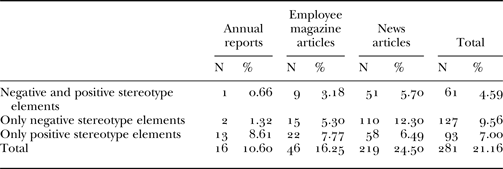
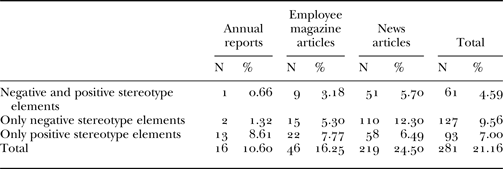
Table 2 displays our descriptive results. The majority of the items do not mention stereotype elements: in 281 (21.2%) items, stereotype elements were coded. In these items, a total of 290 negatively valenced and 283 positively valenced stereotype elements were coded. These stereotype elements appeared in 16 (10.6%) annual reports, 46 (16.3%) employee magazine articles and 219 (24.5%) newspaper articles (see Table 2). This indicates that, overall, news articles are more likely to contain stereotype elements compared to employee magazine articles and annual reports. There is variation in the distribution between negative, positive and mixed-media stereotypes across outlets. Annual reports (8.6%) and employee magazines (7.8%) more often mention only positive stereotypes compared to news media (6.5%). On the contrary, it is more common that only negative stereotypes appear in news articles (12.3%) compared to corporate media (annual reports: 1.3%; employee magazine articles: 5.3%).Footnote 3
Negative and positive stereotype elements across annual reports, employee magazine articles and news articles
Content stereotype elements
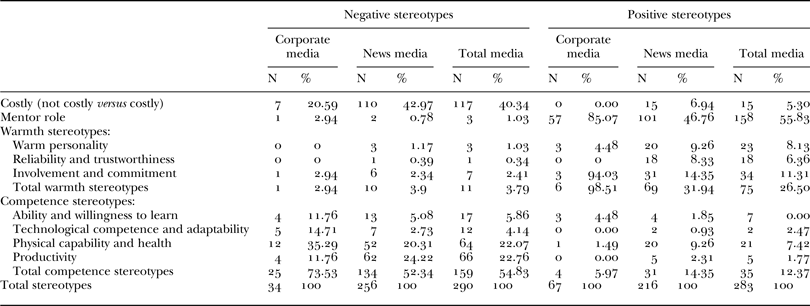
We now turn to the prominence of the different stereotypes, as displayed in Table 3. First, regarding all negative stereotypes, the stereotype that older employees are costly is most common (N = 177, 40.3%), followed by the stereotype that older employees are unproductive (N = 66, 22.8%) and less physically resilient and unhealthy (N = 64, 22.1%). The stereotype ability and willingness to learn (N = 17, 5.9%) and technological competence and adaptability (N = 12, 4.1%) were less frequently present. Notice that competence stereotypes (N = 159, 54.8%) are more frequently coded as negatively valenced compared to warmth stereotypes (N = 11, 3.8%).
Negative and positive stereotypes about older employees in corporate and news media
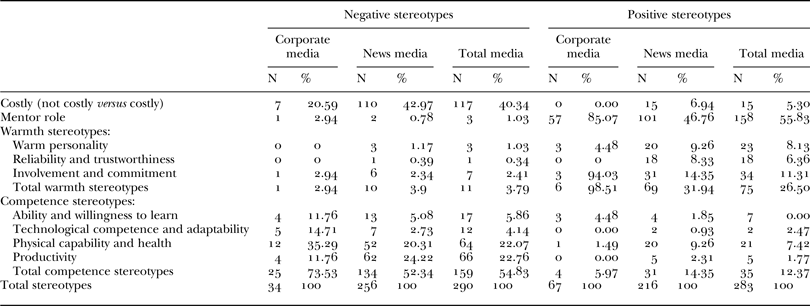
Note: Data show the variation of positively and negatively valenced stereotype elements across nine stereotype categories; 256 negative and 283 positive stereotypes are reported which appeared in 16 annual reports, 46 employee magazine articles and 219 news articles.
Of all positive stereotypes, the mentor role stereotype is the most common (N = 158, 55.8%), followed by the stereotype that older workers are involved and committed (N = 34, 11.3%). The stereotypes that older workers have a warm personality (N = 23, 8.1%) and are reliable and trustworthy employees (N = 18, 6.4%) received less attention. Warmth stereotypes are more often coded as positively valenced (N = 75, 26.5%) compared to competence stereotypes (N = 35, 12.4%).Footnote 4
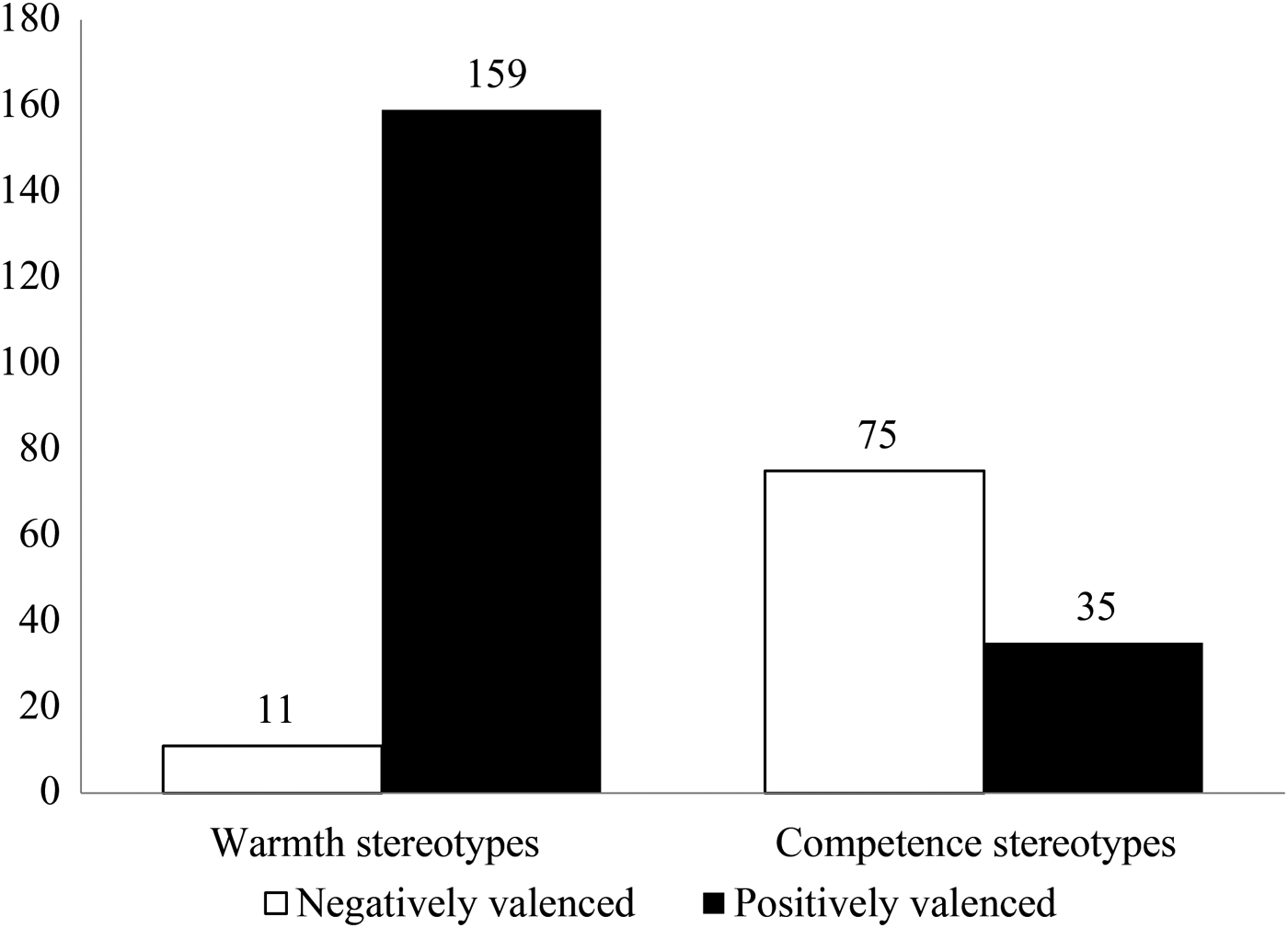
Herewith, and as visualised in Figure 1, our descriptive data support the expectation that older employees are portrayed positively with regard to warmth stereotypes, but negatively with regard to competence stereotypes (H1). To investigate whether the categories indeed differ significantly from each other, a chi-square test was performed. First, warmth stereotype elements were more often positively than negatively valenced (χ2 = 41.81, degrees of freedom (df) = 1, p < 0.001). Conversely, competence stereotype elements were less often positively than negatively valenced (χ2 = 79.26, df = 1, p < 0.001). Hence, H1 is supported by the data.
Number of negatively and positively valenced stereotypes for the warmth and competence stereotypes of older employees in corporate and news media.

Explanatory results
Regarding our expectations about the association between media (H2) and source characteristics (RQ1 and H3) and the percentage of negative stereotypes, our data call for a multi-level model, as our units of analysis are clustered (Hox Reference Hox2005). Stereotypes stated by sources are nested within time periods and (news) organisations. To account for the clustering of observations, we aggregated our data to the level of (news) organisations, months and sources. Choosing a monthly aggregation level, we can closely track over-time variation while too many missing values on the weekly level were avoided (see e.g. Kleinnijenhuis et al. Reference Kleinnijenhuis, Schultz, Oegema and Van Atteveldt2013). As the highest two levels (i.e. organisations and months) are not hierarchically nested, we use a cross-classified multi-level design with maximum likelihood estimation.
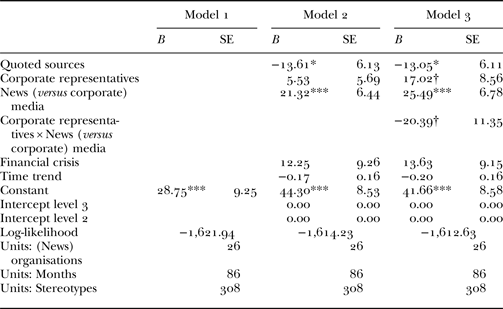
Table 4 displays three models summarising the results of the multi-level analysis predicting the percentage of negative stereotype elements relative to all stereotype elements. On the highest two cross-classified levels, we find 26 (news) organisations and 86 months, indicating that stereotypes were not mentioned by all organisations. On the lowest level, 308 sources expressing positive or negative stereotypes are present. Model 1 displays the intercept-only model without explanatory variables. In Model 2, the explanatory variables were added, namely quoted (versus unquoted) sources, corporate representatives, news (versus corporate) media, financial crisis and time trend. Last, in Model 3 the interaction term of corporate representatives and media type was added. Fit statistics (log-likelihood) indicate that the models with explanatory variables (Models 2 and 3) fit the data better compared to the intercept-only model (Model 1). The intra-class correlations (ICC) on the level of (news) organisations is 0.07, indicating that a substantial part of the variance can be explained by this level. The ICC of months is 0.00, signifying over-time consistency. Our control variables time trend and financial crisis are not related to the likelihood that negative stereotypes are stated.
Multi-level model explaining percentage of negative relative to positive stereotypes
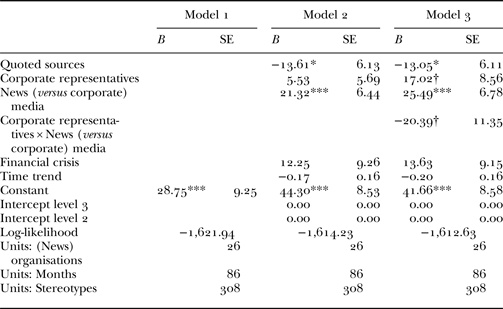
Notes: Unstandardised coefficients (B) are reported from multi-level models using maximum likelihood estimation. SE: standard error.
Significance levels: † < 0.10, *p < 0.05, ***p < 0.001.
We expected that the share of negative stereotypes would be lower in corporate media compared to news media (H2). Table 3 shows that in descriptive terms, the data support this assumption. Corporate media contains more positive (N = 67, 66.3%) compared to negative (N = 34, 33.7%) stereotypes. The reverse holds for our sample of news media. Here, we find slightly more negative (N = 256, 53.3%) compared to positive (N = 216, 46.8%) stereotypes. Table 4 shows that the effect of the media type is significant. Specifically, we find a positive effect of news media on the likelihood that negative stereotypes are stated. As displayed in Table 4, Model 2, the probability of finding negative instead of positive stereotypes is 21.32 per cent higher in news media compared to corporate media, keeping other variables constant. Hence, H2 is supported by the data.
We now move to the question of to what extent corporate representatives use negative stereotypes when they discuss older workers in corporate and news media (RQ1). Our descriptive results show that, in absolute terms, corporate representatives state approximately the same amount of negative (N = 23, 52%) as positive (N = 21, 47.73%) stereotypes. Accordingly, Model 2 in Table 4 shows that there is no significant association between the presence of corporate representatives as sources and the share of negative stereotypes present in news and corporate media. In Model 3, the interaction term of news (versus corporate) media and corporate representatives as sources was added to the model. The coefficient of this interaction term is marginally significant (p = 0.073). This indicates that the share of negative stereotypes expressed by corporate representatives is slightly lower in news media (mean = 50, standard deviation (SD) = 11.48) compared to corporate media (mean = 53, SD = 14.35).
Last, we expected that quoted sources are less likely to state negative stereotypes compared to unquoted sources in corporate and news content. In absolute terms, quoted sources were more prone to state positive (N = 227, 53.5%) compared to negative (N = 197, 46.5%) stereotypes. Contrary, we find that, in descriptive terms, unquoted sources more frequently stated negative (N = 93, 62.4%) compared to positive (N = 56, 37.6%) stereotypes. To test whether this association is significant, we consult Table 4, Model 2 again. Here, we find a significant negative relation between quoted sources and the share of negative stereotypes. The probability of finding negative stereotypes (relative to positive stereotypes) is 13.61 per cent lower when sources are quoted compared to unquoted. As such, H3 is supported.
Discussion
As workforces worldwide grow older, an increasing number of people, organisations and societies can be affected by stereotypes about older employees. Motivated by the knowledge that media play a crucial role in constructing and confirming images of groups in society, this study investigates stereotypes of older employees in corporate and news media. From our analyses, we can draw three main conclusions. First, older employees are generally positively portrayed with regard to warmth stereotypes, such as reliability and commitment, but negatively with regard to competence stereotypes, such as productivity and adaptability. In addition to these warmth and incompetence stereotypes, older workers are frequently portrayed as costly, and as possessing mentor skills. Second, our results show that negative stereotypes are more common in news media compared to corporate media. Last, we found that corporate representatives are less likely to state negative stereotypes in news media compared to corporate media, and that quoted sources are less prone to state negative stereotypes compared to unquoted sources. We will discuss the implications of these findings in more detail below.
The categorisation of older employees as warm but incompetent is consistent with stereotypes of elderly adults as predicted by the SCM (Fiske et al. Reference Fiske, Cuddy, Glick and Xu2002). In a content analysis of Dutch media, Lepianka (Reference Lepianka2015) found that ‘seniors’ and ‘the elderly’ are relatively negatively portrayed with regard to competence traits, and positively with regard to warmth traits. In line with this, our findings demonstrate that older employees receive low-competence and high-warmth media stereotypes. Hence, despite that the older employees (>45 years of age) are a much younger and more active group than the elderly typically studied in research on the SCM (>65 years of age; e.g. Cuddy, Norton and Fiske Reference Cuddy, Norton and Fiske2005), the content of media stereotypes of both groups seems largely comparable. With this, our findings demonstrate the usefulness of the SCM in understanding the puzzling mix of positive and negative media stereotypes of older employees.
High-warmth and low-competence stereotypes bring us to the core of the image problem that older employees face. Previous research suggests that low-competence stereotypes about older employees’ physical capability, technological competences and flexibility carry more weight in the formation of productivity perceptions of employers than high-warmth stereotypes (see Van Dalen, Henkens and Schippers Reference Van Dalen, Henkens and Schippers2010). Our findings indicate that low-competence and high-warmth stereotypes are at least partly reflected and potentially reinforced by the media. Warmth and incompetent stereotypes might, therefore, amongst other factors (Skirbekk Reference Skirbekk2004), contribute to the competitive disadvantage of older employees in the labour market.
Yet, warmth and competence stereotypes did not cover the total palette of stereotypes about older workers that exist in news and corporate media. First, the stereotype that older workers are costly was prominently present. Although there is indeed some evidence that older workers are more costly than younger workers (Finkelstein, Higgins and Clancy Reference Finkelstein, Higgins and Clancy2000), this is not necessarily true, as wage differentials may be offset by other factors, such as performance (Posthuma and Campion Reference Posthuma and Campion2009). Second, we found that older workers are commonly portrayed as good mentors. This stereotype possesses both elements of competence and warmth. Thus, although the SCM is useful for understanding how older workers are portrayed in the news, warmth and competence stereotypes are not necessarily mutually exclusive categories and do not cover the complete palette of media stereotypes of older workers.
In addition, our results revealed a lower share of negative stereotypes in corporate compared to news media. This, however, does not indicate that negative stereotypes are absent in Dutch organisations. On the contrary, recent research has shown that age discrimination is widely experienced in the Dutch labour market (Andriessen, Fernee and Wittebrood Reference Andriessen, Fernee and Wittebrood2014). Rather, corporate media seems to be a more restricted environment when it comes to expressing stereotypes. Arguably, corporate attempts to safeguard the reputation and avoid accusations of stereotyping limit the extent to which skills and capacities of older employees are openly discussed, especially in a negative manner (Kunze, Boehm and Bruch Reference Kunze, Boehm and Bruch2011).
Last, our results show that sources indeed accounted for variation in the share of negative stereotypes of older workers. We found that corporate representatives are less likely to state negative stereotypes in the news compared to the corporate environment. This might indicate that corporate representatives are especially aware of the reputational consequences of communicating ageist stereotypes when talking to the media. This is not surprising, as accusations of ageist beliefs and behaviours are likely to stain the corporate reputation (Kunze, Boehm and Bruch Reference Kunze, Boehm and Bruch2011). In addition, we found that quoted sources are less prone to state negative stereotypes compared to unquoted sources. This seems to indicate that individuals are willing to endorse positive stereotypes, but fear to be associated directly with negative stereotyping. This corresponds with previous research which suggests that explicit stereotypes about elderly adults are generally more positive compared to implicit stereotypes (Nosek, Banaji and Greenwald Reference Nosek, Banaji and Greenwald2002), and might reflect tendencies to deny stereotypes because of personal or social norms and standards.
Stereotypes about older employees are largely inconsistent with reality (Posthuma and Campion Reference Posthuma and Campion2009). For example, previous research shows that older employees are not per definition less physically competent and healthy compared to younger workers (Ng and Feldman Reference Ng and Feldman2012), one of the most prominent negative media stereotypes we found. Because age is a poor predictor of employees’ performance (McDaniel, Pesta and Banks Reference McDaniel, Pesta, Banks, Hedge and Borman2012), stereotypes are not a solid basis for decisions about whom to hire, promote or fire. In various settings, age stereotypes have been shown to influence employment decisions negatively (Gordon and Arvey Reference Gordon and Arvey2002) and cause resistance to investing in training of older employees (Van Dalen, Henkens and Schippers Reference Van Dalen, Henkens and Schippers2010). Therefore, consequences of stereotypes are real.
Following from this, we argue that people, organisations and societies are likely to benefit from a more realistic media debate about older employees’ skills and capacities. This relates especially to negative competence media stereotypes. A more balanced portrayal of older employees’ competences might help to counter stereotypical beliefs about this group (Van Selm and Van der Heijden Reference Van Selm and Van der Heijden2014). For example, media could emphasise that individual skills and health are of greater importance to job performance than age (Posthuma and Campion Reference Posthuma and Campion2009).
This study has a number of shortcomings. First, we consciously selected corporate media because stereotypes about older workers are likely being most influential in an organisational setting. However, the low number of stereotypes reported in corporate media may be due to its self-promotional nature. This material follows different logics compared to news media, which may explain our findings in part. Future studies should compare outlets that are more comparable in nature, such as different sections of business news or financial outlets. Second, we may not have captured all sources of variation in stereotype elements. Particularly, the specific context of the older worker(s) discussed in the media may have influenced these results. For example, stereotypes expressed by corporate representatives might have been overtly positive due to loyalty reasons (Skirbekk Reference Skirbekk2004).
Second, it should be noted that we only measured direct references to stereotypes of older employees in this study. As a consequence, we might have missed out on predictors of warmth and competence stereotypes. Previous research has indicated that warmth stereotypes are rooted in perceived lack of competitiveness, while perceptions of competence are related to status (Cuddy, Norton and Fiske Reference Cuddy, Norton and Fiske2005; Fiske et al. Reference Fiske, Cuddy, Glick and Xu2002). By focusing on elements of competition and status, future studies might capture warmth and competence stereotypes about older employees with a higher level of detail.
Third, we have treated older employees as a single category, encompassing references to all workers aged 45 years and older. Yet, previous research suggests that ageist stereotypes differ across life stages, so that old-old individuals receive fewer positive stereotypes than young-old individuals (Hummert, Garstka and Shaner Reference Hummert, Garstka and Shaner1997). In addition, previous research indicates that industry (Posthuma and Campion Reference Posthuma and Campion2009) and (job) positions (Abrams et al. Reference Abrams, Russell, Vauclair and Swift2011) moderate the prevalence and, potentially, content of stereotypes. Future research may include these explanatory variables to investigate in more detail how media stereotypes vary across age stages, industries and job positions. Last, future research should investigate the real-world consequences of the here-reported stereotypes in order to answer the significant question of what effect these media stereotypes have on the actual employability opportunities of older workers.
This study is the first to investigate empirically stereotypes of older employees in corporate and news media. The finding that warmth and competence stereotypes of older employees hold in both media strengthens our belief that this media approach offers a fertile research line. Media analyses allow for unobtrusive measurements across diverse settings and contexts, making it possible to assess the influence of several contextual and economic factors – which were beyond the scope of this article. This is likely to boost our understanding of how stereotypes about older employees can be combatted, which might, in turn, contribute to a more positive media environment for older employees to gain and retain employment. With this study, we hope to have set the first step in that direction.