Introduction
According to the World Health Organization (WHO) (2011), oldest old represent the population with the highest growth rate, especially in developing countries. On a global level, this population is projected to increase 351% between 2010 and 2050. Many oldest old lose their ability to live independently because of limited mobility, frailty, and other declines in physical and cognitive function (WHO, 2011). The estimated percentage of people over 85 years to develop mild cognitive impairment is 29% (Lopez et al., Reference Lopez2003). When compared with people between 55 and79 years, oldest old present higher risk of depression (Zhao et al., Reference Zhao2012). Depression is associated with functional decline, is a risk factor for mild cognitive impairment and dementia, and accelerates the progression of these disorders in older adults (Schillerstrom et al., Reference Schillerstrom, Royall and Palmer2008; Richard et al., Reference Richard2013).
With aging, there are changes in gait, which can partly be compensated by cognitive strategies. However, people with cognitive impairment have limited access to this compensation, especially when there is a dual task condition. Montero-Odasso et al. (Reference Montero-Odasso, Verghese, Beauchet and Hausdorff2012) reported that the evaluation of dual task walking could indirectly analyze brain function in early stages of cognitive decline. Furthermore, older people with depression are often impaired on tasks that require executive control processes, but it is not clear that all executive abilities are impaired in depression. Nebes et al. (Reference Nebes2001) verified that dual task performance was impaired in depressed older people. However, the association between dual task performance and risk of depression in oldest old needs to be studied.
There are studies that assessed walking associated with a cognitive task (Verghese et al., Reference Verghese, Lipton, Hall, Kuslansky, Katz and Buschke2002; Beurskens and Bock, Reference Beurskens and Bock2012). However, there is a lack of studies involving community oldest old people. Hofheinz and Schusterschitz (Reference Hofheinz and Schusterschitz2010) assessed walking associated with the manual task of holding a full glass of water in 120 community older adults, but they took into account its relationship with risk of falls. The same performance was analyzed in fallers and non-fallers by Shumway-Cook et al. (Reference Shumway-Cook, Brauer and Woollacott2000), who also did not study the influence of dual task on cognition.
The risk of developing psychological and cognitive disorders, such as mild cognitive impairment and depression, increases rapidly in aging (WHO, 2011). A better understanding about the relationship between dual task, which challenge executive function and memory, and cognition and depression in oldest old people could facilitate the understanding about motor and mental disorders, optimize assessments, and help future cognitive screenings. The present study examined the relationship between dual task walking, cognition, and depression in oldest old people living in the community.
Methods
Sample
The study was approved by the UFSCar Ethics Committee (ID: 72053/2012) and all participants provided signed consent to participate.
Eligible participants included male and female community-dwellers at least 80 years of age from São Carlos (Brazil) who could be contacted by phone. They were recruited from Open University of Brazil (São Carlos, SP) programs for older adults and from health units either near the University or with a high older adults concentration.
Inclusion criteria included being at least 80 years old, non-institutionalized, sedentary, and able to walk alone either with or without a cane. Sedentary lifestyle was defined as not engaging in any of the following activities five or more times per week: walking, running, cycling, swimming, aerobic, dancing, gardening, or weightlifting (Nelson et al., 2002; Ricciardi, Reference Ricciardi2005).
Exclusion criteria included older adults who walked with a walker, cognitive, neurological, and skeletal muscle disorders that would prevent participation in the assessments or an MMSE score below the designated educational level cut-off (Herrera et al., Reference Herrera, Caramelli, Silveira and Nitrini2002) minus one standard deviation.
Measures
The participants were assessed by a single trained professional. Before the assessment, the participants were instructed to wear comfortable clothing and appropriate shoes, to have eaten at least one hour prior to the tests, and to have avoided vigorous exercise the day before the tests. Descriptive variables were assessed using a questionnaire (age, gender, body mass index, educational level, medication in use, total number of diseases, and history of falls in the past three months) (Chiu et al., Reference Chiu, Au-Yeung and Lo2003).
Dual task measure
The dual task was assessed using the Timed Up and Go test associated with two different situations, a motor task (TUGT-motor), and a cognitive task (TUGT-cognitive). A pre-test was conducted for familiarization with a 1-min interval between attempts. The assessor stayed behind the patient to prevent falls or injuries. The participants initially sat in a chair 45-cm high with trunk support and 68-cm-high armrests.
In the TUGT-motor, after the command “go”, participants were to stand up and, without pausing, grasp a drinking glass (8 cm in diameter and 9.5 cm high) filled with water (to 1 cm below the rim) from a 68.5-cm-high table with the dominant hand. They then had to walk three meters at a normal pace, turn 180°, come back, replace the glass on the table, and sit down again. The time taken until the participant was seated against the trunk support again was recorded with a stopwatch (in seconds). Besides the time, both the number of steps taken and whether any water was spilled were recorded. Participants who normally used canes were allowed to use them during the test (intra-rater reliability = 0.99) (Hofheinz and Schusterschitz, Reference Hofheinz and Schusterschitz2010). In the TUGT-cognitive, while performing the above-described routine (minus the glass of water), participants simultaneously and without pausing were to repeat the days of the week in reverse order beginning with Sunday. The time was recorded with a stopwatch (in seconds), as well as the number of steps and the number of correct and incorrect answers. Participants who normally used canes were allowed to use them during the test (intra-rater reliability = 0.88) (Campbell et al., Reference Campbell, Rowse, Ciol and Shumway-Cook2003; Barbosa et al., Reference Barbosa, Prates, Gonçalves, Aquino and Parentoni2008).
Cognition measures
We used MMSE and MoCAto assess cognition. If the participant had 12 years of study or less, we added an extra point to the total score of MoCA. The total score is 30 points and 26 is considered normal (Lu et al., Reference Lu2011; Memória et al., Reference Memória, Yassuda, Nakano and Forlenza2013). Through MoCA, we collected CDT and verbal fluency in one minute. In CDT, we instructed the participant to draw an analog clock, marking 2hours and 45 minutes. The CDT score relied on the shape and place of numbers and hands, using criteria proposed by Sunderland et al. (Reference Sunderland1989). The score ranges from 0 to 10, where 6 or more points indicate cognition decline.
Depression measure
We assessed depression by the 15-item GDS-15, which 5-point indicates risk of depression (Castelo et al., Reference Castelo2010).
Data analysis
The sample size was calculated by the G*Power 3.1 software. Assuming the type of study design, type I error at 5%, statistical power at 80%, and effect size of 0.35 (medium magnitude), the minimum of 59 participants should constitute the total sample.
Descriptive statistics indicated that data were not normally distributed. Therefore, descriptive data were presented as median and interquartile intervals for continuous variables. Categorical variables were expressed as absolute and relative frequencies. We used the Spearman product–moment correlation to analyze the associations between dual task with cognition and depression. The correlation coefficient r represents the magnitude of association. A positive r indicates a direct correlation and a negative r indicates an inverse correlation. The significance level was set at 0.05. All analyses were performed in SPSS (20.0).
Results
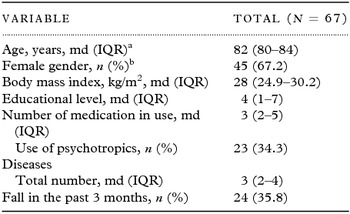
Of 570 eligible participants, 67 were selected for the study. Reasons for exclusion were not being sedentary (n = 26), older people who walked with a walker (n = 2), disorders that would prevent participation in the assessments or not being able to walk alone (n = 145), low MMSE score (n = 6), difficulty in transport to go to the assessment (n = 109) and refusal to participate (n = 215). The characteristics of the sample are presented in Table 1. The sample was predominantly women, with body mass index (median) above the ideal parameters for their age, low educational level (median of 4 years) and absence of polypharmacy. Besides, 35.8% had fallen in the past three months.
Characteristics of the sample

aMd (IQR) = median (interquartile interval), b n (%) = absolute number (%).
Dual task, cognition, and depression performances
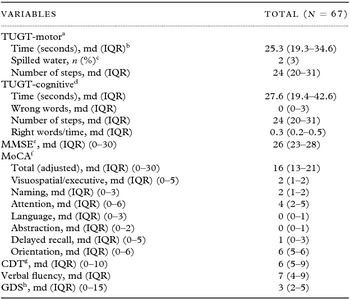
Dual task, cognition, and depression performances of the sample are presented in Table 2. In the TUGT-motor, only two older people poured water, but the median of time spent was 25.3 seconds. In the TUGT-cognitive, the median of wrong words pronounced was zero, but the median of time was 27.6 seconds. The medians of GDS and number of words in the verbal fluency were 3 points and 7 words, respectively. The medians of MoCA (total) and CDT were 16 and 6 points, respectively.
Dual task, cognition, and depression performances

aTUGT-motor = Timed Up and Go Test associated with a motor task, bmd (IQR) = median (interquartile interval), c n (%) = absolute number (%), dTUGT-cognitive = Timed Up and Go Test associated with a cognitive task, eMMSE = Mini-Mental State Examination, fMoCA = Montreal Cognitive Assessment, gCDT = Clock Drawing Test, hGDS = Geriatric Depression Scale.
Dual task and cognitive tests presented correlation statistically significant with education level. However, dual task tests presented a smaller correlation coefficient (time of TUGT-motor: r = −0.311, p = 0.010; time of TUGT-cognitive: r = −0.416, p = 0.000) compared to MMSE (r = 0.681, p = 0.000) and MoCA (r = 0.680, p = 0.000).
Relation between TUGT-motor with cognitive and depressive measures
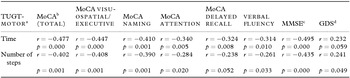
Table 3 displays the correlation between TUGT-motor with cognitive and depressive measures. CDT and language, abstraction, and orientation domains of MoCA had no significant correlation with any variable of TUGT-motor (p >0.05), therefore they were not included in Table 3. The time of TUGT-motor presented the highest correlations with MMSE (r = −0.495), MoCA (total score) (r = −0.477), and MoCA visuospatial/executive domain (r = −0.447). The number of steps taken in TUGT-motor presented the highest correlations with MMSE (r = −0.435), MoCA (total score) (r = −0.402), and MoCA visuospatial/executive domain (r = −0.408). GDS only correlated significantly with the number of steps taken in TUGT-motor (r = 0.241).
Correlation between TUGT-motor with cognitive and depressive measures (n = 67)

aTUGT-motor = Timed Up and Go Test associated with a motor task, bMoCA = Montreal Cognitive Assessment, cMMSE = Mini-Mental State Examination, dGDS = Geriatric Depression Scale.
Relation between TUGT-cognitive with cognitive and depressive measures
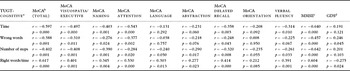
Table 4 displays the correlation between TUGT-cognitive with cognitive and depressive measures. CDT presented no significant correlation with any variable of TUGT-cognitive (p >0.05), therefore it was not included in Table 4. For motor components (time and number of steps) of TUGT-cognitive, the highest correlations were found between number of steps and MMSE (r = −0.642), time and MMSE (r = −0.640), time and MoCA (total score) (r = −0.597), and between time and attention domain of MoCA (r = −0.543). For cognitive components of TUGT-cognitive (right and wrong words and right words/time relation), the highest correlations were found between right words/time and MoCA (total score) (r = 0.617) and right words/time and MMSE (r = 0.604). GDS only correlated significantly with wrong words and right words/time of TUGT-cognitive.
Correlation between TUGT-cognitive and cognitive and depressive measures (n = 67)

aTUGT−cognitive = Timed Up and Go Test associated with a cognitive task, bMoCA = Montreal Cognitive Assessment, cMMSE = Mini-Mental State Examination, dGDS = Geriatric Depression Scale.
Discussion
This study investigated the association of dual task walking tests with cognitive and depressive measures in 67 community-dwelling oldest old people. There was correlation with higher magnitude between cognitive tests and TUGT-cognitive, compared to TUGT-motor. For TUGT-motor, the highest correlations with cognitive tests were found between time and MMSE, MoCA (total score) and visuospatial/executive domain. For TUGT-cognitive, the highest correlations with cognitive tests were between number of steps and MMSE and between time and MMSE. CDT presented no significant correlation with any variable of TUGT-motor or TUGT-cognitive. GDS showed a significant weak correlation with number of steps taken in TUGT-motor, wrong words, and right/time of TUGT-cognitive.
According to Castelo et al. (Reference Castelo2010), the participants did not present risk of depression, assessed by GDS. The medians of MoCA (total) and CDT were below the cut-off for healthy older people (Sunderland et al., Reference Sunderland1989; Memória et al., Reference Memória, Yassuda, Nakano and Forlenza2013), which suggest a striking level of cognitive impairment, especially executive functions. The number of words (median) in verbal fluency was seven, which was below the median found by Machado et al. (Reference Machado2009) in healthy Brazilian older people aged above 80 years with educational level between 4 and 7 years. Nevertheless, no participant had a diagnosis of mild cognitive impairment. There is a need of more studies with cut-off scores for cognitive screening tests in oldest old and a better monitoring of older adults at risk of developing dementia.
Regarding dual task, the participants presented good performance in the secondary task of both TUGT-motor and TUGT-cognitive, which is verified by the low frequency of spilled water and the absence of incorrect answers. However, the time spent in both dual task tests was less than optimal, compared to other studies (Campbell et al., Reference Campbell, Rowse, Ciol and Shumway-Cook2003; Hofheinz and Schusterschitz, Reference Hofheinz and Schusterschitz2010). Campbell et al. (Reference Campbell, Rowse, Ciol and Shumway-Cook2003) found a mean time for the same task of TUGT-cognitive of 11.58 seconds in ten healthy older people with mean age of 76 years. Hofheinz and Schusterschitz (Reference Hofheinz and Schusterschitz2010) found a mean time for the same task of TUGT-motor of 14.14 seconds in healthy oldest old people.
According to Beurskens and Bock (Reference Beurskens and Bock2012), older people trend to prioritize the secondary task (motor or cognitive) rather than the primary task (walking), which severely impairs postural control. Dual task activities require more cognitive demand and competition of attentional resources, compared to a simple walking. Nevertheless, deficits in cognition, mainly attention and executive function, are independently associated with risk of postural instability, impairment in activities of daily living, and risk of falls (Montero-Odasso et al., Reference Montero-Odasso, Verghese, Beauchet and Hausdorff2012). Thus, the more severe cognitive impairment is, more adverse effects of dual task occur on walking (Amboni et al., Reference Amboni, Barone and Hausdorff2013). The participants of the present study showed a cognitive performance less than optimal, which may explain the long time spent on dual task.
Supporting the results of this study, Venema et al. (Reference Venema, Bartels and Siu2013) found a moderate correlation between MMSE and walking performance associated with an arithmetic task in community-dwelling older people (mean age of 80.2 years). TUGT-motor is often used to assess balance and screen risk of falls in older adults (Shumway-Cook et al., Reference Shumway-Cook, Brauer and Woollacott2000). Although we found a correlation with higher magnitude using TUGT-cognitive, TUGT-motor also correlated significantly with cognitive tests. Therefore, a cognition assessment should involve tests of all cognitive functions and dual task tests with different secondary tasks (motor and cognitive). Therefore, it would be possible to encircle cognitive mechanisms involved to postural control and set targets for effective intervention to prevent cognitive alterations in oldest old people. Validation studies are needed to confirm if dual task is a useful and fast test for cognitive screening in oldest old.
Doi et al. (Reference Doi2014) analyzed the relation between walking performance associated with counting backwards starting at 100 and cognitive functions in 389 older people with mild cognitive impairment (mean age: 71.6 years). There were strong associations between gait speed and processing speed, executive function, visual memory, and working memory. In this study, the executive function domain of MoCA also significantly influenced the performance of both dual task tests. Hausdorff et al. (Reference Hausdorff, Schweiger, Herman, Yogev-Seligmann and Giladi2008) found a significant association between executive function and walking performance associated with an arithmetic task and a phonemic task in community healthy older people (mean age: 76.2 years). In addition, there was an association between attention and the walking performance associated with the phonemic task. In the present study, TUGT-motor had a higher association with executive function domain of MoCA and TUGT-cognitive with attention domain. However, no test was related with CDT, which is an executive function test. Executive functioning involves a set of higher order cognitive skills, such as dual tasking, construction, planning, and working memory (Nebes et al., Reference Nebes2001). Thus, it is suggested that cognition contributes to performance of dual task in oldest old, but this relationship seems to depend on the type of dual task, walking variables analyzed, and the choice of specific executive function tests.
In the present study, GDS showed a significant correlation, but with a weak magnitude, between number of steps taken in TUGT-motor and number of wrong words and right/time of TUGT-cognitive. However, our sample had a restricted range of depression scores, which could influence the weak correlation between GDS and other tests. Since depression is a risk factor for mild cognitive impairment and dementia (Richard et al., Reference Richard2013), the use of simple tests, which have association with both cognition disorders and depression, could be important to screen older adults with more chance to accelerate the progression of cognitive disorders. Donoghe et al. (Reference Donoghe, O’hare, King-Kallimanis and Kenny2014) found a relationship of gait stride length associated with a cognitive task with the presence of depressive symptoms and the use of antidepressants. However, Hausdorff et al. (Reference Hausdorff, Schweiger, Herman, Yogev-Seligmann and Giladi2008) found no relationship between the performance of dual task and depression measured by GDS in community healthy older people (mean age: 76.2 years). Further, Lonie et al. (Reference Lonie2009) did not find differences on performance of dual task between healthy and depressive older people. More studies analyzing risk of depression and different variables of dual task, such as cognitive performance, are needed.
The study has some limitations, such as difficulty of having tests for oldest old people with low educational level, difficulty of diagnosing mild cognitive impairment in Brazil, a cross-sectional design, the small sample size with limited contrast and possible selection bias due to the recruitment strategy, which may have influenced our results.
Dual task performances are associated with cognition in oldest old. The use of dual task tests to assess cognition is important due to lower influence of educational level, which facilitates its use in oldest old. Furthermore, dual task tests are functional, fast and applicable in clinical practice. New research with different types of tasks associated with walking and more sophisticated analyzes need to be performed in order to confirm if dual task test is useful for cognitive screening and early identification of cognitive decline in oldest old.
Conflicts of interest
The authors have no conflicts of interest to declare.
Description of authors’ roles
J. H. Ansai contributed to the study on conception and design, acquisition of data, analysis, and interpretation of data and on drafting this article. T. R. Aurichio contributed to the study on analysis and interpretation of data and on drafting this article. J. R. Rebelatto contributed to the study on conception and design, analysis, and interpretation of data and on drafting this article.
Acknowledgments
This study was supported by the Coordination for the Improvement of Higher Education Personnel (CAPES). The sponsor had no involvement in the study design, in the collection, analysis and interpretation of data.