Between September 1704 and January 1705, the elected authorities of at least 105 Zapotec, Chinantec, and Mixe communities from the alcaldías mayores (colonial provinces) of Villa Alta and Nexapa registered communal confessions about their local ritual observances before a representative of Oaxaca bishop Friar Ángel Maldonado in exchange for blanket immunity from ecclesiastic idolatry proceedings (Alcina Franch Reference Alcina Franch1993; Miller Reference Miller, Küchler and Melion1991; Tavárez Reference Tavárez and Nesvig2006b). Zapotec officials from at least 40 separate Villa Alta communities also surrendered booklets containing alphabetic texts in Zapotec. These communities designated themselves Cajonos, Bijanos, and Nexitzo, based primarily on historical and sociopolitical criteria (Chance Reference Chance1989), although still poorly known linguistic criteria were probably relevant to these divisions.
All told, the preserved part of the corpus of documents that was obtained through these measures consists of 106 separate textual units, currently bound into 103 booklets. These are not all of the texts that were collected by Maldonado's representatives as part of these proceedings. Included in the confessions, as Michel Oudijk (personal communication, 2007) points out, are references to other booklets and “instrumentos de idolatrías” (objects/devices used in idolatrous practices) that were surrendered to ecclesiastical authorities. Their final fate is unknown to us.
One hundred two of the preserved units, now bound into 99 booklets, contained, among other writings, full or partial copies of the 260-day Zapotec divinatory calendar, referred to in Zapotec as ‘time period’ (〈bie〉 ~ 〈biye〉 ~ 〈biyee〉 in these booklets, 〈pije〉 ~ 〈piye〉 in Córdova [Reference de Córdova1578b], from a proto-Zapotec form pronounced something like kwiye). They constitute the largest single collection of Mesoamerican calendars in existence. The remaining four booklets, each of which is a separate unit, bore four separate collections of Zapotec ritual songs. Two of these booklets transcribe traditional mytho-historical performances (〈dij dola nicachi〉, “Songs of the Wooden Drum [teponaztli]”); the other two represent a Christian genre (〈libana〉, or “Elegant Words”; see Tavárez Reference Tavárez2006a).
The calendars show that local Zapotec ritual specialists had continued to maintain the formal features of the Zapotec 260-day calendar, and the communal confessions show that they continued to use it for divination, to schedule sacrifices as propitiation to gods, and to determine the calendrical names to be given to newborns.
These texts were spared from the flames due to a conflict between the bishop and the Dominicans of Oaxaca regarding the creation of new curates, which led Maldonado to submit a dossier to the Council of the Indies containing the collective confessions and the booklets. Eventually, these documents were incorporated into the holdings of the Archive of the Indies in Seville as legajo (bundle) 882 from the Audencia de México (hereafter, AGI México 882).
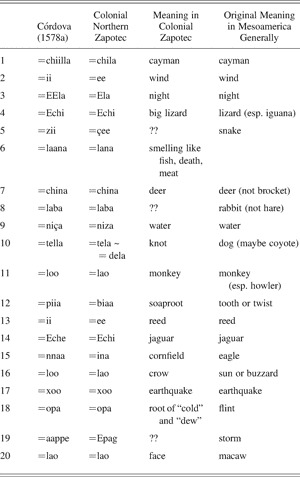
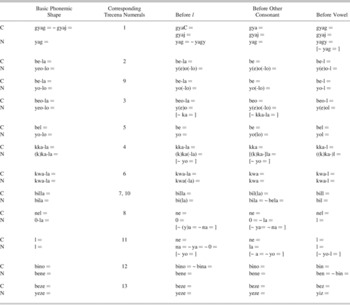
Most of these northern Zapotec calendars contain a complete list of the 260 day names, in order, always starting with 1 Cayman (spelled 〈yagchila 1〉, or the like). The terms that serve as names for these days are probably single words, each consisting of one of 20 roots that designate the days of the veintena, combined with a preceding augment (see later) that is not a numeral in Zapotec but corresponds to one of the 13 numerals in the trecena. Normally, the numeral in the trecena—a Zapotec word for the numeral, judging from Córdova (Reference de Córdova1578a, Reference de Córdova1886:204–212)—follows this term. Postulated underlying forms are given for the 20 days of the veintena in Table 1 and for the augments in Table 2.
Colonial Zapotec day names

Notes: Capital E transcribes a letter that appears sometimes as 〈e〉 and sometimes as 〈i〉; EE is for 〈ee〉 varying with 〈ii〉; = joins the compounded units within a compound word. Meanings are as determined by Kaufman, informed by Urcid (Reference Urcid1992, Reference Urcid2001). Kaufman's reconstructed meanings are sometimes used in this paper to label veintena positions. Our only departure from Kaufman's results is in treating spelling variations of “Wind” and “Reed” as reflecting of shift of underlying e and E to a after augments ending in -l(aa) rather than a variant root shape = laa. These names do not include the classifiers that appear with some of these roots in their ordinary meanings.
Sources: As extracted by Kaufman from Córdova (Reference de Córdova1578a) and from calendars reported by Alcina Franch (Reference Alcina Franch1993) for the Villa Alta and Choapan regions of Northern Zapotec. See also Justeson and Tavárez (Reference Justeson, Tavárez, Ruggles and Urton2007:Table 1.1).
Colonial Zapotec day-name augments

Notes: C label forms are as extracted by Kaufman (Reference Kaufman1994–Reference Kaufman2000) from Córdova (Reference de Córdova1578a); N labels forms were extracted by Justeson from Alcina Franch (Reference Alcina Franch1993) and analyzed following Kaufman's treatment; rare forms (some possibly errors in the manuscripts) are in square brackets. The symbol 0 indicates that the day name appears without an orthographically recoverable augment.
Source: After Justeson and Tavárez (Reference Justeson, Tavárez, Ruggles and Urton2007:Table 1.2).
The spellings of the day names vary, even within a single booklet, but they are structurally similar to those given by Juan de Córdova in his Reference de Córdova1578Arte en lengva zapoteca, the earliest colonial documentation of the Zapotec calendar and the only such data from the sixteenth century. In this work, in a section on numerals and counting in various domains, he describes the general structure of the 260-day calendar, provides linguistic and ethnographic details about its features and its uses, and presents a complete 260-day calendar. Córdova also described the use of auguries in connection with this calendar; many of the notebooks from AGI México 882 contain auguries for each day or for several days, and these auguries recur at predictable intervals.
Each term for a day name begins with one of 11 orthographically distinguishable words that we refer to as augments, a term suggested by Terrence Kaufman to avoid prejudging their grammatical status and semantic role. The most important contributions to the analysis of these augments are due to Seler (Reference Seler1904), Whittaker (Reference Whittaker, Aveni and Brotherston1983), and Kaufman (Reference Kaufman2000). Our discussion summarizes the synthesis and revision by Justeson and Tavárez (Reference Justeson, Tavárez, Ruggles and Urton2007). The form of each augment can be predicted with general reliability from the numeral coefficients that follow the day names. In each case, the form of the augment varies, depending on (Reference Alcina Franch1) how the root of the veintena name begins (Kaufman Reference Kaufman2000); and (Reference Alcina Franch2) whether an optional morpheme -l(a) is suffixed to the augment (Kaufman Reference Kaufman2000; Whittaker Reference Whittaker, Aveni and Brotherston1983).
José Alcina Franch produced the first published scholarly analysis of these documents and published and discussed 22 of them, along with a facsimile of one full calendar (Booklet 85-1). Alcina Franch's (Reference Alcina Franch1966, Reference Alcina Franch1993) publications reported on the ritual practices described in the collective confessions, proposed a generally accurate list of the 20 underlying day-name forms in these calendars, and gave a broader scholarly audience access to these important texts. In his 1993 publication, Calendario y religión entre los zapotecos, Alcina Franch identifies each published calendar with a place of origin based on the post-1960s order of binding of collective confessions and calendars of the AGI México 882 collection. However, linguistic criteria and annotations found in the calendars strongly suggest that place of origin cannot be systematically assigned by binding order alone. Alcina Franch also numbered the Villa Alta calendrical booklets beginning with 1 and ending with 99, and this numeration is used by the Archive of the Indies. Nevertheless, some of the booklets contain two different calendars or split the same calendar into two succeeding booklets. Overall, the corpus is composed of 103 textual units divided into 93 complete calendars, six calendars with at least 75% of the 260 day names (Booklets 16, 18, 40, 50, 64, 86), two calendar fragments (Booklet 47, Part 1, and Booklet 63, Part 1), and two copies (Booklets 79–80) of an aberrant calendar with a selection of day names, many of which repeat, in a seemingly haphazard sequence. Since there are in fact 103 separate partial or complete versions of the calendar bound into 99 booklets, Alcina Franch's system identifies separate booklets but not separate calendars. This paper uses Alcina Franch's booklet numeration to assist interested readers in referring to the AGI materials and to Alcina Franch's published data.
The first calendar bound in Booklet 85 (or Booklet 85-1) begins with a much discussed representation of the Zapotec year of 365 days. These years were named by the day of the 260-day cycle on which they began (Justeson and Tavárez Reference Justeson, Tavárez, Ruggles and Urton2007)—Earthquake, Wind, Deer, or Soaproot—just as they were throughout the corpus of Preclassic and Classic Zapotec hieroglyphic inscriptions; this practice yields a cycle of 52 named years. About half of the calendars are followed by a list of these 52 years, beginning with 1 Earthquake and ending with 13 Soaproot. The proto-Zapotec term for the 365-day period can be reconstructed as *yiza, spelled 〈yza〉 both by Córdova (Reference de Córdova1578a) and in the AGI México 882 corpus. The structure of the year is not explicitly discussed by Córdova. In this paper, we refer to the 260-day cycle by using the label “divinatory calendar,” given that this term highlights its main pragmatic objective.
Several of these Zapotec calendars have annotations that associate Zapotec dates with Spanish calendar features—day names or dominical letters, the month and day of the month, and the year. Rarely do all of these features coincide—never, in Alcina Franch's transcriptions. In a comprehensive analysis of all of these annotations (Justeson and Tavárez Reference Justeson, Tavárez, Ruggles and Urton2007), including those not published by Alcina Franch, we establish the correlation of the Gregorian calendar with the colonial Zapotec calendar—both the 260-day divinatory calendar and the 365-day year—as it was in the alcaldía mayor of Villa Alta at the end of the seventeenth century. Aside from a possible difference in the time on which the days began—at noon for the Zapotecs, according to Córdova (Reference de Córdova1578a, Reference de Córdova1886:212; cf. Justeson and Tavárez Reference Justeson, Tavárez, Ruggles and Urton2007)—the correlation of the northern Zapotec divinatory calendar with the Gregorian is identical to that proposed by Caso (Reference Caso1939; cf. Calnek Reference Calnek, Ruggles and Urton2007) for the Mexica divinatory calendar of Tlatelolco. The Zapotec year began 63 days later than the Mexica year.
The present paper concerns the eclipse records in these annotations. The most explicit of these records comes from Booklet 81. This calendrical booklet, transcribed by Alcina Franch (Reference Alcina Franch1993: 377–386) as “Booklet 82 from San Juan Lalao,” is one of only a handful whose owner was recorded on the document's front or back cover after it was surrendered to ecclesiastical authorities at San Ildefonso de Villa Alta. The owner of Booklet 81 is identified on the front cover in the note, “Juan Matias es M[aest]ro (Juan Matías is a teacher [of idolatries]).” Providentially, he is also identified in the record of the proceedings of a communal confession at San Ildefonso on December 22, 1704. This confession was presented by the town officials of San Juan Malinaltepec, within the parish of Choapa in the Bijanos district, before Juan Gracia Corona, the resident secular priest of the parish of Santa Cruz Yagavila. During the proceedings, a native fiscal (minor church official) named Juan Matías pointed to a specific booklet and “said it was his, and that his father had left it to him about seven years before” (AGI México 882:914r)—that is, around 1697.
Assuming that ecclesiastical authorities wrote Juan Matías's name on the text he surrendered to them at this time, we can conclude that Booklet 81 was owned by Juan Matías's father, who resided in the community of San Juan Malinaltepec in the parish of Choapa during the second half of the seventeenth century and who died only a few years before Maldonado's 1704 extirpation campaign. Hence, it is possible that the father of Juan Matías was the author of the annotations that are discussed in this paper.
This attribution is consistent with the use of 〈tz〉 rather than 〈ch〉 in this document in certain words such as 〈Yagtzina〉 ‘1 Deer’ and 〈latzi〉 ‘8 Jaguar’ (AGI México 882:1369r). Tavárez has observed that colonial Zapotec texts that originate in the Nexitzo or Bijanos districts use 〈ts〉 or 〈tz〉 to represent a voiceless alveolar affricate [¢] in textually frequent Northern Zapotec words such as 〈guetze〉 ‘town’ or the coordinating conjunction 〈tzela〉 (see Tavárez Reference Tavárez2006a). In colonial Cajonos texts, in contrast, this phoneme is transcribed with 〈ch〉 in the same words. This spelling reflects a voiceless alveopalatal affricate [č], yielding 〈gueche〉 and 〈chela〉 for these words. It is not yet known how these and other orthographic features may correlate with linguistically distinguishable dialects of Northern Zapotec, which are likely to have been represented in these texts, nor how such dialect differences may have correlated with the political geography reflected by the terms Bijanos, Nexitzo, and Cajonos. This phonetically based orthographic difference can nonetheless be used to circumscribe the geographic origin of colonial Northern Zapotec texts; the use of 〈tz〉 in the calendar of Booklet 81 provides independent evidence that it was produced by a colaní (calendar specialist: 〈colanij〉 ‘divino’, Córdova Reference de Córdova1578b:143v; proto-Zapotec *ko+ lla+ ni) from the Nexitzo or Bijanos district.
The eclipse records in this calendar by themselves make it possible to establish the correlation of the Gregorian calendar with the colonial northern Zapotec divinatory calendar. This is demonstrated in the “Correlation Statements” section of this paper and in somewhat more detail by Justeson and Tavárez (Reference Justeson, Tavárez, Ruggles and Urton2007:42–47). The section “Zapotec Eclipse Statements in the Annotations of Folio 4r, Booklet 81” shows how one colaní represented eclipse events in Zapotec, and that his usage agrees both with Zapotec usage generally and in one case with a more widespread Mesoamerican expression for eclipses. “Eclipse-Related Annotations in Booklet 63” discusses a set of dates from another calendrical manuscript, Booklet 63, that are referred to the celebration of the Catholic saints' days. Two of these appear to relate to eclipses. The final section, “Zapotec Calendrical Practices Relating to Eclipses,” explores how these four eclipse-related annotations may reflect some of the ways that the colanís used the divinatory calendar to relate the appearances of eclipses and, perhaps, to anticipate them.
Besides Alcina Franch, Oudijk has made transcriptions of the Villa Alta calendrical corpus, and he has generously shared these transcriptions with us and with many other scholars. Independently, Tavárez has transcribed the song corpus and most of the calendrical corpus. The textual data in this paper come from direct transcriptions by Tavárez, made either from a microfilmed reproduction of the corpus or directly from the originals. Some of our references to the non-calendrical contents of AGI México 882 are based on Oudijk's transcriptions.
THE CORRELATION STATEMENTS
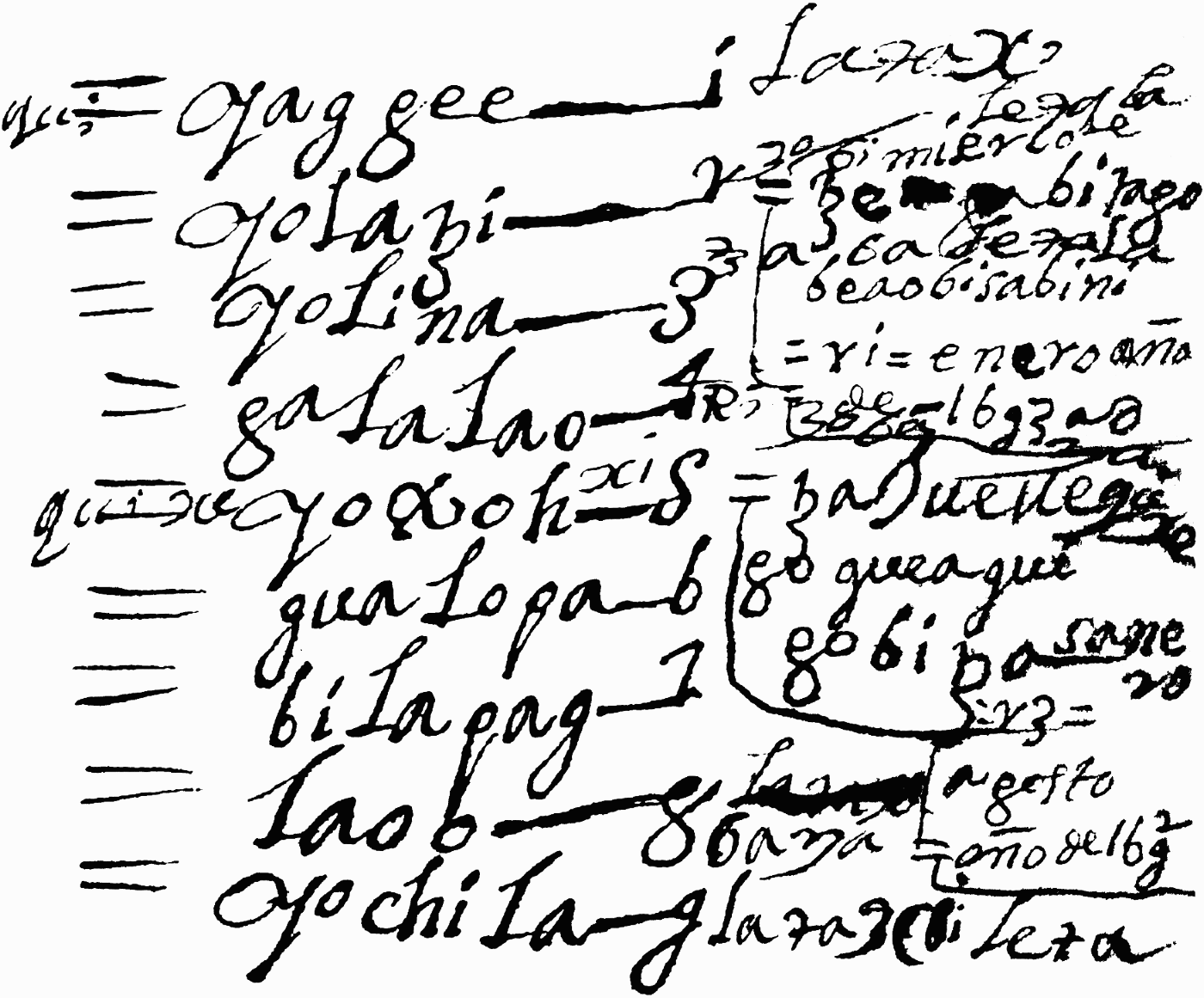
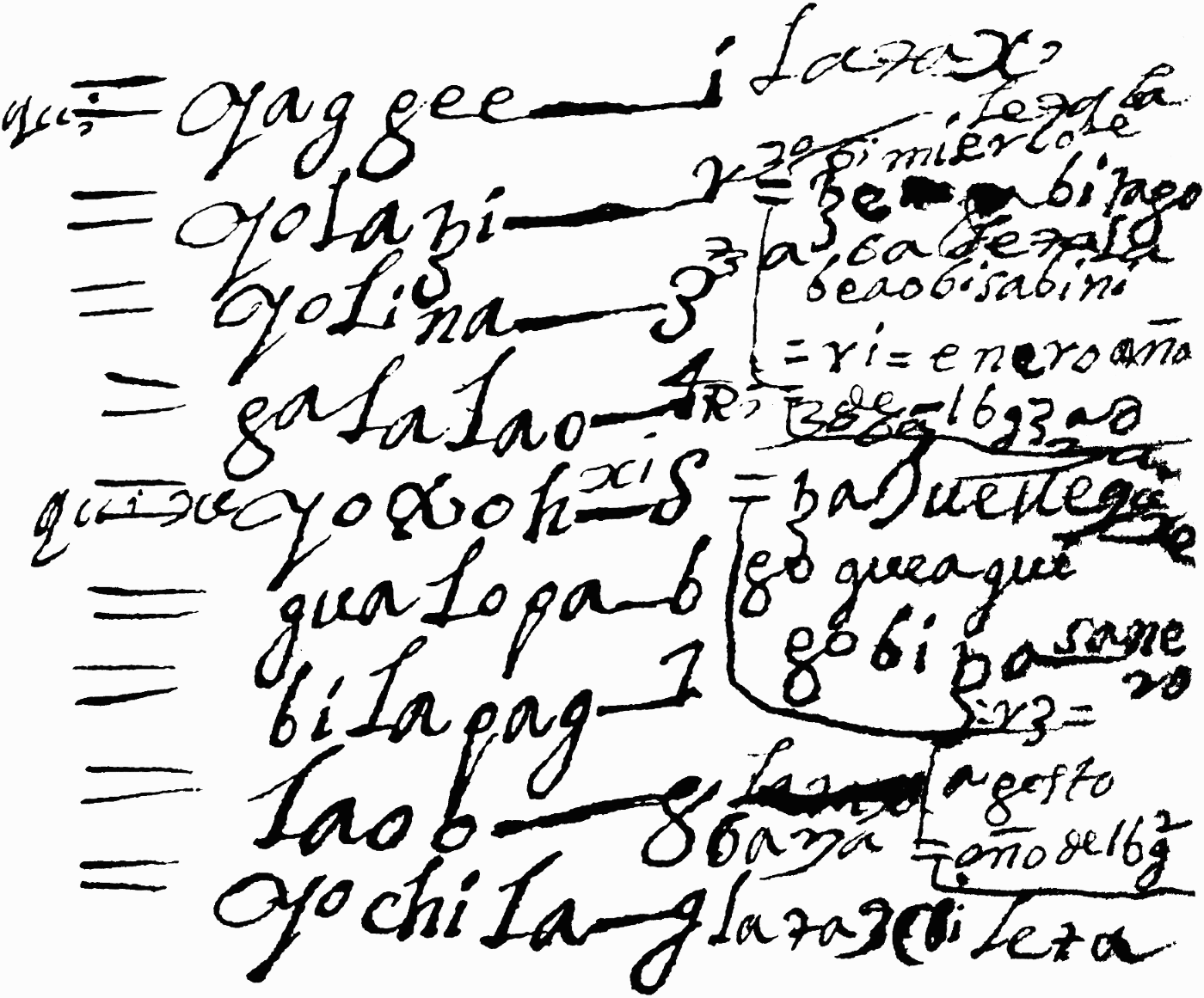
In most of Booklet 81, the right half of the page is provided with auguries that are typical of those in the collection of which this booklet is a part. On folio 4r, however, much of the right half of the page is filled by two annotations that begin with a comment in Zapotec and end with a date in Spanish (see Figure 1). The annotations occur on evenly spaced lines running alongside the days from 2 Jaguar (written 〈yolatzi〉 to 7 Storm (written 〈bilapag〉). Each annotation is “circled”—that is, each is contained within a space marked off above, below, and on the left by bordering lines. Fit between these lines are auguries, using the same vocabulary as in auguries that occur earlier and later in the manuscript, but written somewhat smaller and at angles to fit into the space left by the annotations.
AGI México 882:1370r (Booklet 81). Processed by Justeson from a microfilm of the original manuscript (after Justeson and Tavárez Reference Justeson, Tavárez, Ruggles and Urton2007:Figure 6.5).
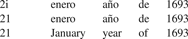
According to Alcina Franch's transcription, the first annotation ends with
=ri = enero año
de 1693
and the second with
agosto
año de 1692
Alcina Franch and his collaborators had little knowledge of colonial Northern Zapotec morphology, syntax, and orthographic practices, and therefore his published transcriptions of the calendars are useful but not entirely accurate or complete. The cited transcription is a case in point. The form of the letter 〈r〉 in this manuscript is effectively identical to that of the numeral 〈2〉, which is executed with its base line on a 30° to 40° angle. In addition, the numeral 〈1〉 is dotted like the letter 〈i〉; this orthographic trait is found in other calendars in the corpus. As a result, what Alcina Franch interpreted as 〈= ri = enero〉 should be read as 〈= 21 = enero〉.
The full annotation of which the January 1693 comment is a part contains both Zapotec and Spanish material. The Zapotec portion of the annotation is discussed in the next section. The upper-left-hand corner of the full annotation is directly aligned with the day 2 Jaguar, and this corner is explicitly joined to the end of this date by a pair of short horizontal lines. This amounts to a statement of correlation, equating January 21, 1693, in the Gregorian calendar and 2 Jaguar in the northern Zapotec divinatory calendar. Similarly, the upper left corner of the annotation containing the August 1692 statement is aligned with the day 5 Earthquake, and a similar pair of horizontal lines joins the annotation to that date.
While both annotations appear to have been precisely associated with Zapotec dates, they occupy a continuous space on the page. Once one of the annotations was written, issues of available space rather than a precise alignment with the Zapotec calendar could have affected the placement of the other annotation.
If the day 2 Jaguar fell on January 23, 1693, the days 2 Jaguar through 7 Storm did not occur in August 1692. The last preceding instance of 5 Earthquake would have fallen on May 9, 1692; it is 1 Earthquake rather than 5 Earthquake that would have fallen on August 3, 1692—160 rather than 260 days before 5 Earthquake in January 1693. If both the January and August comments are meant to pertain to the part of the divinatory calendar with which each is associated, the distance separating the different instances of 5 Earthquake would have to differ by some multiple of 260 days. Either one of the Spanish dates is in error or at least one of the two Spanish dates was not intended to be equated with any of the days of the divinatory calendar with which they are aligned. In either case, at least one of the equations must be rejected.
Two lines of evidence show that Booklet 81 correctly associates 2 Jaguar with January 21, 1693:
1. Justeson and Tavárez (Reference Justeson, Tavárez, Ruggles and Urton2007) show that there is external evidence for the correlation of the calendars in AGI México 882, which independently establish that Booklet 81 associates its divinatory calendar dates with these two eclipse dates. Booklet 63 by itself provides ample evidence to establish a correlation between the Zapotec divinatory calendar and the Gregorian calendar. Independent of the Booklet 63 data, Booklets 27 and 85 together provide just enough evidence to establish a correlation. Booklet 94 contains two passages that provide evidence on the correlation of the divinatory (and 365-day) calendars with the Gregorian. The two passages are inconsistent with each other, but one of them is equivalent to the correlation provided by the other manuscripts. The correlation established by these three independent lines of evidence is identical with that provided by Booklet 81: all place 2 Jaguar on January 21, 1693.
2. On the evening of Wednesday, January 21, 1693, a total eclipse of the moon was visible throughout Mesoamerica. Eclipses are relatively rare events—on average, about one per year is visible from any given location—and they are occasionally noted in other colonial calendars (see Aveni and Calnek Reference Aveni and Calnek1999 for a systematic study of eclipses and other celestial events recorded in the Codex Telleriano-Remensis). This constitutes circumstantial evidence that this is indeed the intended Gregorian date of the annotation within which it occurs and that it is intended to be associated with this part of the divinatory calendar. We infer that 2 Jaguar fell on or near January 21, 1693, and therefore that it did not fall in August 1692.
Even if a date in August 1692 is not consistent with a divinatory calendar date on or near 2 Jaguar, the reference cannot be ignored. It is useful to consider why a reference to a prior August date was made at the end of this annotation and why that reference is chronologically inconsistent with its placement in the divinatory calendar.
The chronological inconsistency between the annotation and its placement in the divinatory calendar must be resolved in one of two ways: either the August 1692 statement is chronologically correct, having been intended to be associated in some way with the January 1693 statement but not with this part of the divinatory calendar, or the August 1692 statement is incorrect as written and was intended to correspond to one of the six days from 2 Jaguar to 7 Storm in the colonial Zapotec divinatory calendar.
The January and August annotations fill out the entire area between 2 Jaguar and 7 Storm, and no other Spanish annotations are found in any other part of this calendar. The two together therefore seem to constitute a single, broader annotation. They can therefore be expected to have some thematic relationship or to reflect some sequential logic. The event attributed to August 1692 may provide a kind of background or frame of reference for the lunar eclipse reference.
The most obvious kind of related event would be either another eclipse or an event whose description parallels the earlier description. This hypothesis is addressed in terms of the non-chronological content of the annotations in the next section. Chronologically, the most straightforward and easily tested hypothesis about the relationship between the two events is that both were visible eclipses.
No eclipse was visible in Mesoamerica in August 1692. A lunar eclipse was visible not long before, on July 28. A solar eclipse occurred on August 12 but was not visible because it ended before sunrise. The failure of a clear association here is unsurprising, given that the alignment of the August 1692 date with this part of the Zapotec calendar is inconsistent with the eclipse-validated equation of January 21, 1693, with 2 Jaguar. Accordingly, the most likely alternative hypothesis is that there was an error in associating August 1692 with this part of the divinatory calendar. The most readily testable version of this hypothesis is that a similar European date that does occur in this part of the divinatory calendar is that of a visible eclipse. This hypothesis turns out to be correct.
An eclipse can (but need not) take place near the same date in the divinatory calendar every 520 days (see “Zapotec Calendrical Practices Relating to Eclipses”). Counting 520 days back from the lunar eclipse of January 21, 1693, leads to August 20, 1691. Three days later, on Thursday, August 23, 1691, a total eclipse of the sun would have been seen throughout the northern Zapotec region, including at Villa Alta. Solar eclipses are so rare from any particular location that there can be little doubt that this was indeed the rationale for the reference. Total solar eclipses are rarer still and are so striking—turning day into night—that they are well remembered. The reference must have been obvious to the colaní who wrote down the reference to the lunar eclipse of 2 Jaguar; he simply wrote 〈1692〉 instead of 〈1691〉 when recording the prior Spanish date.
The distance between the dates of these two eclipses was 517 days. The reference to a Gregorian solar eclipse date is overtly aligned with the Zapotec date 5 Earthquake, and the reference to a following Gregorian lunar eclipse date is overtly aligned with 2 Jaguar. These divinatory calendar dates are also 517 days apart. We conclude that the apparent alignments of the annotations are intended to be as they appear: the day 2 Jaguar fell on January 21, 1693, and the day 5 Earthquake fell on August 23, 1691. These data appear sufficient to establish the correlation of the northern Zapotec divinatory calendar with the Gregorian calendar.
THE ZAPOTEC ECLIPSE STATEMENTS IN THE ANNOTATIONS OF FOLIO 4r, BOOKLET 81
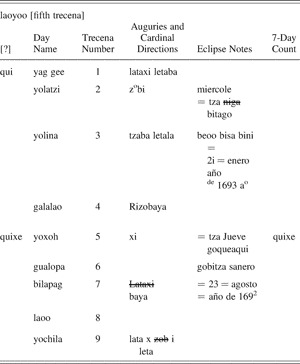
The results of the previous section are directly supported by three features of the transcription in Table 3 that were not represented accurately in Alcina Franch's transcription:
1. The assignment of the first annotation to January 21, 1693, can be confirmed on independent grounds. Just within the first circled annotation, a sentence in Zapotec immediately precedes the Spanish date of January 21, 1693. The Zapotec statement begins with a comment, which seems to have been inserted after the rest of the first annotation was written in, indicating that the event occurred on 〈miercole〉 ‘Wednesday’. In 1693, January 21 did indeed fall on a Wednesday.
2. The second annotation, referring to August 1692, begins with a reference to 〈tza Jueve〉 ‘the day Thursday’. August 23, 1691, was in fact a Thursday. The last preceding year on which August 23 fell on a Thursday was 1685; the next was 1696.
3. The comment 〈tza Jueve goqueaqui gobitza sanero〉 is written with strokes that are consistently heavier than those for the first comment. It is demarcated by an L-shaped line of similar thickness. The comment 〈agosto = año de 1692〉 was added below it and to the right in a fine pen, with a smaller L-shaped line joining it to the one above. Inside the upper area, below the last line of Zapotec and directly above the word 〈agosto〉. 〈= 23 =〉 is written using the fine lines of the 〈agosto = año de 1692〉 comment. The full comment must therefore be read as 〈= 23 = agosto = año de 1692〉. The August date is therefore specified as August 23, 1692. The new reading provides independent evidence for the demonstration that August 23 is the day of the year specified in the second annotation.
Transcription of Folio 4r, Calendar 82

Notes: The transcription is by David Tavárez and differs at several points from that provided in Alcina Franch (Reference Alcina Franch1993:379–380). The word 〈quixe〉, or orthographic variants of it, mostly appears in these manuscripts at stations in a seven-day cycle, on the first day of the ritual calendar and at multiples of seven days thereafter. The words 〈qui〉 and 〈quixe〉 in the far-left-hand column may pertain to the page adjoining on the left.
The Zapotec text of the first annotation could not be more specific about the nature of the associated event:
Zapotec annotation:

Spanish annotation:
Wednesday. On this day, the moon got eaten [eclipsed]. It floated in the air. January 21, year of 1693.
Córdova (Reference de Córdova1578b:150v) glosses “Eclipsarse el Sol” with three verbs: tati ‘to die’, titágo ‘to be eaten’, and tigáchi ‘to be hidden’, with copijcha ‘sun’ as their subject. The entry for an eclipse of the moon, on the same page, reads: “Eclipsarse la Luna, vide esconderse Tigàchi pèo, pi, &c. vt su[pra] táti péo.” The scribe of Booklet 81 used 〈tago〉 ‘to get eaten’ (proto-Zapotec, proto-Zapotecan *t.aku ‘to get eaten’, a non-active intransitivization of *aku ‘to eat’; Zoogocho agw), which the “vt supra” (‘as above’) notation indicates was used to refer to lunar as well as to solar eclipses. Expressions such as “sun gets eaten” and “moon gets eaten” are widely used in Mesoamerican languages to refer to eclipses (cf. Smith-Stark Reference Smith-Stark, Mackay and Vázquez1994:20).
Although it is less obvious, the second annotation also uses a verb that relates specifically to eclipses and is consistent with a reference to the eclipse of the sun on August 23—erroneous only in placing it in 1692 instead of 1691:
Zapotec annotation:

Spanish annotation:

Previously, it was on a Thursday [that] the sun burned [was eclipsed]. August 23, year of 1692.
Apart from the chronological data, this annotation contains just four words. The phrase 〈sa nero〉 ‘at first’, in this context—following the reference to the eclipse of the moon—is consistent with others in which it indicates that an event occurred before another previously mentioned reported event. For example, in a 1639 testament from Villa Alta written for Juan Pérez (Archivo Judicial de Villa Alta, Civil 3), we find the following Zapotec text and Spanish translation:
niaquie bitae goca lenie yogo b[e]ne bichina zanero …
por que vino a ayudar a todos los que llegaron primero
The instance of 〈sa nero〉 in Booklet 81 therefore indicates that the eclipse of the sun had occurred (on August 23, 1691) before the previously mentioned eclipse of the moon (on January 21, 1693).
Establishing the interpretation of the remaining word—the verb—requires extended discussion because it involves a complex interplay of Northern Zapotec historical phonology and the development of a Northern Zapotec orthographic convention. Its final part, 〈aqui〉, suggests the verb ‘to burn’. Kaufman (Reference Kaufman1994–2004) reconstructs proto-Zapotec *ä7ki7 as an intransitive root meaning ‘to get cooked; to burn’, as a subentry under the proto-Zapotec *ki: ‘fire’. Córdova provides the following forms:
Encenderse algo en el fuego. Tiàaqui, coyàqui (Córdova Reference de Córdova1578b:161r).
Quemado ser, vide arder. Tiàaquia táaquia, teyáaquia (Córdova Reference de Córdova1578b:336v).
The /y/ before /a/, explicitly spelled out in 〈coyàqui〉 and 〈teyáaquia〉 and implicit in the orthographic vowel sequence in 〈Tiàaqui〉 and 〈Tiàaquia〉, is a prefix that derives a stem meaning ‘it caught fire’ from a stem, spelled 〈àqui〉 ~ 〈aqui〉, meaning ‘to burn’. Córdova contrasts the forms with and without the prefix /y/:
Arder estar ardiendo quemandose. Tàaqui. còoqui (Córdova Reference de Córdova1578b:37r).
Arder consumirse ardiendo. Tiàaqui, coyàaqui (Córdova Reference de Córdova1578b:37r).
Thomas Smith-Stark (personal communication 2005) points out that there are other vowel-initial verbs that show such 0/y variation—for example, ‘entrar’, which can be ti + yòo + a or t + òo + ya. He states that it is not always clear that there is a semantic difference, as there is in ‘to burn’ versus ‘to catch fire’, but examples that do show such a difference are the verbs for ‘to go’ and ‘to come’, where the forms with and without /y/ probably differ in terms of whether the movement is defined in terms of the home base or not.
Before arriving at an interpretation for the verb 〈goqueaqui〉, it is necessary to discuss two features of Northern Zapotec historical phonology. For most consonants, proto-Zapotec distinguished between single and geminate occurrences. In the case of stops, such as k, the geminates had a fortis pronunciation, while the single stops were lenis, or lax; thus, *kk sounded like Spanish k, and *k sounded like Spanish g. Sixteenth-century spellings did not always distinguish these; ke (from *kke) was spelled 〈que〉, while ge (from *ke) was spelled variably, not only as 〈gue〉 but also as 〈que〉.
A sound change g > y took place in Northern Zapotec, before i or e, during the sixteenth or seventeenth century: ge came to be pronounced as ye, and gi as yi. For example, proto-Zapotec *ketye ‘pine kindling’ and *ki: ‘fire’ yield present-day Zoogocho Zapotec Reference Bunzel4yedx and Reference Alcina Franch2yi, respectively (Long and Cruz Reference Long and Cruz1999:298, 304). Words now pronounced with ye or yi were accessible both in older documents and in documents written in forms of Zapotec that did not undergo the *k > y shift. In such documents, these words would have been spelled with 〈gue〉 or 〈gui〉 (or 〈que〉 or 〈qui〉) when y was from g, and with 〈ye〉 or 〈yi〉 when y continued an original proto-Zapotec y.
After the sound change had been completed, the writings 〈gue〉 and 〈ye〉 would both have been pronounced ye; with no synchronic difference, 〈gue〉 could be used alongside 〈ye〉 to spell the current ye, whatever its proto-Zapotec source. Such spellings are well attested. For example, the word ‘river’ (proto-Zapotec *ke:7ku; cf. Zoogocho Reference Bunzel4yegw) is spelled in two distinct ways on a single page of a 1739 document from the town of Yatzachi el Bajo (Archivo Judicial de Villa Alta [AJVA], Civil 157:1v–2r): the spelling 〈guego〉 occurs three times, which shows that it is a legitimate spelling for this word, although 〈yego〉 is more common.
Older documents, and documents from other areas, also had spellings with 〈que〉 alongside 〈gue〉 for words that had been pronounced with ge. In the late seventeenth century, these spellings provided a low frequency of synchronic support for the use of 〈que〉 as a spelling for ye in Northern Zapotec texts. For example, the usual spelling for the word for ‘town’ (proto-Zapotec *ke:tze) was 〈yeche〉 in colonial Zapotec texts from the Cajonos district and 〈yetze〉 in colonial texts from Nexitzo (and probably also from Bijanos). Some scribes used 〈queche〉 and 〈yeche〉 interchangeably, even in the same text. The scribe who drafted the 1695 will of Domingo Pérez of Talea (AJVA, Civil 52:14r) repeated the phrase 〈bichinaa queche〉 (he/they arrived in town) as 〈bichiinee yeche〉 on the same page. Since the spelling 〈que〉 had earlier been used both for ke as well as for ge and thus for later ye, it continued to be used in seventeenth century Northern Zapotec texts for ke as well as for ye.
In fact, we know of no viable alternative to interpreting both of the 〈qu〉 sequences in 〈goqueaqui〉 as spellings for y. The first continues the original y of the passivizing prefix, and the second descends from the g in an earlier Northern Zapotec descendant of proto-Zapotec *ä7ki7.
There is one other peculiarity in the spelling of this verb: the presence of an orthographic vowel sequence 〈ea〉. The peculiarity is that Zapotec languages do not tolerate vowel sequences; so, for example, when a morpheme ending in a vowel immediately precedes a morpheme beginning in a vowel, one of the vowels typically is deleted. As a result, orthographic vowel sequences cannot be interpreted as spellings for actual vowel sequences.
The letter sequence 〈ea〉 is used in two ways. One is to spell sequences such as eya, in which a y intervenes between the explicitly spelled vowels. This practice does not yield a meaningful interpretation for 〈goqueaqui〉. The other context of the use of 〈ea〉 is when a follows a palatal consonant. The 〈e〉 is effectively a part of the spelling of the palatal consonant or of the transition between the consonant and vowel, while 〈a〉 spells the vowel. This usage is illustrated by the variation between 〈yag〉 and 〈yeag〉 in spellings of the verb ‘to go away’ (proto-Zapotec *yak) in Nexitzo and Cajonos texts; 〈yag〉 also varies with 〈yeag〉 in spellings of the day-name augment that corresponds to a trecena coefficient of ‘one’ in the calendars of AGI México 882.
Accordingly, we analyze 〈goqueaqui〉 as a viable (if admittedly unexpected) spelling for something like go-y-ayi (proto-Zapotec *ko-y-ä7ki7)—a non-active intransitivization of a verb ‘to burn’, in the completive aspect. This word is cognate with Córdova's 〈coyàqui〉 ‘encenderse algo en el fuego’. The Northern Zapotec y from proto-Zapotec *k (later g) is verified by its occurrence in cognates in Atepec (Nellis and Nellis Reference Nellis and de Nellis1983:84) and Zoogocho (Long and Cruz Reference Long and Cruz1999:107). The stem is cognate also with Juchitan Zapotec y.a7ki ‘quemarse; quemar y levantar llamarada’ (Kaufman et al. Reference Kaufman, Pérez and Feke1995–2004), although the details are unclear since the k in this form reflects original *kk. The uses of the Juchitan y.a7ki show it to be a non-active intransitive verb ‘to burn’, whose subjects are things that are burning or have burned. This range of meanings is consistent with a sentence from Booklet 37 (AGI México 882:951r, 959v):

With this meaning, 〈goqueaqui gobitza〉 would be read literally as ‘the sun burned’ or ‘the sun caught fire’. This appears to be precisely the intended literal interpretation of this verb, given the use of the expression in diverse varieties of Zapotec, as in Zaniza Zapotec (Operstein and Bakshi Reference Operstein and Bakshi1996–2003):

and Zoogocho Zapotec (Long and Cruz Reference Long and Cruz1999:107):

where a non-active, intransitive verb meaning ‘to burn’ is in fact the standard expression for the eclipsing of the sun or moon.
The comment 〈= 23 = agosto año de 1692〉 was added to the Zapotec comment to which it pertains: it was written with a different, much thinner pen from the Zapotec part, and the area in which it was written is appended directly below a part of the Zapotec section. With this addition, the two annotations have a strongly parallel structure:

It appears that the first and second annotations were made by different hands and thus at different times. The letter 〈e〉 has a consistently flatter cross stroke in the first annotation than in the second annotation; the lines of the lettering also appears to be slightly thicker in the second annotation than in the first annotation. Because the date of the first annotation is correct while that of the second is not, the second annotation is more likely to have been added well after the event. If so, the notation of the lunar eclipse must have been made first, and the back reference to the solar eclipse was added later. This is supported further by examples of the letter 〈e〉 in the main body of the calendar, which appear more similar to those in the first annotation.
The comment 〈Rizobaya〉 appears to have been slipped in, at an angle, to fit in opposite 4 Crow and between the two partly circled annotations. We believe that it is part of an augury and does not pertain to the eclipse statements. This calendar has the same augury written alongside other day names: 〈rizobayaa〉 opposite 6 Soaproot, 〈Rizobaya〉 opposite 7 Reed, 〈Rizobayaa〉 by 8 Death, 〈rizoba gola〉 by 7 Monkey, and 〈rizabaya〉 at the beginning of the third 65-day period. Note that the 65-day quarters of the divinatory calendar were structurally recognized units among colonial Zapotecs, as indicated both by Córdova (Reference de Córdova1578a, Reference de Córdova1886:201–202) and in the AGI México 882 booklets. It is referred to as a 〈gocio〉 (proto-Zapotecan *ko+ se7yu ‘thunder, lightning’ [cf. Córdova Reference de Córdova1578a, Reference de Córdova1886:204, 206, 208, 210], also meaning “Dios de las lluuias” [Córdova Reference de Córdova1578b:141r]).
The structure of the account in the section “Correlation Statements” is based on the lines of inference that originally led to the recognition of the eclipse statements of Booklet 81. With the new reading of this calendar, that account might logically have begun where it has ended, with the Zapotec record of a lunar eclipse attributed to Wednesday, January 21, 1693, which in turn is equated with the day 2 Jaguar.
The equation of Thursday, August 23, 1692 with 5 Earthquake is doubly inconsistent:
1. August 23 did not fall on a Thursday in 1692.
2. The distance from 5 Earthquake to a subsequent day 2 Jaguar must be three days less than a multiple of 260 days, and the distance from 5 Earthquake back to a previous day 2 Jaguar must be three days more than a multiple of 260 days. But August 23, 1692 is only 157 days before January 21, 1693.
August 23 occurred at the required distance from January 21, 1693, only twice in the seventeenth century: on a Monday in 1649 and on a Thursday in 1691. Any date other than Thursday, August 23, 1691, for this record would therefore entail at least two errors.
In addition, the emendation of the year date to 1691 is supported by circumstantial evidence: the fact that it coincides with a total eclipse of the sun witnessed in the area; the fact that the associated Zapotec annotation refers to an event undergone by the sun; and the fact that that event is referred to by an expression that is used for an eclipse of the sun in some modern forms of Zapotec. The eclipse association is clinched by the fact that the immediately preceding annotation refers to the occurrence of a lunar eclipse on the night of 2 Jaguar: the eclipse association provides the rationale for the mention of the August 23 event.
The lunar-eclipse correlation of Booklet 81, with or without the solar-eclipse statement, secures a correlation of its divinatory calendar with the Gregorian calendar. That correlation is identical to the traditional Mexica and Guatemala highland correlation. Booklet 27 assigns the date 11 Earthquake to the day March 1 in a year that was not a leap year (this is in the first 65 days of the sacred calendar, each of which is associated with a dominical letter). Given a correct correlation, only about one non-leap year in 260 is a year in which a specific day of the Gregorian year falls on any particular day of the divinatory calendar. Before the finalization of this calendar collection in January 1705, the only year consistent with these constraints since the voyage of Columbus is 1690; this provides modest support for the correlation, because the dated manuscripts in the collection are mostly from the 1680s and 1690s. The dating of the annotations in the first 65 days of Booklet 27 to 1690 is verified by an explicit assignment of February 19 to a Sunday, which is correct for 1690. Further support for this general placement of the calendar as a whole comes from the annotation 〈asobcione〉 alongside the date 7 Flint; 7 Flint fell on August 14, 1689, the eve of the feast of la asunción (de la virgen María).
ECLIPSE-RELATED ANNOTATIONS IN BOOKLET 63
Booklet 63 is remarkable in that it contains 19 useable correlation statements. The only one of these statements in which the reason for the annotation seems completely transparent from the vantage point of the Christian calendar is the association of 3 Cayman with 〈pascua nabidaa〉 ‘the feast of the Nativity’ (3 Cayman fell on December 24 in 1695).
Twelve of the 19 useable correlation statements give at least two elements of the Spanish date (year, month, day of the month, day of the week) on which a Zapotec date fell during the early 1690s. Six of the remaining annotations refer to a feast in the Catholic ecclesiastical calendar. (One of these also supplies the year; another, the day of the week.) This section explores the rationales for these particular feasts' having been marked in this way.
Two of these feasts relate to celebrations that were timed for structurally important dates in the calendar—not in the Christian, but in the Zapotec, calendar:
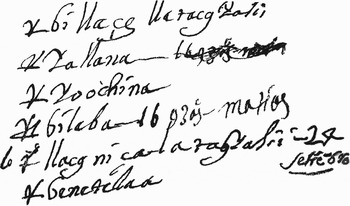
(1) 10 Rabbit is associated with the feast of Saint Matthias (February 24) in 1693 (Figure 2). The annotation reads 〈1693 a[ño]s—matías〉. Justeson and Tavárez (Reference Justeson, Tavárez, Ruggles and Urton2007:28–30) show that February 23, 1695, was the first day of a Zapotec year. In 1693, this was the second day of the Zapotec year; during 1689–1692, the feast of Saint Matthias had coincided with the first day of the year. Several of the collective confessions from Villa Alta collected in 1704 assert that various local ritual specialists had identified the feast of Saint Matthias as one of the main occasions when collective ceremonies should be carried out. The admonition to perform collective ceremonies on Saint Matthias's day was reported by town officials from Juquila (AGI México 882:1144r), Xogochi (AGI México 882:1456r), Xozaa (AGI México 882:1512v), and San Pedro Yagneri (AGI México 882:1542r). While none of these ceremonies is described in detail, none of these four communities had Saint Matthias as its patron saint.
Extract from AGI México 882:1198r (Booklet 63), showing the correlation of 10 Rabbit with the feast of Saint Matthias. Processed by Justeson from a microfilm of the original manuscript. The next line associates 8 Water with 〈24 Setiẽbrẽ〉. Details of the final 〈brẽ〉 of 〈Setiẽbrẽ〉 are indistinct because of poor contrast at the edge of the microfilm; the representation of these letters is at best approximate.

It therefore appears that ritual specialists employed this holiday as an expedient Christian correlation for observing the beginning of the Zapotec year, which began on the feast of Saint Matthias from 1689 to 1691 and on the vigil or eve of that feast from 1692 to 1695. Some such practice or association is cited by Ruth Bunzel (Reference Bunzel1952:285) for the K'ichee7s of Chichicastenango:
The more important of these [divinatory calendar] days are equated with certain days in the Catholic calendar, to which are attributed the same character, and which are celebrated with similar rites. The Christian equivalent of 8 ix, the Commemoration of the Earth, is May 3, the Exaltation of the Cross; the feast of All Souls, November 2, is equivalent to 8 kiej; Corpus Christi to 8 q'anil; the feast of San Juan Bautista (June 24, Midsummer night) to 8 ‘e, (San Juan is the patron of person's name and fortune); the feast of San Pedro, patron of divination, is equivalent to 8 bats.
Clearly, these particular associations would be valid only in a particular year.
(2) The day 13 Face has the annotation 〈nij miercoles bijzaa jueves … lao xilaa vispere S[an] P[edr]o Apostoles S[an] Pablo〉 ‘[From] this Wednesday to the beginning of Thursday … at the command … of the vespers of Saint Peter the Apostle and Saint Paul’. The feast of Saint Peter is celebrated on June 29, and the feast of Saint Paul is celebrated on June 30. The date 13 Face corresponded to June 27, 1691, which fell on a Wednesday. The text indicates that the festival ran from Wednesday to Thursday on the vespers of Saint Peter (i.e., the night before his feast day). This indicates that the celebration ran from the day 13 Face, which is the last day of the divinatory calendar, to at least the evening of 1 Cayman, the inauguration of another 260-day cycle. The mention of the feast of Saint Paul raises the possibility that this celebration continued for another day or two, but a part of the passage that might have clarified this was destroyed.
A parallel to these two cases comes from Booklet 60, where the feast of Saint John is mentioned alongside the day 13 Snake (perhaps corresponding to Saint John Gualbert on July 12, 1689). This day in the divinatory calendar was the last day of the first of the 65-day quarters of the divinatory calendar.
(3) What appears to be a single annotation is written in two lines, set alongside two consecutive days, 2 Night and 3 Lizard. The first annotation, which reads 〈1695 a[ño]s lagulasion〉, is aligned with 2 Night. The second line reads, 〈Sa[n] Juo [San Juan]〉, and is aligned with 3 Lizard. During the recorded year of 1695, 2 Night fell on August 28, which is the feast of Saint Augustine; in the same year, 3 Lizard fell on August 29, the feast of the martyrdom of Saint John the Baptist. In some Spanish almanacs, this feast is recorded as “la degollación de San Juan Bautista” (the beheading of Saint John the Baptist). An example of such an annotation appears in a 1510 edition of Andrés de Li's Reportorio de los tiempos nuevamente enmendado, which reads “la degollacio[n] de sant Jua[n] baptista” (Li Reference Li1510:d:1v). That Li's Reportorio was known to indigenous calendar specialists in central Mexico is suggested by a Nahuatl summary of one of its sections that was included in a seventeenth-century miscellaneous work (Tavárez Reference Tavárez1999).
Thus, it seems clear that the entry 〈lagulasion Sa[n] Ju[an]〉 is a reference to this feast and that it constitutes another correlation between a day name (3 Lizard) and a saint's feast (the martyrdom of Saint John the Baptist, August 29, 1695). It is not clear whether this annotation would relate to a ceremony performed on the day of this feast or, as in some of the other cases discussed, on the night before the feast.
Like the two previous instances, this feast day may have been cited in relation to a ceremony performed in connection with the Zapotec calendar. In 1695, the Zapotec year 11 Earthquake began on February 23, 1695. The midpoint of that year—its 183rd day—occurred on August 23, 1696, on the third day of the tenth Zapotec month. August 28 and 29 would have been the 188th and 189th days of that Zapotec year, five or six days into its second half.
The reason for suspecting the relevance of this part of the year is that at least two passages in the Villa Alta confessions state that a ritual celebration was held on or near the midpoint of the Zapotec year in several communities. The officials of San Bartolomé Lachixoba declared that “from the time of heathendom (gentilidad) until the present, they have committed the crime of idolatry twice a year, once around the new year when [the elected officials] take their staffs, and the other in August, before the day of the observance of the town's patron saint” (AGI México 882:711r). The feast of this town's patron saint, Saint Bartholomew, takes place on August 24, so the ceremony would have taken place on or about August 23. The midpoint of the Zapotec year was its 183rd day; this date fell on August 23 from 1696 to 1703. Similarly, the officials of Lachixila reported the execution of “communal sacrifices twice a year, once around the month of January and the other in the middle of the year” (AGI México 882:614v).
Nonetheless, there is reason to doubt that this association is genuinely with the middle of the Zapotec year. The characterization of these dates as the “middle” of the year may have been adventitious. First, in the case at hand, the date is not exactly on the middle day of the year; it is not at the beginning of the second group of nine 20-day months, either. Instead, it is a few days later than each of them. Second, this midpoint may be related to the timing of the harvests, and it was not an exclusively Zapotec observance. Alonso Básquez, a ritual specialist from the Mixe town of Santa María Asumpción Yacochi in the parish of Tlahuitoltepec, states that three communal ceremonies were held in his town. During the second one, which took place “sometime in August,” the town asked for a good maize harvest (AGI México 882:317r). Third, other towns report ceremonies, apart from those related to the installation of new alcaldes at the beginning of the Spanish year in January or those relating to the beginning of the Zapotec year in February, in every month from March through December. Some of these may be ceremonies associated with the feast of the town's patron saint, whose name is the Spanish part of the town's name. In some cases this seems reasonably clear. In the case of San Bartholomé Lachixoba, the observance was evidently on the night before the feast of the town's patron; the people of San Pedro Yacneri avowed observing a ritual bath and a three-day period of sexual abstinence on the feast of their patron, Saint Peter (AGI México 882:1542r), which was commonly observed on June 29. Others are not as clear, because we do not know the patron saint of the town in question. Among them, however, the ceremony “in the middle of the year” at (San Juan) Lachixila may in fact have been at the feast of the beheading of San Juan Bautista, a few days after the middle of the Zapotec year. The impulse to relate these ceremonies to salient parts of the year are also suggested by the report by the officials of Yaxila that a third communal ceremony was celebrated “toward the end of June, a time during which the half point of the year occurs, according to pagan rules” (AGI México 882:761r; this is in fact the midpoint of the Spanish rather than the Zapotec year).
Three other passages refer to feasts in the ecclesiastical calendar.
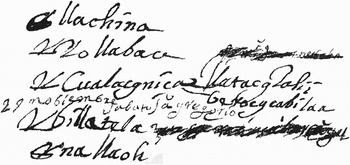
(4) Between the records for 6 Water and 7 Knot, in a different hand, is the annotation 〈29 nobiembre sabato sa[n] gregorio〉 (Figure 3). This annotation is in a different hand from that of the calendar and from those of the earlier annotations. Given the equation of February 24, 1693, with the day 10 Rabbit in the same calendar, the correlation otherwise established for these calendars is secured for Booklet 63, as well. Using this correlation, the day 6 Water would indeed fall on November 29, 1686 (7 Knot would not fall on November 29 in any year from 1650 to 1702).
Extract from AGI México 882:1200v (Booklet 63), showing the correlation of 6 Water with the feast of Saint Gregory. Processed by Justeson from a microfilm of the original manuscript.

Note that the correlation of this date with the days of the Spanish week is off by one day, with November 29, 1686 falling on a Friday rather than a Saturday. Justeson and Tavárez (Reference Justeson, Tavárez, Ruggles and Urton2007:28–30) show that the correlation is secured for Booklet 63 by many other records and that it is the same correlation as for Booklet 81, so the correlation is not at issue here. The annotation is simply in error in assigning November 29 to a Saturday rather than to a Friday. This calendar shows other errors concerning the day of the Spanish week that was associated with a particular Gregorian date—for example, October 6, 1693, is said to have occurred on a Sunday when it actually occurred on a Tuesday.
Unlike the feast of Saint Matthias, the feast of Saint Gregory is not singled out for special attention in the testimony accompanying the calendars, and November 29, 1686, corresponds to no known station in the Zapotec calendar. As in the previously discussed instances, however, it appears that this date was not selected in honor of the saint. Rather, on this date the moon rose in eclipse in the Sierra Zapoteca, with about 23% of the moon's disk in the umbra. The moon was completely within the penumbra for half an hour and remained partially in eclipse for nearly two hours. This annotation therefore relates the feast of Saint Gregory to a visible lunar eclipse.
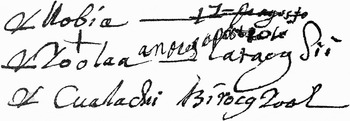
(5) The day 5 Reed is accompanied by the annotation 〈andres apostol〉 (Figure 4). The feast of Saint Andrew the Apostle fell on November 30; 5 Reed fell on December 1, 1694. (Although 5 Reed fell just two days later in the Gregorian calendar for 1694 than the lunar eclipse of November 29, 1686, mentioned earlier, it is separated by 64 days in the divinatory calendar.) December 1, 1694, turns out to be the date of another lunar eclipse. This eclipse, however, was not visible in Mesoamerica. This instance receives further discussion in the next section.
(6) The day 3 Water is accompanied by the annotation 〈saltacio〉. The feast of the Exaltation of the Holy Cross fell on September 14, 1693; 3 Water fell on the vigil of that instance of this feast day. Although this statement places a Christian feast within the Zapotec divinatory calendar, no other calendrical or cosmological rationale for stressing this correlation is clear to us.
Extract from AGI México 882:1203r (Booklet 63), showing the correlation of 5 Reed with the feast of Saint Andrew. Processed by Justeson from a microfilm of the original manuscript. The annotation reads, literally, 〈andres aposteolo〉, with the letter 〈e〉 crossed out. The preceding line associates 〈17 agosto〉 with 3 Soaproot.

In summary, five of the six statements discussed here provided correlations between Christian holidays and either lunar eclipses or landmarks in Zapotec calendars: the feast of Saint Matthias fell at the beginning of the 365-day Zapotec year in 1689–1692; the vespers of the feasts of Saint Peter and Saint Paul fell at the end of one 260-day cycle and the beginning of the next in 1691; the feast of Saint John the Baptist may be related to a harvest ceremony that fell toward the middle of the Zapotec year; and the feasts of Saint Gregory and Saint Andrew coincided with lunar eclipses in 1686 and 1694.
ZAPOTEC CALENDRICAL PRACTICES RELATING TO ECLIPSES
Eclipses take place at the new moon (for solar eclipses) and full moon (for lunar eclipses) nearest the nodes of the eclipse cycle. The nodes occur at intervals of 173.31 days. Three nodal passages (3 × 173.31 days) amount to 519.93 days, and this period is just short of two passes through the divinatory calendar (2 × 260 = 520 days). The result is that eclipses recur on or near the same date of the divinatory calendar for a long period in three separate parts of the divinatory calendar that are about a third of a divinatory-calendar cycle apart. Because it is only with two passes through the divinatory calendar that an eclipse can appear near the same divinatory-calendar date, these repetitions can take place only on alternate returns of a given date.
To get a sense of eclipse-recurrence phenomena in the experience of the colanís who produced this corpus of calendars, we chart the 37 lunar eclipses that were visible in the Villa Alta area in the 25 years from 1669 through 1693. We use a period of 25 years because it is a reasonable approximation of the working life of a divinatory-calendar specialist and because Justeson (Reference Justeson and Aveni1989:84) found it to be sufficient for a single calendar priest to arrive at an accurate and relatively complete model for the timing of lunar eclipses based on projections of near recurrences at intervals of 10, 26, 36, and 46 divinatory-calendar cycles.
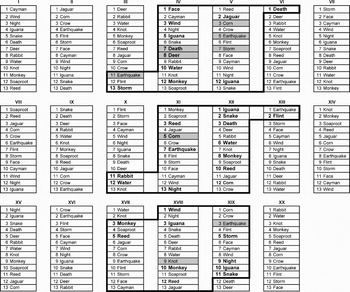
The divinatory-calendar dates of these 37 lunar eclipses are given in bold type in Figure 5 (one lunar eclipse on each date, except that two occurred on both 5 Corn and 6 Water). The table shows that eclipses were concentrated in the divinatory calendar; they repeatedly took place on a full moon or near 1 Reed, 13 Night, and 7 Rabbit. Because lunar eclipses occur for about 18 days on each side of the node, there is a span of a little fewer than three trecenas during which eclipses can take place. During this era, they were concentrated in trecenas IV–V, XI–XII, and XVII–XIX. Because it takes two passes through the divinatory calendar to commensurate the internodal cycle, eclipses took place in each segment of the divinatory calendar only on alternate returns.
Dates in the divinatory calendar of eclipses visible in the Sierra Zapoteca, 1669–1693. Cells with dates of visible solar eclipses are marked with a gray background; cells with dates of visible lunar eclipses are marked with a larger, bold typeface. Bold lines enclose the equally spaced thirds of the divinatory calendar, each 30–35 days long, during which eclipses took place in that era.

Nine solar eclipses were also visible in this era. They are indicated by grey backgrounding in Figure 5. The most striking of these eclipses was the total solar eclipse of 5 Earthquake (August 23, 1691). They fall on new moons in the same parts of the divinatory calendar as the lunar eclipses.
During this period, leading up to the eclipse record of Booklet 81, a lunar eclipse was visible on about 57% of the viable divinatory-calendar dates. Calendar specialists must have been aware that eclipses kept recurring in the same parts of the divinatory calendar, about 520 days apart. This seems likely to be part of the rationale for the paired records of eclipses in Booklet 81. The total lunar eclipse of 2 Jaguar was noted precisely because it constituted a recurrence of the total solar eclipse of 5 Earthquake, 517 days earlier. This is made semi-explicit by the grammatical treatment of the solar eclipse as a background event.
The annotations of saints' feast days in Booklet 63 and in the communal confessions suggest that Zapotec colanís systematically used the feasts of the saints to refer to events of particular interest in connection with indigenous ritual practices and observances, including cardinal dates in a Zapotec calendar. The record of the feast of Saint Gregory on 6 Water seems pretty surely intended as a reference to the lunar eclipse that occurred on that date in 1686. There was no visible solar or lunar eclipse roughly 520 days earlier; there is no annotation of any sort for any other record near this one; and no other annotation is near the date of a visible eclipse. This annotation is therefore not of the same sort as the explicit one in Booklet 81.
It is important to note, however, that a lunar eclipse can follow a solar eclipse, and a solar eclipse can follow a lunar eclipse, after about 517 days, but two lunar eclipses cannot come this close to one another in the lunar calendar until at least 10 divinatory-calendar cycles have passed. Since solar eclipses are so rare, although the kind of association found in Booklet 81 is revealing it cannot have been commonplace. (In keeping with the general frequency of visible lunar eclipses at lunar-eclipse stations, four of the nine solar eclipses that occurred in 1669–1693 were preceded and/or followed by a lunar eclipse at an interval of 516–517 days.) Given that a span of 88 lunations averages 10 × 260–1.3 days, lunar eclipses regularly fall within a day or two of one another after 10 passes through the divinatory calendar. Among the lunar eclipses between 1669 and 1693, there are nine recurrences of a lunar eclipse at 2,599 days, 11 at 2,598 days, and one at 2,597 days—about 78% of the 27 that follow the earliest eclipse in this period by at least 2,500 days. To the best of our knowledge, none of these near recurrences of divinatory-calendar dates were noted in Booklet 63 or in any of the other calendars in the AGI México 882 collection.
However, the lunar eclipse of 6 Water in 1686 was itself followed by a lunar eclipse on the day 6 Water 2,600 days later, on January 11, 1694. Two features of this circumstance are unusual. (Reference Alcina Franch1) Apart from the 1686 eclipse of 6 Water, all of the clear Gregorian dates are from 1691 to 1695. (Reference Alcina Franch2) More important, the return of a visible lunar eclipse on the same divinatory-calendar date is rare over the 25-year interval we have tested. This is the only recurrence of a visible eclipse 2,600 days after a prior visible eclipse during this period—the minimum possible interval for the recurrence of an eclipse on the exact same date. The only other, longer recurrence is the lunar eclipse of 5 Corn on July 28, 1692, which falls 26 divinatory-calendar cycles (6,760 days) after that of 5 Corn on January 22, 1674. Three of the nine solar eclipses occur on the same day as a previous lunar eclipse, 4,680 days later. A span of 158.5 lunations averages 4,679.4 days; from an evening event taking place before midnight, this span usually takes us to a daytime event on the same day of the divinatory calendar. The period of 4,680 days seems to have been known as an interval regularly separating solar and lunar eclipses by both epi-Olmecs (who referred to it most explicitly on La Mojarra Stela 1) and Mayans, for whom its pertinence in the eclipse table of the Dresden Codex was recognized by Harvey and Victoria Bricker (personal communication 2004).
Given these characteristics of the 6 Water date, we hazard the suggestion that the record of the earlier lunar eclipse on 6 Water is a backgrounding reference to the eclipse of 6 Water in 1694. This suggests that the earlier eclipse was noted, and perhaps achieved a particular significance and use by a colaní, only in relation to the subsequent observed eclipse.
This possibility finds support in the otherwise mysterious annotation of the feast of Saint Andrew in connection with the day 5 Reed. This was the date of a lunar eclipse, but one that was not visible in Mesoamerica. Given the seeming rationale for the eclipse of 6 Water, it is of interest that 5 Reed had been the date of a visible lunar eclipse 36 divinatory-calendar cycles earlier, on April 16, 1674 (a penumbral eclipse, with the face of the moon being 50% covered around 1:15 a.m.). An occurrence of these “eclipse-possible” dates on the same day of the divinatory calendar as a previously observed lunar eclipse is rare enough that no other instance is found in the time period we have tested.
Justeson (Reference Justeson and Aveni1989:85) observed, in connection with the structure of the eclipse table of the Dresden Codex, that the calendrical constructs used by divinatory-calendar specialists to predict future eclipses from visible eclipses are just as effective when used to predict future eclipses from the projected eclipse-possible dates on which no eclipse was in fact visible in Mesoamerica. The day 5 Reed would have been known to be a possible eclipse date, because this instance of 5 Reed was an even number of divinatory-calendar cycles after previous eclipses in this part of the lunar calendar; it occurred 502 days after a visible lunar eclipse, a standard interval separating visible lunar eclipses; and it was the date of a full moon, as required for a lunar eclipse. Like the occurrence of a lunar eclipse on the divinatory calendar date of a prior lunar eclipse, the occurrence of a full moon on a date of a prior lunar eclipse on the same date may well have been seen as a like-in-kind event.
CONCLUSIONS
The translation and analysis of annotations in two clandestinely produced seventeenth-century calendars show that Zapotec calendar specialists in that era were monitoring the occurrence of eclipses, solar and lunar, and were probably engaged with the anticipation of eclipses in terms of the divinatory calendar. These specialists had important mantic motivations for keeping track of and anticipating eclipses—for instance, Córdova (Reference de Córdova1578a:124r, Reference de Córdova1886:215) states that lunar eclipses presaged the death of nobles and that, during solar eclipses, the world could come to an end, and the sun “would call out for warfare.” From the data discussed in this paper, it is not possible to determine in detail what level of knowledge of eclipse prediction colanís had maintained or developed by the end of the seventeenth century. However, the circumstances of the four eclipse-related annotations discussed suggest that they were well aware that solar and lunar eclipses recur on or around the same dates in the divinatory calendar, because it was eclipses showing these recurrences that they recorded in their divinatory almanacs. This selectivity indicates that they must also have kept records of occurrences of eclipses more generally, which are not attested in the AGI México 882 corpus.
The explicit eclipse records of Booklet 81 indicates that colanís took special note of eclipses that served as harbingers of eclipses that occurred at intervals of about 520 days. This is the minimum span separating two eclipses that occur around the same divinatory-calendar date, and, as in Booklet 81, it always relates a solar to a lunar or a lunar to a solar eclipse. The two allusions to lunar eclipses in Booklet 63 suggest that colanís took special note of eclipses that occurred on the very same date of the divinatory calendar as a prior visible eclipse. The marking of the date of an eclipse that could not have been seen by the colanís themselves suggests that they were in fact practicing some level of eclipse prediction—at least when, as in this case, a full moon would fall on the same date of the divinatory calendar as a prior observed eclipse an even number of divinatory calendar cycles earlier.
The fact that at least two different colanís produced records reflecting this knowledge, according to two distinct strategies—one by an overt reference to a pair of eclipses showing the temporal recurrence, the other by covert references mentioning only the Christian feasts on which one of such a pair occurred—shows that this knowledge was at least partly shared among colanís and their apprentices.
Finally, while the use of names of Christian feasts as a covert way to refer to significant mantic events scheduled or anticipated by colanís in terms of the divinatory calendar may seem a highly individual practice of the author of Booklet 63, it could in fact reflect a broader practice. This is reflected most clearly with respect to the feast of Saint Matthias, to which Booklet 85 attributes the beginning of the year (Justeson and Tavárez Reference Justeson, Tavárez, Ruggles and Urton2007:32–33) and to which several communal confessions attribute communal ritual practices of unstated significance. This apparently widespread pattern of connecting ritual action with the officially sanctioned Christian calendar may have helped to demystify arcane calendrical practices of the colanís by connecting them more closely with the lived experience of their fellow townspeople.
RESUMEN
Este ensayo traduce y analiza varias anotaciones sobre eclipses que aparecen en dos versiones manuscritas del calendario divinatorio zapoteco de 260 días producidas a finales del siglo XVII. Estos textos forman parte de un corpus de 106 textos calendáricos y 4 compilaciones de cantos rituales que fueron entregadas a las autoridades eclesiásticas en 1704 y 1705 durante una ambiciosa campaña contra especialistas rituales indígenas en la provincia de Villa Alta en el norte de Oaxaca. Los “cuadernos” aquí examinados contienen una lista completa de cada uno de los días en la cuenta zapoteca de 260 días e incluyen un número variable de anotaciones. En el Cuaderno 81, dos de dichas anotaciones registran de manera explícita un eclipse solar y otro lunar visibles en la región en 1691 y 1693. Otra serie de anotaciones en el Cuaderno 63 no se refiere a eclipses directamente, pero alude a los mismos mediante la mención de las fechas en que se celebraban las fiestas de varios santos, las que corresponden con las fechas exactas de dos eclipses en 1686 y 1690. Este tipo de alusiones también se refieren al inicio y al final de varios ciclos calendáricos zapotecos: el inicio de la cuenta de 260 días o sus cuatro subdivisiones de 65 días, y el inicio del año zapoteco de 365 días, por lo que reflejan el modus operandi individual de al menos un especialista ritual con respecto a conocimientos rituales y calendáricos. Nuestro análisis sugiere que los especialistas rituales zapotecos coloniales mantenían un registro y asimismo llegaban a anticipar la llegada de eclipses tomando su propio calendario divinatorio y los patrones de incidencia de futuros eclipses como puntos de referencia.
ACKNOWLEDGMENTS
Several other scholars have contributed to our understanding of the issues addressed here. We thank especially Terrence Kaufman and Thomas C. Smith-Stark for detailed discussions of earlier drafts of this paper and of issues raised by the work reported here, and Victoria Bricker, Aaron Broadwell, Edward Calnek, Michel Oudijk, and John Pohl for useful discussion of particular issues. We further thank Kaufman for the use of his unpublished reconstructions of proto-Zapotec vocabulary and Mesoamerican calendrical vocabulary (Kaufman Reference Kaufman1994–2004); Smith-Stark for access to his electronic version of Córdova's Vocabulario (Smith-Stark et al. Reference Smith-Stark, Bogard and Cruz1993), an invaluable resource for working with colonial Zapotec texts; and Oudijk for sharing his transcriptions of relevant Spanish-language sections of AGI México 882 and of the divinatory calendar booklets. An earlier version of the paper was presented at the spring 2002 meeting of the Northeast Mesoamerican Epigraphy Group. Marilyn Masson and Michael Smith provided useful feedback at that time. Justeson's work was partly supported by a fellowship from the John Simon Guggenheim Foundation. Tavárez's research was funded by the Foundation for the Advancement of Mesoamerican Studies, Inc., a National Endowment for the Humanities grant administered by the John Carter Brown Library, and a research grant administered by Vassar College.