INTRODUCTION
In the tropics, anthropogenic disturbance often permits the proliferation of native species of particular groups (e.g. pioneer plants), contributing to functional and phylogenetic homogenization of assemblages (Lôbo et al. Reference LÔBO, LEÃO, MELO, SANTOS and TABARELLI2011, McKinney & Lockwood Reference MCKINNEY and LOCKWOOD1999, Tabarelli et al. Reference TABARELLI, PERES and MELO2012). One group of organisms that has proliferated in anthropogenic landscapes is generalist herbivores (Estes et al. Reference ESTES, TERBORGH, BRASHARES, POWER, BERGER, BOND, CARPENTER, ESSINGTON, HOLT, JACKSON, MARQUIS, OKSANEN, OKSANEN, PAINE, PIKITCH, RIPPLE, SANDIN, SCHEFFER, SCHOENER, SHURIN, SINCLAIR, SOULÉ, VIRTANEN and WARDLE2011, Martinson & Fagan Reference MARTINSON and FAGAN2014, Wirth et al. Reference WIRTH, MEYER, LEAL and TABARELLI2008). In the Neotropics, leaf-cutting ants (LCA) of the genera Atta and Acromyrmex are dominant herbivores, removing up to 15% of the standing leaf crop in their foraging areas (Urbas et al. Reference URBAS, ARAÚJO, LEAL and WIRTH2007, Wirth et al. Reference WIRTH, HERZ, RYEL, BEYSCHLAG and HOLLDOBLER2003) to cultivate the symbiotic fungus upon which they feed (Hölldobler & Wilson Reference HÖLLDOBLER and WILSON1990). Moreover, these insects have been recognized as being among the most ‘successful’ species in anthropogenically modified tropical landscapes (Leal et al. Reference LEAL, WIRTH and TABARELLI2014), inhabiting from forest to agricultural fields (Fowler Reference FOWLER1983, Oliveira et al. Reference OLIVEIRA, DELLA-LUCIA, ANJOS, DE OLIVEIRA and DOS ANJOS1998, Wirth et al. Reference WIRTH, HERZ, RYEL, BEYSCHLAG and HOLLDOBLER2003). LCA directly profit from (1) increased availability of open areas for nesting sites (Vasconcelos Reference VASCONCELOS1990, Vieira-Neto & Vasconcelos Reference VIEIRA-NETO and VASCONCELOS2010), (2) increased abundance of palatable pioneer plants (Coley & Barone Reference COLEY and BARONE1996, Coley et al. Reference COLEY, BRYANT and CHAPIN1985, Santos et al. Reference SANTOS, PERES, OLIVEIRA, GRILLO, ALVES-COSTA and TABARELLI2008), which are preferred by LCA (Falcão et al. Reference FALCÃO, PINTO, WIRTH and LEAL2011, Farji-Brener Reference FARJI-BRENER2001, Urbas et al. Reference URBAS, ARAÚJO, LEAL and WIRTH2007), and (3) reduced populations of natural enemies such as predators (Terborgh et al. Reference TERBORGH, LOPEZ, NUÑEZ, RAO, SHAHABUDDIN, ORIHUELA, RIVEROS, ASCANIO, ADLER, LAMBERT and BALBAS2001, Wirth et al. Reference WIRTH, MEYER, LEAL and TABARELLI2008) and parasitoids (Almeida et al. Reference ALMEIDA, WIRTH and LEAL2008, Barrera et al. Reference BARRERA, BECKER, ELIZALDE and QUEIROZ2017).
Despite the large literature on LCA in Neotropical rain forests, grasslands and savannas (Leal et al. Reference LEAL, WIRTH and TABARELLI2014), surprisingly little is known about the status and ecological role of these organisms in another major Neotropical biome: the seasonally dry tropical forest (hereafter dry forest) (but see Barrera et al. Reference BARRERA, BUFFA and VALLADARES2015). As in rain forests and savannas, dry forests have experienced high rates of habitat loss through deforestation (Leal et al. Reference LEAL, SILVA, TABARELLI and LACHER2005, MMA & IBAMA 2010). However, the remaining habitat of dry forests is also typically subjected to high rates of chronic anthropogenic disturbance (sensu Singh Reference SINGH1998) in the form of livestock production, timber harvesting and extensive firewood collection in rural areas (Ribeiro et al. Reference RIBEIRO, ARROYO-RODRÍGUEZ, SANTOS, TABARELLI and LEAL2015, Reference RIBEIRO, SANTOS, ARROYO-RODRÍGUES, TABARELLI, SOUZA and LEAL2016). Moreover, dry forests naturally have a more open habitat structure, making it difficult to discern whether such chronic disturbance likely leads to a similar proliferation of LCA in these habitats. This is because causal mechanisms behind LCA proliferation (i.e. increased availability of suitable nesting sites and light-demanding pioneer plants) operate on the assumption that human disturbances lead to an opening of closed canopies as in rain forests.
In this study, we investigate the population responses of three species of Atta LCA to anthropogenic disturbance in areas of dry forest in Brazil. We specifically test the prediction that disturbance does not cause a similar proliferation of LCA as occurs in rain forests, because the dry forest naturally has a more open vegetation structure (Pennington et al. Reference PENNINGTON, LAVIN and OLIVEIRA-FILHO2009). For example, edge effect on tree communities – one of the main drivers of LCA proliferation – has been found to be negligible in dry forest fragments (Oliveira et al. Reference OLIVEIRA, PRATA, SOUTO and FERREIRA2013). Moreover, dry forests are dominated by deciduous species, and it is plausible that the sparse availability of woody plant foliage is not capable of sustaining large populations of LCA during the dry season, especially in species and vegetation-poor disturbed sites (Ribeiro et al. Reference RIBEIRO, ARROYO-RODRÍGUEZ, SANTOS, TABARELLI and LEAL2015).
METHODS
Study area
The study was carried out in Catimbau National Park (8°24′00″–8°36′35″ S, 37°0′30″–37°1′40″ W), a 607-km2 area located in Pernambuco state, Brazil. The climate is semi-arid, with annual temperature averaging 23°C, and mean annual rainfall varying from 480 to 1100 mm, concentrated between March and July, but with marked inter-annual variation (Sociedade Nordestina de Ecologia Reference SOCIEDADE NORDESTINA DE2002). Deep sandy soils are predominant in the Park (quartzite sands, 70% of area), but planosols and lithosols are also present (15% each one; Sociedade Nordestina de Ecologia Reference SOCIEDADE NORDESTINA DE2002). The vegetation is known as caatinga, a mosaic of seasonally dry tropical forest and thorn scrub (sensu Pennington et al. Reference PENNINGTON, LAVIN and OLIVEIRA-FILHO2009) covering an area of 850 000 km2 in north-eastern Brazil (Santos et al. Reference SANTOS, LEAL, ALMEIDA-CORTEZ, FERNANDES and TABARELLI2011). Dominant families of woody plants are Fabaceae, Euphorbiaceae and Boraginaceae, and the ground layer is dominated by Cactaceae, Bromeliaceae, Malvaceae, Asteraceae and Fabaceae (Rito et al. Reference RITO, ARROYO-RODRÍGUEZ, QUEIROZ, LEAL and TABARELLI2017a). The Park was only recently (Reference SOCIEDADE NORDESTINA DE2002) proclaimed, and its original inhabitants still live there, continuing to graze livestock, extract timber, collect firewood, harvest other plant material, and hunt (Rito et al. Reference RITO, ARROYO-RODRÍGUEZ, QUEIROZ, LEAL and TABARELLI2017a).
Atta survey
Atta colonies were surveyed in 59 belt transects of 300 × 20-m, covering a total area of 35.4 ha. Transects were established from roadside points, and ran perpendicular to the road. Distances between transects ranged from 1 to 4 km. All active, inactive and/or abandoned and/or dead colonies of Atta within the survey areas were located and recorded using a GPS with <3-m resolution (Garmin Etrex 10). Most of the colonies were recorded by observing their large mounds, but foraging trails, standing leaves with tell-tale circular cuts, and cut material on the ground were also used to locate colonies (Wirth et al. Reference WIRTH, MEYER, ALMEIDA, ARAÚJO, BARBOSA and LEAL2007). Each colony was identified to species on the basis of mound structure and specimens collected for laboratory identification, and activity status was determined by (1) the presence of active foraging trails or their distinct physical structures, (2) fresh leaf fragments typically left over from nocturnal activity on foraging trails or around nest entrances and (3) appearance of workers after disturbing the colonies by poking a flexible 1-m pole into a nest entrance for 1 min (Almeida et al. Reference ALMEIDA, WIRTH and LEAL2008, Wirth et al. Reference WIRTH, MEYER, ALMEIDA, ARAÚJO, BARBOSA and LEAL2007). Colonies without apparent activity were categorized as ‘inactive’ (i.e. abandoned or dead colonies), although in a few cases colonies may have been alive, but in a longer phase of inactivity at the time of the censuses.
Characterization of anthropogenic disturbance
We used two independent indicators of intensity of anthropogenic disturbance, proximity to roads and vegetation cover. The 207 km of road that run through the Catimbau National Park are used by its inhabitants to travel between local communities and urban centres, to move their livestock, and to collect plant and animal resources. Transport occurs through small cars, 4 × 4 vehicles, tractors, ox- or horse-driven carts, horse-back and by foot. Many studies have shown that distance from the nearest road is a strong indicator of local human activity (Ahrends et al. Reference AHRENDS, BURGESS, MILLEDGE, BULLING, FISHER, SMART, CLARKE, MHORO and LEWIS2010, Coffin Reference COFFIN2007, Martorell & Peters Reference MARTORELL and PETERS2005, Ribeiro et al. Reference RIBEIRO, ARROYO-RODRÍGUEZ, SANTOS, TABARELLI and LEAL2015), and it is a good predictor of loss of woody species in dry forest in Brazil due to use by people (Ribeiro et al. Reference RIBEIRO, ARROYO-RODRÍGUEZ, SANTOS, TABARELLI and LEAL2015). Similarly, vegetation cover is often used as an indicator of forest disturbance and regeneration (Jafari et al. Reference JAFARI, LEWIS and OSTENDORF2007, Purevdorj et al. Reference PUREVDORJ, TATEISHI, ISHIYAMA and HONDA1998), with decreasing forest cover indicating increasing disturbance (Fahrig Reference FAHRIG2013, Gould Reference GOULD2000).
For each Atta colony we measured the shortest distance between the centre point of the colony and the nearest road using ArcGIS 10.1 (ESRI Environmental Systems Resource Institute 2012). Data for vegetation cover were obtained from a cover classification map derived from satellite imagery (RapidEye, 5-m resolution). Iso Cluster Unsupervised Classification in ArcGIS 10.1 was used to create four cover categories in the study area based on reflectance of soil and vegetation: (1) exposed soil (0–10% of vegetation cover) or agricultural field; (2) low vegetation cover (11–30%); (3) medium vegetation cover (31–50%); and (4) high vegetation cover (>51%). The locations of Atta colonies were plotted on the vegetation-cover map, and categorized according to a circular plot with a 200-m radius from the centre of each colony, corresponding to the approximate foraging area of a colony. To evaluate the accuracy of the classification, 69 points (50 × 20 m) were subsequently assessed in the field, and 80.2% were found to be correctly classified (Jain et al. Reference JAIN, MURTY and FLYNN1999). We also calculated the percentage of land covered by vegetation in ImageJ software 1.50.
Data analysis
Each transect was divided into contiguous 10-m sections according to distance from a road (i.e. 0–10 m; 11–20 m, 21–30 m, etc.), and the number of colonies (active and inactive) within each section was counted. We used regression analysis to examine variation in colony density with distance to roads, considering all colonies combined as well as active and inactive colonies separately. We selected the best-fitting model from a set of regressions models for each response variable. We used chi-square tests (Zar Reference ZAR2010) to assess variation in the frequency of occurrence of total, active and inactive colonies among vegetation cover classes. We calculate the expected frequencies considering the percentage of areas cover by the vegetation cover classes (i.e. number of nests in high vegetation cover multiplied by the proportion of area cover by vegetation cover class). All analyses were performed using R software 3.0.1.
RESULTS
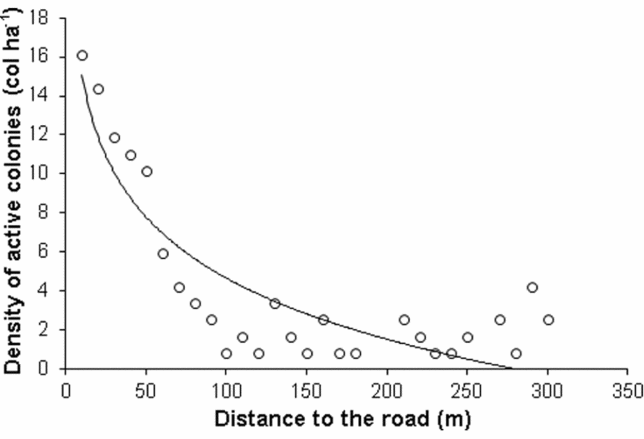
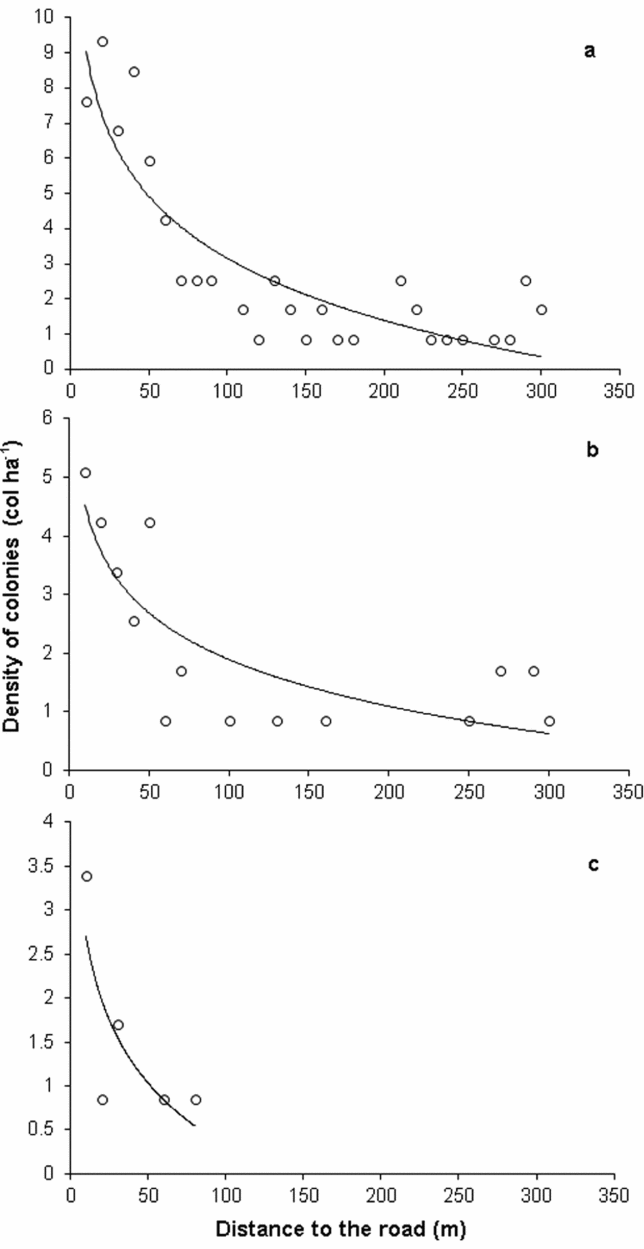
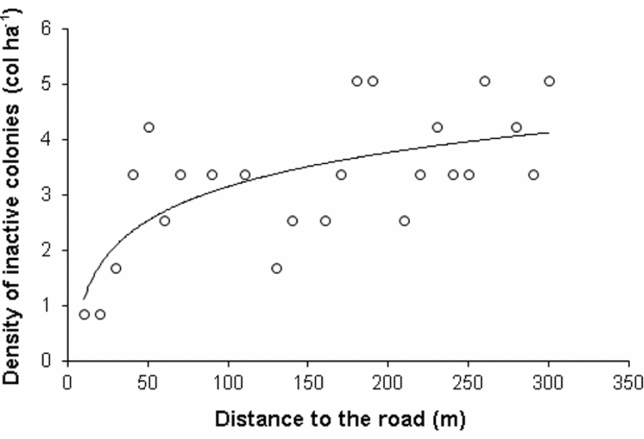
We recorded a total of 224 Atta colonies, 131 (58.48%) of which were active, giving an overall density of 3.7 active colonies ha−1. Of the active colonies, 87 belonged to Atta opaciceps (2.45 ha−1), 35 to A. sexdens (0.98 ha−1) and nine to A. laevigata (0.25 ha−1). The density of active colonies was very high (15 ± 2.92 ha−1) for the first 50 m from a road, and decreased markedly thereafter to only 2.55 ± 1.65 ha−1 at a distance of 300 m (Figure 1). Such a pattern of high colony density for the first 50 m and low density thereafter was shown for both A. opaciceps (Figure 2a) and A. sexdens (Figure 2b). For A. laevigata, high colony density was restricted to the first 20 m, and no colonies were recorded beyond 80 m (Figure 2c). The density of inactive colonies averaged at 2.63 ha−1 and showed a reverse pattern to that of active colonies, with lowest densities in the first 50 m (Figure 3).
Relationship between distances to the road (m) and density of active colonies recorded in Catimbau National Park, Pernambuco, north-eastern Brazil. The black line is the fit of a logarithmic regression analysis (y = −4.5ln(x) + 2.60, R² = 0.78, P < 0.0001).

Relationship between distance to the road (m) and colony density of Atta opaciceps (a), A. sexdens (b), and A. laevigata (c) recorded in Catimbau National Park, Pernambuco, north-eastern Brazil. The black line is the fit of a logarithmic regression analysis (A. opaciceps y = −2.6ln(x) + 14.9, R² = 0.77, P < 0.0001, A. sexdens y = −1.1ln(x) + 7.2, R² = 0.66, P = 0.0004, A. laevigata y = −1.0ln(x) + 5.1, R² = 0.62, P = 0.115).

Relationship between distances to the road (m) and density of inactive colonies recorded in Catimbau National Park, Pernambuco, north-eastern Brazil. The black line is the fit of a logarithmic regression analysis (y = 0.9ln(x) + −0.9, R² = 0.45, P = 0.0003).

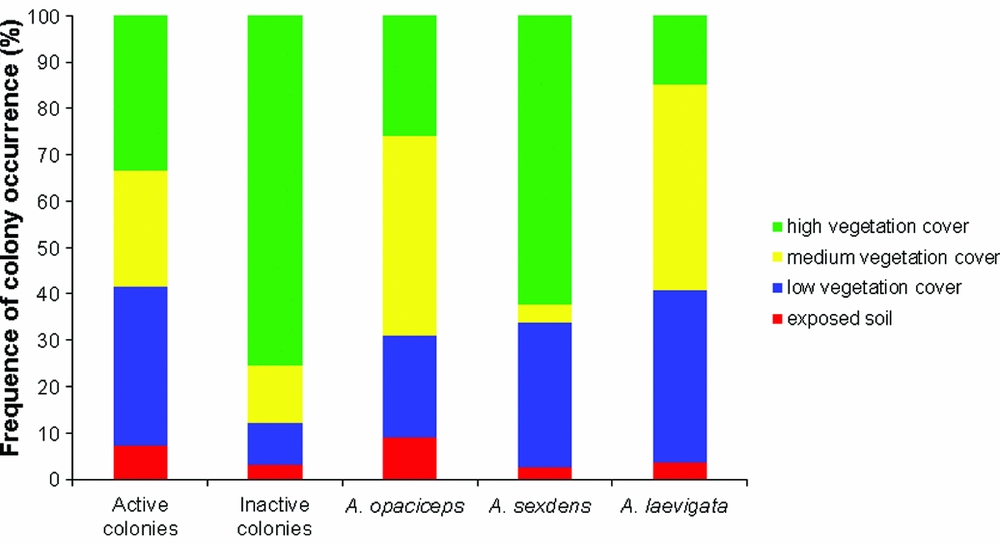
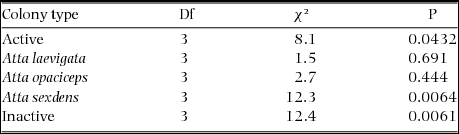
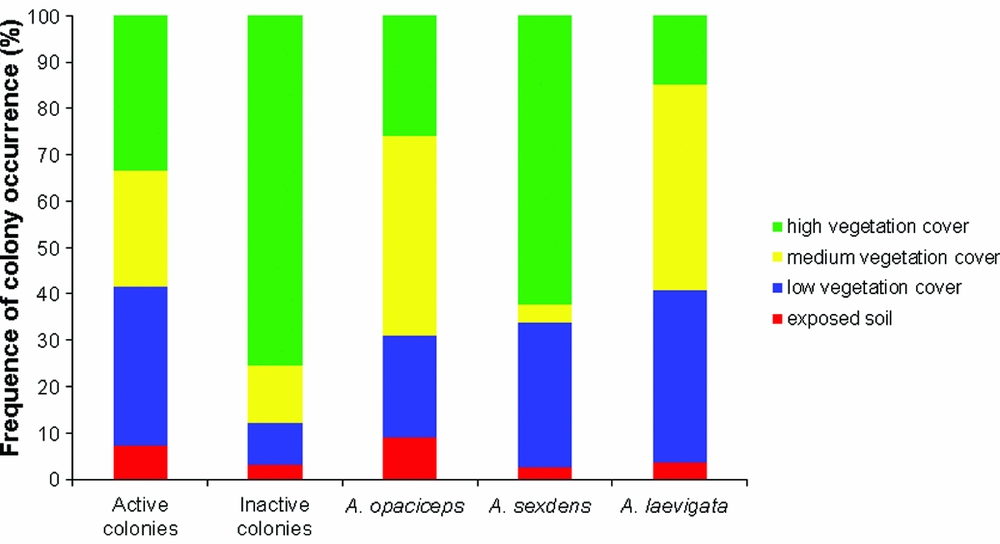
The frequency of occurrence of active Atta colonies varied significantly among the vegetation cover categories, and was lower than expected in sites with high vegetation cover (Figure 4, Table 1). The reverse pattern occurred for inactive colonies, which were far less abundant than expected where vegetation cover was high (Figure 4, Table 1). When assessing the frequency of occurrence for different Atta species separately (Figure 4), species exhibited different patterns. For A. opaciceps and A. laevigata, the most abundant and the rarer species, respectively, there was no difference between the observed and expected frequency of occurrence (Figure 4, Table 1). Colonies of A. sexdens were more abundant than expected in areas of high vegetation cover (Figure 4, Table 1).
Frequency of occurrence of Atta colonies: active colonies, inactive colonies, Atta opaciceps, A. sexdens and A. laevigata in four categories of vegetation cover (exposed soil, low, medium, and high vegetation cover) in Catimbau National Park, Pernambuco, north-eastern Brazil.
Chi-square analyses of the frequency of occurrence of Atta colonies (active and inactive) in different categories of vegetation cover (exposed soil, low, medium and high vegetation cover) recorded in Catimbau National Park, Pernambuco, north-eastern Brazil.

DISCUSSION
Leaf-cutting ants of the genus Atta commonly proliferate after anthropogenic disturbance in Neotropical rain forests due to their preference for open habitats and the lack of population control in those disturbed areas. However, their response to human disturbance in more open and less productive dry forests has received little research attention (but see Barrera et al. Reference BARRERA, BUFFA and VALLADARES2015). Our study tests the hypothesis that Atta abundance does not increase with disturbance in dry forest in Brazil because it naturally has more open-structured vegetation, which is dominated by deciduous species, and the reduced foliage availability of woody plants at disturbed sites might not be capable of sustaining large populations of LCA. Yet, contrary to this prediction, our findings indicate that the density of active Atta colonies sharply increases in a 50-m-wide zone along roads and that colonies preferentially occur in areas with low vegetation cover, while the density of inactive colonies was negatively correlated with road proximity and higher in areas with high vegetation cover. Such a contrasting pattern/response has been rarely documented and can shed some light on the potential mechanisms for the spatial distribution of LCA in the dry forest. This is especially interesting considering that queen preference for open habitats (Vasconcelos Reference VASCONCELOS1990) is unable to explain the positive relationship between vegetation cover and inactive nests. Moreover, although the genus Atta as a whole benefited from the presence of roads and habitats with low vegetation cover, the responses to vegetation cover were clearly species-specific.
Several studies have reported an increased density of LCA near roads (Vasconcelos et al. Reference VASCONCELOS, VIEIRA-NETO, MUNDIM and BRUNA2006, Vieira-Neto et al. Reference VIEIRA-NETO, VASCONCELOS and BRUNA2016), near forest edges of large fragments (Dohm et al. Reference DOHM, LEAL, TABARELLI, MEYER and WIRTH2011, Wirth et al. Reference WIRTH, MEYER, ALMEIDA, ARAÚJO, BARBOSA and LEAL2007), in small fragments dominated by edge habitats (Rao Reference RAO2000, Terborgh et al. Reference TERBORGH, LOPEZ, NUÑEZ, RAO, SHAHABUDDIN, ORIHUELA, RIVEROS, ASCANIO, ADLER, LAMBERT and BALBAS2001) and in early-successional forests (Farji-Brener Reference FARJI-BRENER2001, Silva et al. Reference SILVA, WIRTH, TABARELLI and LEAL2009, Vasconcelos & Cherrett Reference VASCONCELOS and CHERRETT1995), where plant assemblages are functionally and taxonomically similar to forest edge (Santos et al. Reference SANTOS, PERES, OLIVEIRA, GRILLO, ALVES-COSTA and TABARELLI2008). Few studies, however, demonstrated that the density of inactive colonies decrease with human disturbance, suggesting reduced mortality in these habitats (Meyer et al. Reference MEYER, LEAL and WIRTH2009). While LCA density has been shown to be unaffected by vegetation types (Costa & Vieira-Neto Reference COSTA and VIEIRA-NETO2015) and negatively correlated with categories of decreasing vegetation complexity (Fowler Reference FOWLER1983), the influence of vegetation cover remained essentially uninvestigated. We suggest that the preference of active colonies for low vegetation cover, combined with the predominance of inactive colonies in areas with dense vegetation, supports the idea that LCA proliferate in or benefit from human-modified habitats (Leal et al. Reference LEAL, WIRTH and TABARELLI2014).
Cross-species differences in terms of disturbance tolerance or preference for specific types of habitat structure (here represented by vegetation cover) is not an unexpected result. In our focal landscape, A. opaciceps and A. laevigata occurred equally across all classes of vegetation cover, while A. sexdens was more abundant in areas of high vegetation cover. Atta opaciceps is the only species endemic to the dry forest in Brazil (Brandão Reference BRANDÃO1995, Ulysséa & Brandão Reference ULYSSÉA and BRANDÃO2013) and was the most abundant species in the Catimbau landscape. In view of the high variability of the vegetation cover, ranging from seasonally dry forests with higher vegetation cover to more open areas with scrub vegetation (Pennington et al. Reference PENNINGTON, LAVIN and OLIVEIRA-FILHO2009), it is reasonable that this species is able to exist across the natural range of dry forest habitats. In contrast, Atta laevigata and A. sexdens are widely distributed throughout South American rainforests and savannas. While both species do occur in closed forests, they predominate in savannas and open habitats and are strong indicators of forest degradation, road and edge creation (Costa & Vieira-Neto Reference COSTA and VIEIRA-NETO2015, Dohm et al. Reference DOHM, LEAL, TABARELLI, MEYER and WIRTH2011, Fowler et al. Reference FOWLER, PEREIRA, FORTI, Lofgren and Vander Meer1986, Vasconcelos Reference VASCONCELOS1990). In this regard, the preference of A. sexdens for areas with high vegetation cover is a pattern rarely described in the literature.
The increased density of LCA near roads has been associated with more open habitat conditions. This has been explained by the facts that founding ant queens are attracted to areas of high light reflectance (Forys et al. Reference FORYS, ALLEN and WOJCIK2002), exposed soils are preferred nesting sites (Vasconcelos et al. Reference VASCONCELOS, VIEIRA-NETO, MUNDIM and BRUNA2006), and colonies founded in areas of greater exposure to sunlight are more productive (Weber Reference WEBER1972, Vieira-Neto et al. Reference VIEIRA-NETO, VASCONCELOS and BRUNA2016). However, direct road effects appear to be limited to relatively short distances. For example, Vieira-Neto et al. (Reference VIEIRA-NETO, VASCONCELOS and BRUNA2016) showed that such effects were limited to the first 15 m in a Brazilian savanna, where more than a third of all adult colonies occurred. In contrast, we found elevated colony densities as far as 50 m from roads, suggesting that additional disturbance factors associated with roads or forest edges in general are at play.
The reverse pattern of decreased density of inactive colonies near the 50-m edge zones may provide additional cues for other processes controlling LCA colony density in edge habitats. Several studies have demonstrated or suggested that both bottom-up and top-down population control are relaxed near forest edges, small fragments and early successional forests compared with the interior of continuous forest (Almeida et al. Reference ALMEIDA, WIRTH and LEAL2008, Terborgh et al. Reference TERBORGH, LOPEZ, NUÑEZ, RAO, SHAHABUDDIN, ORIHUELA, RIVEROS, ASCANIO, ADLER, LAMBERT and BALBAS2001, Urbas et al. Reference URBAS, ARAÚJO, LEAL and WIRTH2007). In this context, a decrease of inactive nests in areas near edges may be explained by the higher availability of palatable food sources, such as herbs and pioneer/colonizing plants (i.e. reduced bottom-up control). Indeed, several Euphorbiaceae shrubs have been reported to proliferate in disturbed areas of Brazil's dry forest (e.g. Croton, Jatropha and Cnidoscolus, Ribeiro et al. Reference RIBEIRO, ARROYO-RODRÍGUEZ, SANTOS, TABARELLI and LEAL2015, Reference RIBEIRO, SANTOS, ARROYO-RODRÍGUES, TABARELLI, SOUZA and LEAL2016, Ribeiro-Neto et al. Reference RIBEIRO-NETO, ARNAN, TABARELLI and LEAL2016, Rito et al. Reference RITO, TABARELLI and LEAL2017b). These species are often succulent with very conservative leaf-economy and seem to be able to withstand disturbances, including soil degradation and desiccation (Rito et al. Reference RITO, TABARELLI and LEAL2017b). The fact that light is probably not a limiting resource in dry forests suggests however, that LCA proliferation is not driven by increased light availability (opposed to edge-induced pioneers of humid forests). Nevertheless, these species make up a large portion of the diet of LCA (F.F.S. Siqueira, unpubl. data), and may therefore represent a resource advantage in near road environments or sites with low cover of mature-forest vegetation. Herbs also proliferate in disturbed habitats in the dry forest (L.A.F. Vieira, unpubl. data) and we have already documented a frequent use of herbs (e.g. Portulaca elatior Mart. ex Rohrb and Sida galheirensis Ulbr.) by LCA in our focal landscape (F.F.S. Siqueira, unpubl. data). In addition, it is possible that LCA colonies of disturbed areas experience reduced pressure by parasitoid flies (Diptera: Phoridae), because this group is susceptible to open environments with reduced vapour pressure (Morrison et al. Reference MORRISON, KAWAZOE, GUERRA and GILBERT2000, Wuellner & Saundres Reference WUELLNER and SAUNDRES2003). Decrease in populations or behavioural avoidance of vegetation edges by vertebrate predators such as armadillos and anteaters are also common in dry forests (Melo et al. Reference MELO, SIQUEIRA, SANTOS, ALVARES-DA-SILVA, CEBALLOS and BERNARD2014, Superina & Abba Reference SUPERINA and ABBA2014). It is thus entirely reasonable that the same mechanisms that release LCA from population control at rain-forest edges are also operating along road-affected or other disturbed areas of dry forest.
In synthesis, our findings document for the first time a case of drastic Atta proliferation associated with human-disturbances (roads and changes in vegetation cover) in the tropical dry forest of north-east Brazil. This population growth is likely driven by a combination of mechanisms including a preference of founding queens for open habitats and a relaxation of population control forces. However, in contrast to other neotropical ecosystems, these changes are probably not induced by increased light availability as the ultimate causality behind disturbance-induced LCA proliferation. Our study provides not just another instance in which Atta proliferates, but rare evidence that some LCA species are able to persist and even benefit from human disturbance in a very harsh environment (i.e. severe annual and inter-annual droughts), in which evergreen woody plants can represent less than 1% of all stems (Lima & Rodal, Reference LIMA and RODAL2010). As herbivores (Urbas et al. Reference URBAS, ARAÚJO, LEAL and WIRTH2007) and ecosystem engineers (Corrêa et al. Reference CORRÊA, SILVA, WIRTH, TABARELLI and LEAL2010, Reference CORRÊA, SILVA, WIRTH, TABARELLI and LEAL2016; Meyer et al. Reference MEYER, LEAL, TABARELLI and WIRTH2011, Reference MEYER, NEUBAUER, SAYER, LEAL, TABARELLI and WIRTH2013) these ants have far-reaching effects on plant recruitment and the successional trajectory of forest patches (Bieber et al. 2011, Corrêa et al. Reference CORRÊA, SILVA, WIRTH, TABARELLI and LEAL2010, Farji-Brener & Illes Reference FARJI-BRENER and ILLES2000, Meyer et al. Reference MEYER, LEAL, TABARELLI and WIRTH2011). With the human-induced spread of these ants, such activities and their cascading impacts on ecosystem functions have proliferated across the Neotropics and turned LCA into an emerging key player of human modified landscapes (Leal et al. Reference LEAL, WIRTH and TABARELLI2014). We therefore urge further studies aimed at exploring the forces driving LCA proliferation near roads and disturbed habitats, and its consequences for the regeneration of dry forests to maintain the functions and services of this ecosystem, which now faces a future of increased aridity (Magrin et al. Reference MAGRIN, MARENGO, BOULANGER, BUCKERIDGE, CASTELLANOS, POVEDA, SCARANO, VICUÑA, Barros, Field, Dokken, Mastrandrea, Maach and Bilir2014).
ACKNOWLEDGEMENTS
This study was funded by the Conselho Nacional de Desenvolvimento Científico e Tecnológico (CNPq processes 403770/2012-2, 490450/2013-0 and 470480/2013-0), the Coordenação de Aperfeiçoamento de Pessoal de Nível Superior (CAPES processes 88881.030482/2013-01) and the Fundação de Amparo a Pesquisa à Ciência e Tecnologia do Estado de Pernambuco (FACEPE processes 0738-2.05/12 and 0138-2.05/14). We also thank FACEPE for PhD and CAPES for sandwich scholarships to F.F.S. Siqueira and CNPq for productivity grants to M. Tabarelli and I.R. Leal. Finally, our sincere thanks to F.M.P. Oliveira and G.C. Silva for their help in data collection and to all members of the laboratories LIPA and LEVA.