It has been argued that the action properties of objects are an intrinsic part of its mental representation. Gibson (Reference Gibson1979) used the term affordance to refer to the fact that visual perception of the environment is not just perception of objects, but also direct perception of the potential actions that the perceiver can carry out with them. Supporting the view are the results of increasing number of studies showing that the appearance of an object automatically activates a series of actions which are congruent with some of the object’s visual properties, such as its location, its size and the orientation of eventual graspable parts (Ellis & Tucker, Reference Ellis and Tucker2000; Phillips & Ward, Reference Phillips and Ward2002; Symes, Ellis, & Tucker, Reference Symes, Ellis and Tucker2007; Tucker & Ellis, Reference Tucker and Ellis1998; Reference Tucker and Ellis2001). For instance, in a well-known experiment by Tucker and Ellis (Reference Tucker and Ellis1998), participants were required to make a left or right response depending on whether a household object was upward or inverted. Results showed that reaction times (RTs) were faster when the handle orientation were congruent with the side of the responding hand. This advantage has been interpreted as an indication that the orientation of the object’s graspable part automatically elicited the activation of a reach-to-grasp response specifically directed to interact with the object. It was found that the canonical neurons (parietal-premotor cortical circuits) responded both to an action and to the visual properties of an object (Di Pellegrino, Fadiga, Fogassi, Gallese, & Rizzolatti, Reference Di Pellegrino, Fadiga, Fogassi, Gallese and Rizzolatti1992; Murata, Gallese, Luppino, Kaseda, & Sakata, Reference Murata, Gallese, Luppino, Kaseda and Sakata2000; Rizzolatti, Fadiga, Gallese, & Fogassi, Reference Rizzolatti, Fadiga, Gallese and Fogassi1996).
To survive, humans need to discriminate between ‘‘dangerous objects’’ that pose a potential risk and ‘‘neutral objects’’ that can be approached without any risk. In the existing literature, only a few studies investigated the affordance activated by the dangerous objects. In a study, researchers investigated the interaction between the body and objects on the boundary of peripersonal space (Coello, Bourgeois, & Iachini, Reference Coello, Bourgeois and Iachini2012). It was demonstrated that the size of such space was influenced by the objects’ dangerousness. The peripersonal space significantly reduced when the threatening part of dangerous objects was oriented toward the participants, compared to when it was oriented away from them. In another study, Anelli, Borghi, and Nicoletti (Reference Anelli, Borghi and Nicoletti2012), they presented an image prime (hand) following by graspable objects (neutral or dangerous objects), and required participants to perform a natural/artifact categorization task by pressing different keys. They showed that graspable objects activated a facilitating motor response, while dangerous objects generated an interference effect, as demonstrated by the slower RTs required to process dangerous objects. In another study (Anelli, Nicoletti, Bolzani, & Borghi, Reference Anelli, Nicoletti, Bolzani and Borghi2013), participants were presented with a video of an object moving away or near to the participant. They were required to decide whether the object was an artifact or a natural object by pressing or releasing one key. Participants’ responses were influenced by the kind of object movement direction. Neutral objects were processed faster when they moved toward-approached the participant, whereas dangerous objects were processed faster when they moved away from the participant.
In short, previous studies provided clear evidence that individuals were sensitive to the difference between dangerous and neutral objects. In particular, dangerous objects produced an interference effect, whereas neutral objects produced a facilitation effect. Given the apparent distinction between neutral and dangerous objects to potentiate actions, the question arises whether dangerous object that remains outside the focus of attention can also produce affordance effects.
In a previous study, Murphy et al. (Reference Murphy, van Velzen and de Fockert2012) investigated the affection of perceptual load on graspable object to activate the associated action that it affords. Participants carried out a letter-search task and identified a target letter with the right or left hand while ignoring a graspable object with a handle oriented on the left or the right side of the object. It was found that the judgments of letter were faster when the action afforded by the ignored object was congruent (vs. incongruent) with the current response to be executed. However, this positive congruent effect was observed only when the perceptual load of letter-search task was low. That was, an irrelevant object can potentiate an action, but only when it receives sufficient attention.
In the present study, we explored the automaticity of affordance of dangerous objects, by measuring whether the object affordance would be observed when it receives insufficient attention. Given that the unique properties of dangerous objects, it is possible that the affordance related to the distractor object could override the effect of load, and as a result congruency effects would be seen regardless of load.
Method
Participants
A group of 28 students (12 males, 16 females; age range: 21–25) participated in this experiment. All of them were right-handed by self-report and had normal or corrected-to-normal vision. All were naive as to the purpose of the experiment. Participants received experimental fees for participation. Informed consent was obtained from all participants included in the study.
Apparatus and stimuli
The stimuli were presented on a 19-in monitor (resolution 1024 × 768 pixels), which were displayed at a viewing distance of 60 cm. E-Prime software was used for stimulus presentation and data collection.
The stimuli consisted of a series of a single target letter (low perceptual load), or a horizontal row of six letters (high perceptual load), or a horizontal row of nine letters (super high perceptual load). Each display contained a target letter (X or N) that was randomly likely to appear in each of the six letter positions (the other five non-target letters was selected from H, K, M, V, W, and Z) or nine letter positions (the other eight non-target letters was selected from E, F, H, K, M, R, V, W, and Z) . Each letter subtended a visual angle of 0.95 horizontally and 0.95 vertically.
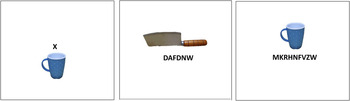
Each display also contained an additional distractor object. The distractors were color photographs of four neutral objects (cups) and four dangerous objects (knives) with a graspable handle (5.71 × 5.71) (see Figure 1). Distractor objects were equally likely to appear above or below the row of letters, centered at a distance of 1.66 (edge to edge) from the letter display. All the objects could appear either oriented to the left or right. The orientation of the handle simulated an apparent affordance for grasping with either left or right hand.
Example stimulus displays (images not to scale) in three level of perceptual load. Left Panel represented the congruent stimuli for prticipants who responded to X with the left hand under the low perceptual load. Middle Panel represented the congruent stimuli for participants who responded to N with the right hand under the high perceptual load. Right Panel represented the incongruent stimuli for participants who responded to N with the right hand under the super high perceptual load.

Each object was evaluated in a pre-experimental phase. A group of 20 healthy participants (12 female, 8 male; age 20–23 years) viewed each object, and they were asked to evaluate the risk degree of object. Each was evaluated on a 7-point Likert scale from 1 (not at all dangerous) to 7 (extremely dangerous). It was found that the level of risk for each group of dangerous object (M = 6.20) was significantly different from each group of neutral object (M = 1.91), t(19) = 5.42, p < .001.
Procedure
At the beginning of each trial block, a fixation cross was presented in the center of the screen (0.5 × 0.5) for 500 ms. After the fixation cross disappeared, the stimuli were presented. The participants were asked to identify the target letter, by using the “A” key with their left index finger for the target letter X and the “4” key on the numerical keyboard with their right index finger for N. The stimulus-response mapping was counterbalanced across the participants. The other half of the participants received the opposite key-response instructions. They were instructed to respond to each letter as quickly as possible and to avoid errors. Immediately after a response key was pressed, the stimulus disappeared from the screen. Each stimulus was presented for a maximum of 2,000 ms.
Design
The experiment comprised 6 blocks of 72 trials each in a within-subject three-factor design. The factors consisted of perceptual load (low, high, super high), object type (neutral, dangerous), and congruency between response hand and handle orientation (congruent or incongruent).
The stimuli were arranged in pseudo-randomized order. In each trial block, the number of left-hand and right-hand responses was balanced across the trials. Super High-, High- and low-perceptual load blocks alternated, and the order of blocks was counterbalanced between participants randomly. The participants performed 24 practice trials before beginning the experimental phase, and they were allowed to rest between the blocks in the experimental phase.
Results
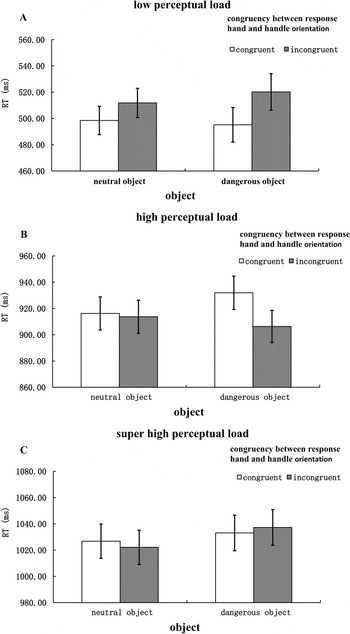
Figure 2 showed the reaction times (RTs) in the present Experiment. For analysis of RTs, trials in which the participant made an error and reaction times that exceeded the participant’s mean by more than three standard deviations were excluded from analysis (7.8%). The remaining RTs were entered into a 3 × 2 × 2 repeated measurements ANOVA within-participants factors perceptual load (low, high, super high), object type (neutral, dangerous), and congruency between response hand and handle orientation (congruent, incongruent). The ANOVA revealed a main effect of perceptual load, F(2, 54) = 729.50, p < .001, η2 = .96. RTs during low perceptual load were fastest (M = 506 ms) and RTs during super high perceptual load were slowest (M = 1030 ms), confirming that perceptual load was successfully. The perceptual load interacted with congruency, F(2, 54) = 28.20, p < .001, η2 = .51. Furthermore, the perceptual load, object type and congruency produced a significant three-way interaction, F(2, 54) = 10.65, p < .001, η2 = .28. No other main effects or interactions approached significance (all ps > .10).
Handle-response congruency effect (handle orientation of ignored object to the response hand congruent vs. incongruent pairings) in three level of perceptual load for mean reaction times (RT). In each graph, bars at left indicate trials in which distractor objects were neutral objects, and bars at right indicate trials in which distractor objects were dangerous objects.

Given our a priori interest in the influence of perceptual load on object affordance generation, we decided to run separate 2 (object type: neutral, dangerous) × 2 (congruency between response hand and handle orientation: congruent, incongruent) ANOVAs for each level of perceptual load.
In the low perceptual load (figure 2a), the main effect of congruency approached significance, F(1, 27) = 66.47, p < .001, η2 = .71, which significantly interacted with object type, F(1, 27) = 8.76, p < .01, η2 = .25. For the neutral object, a reliable congruency effect was observed, with faster responses for congruent (M = 498 ms) than for incongruent (M = 512 ms) trials, t(27) = 4.44, p < .001. For the dangerous object, there was a more significant congruency effect, with faster responses for congruent (M = 495 ms) than for incongruent (M = 520 ms) trials, t(27) = 7.99, p < .001.
In the high perceptual load (figure 2b), the main effect of congruency approached significance, F(1, 27) = 14.11, p < .001, η2 = .34, which significantly interacted with object type, F(1, 27) = 12.23, p < .01, η2 = .31. There was a reversal congruency effect for dangerous object, with faster responses for incongruent (M = 942 ms) than for incongruent (M = 906 ms) trials, t(27) = 4.97, p < .001, but not for the neutral object (congruent, M = 916 ms; incongruent, M = 914 ms; t < 1).
In the super high perceptual load (figure 2c), the main effect of object type did not reach significance, F(1, 27) = 1.04, p = .316, η2 = .04. The main effect of congruency was not significant, F(1, 27) = .004, p = .952, η2 = .00. The interaction between object type and congruency was not significant, F(1, 27) = 2.32, p = .14, η2 = .08.
The error rates were also entered into a 3 × 2 × 2 repeated measurements ANOVA within-participants factors perceptual load (low, high, super high), object type (neutral, dangerous), and congruency between response hand and handle orientation (congruent, incongruent). Only the main effect of perceptual load reached significance, F(2, 54) = 9.19, p < .001, η2 = .25. Error rates during low perceptual load were lowest (M = 3.8 %) and Error rates during super high perceptual load were highest (M = 6.5 %), again confirming that our manipulation of perceptual load was successful. No other main effects or interactions approached significance (all ps > .10).
Discussion
The present study investigated the automaticity of affordance of dangerous object through manipulating the perceptual load in a letter identification task. Results showed an interesting pattern for neutral and dangerous object under different perceptual load. When the perceptual load of a concurrent letter identification task was low, a significant positive congruency effect between the affordance of the ignored object and the response to be executed was observed for neutral or dangerous object. Under high perceptual load, this congruency effect for neutral object was not observed, but a reversed congruency effect for dangerous object was found. Under super high perceptual load, there was not any difference in performance between conditions when the object was congruent versus incongruent with the response. The present study extends previous evidence demonstrating that not only the affordance of neutral object but also the affordance of dangerous object are sensitive to the perceptual load.
The occurrence of object affordance was assumed to be automatic. Previous evidence demonstrated that a relevant object with an intrinsically associated action pattern can affect performance in an ongoing task, even when the graspable component is irrelevant to the task (e.g., Phillips & Ward, Reference Phillips and Ward2002; Tucker & Ellis, Reference Tucker and Ellis1998; Vainio, Ellis, & Tucker, Reference Vainio, Ellis and Tucker2007). The present study demonstrated that this automaticity does not seem to hold when one is engaged in a relevant task of high perceptual demands. In another study, Wamain, Gabrielli, and Coello (Reference Wamain, Gabrielli and Coello2016) found that the greater activation of object motor affordances in peripersonal space was reflected by an increased desynchronization of μ rhythm at the neural level when objects were perceived as reachable. However, the neural modulation of affordance activation as a function of space was present only when the discrimination task was relevant for action (i.e., reachability judgments), but not when the discrimination task focused on object surface properties (i.e., object versus non-object judgments). They suggest motor coding of manipulable objects in peripersonal space does not rely exclusively idiomatically process, which is in line with our view.
Given the unique properties of dangerous objects, these actions associated with these objects may generate more automatic influence to performance. Indeed, under low perceptual load, the congruency effect of dangerous object was more obvious compared to the neutral object. However, a reversed congruency effect for dangerous object was found under high perceptual load. This could be interpreted that the activation of actions associated with objects required adequate attention. The reversed congruency effect for dangerous object might reflect attention capture for dangerous information, because non-handle side (e.g., knife) was most likely to bring harm to people. Other evidence has shown that that the processing of negative emotional information is relatively automatic (Pessoa, McKenna, Gutierrez, & Ungerleider, Reference Pessoa, McKenna, Gutierrez and Ungerleider2002). Compared with neutral emotions, negative emotional information is more likely to capture the individual’s attention, when it receives sufficient attention. When the perceptual load of letter-search task was high, the non-handle side of dangerous object caught the individual’s attention. However, there was not adequate attention to process the information of handle side. The attention focused on the non-handle side of dangerous object, leading to a reversed congruency effect. The finding that there was not any congruency effect of dangerous object under super high perceptual load, further proved this point of view, because the object could not receive sufficient attention either handle side or non-handle side of dangerous object.
Anelli et al. (Reference Anelli, Borghi and Nicoletti2012; Reference Anelli, Nicoletti, Bolzani and Borghi2013) suggest there exist two specific mechanisms: the facilitation mechanisms evoked by neutral objects and the interference mechanisms induced by dangerous objects. The reversed congruency effect for dangerous object which was found under high perceptual load allowed us to make some speculations about the possible mechanisms involved in the affordance processing of neutral and dangerous objects. With respect to the current data, it is easily accounted by the fact that compared with the neutral object, the dangerous object can still catch the individual attention under the condition of less attention to the resources. However, in this condition, the attention of the individual to the dangerous position will interfere with the individual’s judgment. The present work extends previous evidence demonstrating that the neutral and dangerous object possibly relies on a collection of independent pathways that process different types of affordance.
Finally, some authors consider that this kind of protocol as actually reflect attentional bias (e.g., Anderson, Yamagishi, & Karavia, Reference Anderson, Yamagishi and Karavia2002), since the handle can cue attention toward the left or right side of the screen (a with-in object Simon effect). There even was a view that this effect was derived from the visual encoding of the object space information (Cho & Proctor, Reference Cho and Proctor2010; Reference Cho and Proctor2011). We admit that this is a possible explanation for the present data to some extent. Actually, it had been found that both Simon effect and affordance contributed to this kind of congruency effect (e.g., Pellicano, Iani, Borghi, Rubichi, & Nicoletti, Reference Pellicano, Iani, Borghi, Rubichi and Nicoletti2010; Pellicano, Lugli, Baroni, & Nicoletti, Reference Pellicano, Lugli, Baroni and Nicoletti2015; Riggio et al., Reference Riggio, Iani, Gherri, Benatti, Rubichi and Nicoletti2008; Symes, Ellis, & Tucker, Reference Symes, Ellis and Tucker2005). It was supposed that attention (predominantly perceptual) and affordance (predominantly motoric) had independent coding system. In any case, the current task might not be able to distinguish between attention and affordances completely. In addition, we used four neutral objects (cups) and four dangerous objects (knives) in the task. Although the results were sufficiently stable to illustrate our point of view, it was hard to speculate how this effect generalized to other dangerous objects others than the one specifically used here. Nevertheless, some researchers also used one kind of material to carry out the research and got important results in previous studies (e.g., Cho & Proctor, Reference Cho and Proctor2013; Pellicano et al., Reference Pellicano, Iani, Borghi, Rubichi and Nicoletti2010; Tipper, Paul, & Hayes, Reference Tipper, Paul and Hayes2006). Further research can use more abundant materials and flexible task to further clarify the affordance mechanisms underlying neutral objects and dangerous object.
In the present study we simply investigated the automaticity of affordance of dangerous object through manipulating the perceptual load. Our study suggests that dangerous objects potentiate associated action plans, but that depends upon how much attention they received. This finding demonstrates that the affordance of dangerous object is not completely automatic, instead being constrained by perceptual load on the relevant processing.
This study was supported by a grant from Programs of Scientific Research Foundation for Doctor (ZK16037) of Baoji University of Arts and Sciences to Liang Zhao.