



Pseudocyesis, derived from the Greek (pseudo – false, cyesis – pregnancy) can be defined as the belief that one is pregnant with objective pregnancy signs and reported symptoms, in the absence of a pregnancy confirmation or diagnosis. Other pseudonyms include false pregnancy, hysterical pregnancy, spurious pregnancy, and phantom pregnancy. Historically, pseudocyesis has baffled clinicians from as early as 300 BC, where it is noted that Hippocrates himself observed 12 cases in his medical practice.Reference Kulcsar1 One of the most famous cases is that of Queen Mary, eldest daughter and successor of King Henry VIII as the first Queen of England. Married at the relatively late age of 38, she struggled to conceive and experienced two phantom pregnancies during her reign in 1554 and 1557. Physicians and midwives confirmed her pregnancy as she experienced typical symptoms such as morning sickness and a swollen abdomen, but after months of waiting, the baby never arrived. Queen Mary was under significant societal and political pressure to produce an heir to the throne, and it is reported that she felt traumatised by the affliction, dying the following year from what was later suspected to be a possible uterine malignancy.2
The true prevalence of pseudocyesis cases in the UK has been difficult to quantify given that knowledge is limited predominantly to case studies; however, it reached an alarming rate of 1 in 250 pregnancies in the mid-20th century. This surge may be attributed to the sociocultural values of the time, which emphasised traditional gender roles and societal expectations around marriage and motherhood with the pressure to conceive amidst the post-war ‘baby boom’. High reporting of pseudocyesis interestingly coincides with an increase in the prevalence of amenorrhea following World War II, attributable to a possible ‘emotional shock response’ among women during wartime, decades before our collective understanding and investigation of infertility. In modern-day practice, it is an infrequent disorder affecting 1 in 200 000 women. This is partly because of our readily available technology, which can confirm pregnancy quickly and accurately within a few weeks of conception. However, although we can detect pregnancy (or lack thereof), the diagnosis, aetiology and management of pseudocyesis continue to be an enigma.Reference Daley3
What’s in a name? Classification and diagnosis of pseudocyesis
Although previously named in ICD-10, the updated 11th edition (ICD-11) has moved it from a somatoform disorder (now renamed ‘bodily distress disorder’) to a new grouping, ‘disorders specifically associated with stress’. Pseudocyesis is not explicitly mentioned in ICD-11, categorised loosely under ‘other specified disorders specifically associated with stress’, alongside post-traumatic stress disorder and prolonged grief reaction.4 Although one may argue that it could be grouped within mental or behavioural disorders associated with pregnancy, childbirth or the puerperium, the counterargument is that as there is no pregnancy to begin with, it would not belong in that category. Both somatoform and stress-related disorders have a higher prevalence in women, and their existence in the grey areas of diagnostic classification is reflective of the challenges women with neuro-endocrine/reproductive conditions face, falling between the gaps of service provision among psychiatric, gynaecological and endocrine specialists.
The largest study to date was that by Bivin and Klinger in 1937, who analysed 444 case studies dating back to the 17th and 18th centuries. Most women were of reproductive age, often newlywed and nulliparous, with no documented history of mental illness. All strongly believed they were pregnant and exhibited classical symptoms of pregnancy, including weight gain, distended abdomen, nausea, lethargy and breast changes. Duration of pseudocyesis varied from days to years – the longest declaration from a patient stating she had been pregnant for 18 years. Emotional stability varied between patients, and although the desire to have a baby was frequently stressed, 31 patients expressed a fear of pregnancy and even ambivalence.Reference Bivin and Klinger5 These findings correlate with what we know in perinatal psychiatry, in that the wish to conceive and wanting/planning to have a child is not a binary notion but rather a complex interplay of emotions requiring a nuanced exploration in clinical practice.Reference Barrett and Wellings6
Pseudocyesis presents as a complex mind–body condition where a woman may present with a relatively normal mental state but exhibits objective signs and symptoms of pregnancy and is convinced she is pregnant. This contrasts with delusional pregnancy, where a woman is convinced she is pregnant, despite the absence of physical signs or positive test results.Reference Sharma, Singh, Sahu and Pruthi7 Psychiatric conditions such as schizophrenia or severe depression may feature delusions of pregnancy within their presentation – however, the pivotal distinction in these cases is the objective lack of pregnancy symptoms alongside altered mental state (such as fixed delusional beliefs), whereas pseudocyesis is the belief that one is pregnant alongside objective physical signs akin to pregnancy, with most patients exhibiting an intact mental state otherwise. The two conditions warrant distinction because of a different approach in management – delusions of pregnancy usually respond better to antipsychotics, whereas pseudocyesis has a limited response to psychotropic medication and benefits from a psychotherapeutic intervention in most cases.Reference Yadav, Balhara and Kataria8 Manjunatha et alReference Manjunatha, Sarma, Math and Chaturvedi9 postulated a broader rubric of the delusional procreational syndrome, which encompasses delusions at various stages of the maternity journey: pre-conception, the delusion of having a spouse, delusion of paternity/maternity, delusional pregnancy and delusions regarding childbirth. Pseudocyesis may also be seen with organic disorders such as epilepsy, hyponatraemia, prolactinomas hypothyroidism/thyroiditis, metabolic syndrome and sepsis. Other examples cited in past case studies include the neuropsychiatric manifestations of HIV/AIDs, systemic lupus, malnutrition and medical or gynaecological conditions that may give the appearance of a distended abdomen (such as intrauterine fibroids or malignancy). The ‘labour pains’ thought to be contractions may be a misinterpretation of abdominal issues such as severe constipation, gas or irritable bowel syndrome, as described in a case report published in 1951 in the Canadian Medical Journal, ‘a mix of wind and water in the womb’.Reference Trivedi and Singh10,Reference Rubman, Goreczny, Brantley and Pevey11
The emerging field of neuro-endocrinology highlights the intricate link among hormonal, emotional and psychological states in women. External stress can delay periods or cause temporary amenorrhea, along with symptoms mimicking early pregnancy, such as food cravings, nausea and mood fluctuation. Mental health disorders such as anorexia, depression and anxiety can significantly disrupt menstrual cycles. Reproductive-endocrine disorders, including polycystic ovary syndrome (PCOS), hypothalamic amenorrhea, premenstrual dysphoric disorder (PMDD), endometriosis, premenstrual syndrome (PMS) and menopause, frequently present with disabling psychological and psychiatric comorbidity.Reference O’Grady and Rosenthal12
The situation becomes further complicated when well-known side-effects of psychotropic medications mimic pregnancy symptoms. For instance, antipsychotics can cause weight gain, nausea and vomiting, fatigue, hyperprolactinemia, gynecomastia, galactorrhoea and amenorrhea.Reference Grover, Sharma, Ghormode and Rajpal13,Reference Baranowska, Baranowska-Bik, Bik and Martynska14 Contraceptive methods are also associated with notable mental health side-effects, which can lead to reduced adherence and an increased risk of unplanned pregnancies, and there are noted case reports of pseudocyesis following long-acting reversible contraceptive-eliciting amenorrhea and other progesterone-related side-effects triggering the condition.Reference Jayarajah and Seneviratne15,Reference Flanagan and Harel16
Infertility is a recognised risk factor for developing pseudocyesis, often cited as a primary cause in numerous case reports, especially in cultures with strong expectations for women to conceive. Menopause was also another reported missed diagnosis historically, particularly in those with limited understanding of reproductive function, who may equate cessation of periods automatically to pregnancy.Reference Ladipo17 It is also worthwhile to note that there may be cases of pseudocyesis where the reporting of a ‘false positive’ self-pregnancy test may lead to confusion as to the validity of pregnancy. In the majority of case reports published, all assumed the benevolence of the patient; however, it is possible for deception and consideration of a (albeit unusual) form of malingering or factitious disorder imposed upon oneself.
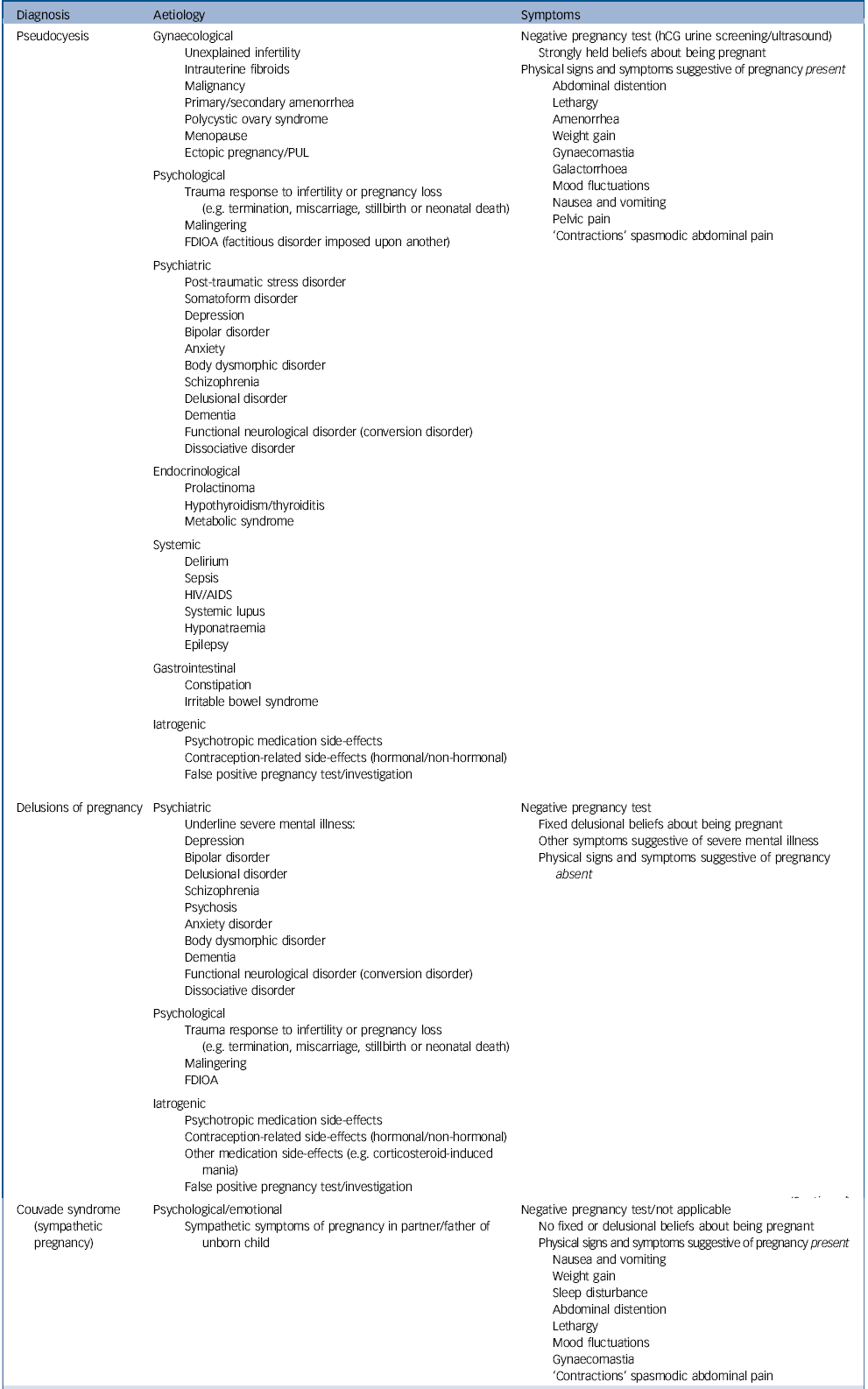
Traumatic events relating to pregnancy also need to be explored, including previous experience of missed miscarriage, recurrent miscarriages or stillbirth, which may heighten the strong emotive desire to conceive again or indeed complete denial of the pregnancy loss. Much was written about pseudocyesis and ideas of pregnancy and motherhood in the early 20th century. Helene Deutsche, a prominent psychoanalyst and trainee of Freud, wrote extensively on the topic of motherhood. She suggested that the unusual phenomenon of pseudocyesis may serve as a psychological response to unresolved conflicts regarding motherhood and femininity, and proposed that the symptoms could function as a defence mechanism, allowing women to cope with anxieties surrounding their fertility or societal pressures to bear children. By manifesting physical signs of pregnancy, individuals may be attempting to fulfil deeply held desires or evade feelings of inadequacy related to motherhood, highlighting its complexity as a psychosomatic phenomenon.Reference Deutsch18 Couvade syndrome, commonly known as ‘sympathetic pregnancy’, reflects how men experience pregnancy-like symptoms, contrasting sharply with the ridicule and judgement faced by women with pseudocyesis.Reference Christodoulou19 These women often feel humiliated when discovering their symptoms are not genuine, compounded by stigma from healthcare professionals and family, who may label them as delusional or mentally unstable. For an overview of the aetiology and symptomatology of pseudocyesis, delusions of pregnancy and Couvade syndrome, please see Table 1.
Aetiology and symptomatology of pseudocyesis, delusion of pregnancy and Couvade syndrome (sympathetic pregnancy)

hCG, human chorionic gonadotrophin; PUL, pregnancy of unknown location.
Mind over matter: unpacking the neuroscience of pseudocyesis
The hormonal reproductive axis, often referred to as the hypothalamic–pituitary–gonadal (HPG) axis, is a complex network of interactions among the hypothalamus, pituitary gland and gonads (ovaries in females) that regulates reproductive function and hormone production. The axis operates in a homeostatic mechanism and is essential for reproductive health, fertility and the regulation of menstrual cycles in females. Disruptions in this axis can lead to various reproductive disorders, infertility and other health issues.Reference Forsbach, Güitron, Munoz and Bustos20
From a neuroscientific perspective, physiological changes seen in pseudocyesis may be caused by an imbalance of pituitary–ovarian function mediated by neurotransmitters in the pituitary and/or hypothalamus. Mental health disorders such as depression can lead to a cascade of changes in the cortical and limbic systems, affecting the reproductive pathway. This results in decreased levels of luteinising hormone and follicular stimulating hormone (FSH), causing suppression of ovulation and subsequent amenorrhea. Other pathways such as dopamine stimulation and prolactin inhibition may be involved.Reference Tarín, Hermenegildo, García-Pérez and Cano21
A recent literature review noted that pseudocyesis shares many neuro-endocrine traits with PCOS and major depressive disorder. These include increased sympathetic nervous system activity, dysfunction of central nervous system (CNS) catecholaminergic pathways and decreased steroid feedback inhibition of gonadotrophin-releasing hormone (GRH). These changes may, in part, explain the objective somatic signs presenting in pseudocyesis (amenorrhea, galactorrhoea, diurnal/nocturnal hyperprolactinemia, abdominal distention, fetal movements and labour pains).Reference Pruneti and Guidotti22
While it has long been understood that stress can delay periods or lead to temporary amenorrhea, recent neuroscientific evidence supports the theory of an emotional-psychophysiological mechanism at play. Those experiencing significant stress, or with underlying anxious, obsessive or perfectionistic tendencies may use control as a coping mechanism for the management of emotions. This psychological rigidity is mirrored in the physiological state with increased muscle tension, heightened alertness, restlessness, nausea and digestive issues. This heightened psychological and physiological state may influence a woman’s experience of intimacy, prompting the ‘fight or flight’ sympathetic autonomic nervous system response to override relaxation typically observed with the parasympathetic autonomic nervous system. In pseudocyesis, the heightened anxiety state accompanied by physiological changes may also serve to prolong the clinical signs and symptoms believed to be related to pregnancy.Reference Felker, Patel, Kotnis, Kenyon and Knight23
Management of pseudocyesis
To diagnose pseudocyesis one must be sure that there is no viable pregnancy. Although home pregnancy tests often state a ‘99% accuracy rate’ if used correctly, there may be causes for a false positive result, such as previous miscarriage or abortion, molar pregnancy, medications containing synthetic human chorionic gonadotrophin (hCG) and medical conditions producing hCG, such as ovarian cysts. It is common practice to offer a pregnancy test initially and then transabdominal/transvaginal ultrasound with serial serum beta-human chorionic gonadotrophin (bhCG) to exclude differential diagnoses of pregnancy of unknown location or ectopic pregnancy. Manual examination (Leopold’s manoeuvre) can be used whether access to antenatal care or investigations is limited. To manage the physical symptoms, placing the patient under general anaesthetic was used in the past to release abdomen distension and relax the abdominal muscles, although this would be subject to ethical scrutiny by current standards. Medication may be used to regulate the menstrual cycle as a ‘quick fix’; however, if given in isolation it fails to address the psychosomatic weight of the problem.Reference Thippaiah, George, Birur and Pandurangi24
Management of pseudocyesis requires careful differential diagnosis and treatment of underlying issues, especially delusions of pregnancy, which respond better to antipsychotics. However, women may refuse medication because of fears of harming a non-existent fetus or, in denial of the diagnosis, complicating treatment. Additional investigation of hormonal profile and fertility assessments is essential to identify potential neuro-endocrine or gynaecological issues, such as unexplained infertility or PCOS. Psychotherapeutic intervention appears to be the most reliable treatment option, as those with pseudocyesis have a strong psychological desire to become a mother, which becomes essential to their identity and self-esteem. Individual therapy may focus on feelings related to perceived loss, humiliation, emotional distress and struggles with coming to terms with infertility. Patients with pseudocyesis often receive minimal follow-up support, resulting in a limited understanding of the associated risks. Women may ‘shop around’ for maternity care, questioning the expertise of the obstetrician or validity of investigations. Given the emotive nature coupled with a comorbid delusional mental state, the patient may believe that staff are deceiving them, as described in one case reported in India where a doctor was accused of malpractice and stealing a baby following delivery. Although it is advised to be transparent, some physicians in the past have colluded with the beliefs out of compassion, for example, telling the woman they have ‘removed a stillborn child’ (in this case study example, the patient then became convinced she had twins).Reference Christodoulou19 Clinicians must approach the delicate task of disclosing the non-existence of pregnancy with care, as this revelation can trigger significant emotional distress. As detailed in the Mothers and Babies: Reducing Risk through Audits and Confidential Enquiries (MBRRACE) report on confidential inquiries into maternal deaths, women who have experienced pregnancy loss are at increased risk of self-harm and suicide.Reference Gaskin25
Integrated specialist care among general practitioners (GPs), psychiatrists, endocrinologists and gynaecologists is vital for effectively managing this complex presentation and to ensure that physiological differential diagnoses have been excluded.
In conclusion, to quote Dr. Mary Doreen Daley, an obstetrician writing about pseudocyesis in 1946, ‘We know very little of the true nature of the condition, in spite of having so many aids to investigation at our disposal’.Reference Daley3 Her words remain true today, as did her foresight on the emerging field of endocrinology, and plea for researchers to explore the correlation of hormonal dysfunction with pseudocyesis and other mental health disorders. Pseudocyesis necessitates a specialised, multidisciplinary approach, which can be enhanced through collaborative training opportunities across fields such as obstetrics, gynaecology, sexual and reproductive healthcare and general practice, and the proposal of joint multidisciplinary clinics for enhanced reproductive-psychiatry care.Reference Nagle-Yang, Lebin, Standeven, Howard and Toscano26
It is essential to consider the mental health sequelae of reproductive and gynaecological care, and this paper hopes to add to the strong evidence case for broadening the remit of service provision beyond the hyper-focus on perinatal mental health. It is important to acknowledge that women experiencing pseudocyesis, infertility, PCOS, menopause, PMDD and other gynaecological difficulties are, by the very nature of their illnesses, often excluded from increased access to care during pregnancy. This evidence is supported by the Women’s Health Strategy published in 2022, which acknowledges that the health of women and girls throughout their lives has long been neglected, with the UK having the largest gender health gap among the G20 nations. It encourages a lifelong approach to women’s reproductive healthcare with investment in data, research, healthcare and education.Reference Hirst, Witt, Mullins, Womersley, Muchiri and Norton27,Reference Womersley, Hockham and Mullins28
While pseudocyesis is rare, historical records indicate an association with infertility in most patients, although the terminology and understanding were limited at that time. The World Health Organization’s 2023 report indicates a lifetime prevalence of 9.6% for infertility, significantly affecting people’s lives and confirming its status as a prevalent chronic disease among reproductive-aged individuals. This, with the additional concerns of declining fertility rates seen across many countries because of various cultural, social and economic factors, highlights the need for family building to be integrated into global family planning policies to better serve these populations, with improved awareness and equitable access to infertility care.Reference Fauser, Adamson, Boivin, Chambers, de Geyter and Dyer29
In conclusion, this paper aims to provide a comprehensive understanding of pseudocyesis, integrating both historical insights and contemporary scientific findings to improve diagnosis, treatment and support for those affected by this complex condition, whilst also advocating for women affected by more common related psychiatric and reproductive-endocrine challenges in clinical practice.
Data availability
Data availability does not apply to this article as no new data were created or analysed in this work.
Funding
This research received no specific grant from any funding agency or commercial or not-for-profit sectors.
Declaration of interest
None.



eLetters
No eLetters have been published for this article.