Introduction
Pill-induced oesophageal injuries are uncommon and range in severity from trivial to potentially life-threatening. Erosions and ulceration are the commonest injuries seen, followed by stricture formation and haemorrhage.Reference Kikendall1 Perforation is extremely rare but carries a significant risk of morbidity and possible mortality.Reference Yamaoka, Takenawa, Tajiri, Yamane, Kadowaki and Marumo2
We present a rare case of oesophageal perforation following ingestion of over-the-counter ibuprofen capsules.
Case report
An 18-year-old man presented to the emergency department with dysphagia, odynophagia, mild dyspnoea and general malaise. Two days prior to presentation, he had ingested an over-the-counter ibuprofen capsule (Nurofen Liquid Capsule, 200 mg, Boots Healthcare, North Ryde, Australia) for a toothache. Initially, he had felt the capsule impact in his upper oesophagus. After drinking several glasses of water, he had felt the capsule pass. Subsequently, he had been able to eat and drink normally. On the morning of presentation, he had experienced another toothache and had ingested a further ibuprofen capsule. Again, he had felt the capsule impact proximally. On this occasion, drinking water had not relieved his symptoms. Several hours after ingestion, he had cleared his throat and had immediately experienced a sudden, burning pain in his neck and chest. The pain had gradually increased in severity and had been accompanied by odynophagia, dysphagia and dyspnoea. At no stage had he retched or vomited. There had been no abdominal symptoms.
The patient had no other significant medical history. He had a two pack year smoking history and consumed minimal alcohol. He took no medications and had no allergies.
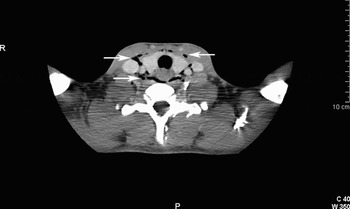
On presentation, vital signs were normal. Physical examination demonstrated subcutaneous emphysema of the neck. Blood investigations showed a mild leucocytosis. Lateral chest X-ray demonstrated retropharyngeal air and subcutaneous emphysema. Computed tomography (CT) of the neck and chest with intravenous (IV) contrast confirmed a large amount of air within the posterior and superior mediastinum, tracking into the prevertebral and retropharyngeal soft tissues of the neck, to the level of the oropharynx (see Figure 1). Air could also be seen more anteriorly in the subcutaneous soft tissues at the level of the sternal notch.
Axial computed tomography scan of the neck with intravenous contrast at the level of the thyroid, showing free gas in the prevertebral and parapharyngeal soft tissues (arrows).

Based on a presumptive diagnosis of pill-induced oesophageal perforation, the patient was admitted to the intensive care unit and managed with IV fluids, IV antibiotics (ticarcillin 3 g plus clavulanate 0.1 g, four times daily), IV proton pump inhibitor (omeprazole 40 mg daily) and nil by mouth. Symptoms improved with conservative management and vital signs remained stable.
After several days, a barium meal and swallow followed by a contrast swallow with non-ionic media (Ultravist™; Schering, Berlin, Germany) was performed and did not demonstrate any residual leak. Oral intake was gradually introduced, commencing with water then clear fluids, free fluids and finally a soft diet. The patient was discharged without subsequent complications.
Follow-up endoscopy at six weeks did not demonstrate any oesophageal abnormality.
Discussion
The term ‘pill oesophagitis’ was first described in the 1970s and encompasses a range of oesophageal injuries related to the ingestion of tablets or capsules. Erosions and ulceration are the commonest injuries seen, followed by stricture formation and haemorrhage.Reference Kikendall1 Perforation is extremely rare.Reference Yamaoka, Takenawa, Tajiri, Yamane, Kadowaki and Marumo2 The incidence of pill oesophagitis in the 1970s was reported as four cases per 100 000 population.Reference Kikendall1 This figure is likely to have increased with the proliferation of regular oral medications and the aging of the population.
Pill oesophagitis results from prolonged contact between oesophageal mucosa and caustic pill contents, secondary to delayed oesophageal transit.Reference Kikendall1 Risk factors may be classified as pill-related, patient-related and ingestion technique related.
Pill-related risk factors include the caustic potential of the pill and the pill's physical properties. Around 100 different medications have been demonstrated to be capable of causing injury, with the commonest culprits including antibiotics (particularly doxycycline), potassium chloride and bisphosphonates.Reference Kikendall1 Nonsteroidal anti-inflammatory drugs (NSAIDs) have been reported to cause pill oesophagitis clinicallyReference Kikendall1, Reference Minocha and Greenbaum3 and experimentally,Reference Carlborg and Densert4 but are significantly under-represented in the literature despite their widespread use and known association with gastric injury.Reference Minocha and Greenbaum3 However, some clinical studies suggest that NSAID-related oesophageal injury is under-diagnosed and may be as high as 20 per cent with regular NSAID use.Reference Semble, Wu and Castell5, Reference Mason6 Ibuprofen has become one of the most widely used medications in the world since its introduction in the UK in 1969.Reference Moore7 It has an excellent safety record and is associated with the lowest risk of gastrointestinal toxicity of any NSAID.Reference Moore7 However, it has been identified as the causative agent in several case reports of pill oesophagitis.Reference Minocha and Greenbaum3, Reference Semble, Wu and Castell5, Reference Coates, Nostrant, Wilson, Elta and Agha8–Reference Mohandas, Swaroop, Desai, Dhir, Nagral and Desai11 Animal experiments suggest that ibuprofen is capable of injuring the oesophagus.Reference Brewer, Smyrk, Bailey, Bonavina, Eypasch and Demeester12
Nurofen Liquid Capsules are an over-the-counter preparation containing 200 mg of ibuprofen in liquid form. Other ingredients include gelatin (130.6 mg), macrogol 600 (polyethylene glycol) (215 mg), povidone (polyvinyl pyrrolidone) (130 mg), maltitol solution (28 mg), sorbitol solution (21.3 mg), water (15.7 mg), vitamin E (35 mg), brilliant scarlet 4R red dye (0.5 mg) and opacode S-1-7020 white ink (trace). None of these other agents have been associated with oesophageal injury.
The physical properties of pills which delay oesophageal transit include large size,Reference Hey, Jorgensen, Sorensen and Wamberg13 round (versus oval) shapeReference Hey, Jorgensen, Sorensen and Wamberg13 and pill casing, with capsules carrying a higher risk of delay than tablets.Reference Kikendall1, Reference Minocha and Greenbaum3, Reference Carlborg and Densert4 Capsules are made with gelatin and become sticky when moist, resulting in a higher tendency to adhere to the oesophageal wall.Reference Minocha and Greenbaum3 The gelatin casing is designed to degrade rapidly to allow fast absorption of capsule contents within the stomach. However, following oesophageal adherence, degradation of the gelatin casing will result in the oesophageal wall being exposed directly to capsule contents.Reference Hey, Jorgensen, Sorensen and Wamberg13
Nurofen Liquid Capsules have a soft gelatin casing and are relatively large, with an oval shape, measuring 15 mm in length and 10 mm in diameter.
Risk factors related to the technique of ingestion include taking pills with little or no fluid bolus, and taking pills whilst supine or immediately before bedtime, when saliva production and peristalsis are decreased.Reference Minocha and Greenbaum3, Reference Hey, Jorgensen, Sorensen and Wamberg13 In the case of our patient, appropriate ingestion techniques were followed.
Patient-related risk factors include increased patient age, oesophageal dysmotility and oesophageal constriction, either due to internal stricture or external compression.Reference Kikendall1, Reference Hey, Jorgensen, Sorensen and Wamberg13 However, in the literature, the majority of cases of pill oesophagitis occur in patients with normal oesophageal anatomy and function.Reference Kikendall1, Reference Minocha and Greenbaum3, Reference Carlborg and Densert4 In our case, none of these risk factors were present.
The exact mechanism of NSAID injury to the oesophagus is not completely clear but is likely to be multifactorial. Although the evidence is compelling regarding NSAID actions upon gastric mucosa, oesophageal studies have proven to be less conclusive. The components of the oesophageal mucosal defence system include the mucous barrier, the actual mucosa itself and the mucosal blood supply.Reference Mason6 Damage to the mucous barrier may occur through NSAID-induced inhibition of bicarbonate secretion.Reference Semble, Wu and Castell5, Reference Mason6 In addition, NSAIDs inhibit prostaglandin synthesis. Whether this impairs or improves oesophageal mucosal cytoprotection is controversial, as there is conflicting evidence for both assertions.Reference Minocha and Greenbaum3–Reference Mason6 Nonsteroidal anti-inflammatory drugs are lipid-soluble at low pH and may enter oesophageal mucosal cells directly, causing toxic effects.Reference Semble, Wu and Castell5, Reference Mason6 They may also reduce mucosal blood supply, increasing the risk of injury.Reference Mason6
• Pill-induced oesophageal injury is uncommon and can be avoided through simple measures
• Perforation is rare but potentially fatal
• This paper describes a case of oesophageal perforation associated with over-the-counter ibuprofen capsules in an otherwise healthy 18-year-old. Perforation has not previously been reported with ibuprofen
Apart from their direct local effects, NSAIDs are thought to cause relaxation of the lower oesophageal sphincter, increasing acid reflux and the subsequent inflammatory effect of such refluxate.Reference Mason6
Oesophageal perforation is a potentially life-threatening condition. The most common cause is iatrogenic trauma, usually during diagnostic or therapeutic endoscopy, accounting for 59 per cent of cases.Reference Brinster, Singhal, Lee, Marshall, Kaiser and Kucharcuzuk14 Less common causes include external trauma, foreign body ingestion, caustic ingestion and Boerhaave's syndrome.Reference Brinster, Singhal, Lee, Marshall, Kaiser and Kucharcuzuk14 This syndrome refers to spontaneous perforation, typically following repeated bouts of vomiting.Reference Brinster, Singhal, Lee, Marshall, Kaiser and Kucharcuzuk14 The mechanism of rupture is postulated to be the sudden rise in intraluminal oesophageal pressure created by neuromuscular incoordination and failure of the cricopharyngeus muscle to relax.Reference Kamiyoshihara, Kakinuma, Kusaba, Kawashima, Kasahara and Koyama15 A similar mechanism of rupture may explain cases of perforation following attempts to clear an impacted food bolus.Reference Kamiyoshihara, Kakinuma, Kusaba, Kawashima, Kasahara and Koyama15 In our case, weakening of the oesophageal wall via pill-induced injury may have facilitated this mechanism of rupture.
Oesophageal perforation following pill ingestion is extremely rare, with only a handful of cases reported, some of which were fatal.Reference Yamaoka, Takenawa, Tajiri, Yamane, Kadowaki and Marumo2 Medications reported to have caused perforation include potassium chloride, sodium valproate, aledronate and an aspirin plus caffeine combination.Reference Kikendall1, Reference Yamaoka, Takenawa, Tajiri, Yamane, Kadowaki and Marumo2
To the best of our knowledge, ours is the first reported case of oesophageal perforation associated with ibuprofen use. This case is particularly unusual as injury occurred following the ingestion of only two capsules rather than a prolonged course of regular medication.
Prevention
Pills will not cause oesophageal injury if they pass rapidly through the oesophagus into the stomach.Reference Kikendall1 Clinicians, pharmacists and nurses can significantly reduce the risk of pill oesophagitis by giving patients the following advice.
Firstly, pills should always be ingested in the upright position (standing or sitting).
Secondly, pills should always be ingested with a fluid bolus. We recommend a minimum of 100 ml,Reference Minocha and Greenbaum3, Reference Hey, Jorgensen, Sorensen and Wamberg13 although some authors suggest a minimum of 250 ml.Reference Kikendall1
Thirdly, patients should remain upright after ingestion. We recommend a minimum of 10 minutes in this position.Reference Kikendall1 Other authors have quoted a minimum of between 90 secondsReference Hey, Jorgensen, Sorensen and Wamberg13 up to 1 hour.Reference Minocha and Greenbaum3, Reference Semble, Wu and Castell5 For known caustic medications, 30 minutes is the recommended minimum.Reference Kikendall1
Fourthly, pills known to be associated with oesophageal injury should be avoided where possible in bedridden patients and those with oesophageal stricture, compression or dysfunction.Reference Kikendall1
Manufacturers may reduce the risk of pill oesophagitis by decreasing the size of pills and choosing oval over round shapes for larger pills.Reference Hey, Jorgensen, Sorensen and Wamberg13 Consideration should be given to avoiding gelatinous capsules for caustic medications.Reference Hey, Jorgensen, Sorensen and Wamberg13 Where such combinations are used, clear patient instructions and warnings are essential, particularly for medications that are available over-the-counter.