INTRODUCTION
Macroparasites with a life cycle comprising several hosts are known to modify a wide range of host characteristics. Infections may affect physiological traits (e.g. impaired mobility, fecundity, or survival), but also behaviour (e.g. impaired predator evasion, altered microhabitat choice and altered vertical distribution) and morphology (e.g. increased body size and altered body coloration) (see review by Poulin & Thomas, Reference Poulin and Thomas1999). Digenean trematodes, the most common metazoan parasites amongst intertidal invertebrates (Mouritsen & Poulin, Reference Mouritsen and Poulin2002), exhibit complex life cycles, usually comprising a vertebrate final host, a molluscan first intermediate host and an invertebrate or vertebrate second intermediate host. Various larval stages (miracidia, cercariae and metacercariae) act to ensure transmission from the respective upstream to the downstream host. Whilst some of the alterations of host traits observed in digenean trematodes can be regarded as pure side effects of parasitic infections with no obvious benefit to the parasite (Probst & Kube, Reference Probst and Kube1999), others apparently act to facilitate transmission of the parasite to the next host in the life cycle (Curtis, Reference Curtis1993; McCarthy et al., Reference McCarthy, Fitzpatrick and Irwin2000, Reference McCarthy, Fitzpatrick and Irwin2004), which has favoured the evolution of some remarkable manipulation strategies (Poulin, Reference Poulin1995). In infaunal marine molluscs of soft sediment shores, changes in host behaviour, such as emergence from the substrate or crawling on the sediment surface, have in the past been attributed to the effect of metacercariae of digenean trematodes (Swennen, Reference Swennen1969; Hulscher, Reference Hulscher1973; Huxham et al., Reference Huxham, Raffaelli and Pike1995; Bowers et al., Reference Bowers, Bartoli, Russell-Pinto and James1996; Desclaux et al., Reference Desclaux, de Montaudouin and Bachelet2002; Mouritsen, Reference Mouritsen2002). Lying on the substrate at low tide makes endobenthic bivalves or gastropods apparently more susceptible to predation by avian final hosts, which may considerably enhance the likelihood of successful transmission (Thomas & Poulin, Reference Thomas and Poulin1998). This mechanism of alteration of host behaviour is commonly referred to as ‘favourization’ (Combes, Reference Combes1980). However, some of these behaviours, which had been attributed to metacercarial infections, proved to be either part of the host's normal behavioural repertoire and thus are not necessarily parasite-induced (Mouritsen, Reference Mouritsen1997) or were caused by agents other than digenean trematode metacercariae (e.g. Jonsson & André, Reference Jonsson and André1992; Desclaux et al., Reference Desclaux, de Montaudouin and Bachelet2002; Blanchet et al., Reference Blanchet, Raymond, de Montaudouin, Capdepuy and Bachelet2003; Thieltges, Reference Thieltges2006a), therefore not representing an example of favourization. This emphasizes the need to critically revisit further assumed parasite-induced alterations.
Bowers et al. (Reference Bowers, Bartoli, Russell-Pinto and James1996) have ascribed the emergence of cockles Cerastoderma edule from the substrate and lying on the sediment surface with incompletely closed shell valves facing upwards, to heavy metacercarial infections by the digenean trematode Meiogymnophallus minutus, which are located in the wedge-shaped cavity of the shell beneath the hinge. The authors speculated that metacercariae of the gymnophallid stimulate the cockle host to produce large quantities of ligament protein, on which they possibly feed. Ligament fragments accumulate in the space around the metacercariae in heavily infected C. edule, preventing the tooth from fitting into the wedge-shaped cavity of the shell, which results in the incomplete closure of the shell valves. In this position, cockles are easily preyed upon by the final host of M. minutus, the oystercatcher Haematopus ostralegus. Bowers et al. (Reference Bowers, Bartoli, Russell-Pinto and James1996) have considered this as a parasite-induced effect, increasing the probability of successful transmission. However, the authors neither defined what they regard as ‘slight’ and ‘heavy’ metacercarial infections, nor did they mention whether their detailed description of the behavioural alteration of C. edule has been inferred from observations solely or if it was backed up by any experiments.
The present laboratory experiment comparing cockles with slight and very heavy metacercarial infections aimed to examine, whether M. minutus may impair the closure of the shells and burrowing ability of C. edule. Since some parasite-induced effects are known to become more pronounced under environmental stress like high temperatures (e.g. Thieltges, Reference Thieltges2006a), response and burrowing time of cockles were tested at different temperature regimes.
MATERIALS AND METHODS
Sampling
Sixty Cerastoderma edule (one annual growth ring, 14.1–15.7 mm shell length) were collected from each of two intertidal localities at Flaxfort Strand, Courtmacsherry Bay, County Cork, Ireland (51°38′N 8°41′W), with comparatively low (sampling site 1; ~300 metacercariae per host) and extremely high (sampling site 2; ~3000 metacercariae per host) Meiogymnophallus minutus infection levels, respectively, as known from previous studies. The distance between sampling sites 1 and 2 was about 300 m. The substrate was composed of fine sand and smaller particles at both localities. All collected cockles were returned to the laboratory and kept in separate tanks until the start of the experiment.
Burrowing experiment and parasitological analysis
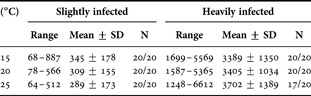
The experimental setup consisted of a large tank containing forty plastic dishes (50 mm in diameter, 30 mm in height) filled with defaunated sediment from the sampling site. The tank was placed in a constant temperature room, filled with seawater and constantly aerated. Twenty C. edule individuals slightly infected and twenty individuals heavily infected were randomly selected from the subsamples and placed individually in the dishes. Response time (time elapsed until cockles started to burrow) and burrowing time (time cockles needed to burrow into the sediment) was determined (see Jensen et al., Reference Jensen, Castro and Bachelet1999). In the situation when the cockles did not burrow completely, but remained slightly emerged, the time elapsed to when they had stopped burrowing was taken. The experiment was run at 15, 20, and 25°C to test, whether additional environmental stress in the form of high water temperatures may affect the results. Prior to each run, the cockles used in the experiment were kept at the respective water temperature for 15 minutes to allow them to adapt to the experimental conditions. Response times exceeding 40 minutes (three out of 120 cockles did not respond within this period of time; see Table 1) were excluded from the analysis. Individual infection levels were determined subsequently to the experiment. To extract metacercariae of M. minutus from the wedge-shaped cavity of the shell and surrounding subarticulate extrapallial space, ligament and adductor muscles were severed with a scalpel and the left shell valve was detached. Opened C. edule were screened for M. minutus infections using a stereomicroscope with incident illumination. The whitish mass of metacercariae and surrounding host epithelium was isolated, squashed using pressure glasses provided with a counting grid, and numbers of metacercariae were counted under a transmitted light stereomicroscope. Since several parasitological investigations previously conducted at Flaxfort Strand, Courtmacsherry Bay (Fermer et al., in preparation) have shown, that other digenean trematode species are virtually absent from this locality (≤1 metacercaria per cockle host), cockles were not screened for further metacercarial infections.
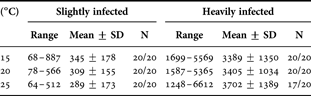
Meiogymnophallus minutus infection levels in Cerastoderma edule compared in the burrowing experiments at water temperatures of 15, 20, and 25°C. Numbers of metacercariae (range minimum–maximum, mean ± SD) are given for slightly infected (collected from sampling site 1) and heavily infected cockles (collected from sampling site 2). Number of replicates (N) used in the analysis of response/burrowing time.
Statistical analysis
All analyses were performed using the statistical software SPSS. Data were checked for normality and homogeneity of variance prior to the analyses and transformed, if assumptions were violated. Two-way ANOVAs were applied to evaluate differences in response time as well as burrowing time of cockles in the treatments, with infection level (slightly and heavily infected) and water temperature (15, 20, and 25°C) as fixed factors. Response and burrowing times were square root-transformed prior to the analyses. Differences in infection levels between slightly and heavily infected cockles used in the burrowing experiments at water temperatures of 15, 20, and 25°C, respectively, were tested with t-tests. Numbers of metacercariae were log-transformed prior to the analyses. To evaluate, if infection levels of slightly and heavily infected cockles, respectively, were similar in the three temperature treatments, one-way ANOVAs were run. Shell lengths of slightly and heavily infected cockles were compared using a t-test.
RESULTS
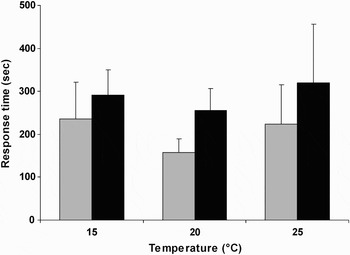
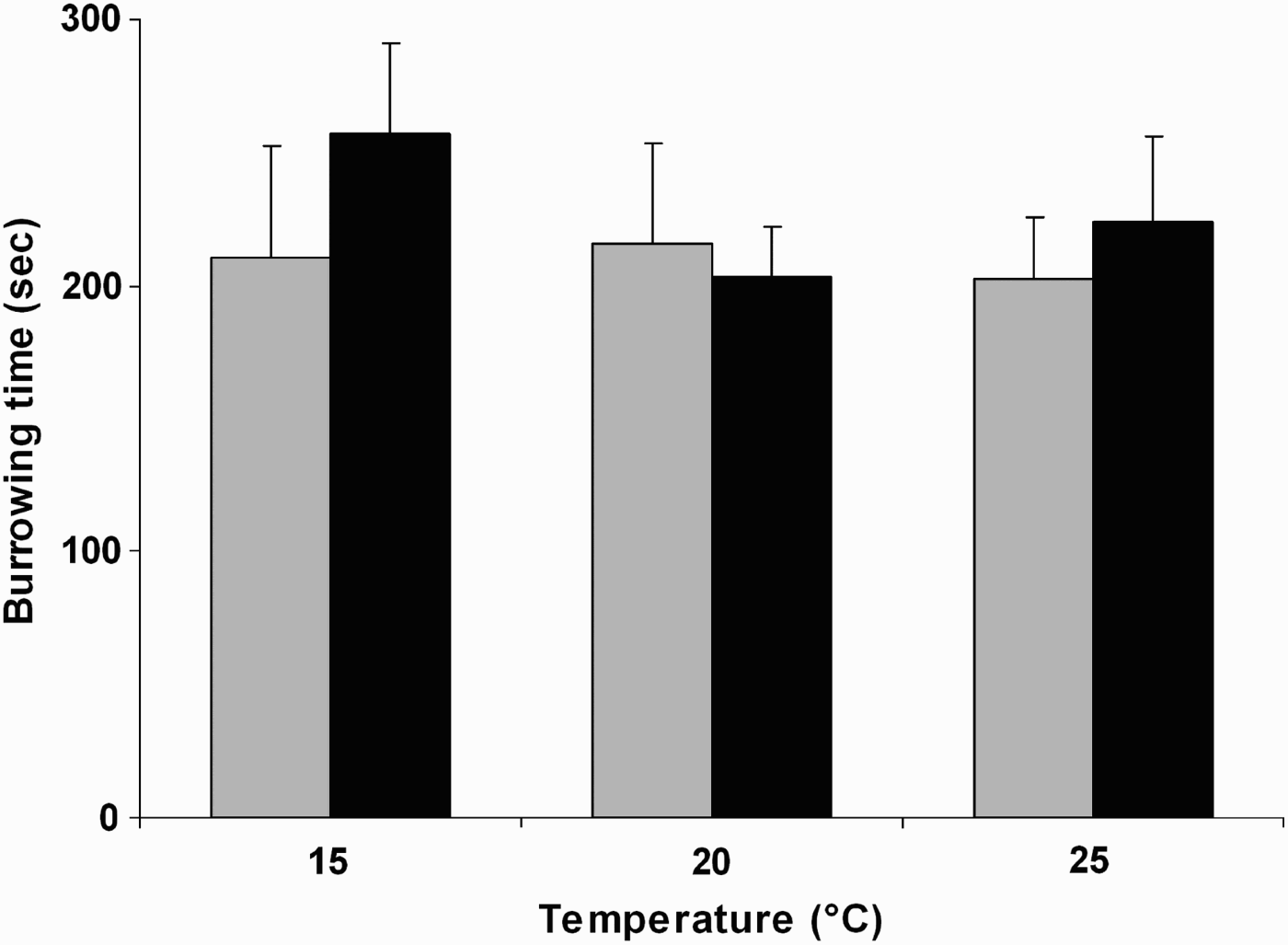
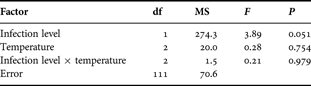
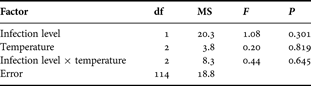
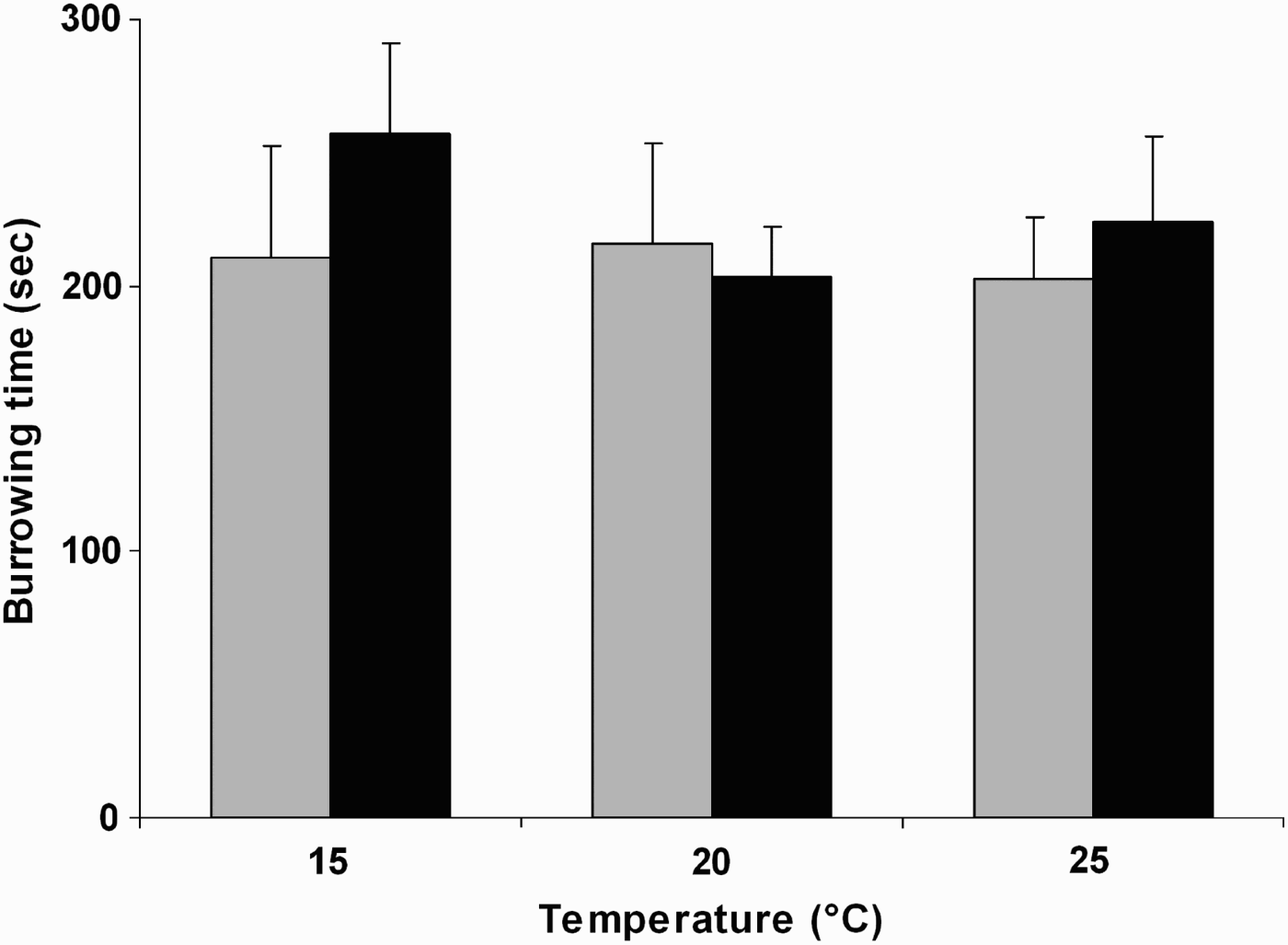
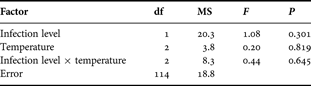
No surfacing or gaping of Cerastoderma edule was observed in the field while sampling or in the laboratory in the course of the experiment. Individuals removed from the sediment were invariably able to completely shut their shell valves. No abnormalities in burrowing behaviour were noticed. All cockles were found to be infected with Meiogymnophallus minutus when analysed subsequently to the experimental runs (Table 1). Numbers of metacercariae differed significantly between slightly and heavily infected cockles at 15, 20, and 25°C (t-tests; P < 0.001). Infection levels of slightly and heavily infected cockles, respectively, were similar in the three temperature treatments (one-way ANOVAs; P = 0.562 and P = 0.682, respectively). Neither infection level nor water temperature significantly influenced response or burrowing time of cockles (Figures 1 & 2; Tables 2 & 3). Statistical analysis did not reveal an interaction between the two factors. Shell lengths of slightly and heavily infected cockles did not differ significantly (t-test; P = 0.445).
Response time of Cerastoderma edule (mean + SE) slightly ( ) and heavily (
 ) infected with metacercariae of Meiogymnophallus minutus at water temperatures of 15, 20, and 25°C. For N see Table 1.

Burrowing time of Cerastoderma edule (mean + SE) slightly ( ) and heavily (
 ) infected with metacercariae of Meiogymnophallus minutus at water temperatures of 15, 20, and 25°C. For N see Table 1.
Results of a two-way ANOVA testing the response times of cockles Cerastoderma edule slightly and heavily infected with metacercariae of Meiogymnophallus minutus at water temperatures of 15, 20, and 25°C. Response times were square root-transformed prior to the analysis. For N see Table 1.
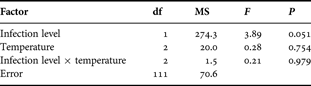
Results of a two-way ANOVA testing the burrowing times of cockles Cerastoderma edule slightly and heavily infected with metacercariae of Meiogymnophallus minutus at water temperatures of 15, 20, and 25°C. Burrowing times were square root-transformed prior to the analysis. For N see Table 1.
DISCUSSION
Some of the Cerastoderma edule sampled for the burrowing experiment were found to be extremely heavily infected with Meiogymnophallus minutus. Individuals of relatively small size (~15 mm) contained large numbers of gymnophallid metacercariae (>6000). Although high intensities of infection are not unusual for this host–parasite system (see Goater, Reference Goater1993; Gam et al., Reference Gam, Bazaїri, Jensen and de Montaudouin2008; Fermer et al., Reference Fermer, Culloty, Kelly and O'Riordan2009), such figures have not been reported before. The respective cockles were collected from a locality, where they occur sympatrically with the first intermediate host of the trematode, the peppery furrow shell Scrobicularia plana. The close association of the two bivalve intermediate hosts and the fact, that S. plana is frequently infected with M. minutus at this site (Fermer et al., Reference Fermer, Culloty, Kelly and O'Riordan2009), presumably account for such exceptionally high infection levels. However, neither while sampling in the field nor in the laboratory did any of the cockles show the symptoms described for M. minutus metacercarial infections by Bowers et al. (Reference Bowers, Bartoli, Russell-Pinto and James1996).
Concerning our experimental design, sampling of uninfected cockles from a single sampling site, experimental infection and a subsequent comparison of the burrowing ability between uninfected and artificially infected cockles would have been preferable. However, metacercariae need one to two months to grow into final dimensions and to establish in the wedge-shaped cavity under the hinge (Fermer et al., submitted). Keeping cockles in the laboratory for such a long time would probably result in behavioural changes. Furthermore, possible long-term effects of M. minutus infections would not have been considered. Therefore, it was decided to use naturally infected C. edule. However, we did not find a locality where both uninfected and heavily infected cockles are sympatric. We therefore used slightly and heavily infected cockles from Flaxfort Strand, Courtmacsherry Bay to make sure that cockles are similar with regard to their traits. Differences in infection levels were highly significant with numbers of metacercariae counted in heavily infected cockles being ten times higher than in slightly infected ones. Regardless of their infection levels, all C. edule individuals were able to burrow into the substrate and completely shut their valves when removed from the sediment. There was no relationship between the number of metacercariae and response and burrowing time, respectively, not even when cockles were experimentally subjected to additional environmental stress in the form of high water temperatures. This indicates that even very heavy metacercarial infections by M. minutus do not necessarily induce surfacing of cockles and gaping of their shell valves, as suggested by Bowers et al. (Reference Bowers, Bartoli, Russell-Pinto and James1996). Although the effect of infection level on response time was almost significant, we do not think that this can be considered as manipulation of the cockle host as described by these authors. It might be that ligament fragments accumulate in the wedge-shaped cavity under the hinge over a longer period of time and that the effect becomes significant in aged cockles. However, since the size of the wedge-shaped cavity and the strength of the adductor muscles also strongly increase with cockle age, we do not think that this is very likely. It is not clear if the detailed description of the behavioural alteration of C. edule given by Bowers et al. (Reference Bowers, Bartoli, Russell-Pinto and James1996) has been inferred solely from observations or if it was backed up by experiments. Considering our results, it appears rather unlikely that the gymnophallid impairs its second intermediate host in such a manner. Furthermore, to our knowledge, no studies exist which prove the assumption that the emergence of the second intermediate host C. edule from the sediment actually facilitates transmission of M. minutus to its final host, the oystercatcher Haematopus ostralegus. Surfaced cockles are not only exposed to oystercatchers searching for prey on tidal mudflats at low tide, but also may attract non-host predators such as various other seabirds, fish and crabs, posing a dead end in the parasite life cycle. If the increased susceptibility is not specific, the assumed manipulation seems even more unlikely (Poulin, Reference Poulin1995).
Metacercariae, in which a negative effect on the burrowing ability of cockles has been established, exclusively belong to the echinostomatids (Lauckner, Reference Lauckner1984; Thomas & Poulin, Reference Thomas and Poulin1998; Jensen et al., Reference Jensen, Castro and Bachelet1999; Desclaux et al., Reference Desclaux, de Montaudouin and Bachelet2002). Members of this family mainly penetrate and encyst in the foot tissue. As a consequence, food muscle fibres are destructed and burrowing capacity of affected cockles is thereby directly impaired. In contrast, the metacercaria of M. minutus remains unencysted. Penetration glands are absent (Bowers et al., Reference Bowers, Bartoli and James1990), which indicates that the gymnophallid never invades any tissues. Thus, the second intermediate host does not have to repair penetration holes and damaged tissue. This might partly explain why the gymnophallid may occur in such high numbers without affecting host burrowing ability, whilst metacercariae of echinostomatids have detrimental effects at considerably lower infections levels already. Apart from the above mentioned examples, metacercarial infections are generally assumed to have relatively benign effects on the host, which are difficult to detect under moderate infection levels and normal environmental conditions. However, the impact may become more pronounced under unfavourable environmental conditions such as oxygen depletion or long periods of emersion (Wegeberg & Jensen, Reference Wegeberg and Jensen1999, Reference Wegeberg and Jensen2003; Thieltges, Reference Thieltges2006b). Under certain circumstances, metacercarial infections may even be lethal to the second intermediate host (Jensen & Mouritsen, Reference Jensen and Mouritsen1992; Gam et al., Reference Gam, de Montaudouin and Bazaїri2009). In our experiment, water temperature had no significant effect on the burrowing ability of cockles. In the intertidal zone in general and on mudflats in particular, short-term changes of water temperature may be pronounced. It appears that cockles are well adapted to a wide range of temperatures and considerable fluctuations within a short period of time. This ability is not affected by heavy M. minutus infections.
As revealed by a number of studies, emergence of C. edule from the sediment and gaping are not necessarily induced by digenean trematode metacercariae. There are various explanations for the surfacing of cockles other than favourization, such as high concentrations of heterotrophic bacteria (Blanchet et al., Reference Blanchet, Raymond, de Montaudouin, Capdepuy and Bachelet2003), sporocyst infections by digenean trematodes (Jonsson & André, Reference Jonsson and André1992; Desclaux et al., Reference Desclaux, de Montaudouin and Bachelet2002; Thieltges, Reference Thieltges2006a), infections by protozoan pathogens or normal host behaviour (Richardson et al., Reference Richardson, Ibarrola and Ingham1993). Surfacing and gaping of the shell valves may merely be a consequence of the poor constitution of already weakened individuals.
ACKNOWLEDGEMENTS
Jan Fermer received funding from The Embark Initiative, operated by the Irish Research Council for Science, Engineering and Technology (IRCSET). The authors are grateful for the comments of two anonymous referees.