This story starts with a meal. A meal cooked at the Late Moche (ad 600–850) site of Wasi Huachuma, located on the north side of the lower Jequetepeque river on the north coast of Peru. It was cooked within a plain, utilitarian pot with a standard form, ubiquitous amongst cooking vessels across multiple time periods in this region. It was prepared in a typical, quotidian style—boiling—contained typical, quotidian materials in a typical, quotidian pot. And yet this was far more than a simple meal. This meal, in this pot, brought together a local, yet interregional cuisine: a cuisine that featured products from the sea, the irrigated coastal plain, the highlands and the jungle. It included dietary staples as well as both flavourful condiments and important ritual or medicinal ingredients. Animals were combined with plants and boiled together in water, assembled into an inseparable stew. However, this meal was not consumed by its makers.
The meal and the unadorned, utilitarian cooking pot in which it was cooked were buried under the floor of a structure and covered with a large, prominent stone that marked its presence. It was a meal that was created and intentionally deposited by its makers immediately prior to the construction of a domestic structure. The dedicatory deposit of this meal before the construction of this structure occurred during the particularly tumultuous Late Moche period on the north coast of Peru (Castillo Reference Castillo and Pillsbury2001; Dillehay Reference Dillehay and Pillsbury.2001; Quilter & Koons Reference Quilter and Koons2012; Swenson Reference Swenson2007). According to Swenson and Warner (Reference Swenson and Warner2016, 46), the defining characteristic of the region during this period was the florescence of multiple feasting centres, a proliferation directly associated with political decentralization and the rise of new forms of ritual observance (see also Swenson Reference Swenson and Silverman2006; Reference Swenson, Castillo, Bernier, Lockard and Rucabado Y2008). Indeed, the emergence of numerous smaller centres on the north side of the Jequetepeque river occurred concurrent with a general shift from the south to the north (Dillehay & Kolata Reference Dillehay and Kolata2004; Donnan Reference Donnan2007; Moseley et al. Reference Moseley, Donnan, Keefer, Bourget and Jones.2008; Swenson Reference Swenson2004; Swenson & Warner Reference Swenson and Warner2016) with evidence from Cerro Chepén (Rosas Rintel Reference Rosas R.2010), San Ildefonso (Swenson Reference Swenson, Castillo, Bernier, Lockard and Rucabado Y2008), Portachuelo de Charcape (Johnson Reference Johnson, Zori and Johnson2011) and Wasi Huachuma (Duke Reference Duke2017), amongst other sites (Swenson Reference Swenson2004) exemplifying this shift. It is within this unstable context that a new domestic structure was erected and this meal was deliberately placed beneath it.
Ritual, ‘doings’, consumption and contextuality
Food, whether used in an economic or ritual context, can signify spheres of ideological, economic and technological practices on multiple scales and should be understood for its social importance. The entangled convergences of food, ritual, cooking style and daily activities show us how deeply non-daily, special events inform everyday practice, but also that this quotidian, utilitarian world underwrites these special events in both literal and figurative ways. It is through the assemblage of specific materials in specific contexts that social meaning is encapsulated and created (DeLanda Reference DeLanda2006; Deleuze & Guattari Reference Deleuze and Guattari1993). However, it is the act of assembly itself that imbues the materials with those social meanings.
As Amanda Logan (Reference Logan2012, 6) has asserted: ‘as a starting point, foodways must be studied as actions or practices, how people ‘do things,’ not just species lists.’ The practices, actions, and rituals performed in the preparation and consumption of food are the ultimate purpose of study, whether the focus is grand feasts, simple meals, or something in between. Severin Fowles (Reference Fowles2013) applies the term ‘doings’ as a means of better understanding past practices, specifically defining them ‘as practices characterized by a heightened awareness of interconnectedness and the relations between things’ (Fowles Reference Fowles2013, 103). While Fowles applies ‘doings’ as a translation of a Puebloan word used to describe activities that most anthropologists might consider ‘ritual’, in the context of a dedicatory deposit of a utilitarian pot containing the detritus of a meal, the concept of ‘doing’ is particularly salient. Indeed, the interconnectivity between the preparation/consumption of food and religious/ritual practice is a crucial component of understanding the world of the Moche. The consumption of food at specific and often powerful places, whether as part of conspicuous feasting events or small meals shared with kin while in temporary camps during pilgrimages, brought people together and united them with a specific place and shared identity. In fact, Swenson and Warner (Reference Swenson and Warner2016) have postulated for the Late Moche ceremonial site of Huaca Colorada that the consumption of food was not only intimately tied to place, but the place itself was a consumer and in need of nourishment via a variety of sacrificial offerings.
Michael Dietler (Reference Dietler, Dietler and Hayden.2001) acknowledges the entanglements between power and ritual. To Dietler (Reference Dietler, Dietler and Hayden.2001, 67), a ritual act can be an elaborate, public spectacle, with attendant conspicuous consumption in the form of feasts taking place on or near monumental architecture, or a simple, individual act with little material trace. Additionally, he specifically points out that ritual also need not be sacred or religious. Instead, Dietler, following Kertzer (Reference Kertzer1988, 9), identifies ‘the defining criterion of rituals is that they are in some way symbolically differentiated from everyday activities in terms of forms of action or purpose’ (Dietler Reference Dietler, Dietler and Hayden.2001, 67). In essence, the argument made by Dietler (Reference Dietler, Dietler and Hayden.2001, 70) is that ritual acts are performative, with feasting as publicly performed ritual defined against the private, almost anonymous performance of everyday domestic ritual.
However, the separation of the domestic and ritual spheres is a problematic divide. Joanna Brück (Reference Brück1999) has critiqued the ritual/domestic dichotomy as being a projection of contemporary distinctions onto past practices that has severely limited our abilities to understand them. In essence, she argues that these past practices all followed an internal and entirely practical logic which not only blurred the distinction between quotidian and ritual, but merged them into one and the same, effectively eliminating the discrete, catch-all category of ‘ritual’ altogether. To Brück, all practices are symbolic, and all symbols are practical.
Severin Fowles (Reference Fowles2013, 7) asks, ‘What is ritual? What is it not? When is a building a temple rather than an elite residence? How is one to pull from the entangled categories of premodernity some strands of behavior that can serve as the special subject matter of an archaeology of religion?’ While Brück (Reference Brück1999) rejects ‘ritual’ for being a catch-all term for supposedly irrational behaviours, arguing instead that all behaviour is rational and logical to the practitioner, Fowles (Reference Fowles2013) rejects ‘religion’ for being a construct of post-Reformation European modernism created as a categorical contrast to the similarly created discrete realms of ‘politics’ and ‘economics’. Both positions arise from similar dissatisfactions with the ways in which the supposedly non-economic and non-political realms are addressed in the anthropological and archaeological literature. The key difference between them, as noted by Fowles (Reference Fowles2013, 10), is that where Brück seeks alternative perspectives of the world, Fowles, following Alberti and colleagues (Alberti & Bray Reference Alberti and Bray2009; Alberti & Marshall Reference Alberti and Marshall2009; Alberti et al. Reference Alberti, Fowles, Holbraad, Marshall and Witmore2011), seeks alternative worlds altogether. His rejection of ‘religion’ calls not for attempts to rationalize and make legible in our own world the practices of the past, but to attempt to understand the non-modern worlds of the past (and present) on their own terms.
‘Doings’ are practices rooted in specific historical contexts, performed by people, and are inextricable from, but not defined by, the materials through which they are enacted. These doings are not instinctual or natural. As people operating in the world, we actively adapt and adjust our interactions to the contexts in which we find ourselves. These interactions are bodily performed with material objects and immaterial concepts, all of which are inextricably intertwined. The crucial element here is the act of doing, an act that must be learned within a social context. In essence, the exploration of the practices of cooking and eating of specific foods by specific people at specific times and places requires the basic understanding that these practices are taught and learned by individual members of particular groups who maintain these practices while also modifying them in personal ways. To quote Marcel Mauss (Reference Mauss1973, 71), ‘a manual knack can only be learnt slowly’. While the recovery of recipes, complete with instructions and serving suggestions, is not generally possible, the rich and varied archaeological evidence of food preparation and consumption provides an excellent arena for exploring the continuities and dislocations between different types of culinary practices.
Moche culinary traditions in and out of context
Food and drink are generally considered under the same umbrella. Both are ingested, require preparation and have significant social meanings connected to them. In the Andes, both are frequently discussed in regard to the reciprocal feasting economies prevalent in the region over the millennia (e.g. Bray Reference Bray2003; Chicoine Reference Chicoine2011; Gumerman Reference Gumerman and Klarich.2010; Hastorf Reference Hastorf2003; Isbell & Groleau Reference Isbell, Groleau and Klarich.2010; Knudson et al. Reference Knudson, Gardella and Yaeger2012; Lau Reference Lau2002; Logan et al. Reference Logan, Hastorf and Pearsall2012; Nash Reference Nash and Klarich2010; Swenson Reference Swenson and Silverman2006). However, drink, and in particular the various forms of the mildly alcoholic beverage chicha, have taken precedence, with food taking a secondary or even tertiary role behind chicha and a variety of psychoactive substances in discussions of the social importance of ingested substances (e.g. Bussmann & Sharon Reference Bussmann and Sharon2009; Cummins Reference Cummins2002; de Rios Reference de Rios1977; Glowacki Reference Glowacki2005; Hayashida Reference Hayashida2008; Jennings & Bowser Reference Jennings and Bowser2009; Martin Reference Martin1970; Morris Reference Morris, Gastineau, Darby and Turner1979). More commonly, food has been considered for its dietary and nutritional significance, rather than its symbolic importance (e.g. Gagnon Reference Gagnon2004; Kellner & Schoeninger Reference Kellner and Schoeninger2007; Kurin Reference Kurin, VanDerwarker and Wilson.2015; Pozorski Reference Pozorski1979; Quilter & Stocker Reference Quilter and Stocker1983; Quilter et al. Reference Quilter, Ojeda E, Pearsall, Sandweiss, Jones and Wing1991). This is not to say that the symbolism of food in the Andes has been ignored (e.g. Cutright Reference Cutright, Johnson and Zori2011; Hastorf Reference Hastorf, Gero and Conkey.1991; Ryser Reference Ryser, Castillo, Bernier, Lockard and Rucabado Y.2008). Instead, what I seek here, in part, is to show that everyday foods were equally as ritually important as alcoholic beverages and other perception-altering substances.
For the most part, preconquest Andean cooking was rooted in two primary techniques: boiling and roasting (Bray Reference Bray2003, 8; Rowe Reference Rowe and Steward1946, 220–21). The stews, gruels, pottages and soups that dominated the culinary repertoire contained a varied combination of comestibles. Evidence from multiple sites in the lower Jequetepeque Valley shows a mixed dietary emphasis including agricultural produce from the nearby irrigated fields, as well as marine resources and domesticated terrestrial fauna (see Chiou Reference Chiou2017; Duke Reference Duke2017; Johnson Reference Johnson, Zori and Johnson2011, 58–9; Rosas R. Reference Rosas R.2010, 741–73; Swenson Reference Swenson2004, appendix B). Shellfish, camelids and maize, along with guinea pig, local fish, squash and crab were all in use during the Late Moche period. While cooking techniques appeared relatively consistent across time, within the Moche region and especially in the Jequetepeque Valley during the Late Moche period there is evidence for transformations in culinary practices connected to a likely combination of factors, including shifts in political organization and environmental change.
The earliest evidence of Moche material culture in the Jequetepeque valley comes from the sites of La Mina, Masanca and Dos Cabezas, first occupied around ad 300 and continuing until around ad 850 (Dillehay & Kolata Reference Dillehay and Kolata2004; Donnan Reference Donnan2006; Reference Donnan2007; Johnson & Zori Reference Johnson, Zori, Zori and Johnson.2011; Narváez Reference Narváez V., Uceda and Mujica.1994; Swenson Reference Swenson2004; Swenson & Warner Reference Swenson and Warner2016). While the occupation of Dos Cabezas spanned both the Early and Middle Moche periods in the Jequetepeque, the Middle Moche period saw increased expansion of irrigation, particularly on the north side of the river (Castillo Reference Castillo, Quilter and Castillo B.2010), a possible response to an increase in the availability of water in general due to the end of a long drought preceding this era. In fact, the two largest sites from the Middle Moche period in the Jequetepeque were both on the north side of the river: Pacatnamú and San José de Moro (Johnson & Zori Reference Johnson, Zori, Zori and Johnson.2011, 10).
The Moche occupation at Pacatnamú was most intensive in the Middle Moche period, but continued into the Late Moche and well beyond, into the Lambayeque era (Donnan Reference Donnan1997; Donnan & Cock Reference Donnan and Cock1997). The site is marked by a number of large adobe pyramids, expansive residential areas, numerous plazas and extensive, well-preserved burials, both elite and commoner (Donnan & McClelland Reference Donnan and McClelland1979; Zori Reference Zori, Johnson and Zori.2011). Situated at the mouth of the Jequetepeque, atop the ridge directly above the river and overlooking the abandoned site of Dos Cabezas, Pacatnamú was a strategic and symbolically important urban and mortuary centre (Donnan Reference Donnan1997; Gumerman Reference Gumerman, Johannessen and Hastorf.1994). Occupying a place with vistas extending up the valley and along the coast, Pacatnamú was an important nexus point in coastal and inter-valley trade as well as a place of significant symbolic import, in part due to its proximity to Dos Cabezas and the Pacific Ocean (Donnan Reference Donnan1997).
Large amounts of well-preserved botanical remains were found within the Moche burial components excavated at Pacatnamú (Gumerman Reference Gumerman, Johannessen and Hastorf.1994; Reference Gumerman, Donnan and Cock.1997). Gumerman (Reference Gumerman, Johannessen and Hastorf.1994, 401–2; Reference Gumerman, Donnan and Cock.1997, 243) found that food offerings were present in nearly half of the burials excavated, and those lacking food remains had been disturbed or were poorly preserved. Seventeen species of plant were identified in the burials, with three of these (maize (Zea mays), bottle gourd (Lagenaria sicerania) and seaweed) occurring regularly (Gumerman Reference Gumerman, Donnan and Cock.1997, 243). Other, less frequently recovered, but still common, plant materials included common bean (Phaseolus vulgaris), lima bean (Phaseolus lunatus), coca (Erythroxylum coca), peanut (Arachis hypogea), squash (Cucurbita sp.), cotton (Gossypium barbadense), pacay (Inga feuillei), lúcuma (Pouteria lucuma), espingo (Nectandra sp.), chili pepper (Caspicum sp.), acacia (Acacia sp.) and algarroba (Prosopis sp.) (Gumerman Reference Gumerman, Donnan and Cock.1997, 245). Notably, Gumerman shows that maize was not only the most frequent plant offering in the burials, but that the offerings of maize were of a different type (14 -to 16-row varieties) than the maize excavated from Moche middens (8- to 10-row varieties) at Pacatnamú (Gumerman Reference Gumerman, Donnan and Cock.1997, 243–5). Beyond the differences in types of maize, Gumerman (Reference Gumerman, Johannessen and Hastorf.1994; Reference Gumerman, Donnan and Cock.1997) points out that while there were minimal amounts of marine fauna present in Pacatnamú burials (fish bones and scales, unmodified shell and a single sea-mammal bone), the overwhelming predominance of agricultural goods in the burials is the opposite of what was excavated from Moche middens at Pacatnamú, in which marine resources (shellfish, fish and marine mammals) far outnumbered agricultural products. Llama (Lama glama),Footnote 1 dog (Canis familiaris) and guinea pig (Cavia porcellus) have also been recorded in Moche burials at Pacatnamú (Donnan Reference Donnan1997, 34; Goepfert Reference Goepfert2012, 106). The more varied diet of marine and agricultural resources indicated by the midden depositsFootnote 2 when compared to the burial offerings is asserted by Gumerman to indicate that the dead were thought to need different foods from the living in the Moche period at Pacatnamú. However, as Goepfert (Reference Goepfert2012) highlights, burial offerings should not automatically be assumed as food offerings—sacrificial offerings had multiple meanings to Moche and these materials, particularly llama, could have had significance beyond consumption (see also Swenson Reference Swenson2011; Reference Swenson2012).
San José de Moro, located inland and east of the Catalina hills from Pacatnamú on the north side of the Jequetepeque river, was an important ceremonial site during both the Middle and Late Moche periods and during the Lambayeque era (Castillo Reference Castillo, Quilter and Castillo B.2010; Reference Castillo2012). Excavations here have focused on the extensive mortuary remains, partly due to the destruction of large portions of the residential areas from modern agricultural activity (Johnson & Zori Reference Johnson, Zori, Zori and Johnson.2011, 11). However, the evidence demonstrates that the production of large amounts of chicha was undertaken, indicating that the site was a locus of feasts and redistributive exchanges. The general lack of botanical remains recovered from San José de Moro has been ascribed to poor preservation conditions due to the deleterious effects of frequent ENSO events and the subsequent changes in humidity and temperature at the site (Delibes & Barrgán Reference Delibes, Barragán, Castillo, Bernier, Lockard and Rucabado Y.2008, 106).
The emergence of numerous smaller centres on the north side of the river occurred concurrent with the general shift from the south to the north (Dillehay & Kolata Reference Dillehay and Kolata2004; Donnan Reference Donnan2007; Moseley et al. Reference Moseley, Donnan, Keefer, Bourget and Jones.2008; Swenson Reference Swenson2004; Swenson & Warner Reference Swenson and Warner2016). Evidence from Cerro Chepén (Rosas R. Reference Rosas R.2010), San Ildefonso (Swenson Reference Swenson, Castillo, Bernier, Lockard and Rucabado Y2008) and Portachuelo de Charcape (Johnson Reference Johnson, Zori and Johnson2011), and many other sites (see Swenson Reference Swenson2004), indicates that political instability was prevalent and that the ‘popularization of Moche cultic practices’ (Swenson & Warner Reference Swenson and Warner2016, 46) was intimately connected to this. Evidence from these sites shows a continued mixed dietary emphasis including agricultural produce from the nearby irrigated fields, as well as marine resources and domesticated terrestrial fauna (see Johnson Reference Johnson, Zori and Johnson2011, 58–9; Rosas R. Reference Rosas R.2010, 741–73; Swenson Reference Swenson2004, appendix B). Shellfish, camelids and maize, along with guinea pig, local fish, cotton, squash and crab were all in use at these sites in the Late Moche period. These materials were also represented at the Late Moche sites of Wasi Huachuma and Huaca Colorada.
For the Moche, food and food items were much more than simply a means of meeting dietary requirements. The vast array of food items depicted in ceramic form along with recurring themes in Moche iconography, such as the presentation of anthropomorphic bowls of food to a seated lord, exemplify the high value placed on comestibles (Donnan Reference Donnan1978, 66). Moreover, numerous depictions of hunting (Donnan Reference Donnan1978, 178–82) and fishing (Donnan Reference Donnan1978, 102–6), the presence of food and serving vessels in scenes of craft production (Donnan Reference Donnan1978, 65), as well as the presence of food offerings in burials, highlight the extraordinary emphasis placed on the ideological importance of food in Moche society (Gumerman Reference Gumerman, Donnan and Cock.1997).
Literature addressing the food and diet of the Moche has primarily focused on feasting, nutrition, economics, or ritual aspects of consumption. Without doubt, the ritual consumption of food by way of feasting was an integral part of Andean political, economic and religious life (Arsenault Reference Arsenault1992; Bray Reference Bray2003; Costin & Earle Reference Costin and Earle1989; Gumerman Reference Gumerman, Donnan and Cock.1997; Reference Gumerman and Klarich.2010; Hastorf Reference Hastorf2003; Jennings & Duke Reference Jennings, Duke, Alconini and Covey.2018; Swenson Reference Swenson and Silverman2006). However, too often interpretations of past Andean practices are presumed, based on ethnographic and ethnohistoric observations, essentially fitting archaeological data to these observations rather than analysing them within their own particular contexts. There is, obviously, utility to interpreting the archaeological past based on more recent observations, but just as obviously there are serious limitations.
In Andean studies, the fingerprints of the Inka empire are noted everywhere. Yet powerful and far-reaching though the Inka empire was in the Andes, it did not conquer the past (though one might argue they tried: see Bray Reference Bray2009). Despite its undisputed influence on Andean societies across a massive geographical spread, the Inka empire was brief in its temporality and was truly an outlier in its organization when compared to the societies it succeeded. While the Inka built upon the traditions of societies such as Tiwanaku and Wari, incorporating aspects of mythology, engineering, political organization and statecraft into their own practices (Moore Reference Moore, Alconini and Covey2018), the Inka were pioneers in economic collection and redistribution, colonization and relocation, and expansion and domination.
As such, Moche practices need to be understood on their own terms. Unlike for the Inka, the organization of labour was not centralized, nor was the collection of foodstuffs or crafts. Instead, late Moche culinary politics were locally negotiated without the intervention, at any level, of state apparatuses. Domestic ritual performances were just as variable as feasts and the two types of meals were intimately interconnected with one another (Gumerman Reference Gumerman and Klarich.2010; also see Graff & Rodríguez-Alegría Reference Graff and Rodríguez-Alegría2012; Klarich Reference Klarich2010, for some archaeological examples from elsewhere).
That households are more than structures where people undertake domestic economic activities, but locales of important daily and non-daily rituals, is no longer a controversial statement. Numerous ethnographic works, both in the Andean region and elsewhere, document the symbolic practices associated with the construction and subsequent occupation of domestic structures (e.g. Arnold Reference Arnold and Arnold.1992; Bourdieu Reference Bourdieu, Bourdieu and Nice1979; Gose Reference Gose1991; Mayer Reference Mayer, Bolton and Mayer1977; Weismantel Reference Weismantel and Wilk1989). Understanding that the production and consumption of food was a central element to household life, and that much of this ritual behaviour will revolve around these activities, is clear. It is with this in mind that I analyse the commensal politics and everyday foodways of the Late Moche period in the Jequetepeque Valley.
The context
The north coast of Peru has long been known as a focal point of interaction and convergence in the Andean region. With wide-ranging and long-standing connections with the nearby and more distant highlands and the eastern jungles, as well as the coasts to the north and south prominent in the archaeological record, researchers have regularly noted the inter- and intra-regional exchange of goods and ideas (Bawden Reference Bawden1996; Castillo Reference Castillo2012; Donnan Reference Donnan1992; Pozorski & Pozorski Reference Pozorski and Pozorski1979; Shimada Reference Shimada1982; Swenson Reference Swenson2004). The Moche period in the Jequetepeque Valley, which spanned from approximately ad 200 to 850, saw the expansion of irrigation systems and urbanization as well as a number of practices and traditions, from ceramic styles to modes of architectural construction. While these practices and traditions obviously were altered and modified over the centuries, it is clear that a definitive ‘Moche tradition’ was in evidence throughout the north coast valleys, including the Jequetepeque. By the Late Moche period (ad 600–850), political control of the Jequetepeque had splintered, with evidence pointing to a combination of environmental instability and political or military disruption from external groups leading to a period of internecine conflict (Castillo Reference Castillo and Pillsbury2001; Dillehay Reference Dillehay and Pillsbury.2001; Dillehay et al. Reference Dillehay, Kolata and Pino Q2004; Johnson Reference Johnson, Zori and Johnson2011; Quilter & Koons Reference Quilter and Koons2012; Shimada et al. Reference Shimada, Schaaf, Thompson and Mosley-Thompson1991; Swenson Reference Swenson2007; Reference Swenson, Castillo, Bernier, Lockard and Rucabado Y2008).
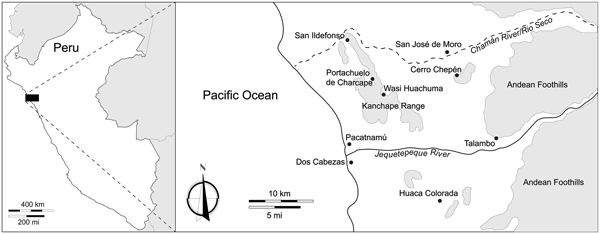
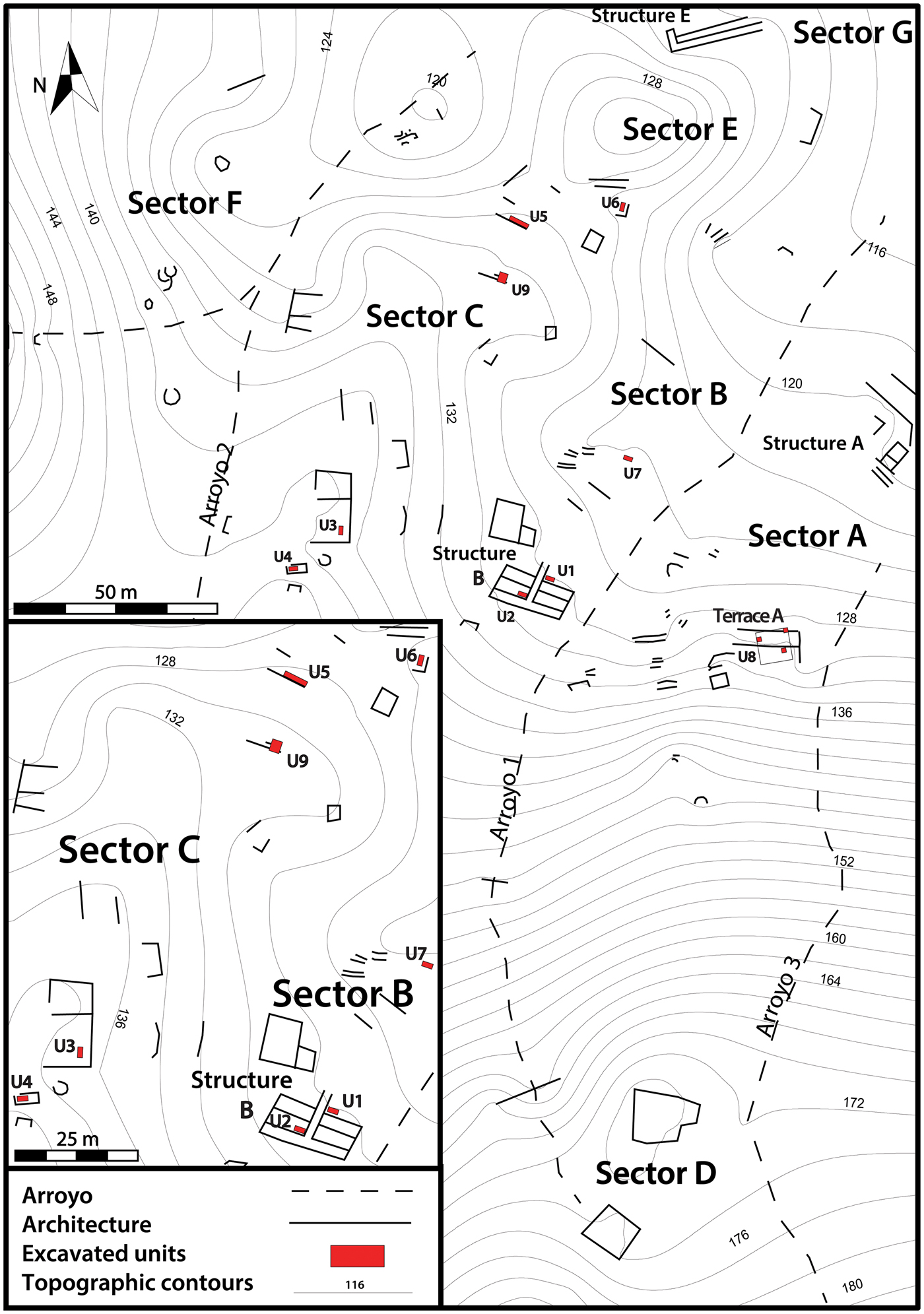
The Late Moche site of Wasi Huachuma is located on the lower northeast slope of the Catalina Hills, 12 km south of San José de Moro, 10 km northeast of Pacatnamu and 12 km west of Cerro Chepén, three major centres of political power during the Moche period in the Jequetepeque Valley (Castillo Reference Castillo2012; Cusicanqui M. Reference Cusicanqui M.2010; Donnan & Cock Reference Donnan and Cock1997; Rosas R. Reference Rosas R.2010) (Fig. 1). The site consists of seven distinct sectors delineated by three dry arroyos running northeast from the top of the hills to the irrigated plain below (Dillehay et al. Reference Dillehay, Kolata and Swenson2009, 86–9; Duke Reference Duke2017, 100–109; Swenson Reference Swenson2004, 609–17) (Fig. 2). I focus on a specific deposit found within Sector C, which is located on a ridge above and to the west of the ceremonial core of the site (Sector B) and is bordered on its west by Arroyo 2. This sector features a number of stone alignments and disinterred burials, and in previous surveys had been identified as the primary residential sector (Dillehay et al. Reference Dillehay, Kolata and Swenson2009, 86–9; Swenson Reference Swenson2004, 609–17). There is significant evidence of habitation and food processing, including burnt floors, hearths, food-processing implements, such as grinding stones, cutters and scrapers, and ceramic graters, and the remains of food items themselves (Duke Reference Duke2017, 130–61).
Map of the lower Jequetepeque Valley with important Moche sites.

Topographic map of Wasi Huachuma and its designated sectors, with Sectors B & C inset.

Sector C was the most complex sector at Wasi Huachuma, containing numerous structures, terraces and stone alignments as well as a small cemetery. It is likely that this area was used for a combination of residential, storage and domestic production activities. Sector C, particularly the northeast portion, was likely more intensively occupied, as indicated by the number of hearths excavated in the various units, as well as the greater concentrations of botanical and faunal materials (Duke Reference Duke2017, 136–46). The foods (including maize, beans, chilli peppers, potato (Solanum tuberosum), squash, marine fish, guinea pig and camelid) prepared here were likely intended for the direct consumption of the inhabitants of this area.
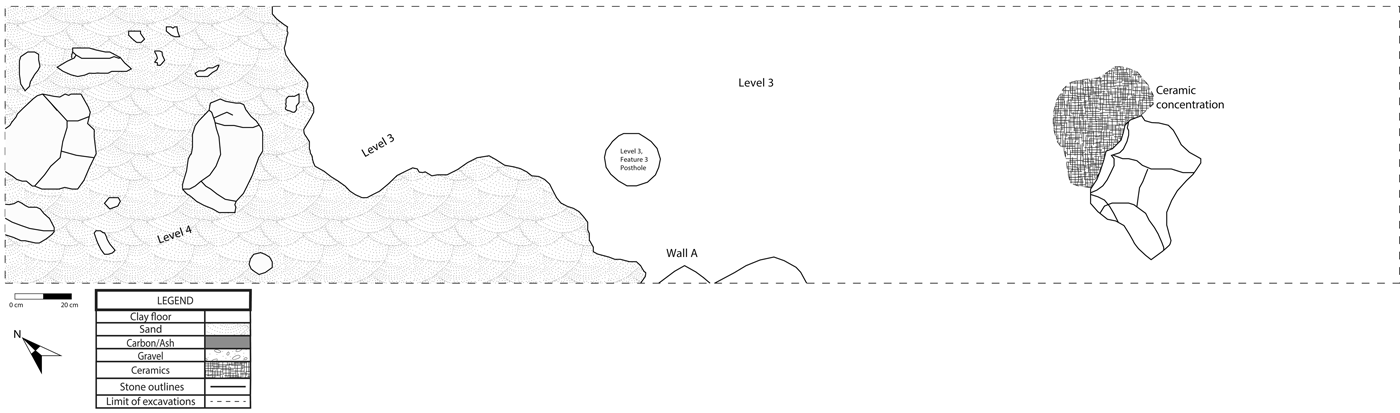
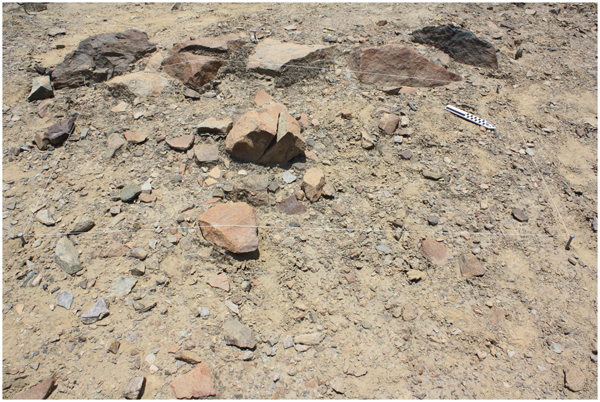
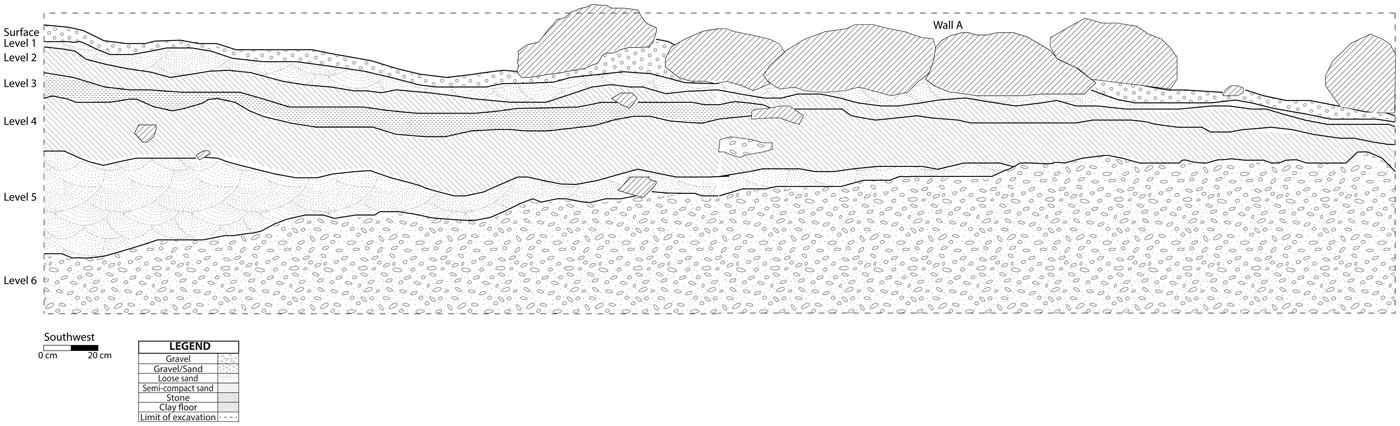
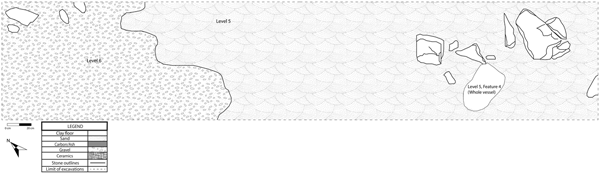
The deposit in question was recovered from Unit 5-2013 in a sand matrix (Level 5) below the clay floor (Level 3) and sub-floor fill (Level 4) of a probable domestic structure on the northeast section of the Sector C residential zone (Fig. 3). The structure itself was not excavated in its entirety, but was defined as a domestic structure by a clay floor, a post-hole and a concentration of utilitarian ceramics and food detritus (Fig. 4). This likely domestic structure was identified on the surface by a long, stone alignment (Fig. 5). This was one of a number of stone alignments in this portion of the site (see Fig. 2 inset), and two nearby parallel walls were also excavated in the 2013 field season (Unit 9). Both units uncovered floors, hearths and food remains indicative of residential occupation.
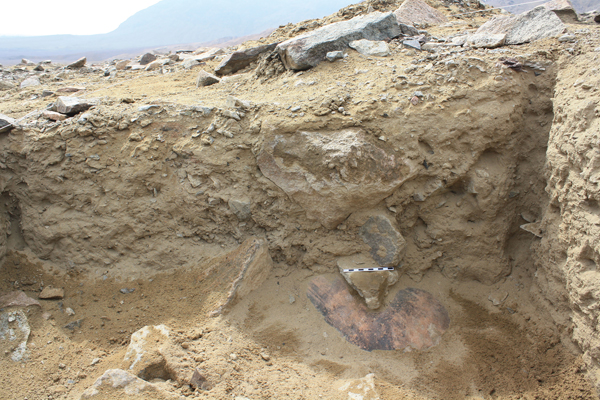
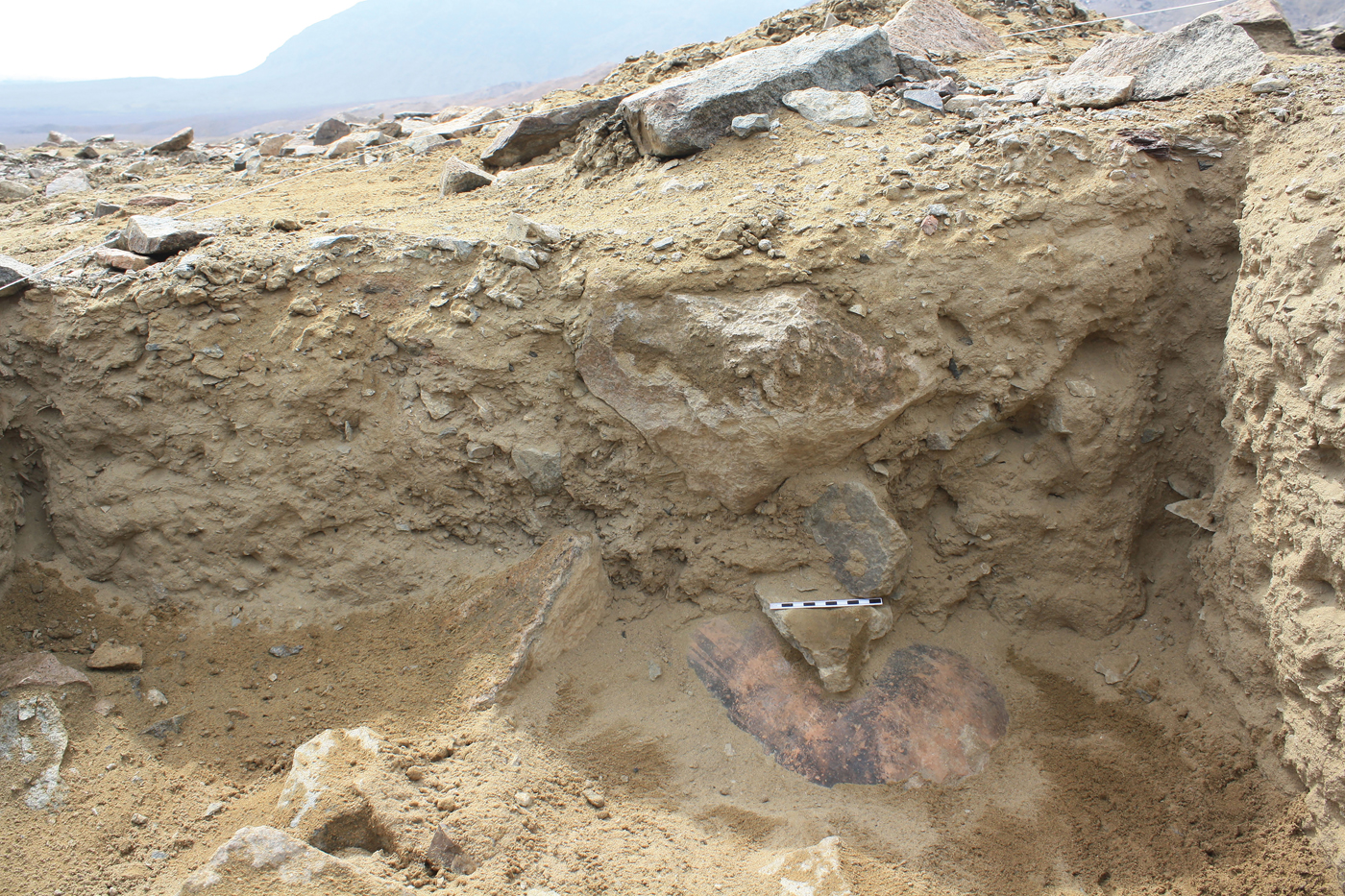
Whole vessel in context below large stone in Unit 5-2013, at Wasi Huachuma.
Plan map of Unit 5-2013, Level 3, with post-hole, stone and ceramic concentration identified.

Surface stone alignment marking the structure associated with Unit 5-2013 at Wasi Huachuma.
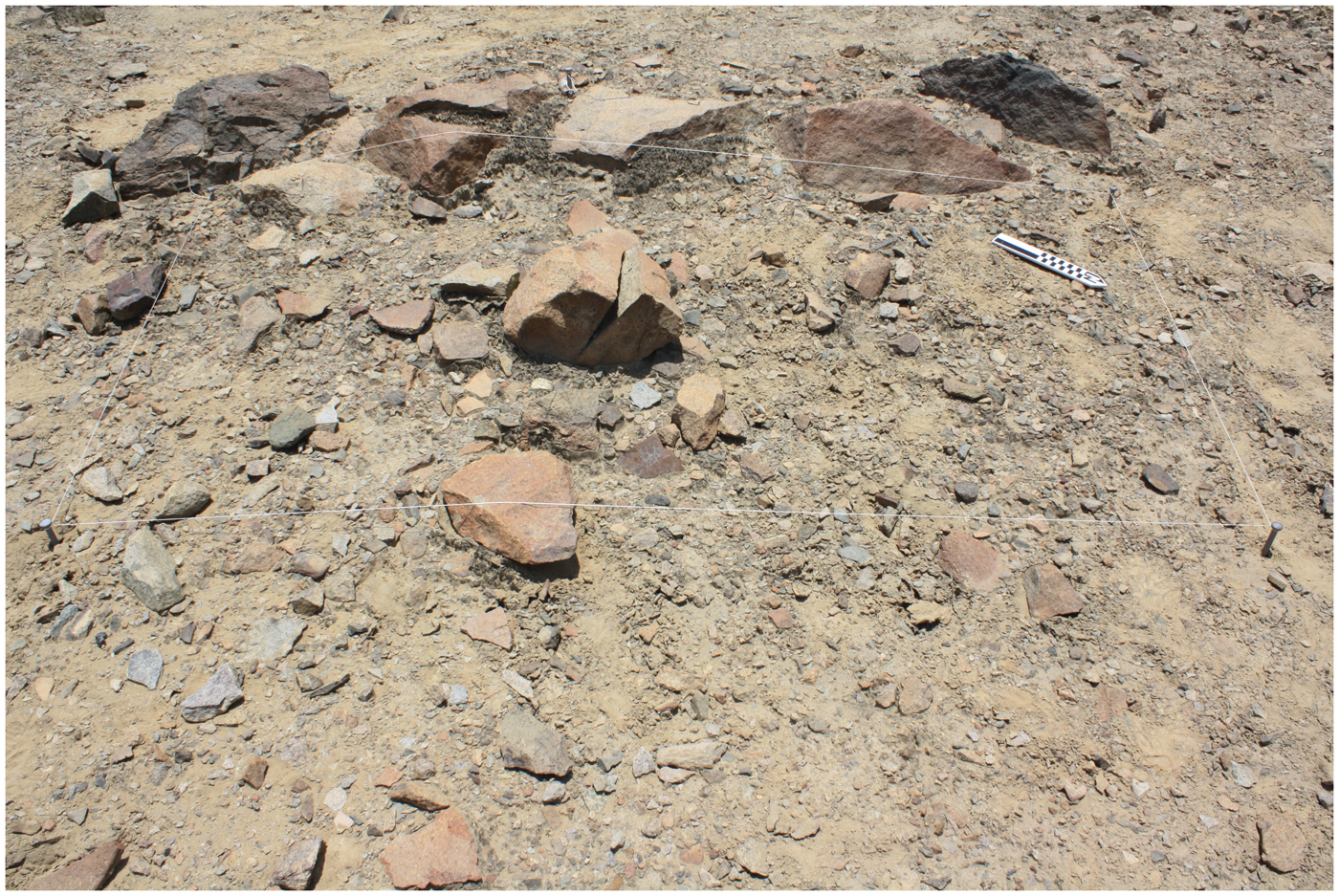
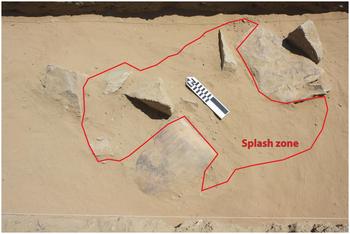
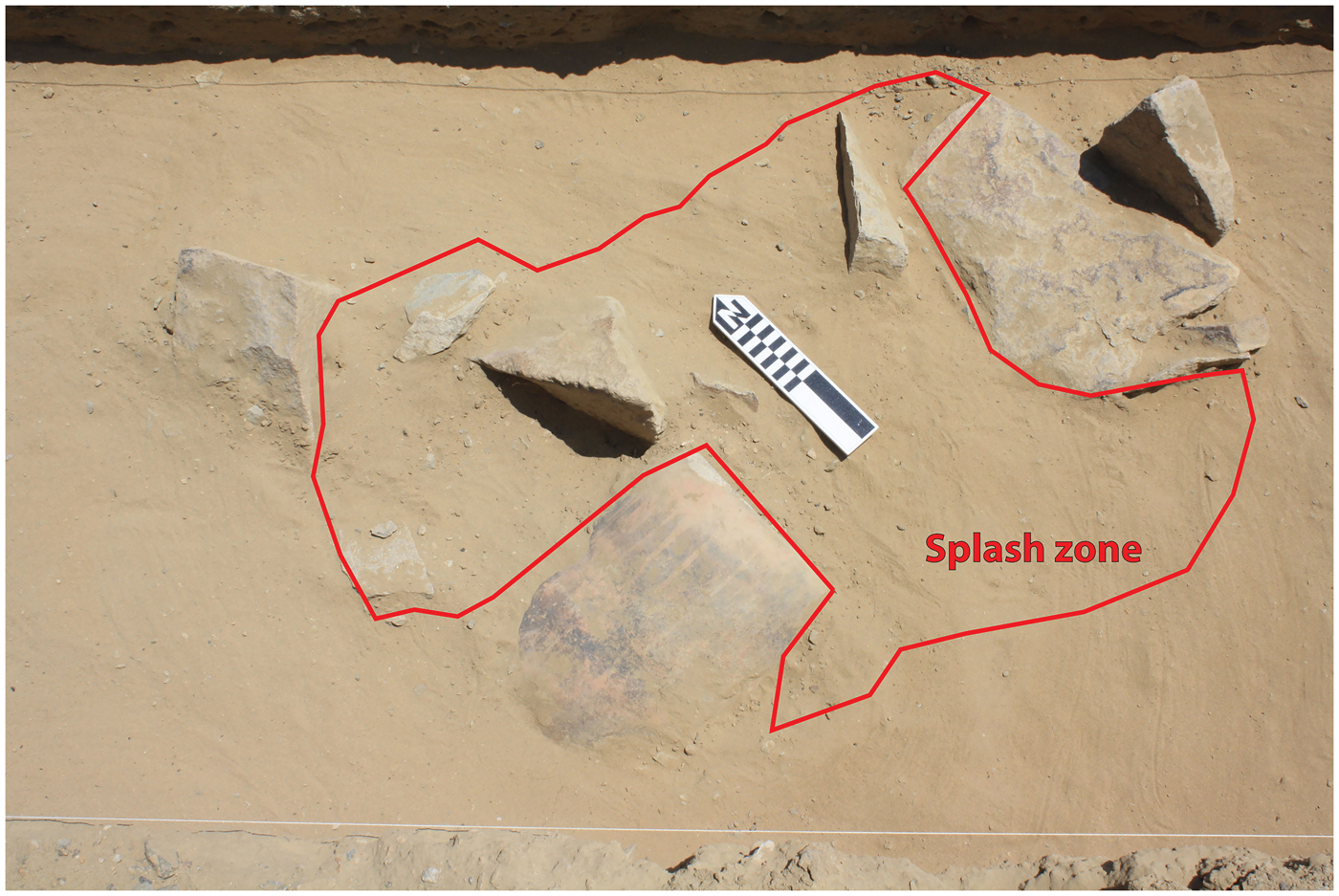
The structure floor (Level 3) and the gravelly sand fill above it (Level 2) extended below an alignment of stones visible on the surface (designated Wall A within the unit), indicating that this stone alignment was added after the structure had been abandoned and subsequently buried (Fig. 6). A post-hole and a large stone embedded in the floor were exposed as part of Level 3. The large stone penetrated the floor and sub-floor fill levels (Levels 4 and 5) and was positioned directly above a whole tinaja (Fig. 7). The vessel itself was found on its side within the sand matrix, with the mouth opening to the east and a splash zone of botanical and faunal materials surrounding it (Fig. 8).
Unit 5-2013 southwest profile.

Plan map of Unit 5-2013, Level 5, with whole vessel identified.

Whole vessel in context with splash zone of materials indicated, from above.
A radiocarbon date was secured from the charred plant materials surrounding the whole vessel, giving a date of 1340±25 bp or 1284–1179 cal. bp (ad 666–771), placing it firmly within the Late Moche period.
Assembling the llama face stew
The composition of this deposit demands deeper scrutiny. First, the seemingly direct relationship between the two fill levels, the whole vessel and its contents, the floor and the stone embedded in the floor indicate that these were all intimately interconnected and were likely part of the same construction event for the floor and that the pot and its contents were intentionally placed there prior to construction.
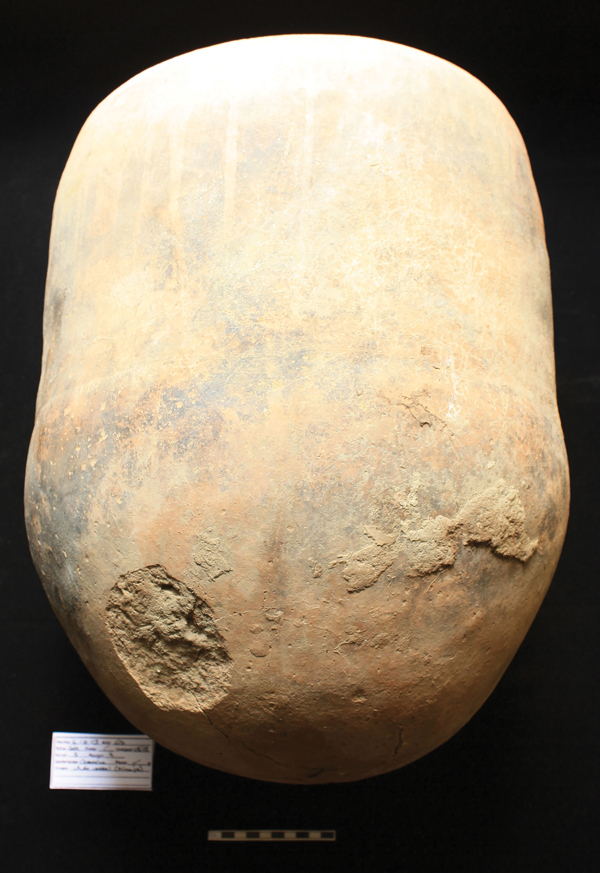
The pot itself is a standard cooking pot (Fig. 9). It has a wide mouth (28 cm) and a rounded bottom and measures 44 cm tall and 36 cm wide. It has an inverted aperture and gradually widens towards the middle, with a bulge in the lower half and relatively quick tapering to its rounded bottom. There is evidence of exterior burning around the entire pot and interior burning on the bottom. While whole, it has cracks on the bottom and a notable, circular worn patch that appears to be an intentional modification, potentially as a level area to balance on. All of this indicates that this vessel was well used before being deposited. This style of pot has been noted throughout the northern Moche region (Johnson Reference Johnson2010, 506; Rosas R. Reference Rosas R.2010, 912; Swenson Reference Swenson2004, 746). It was used for boiling foods such as stews and in the making of chicha (maize beer), both at large and small scales. Its use spanned time periods from the Late Moche (ad 600–850) into the Late Intermediate Period (ad 1000–1400), possibly seven centuries of use.
Whole vessel with worn patches and cracks visible.

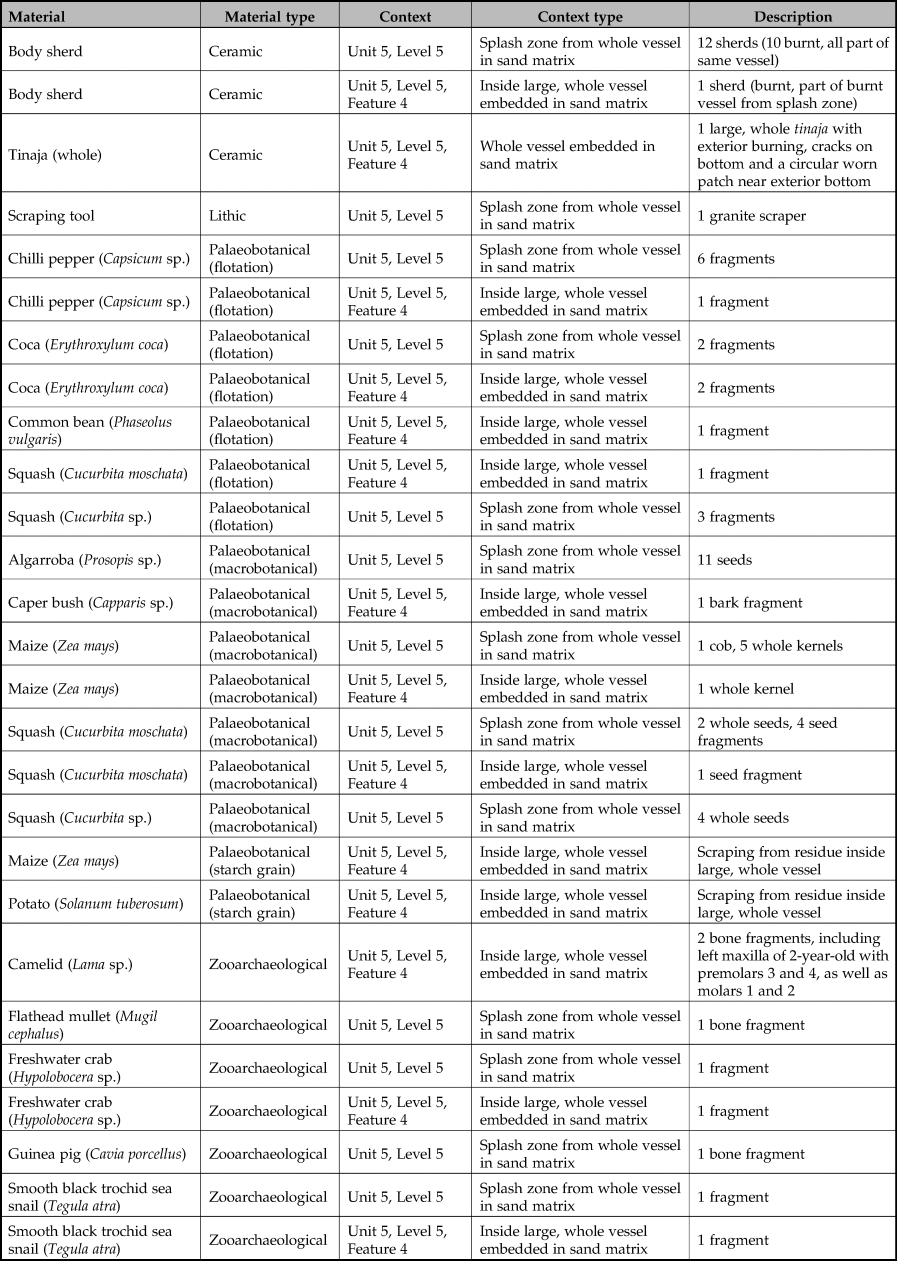
Within the pot and its splash zone were the remains of the meal itself (Table 1). This varied assemblage of material included bones from domesticated animals such as guinea pig and the left maxilla of a two-year-old camelid (Lama sp.—the llama face that is the namesake of this paper). Both were likely locally raised (see Shimada & Shimada Reference Shimada and Shimada1985), despite their initial domestication in the highlands centuries previously (Sandefur Reference Sandefur1988, 155–7; Stahl Reference Stahl, Silverman and Isbell.2008, 128).
Materials recovered from Unit 5-2013, Level 5 and Feature 4 (whole vessel and splash zone).

This assemblage also contained locally produced agricultural products such as maize, common beans, squash, potato and chilli pepper. Additionally, coca, the only item not of local origin (Rosas R. Reference Rosas R.2010, 735), was also a part of this collection of materials. Non-agricultural plants recovered from this assemblage were algarroba seeds and bark fragments from caper bushes (Capparis sp.).
Other locally sourced ingredients recovered from this deposit were freshwater crabs (Hypolobocera sp.), which may have been harvested from the river or local irrigation canals. Additionally, marine products such as fish (flathead mullet Mugil cephalus and sea snail Tegula atra) were included in this assemblage. These marine species would have been obtained from the nearby Pacific Ocean and brought to the site.
Aside from the plant and animal remains, a variety of ceramic fragments were found within and surrounding the larger, whole vessel, including sherds from a highly burnt vessel. Additionally, a lithic scraping tool was recovered from this assemblage.
In summary, this deposit of a whole ceramic vessel and a wide variety of food and food-related materials was recovered from a fill of clean sand beneath a large stone embedded in a clay floor of a residential structure. This residential structure was part of a complex of similar structures located in the northeast section of the likely residential portion of Wasi Huachuma (Sector C). These structures each featured floors, hearths and post-holes, as well as similar (if not identical) palaeobotanical and zooarchaeological remains (see Duke Reference Duke2017, 137–46; Vásquez & Rosales Reference Vásquez and Rosales2014), and clearly operated as the physical bases of operations for household groups residing at this site during the Late Moche period.
Discussion
Based on these attributes, it is hard to deny the possibility that the vessel and its contents were a dedicatory offering of some sort. This large, whole vessel, placed on its side and buried below a prominent stone along with its contents, was likely deposited as an offering to commemorate the construction of a communal kitchen floor or domestic structure. Although it is common for such jars to be found embedded in floors for storage purposes (e.g. Cutright Reference Cutright2009, 72; Shimada Reference Shimada1994, 216; Swenson et al. Reference Swenson, Chiguala and Warner2013, 103–4), the diversity of the contents of this vessel is not typical of stored goods––storage vessels are usually more uniform in their contents. Instead, it was likely at one point used as a cooking vessel for soups or stews, as indicated by its burnt exterior and the materials found within and around it. After it no longer functioned as a cooking pot, it was subsequently buried under the floor with a large stone placed over it, suggesting that the location of the vessel under the floor was still acknowledged after its burial.
Furthermore, these materials are the practices that produced them and they are memorialized through their deposition here. In the case of the contents of this pot, this would necessitate the convergence of practices for preparing, and possibly producing, products from a variety of ecological and geographic regions, each of which requires specific knowledge bases. While the method of cooking was simple—add ingredients plus water to the pot, heat to boil—understanding how and whether to apply particular knowledge was dependent on the material. For example, the means of processing a llama in order to acquire the left maxilla, as found in this pot, requires an entirely different knowledge set than that needed to prepare potatoes or squash, or to butcher a large marine fish. Additionally, obtaining each material required not only different skill sets, but potentially different social networks. For instance, it has been proposed that fishing and farming villages in the Moche period were relatively autonomous from one another (Johnson Reference Johnson, Zori and Johnson2011) and so the acquisition of marine products may have been through trade rather than directly. Also, coca requires very specific environments to grow and almost certainly was obtained via exchange with producers up-valley, or even further away (Cortella et al. Reference Cortella, Pochettino, Manzo and Raviña2001; Martin Reference Martin1970; Rosas R. Reference Rosas R.2010, 735). It is in the quotidian task of preparing a stew that these multiple knowledge sets are materially assembled and bundled together––the meal could not otherwise be prepared or, ultimately, consumed.
Beyond the specific skill sets for their practical applications in cookery, however, is the knowledge of the social importance of each ingredient. Camelids were extremely important in the Andes for a multitude of reasons, including for wool, their utility as a pack animal and the consumption of their meat, blood, viscera and grease (de Acosta Reference de Acosta1590, 293–6; Sandefur Reference Sandefur, D'Altroy and Hastorf.2002; Vallières Reference Vallières2012, 62–3), but their ritual significance was likely as great as their functional significance (Goepfert Reference Goepfert2010). Sacrifices and offerings of camelids have been recorded in the Jequetepeque Valley at Pacatnamú (Donnan Reference Donnan1997, 34), San José de Moro (Goepfert Reference Goepfert2012, 106), and Huaca Colorada (Swenson et al. Reference Swenson, Chiguala and Warner2012) and were an integral element of Moche ritual life. While less ideologically imbued than llamas and alpacas, guinea pigs were still an important part of feasting and ritual events as well as more general, everyday consumption (Arriaga Reference Arriaga and Esteve Barba1968, 210; Miller & Burger Reference Miller and Burger1995; Sandefur Reference Sandefur, D'Altroy and Hastorf.2002, 182–3; Sandweiss & Wing Reference Sandweiss and Wing1997).
Maize was clearly of importance to the Moche and was the predominant plant material recovered from most Moche-era archaeological sites (e.g. Gumerman Reference Gumerman, Donnan and Cock.1997; Shimada Reference Shimada1994, 221–4). It has been recovered from burial contexts (Gumerman Reference Gumerman, Donnan and Cock.1997) as well as depicted in a wide variety of Moche iconographic representations, including in association with presentation rituals and as the Moche decapitator deity, Ai Apaec (Donnan Reference Donnan1978; Duke Reference Duke2017, 64; Eubanks Reference Eubanks1999). Maize also held a high status as the main ingredient for making corn beer, or chicha (Burger & van der Merwe Reference Burger and van der Merwe1990; Weismantel Reference Weismantel, Jennings and Bowser2009) and may have been an indicator of status during the Moche era (Lockard Reference Lockard2005, 215–19; Ringberg Reference Ringberg2012, 260–67).
Common beans had a relatively consistent presence in most domestic and festive contexts across time periods on the coast of Peru and were a crucial part of the Moche diet, though they did not appear to signify status or have any special ritual significance (Gumerman & Briceño Reference Gumerman, Briceño R, Uceda and Mujica2003; Pozorski Reference Pozorski1979; Rosas R. Reference Rosas R.2010, 765–9; Ryser Reference Ryser, Castillo, Bernier, Lockard and Rucabado Y.2008). Similarly, squash was one of the most easily grown and wide-ranging cultivars in the Americas, but its social significance appeared to remain within the culinary realm (Cutright Reference Cutright2009; Gumerman Reference Gumerman, Donnan and Cock.1997). To date, only two examples of potato from the Moche period have been documented: starch grain analyses on dental calculus from a Moche burial at Huaca Cao Viejo in the Chicama valley (Vásquez et al. Reference Vásquez, Jordán and Rosales2014) and the starch grain evidence from Wasi Huachuma (Duke Reference Duke2017, 171; Duke et al. Reference Duke, Vásquez-Sanchez and Rosales-Tham2018). Despite the lack of macrobotanical evidence for potato, the starch grain evidence from Wasi Huachuma indicates that it was likely a common part of the daily diet, but likely did not have any elevated status attached to it on the coast (Duke et al. Reference Duke, Vásquez-Sanchez and Rosales-Tham2018).
Due to their ritual significance and intense flavour, chili peppers have been considered by some to be a restricted luxury food (e.g. Hayden Reference Hayden1990; Reference Hayden, Gebauer and Price1992; Reference Hayden, Price and Gebauer1995). However, chili peppers are not exclusively found within elite or ritual contexts (Chiou et al. Reference Chiou, Hastorf, Bonavia and Dillehay2014; Duke Reference Duke2017, 427) and the relative ease with which they are grown and stored may indicate that they were more broadly used as a general flavouring than has been previously identified. In many ways, coca shares a similar place in Andean botanical history to chili peppers. Both are relatively easily grown, fairly ubiquitous in the archaeobotanical record, demonstrably associated with ritual, yet also a part of everyday life (Chiou et al. Reference Chiou, Hastorf, Bonavia and Dillehay2014; Cortella et al. Reference Cortella, Pochettino, Manzo and Raviña2001; Martin Reference Martin1970).
The seedpods of algarroba trees were frequently used as camelid fodder and have also been documented in culinary contexts (Johnson Reference Johnson, Zori and Johnson2011, 259). The beans and pods are sometimes fermented to make a specific type of chicha (chicha de algarrobo) or boiled and reduced to create algarrobina, a sweet syrup (Goldstein Reference Goldstein2008). The importance of this tree to the Moche was high and it was also frequently depicted on ceramic vessels (Duke Reference Duke2017, 80), though there does not appear to be any specific ritual or other social importance associated with it. The bark fragments from caper bushes (Capparis sp.) may have been used as a construction material or as fuel for cooking (Fernández H. & Rodríguez R. Reference Fernández H. and Rodríguez R2007, 58–9; Grandtner & Chevrette Reference Grandtner and Chevrette2014, 151; Pozorski Reference Pozorski1979; Quilter et al. Reference Quilter, Ojeda E, Pearsall, Sandweiss, Jones and Wing1991) but do not appear to have had greater social significance.
Beyond subsistence, fish remains have been recorded as burial offerings (Benson Reference Benson2012, 110) and depicted in iconography on Moche ceramics (Bawden Reference Bawden and Reycraft2005, 296–8; Benson Reference Benson2012, 112). In regards to marine gastropods such as Tegula atra, Roselló et al. (Reference Roselló, Vasquez, Morales and Rosales2001, 78) argue that they ‘probably constitute by-products of transport activities or alternative gatherings (i.e. algae, mussels, etc.)’, essentially relegating marine gastropods to ‘carcasses’ rather than as dietary elements, despite their edibility. Marine crab is remarkably ubiquitous in the archaeological record on the Peruvian coast, speaking to its importance as a secondary element in coastal cuisine (Cutright Reference Cutright2009, 177–9; Rosas R. Reference Rosas R.2010, 749–53). Additionally, they were regularly depicted with other marine animals in iconographic fishing scenes by the Moche (Duke Reference Duke2017, 60) as well as depicted as or with Ai Apaec (Bourget Reference Bourget1994, 433–6). However, while marine crab was found elsewhere at Wasi Huachuma (Vásquez & Rosales Reference Vásquez and Rosales2014), the crab recovered from this deposit was a freshwater genus (Hypolobocera). These are far less ubiquitous, though by no means uncommon, either, and were likely procured from the rivers, lakes and irrigation canals in the region.
The ceramics and lithics together indicate an active, lived-in structure in which food was prepared and cooked and pots were used, broken and discarded. The whole vessel itself was clearly well worn and perhaps past its usefulness as a functioning kitchen vessel, potentially indicating that its inclusion here marked a shift from old to new. The appearance of these materials in connection to this specific deposit perhaps indicates more than this, however. These items, like the food stuffs in this assemblage, were intentionally included. The significance of these common food-related materials is important as a bundled collection of edibles and culinary utensils endemic to everyday household life.
Based on the above descriptions, the materials assembled in this dedicatory deposit neatly bundle together the various geographic and environmental regions accessed by the Moche. And while these convergent practicalities were important in the everyday life of the Moche residents of Wasi Huachuma, equally important was the deposit of quotidian materials in a likely dedicatory context. They were bundled together precisely as an amalgam of products with a variety of social significances, from the practical to the supernatural, but all of which were a part of the everyday lived experience of a Moche person.
Two similar domestic structures were excavated in the same portion of Wasi Huachuma with similar artifactual and organic remains recovered from both. However, evidence of a dedicatory deposit was only found under the floor of one of them. This may have been due to a number of reasons, including the fact that neither structure was excavated in its entirety, so a similar deposit under the other floor may simply have been missed. It is also possible that the structure from Unit 5-2013 where the deposit was recovered was in some way special or deserving of such a commemoration. The full significance this deposit, as well as any discussion of a potential pattern of dedicatory deposits under the floors of domestic structures at Wasi Huachuma, would require further excavation. However, it is fair to say that this one deposit is indicative that this structure was important to the people constructing it and that they felt that the most appropriate way to mark this importance was through a deposit of a meal beneath its floor.
Ultimately, the most important element of this was that these specific materials were bundled together intentionally (sensu Pauketat Reference Pauketat2013). While the intentions themselves may never be knowable, the acts of bundling, depositing and constructing, as well as the materials themselves, all straddle the worlds of the mundane and the special. These doings (sensu Fowles Reference Fowles2013) were neither unambiguously ritual nor quotidian. They were simultaneously both and served as a reminder of the inseparability of these two domains.
Conclusion
Perhaps this deposit was a meal offered to the gods, or the ancestors, or even the living structure under whose floor it was buried. However, what its exact purpose was I cannot say with any absolute certainty. To paraphrase and apply Igor Kopytoff (Reference Kopytoff and Appadurai2013), the life-history of the pot and its contents are not fully known. The maker of either, whether it was the same person or two (or more) people, is beyond our purview. But it is clear that this deposit, in this location, was purposeful, intentional and laden with meaning. Each element of it was chosen from an array of materials available, some from the local fields and seas, some from much further afield, though not necessarily any less familiar.
Within this pot, beneath this floor, at one point simmered a stew in which geography and time converged; and this convergence was subsequently and purposefully placed here, to be either remembered or forgotten (Mills Reference Mills, Mills and Walker2008), the stone marking its placement. Further convergences are also clear. Importantly, this was a utilitarian, everyday pot containing utilitarian, everyday foods. These foods were combined with less utilitarian items, but in a standard, everyday cooking style. But then the whole of these local and foreign foods cooked in this ubiquitous pot was used in a decidedly ritual manner, as a dedicatory deposit during the construction of a domestic structure, effectively blurring the imaginary lines between ritual/quotidian, domestic/supernatural.
The convergences of these foods, these practices, at this obscure site highlight the intricate interconnectedness of the surrounding area and the regions beyond. Additionally, these convergences extend beyond geography and ecology, beyond time periods, and into the realms of cosmology and embodied cultural practice. This stew, in this pot, under this floor, at this site encompassed the convergences of practices, the convergences of geography and ecology, the convergences of ideas in a deceptively simple and elegant way that belies its complex entanglements. The entangled convergences of food, ritual, cooking style and daily activities show us how the quotidian, utilitarian world of the Moche feeds special events in both literal and figurative ways. Ultimately, this singular deposit encapsulates the role of the everyday in the special and, perhaps even more importantly, the special in the everyday.
Acknowledgements
I would first like to thank my excavation team at Wasi Huachuma, Elvis Chávez and André Kinsiño Vidal Urquiaga, as well as Elizabeth de la Rosa in Pacasmayo for making the field season that led to this data possible. Additionally, many thanks go out to Ryan Kennedy and Guido Pezzarossi for inviting me to present an early version of this paper at the Theoretical Archaeology Group meetings in Urbana-Champaign in 2014. And lastly, my deep appreciation goes out to Anna Guengerich, Danielle MacDonald, Edward Swenson, Sarah Rowe and the two anonymous reviewers for their commentary and critiques on earlier drafts of this paper.