Introduction
A prominent theoretical view on the retrieval of words from the bilingual mental lexicon is that the lexicon is organized and accessed in a language non-specific manner (e.g., Dijkstra & Van Heuven, Reference Dijkstra and Van Heuven2002). This view implies that an input letter string can simultaneously activate representations from both the target language and the non-target language. Indeed, cognates – words that share form and meaning across languages (e.g., Dutch–English: drinken – to drink) – are recognized and produced faster than non-cognates, indicating co-activation of lexical codes in two languages (e.g., Acheson, Ganushchak, Christoffels & Hagoort, Reference Acheson, Ganushchak, Christoffels and Hagoort2012; Costa, Caramazza & Sebastián-Gallés, Reference Costa, Caramazza and Sebastián-Gallés2000; Dijkstra, Grainger & Van Heuven, Reference Dijkstra, Grainger and Van Heuven1999; Hoshino & Kroll, Reference Hoshino and Kroll2008; Lemhöfer, Dijkstra, Schriefers, Baayen, Grainger & Zwitserlood, Reference Lemhöfer, Dijkstra, Schriefers, Baayen, Grainger and Zwitserlood2008; for reviews, see Dijkstra, Reference Dijkstra, Kroll and de Groot2005; Van Assche, Duyck & Hartsuiker, Reference Van Assche, Duyck and Hartsuiker2012). However, research on language switching has shown that when bilinguals produce a word in one language and then produce another, unrelated, word in the other language, this switching incurs a cognitive cost: Producing a language-switched word takes longer than producing a non-switched word (for a review, see Meuter, Reference Meuter2009). This suggests that although languages can be active at the same time, they may not be active to the same degree, which implies that switching from one language to the other is associated with a measurable switching cost.
The size of the switch cost is dependent on the direction of the language switch (from language A to B or vice versa), as shown by evidence from the language production domain (see Meuter, Reference Meuter2009). Furthermore, corpus studies on language production indicate that the ease of switching can be influenced by cross-linguistic overlap (e.g., Broersma & De Bot, Reference Broersma and De Bot2006). Little work on these effects has been done, however, in the field of language comprehension (for a review, see Van Hell & Witteman, Reference Van Hell and Witteman2009). In the present study, we investigate whether switch costs in both directions in sentence comprehension are affected by differences in relative proficiency in bilinguals’ first and second language, and whether these switch costs are modulated by cross-linguistic lexical activation. For these purposes, we conducted a self-paced reading task to measure how sentence internal switch costs that are preceded by a verb cognate are processed by unbalanced bilinguals. To set the stage for this study, we will first discuss literature on language switching, followed by a review of studies showing effects of cross-linguistic activation on language switching. Throughout, we will highlight differences between comprehension and production.
Language switching and language proficiency
Empirical studies on language production show that switching from one language to another incurs a cognitive cost. In picture and number naming studies, the switch is accompanied by a slow-down in performance (e.g., Christoffels, Firk & Schiller, Reference Christoffels, Firk and Schiller2007; Costa & Santesteban, Reference Costa and Santesteban2004; Jackson, Swainson, Cunnington & Jackson, Reference Jackson, Swainson, Cunnington and Jackson2001; Meuter, Reference Meuter2009; Verhoef, Reference Verhoef2008). Although under normal circumstances, processing in the first language (L1) is easier than processing in the second language (L2), these switch costs tend to show an opposite pattern. Most of the naming studies indicate that backward switches from the weaker L2 back to the dominant L1 take longer than forward switches from L1 to L2 (Meuter & Allport, Reference Meuter and Allport1999; but see Costa & Santesteban, Reference Costa and Santesteban2004; Costa, Santesteban & Ivanova, Reference Costa, Santesteban and Ivanova2006; for findings of equal switch costs in both directions with balanced bilinguals). This asymmetry is generally accounted for by the assumption that the non-target language representation must be inhibited during production to ensure that the intended lexical candidate in the target language is selected for output (see Green, Reference Green1998; Kroll, Bobb, Misra & Guo, Reference Kroll, Bobb, Misra and Guo2008). According to the Inhibitory Control Model (Green, Reference Green1998), it takes more effort to suppress the dominant, more active, L1 representation during L2 production than vice versa. Due to a phenomenon known as ‘task set inertia’, the inhibition of L1 during processing on the preceding L2 trial carries over to the subsequent L1 trial (Allport & Wylie, Reference Allport, Wylie, Humphreys, Duncan and Treisman1999). As a consequence, the re-activation of the L1 following L2 production is more effortful than reactivation of the less suppressed L2 after naming an item in the L1.
While language switching studies using a production task often examined switching between single, unrelated items, language switching studies using a comprehension task often examined reading times of a word in another language embedded in a meaningful sentence context. Studies that examined forward and backward switches in reading indicate a processing cost for language-switched words analogous to language production. However, the asymmetry in switch costs observed in language comprehension is not always similar to that observed in spoken responses to cued targets.
Ibáñez, Macizo and Bajo (Reference Ibáñez, Macizo and Bajo2010) examined lexical access and language control in bilinguals and professional translators. Participants were visually presented with sentences in their L1 Spanish or L2 English, which contained a cognate. The language of the sentences switched between trials. When asked to read and repeat the sentences out loud afterwards, the bilinguals’ self-paced reading times were slower for sentences in their L1 Spanish when the previous sentence was in their L2 English (switch condition) compared to when it was in the same language (non-switch condition), but showed no difference in reading times of English sentences that were preceded by either English or Spanish sentences. Furthermore, the bilinguals showed no cognate effect, suggesting that selection of one language in a mixed language context did not leave room for co-activation of the non-target language. The translators, on the other hand, showed no switch cost in either direction, but did show a cognate facilitation effect in both L1 and L2 reading times. When both groups of participants were asked to perform the cognitively less demanding task of reading the sentences without repeating them afterwards, both bilinguals and translators showed a cognate effect in reading L2 sentences, suggesting parallel activation of both languages, but no switch cost in either language. The data of the reading for repetition experiment, involving a production component, thus suggest a switch cost asymmetry similar to language production studies, whereas the reading experiment showed no evidence of switching costs.
Electrophysiological studies provide further evidence for a difference between comprehension and production regarding the switch cost asymmetry. In an ERP study by Proverbio, Leoni and Zani (Reference Lemhöfer and Dijkstra2004), comprehension of language switching was examined in simultaneous interpreters who read sentences containing language switches in both switching directions. RT data revealed that forward switches from the L1 to the L2 were processed slower than backward switches. In agreement with the behavioural findings, ERPs showed a difference between switches from L1 to L2 compared to switches from L2 to L1 in the form of an N400 effect, a negative-going brain wave at about 400 ms following the critical event, indicating a lexical integration difficulty. This N400 effect was smaller for switches from L2 to L1 (a similar asymmetrical effect regarding the N400 for sentence comprehension was observed by Brenders, 2004, described in Van Hell & Witteman, Reference Van Hell and Witteman2009). Because the N400 showed no main effect of language in the non-switch condition, the authors argued that the switch asymmetry could not be due to proficiency differences between the L1 and L2. Age of acquisition instead of L2 proficiency was proposed to explain why comprehension of forward switches was easier than that of backward switches. The authors proposed that the L1 word form directly activates meaning, because L1 is acquired prior to L2; therefore, it is easier to integrate an L1 word at the end of an L2 sentence. Note, however, that the participants tested were professional simultaneous interpreters, who were highly skilled in both languages as well as in switching, which may explain why no proficiency differences were observed by Proverbio et al.
A similar pattern of switch costs was observed in a sequential word reading task by Alvarez, Holcomb and Grainger (Reference Alvarez, Holcomb and Grainger2003). Their task, performed by unbalanced bilinguals who were late L2 learners, involved within-language and between-language repetitions of (non-cognate) words. In both conditions, a repetition effect was observed, as indicated by a decrease in the N400 amplitude for the second word of a pair. This repetition effect was smaller in the between-language condition compared to the within-language condition, indicating that translations are more difficult to process than same-language repetitions. The observed within-language effect was larger in the L2 than in the L1, indicating a proficiency effect. For the between-language condition, the L1 to L2 switches showed larger repetition effects in the time window immediately following the N400, whereas repetition effects for L2 to L1 switches were larger at an earlier time point that fell within the N400 time window. Alvarez et al. (Reference Alvarez, Holcomb and Grainger2003) argue that language dominance (rather than age of L2 acquisition, see Proverbio et al., Reference Proverbio, Leoni and Zani2004) can account for the difference in time course for forward and backward switches. In line with the Revised Hierarchical Model (Kroll & Stewart, Reference Kroll and Stewart1994; Kroll, Van Hell, Tokowicz & Green, Reference Kroll, Van Hell, Tokowicz and Green2010), it was proposed that an L2 prime word automatically activates L1, thus speeding up recognition of a subsequently presented L2 target for the switches from L2 to L1, whereas the initial L1 word need not activate the L2 automatically, hence the delayed repetition effect in the L1 to L2 condition. The notion that proficiency rather than age of acquisition is responsible for this effect is supported by a more recent study by Geyer, Holcomb, Midgley and Grainger (Reference Geyer, Holcomb, Midgley and Grainger2011), who tested the same repetition paradigm with balanced bilinguals with a late onset of L2 acquisition. Other than in Alvarez et al. (Reference Alvarez, Holcomb and Grainger2003), Geyer et al. observed no asymmetry in translation priming effects and equal within-language repetition priming effects. All in all, this suggests that L2 proficiency plays a role in the asymmetrical effects obtained (see also Duñabeitia, Perea & Carreiras, Reference Duñabeitia, Perea and Carreiras2010).
Other studies on language switching in sentence processing support the notion that L2 proficiency affects switch costs. Moreno, Federmeier and Kutas (Reference Moreno, Federmeier and Kutas2002) examined forward switches in English–Spanish bilinguals, dominant in English, using ERPs. Backward switches were not examined in this study. Unlike in the study by Proverbio et al., no unequivocal modulation of the N400 was obtained for language switches, which suggests that language switches occurring in a sentence were not too problematic for these bilinguals at the semantic level. The study did report an enhanced Late Positive Component (LPC) for switch in comparison to non-switch sentences, which Moreno et al. (Reference Moreno, Federmeier and Kutas2002) interpret to reflect that bilinguals treat a language switch as an unexpected event at a non-linguistic level. Further, the LPC effect was modulated by L2 proficiency: more proficient bilinguals showed an earlier peak latency and smaller amplitude of the LPC than lower proficient bilinguals. More recently, Van der Meij, Cuetos, Carreiras and Barber (Reference Van der Meij, Cuetos, Carreiras and Barber2011) tested high and low proficient Spanish–English bilinguals who read sentences in their L2 English that contained a Spanish adjective (only backward switching was studied). Evidence was found for a switch cost for backward switches. Specifically, the L2–L1 switch evoked both early (N250) and later (N400, LPC) ERP effects that were argued to point to processing costs in relation to form, semantic integration and updating respectively. Interestingly, the results showed that N400 and LPC effects were present for both high and low proficient bilinguals, while the N250 effect was only present for the low proficient group. This indicates that more and less proficient L2 users may process language switches differently.
The findings discussed so far suggest a difference between switch costs in production (the naming of isolated items) and comprehension of language (items in sentence context) in terms of switch cost asymmetries (see also Chauncey, Grainger & Holcomb, Reference Chauncey, Grainger and Holcomb2008). The available comprehension studies, however, show mixed results. Some suggest that switching into the L2 gives rise to a processing difficulty that is larger than switching into the L1 (Proverbio et al., Reference Proverbio, Leoni and Zani2004), which is in contrast to production studies indicating that switching into L1 is more demanding than switching into L2 (e.g., Meuter & Allport, Reference Meuter and Allport1999). Yet, other studies suggest switching from L2 to L1 similarly results in a significant switch cost in reading (Van der Meij et al., Reference Van der Meij, Cuetos, Carreiras and Barber2011) or shows no switch cost in either direction for reading of sentences (Ibáñez et al., Reference Ibáñez, Macizo and Bajo2010). This raises the question of how language switches in sentence comprehension must be understood. Whereas the mechanism behind switch costs in production has been extensively discussed, studies conducted so far have not explicitly addressed the mechanism driving the asymmetric switch costs in comprehension of language switches and remarkably few behavioural studies have looked at sentence internal switch costs in both switching directions in comprehension. Given processing differences between comprehension and production of language (see also Gollan, Slattery, Goldenberg, Van Assche, Duyck & Rayner, Reference Gollan, Slattery, Goldenberg, Van Assche, Duyck and Rayner2011; Pickering & Garrod, Reference Pickering and Garrod2004), a different mechanism explaining switch costs in the two modalities may be assumed. In contrast to the proactive nature of speaking, the understanding of language is reactive in nature, implying that inhibition as required in selection for production need not play a role, which is likely to influence effects of switching.
In order to understand processing of language switches in comprehension, it is important to consider the source of switch costs. There are two opposing views on the origin of switch costs. One account holds that language switch costs are similar in nature to task switch costs in general, both of which are the result of stimulus/response task schemas outside the language system (e.g., Green, Reference Green1998). The other account assumes that costs associated with language switching are language-specific and stem from the lexicon. For example, Chauncey et al. (Reference Chauncey, Grainger and Holcomb2008) showed the effects of language switching in a masked priming task. Participants were visually presented with target words preceded by masked primes and had to perform a go/no-go semantic categorization task. On no-go trials, the language in which the words were presented could switch between the prime and target. This means that switches were not overt. The presence of a switch cost in the absence of executive control in such a task supports the claim that costs in comprehension tasks may not depend on inhibition (see Chauncey et al., Reference Chauncey, Grainger and Holcomb2008). Recent studies provide evidence that mechanisms for task switching and language switching are not fully shared (e.g., De Bruin, Roelofs, Dijkstra & FitzPatrick, Reference De Bruin, Roelofs, Dijkstra and FitzPatrick2014; Della Rosa, Reference Della Rosa2011), giving rise to the belief that language switch costs may in part be specific to language.
In sum, the present evidence on language switching in comprehension shows mixed results concerning asymmetrical switch costs, leaving the debate on the origin of switch costs unsettled. Most studies conducted so far do suggest a modulating role for language proficiency. Another factor that has been suggested to modulate switch costs is cross-linguistic overlap.
Effects of cross-linguistic activation on language switching
There is reason to believe that the ease of language switching can be influenced by the presence of cross-linguistic overlap. This is supported by the notion that more switching occurs between highly similar languages (see Rodríguez-Fornells, Krämer, Lorenzo-Seva, Festman & Münte, Reference Rodríguez-Fornells, Krämer, Lorenzo-Seva, Festman and Münte2011). Secondly, there is evidence that local cross-linguistic lexical activation, as present for cognates, can affect switching between languages in sentence context. This idea was originally put forward in Clyne's (Reference Clyne2003) trigger hypothesis, based on the observation that the switches of habitual code switchers seemed to co-occur with lexical overlap between languages. A name associated with the L2 may, for example, enhance the likelihood of a switch to this L2 when someone is speaking in their L1, such as in the case of Maar ‘t is een andere stad dan Melbourne OF COURSE “But it is a different city than Melbourne of course”. Here the name “Melbourne” can be said to have triggered the continuation of the Dutch sentence in English. Clyne (Reference Clyne2003) proposed that, similar to proper nouns, cognates can facilitate switching to the other language.
Cognates are translation equivalents that also overlap in form, such as the English verb to start and the Dutch verb starten, and are assumed to be more closely linked in the lexicon than words that are dissimilar across languages, such as the English–Dutch translation equivalents to cycle and fietsen. Due to activation spreading, associative connections between lexical representations give rise to additional non-target language activation for words that are cross-linguistically similar in orthography, phonology, and semantics (Dijkstra et al., Reference Dijkstra, Grainger and Van Heuven1999; Van Hell & De Groot, Reference Van Hell and De Groot1998). As a result, cognates are processed faster and with fewer errors than non-cognates in visual word recognition (e.g., Dijkstra, Miwa, Brummelhuis, Sappelli & Baayen, Reference Dijkstra, Miwa, Brummelhuis, Sappelli and Baayen2010; Duyck, Van Assche, Drieghe & Hartsuiker, Reference Duyck, Van Assche, Drieghe and Hartsuiker2007; Lemhöfer et al., Reference Lemhöfer, Dijkstra, Schriefers, Baayen, Grainger and Zwitserlood2008; Lemhöfer & Dijkstra, Reference Lemhöfer and Dijkstra2004; Schwartz & Kroll, Reference Schwartz and Kroll2006) and word production (Christoffels et al., Reference Christoffels, Firk and Schiller2007; Costa et al., Reference Costa, Caramazza and Sebastián-Gallés2000; Poarch & Van Hell, Reference Poarch and Van Hell2012). The trigger function of cognates is thus explained by co-activation. The heightened availability of words in the non-target language can trigger a switch to that other language.
On the basis of a corpus study, Broersma and De Bot (Reference Broersma and De Bot2006) found that the probability of a language switch in the speech samples of three bilinguals in Moroccan Arabic and Dutch was statistically higher in the direct neighbourhood of a cognate. A later study replicated this observation in code-switches produced by Russian–English bilinguals as well as Dutch–English bilinguals (Broersma, Isurin, Bultena & De Bot, Reference Broersma, Isurin, Bultena and De Bot2009), which showed that the effect is not restricted to distant languages (Russian–English), but is also present for typologically similar languages (Dutch–English). These corpus studies are considered to be proof for the cognate trigger hypothesis.
Apart from the observation that cognates enhance the degree of switching as observed in corpora of naturally occurring code-switches, there are also experimental data supporting the trigger hypothesis. Kootstra (Reference Kootstra2012) examined the effect of cognates on code-switching behaviour using picture description. Dutch–English bilinguals were asked to describe pictures in a dialogue setting involving a confederate who also described pictures. The pictures included cognates such as the Dutch–English word “baby”, and participants were instructed to code-switch to their L2 English on particular trials. In cases where the confederate had switched in the previous trial, participants switched more often when describing a picture that depicted a cognate than when it depicted a non-cognate. This showed that the frequency of switching was enhanced by the presence of cognates, indicating that cognates facilitated the processing of multiple languages (see Kootstra, Van Hell & Dijkstra, Reference Kootstra, Van Hell and Dijkstra2012, for a similar lexical effect in structural priming; see also Broersma, Reference Broersma, Schmid and Lowie2011, for related findings).
So far, studies testing the triggering hypothesis for cognates have involved language production. In the present study, we wanted to investigate whether a similar trigger effect could be observed in comprehension. Production data indicate that cognates can enhance the likelihood of switching. Because the likelihood of switching cannot be manipulated in language comprehension, we focused on the magnitude of the switch cost instead. If comprehension of switches is facilitated following a cognate, an effect may arise in terms of a reduction in the magnitude of switch costs.
The present study
In this study, we examined to what extent L2 proficiency and cognates modulate language switch costs in sentence comprehension. Comprehension of language switching has predominantly been tested using EEG with single word priming (e.g., Alvarez et al., Reference Alvarez, Holcomb and Grainger2003; Geyer et al., Reference Geyer, Holcomb, Midgley and Grainger2011) or with single word insertions in sentences in another language (e.g., Moreno et al., Reference Moreno, Federmeier and Kutas2002; Proverbio et al., Reference Proverbio, Leoni and Zani2004; Van der Meij et al., Reference Van der Meij, Cuetos, Carreiras and Barber2011). In the present study, we examine the cognitive processing of full language switches (i.e., no single word insertions) at mid-sentence position during reading to examine switch effects in sentence continuation. We employed a self-paced reading task to examine which factors influence switch costs and to test the trigger hypothesis in sentence comprehension. Bilinguals were visually presented with sentences in Dutch and English that could contain a switch preceded by a cognate. We manipulated the cognate status of the sentence main verb, which always came right before the switch, to see if cognate verbs modulate the size of the switch cost. Within sentence context, the main verb carries the syntactic structure and is therefore prominent for sentence processing. The choice for manipulating the verb was motivated by the notion that co-activation for verbs might be enhanced, as the verb can directly activate syntactic structures in two languages in case sentence structures overlap between languages. Similar to nouns, verb cognates have been shown to give rise to a facilitation effect in lexical decision (e.g., Bultena, Dijkstra & Van Hell, Reference Bultena, Dijkstra and Van Hell2013), even though they are less similar across languages in terms of word form and meaning. Furthermore, an analysis of corpus data showed no difference in the triggering potential of different word categories, which, amongst others, included nouns and verbs (Broersma, Reference Broersma2009). Moreover, corpus data indicate that Russian–English cognates with limited form overlap also had triggering potential (Broersma et al., Reference Broersma, Isurin, Bultena and De Bot2009).
We made two major predictions. First, in line with relative L1 and L2 proficiency and given that a role of proficiency is suggested in both comprehension (e.g., Moreno et al., Reference Moreno, Federmeier and Kutas2002; Van der Meij et al., Reference Van der Meij, Cuetos, Carreiras and Barber2011) and production (Costa & Santesteban, Reference Costa and Santesteban2004) studies, we predicted that a switch cost asymmetry would be found depending on language dominance for unbalanced bilinguals. That is, we expected that switches into the less proficient L2 should be harder to process than switches back into the dominant L1. If language dominance drives switch costs, then these costs and the magnitude thereof should also depend on bilinguals’ relative proficiency in the two languages. We therefore also examined the role of relative proficiency on the size of switch costs. Second, we hypothesized that switch costs would be modulated by the presence of a cognate in the sentence, as observed in language production. If cognates function as trigger words that lead to lexical facilitation, then at a lexical level it should be easier to process switches following cognates, as evidenced by reduced switch costs.
Method
Participants
Sixty-eight Dutch–English bilinguals (19 males), students drawn from the Radboud University Nijmegen participant pool, between 18 and 32 years of age (M = 22, SD = 4) took part in the experiment. All participants were native speakers of Dutch and had learned English at school as an L2 starting at around the age of 11. To assess their L2 proficiency, all participants performed the English version of the XLex vocabulary knowledge test (Meara, Reference Meara2006). This non-speeded lexical decision task, which includes more and less familiar words as well as non-words, determines a participant's vocabulary range in English and is generally taken as an indication of proficiency. The participants’ mean score was 82% (SD = 14), indicating that their average proficiency in English was relatively high. Language background questionnaires showed individual differences among the learners in terms of L2 proficiency. Included in the group of participants were some students of English, one student who had learned English in an immersed setting at secondary school, and several students who indicated that they were exposed to native English regularly via friends or family; the scores of these participants on the XLex task were higher (M = 90%, SD = 9, N = 17) than those who did not report any additional exposure to English (M = 80%, SD = 15, N = 51) and this difference was significant (p < .05). Variation in L2 proficiency was therefore accounted for in the analyses of the data. None of the participants reported any reading problems. They were paid a small amount of money or received course credit for their participation.
Stimulus materials
Forty different sentences were created. All sentences were declarative main clauses with a Subject Verb Object construction. This syntactic structure is common in both English and Dutch. The experiment involved a 2 (English or Dutch) × 2 (cognate or non-cognate) × 2 (switch or non-switch sentence) factorial design, yielding eight possible versions of each sentence. In all cases, the verb was manipulated for cognate status and was always presented in its infinitival form. A switch was always located directly after the verb. Dutch and English sentences were exact translations (see Appendix).
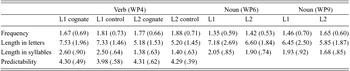
For each cognate verb, a control verb was selected that fitted in the same sentence context as the cognate verb (see Appendix). The predictability of the target word in context was assessed in a separate rating task. Thirty-two different Dutch–English bilinguals, from the same participant pool as the actual experiment, were shown the sentence onset of all forty sentences up to the verb. The presented sentence fragments were either in Dutch or in English, and all conditions were counterbalanced across participants, such that they saw either the cognate or control verb in one language. Participants were asked to rate the predictability of the verb in relation to the preceding noun phrase on a scale from 1 (very surprising) to 7 (very predictable). Univariate analyses by participants and items with language and cognate status as between-subject variables showed no significant differences for either comparison (all ps >.10). Mean values can be found in Table 1. Target verbs were furthermore matched both within languages (cognates vs. controls) and between languages (Dutch vs. English) with respect to lemma frequency (ps >.10) as obtained from the CELEX database (Baayen, Piepenbrock & Gullikers, Reference Baayen, Piepenbrock and Gullikers1995). Verbs in Dutch and English could not be matched in word length, because Dutch verbs were on average two letters longer due to a fixed -en suffix for infinitival verbs. Independent samples t-tests indicated that cognate and control verbs in Dutch as well as English did not differ from each other with respect to word frequency and word length (all ps > .10).
Mean values of frequency, length, and predictability for cognate and control verbs and subsequent nouns in the sentences in L1 (Dutch) and L2 (English).

Note: Frequency is indicated by logarithmic values, word length is expressed in number of letters, and predictability ratings are based on a seven-point Likert scale.
The cognate status of all verbs was assessed with two measures of orthographic similarity. Cognates (M = .71, SD = .97) and controls (M = .10, SD = .08) substantially differed in terms of Van Orden's similarity measure (Van Orden, Reference Van Orden1987); similarly, the Levenshtein distance indicated more letter transitions between translation equivalents for controls (M = 6.18, SD = 1.39) compared to cognates (M = 3.10, SD = .96). All lexical items in the sentences other than the manipulated verbs were non-cognates, and no loan words were used. Furthermore, noun translation equivalents in the Dutch and English sentences following the verb at WP6 and WP9 were matched across languages on word form frequency and word length in letters (all ps > .10; see Table 1 for descriptive data). Sixty filler sentences were added, which could start in Dutch or English. Half of the filler sentences contained a switch, which could be located at different positions in the sentence. The syntactic structure of filler sentences differed from that of target sentences in that they contained inflected past or present tense verbs, or passive constructions.
Conditions were counterbalanced across groups according to a Latin square design. Eight different lists were constructed, such that all combinations of language, switch, and cognate manipulations appeared equally often across the lists. Each experimental list contained one version of each sentence. A comprehension question was constructed for each sentence, to which participants had to answer ‘yes’ or ‘no’. Comprehension questions addressed the lexical content of the sentences with respect to the first, middle, or last part of a sentence.
Procedure
Participants were tested individually on a Windows XP Intel® Pentium® 4CPU computer with a 17-inch Philips 107 MB monitor (60 Hz refresh rate). The experiment was designed and run with Presentation software (www.neurobs.com) and RTs were measured via a button box. Participants were seated at approximately 60 cm from the computer screen.
Prior to the experiment, participants performed the English XLex task (Meara, Reference Meara2006), to assess their level of English proficiency. Before the start of the self-paced reading task, participants received Dutch instructions on the computer screen, which encouraged them to read silently at a normal pace that allowed them to answer comprehension questions. The instructions emphasized that participants had to use the index finger of their dominant hand to press the button in order to perform the task. The experiment started with 20 practice sentences.
Sentences were aligned to the middle of the screen in a white 22 pts Courier New font on a black background. Sentences were presented using a self-paced reading variant of the moving window paradigm (Just, Carpenter & Woolley, Reference Just, Carpenter and Woolley1982), meaning that each sentence was presented word by word controlled by the participant. Sentences were initially dashed, with each dash corresponding to a letter on the screen (e.g., __________ for ‘the sailors’). By indicating the number of words, letters and spaces, the actual reading pattern was preserved as much as possible. When a participant clicked a button, a dashed line changed into the first word of the sentence; upon the next click, the next word was revealed while the first word changed back into its dashed form. Reading times for each word were measured from the moment a word was displayed until it disappeared from the screen. Every sentence ended with a period and was followed by a comprehension question that required a yes/no response; feedback was only given when participants chose the wrong answer. Between two trials, a fixation cross was presented in the middle of the screen for 1000 ms.
Results
Prior to analyzing the RT data, performance on the comprehension questions was evaluated. Two participants performed with an accuracy rate below 80%, and for that reason their data were discarded from the analyses. The data of one other participant were removed, because of poor performance on the XLex task (below 30%). For the remaining 65 participants, the data yielded 8.2% errors over all. Furthermore, one sentence was deleted as a whole, because of an error in the presentation (marked in the appendix). Outliers were filtered for each of the 10 word positions (WP) separately; all items that were more than 2.5 SD away from the participant mean over a specific position were removed. Reaction times (RTs) were analyzed over correct trials only.
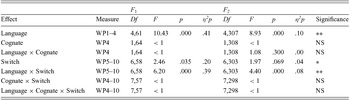
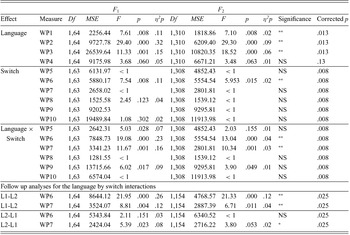
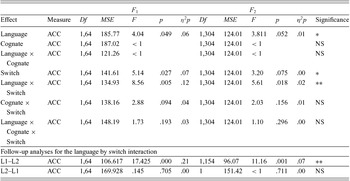
A series of 2 × 2 × 2 ANOVAs was performed on the RT and accuracy data with language, cognate status and presence of a switch and as within-subject factors for the participant analyses (F 1), and as between-subject factors in the item analyses (F 2). Tests were conducted based on specific predictions for different word positions. Based on significant effects in the multivariate tests (see Table 3 below), univariate ANOVAs were conducted for separate word positions using Bonferroni adjusted alpha levels per comparison (corrected p = .05/number of tests), which are reported below (see Tables 4 and 5). We first tested for effects of language and switching, and then examined whether these were influenced by the presence of a cognate. Furthermore, we examined effects of L2 proficiency based on XLex scores and a reading speed difference measure on the magnitude of switch costs.
Effects of language and switching
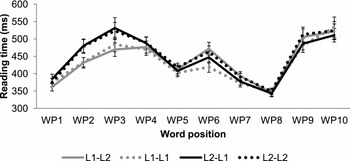
Effects of language were observed at the first four positions in the sentences before the switch in the overall dataset (see Figure 1 and Tables 2 and 3). Univariate analyses revealed an effect of language at the determiner at WP1 with slower reading times in L2 (M = 380, SE = 13) than in L1 (M = 369, SE = 12), which was also present at the adjective at WP2, with significantly slower reading times in L2 (M = 482, SE = 20) compared to L1 (M = 435, SE = 14). A similar significant difference between L2 (M = 528, SE = 26) and L1 processing (M = 480, SE = 20) was observed at the noun at WP3. Also for the verb at WP4, readers took more time to process items in L2 (M = 490, SE = 16) than in L1 (M = 474, SE = 16), but this was not significant after applying the Bonferroni correction. The accuracy data also showed a main effect of language, with better performance on sentences that started in L1 (M = 94%, SE = 8) compared to sentences that started in L2 (M = 91%, SE = 10), which was only marginally significant in the item analysis (see Table 5).
Sample sentences in English and Dutch. All target sentences followed the same structure: WP4 was manipulated for cognate status and switches occurred at WP5.

Results of multivariate repeated measures analyses over reading times regarding language, cognate and switching manipulations.

Line graph of reading times (+SE) for all word positions in switch and non-switch sentences in L1 and L2.

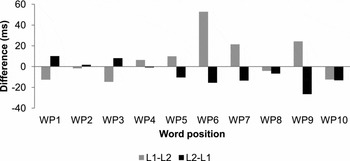
We tested for an effect of switching at all positions following the language switch (WP5–WP10; see Table 2). Univariate analyses indicated a main effect of switching only at WP6, the first content word following the language switch, with significantly slower reading times for switched items (M = 459, SE = 17) in comparison to non-switched items (M = 440, SE = 15; see Figure 1 and Table 3). The switch effect was subject to an interaction with language for content words following the switch. Analyses indicated a language by switch interaction for the noun at WP6 and the preposition at WP7. To examine the language by switch interaction, we conducted analyses over the two language switch directions separately (see Table 4). Switches from L1 to L2 showed a cost at WP6 with slower reading times for switched items (M = 473, SE = 18) compared to non-switched items (M = 419, SE = 15). A similar difference between forward switch (M = 395, SE = 12) and non-switch items (M = 373, SE = 10) was present at WP7. Switches from L2 to L1 showed no significant effect at WP6, although there was a numeric effect indicating faster processing for L2 to L1 switches (M = 449, SE = 16) compared to non-switches (M = 462, SE = 17). Similarly, WP7 showed faster reading times for the backward switch sentences, (M = 377, SE = 10) compared to non-switch sentences (M = 391, SE = 10), which was significant only in the participant analysis. An overview of the effects of switching direction can be found in Table 4 and Figure 2.
Results of univariate repeated measures analyses over reading times regarding language, cognate and switching manipulations.

Switch costs from L1 to L2 and L2 to L1 per word position computed as the difference in RTs between switch and non-switch sentences.

The comprehension accuracy data also showed a main effect of language switching, which only reached significance in the analysis over participants (see Table 5). Performance was better on sentences without a switch (M = 94%, SE = 7) than on sentences containing a switch (M = 91%, SE = 10). Similar to the reading times analyses, the accuracy data showed a language by switch interaction.To further examine the interaction effect, separate analyses on the two switching directions were performed (see Table 5). These showed that switching from L1 to L2 (M = 91%, SE = 13) lead to worse performance compared to sentences that continued in L1 (M = 96%, SE = 7), whereas switches from L2 to L1 yielded no difference in performance (M = 92%, SE = 13) compared to continuing in the L2 (M = 91%, SE = 14).Footnote 1
Results of univariate repeated measures analyses over accuracy rates regarding language, cognate and switching manipulations.

Effects of cross-linguistic activation
There was no difference in reading times between cognate (M = 482, SE = 17) and non-cognate control verbs (M = 483, SE = 15) at the verb at WP4 (see Table 3). In the continuation of the sentences (WP4 to WP10), there were also no interactions with the factors of language and switching (see Table 3). With regard to accuracy, there were no differences between cognate (M = 93%, SE = 9) and non-cognate sentences (M = 92%, SE = 10), and no interaction effects either (see Table 5).
Effects of L2 proficiency
We further considered whether L2 proficiency would affect switch cost patterns. Two measures of proficiency were used: The XLex score and the difference in average reading speed between L2 and L1. The latter measure was based on reading times for each word in the sentences without a switch in L1 and L2 (see Libben & Titone, Reference Libben and Titone2009). A higher score on the XLex indicates better proficiency in L2, whereas a larger reading speed difference (L2 minus L1) indicates a slower reading speed in L2 compared to L1. The latter score can therefore be considered as a measure of relative proficiency in the two languages. There was a marginally significant negative correlation between the two measures of proficiency [r(65) = –.24, p = .057], which indicated that a higher score on the XLex task tended to go together with a larger reading speed difference between L1 and L2. Switch costs in forward and backward direction were calculated as the difference in RTs per WP between switch and non-switch sentences.
Negative correlations were observed between L1 to L2 switch costs and XLex scores at WP6 [r(65) = −.27, p < .05], at WP7 [r(65) = –.26, p < .05], and WP9 [r(65) = −.38, p < .01], indicating that a higher proficiency in L2 yielded smaller switch costs in forward direction (from L1 to L2). A comparable pattern was observed for the reading speed difference measure (L2 minus L1), in terms of a positive correlation with switch costs in the L1 to L2 direction, indicating that switching costs were larger for participants whose relative reading speed indicates less proficiency in L2. This effect was significant at WP6 [r(65) = .46, p < .001], WP7 [r(65) = .55, p < .001], and WP8 [r(65) = .41, p < .01]. For switches from L2 to L1, which yielded a non-significant processing benefit after WP6, an opposite pattern of results was obtained. Facilitatory switch effects at WP9 showed a positive correlation with XLex scores, [r(65) = .32, p < .05], indicating less proficient L2 users showed more facilitation for switching back to L1. In line with this pattern, differences in reading speed showed negative correlations with switch effects at WP6 [r(65) = –.42, p < .001], WP7 [r(65) = –.36, p < .01], WP8 [r(65) = −.37, p < .01], and WP9 [r(65) = –.73, p < .001], implying that participants whose reading speed indicated a lower proficiency in L2 showed more facilitation for switching back to L1.
Discussion
In order to examine whether switch costs in sentence comprehension are subject to effects of language proficiency and lexical triggering, we had Dutch–English bilinguals read sentences containing language switches that were preceded by verb cognates using the self-paced reading paradigm. Reading times indicated faster processing for L1 compared to L2. Specifically, the sentence beginnings, prior to switching, showed that L1 was read faster than L2, which is in line with the fact that the unbalanced bilingual participants in the present study were less proficient in their L2. More importantly, the results showed a switch cost asymmetry, i.e., larger costs for L1 to L2 switches than L2 to L1 switches. The magnitude of the switch effects depended on how proficient bilinguals were in their L2, with less proficient bilinguals showing higher costs for forward switches and more benefits for backward switches than more proficient bilinguals. There were neither effects of facilitatory processing on the verb cognate in both languages, nor of a cross-linguistic modulation of switch costs due to preceding cognates.
Switch cost asymmetry
Comprehension of language switching resulted in asymmetric switch costs. Language switches from L1 to L2 yielded longer reading times than sentences that continued in the L1, reflecting as a cost for comprehension of forward switches. Specifically, the results indicated a major switch cost at the first content word following the forward switch (WP6), and a continued but reduced slow-down in reading times on the preposition (WP7) and noun (WP9) in the remainder of the sentence. This pattern suggests the actual switch cost is short-lived and only present at the first switched content word, which points to incremental processing in sentence reading: Costs are incurred and resolved on the spot. The finding that no difference between the languages was observed at the very first switched word (the determiner at WP5) can be accounted for in terms of length and frequency. Because determiners in both languages are short and highly frequent, processing times are very fast at this position and likely at floor level, such that no differences can be observed. The same may hold for the determiner at WP8.
In contrast to the forward switches, switches in the L2 to L1 direction did not indicate a switch cost. Reading times showed a null effect at the first switched content word, while in the continuation of the sentences, switches showed a small facilitatory effect, indicating that L1 content words were read faster than L2 translations at the same positions. The observed pattern suggests that the recognition of switches into the dominant language is barely hampering recognition, given that switches to L1 did not show any switch costs. Yet, the null effect at the first switched content word for L2 to L1 switches suggests the benefit of processing in L1 does not start immediately, which could reflect an initial processing difficulty associated with the switch in agreement with findings of an L2 to L1 switch cost in EEG studies (Van der Meij et al., Reference Van der Meij, Cuetos, Carreiras and Barber2011). The effects for language switches in both forward and backward direction can thus be taken to indicate an asymmetric switch cost for comprehension in sentence context (see also Brenders, 2004, in Van Hell & Witteman, Reference Van Hell and Witteman2009; Proverbio et al., Reference Proverbio, Leoni and Zani2004). The switch cost asymmetry observed here is opposite to the pattern commonly reported in naming studies studying switching between unrelated items (e.g., Meuter & Allport, Reference Meuter and Allport1999), which are usually justified by an inhibitory account. The question to answer at this point is how to account for the observed pattern of switch costs in reading.
The pattern of results regarding switch costs in reading seems best explained by differences in relative proficiency between L1 and L2 (see Alvarez et al., Reference Alvarez, Holcomb and Grainger2003), which is supported by the finding that comprehension of particularly forward switches comes with a cost. It is furthermore supported by the finding that the magnitude of switch costs in both directions was dependent on the participants’ relative proficiency in L2. For switches from L1 to L2, larger switch costs were observed for bilinguals with lower L2 proficiency, while these bilinguals showed more facilitation for switches from L2 to L1. A lower proficiency in L2 thus meant that L1 dominant bilinguals benefitted more from switching to their L1, while a higher proficiency in L2 decreased switch costs into L2, and showed smaller beneficial effects for switching to L1. Thus, the asymmetric switch cost in the present comprehension study can essentially be explained in terms of the relative activation strength of the two languages, or, more precisely, of their words. A higher frequency of use of a language (and thus its words) increases its ease of activation. As a consequence, lexical representations in the frequently used L1 have on average a higher resting level activation than those in the less frequently used L2, leading to faster activation of L1 representations. Hence, switching to L1 bears little to no cost, because it is easier to activate more frequently seen L1 words than L2 words; by the same argument, switching to L2 does yield a cost, because processing in L2 is harder than in L1. Therefore, the strength of representations in the mental lexicon seems to play a major role in the costs associated with the understanding of language switching.
Such an activation account for comprehension differs from the inhibition account, involving top–down controlled task schemas, that is common in the production literature. Both of the accounts are in line with existing models on language processing, which suggest a difference in the time course of language-specific information in comprehension and production. Models of bilingual language production assume top–down processing from concept to utterance, which means that the language of the output must be specified early on in the process in order to select the lexical candidate in the target language (De Bot, Reference De Bot1992, Reference De Bot2004; see also Costa & Caramazza, Reference Costa and Caramazza1999; Kroll, Bobb & Wodniecka, Reference Kroll, Bobb and Wodniecka2006; Levelt, Reference Levelt1989). In case of language switching, a task schema is assumed to guide the language of the output, which is held responsible for suppression of the non-target language (Green, Reference Green1998).
In reading comprehension, on the other hand, processing is driven by visual input that activates mental representations of words, implying bottom–up processing, at least in initial stages. According to the BIA+ model on recognition, language membership is identified at the word level, following feature and letter recognition, which means that language nodes are activated relatively late in the system (Dijkstra & Van Heuven, Reference Dijkstra and Van Heuven2002). Language activation in comprehension thus partly arises in a bottom–up fashion. Although it is generally assumed that word recognition in sentence context is the result of an interactive process in which factors such as semantics and syntax are assumed to exert top down control (e.g., Libben & Titone, Reference Libben and Titone2009; Van Hell & De Groot, Reference Van Hell and De Groot2008), the precise role of the language node in this process, remains underspecified. Because recognition works mostly in a bottom–up fashion based on a word's activation level, top–down language control, such as the suppression mechanism assumed in language production, does not seem to apply. Assuming that the activation of the language node does not disappear completely before the next word is processed, a switch cost can be explained by lingering activation of the language node. The language node is activated bottom–up by previous words, which can influence the ease of processing of subsequently incoming words. Thus, pre-activation of the corresponding language node facilitates processing of a subsequent word in the same language, while a previous word in another language makes activation of the new language more effortful. To what extent the language node also has any top–down influence, however, remains unclear.
Yet, the above account does not explain why Ibáñez et al. (Reference Ibáñez, Macizo and Bajo2010) in a very similar sentence comprehension study did find evidence for a switch cost asymmetry similar to production studies. In their study, bilinguals showed larger switch costs in processing L1 sentences compared to L2 when reading sentences with the purpose of reproducing them. This is in line with the task set inertia observed in naming, suggesting that L1 was more strongly inhibited during reading of L2 sentences than vice versa. The lack of a cognate effect in the Ibáñez et al. study further supported an account based on strict language control. There is however, an important difference between the language switches in the two studies. In the Ibáñez et al. study, the language switch occurred between trials (similar to switching in naming of isolated items), implying that bilinguals could inhibit the non-target language during the processing of an entire sentence. In our study, however, language switches were located at mid-sentence position, which meant that participants had to switch while comprehending the sentence. The context in the present study thus strongly demanded input driven processing, which can account for the guiding role of lexical activation. We further note that the reading for repetition task in the Ibáñez et al. study, in which the inhibition effect was most prominent, included a preparatory production component, which may also account for the similarity in findings between their task and other studies examining switching in language production. Indeed, when reading the sentences for comprehension only without the instruction to repeat them out loud afterwards, the bilinguals in the Ibáñez et al. study did not show a switch cost in either direction.
The account sketched above implies that the mechanisms underlying comprehension and production are essentially different, but this may not be the only explanation why the pattern of results of the present study differs from that in studies examining the naming of unrelated items presented in isolation. Another difference between naming and the sentence reading paradigm that can account for the opposite switch cost asymmetries is the task used. The cued naming paradigm often applied in production studies involves an arbitrary language cue that can be interpreted both as a language and task switch, meaning that costs can originate both from switching between languages and switching between cues (e.g., colour; see also Ibáñez et al., Reference Ibáñez, Macizo and Bajo2010). The observed inhibition effect may therefore in part be inherent to task demands involved in the cued naming paradigm. Sentence reading excludes a task switch, because there is only a language switch. It may thus be questioned to what extent cued naming reflects proper language processing. Due to task demands, the processing involved in cued naming is more similar to task switching in general, involving inhibition and resulting in similar effects of task set inertia (see Allport & Wylie, Reference Allport, Wylie, Humphreys, Duncan and Treisman1999). The decision involved in this type of task, however, has been argued to be specific to a laboratory setting (see Chauncey et al., Reference Chauncey, Grainger and Holcomb2008). The recognition of language switches during reading, on the other hand, seems to better resemble the comprehension of language switches in conversations by habitual code-switchers. This implies that a specific task switch is absent, and hence a strong need for inhibitory processing seems to be absent too (see also Chauncey et al., Reference Chauncey, Grainger and Holcomb2008). Which of these paradigms best reflects the cognitive mechanisms underlying naturally occurring code-switches remains an open question, and a combined study of multiple paradigms is probably needed to gain better insight into the cognitive correlates of language switching.
Cross-linguistic activation
We hypothesized that if switch costs are incurred within the language processing system, implying they have a lexical basis, co-activation should be able to influence the magnitude of the cognitive cost associated with language switches in language comprehension. We therefore examined whether a switch cost modulation would be observed in terms of a smaller magnitude of switch costs in comprehension following a cognate. The present data do not show any facilitatory effects in processing of the verb cognate and found that verb cognates did not modulate language switching. This means that, based on the current data, we cannot draw any strong conclusions regarding a modulation of switch costs by cognates. There are several explanations possible for the absence of a cognate effect.
One reason for the absence of a cognate effect may be due to the nature of the cognates used. The size of the cognate facilitation effect depends on orthographic similarity, particularly so in sentence context (Duyck et al., Reference Duyck, Van Assche, Drieghe and Hartsuiker2007). A comparison of the stimulus materials of similar studies showed that the orthographic overlap for verb cognates in the present study (mean score on Van Orden's orthographic similarity measure = 0.71; see Van Orden, Reference Van Orden1987) is somewhat lower than that of studies using Dutch–English nouns in an L2 sentence context that find evidence for cognate facilitation with non-identical noun cognates. For example, noun stimuli in Duyck et al. (Reference Duyck, Van Assche, Drieghe and Hartsuiker2007) included 8 identical cognates (Van Orden score 1.0) and 22 non-identically overlapping items (Van Orden score 0.75); the 32 noun cognates used in Van Assche, Drieghe, Duyck, Welvaert and Hartsuiker (Reference Van Assche, Drieghe, Duyck, Welvaert and Hartsuiker2011) included 11 identical items, which yielded an overall average Van Orden score of 0.77. Like noun cognates, verb cognates have been shown to give rise to cognate facilitation effects in lexical processing outside of sentence context (e.g., Bultena et al., Reference Bultena, Dijkstra and Van Hell2013; Van Assche, Duyck & Brysbaert, Reference Van Assche, Duyck and Brysbaert2013; Van Hell & De Groot, Reference Van Hell and De Groot1998). Almost half of the stimulus materials of the present study were identical to the verb pairs used in Bultena et al. (Reference Bultena, Dijkstra and Van Hell2013), which showed cognate effects for nouns and verbs alike, despite differences in orthographic overlap. This suggests that, in principle, the used cognate and non-cognate verbs can give rise to cognate facilitation effects. However, recent evidence based on measurement of eye movements has pointed out that verb cognate effects in sentence context are largely reduced in comparison to nouns. A recent study by Van Assche et al. (Reference Van Assche, Drieghe, Duyck, Welvaert and Hartsuiker2013) examining processing of verb cognates in monolingual sentence context (reporting a Van Orden score of .64 for present tense and .55 for past tense cognate verb pairs) showed limited evidence for a facilitation effect, which may be due to reduced cross-linguistic overlap for verb pairs. Similar results were obtained in a comparable eye-tracking study on the processing of verb cognates in sentences (Bultena, Dijkstra & Van Hell, published online December 3, Reference Bultena, Dijkstra and Van Hell2013), althought the observed effect depended on the bilinguals’ L2 proficiency. So, the currently available evidence for verb cognate facilitation effects is mixed, and possibly sensitive to context. It is also possible that the cross-linguistic overlap of the verb cognates embedded in sentences in our study may not have been high enough to yield a cognate facilitation effect. Indeed, using noun cognates, Witteman (Reference Witteman2008; see also Van Hell & Witteman, Reference Van Hell and Witteman2009) observed that cognates modulated switching costs in a self-paced reading study. Yet, this modulating effect was only present when switching from L2 to L1, and not from L1 to L2. For unbalanced bilinguals, the amount of co-activation is assumed to be larger during L2 cognate processing compared to L1 (Van Hell & Dijkstra, Reference Van Hell and Dijkstra2002). This suggests that sensitivity to the trigger effect also depends on L2 proficiency.
An additional explanation for the variation in findings of lexical triggering may relate to the paradigm used. Originally, the trigger hypothesis was proposed based on corpus data containing speech samples of habitual code-switchers. These corpus data suggested that cognates of all syntactic categories are equally likely to function as triggers (Broersma, Reference Broersma2009). While a less perfectly overlapping cognate may be enough to trigger a switch in speech, possibly due to the additionally salient phonological overlap, it may not be enough to overcome switch costs on the receiving end when it is presented in print.
Conclusion
The language switching costs associated with the comprehension of intra-sentential switches differs from the switching costs observed in language production in which participants respond to single word targets that are cued for language. Using a task involving more natural language processing, the present findings show that the recognition of intra-sentential switches is primarily driven by bilinguals’ relative proficiency in their two languages: When comprehending a language-switched sentence, switching into the dominant L1 is easier than switching into L2. In line with these findings, the magnitude of switch cost was shown to depend on L2 proficiency. The asymmetry in switch costs in comprehension can therefore be explained by activation of lexical items dependent on L2 proficiency. Finally, whether cognitive costs for understanding of language switches can be modulated by the presence of verb cognates remains an open question. The present data provide no evidence for facilitatory processing of switches following verb cognates, which suggests that lexical overlap of cognate triggers must be relatively high in order to modulate switching effects.
Appendix. Stimulus materials
The asterisk marks items discarded from the analyses.