INTRODUCTION
The question of why variation in immune response exists among hosts and the subsequent consequences of this variation are central to the study of evolutionary-ecological immunology (Schmid-Hempel and Ebert, 2003; Rolff and Siva-Jothy, Reference Rolff and Siva-Jothy2003; Sadd and Schmid-Hempel, Reference Sadd and Schmid-Hempel2009; Hawley and Altizer, Reference Hawley and Altizer2010). Schmid-Hempel and Ebert (2003) suggested that the specificity of host responses to different parasite strains is a major component of immune response variation and that this interaction has been underrated in the literature. Knowledge of the parasite's genetic composition is therefore essential to understanding its immunogenicity, or the ability of a parasite to elicit an immune response (Read and Viney, Reference Read and Viney1996). Only with this knowledge will a more complete picture of the role of immune response variation be achieved.
The ability to effectively discern distinct parasite lineages is thus crucial when trying to correlate host immune response with specific parasite genotypes. There have been earlier studies investigating the host's immune response to several parasite genotypes (reviewed by Lazzaro and Little, Reference Little2009). In these studies, methods for determining individual parasite lines have included geographical distinction (Goyal and Wakelin, Reference Goyal and Wakelin1993), microsatellite markers (Vardo-Zalik, Reference Vardo-Zalik2009), or multiple laboratory lines (Paterson, Reference Paterson2005; Rauch et al. Reference Rauch, Kalbe and Reusch2006). More complex studies have used the host genotype by parasite genotype approach to determine whether hosts varied in their susceptibility to distinct parasite genotypes and reciprocally, whether various parasite clones demonstrated different host infectivity (Carius et al. Reference Carius, Little and Ebert2001; Seppälä et al. Reference Seppälä, Karvonen, Valtonen and Jokela2009; de Roode and Altizer, Reference de Roode and Altizer2010). To our knowledge, past studies using microsatellites have relied on only a few markers to differentiate parasite strains (Vardo-Zalik, Reference Vardo-Zalik2009) and no study has used 20 or more markers to distinguish unique parasite genotypes. The use of multiple microsatellite markers also allows for an estimate of genomic heterozygosity and subsequently the ranking of specific parasites by their degree of heterozygosity. This estimate can be used to investigate heterozygosity–fitness correlations (HFC) (reviewed by Hansson and Westerberg, Reference Hansson and Westerberg2002; Chapman et al. Reference Chapman, Nakagawa, Coltman, Slate and Sheldon2009) between the heterozygosity of the pathogen and some component of its fitness. In this case, if the immune response induced in the host varies among parasite genotypes, then it constitutes an aspect of parasite fitness since, all else being equal, those parasite genotypes eliciting weaker immune responses would achieve greater infection success and survival. Based on prior HFC studies, organisms with higher heterozygosities are predicted to have a higher fitness than those with lower heterozygosities (Chapman et al. Reference Chapman, Nakagawa, Coltman, Slate and Sheldon2009); although the HFC is rarely tested on parasites, the same prediction should apply.
In this study the immune response of a decapod crustacean (the ocypodid crab Macrophthalmus hirtipes Jacquinot in Hombron and Jacquinot 1846) when exposed to the cercarial stages of a marine trematode parasite (Maritrema novaezealandensis Martorelli et al. 2004, family Microphallidae) was examined. Trematode parasites are ideal candidates for studying immune response variation among single-genotype infections, and subsequently the role of parasite heterozygosity in host response. Trematodes multiply asexually within a snail intermediate host, producing extensive numbers of dispersal stages (known as cercariae), all genetically identical replicates (clones) of the original larva that infected the snail. In M. novaezealandensis, cercariae leave the snail to penetrate any of a range of crustacean species serving as second intermediate hosts, in which they encyst as metacercariae (Koehler and Poulin, Reference Koehler and Poulin2010). When an invading particle such as a cercaria penetrates a crustacean, an innate immune response is triggered via the haemolymph inducing both cellular and humoral responses (Jiravanichpaisal et al. Reference Jiravanichpaisal, Lee and Söderhäll2006). The cellular response involves phagocytosis, aggregation, or encapsulation of the particle by haemocytes, which are found circulating in the haemolymph (Jiravanichpaisal et al. Reference Jiravanichpaisal, Lee and Söderhäll2006). The humoral response is closely tied to the cellular response as haemocytes contain the molecules responsible for inducing the pro-phenoloxidase (pro-PO) cascade, which melanises the cercariae (Söderhäll and Cerenius, Reference Söderhäll and Cerenius1998; Jiravanichpaisal et al. Reference Jiravanichpaisal, Lee and Söderhäll2006). The present study concentrates on the cellular response.
Using experimental infections of crabs by M. novaezealandensis, the goals of this study were 3-fold. First, the variability of immune reactions, measured as total haemocyte counts, induced in the host among 10 clonal parasites was assessed. Second, we tested whether or not parasites with higher heterozygosities demonstrate a higher fitness, estimated here as being inversely proportional to the immune response they elicit. It was predicted that either (a) high heterozygosity clones will be more adept at evading host defences by triggering a reduced immune response compared to the low heterozygosity clones, or (b) assuming equal immune responses are triggered by all clones, high heterozygosity clones should be more successful at evading the response. This study investigated the former scenario. Third, we determined how the presence of pre-existing parasite infections in the crabs (other than the trematode M. novaezealandensis) influenced their immune response.
MATERIALS AND METHODS
Parasite collection
Zeacumantus subcarinatus (Sowerby 1855) snails (first intermediate hosts of Maritrema novaezealandensis) were collected on 4 July 2010 from Company Bay, Otago Harbour, Dunedin, New Zealand (45° 51′ 23.8″ S, 170° 35′54.3″ E). To screen them for the presence of M. novaezealandensis, 1368 snails were placed individually into 12-well polystyrene plates filled with 5 ml of seawater. Snails were then exposed to the conditions that promote cercarial shedding (25 °C under bright light for 3 h; Fredensborg et al. Reference Fredensborg, Mouritsen and Poulin2004) and 73 snails (5·3%), from which microphallid cercariae were released, were found. Snails were measured to the nearest 0·1 mm with Vernier calipers from the base of the aperture to the apex (Hay et al. Reference Hay, Fredensborg and Poulin2005) and individually marked using cyanoacrylate glue and numbered plastic tags (Bee Works, Orillia, ON, Canada). Infected snails were held in captivity for approximately 3 months prior to experimental infections, in a 40 L aquarium containing an autoclaved mixture of fine sand collected from Lower Portobello Bay, Otago Harbour. Captive snails were fed ad libitum with sea lettuce (Ulva spp.) collected from Otago Harbour. Water in the aquarium was maintained at approximately 19°C using an aquarium heater, aerated and replaced with fresh seawater from Otago Harbour once a month. Light was supplied through full UV spectrum light bulbs set on a 12 h cycle (Sylvania GroLux F36W/T8, Germany).
Genotyping
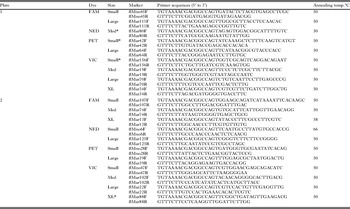
To verify that each experimental snail was only infected by M. novaezealandensis and by a single clone of that species, cercarial shedding was stimulated on 3 occasions, their DNA extracted using Chelex (Walsh et al. Reference Walsh, Metzger and Higuchi1991) and pooled, and their mitochondrial cytochrome oxidase I genes were sequenced and compared (methods detailed by Koehler et al. Reference Koehler, Springer, Keeney and Poulin2011b). No parasites other than M. novaezealandensis were detected. Then, snails infected with multiple clones of M. novaezealandensis were ruled out and genome-wide heterozygosity (percentage of heterozygous loci) was estimated by a genotyping method modified from Schuelke (Reference Schuelke2000) and Hayden et al. (Reference Hayden, Nguyen, Waterman, McMichael and Chalmers2008) involving multiplexes of 4 fluorescent dyes (NED, FAM, VIC and PET (Applied Biosystems)) and 4 product sizes. Thirty-one previously reported M. novaezealandensis microsatellite primers (Keeney et al. Reference Keeney, Waters and Poulin2006; Molecular Ecology Resources Primer Development Consortium, 2009) were altered by adding M13(-21) tags (TGTAAAACGACGGCCAGT) to the 5′ end of each primer (Schuelke, Reference Schuelke2000) and a pigtail (GTTTCTT) (Brownstein et al. Reference Brownstein, Carpten and Smith1996) to the 5′ end of each reverse primer. Each primer was assigned to one of two plates (provided in Appendix 1). Some primers were also altered to accommodate the 4 size classes. After these alterations, 20 of the 31 primers successfully amplified microsatellite regions (Appendix 1). For each of the 20 primer pairs, a PCR was performed on the 73 parasite extractions see Schuelke (Reference Schuelke2000) for PCR reaction concentrations and conditions. For both groups of primers, 2 μl of PCR product were diluted 1:20 with dH20. These were run on a 3730XL DNA Analyser machine (Applied Biosystems). Results were interpreted using the program GeneMapper v 3.7 (Applied Biosystems).
Experimental infections
Host collection
A previous study on immune reaction of the crabs Macrophthalmus hirtipes and Hemigrapsus crenulatus (H. Milne-Edwards 1837) when exposed to M. novaezealandensis, found that M. hirtipes had a greater, more pronounced immune reaction compared to H. crenulatus (Dittmer, Reference Dittmer2010); therefore M. hirtipes was selected for this study. Female M. hirtipes crabs (N=240) of similar size (mean carapace width=15·6 mm±1.44 s.d.) and reproductive status (non egg-bearing) were collected from Taieri River Mouth, Otago, New Zealand (46° 3′ 3.0″ S, 170° 11′ 24.2″ E) on 13 September 2010. This site was chosen because it has a high abundance of crabs, generally lower parasite densities than other neighbouring localities, and lacks the snail Z. subcarinatus, an important intermediate host for several trematodes in addition to M. novaezealandensis (Dittmer, Reference Dittmer2010; Dittmer et al. Reference Dittmer, Koehler, Richard, Poulin and Sicard2011; A. Koehler, unpublished observations). Parasite-naïve crabs would have been preferred for this study; however, the culturing of crabs in a sterile environment from eggs to an age where they can be infected was not a feasible option.
Infection procedures
Crabs were divided up and housed in twenty 2 L plastic containers filled with 1 L of aerated seawater, fed Ulva spp. ad libitum, and maintained at approximately 12°C. They were allowed to acclimate to their surroundings for 5 days prior to the first infections. In total, 10 trematode clones (5 with the highest heterozygosity and 5 with the lowest heterozygosity) were used to infect 20 crabs each. Infections were conducted over a 5-day period. On days 1, 3, 4, and 5 of infection, 10 control crabs that received no cercariae (sham-infected) were also included in the trial, for a total of 40 control individuals. Infections were conducted as outlined below. Crabs were contained in plastic Petri dishes (35 mm diameter by 10 mm height) filled with 1 ml of seawater. These small containers prevented any avoidance behaviour by the crabs when exposed to cercariae by confining their movements. Cercariae were added through a hole that had been drilled into the lid of the Petri dish, with a rubber band securing the lid. As before, snails were induced to shed cercariae at 25°C and 50 cercariae of a given clone were transferred, using a 0·5–10 μl pipette, to each Petri dish containing a crab. Crabs were kept at 24°C for 5 h (incubation conditions adapted from Fredensborg et al. (Reference Fredensborg, Mouritsen and Poulin2004)) to ensure that infections took place. Crabs were then transferred from their Petri dishes to 2 L white plastic containers filled with seawater and placed in an incubator set to 20°C for 48 h.
Haemolymph analysis
The immune responses of invertebrates can be measured using several methods including total haemocyte counts (THC) and circulating levels of the pro-PO molecules in the haemolymph. The use of THC to assess immunological responses was scrutinized by Söderhäll et al. (Reference Söderhäll, Bangyeekhum, Mayo and Söderhäll2003) and Kurtz (Reference Kurtz2002) because of the documented extent of variation in THC among individual hosts. However, when sources of variation are taken into account and results are treated with caution, this method still provides useful insights into immunity. Kurtz (Reference Kurtz2002) identified host developmental stage, age, gender, reproductive stage, and environment (i.e., food, stress, activity, temperature, salinity, pH, and O2 levels) as potential sources of variation. Here, each of these factors is addressed by using only non egg-bearing female crabs of similar size (age class) collected from the same locality, on the same day and maintained under identical conditions while in captivity. A prior study of host-parasite immune reaction in the same system found that THC were more reliable than pro-PO levels (Dittmer, Reference Dittmer2010), justifying the present choice of THC to measure the immune response. Nevertheless, there is no consensus regarding what post-infection THC should be. Some studies, including one using the same crab and parasite species used in this study (Dittmer, Reference Dittmer2010), found increased THC levels. The inclusion of appropriate controls to obtain suitable baseline measures is thus essential.
At the end of the 48-h period, each crab's rear pereopods were removed and 4 μl of haemolymph were collected and added to 8 μl of the anticoagulant Modified Alsever Solution (MAS) (366 mm NaCl, 9 mm EDTA, 115 mm glucose, 27 mm sodium citrate, pH 7·4 (Rodriguez et al. Reference Rodriguez, Boulo, Mialhe and Bachere1995)), and 4 μl of Trypan Blue dye (0·4% aqueous) used to stain dead cells (Sicard et al. Reference Sicard, Chevalier, De Vlechouver, Bouchon, Greve and Braquart-Varnier2010). Fifteen microlitres of this mixture were then pipetted onto a haemacytometer (Hawksley, Lancing, England) where 10 rows were counted and extrapolated to give the number of haemocytes/ml of haemolymph. Dead haemocytes, stained blue, were ignored. Counts were made by a single observer to minimize variability.
Dissections
Crabs were killed by first placing them in a −20°C freezer for 8 min followed by severing their ventral nerve cords. All tissues in each crab were thoroughly examined for macroparasites (nematodes, trematodes, acanthocephalans and parasitic isopods). Pre-existing parasites within crabs were unavoidable, although we chose a locality with low parasite loads compared to surrounding areas. In other ecological systems, concomitant infections can either increase immune reactions or suppress them (Cox, Reference Cox2001). Therefore an attempt was made to control for immune responses elicited by pre-existing parasites by including them as factors in the regression outlined below. Parasite prevalence and mean intensity (total number of parasites divided by the total number of infected hosts) were computed for each parasite species. The same observer performed all dissections.
Statistical analysis
Analyses were performed using the statistical program R v2.11.1 (R Development core team, 2010). When appropriate, data were Box-Cox transformed to meet assumptions of normality and homogeneity of variances. A one-way ANOVA was performed to detect differences among parasite clones (and versus sham-infected control crabs) in the host immune response they elicited, measured as haemocyte count. A multiple linear regression was used to assess the respective influence of crab size, heterozygosity level of the trematode clone, and numbers of each pre-existing parasite species on haemocyte counts among individual crabs; control crabs were excluded, i.e. the multiple regression included only crabs exposed to M. novaezealandensis. Clone identity itself could not be added to the multiple regression because of collinearity with heterozygosity.
RESULTS
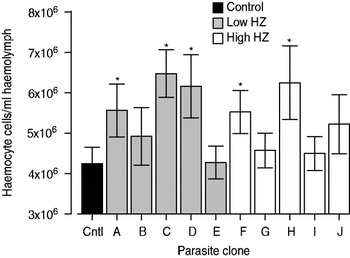
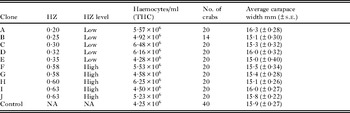
The Average Total Haemocyte Counts (THC) per individual crab ranged from 4·25×106 for the control group to 6·48×106 for crabs exposed to clone ‘C’ (Table 1); therefore, all groups of exposed crabs showed higher THC than control crabs, by up to about 50% in some cases. Indeed, the one-way ANOVA shows a significant difference in haemocyte levels among groups, more specifically between some of the clones and the control group (F 10,223=1·885, P=0·048) (Fig. 1). Heterozygosities of the M. novaezealandensis clones from 73 infected snails, at 20 microsatellite loci, ranged from 20·0% to 63·2% with an average of 46·7%±1·2 (Table 1).
Average total haemocyte count (THC) of the host, Macrophthalmus hirtipes, when exposed to 50 Maritrema novaezealandensis cercariae from 5 low heterozygosity clones (Low HZ) and 5 high heterozygosity clones (High HZ), and values for an unexposed control group. Asterisks (*) indicate which clones have THCs significantly different from the control group (P<0·05). Error bars=s.e.

Summary data on heterozygosity (HZ), average total haemocyte counts (THC), and host size associated with clones of the parasite Maritrema novaezealandensis in experimental infections of the host Macrophthalmus hirtipes

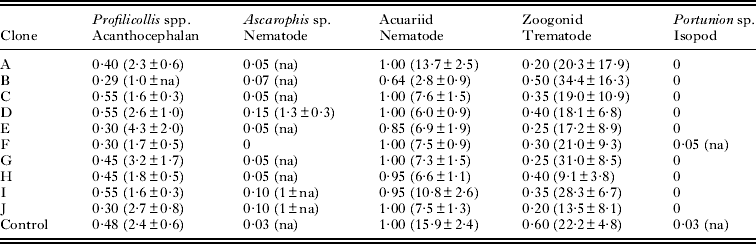
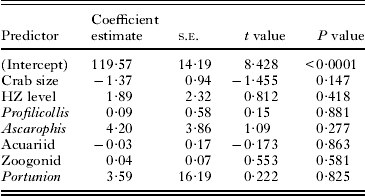
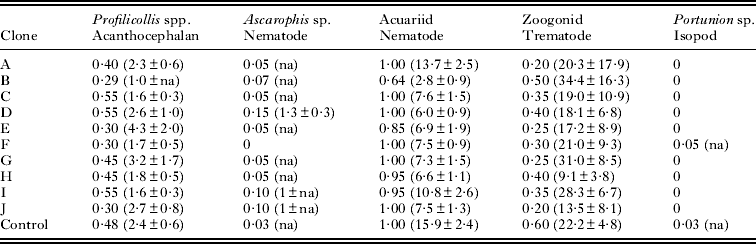
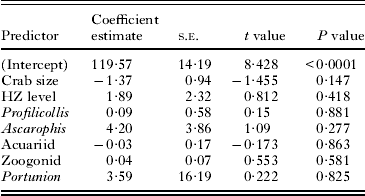
The dissections revealed that pre-existing parasites were abundant. Acuariid nematodes were the most common parasites found in the crabs, followed by the acanthocephalan Profilicollis spp. and an unidentified zoogonid trematode, while the nematode Ascarophis sp. and the parasitic isopod Portunion sp. were more rare (Table 2). The multiple linear regression shows that none of these pre-existing parasites had a significant influence on immune variation among crabs (Table 3). Further, crab size and heterozygosity level of the M. novaezealandensis clone to which they were exposed also did not significantly influence variation in immune response (haemocyte count, THC) among exposed crabs (Table 3).
Prevalence and mean intensity (in parentheses, ±s.e.) of pre-existing parasites found in the crabs infected by each of the Maritrema novaezealandensis clones and in control crabs
Summary of multiple linear regression with haemocyte count as the response variable and crab size, heterozygosity (HZ) level (high or low) of the Maritrema novaezealandensis clone used, and pre-existing numbers of other parasites as predictor variables
DISCUSSION
The goals of this study were to assess the variability of immune reaction among crabs exposed to the 10 Maritrema novaezealandensis clones, to test whether the HFC hypothesis predicting an association between immune reaction and 2 levels of parasite heterozygosity is supported in this system, and to see how the presence of other pre-existing parasites influences the immune response. With variability in host developmental stage, age, gender, reproductive stage, and environment excluded from the experiment, we found that immune reaction varied among the crab hosts exposed to the 10 different parasite clones. All parasite clones elicited an increase in haemocyte counts, although no relationship was found between either parasite heterozygosity and host immune response, or infection by pre-existing parasites and immune response.
Variability of immune response among clones
The increase in THC following exposure to parasites agrees with results from a previous study on this system (Dittmer, Reference Dittmer2010) and several other studies that have examined post-exposure invertebrate THC levels (Nappi, Reference Nappi1981; Sequeira et al. Reference Sequeira, Tavares and Arala-Chaves1996; Eslin and Prévost, Reference Eslin and Prévost1998; Kraaijeveld et al. Reference Kraaijeveld, Limentani and Godfray2001). However, the increase observed here contrasts with other studies showing a decrease in THC (Hillyer et al. Reference Hillyer, Schmidt, Fuchs, Boyle and Christensen2005; Cornet et al. 2009) and still others showing an initial decrease followed by a return to prior levels (Persson et al. Reference Persson, Cerenius and Soderhall1987; Lorenzon et al. Reference Lorenzon, de Guarrini, Smith and Ferrero1999). This discrepancy can be attributed to a number of possible factors. Haemocytes are produced by haematopoietic tissue and are released into the haemolymph via unknown mechanisms (Jiravanichpaisal et al. Reference Jiravanichpaisal, Lee and Söderhäll2006). Most of the studies measuring haemocyte counts in crustaceans involve bacterial and viral pathogens as these are of most concern to the aquaculture industry (Jiravanichpaisal et al. Reference Jiravanichpaisal, Lee and Söderhäll2006), yet these studies using microparasites might not be comparable to the current study where relatively large cercariae serve as the invading pathogen. The timing of the THC may also contribute to the observation of either an increase or decrease in counts. Several studies performed counts within minutes to hours post-exposure and found immediate decreases in THC (Persson et al. Reference Persson, Cerenius and Soderhall1987; Lorenzon et al. Reference Lorenzon, de Guarrini, Smith and Ferrero1999). One study that used acanthocephalans and isopods included a period of several weeks post-exposure before measurement of THC and found an overall decrease, which could be attributed to declining host health (Cornet et al. 2009). In the current study, counts were only taken after a period of 48 h to allow for the cercariae to penetrate the host and migrate into the haemolymph. At that time, THC counts in crabs exposed to cercariae were consistently higher than in control crabs, with different parasite clones eliciting THC increases of different magnitudes.
Heterozygosity fitness correlation and immune response
The current study attempted to see if the heterozygosity of the parasite influenced the immune response elicited in the host, as an extension of the general heterozygosity–fitness correlation (Chapman et al. Reference Chapman, Nakagawa, Coltman, Slate and Sheldon2009) that suggests organisms with higher heterozygosities have higher fitness levels. An earlier study on Maritrema novaezealandensis (Koehler et al. Reference Koehler, Gonchar and Poulin2011a) found that infection success was significantly greater for clones with low heterozygosity than those with high heterozygosity in one amphipod host, but not in a different amphipod species. Another study (Koehler et al. Reference Koehler, Springer, Keeney and Poulin2011b) on M. novaezealandensis found no relationship between clone heterozygosity and various phenotypic measurements of the cercariae that may relate to infection success. The results herein do not support the hypothesis that parasites with higher heterozygosities achieve a higher fitness by eliciting lower immune responses. This expectation was based on the assumption that clones possessing high heterozygosities would be more adept at evading immune responses than low-heterozygosity clones. Instead, no significant difference in the crab immune response elicited by parasite clones with high and low heterozygosities was found. These results concern only the cellular immune response, and it is possible that a different pattern applies to the humoral response involving melanization of invading pathogens. Evidence of differential immune reactions, where some cercariae or other helminth larvae are melanized and others not, has been reported for a number of host/parasite associations (Thomas et al. Reference Thomas, Renaud, Rousset, Cezilly and de Meeûs1995, Reference Thomas, Guldner and Renaud2000; Le Moullac and Hafner, Reference Le Moullac and Haffner2000; Rigaud and Moret, Reference Rigaud and Moret2003; Kostadinova and Mavrodieva, Reference Kostadinova and Mavrodieva2005). Partial melanization is also seen with M. novaezealandensis in multiple crustacean host species (Bryan-Walker et al. Reference Bryan-Walker, Leung and Poulin2007; Koehler and Poulin, Reference Koehler and Poulin2010). No studies have used single genotype infections to determine whether certain parasite strains are more susceptible to melanization than others. However, Seppälä et al. (Reference Seppälä, Karvonen and Valtonen2007) exposed cercariae (presumably from single-genotype infections) to fish and found variable infectivity suggesting a genetic basis for this variability. Based on the results from this study, the heterozygosity–fitness correlation does not help to explain the variation. If immune variability does have a genetic basis, genome-wide heterozygosity may not be reflective of potential genes that are actually involved in the parasite's immune evasion. Although Dittmer (Reference Dittmer2010) measured the pro-PO enzyme cascade involved in melanization and found it much less responsive to trematode infections compared to THC, additional attempts at using methods to quantify pro-PO should be considered in future studies.
Concomitant parasitic infections and immune response
Pre-existing parasite infections did not influence the host's immune reaction to experimental exposure to M. novaezealandensis, a finding that supports the results of Dittmer (Reference Dittmer2010). Interspecific interactions between parasites that infect hosts with pre-established infections have been shown to either increase infectivity (from depleted host immune responses) or decrease infectivity (through resource competition or elevated host immune responses) (Seppälä et al. Reference Seppälä, Karvonen, Valtonen and Jokela2009). However, the majority of studies investigating concomitant parasite infections have involved vertebrate immune systems (Cox, Reference Cox2001; Bordes and Morand, Reference Bordes and Morand2009; Seppälä et al. Reference Seppälä, Karvonen, Valtonen and Jokela2009) which, given adaptive immunity, are more complex and not comparable to invertebrate immune systems. Studies focused on invertebrates typically involve interactions between helminths and microparasites such as protozoa, bacteria or viruses and rarely interactions among helminths (Thomas et al. Reference Thomas, Watson and Valverde-Garcia2003). In this study, M. novaezealandensis was the only parasite with an experimentally controlled infection intensity level, as all other parasites were from wild infections. Because parasite-naïve crabs were not used we cannot rule out the possibility that the pre-existing parasites had altered the crab's immune system prior to infection with M. novaezealandensis. Inferences from experimentally controlled studies provide solid evidence whereas studies using natural infections provide only circumstantial evidence (Poulin, Reference Poulin2001).
In summary, immune responses were successfully induced in crabs by exposure to cercariae, there were interclonal differences among the parasites in immune response elicited, haemocyte counts in exposed crabs did not correlate with parasite heterozygosity, and there was no evidence that the presence of other parasite species in the hosts influenced their immune response to newly-acquired cercariae. Future studies could benefit from using different measures of immunity. It may also be informative to allow infections to reach the metacercarial stage in the crustacean host, to enable the proper measurement of infection success. In addition, it would be interesting to see how immune responses vary among multiple host species with differing capacities of melanization. Finally, the use of a host-parasite system with a parthenogenetic crustacean host such as the Marmorkrebs crayfish (Scholtz et al. Reference Scholtz, Braband, Tolley, Reimann, Mittmann, Lukhaup, Steuerwald and Vogt2003) would allow for more sophisticated host-genotype X parasite-genotype experimental designs. All these would be promising ways to build on the present results demonstrating interclonal (i.e. genetic) differences in the magnitude of immune responses elicited by parasites in their crustacean hosts.
ACKNOWLEDGEMENTS
We thank L. Kremer, J. Nelles, J. Dittmer, K. Judge, T. King, and S. Townsend for technical assistance and advice. We thank B. Presswell for comments on an earlier draft of this manuscript.
FINANCIAL SUPPORT
This project was funded by a Marsden Fund (Royal Society of New Zealand) grant awarded to R.P. and Devon Keeney.
Microsatellite primers for Maritrema novaezealandensis