Introduction
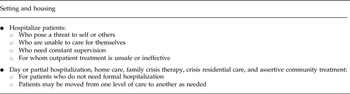
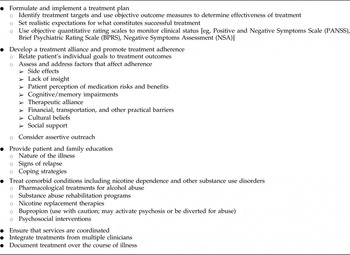
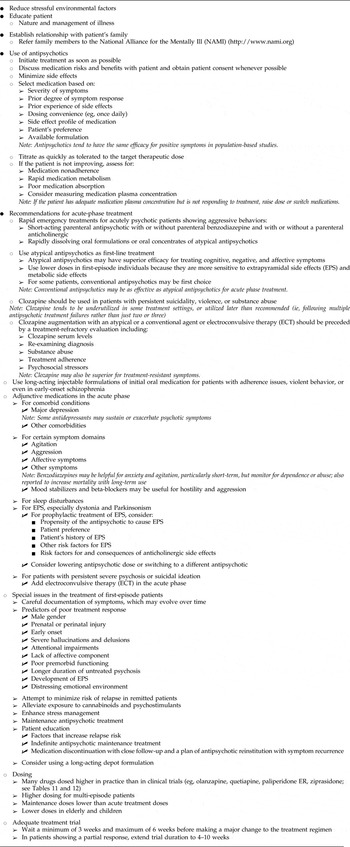
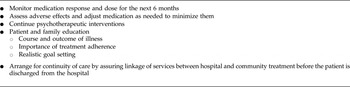
Managing patients with schizophrenia can be challenging, even for the most experienced of clinicians. Over the past decade, numerous experts in various countries have made recommendations in a number of published guidelines.1–Reference Kreyenbuhl, Buchanan and Dickerson8 In addition, many institutions and hospitals have their own unpublished versions of guidelines for how to treat patients with schizophrenia. Often these recommendations contradict one another and are quickly out of date as the ever-increasing influx of new data accumulate and novel therapeutic agents are made available. In the “meta-guidelines” presented here, we have collected recommendations from various sources, both published and unpublished, and have updated and reconciled the differences from the Patient Outcomes Research Team (PORT), the Texas Medication Algorithm Project (TMAP), the American Psychiatric Association (APA), various state and federal hospitals, and current experts with decades of experience in treating this patient population in order to create an up-to-date “guideline of guidelines.” These meta-guidelines have also been extensively reviewed by a number of anonymous peer reviewers. The goal was to create a comprehensive yet concise set of meta-guidelines that reflects all the current data in order to provide clinicians with an aid in the management of patients with schizophrenia at different stages of illness, including acute and maintenance phases. Although clinical judgment must be exercised in the care of individual patients, these meta-guidelines may serve to assist clinicians in choosing the most evidence-based and up-to-date strategies for addressing treatment selection, medication-induced side effects, treatment nonadherence, and other issues commonly encountered in treating patients with schizophrenia. These meta-guidelines are intended for rank-and-file patients with schizophrenia who are not violent, self-harming, or complicated by various comorbidities, as such patients are excluded from most evidence-based randomized controlled efficacy trials that are the basis of both previously published guidelines and also of the meta-guidelines provided here.1–Reference Kreyenbuhl, Buchanan and Dickerson8 We will provide separate meta-guidelines for more complex, yet commonly encountered patients with schizophrenia, for use and guidance for what to do when the meta-guidelines provided here fail to provide adequate outcomes.Reference Stahl9–Reference Ritsner14 The meta-guidelines are presented here as Tables 1–15 and Figure 1.
Overview and key points

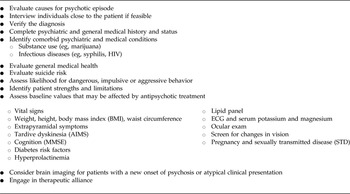
Assessment

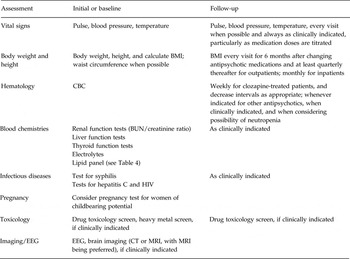
Suggested physical and laboratory assessments to monitor physical status and detect concomitant physical conditions in patients with schizophrenia

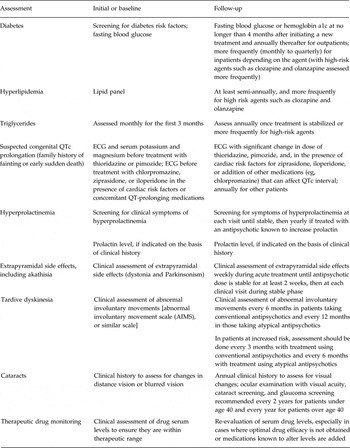
Suggested physical and laboratory assessments to monitor possible treatment-induced side effects in patients with schizophrenia

Treatment

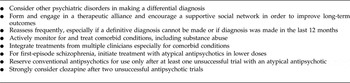
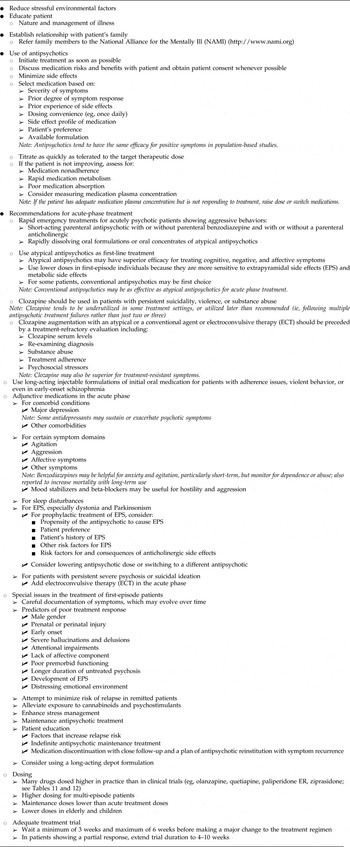
Treatment plan

Acute-phase treatment
Stabilization phase treatment

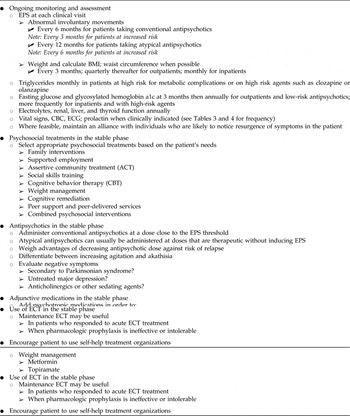
Stable phase treatment

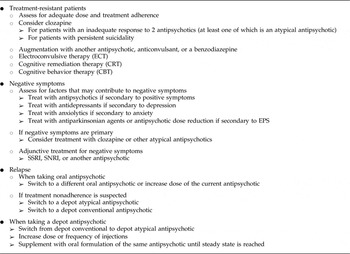
Treatment in special circumstances

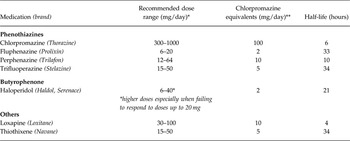
Commonly used medications: conventional antipsychotics

*Dose range recommendations are adapted from the 2009 Schizophrenia Patient Outcome Research Team recommendations.Reference Dixon, Perkins and Calmes5–Reference Kreyenbuhl, Buchanan and Dickerson8 See full prescribing information for details.
**Chlorpromazine equivalents represent the approximate dose equivalent to 100 mg of chlorpromazine (relative potency).
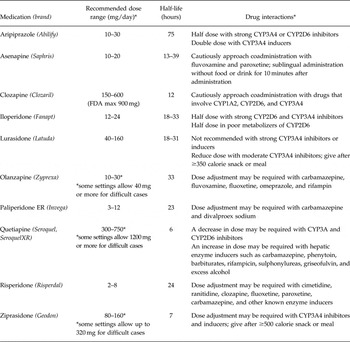
Commonly used medications: atypical antipsychotics

*Dose range recommendations are adapted from the 2009 Schizophrenia Patient Outcome Research Team recommendations.Reference Dixon, Perkins and Calmes5–Reference Kreyenbuhl, Buchanan and Dickerson8 See full prescribing information for details.
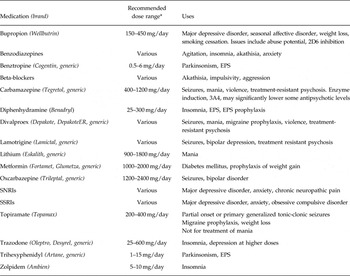
Commonly used medications: other

*Dose range recommendations are adapted from the 2009 Schizophrenia Patient Outcome Research Team recommendations.Reference Dixon, Perkins and Calmes5–Reference Kreyenbuhl, Buchanan and Dickerson8 See full prescribing information for details.
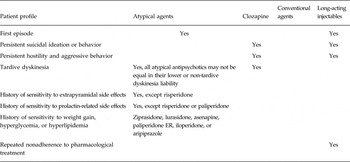
Choice of medication in the acute phase of schizophrenia

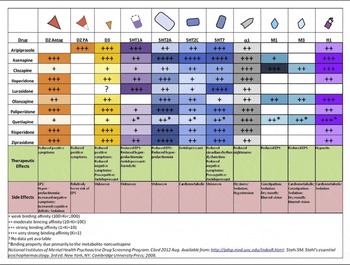
Receptor-binding profiles of atypical antipsychotics

Abbreviations: BMI, body mass index; BUN, blood urea nitrogen; CBC, complete blood count; CBT, cognitive behavioral therapy; CRT, cognitive remediation therapy; CT, computerized tomography; ECG, electrocardiogram; ECT, electroconvulsive therapy; EEG, electroencephalogram; EPS, extrapyramidal symptoms; MRI, magnetic resonance imaging; NMS, neuroleptic malignant syndrome; SNRI, serotonin norepinephrine re-uptake inhibitor; SSRI, selective serotonin re-uptake inhibitor.
Antipsychotic algorithm for schizophrenia. For many acute inpatient settings with limited lengths of stay, trials of antipsychotics may be only 2–3 weeks prior to trying another. Many clinicians do not proceed to clozapine at all or until multiple failures with other antipsychotics; clozapine can be underutilized when this is the case. Response is generally defined as a clinically significant reduction in symptoms, eg, a modest 20% reduction in Positive and Negative Symptom Scale (PANSS) score observed at 2 weeks can predict a more robust 40% decrease in PANSS at 6 months. Lack of any response at 2 weeks is discouraging and requires reevaluation, including compliance and pharmacokinetics/therapeutic drug levels.

Disclosures
Stephen Stahl has the following disclosures: Avanir, consultant, consulting fees; Biomarin, consultant, consulting fees; Forest, consultant, consulting fees; Genetech, consultant, consulting fees; Genomind, consultant, consulting fees; GSK, consultant, consulting fees; Jazz, consultant, consulting fees; Merck, consultant, consulting fees; Navigant, consultant, consulting fees; Novartis, consultant, consulting fees; Noveida Health, consultant, consulting fees; Otsuka, consultant, consulting fees; PamLambs, consultant, consulting fees; Reviva, consultant, consulting fees; Shire, consultant, consulting fees; Sunovion, consultant, consulting fees; Teva, consultant, consulting fees; Trius, consultant, consulting fees; Arbor Scientia, speakers bureau, speakers fee; Genomind, speakers bureau, speakers fee; Janssen, speakers bureau, speakers fee; Lilly, speakers bureau, speakers fee; Neuroscience Education Institute; PamLabs, speakers bureau, speakers fee; Pfizer, speakers bureau, speakers fee; Avanir, grant recipient, grant; Cenerex, grant recipient, grant; Dey Pharma, grant recipient, grant; Eli Lilly, grant recipient, grant; Forest, grant recipient, grant; Genomind, grant recipient, grant; Mylan, grant recipient, grant; Otsuka, grant recipient, grant; PamLabs, grant recipient, grant; Servier, grant recipient, grant; Shire, grant recipient, grant; Sunovion, grant recipient, grant; Takeda, grant recipient, grant. Dr. Stahl is also a board member of RCT Logic and GenoMind. Leslie Citrome has the following disclosures: Alexza, consultant, consultant fees; Alkermes, consultant, consultant fees; Avanir, consultant, consultant fees; Bristol-Myers Squibb, consultant, speaker, consultant and speaker fees, small amount of common stock; Eli Lilly, speaker, speaker fees, small amount of common stock; Envivo, consultant, consultant fees; Forest, consultant, consultant fees; Genentech, consultant, consultant fees; Janssen, consultant, consultant fees; Lundbeck, consultant, consultant fees; Merck, speaker, speaker fees, small amount of common stock; Mylan, consultant, consultant fees; Novartis, consultant, speaker, consultant and speaker fees; Noven, consultant, consultant fees; Otsuka, consultant, speaker, consultant and speaker fees; Pfizer, speaker, speaker fees, small amount of common stock; Shire, consultant, consultant fees; Sunovion, consultant, speaker, consultant and speaker fees; J&J, small amount of common stock; AstraZeneca, speaker, speaker fees. Stephen Saklad has the following disclosures: Merck, speaker's bureau, honoraria; Novartis, speaker's bureau, honoraria; Sunovion, speaker's bureau, honoraria; Janssen, research (grant recipient), research support (grant). Jonathan Meyer has the following disclosures: Sunovion, speaker's bureau, speaker's fees; BMS, speaker's bureau, speaker's fees; Genetech, advisor, consulting fees; Otsuka, advisor, consulting fees. The remaining authors do not have anything to disclose.