Implications
Low and variable intake of fresh herbage is a strong constraint of milk production in grazing high genetic merit dairy cows in temperate climates. This paper aimed to test the hypothesis that rumen fill could be a determinant of intake in dairy cows offered pasture, even with highly digestible pasture. These results should contribute to a better understanding of the constraints involved in the low intake of grazing dairy cows, which will help to improve the prediction of daily intake variation and build new criteria for assessing sward quality.
Introduction
In temperate grazing systems, low and variable intake of fresh herbage has been reported as a strong constraint of milk production in grazing high genetic merit dairy cows. Grass swards offered generally are of good nutritional value (Kolver, Reference Kolver2003). Perennial ryegrass grazed in spring can easily exceed 7.0 MJ of net energy for lactation (NEL)/kg of dry matter (DM) with a digestibility of 0.80 (Institut National de la Recherche Agronomique, 2007). Achieving a better understanding of the constraints involved in the low intake of grazing dairy cows will help improve the prediction of daily intake variation and build new criteria for assessing both sward and herbage quality. Distension of the reticulo-rumen could be a strong constraint on intake in grazing dairy cows. Even on highly digestible sward, NDF content of ingested herbage largely exceeds 25% DM, the limit above which NDF content has a negative impact on intake via distension of the reticulo-rumen (Allen, Reference Allen2000). It has also been observed that the reticulo-rumen of grazing cows can contain large amounts of digesta at the end of the day, suggesting that the cows have reached a maximum ruminal capacity of digesta (Taweel et al., Reference Taweel, Tas, Dijkstra and Tamminga2004). However, it is also known that the role of rumen fill in intake regulation increases with decreasing digestibility (Dove, Reference Dove1996) and the sward digestibility grazed by dairy cows can be higher than that of most other forages used. More specifically, the filling effect of NDF from high quality herbage could be low, given that the NDF digestibility of such forage estimated in sacco can reach values in excess of 0.75 (Salaün et al., Reference Salaün, Van Straalen, Kogut, Peyraud and Van Vuuren1999). The predominance of constraints from reticulo-rumen distension relative to other constraints such as the amount of energy absorbed during digestion, remain to be demonstrated in the context of dairy cows grazing highly digestible swards.
Studies have shown that rumen fill clearly impacted the feeding behavior of grazing beef heifers (Gregorini et al., Reference Gregorini, Gunter, Masino and Beck2007) or dairy cows (Chilibroste, Reference Chilibroste1999) but they did not evaluate the impact of rumen fill on daily intake. In these studies, rumen fill was modified either by physical removal of a proportion of rumen contents (Gregorini et al., Reference Gregorini, Gunter, Masino and Beck2007) or by addition of inert bulk in the rumen (Chilibroste, Reference Chilibroste1999) and, effects on feeding behavior were measured during short periods, i.e. less than 48 h. In experiments with longer observation periods, but with diets based on conserved forage, it has been observed that dairy cows can partially adapt to an artificial rumen fill by increasing their chewing time per ingested unit or total rumen contents and modifying the pattern of eating and ruminating bouts (Dado and Allen, Reference Dado and Allen1995; Johnson and Combs, Reference Johnson and Combs1991 and Reference Johnson and Combs1992). The specific need of grazing ruminants to grasp the herbage can cause low intake rates (Penning et al., Reference Penning, Parsons, Orr and Treacher1991; Hodgson et al., Reference Hodgson, Clark and Mitchell1994) and thus limit the possibility of behavioral adaptation of cows in response to rumen fill constraints. This suggests that the impact of rumen fill on intake of grazing ruminants would have to be tested during periods long enough to let the ruminants adapt to the rumen fill constraint, and with grazed herbage rather than herbage offered indoors even though offering fresh herbage indoors allows a better measurement of intake. Intake of fresh herbage offered indoors is used to estimate the Fill Unit value of a forage in the French system of Fill Units (INRA, 2007), even for forages intended to be grazed. Indoor feeding of fresh herbage is also often used as a model of grazing for studies aimed at measuring the dynamics of particle transit through the reticulo-rumen or digestion flows of nutrients in dairy cows.
The age of the dairy cows may also largely affect their ability to adapt to high-fill diets. The ingestion of the younger cows may potentially be hampered by behavioral constraints. Bao et al. (Reference Bao, Giller and Kett1992) observed that grazing time during the day increased as cow parity, and thus age, decreased. The authors linked this relationship to a dominant relationship between the mature and the younger cows that made the younger cows change position more often during grazing. Changes to cows’ dentition with age, i.e. an increase in incisor arcade breadth and total occlusal area, may also be directly responsible for reduced chewing efficiency in younger cows, as illustrated by their lower intake rate or their higher frequency of jaw movements (Perez-Barberia and Gordon, Reference Perez-Barberia and Gordon1998). It has been clearly shown that dairy cows challenged with an inert rumen fill increased their chewing time per kg of dry matter intake (DMI), their rumen fill and the fractional passage rate of fiber from the rumen in such a way as to maintain high intake (Dado and Allen, Reference Dado and Allen1995). It is unclear, however, if younger cows have sufficient capacity to increase their fractional passage rate to maintain intake when challenged with rumen inert bulk (RIB) on high-fill diets.
The aim of this study was (i) to assess the importance of rumen fill in the short-term intake regulation of dairy cows offered highly digestible fresh ryegrass, (ii) to determine the effect of feeding methods (indoor feeding v. grazing), (iii) to evaluate potential cow age effects on the responses of chewing behavior and intake to rumen fill. The impact of rumen fill on intake was evaluated by addition of RIB consisting of coconut fiber compared to a control. This method seemed more specific than physical removal of rumen contents that can affect the dynamics of nutrients absorption (Faverdin et al., Reference Faverdin, Baumont and Ingvartsen1995). It was also assumed that the structure of hydrated and ground coconut would better mimic the structure of ruminal content and would avoid an excessive stimulation of the tactile receptors of the rumen wall compared to the control.
Material and methods
Cows, treatments and experimental design
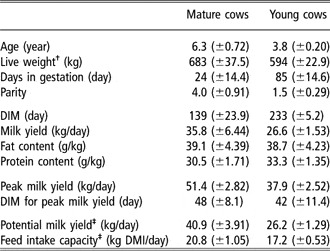
Four mature (6.3 ± 0.72 years old) and four young (3.8 ± 0.20 years old) Holstein cows in mid-lactation were blocked by age. Their milk yield was measured during a pre-experimental period (11 days) where all cows were offered perennial ryegrass ad libitum indoors. Mature cow milk yield was 35.8 (±6.44) kg/day and cows were 139 (±23.9) days in milk. Younger cow milk yield was 26.6 (±1.53) kg/day and cows were 233 (±5.2) days in milk (Table 1). The eight cows were fitted with large ruminal cannula (i.d., 123 mm), at least 1 year before the start of the experiment. Procedures relating to surgery, care and use of animals for the experiment were approved by an animal-care committee of the French Ministry of Agriculture, in accordance with French regulations (Decree-law 2001-464, May 29, 2001).
Age, live weight and milk yield characteristics of the cows during the week preceding the experiment (values in brackets represent standard deviations)

DIM = days in milk; DMI = dry matter intake.
†Live weight before am milking.
‡Calculated according to INRA (2007).
The experimental design comprised of two 4 × 4 Latin squares with four 14-day periods, along with four treatments, which consisted of a 2 × 2 factorial arrangement of two feeding methods (indoor feeding v. grazing) of fresh perennial ryegrass and the addition – or not – of a RIB in the rumen (RIB v. control). The first Latin square was applied to the four mature cows and the second one to the four young cows. Each period consisted of a 7-day adaptation period to treatment and a 7-day measurement period. Both feeding methods were compared each day on the same plots of ryegrass with similar cutting or defoliation heights for indoor feeding or grazing. The RIB consisted of long and almost indigestible coconut fiber (NDF = 92 g/100 g DM; ADL = 53 g/100 g DM; in sacco DM disappearance rate = 0.0%/h over 360 h; density of the hydrated fiber = 0.95) placed in 13 Dacron bags. The bags measured 125 × 600 mm and contained 350 g DM each before washing. The Dacron pore size was 50 μm. The mean volume added by RIB was estimated at 18 l, before the experiment, by dipping the soaked bags in water and measuring the volume of displaced water. The coconut fiber was chosen because it has high water-holding capacity and very low digestibility.
Sward management and animal feeding
The cows were offered a pure perennial ryegrass pasture (Lolium perenne L. var. Ohio) at Méjussaume farm (INRA Le Rheu, France – 48°06′10″N 01°47′39″W; 60 m above sea level). Four adjacent plots were separated and used successively throughout the experiment. Each plot was used for 7 days for indoor feeding or grazing and plots were mown every 28 days. To ensure that the herbage offered indoors and the grazed grass were as similar as possible, each plot was subdivided into two subplots, one for indoor feeding and the other for grazing. The grass offered for all treatments had 21 days of re-growth on the first day of each week. All paddocks were fertilized with 60 kg N/ha after mowing.
The four cows fed indoors were housed in individual stalls with individual troughs, on rubber mats, in an artificially ventilated barn, with free access to water. For these cows, ryegrass was harvested by a mower (capacity = 6 m3; cut width = 1.5 m) twice a day (0600 and 1400 h), in order to simulate variations in the chemical composition of pasture throughout the day (Delagarde et al., Reference Delagarde, Peyraud, Delaby and Faverdin2000) and to obtain an average daily chemical composition of herbage offered similar to that of ryegrass ingested by grazing. Cut ryegrass was offered ad libitum seven times during the day (0630, 0830, 0930, 1100, 1500, 1900 and 2030 h). Freshly harvested herbage was offered after 0830 h and 1900 h and the remainder was stored at 4°C before being offered. Refusals were collected at 1800 and 0830 h. The amount offered was calculated to give at least 10% refusals. The cut height was set at half that of the pre-cut height measured with a rising plate meter (30 × 30 cm base; 50 measurements per day). Artificial light of the barn was off during the night between 2030 and 0630 h. Sunrise and sunset times were 0650 and 2120 h on the first day of the experiment and 0610 and 2210 h on the last day.
Grazing cows were given access to a new paddock on a daily basis, at 0830 h, after the morning milking, using an electric fence. Cows had free access to water at all times. Paddock size was adjusted to provide a pasture allowance per cow of 45 kg DM/day at ground level, which corresponded to approximately to 23.5 kg DM/day above 5 cm. This pasture allowance was assumed to provide herbage ad libitum to the cows and to give a post-grazing sward height equal to 0.5 times the pre-grazing height (Delagarde and O’Donovan, Reference Delagarde and O’Donovan2005). Daily pasture allowance was estimated as the product of the height and the density of the pasture, expressed in cm and g DM/cm per ha, respectively. The density was the ratio between the herbage mass to ground level and the height (rising plate meter) of the sward to be grazed. The height of the sward was measured each day with a rising plate meter (30 × 30 cm base; 50 measurements) in the afternoon for the sward to be grazed the following day. Herbage mass to ground level was determined twice a week according to Ribeiro Filho et al. (Reference Ribeiro Filho, Delagarde and Peyraud2003).
Pre- and post-cut/post-grazing sward heights were measured daily with a rising plate meter, with 50 measurements per sub-paddock, taken randomly. For both feeding methods, the pre-cut/pre-grazing extended height of the longest leaf blade and the longest sheath were measured with a ruler on 100 random tillers of ryegrass, on days 8 and 11 of each period. Post-cut/post-grazing longest leaf and sheath extended heights were measured on days 9 and 13, on 200 tillers.
Intake and milk yield
For cows fed indoors, DMI was determined daily by weighing ryegrass offered and refused. Each day, representative samples of the grass offered indoors were oven-dried in duplicate for the determination of DM content (80°C, 48 h), along with subsequent CP content analysis. Samples were also frozen and freeze-dried for determination of fiber, CP, non-structural carbohydrates (NSC), lipids and in vitro organic matter digestibility (IVOMD). These samples were gathered for each cow and period, from day 8 to day 12.
For both indoor feeding and grazing, DMI was also determined from fecal output estimated with ytterbium (Yb) oxide and the organic matter digestibility (OMD) of the herbage obtained from the herbage ADF and CP contents (Peyraud, Reference Peyraud1998). Each day, all cows were dosed through the rumen fistulae with 300 g of concentrate, with 0.5% YbO and 200 g of minerals (5 g/100 g P, 18 g/100 g Ca and 10 g/100 g Mg), divided twice a day, after the morning and evening milking. An amount of 60 g of colored particles was also administrated to the grazing cows, with one color per cow to identify the feces in the field for fecal sampling. Fecal samples were collected from day 9 to day 13 of each period. Fecal samples were collected, continuously from 0700 to 2100 h in the tie-stalls for indoor feeding and at 2100 h from all feces in the paddocks for grazing. The fecal samples were oven-dried to determine DM content (80°C for 72 h), and gathered for each cow and period at the end of the experiment for CP, fiber and Yb analyses.
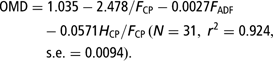
The OMD (g/g OM) was calculated from the CP content of the ingested herbage (CPherbage, g/100 g OM; oven-dried samples) and the fecal contents of CP and ADF (CPFeces, ADFFeces, g/100 g OM), according to the equation established by J.-L. Peyraud et al. (unpublished results) on dairy cows offered pure perennial ryegrass:
To obtain representative samples of the grazed herbage, on each day of feces collection, 15 handfuls of grass as selected herbage were cut to ground level with hand shears, in the paddock, before the entry of the cows in the morning. The samples were bulked and arranged correctly in a large metallic tray to keep the sward structure undamaged, and then immediately frozen. At the end of the experiment, the frozen samples were bulked per period and cut at a height equal to the mean post-grazing extended height of the defoliated tillers. The upper portion was oven-dried for the determination of the DM (80°C, 48 h) and CP contents and freeze-dried for the determination of fiber, CP, NSC, lipids and IVOMD.
All cows were milked twice a day at 0730 h and 1730 h. Milk yield was recorded daily, am and pm, and sampled on five consecutive days during the intake measurement period. Milk samples were preserved with potassium dichromate, stored at 4°C and analyzed for milk fat and protein determination by using an infrared analyzer (Milk-O-Scan 605; Foss Electric, Hillerød, Denmark).
Feeding behavior
The daily patterns of eating and ruminating times were measured automatically over 24 h by recording the jaw movements with a portable device (Brun et al., Reference Brun, Prache and Bechet1984). All cows were equipped simultaneously during the whole week of measurement of each period. A rumination bout was defined as a succession of at least five boli, defined as a regular combination of a sequence of 2.5 s without jaw movements (regurgitation of the bolus) and subsequent sequences of 2.5 s with jaw movements. A meal was defined as a period not included in the rumination bouts, containing at least half of 2.5 sequences with jaw movements, lasting at least 7 min and separated from another meal by at least 7 min. The average time spent eating or ruminating per kilogram of DMI was calculated by dividing the mean daily DMI estimated with Yb by the total daily time of each activity (eating or ruminating). The unitary eating and ruminating times were calculated as the ratio of daily eating or ruminating time to the DMI estimated with Yb. The average intake rate was estimated by dividing the daily DMI estimated with Yb by the daily eating time.
Rumen emptying, particle size of the rumen contents and ingestive boli, and rumen liquid passage rate
Reticulo-rumen digesta were manually emptied from rumen and weighed on days 13 and 14 of each measurement period at 0830 and 2030 h, respectively. The RIB, if present, was removed with digesta and weighed independently. The total digesta of each cow was manually mixed and a 5% weight sample of total rumen contents was taken. Before refilling the rumen, ingestive boli were collected directly at the cardia, through the rumen cannula while the cows were eating ryegrass either indoors or at grazing. To achieve this, a small meal of fresh ryegrass was offered indoors and a small area of pasture was given to the grazing cows. The two or three first boli were discarded and the 15 following were collected, individually weighed and then gathered. A portion of the samples of rumen contents and boli was used for DM determination (80°C forced-air oven for 72 h); the remainder was frozen (−20°C) for chemical analyses and determination of particle size distribution.
Particle size distribution of rumen contents and ingestive boli was analyzed by wet sieving as described by Boudon et al. (Reference Boudon, Acosta, Delagarde and Peyraud2006), using a vertical oscillating sieve shaker (Analysette 3, Fritsch). Sieve pore sizes were 4, 2, 1, 0.5, 0.25, 0.125 and 0.0625 mm for rumen contents and 16, 8, 4, 2, 1 and 0.0625 mm for ingestive boli. Each sample of rumen digesta was sieved in duplicate. The percent DM passing through the 0.0625 mm screen was calculated by difference and considered as the soluble fraction.
In order to determine the rumen liquid passage rate, on day 12 of each period, all cows were dosed with 50 g of LiCo(II)EDTA (Uden et al., Reference Uden, Colucci and VanSoest1980) diluted in 2 l of water at 0630 h through the rumen fistulae. Liquid passage rate was estimated from the declining slope of the natural logarithm of marker concentration (Co) in the rumen contents over time. On the same day, rumen fluid was collected eight times (0700, 0900, 1100, 1300, 1500, 1700, 1900 and 2100 h) and at each collection time, 10 ml of strained rumen fluid was centrifuged and frozen at −20°C for Co analysis.
Chemical analyses
Chemical analyses of offered herbage, refusals and feces were performed on oven-dried samples after grinding through a 0.8-mm screen. Ash, fiber (NDF, ADF and ADL), CP, NSC contents along with IVOMD were analyzed using the methods cited by Boudon et al. (Reference Boudon, Acosta, Delagarde and Peyraud2006) and Delagarde et al. (Reference Delagarde, Peyraud, Delaby and Faverdin2000). Yb content was determined according to Siddons et al. (Reference Siddons, Paradine, Beever and Cornell1985). Cobalt concentration was analyzed according to the flame atomic absorption spectrometry analytical method (Varian, Varian Australia Pty Ltd, Mulgrave Victoria, Australia). Lipid content was determined by extraction with ether (method 920.39; Association of Official Analytical Chemists, 1990) using a Goldfisch Fat Extractor (Labconco Corporation, Kansas City, MO, USA).
Calculations
Net energy for lactation requirements and covers, and intake capacity and intake of Fill Units for lactating cows (FUL) were calculated according to INRA recommendations (INRA, 2007).
Statistical analysis
Data were averaged by cow and period and analyzed by a SAS MIXED model procedure (SAS, 2007). For data related to animal measurements (intake, milk yield, feeding behavior, and rumen characteristics), the model for the fixed effects was:

where Yijklm was the analyzed variable, μ was the overall mean, fmi was the effect of feeding method (indoors or grazing), ribj was the effects of the RIBj (v. control), pk was the effect of the period, agel was the effect of the cow’s age (mature or young), the interactions were fmi × ribj + fmi × agel + ribj × agel + fmi × ribj × agel + pk × agel and eijklm was the residual error. The effect of the cow nested in age group was used as a random effect. For data related to sward or herbage (herbage mass, tiller heights, chemical composition of herbage), a simplified model was used:

Results
Sward structure, length and composition of the ingested herbages
The initial herbage mass and density of the swards at 5 cm above ground level were respectively 2586 (±327.9) kg DM/ha and 284 (±19.0) kg DM/cm per ha and did not differ between the sward used for indoor feeding or grazing. The average herbage allowance per grazing cow was 46 (±1.3) kg DM/day at ground level. The proportion of the sward height (rising plate meter) defoliated was 49.8 (±0.99) mm/100 mm of the initial sward height, in accordance with the aims. The initial extended tiller height and sheath height were on average 313.7 (±18.01) and 110.6 (±8.79) mm, the residual extended tiller height after cutting or grazing was 131.3 (±7.20) mm. These values did not differ significantly between the cut and the grazed swards.
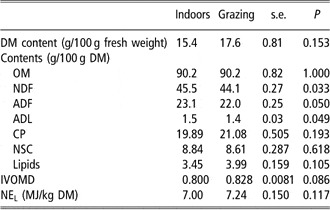
The quality of the offered herbage was good with average DM, NDF, CP contents of 16.5 ± 0.99, 44.8 ± 0.80, 20.5 ± 0.34 g/100 g DM respectively and an average in vitro OMD of 0.814 ± 0.0088 g/100 g DM (Table 2). The NDF, ADF and ADL were higher in the herbage offered indoors compared to the grazed herbage (P < 0.05), but the discrepancy between both herbages was low with less than 1.4 g/100 g DM difference in the NDF contents. Cellulase digestibility also tended to be lower in the herbage offered indoors compared to the grazed herbage (0.800 v. 0.828 g/100 g DM; P = 0.086).
Chemical composition of the ingested herbage indoors and at grazing

DM = dry matter; OM = organic matter; NSC = non-structural carbohydrates; IVOMD = in vitro organic matter digestibility; NEL = net energy for lactation.
Intake, milk yield and composition, net energy for lactation balance
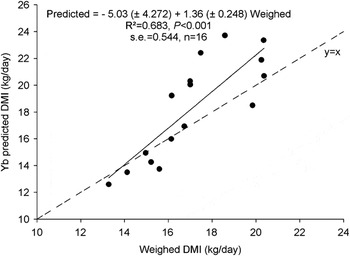
The average Yb-predicted DMI were 19.0 kg DM/day for mature cows and 15.2 kg DM/day for young cows (P = 0.019). For indoor treatments, the Yb-predicted DMI overestimated the weighed DMI for high DMI but slightly underestimated the weighed DMI for low DMI (Figure 1; weighed DMI = −5.03 (±4.272) + 1.36 (±0.248) × Yb-predicted DMI; P < 0.001).
Correlation between Yb-predicted and weighed dry matter intake (DMI) for indoor-fed cows.

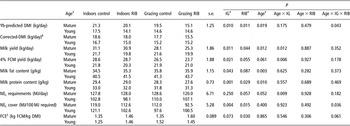
For both age groups, the Yb DMI (Table 3) were higher indoors compared to grazing (18.3 v. 15.9 kg DMI/day; P = 0.010) and for control compared to RIB (18.2 v. 16.0 kg DMI/day; P = 0.011). The interaction between cow age, feeding method and presence of RIB in the rumen was significant (P = 0.043). It was noted that the mature cows did not significantly decrease their DMI with RIB compared with control indoors (21.3 v. 20.1 kg DMI/day) whereas they did at grazing (19.5 v. 15.1 kg DMI/day). The young cows significantly decreased their DMI with RIB compared with control indoors (17.5 v. 14.1 kg DMI/day) whereas there was no change at grazing (14.6 v. 14.6 kg DMI/day).
Dry matter intake, milk yields and composition for mature and young cows (Age) offered indoors or grazing (IG) without or with rumen-inert bulk (RIB)

DMI = dry matter intake; FCM = fat corrected milk; NEL = net energy for lactation.
†IG: indoors feeding v. grazing; RIB: control v. RIB; Age: age of the cows.
‡Yb corrected with the equation: corrected DMI = 7.93 + 0.50 Yb DMI (reciprocal Figure 1).
§FCE: feed conversion efficiency, expressed in kg 4% FCM/kg DMI.
The average milk yield was 28.9 (±1.29) kg/day for the mature cows and 20.7 (±0.54) kg/day for the young cows (Table 3). For both age groups, the milk yield was higher for control compared to RIB (25.6 v. 24.0 kg/day; P = 0.044). There was a significant interaction (P = 0.012) between cow age and feeding method. The mature cows decreased their milk yield by 4.3 kg/day for indoors compared to grazing whereas the young cows did not significantly decrease their milk yield. The average milk fat and protein contents were 32.0 (±0.46) and 28.6 (±0.42) g/kg respectively for mature cows and 41.8 (±0.65) and 35.4 (±0.34) g/kg for young cows. The fat content was 1.2 points lower indoors compared to grazing (P = 0.043) and tended to be lower for the control compared to RIB (P = 0.087). The protein content was 1.1 points higher indoors compared to grazing (P = 0.001) and 0.6 points higher for control compared to RIB (P = 0.029).
Eating behavior
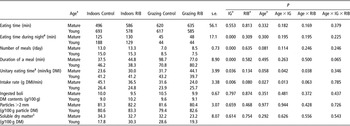
The average daily eating time was 601 (±20.1) min and was not significantly affected by the treatments, the age of the cows or the interactions (Table 4). Cows offered herbage indoors spent 143 min eating during the night (between 2200 and 0700 h), i.e. 24.2/100 min of their eating time, whereas the grazing cows spent 45 min eating during the night, i.e. 6.7/100 min of their eating time, whatever their age (P < 0.001). The meal frequency was higher indoors compared to grazing (14.2 v. 7.9 meals/day; P < 0.001) and the meals were shorter in duration indoors (41.7 v. 81.7 min; P < 0.001). The meal frequency tended to be higher for the mature cows than for the younger ones (11.6 v. 10.5 meals/day; P = 0.081). The mature cows also tended to decrease the duration of their meal between control and RIB at grazing (interaction of age × way of feeding × RIB; P = 0.065). The average intake rate was higher indoors than for grazing (33.2 v. 26.3 g DMI/min; P = 0.006) and was higher for mature than for young cows (34.3 v. 25.2 g DMI/min; P = 0.027). The mature cows decreased their intake rate at grazing compared to indoor feeding and tended to decrease their intake rate with RIB compared to control whereas the young animals did not significantly modify their intake rate (interaction age × feeding method, P < 0.05; and age × RIB, P = 0.063).
Eating behavior for mature or young cows (Age) offered indoors or at grazing (IG) without or with rumen-inert bulk (RIB)

DMI = dry matter intake; DM = dry matter.
†IG: indoors feeding v. grazing; RIB: control v. RIB; Age: age of the cows.
‡The night is defined between 2200 and 0700 h. The unitary eating time was calculated as the ratio between the daily eating time and the DMI.
§Defined as the dry matter passing a 0.063 mm mesh sieve.
The DM content, the proportion of DM in particles retained on the 2-mm sieve and the proportion of soluble matter of ingested boli were unaffected either by the feeding method, or by the presence of RIB, nor the age group.
Ruminating behavior
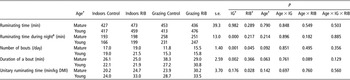
The cows fed indoors spent 189 min ruminating during the night, i.e. 43.2/100 min of their daily ruminating time, whereas the grazing cows spent 247 min ruminating during the night, i.e. 56.3/100 min of their ruminating time, whatever their age (Table 5; P < 0.001). The number of rumination bouts per day was higher indoors compared to grazing (19.1 v. 14.6; P < 0.001) and the bouts were shorter indoors (23.8 v. 31.3 min; P = 0.002). The number of rumination bouts per day was also higher with RIB compared to control (18.0 v. 15.8; P = 0.045). The mature cows tended to have less rumination bouts per day (15.8 v. 17.9; P = 0.092) and longer ones (29.6 v. 25.5 min; P = 0.063) than the younger cows. The mature cows also tended to reduce the duration of ruminating bouts by 5.2 min with RIB compared to control, whereas the younger cows did not (interaction age × RIB; P = 0.089). The unitary ruminating time was higher with RIB compared to control (30.4 v. 24.2 min/kg DMI; P = 0.028).
Ruminating behavior for mature or young cows (Age) offered indoors or at grazing (IG) without or with rumen-inert bulk (RIB)

DMI = dry matter intake.
†IG: indoors feeding v. grazing; RIB: control v. RIB; Age: age of the cows.
‡The night is defined between 2200 and 0700 h. The unitary eating time was calculated as the ratio between the daily ruminating time and the DMI.
Weights of rumen contents
The weight of the RIB, at each rumen emptying, was on average 14.2 (±0.11) kg when saturated with rumen liquid, just after removing from the rumen (n = 32). This corresponded to a volume of 15.0 l, based on the hypothesis that the density of RIB remained 0.95 throughout the experiment. The wet weight of RIB decreased, from 15.0 kg in period 1 to 13.8 kg in period 4 (s.e. = 0.20, P = 0.020). After the last rumen emptying of the experiment, the DM content of RIB measured was 24% (±0.77, n = 4) and the volume of the RIB measured by the displacement of water was 15.0 (±0.12) l (n = 4).
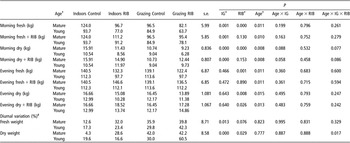
In the morning, the weights of the rumen contents were higher indoors compared to grazing (Table 6; 105.0 v. 88.7 kg for the fresh weight including the RIB; P = 0.001) but in the evening, the fresh and the dry weights of the rumen contents were not significantly different indoors or at grazing. The increase in fresh and dry weight of the rumen content between morning and evening, was lower indoors compared to grazing (for dry weight excluding the RIB, +2.15 kg indoors v. +4.65 kg at grazing (P < 0.001) that represent respectively +17.3 and +43.7% of the daily averages (P < 0.001)).
Weights of the ruminal content for mature or young cows (Age) offered indoors or at grazing (IG) without or with rumen-inert bulk (RIB)

†IG: indoors feeding v. grazing; RIB: control v. RIB; Age: age of the cows.
‡Calculated as the differences of the weight of the ruminal contents between the evening and the morning divided by the daily average.
In the morning and evening, the presence of RIB had an effect on the fresh and dry weights of rumen contents excluding RIB (P < 0.008) but this effect disappeared totally for the weights of rumen contents when including RIB (P > 0.10), except for the dry weights including RIB in the evening. Nevertheless, the dry weights including RIB were only 1.53 kg lower with RIB (P = 0.026), and this difference could be explained in part by the higher DM contents of the 15 l of RIB (24.0% ± 0.77), compared to the average DM contents of rumen contents (11.3% ± 0.49). The presence of RIB compared to the control increased the diurnal variation of the dry weight of rumen content by 13.0/100 kg of average dry weight (P = 0.029).
The fresh and dry weights of rumen contents, whether including the weight of the RIB or not, were always higher (P < 0.015) for mature compared to young cows, in morning and in the evening (Table 6). The interaction of age group × feeding method × RIB was significant for the diurnal variation of the dry weight of rumen contents including, or not, the RIB (P < 0.02). The mature cows increased the diurnal variation of dry rumen contents with RIB compared with control indoors whereas they did not at grazing. The young cows increased the diurnal variation of dry rumen contents with RIB compared with control at grazing and they did not indoors.
Dry matter contents and particle size in the rumen and rumen liquid transit parameters
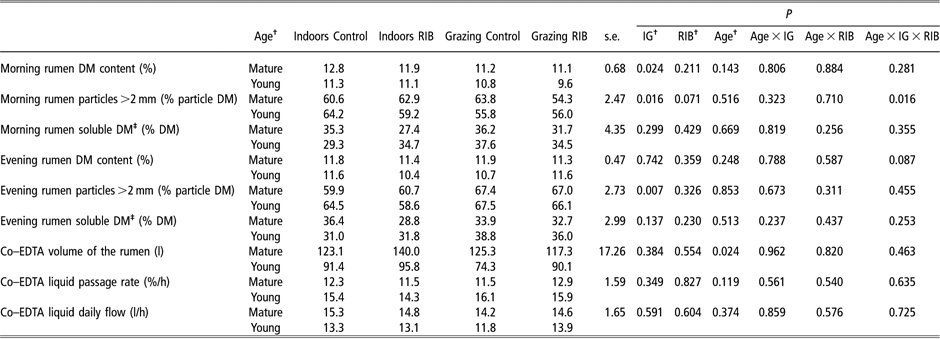
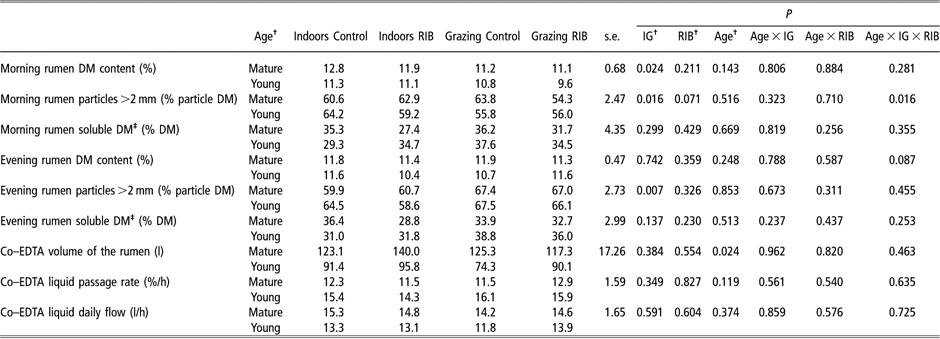
In the morning, the DM contents in the rumen and the proportion of particle DM retained on the 2-mm sieve (Table 7) were higher indoors compared to grazing (for the DM contents, 11.8 v. 10.7 g/100 g, P = 0.024; for the proportion of DM from particles retained on the 2-mm sieve, 61.7 v. 57.5 g/100 g particle DM, P = 0.016). The presence of RIB decreased the proportion of particle DM retained on the 2-mm sieve at grazing for the mature cows and indoors for the young cows (interaction of age × feeding method × RIB; P = 0.016). In the evening, the DM content of the rumen contents was not significantly affected by the treatments or the age of the cows. The proportion of particle DM retained on the 2-mm sieve was lower in ryegrass offered indoors compared to grazing cows (60.9 v. 67.0 g/100 g particle DM; P = 0.007).
DM content, particle size in the ruminal content and ruminal liquid transit parameters for mature or young cows (Age) offered indoors or grazing (IG) without or with rumen-inert bulk (RIB)
DM = dry matter; Co–EDTA = cobalt/ethylenediaminetetraacetic acid.
†IG: indoors feeding v. grazing; RIB: control v. RIB; Age: age of the cows.
‡Defined as the dry matter passing a 0.063 mm mesh sieve.
The average volume of the rumen predicted by Co–EDTA was lower for young compared to mature cows (P = 0.024). None of the other parameters relating to the rumen liquid transit was significantly affected by the treatments or the age of the cows.
Discussion
This experiment showed that RIB could exert a strong constraint on dairy cow intake, even when highly digestible forage is offered. In this experiment, the effect of RIB on intake was strongly influenced by feeding method (indoor feeding or grazing) and its interaction with cow age. Both of these latter factors exerted clear feeding behavior constraints, which would mean that the effect of RIB on intake in dairy cows offered highly digestible herbage could be strongly dependent upon associated behavioral constraints.
An impact of rumen inert bulk on intake dependent on feeding method and cow age
This experiment clearly showed that ruminal capacity or ruminal DM passage rate could limit herbage intake, even with highly digestible ryegrass. The herbage used had an in vitro digestibility above 0.80 OM and a non-limiting content of CP for microbial synthesis in the rumen. Compared to the literature, RIB clearly decreased DMI of the mature cows at grazing and of the young cows fed indoors in this present experiment. The decrease in corrected daily Yb DMI of 2.2 kg with addition of 15 l RIB for mature cows at grazing (Table 3) corresponded to a decrease of 146 g DMI/l RIB and the decrease of 1.7 kg in corrected DMI, with the addition of 15 l RIB for young cows indoors was equivalent to a decrease of 113 g DMI/l RIB. These values were fully within the range reported in the review by Allen (Reference Allen1996) for studies where RIB had an effect on DMI, except that a large part of the studies reported by Allen (Reference Allen1996) were conducted on ruminants offered hay-based diets. It is likely that the OMD of these diets did not exceed 0.80. To compare the decreases of corrected DMI observed in the present experiment to those reviewed by Faverdin et al. (Reference Faverdin, Baumont and Ingvartsen1995), the 15 l RIB had to be converted to the equivalent ruminal DM weight they replaced in the rumen (based on the hypothesis of DM contents of rumen contents of 11.3%). The decrease in corrected DMI for the mature cows at grazing could be expressed as 3.22 g DMI/kg BW for a RIB volume displacing 2.48 g ruminal DM/kg BW. In the same manner, the decrease in corrected DMI for the young cows fed indoors was of 2.86 g DMI/kg BW for a RIB displacing of 2.84 g ruminal DM/kg BW. These values were among the largest decreases of DMI with RIB reviewed by Faverdin et al. (Reference Faverdin, Baumont and Ingvartsen1995) from studies using similar RIB volume. These observations indicate that ruminal fill can play an important role in the regulation of ingestion, even for dairy cows offered a highly digestible ryegrass, but the effect of ruminal fill on intake is not simple to predict given that the same RIB strongly decreased the DMI of mature cows at grazing and young cows indoors but did not affect the DMI of mature cows indoors or of young cows at grazing. The decrease in DMI with the addition of RIB for young cows indoors and mature cows at grazing had clear repercussions on milk yield, but this yield decreased by 1.7 kg with addition of RIB for young cows at grazing whereas the DMI remained constant. The reason of this remained unclear.
A behavioral constraint on dry matter intake at grazing compared to indoor feeding
In the present experiment, corrected daily Yb DMI was 1.1 kg lower at grazing compared to indoor feeding, though the herbage allowance was very high at grazing, as close as possible to ad libitum conditions. The daily average chemical compositions of ingested herbage were similar between both feeding methods. Such an effect would have been clearly expected under conditions where herbage allowance could limit intake (Delagarde and O’Donovan, Reference Delagarde and O’Donovan2005), but it has been seldom reported when the herbage allowance was high. In studies with cattle offered fresh ryegrass and clover herbage, the intake was generally similar between indoor feeding and grazing when the sward was rather short and homogenous and when the offered surface was not limited (Greenhalgh and Rungie, Reference Greenhalgh and Rungie1962; Chenost and Demarquilly, Reference Chenost and Demarquilly1969). Conversely, the intake of fresh herbage indoors was generally lower compared to grazing when the sward was very tall such as alfalfa sward (Lofgreen et al., Reference Lofgreen, Meyer and Hull1957; Dougherty et al., Reference Dougherty, Bradley, Cornelius and Lauriault1989) because it would be easier for the animal to select the most digestible part of the plant and maybe also because of difficulties in constituting bites with very long herbage indoors. It is interesting to note that the effect of the feeding method on the control treatment was higher for young cows.
Given that neither the daily eating time nor the daily ruminating time differed significantly between feeding methods, it is likely that the differences in the cows’ daily dynamics of chewing behavior between both feeding methods had an impact on the DMI. Cows fed indoors had more ingestion and rumination sequences that were shorter and more evenly distributed throughout the day and night. Rumination plays an important role in the comminution of particle (Ulyatt et al., Reference Ulyatt, Dellow, John, Reid and Waghorn1986; McLeod and Minson, Reference McLeod and Minson1988) and, the rate of particle comminution within the reticulo-rumen is an important determinant of particle passage rate from the reticulo-rumen (Ulyatt et al., Reference Ulyatt, Dellow, John, Reid and Waghorn1986). Ingestion likely increases the outflow of particles from the rumen, compared to resting or ruminating, by increasing the frequency of reticulo-omasal orifice contractions (Okine et al., Reference Okine, Mathison, Kaske, Kennelly and Christopherson1998). Consequently, it is likely that the better distribution and succession of eating and ruminating activities during day and night observed indoors could have created a larger outflow of particles from the rumen on a daily basis, and an outflow more steadily distributed throughout the day. This could be particularly true given that the feeding method apparently had no impact on the swallowed particle size after ingestive mastication in the present experiment, contrary to the observations of Boudon et al. (Reference Boudon, Acosta, Delagarde and Peyraud2006) on a short sward. The differences in the distribution of eating or ruminating activities during day and night were responsible for most of the variation observed between the two ways of feeding on the ruminal content weights and particle sizes in the morning. The grazing cows had lower ruminal content weights with smaller proportions of large particles in the morning in relation to their lower proportions of eating time during the night.
Such differences in the daily pattern of chewing behavior between indoor feeding and grazing have previously been described (O’Connell et al., Reference O’Connell, Giller and Meaney1989). The experiment of O’Connell et al. (Reference O’Connell, Giller and Meaney1989) compared continuous grazing with indoor feeding, which means that the grazing management, that is strip grazing in the present experiment, may have a limited impact on the comparison of daily pattern of chewing behavior between grazing and indoor feeding. The effect of night would appear to be very constraining on grazing given that the animals stopped eating abruptly at about 2200 h in the present experiment. This is consistent with other observations (Phillips and Leaver, Reference Phillips and Leaver1985; Albright, Reference Albright1993). It has also been observed that the reduction of the daylight in autumn caused a compression of grazing time to within daylights hours (Phillips and Leaver, Reference Phillips and Leaver1985). In the present experiment, artificial light of the barn was off during the night between 2030 and 0630 h, but it has been observed that artificial light during the night had limited impact of the daily pattern of chewing behavior of dairy cows (Tanida et al., Reference Tanida, Swanson and Hohenboken1984), at least when day length is increasing (Phillips et al., Reference Phillips, Lomas and Arab1998). It is possible that the absence of vision during the night deterred the animals from grazing outside but other external factors, such as temperature or solar radiation, can significantly alter chewing behavior at grazing compared to indoor feeding (Prasanpanich et al., Reference Prasanpanich, Sukpitaksakul, Tudsri and Vajrabukka2003).
The intake rate was lower and less adaptable for young compared to mature cows
The intake rate of the young cows was low, rather constant and unaffected by either RIB or feeding method. The younger age of the cows and their lower body weight in relation to their mouth morphology, rather than their advanced stage of lactation and lower milk yield, may be responsible for their lower intake rates relative to the mature cows. Lower intake rates of younger ruminants compared to mature ones have been observed by several authors (Gordon et al., Reference Gordon, Illius and Milne1996; Perez-Barberia and Gordon, Reference Perez-Barberia and Gordon1998). This may be due to the lower body weight of younger ruminants and the allometric relationship between bite mass and body weight (Gordon et al., Reference Gordon, Illius and Milne1996). This may be related to the fact that the full development of incisors is not reached before the age of 4 years in cattle (Lawrence et al., Reference Lawrence, Whatley, Montgomery and Perino2001). It has been established that young ruminants have a lower molar occlusal contact area; this can reduce jaw movement efficiency to reduce the particle size of food during mastication (Perez-Barberia and Gordon, Reference Perez-Barberia and Gordon1998). Several studies showed that the chewing behavior and more specifically the intake rate were either not affected (Friggens et al., Reference Friggens, Nielsen, Kyriazakis, Tolkamp and Emmans1998; DeVries et al., Reference DeVries, Von Keyserlingk, Weary and Beauchemin2003) or increased (Abrahamse et al., Reference Abrahamse, Vlaeminck, Tamminga and Dijkstra2008) by the stage of lactation, which was in contradiction with the results of the present experiment. A study of Pulido and Leaver (Reference Pulido and Leaver2003) showed, by comparing two groups of grazing dairy cows, that the level of milk production could increase the intake rate. However, the discrepancy in intake rate between both groups in the study of Pulido and Leaver (Reference Pulido and Leaver2003) was low (21.7 v. 28.1 g DM/min) compared to that obtained in the present study although the differences in milk production were similar between both studies.
The variation in intake rates of the mature cows, according to the presence of RIB or to the feeding method, was expected. Faverdin et al. (Reference Faverdin, Bareille and Verite1999) showed that the presence of a RIB in the rumen of dairy cows could decrease their average intake rate because satiety signals may have appeared earlier during the meal. This caused the intake rate to decrease during the meal more rapidly, even though the initial intake rates of the meal were not necessarily different between treatments (Faverdin et al., Reference Faverdin, Bareille and Verite1999). The lower intake rate of the mature cows at grazing compared to indoor feeding was consistent. It has been clearly established that the difficulty to grasp herbage at grazing to form bites had a negative impact on the intake rate (Laca et al., Reference Laca, Ungar and Demment1994) and the bites may be easier to form when herbage is offered indoors, at least when the blades of grass are short (Boudon et al., Reference Boudon, Acosta, Delagarde and Peyraud2006). The intake rate of the young cows was unaffected by either the presence of RIB or the feeding method and it may have been constrained by the mouth morphology of these cows.
Intake rate: a key parameter to explain dry matter intake variation in this experiment
The lower intake rate of the younger cows may explain the effect of RIB on their DMI indoors, whereas RIB did not significantly decrease DMI of mature cows. The only adaptation behavior to RIB that was clearly age group-dependent was the drop in intake rate with RIB, specific to mature cows. For young cows, DMI remained constant with or without RIB, probably because it was constrained by their mouth morphology. For mature cows, the lower intake rate with RIB and the associated higher unit eating time could have increased the ruminal passage rate of particles by decreasing the size of particles swallowed during ingestion. This could have had a positive impact on DMI if the mature cows were able to increase their eating time while decreasing their intake rate. This was not significant but the mature cows increased their daily eating time by 90 min with RIB compared to control indoors. It has already been shown that for given forage and animal, the size of swallowed particles was inversely correlated to intake rate (Boudon et al., Reference Boudon, Acosta, Delagarde and Peyraud2006). In our experiment, the proportion of particles in ingested boli retained on a 2-mm sieve was affected neither by the presence of RIB nor by the interaction between the presence of RIB and the age of the cows. Ingested boli were collected at the beginning of the morning meal and it has already been observed that the initial intake rate of the meal was unaffected by RIB whereas the daily average intake rate was (Faverdin et al., Reference Faverdin, Bareille and Verite1999). For young cows, no adaptation of the intake rate was observed with addition of RIB. It is likely that these cows were not able to increase the passage rate of particles when RIB was added. This may explain why they decreased their intake with RIB, but also their eating time by more than 115 min, even though this was not significant.
Only a few other behavioral adaptations to RIB were observed in our experiment. On average, the cows increased their unitary ruminating time, along with the number of rumination bouts per day when RIB was present in the rumen. This behavior has been reported by others (Johnson and Combs, Reference Johnson and Combs1991 and Reference Johnson and Combs1992), but in the present experiment, it may not have increased the ruminal passage rate of particles sufficiently to limit the effect of RIB on DMI. Indeed, the effect of RIB on ruminating behavior was the same for both age groups of cows, whereas the effect of RIB on DMI was governed by the interaction between age group and feeding method. The cows did not increase their ruminal volume in the presence of RIB, contrary to the observation of Johnson and Combs (Reference Johnson and Combs1991 and Reference Johnson and Combs1992). This must indicate that their rumen did not have any reserve capacity for fill at the end of the day, which could be a specificity of a diet consisting exclusively of fresh highly digestible herbage. This was confirmed by the fact that, at the end of the day, the fresh weight of ruminal content including RIB was very high and similar for all treatments in spite of different DMI. No effect of RIB was observed on the particle size of ruminal content or ruminal liquid passage rate.
The low and less adaptable intake rate of the young cows compared to the older ones could also be responsible for the difference in RIB effect between both age groups at grazing. For mature cows, the decrease in intake rate between indoors feeding and grazing may have contributed to increase the passage rate across the rumen of particles as described above. The fact that mature cows could compensate for the negative impact of the irregular distribution of eating and ruminating activity at grazing by decreasing their intake rate at grazing, could explain why they only slightly decreased their DMI between indoor feeding and grazing (−0.9 kg corrected Yb DMI). It is worth noting that, for these cows, the drop in intake rate between indoor feeding and grazing could have had a neutral impact on DMI because they were able to increase their eating time at grazing by more than 124 min, at least numerically, to maintain their DMI. Contrary to this, they clearly decreased their DMI with RIB compared to the control at grazing. They also decreased their intake rate to a value comparable to the average intake rate of the young cows, but they did not seem to increase their eating time. This latter was already long compared to the control, with more than 620 min/day. In this situation, the decreases in the intake rate led to a decrease of the DMI, probably because the mature cows were unable to sufficiently increase the ruminating time and related unitary ruminating time.
The young cows did not decrease their intake rate between indoor feeding and grazing, possibly because it was already very low and constrained by their young age and associated mouth morphology, even when herbage was offered indoors. They clearly decreased their intake on control between indoor feeding and grazing, suggesting that lack of variation of intake rate between both feeding methods had an impact on intake. The lack of variability in intake rate may have deprived the young cows of means of adapting their ruminal transit to irregular distribution of eating and ruminating activity at grazing. The lack of effect of RIB on intake for the young cows at grazing suggests that rumen fill was a secondary constraint on intake for these cows compared to passage rate of particles. Given that variations in milk yield were not a good reflection of the variation in DMI in the present experiment, these last assumptions would require further investigation.
Conclusion
This experiment showed that rumen fill could be an important signal in short-term intake regulation, even for dairy cows offered fresh highly digestible ryegrass. The impact of rumen fill was also largely dependent upon other constraints applied on the chewing behavior, i.e. in the present experiment, the feeding method – indoor feeding or grazing – and the differences in intake rate between cows related to their age. The effect of the interaction between the feeding methods, the presence of RIB in the rumen and the age of the cows also suggest that indoor feeding of fresh herbage may not be a good model of grazing for studies aimed at understanding short-term regulation of intake. These results suggest that more work is needed to build models to predict daily variation of intake in grazing dairy cows. They also suggest that rumen fill could be an important constraint for grazing ruminant and thus a better understanding of the plant parameters implicated in rumen fill is warranted to build new criteria for assessing grazed variety quality.
Acknowledgements
The authors thank P. Lamberton and the ‘physiology’ team of the experimental farm of Mejussaume for cow welfare, feeding and sampling; and A. Brasseur, N. Huchet and T. Le Mouël for biochemical analyses. The authors are thankful to the agency Caractères et Caetera for its assistance in editing this manuscript.