Introduction
The understanding of communication pathways is of particular interest in the context of complex tritrophic interactions between plants, insects and insect predators and parasitoids (Heil Reference Heil2014) because interactions between plants and their arthropod herbivores and their natural enemies dominate the terrestrial ecology of our planet. It has been shown that, in nature, many predators of herbivorous insects are attracted to their prey through signals provided by the host plants (Heil Reference Heil2014, Zhang et al. Reference Zhang, Xie, Xue, Peng and Wang2009). The attraction between host plants and insect predators is often mediated by volatile organic compounds (VOCs) (De Moraes et al. Reference De Moraes, Lewis, Pare, Alborn and Tumlinson1998, Turlings et al. Reference Turlings, Humlington and Lewis1990), particularly those induced by plants which have been damaged by herbivores (i.e. herbivore-induced plant volatiles, HIPVs). Mäntylä et al. (Reference Mäntylä, Klemola and Haukioja2004) were the first to suggest that insectivorous birds may also use HIPVs to search for prey on plants. The attractiveness of herbivore-damaged trees to birds was later tested in both aviaries (Amo et al. Reference Amo, Jansen, Dam, Dicke and Visser2013, Koski et al. Reference Koski, Laaksonen, Mäntylä, Ruuskanen, Li, Girón-Calva, Huttunen, Blande, Holopainen and Klemola2015, Mäntylä et al. Reference Mäntylä, Klemola and Haukioja2004, Reference Mäntylä, Klemola, Sirkiä and Laaksonen2008) and nature (Koski et al. Reference Koski, Laaksonen, Mäntylä, Ruuskanen, Li, Girón-Calva, Huttunen, Blande, Holopainen and Klemola2015, Mäntylä et al. Reference Mäntylä, Klemola, Sirkiä and Laaksonen2008). Only seven out of 10 existing studies have shown that birds significantly distinguish trees with and without herbivore damage (either natural or induced/simulated chemically). Amo et al. (Reference Amo, Jansen, Dam, Dicke and Visser2013) advanced this field by showing that when birds were provided separately with a chemical and/or visual signal they relied solely on olfaction.
Jasmonates, i.e. jasmonic acid (JA) and methyl jasmonate (MeJA), are endogenous plant phytohormones that regulate a large number of defence responses in plants (Hopke et al. Reference Hopke, Donath, Blechert and Boland1994, Rodriguez-Saona et al. Reference Rodriguez-Saona, Polashock and Malo2013, Thaler et al. Reference Thaler, Stout, Karban and Duffey1996, Xu et al. Reference Xu, Zhou, Chen, Zhang, He, Gu and Zhang2003). Plants treated with exogenous JA or MeJA were shown to emit volatiles similar to those given off by plants attacked by live herbivores (Rodriguez-Saona et al. Reference Rodriguez-Saona, Polashock and Malo2013). To our knowledge, there have only been three studies conducted using trees growing outdoors and none have been conducted under natural conditions in the complex forest systems of tropical regions, where pressure from insect predators and parasitoids is usually higher than in temperate regions (Jeanne Reference Jeanne1979, Roslin et al. Reference Roslin, Hardwick, Novotny, Petry, Andrew, Asmus, Barrio, Basset, Boesing and Bonebrake2017, Schemske et al. Reference Schemske, Mittelbach, Cornell, Sobel and Roy2009).
Both insectivorous birds and predatory arthropods (mostly ants) are important predators, and the overall predation of herbivorous insects is determined to a large extent by their combined effects (Mooney Reference Mooney2007). In many tropical regions, arthropod enemies are responsible for more predatory attacks than insectivorous birds (Roslin et al. Reference Roslin, Hardwick, Novotny, Petry, Andrew, Asmus, Barrio, Basset, Boesing and Bonebrake2017, Sam et al. Reference Sam, Koane and Novotny2015a), but their relative importance may differ between different tropical sites (Van Bael et al. Reference Van Bael, Brawn and Robinson2003, Reference Van Bael, Philpott, Greenberg, Bichier, Barber, Mooney and Gruner2008). However, their abundance and predation usually decrease towards the higher altitudes of the mountains (Roslin et al. Reference Roslin, Hardwick, Novotny, Petry, Andrew, Asmus, Barrio, Basset, Boesing and Bonebrake2017, Sam et al. Reference Sam, Koane and Novotny2015a). In the tropics, altitudinal trends in the strength of trophic interactions are poorly known, since most studies have focused on lowland forest (Novotny & Basset Reference Novotny and Basset2005), and there has not been a single study which has focused on the importance of plant-produced chemical signals for predators in the natural settings of a tropical forest.
The aim of this study was to investigate the dynamics of natural predation on herbivorous insects (represented by dummy caterpillars; Howe et al. Reference Howe, Lövei and Nachman2009, Low et al. Reference Low, Sam, McArthur, Posa and Hochuli2014, Sam et al. Reference Sam, Remmel and Molleman2015b) in response to the application of MeJA to saplings in forest understorey in the natural conditions of an altitudinal gradient (200–2700 m asl), in Papua New Guinea. We hypothesized that (1) MeJA-simulated herbivory would lead to increased predation pressure on the dummy prey, and (2) that the relative proportion of attacks, caused by different groups of predators (birds vs. arthropods), would differ along the altitudinal gradient.
Methods
Study sites
The experiment was conducted along the altitudinal gradient of Mt Wilhelm (05°48′S, 145°02′E) in the Central Range of Papua New Guinea at four study sites at 200, 700, 1700 and 2700 m asl. The gradient and its study sites are described in detail elsewhere (Sam et al. Reference Sam, Koane and Novotny2015a). We conducted the 4-wk-long experiment at the very beginning of the rainy season, in October 2015 (the dry season was extended until the end of September due to El Niño). The season corresponds with the usual period of increased leaf flush and caterpillar appearance.
Plant species
We selected the understorey species Ficus hahliana (Diels) as our focal tree species because it has a large altitudinal distribution (0–2700 m asl in Papua New Guinea; Segar et al. Reference Segar, Volf, Zima, Isua, Sisol, Sam, Sam, Souto-Vilarós and Novotny2016), suitable leaf size. We established a 2250-m-long transect at each study site, along which we selected 24 accessible saplings which were at a distance of at least 60 m from each other and which had foliage between 2 and 3.5 m above the ground. This spacing ensured that the experimental trees could be considered independent, as in field conditions, the transmission of VOCs by air is known up to 60 cm. At longer distances, VOCs are known to degrade (Karban Reference Karban2007). We only worked with saplings which appeared healthy, that had newly flushed leaves and lacked signs of extensive herbivore damage. All focal saplings, at each site, were marked with a small piece of flagging tape on the lower part of the trunk and numbered (1–24). Every odd-numbered tree was considered a control tree and every even-numbered tree was treated with MeJA.
MeJA treatment
The MeJA-treated saplings were prepared by administering daily (for 5 d) morning sprayings with 25 ml of a 30 mM MeJA solution (diluted in distilled water; Sigma Aldrich 30 mM J2500 MeJA; Mrazova & Sam Reference Mrazova and Sam2018). The control trees were not sprayed with distilled water, as the trees received nightly rainfall and their leaves were already wet at the time of the MeJA application. Twenty-four hours after the first application of MeJA, we exposed five artificial caterpillars (Howe et al. Reference Howe, Lövei and Nachman2009, Tvardikova & Novotny Reference Tvardikova and Novotny2012) on each experimental tree (both MeJA-treated and control) to assess the response of predators on herbivorous insects.
Artificial caterpillars
We prepared the artificial caterpillars (3 mm × 2.5 cm) by pressing modelling clay (dark green, oil-based and non-toxic, Koh-I-Noor Hardtmuth, Ceske Budejovice, Czech Republic) through a syringe to ensure a completely smooth surface. The artificial caterpillars mimicked a commonly occurring moth of genus Choreutis (Sam et al. Reference Sam, Koane and Novotny2015a). The method of using artificial caterpillars is suitable for studies that compare the attack rates in various habitats and treatments. It also allows for the coarse identification of predators as was required for our study (Posa et al. Reference Posa, Sodhi and Koh2007, Sam et al. Reference Sam, Koane and Novotny2015a).
The artificial caterpillars were pinned to each MeJA-treated and control tree. They were pinned on to the distal half of the young leaves in such a way that the head of the pin was hidden in the modelling clay and then passed through the leaf. On each sapling we approximated the natural density of two artificial caterpillars m−2 of leaf area, which is constant across all the studied sites (V. Novotny, unpubl. data). After 24 h, each caterpillar was inspected, attack marks were photographed, and predators were identified into rough categories of either arthropods or birds (Low et al. Reference Low, Sam, McArthur, Posa and Hochuli2014). All missing caterpillars and those with attack marks were replaced with new ones after the 24-h period. All the new artificial caterpillars were pinned in different locations on the same sapling to decrease the possibility that the predators would learn to search for them or avoid them. The experiment ran for 4 d at each study site (i.e. caterpillars were replaced four times and MeJA was applied five times). The caterpillars which were attacked by two different types of predator (N = 2) within 1 d were treated as two independently attacked caterpillars.
Bird and ant sampling
We surveyed the bird communities by conducting point counts at each altitude. Point counts (15 min per point) were carried out between 5h45 and 11h00 at 16 points (radius = 50 m) regularly spaced along the 2250-m transect. We conducted three point-count surveys (i.e. 16 points × 15 min × 3 days per each study site) during the experiments with MeJA. A detailed description of point-count surveys, bird species occurring along the gradient, and their feeding specialization can be found in Marki et al. (Reference Marki, Sam, Koane, Kristensen, Kennedy and Jønsson2016), Sam & Koane (Reference Sam and Koane2014) and Sam et al. (Reference Sam, Koane, Jeppy, Sykorova and Novotny2017). In the 3-d survey conducted in October 2015, the total abundance of insectivorous understorey birds was recorded in 12.56 ha at each site and this figure was used in the analyses.
Due to logistical issues and time restrictions, we were not able to re-survey the ants on the focal saplings used in the current experiment, and the ant data we used here originate from the September–October 2013 survey. This approach is valid, as there were no seasonal differences observed in ant communities (Colwell et al. Reference Colwell, Gotelli, Ashton, Beck, Brehm, Fayle, Klimes, Kluge, Longino, Maunsell, McCain, Moses, Noben, Sam, Sam, Shapiro, Wang and Novotny2016). At each study site, we used a combination of two methods to survey ants. Tuna baits, observation and hand collection were used to detect both ant species that are, and are not, attracted to bait (Véle et al. Reference Véle, Holuša and Frouz2009). These methods are described in detail in Sam et al. (Reference Sam, Koane and Novotny2015a). The survey was conducted on 30 selected understorey saplings along the same transects, where the focal species Ficus hahliana was studied.
Statistical analyses
The data were averaged across the four experimental days because the daily number of attacks was low and did not differ significantly between the days (ANOVA; F3,767 = 1.8, P = 0.176). Prior to analyses, we excluded all 85 lost (missing) caterpillars (i.e. 2.21%) from the datasets, as we were not able to identify the potential predator. The effect of the study site (N = 4) and of the treatment (MeJA-treated vs. control) on the incidence of attacks was tested by ANOVA (function aov in R 3.2.4.) with nested design and two within-category effects. All the 24 sampling trees were nested within each of the four study sites. The mean daily proportions of caterpillars attacked, on each experimental tree, were arcsine-transformed to meet the conditions of normality. The method of treatment was used as the first within-sampling effect and the type of predator (arthropod, bird) was used as the second. Tukey post hoc tests (package multcomp, function glht in R; Hothorn et al. Reference Hothorn, Bretz and Westfall2008) were performed to inspect the differences between the study sites and the type of predator.
Results
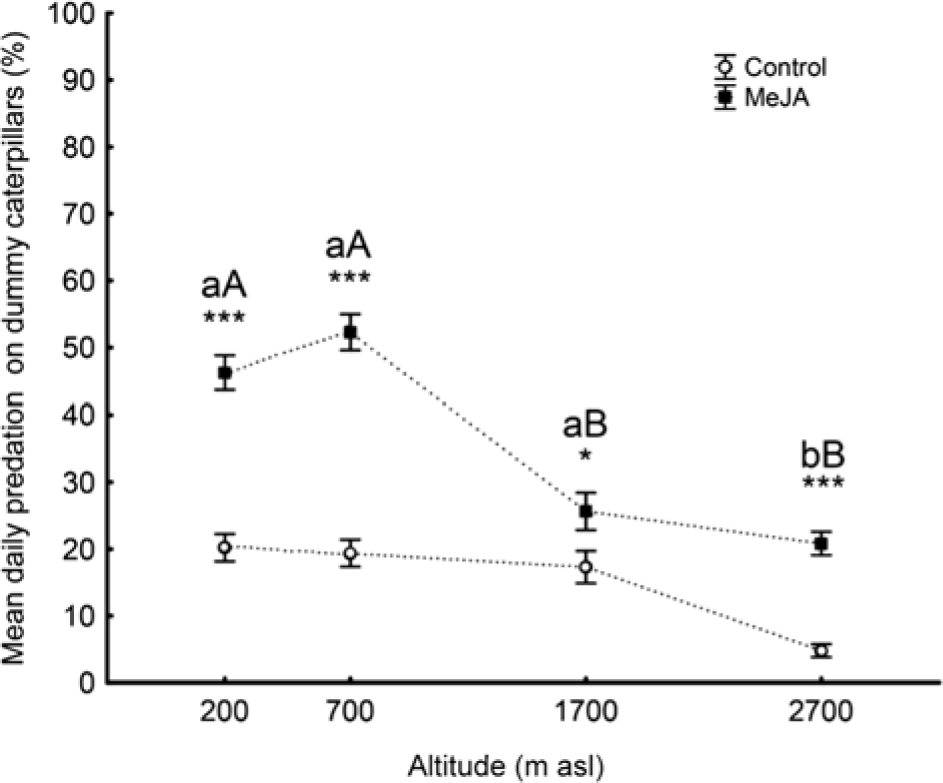
In total, we exposed 960 artificial caterpillars at four study sites within the same time period. This resulted in 3840 caterpillar-days of exposure. In total, 1040 dummy caterpillars were attacked by a natural enemy and 2715 were not attacked during the 24-h experiments. Overall, mean ± error daily predation was 27.6 ± 0.98% across all the trees and study sites. Across the whole gradient, the proportion of attack attempts on caterpillars exposed on the MeJA-treated trees was significantly higher (effect of treatment, Table 1; 38.2 ± 1.48% d−1) than on those on the control trees (17.4 ± 1.31% d−1).
Effect of treatment (MeJA-treated, control), altitude (200, 700, 1700, 2700 m asl) and their combined effect on overall predation on plasticine caterpillars exposed on Ficus hahliana along the altitudinal gradient of Mt Wilhelm by all predators together, and then separately by birds and by arthropods. Results of ANOVA with nested design (saplings by site) and two within-category (treatment and type of predator) effects

At all the study sites, the proportion of attack attempts on the dummy caterpillars exposed on MeJA-treated trees was significantly different from the proportion of attack attempts on the dummy caterpillars which were exposed on the control trees (Figure 1). The percentage of attacked caterpillars which were exposed on the control trees was significantly higher at the three lower forest study sites (i.e. 200–1700 m asl, 20.21–17.3% d−1) than it was on the control trees at 2700 m asl (4.7% d−1; Figure 1). On MeJA-treated trees, the percentage of attacked caterpillars was significantly higher at the two lower study sites (46.2–52.3% d−1) than for MeJA-treated trees at 1700 and 2700 m asl (25.6–20.8% d−1; Figure 1).
Mean daily (N = 4) percentage (± SE) of attacks by all predators on artificial caterpillars exposed (N = 5) on all control (N = 24) and MeJA-treated (MeJA) (N = 24) saplings of Ficus hahliana at four study sites on Mt Wilhelm in Papua New Guinea. Sites with significantly different rates of attacks between the control and the MeJA-treated trees are marked by asterisks (*** P = 0.001,* P = 0.05; results of Tukey post hoc test). The altitudes with significantly different incidences of attack (P < 0.05) within the treatment are denoted by different letters: small letters = control saplings, capital letters = MeJA-treated saplings (results of Tukey post hoc test).

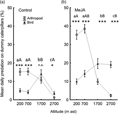
Most attacks on the artificial caterpillars were by arthropods (58.8% of all recorded attacks) and a lower number of attacks were made by birds (40.8%). We were not able to identify three attack marks and one other mark was made by a small mammal. On both the MeJA-treated and control trees arthropods were responsible for significantly more attacks at the lower two study sites than at the upper two sites (Figure 2). Predation by birds was highest on the caterpillars exposed on both types of trees at 1700 m asl (Figure 2). On the MeJA-treated trees only, predation by birds reached similar levels at 2700 m asl as at 1700 m asl. The percentage of attacked caterpillars was higher at each study site in both predator groups on the MeJA-treated trees (Table 1). Significantly more attacks on caterpillars, exposed on both types of trees, were caused by arthropods than by birds in the lowlands at 200 m and 700 m asl (Figure 2). Birds were more dominant predators of caterpillars exposed on both types of trees at 1700 m and at 2700 m asl (Figure 2).
Mean daily (N = 4) predation by the two groups of predators on artificial caterpillars exposed (N = 5) on individual control (N = 24) (a) and MeJA-treated (MeJA) (N = 24) (b) saplings of Ficus hahliana at four study sites on Mt Wilhelm in Papua New Guinea. Sites with significantly different attack rates by arthropods and birds are marked by asterisks (*** P = 0.001,* P = 0.05; results of Tukey post hoc test). Altitudes with significantly different (P < 0.05) incidences of attack by individual predators within the control and MeJA treatment are denoted by different letters: small letters = predation by arthropods, capital letters = predation by birds (results of Tukey post-hoc test).

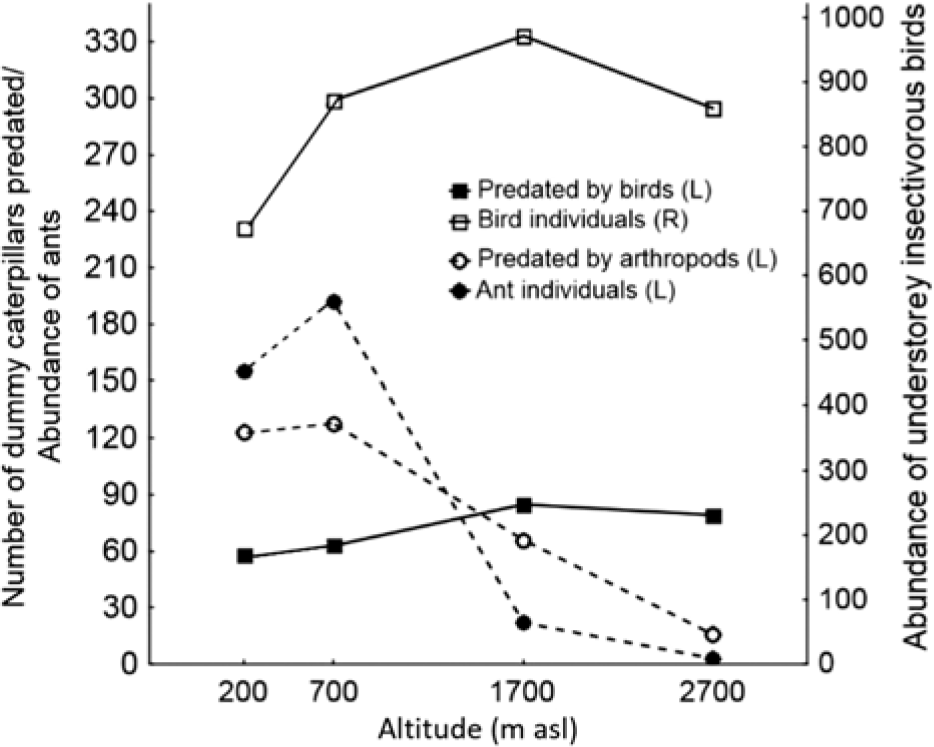
The number of caterpillars attacked by ants was highest where ants were the most abundant (i.e. lowest altitudes, Appendix 1), but the decrease in number of predation attacks by ants did not correspond significantly with the decrease in their abundance (R2 = 0.81, P = 0.10, N = 4; Figure 3). Similarly, the predation rate of birds was not dependent on the number of insectivorous birds (R2 = 0.67, P = 0.18; N = 4, Figure 3, Appendix 1). Due to the small number of study sites, we were not able to investigate the exact relationship statistically.
The total number of artificial caterpillars attacked by birds and ants (left y-axis) and the total abundance of ants recorded on the trunks of 30 understorey Ficus hahliana trees (left y-axis) and the total abundance of understorey insectivorous birds recorded in 12.56 ha during the 3-d survey (right y-axis) in Papua New Guinea.

Discussion
Altogether both groups of natural enemies inflicted about twice as much damage to the artificial plasticine caterpillars which had been placed on the MeJA-treated saplings than on the caterpillars placed on the control saplings. The effect of jasmonic treatment was important along the entire altitudinal gradient studied here, but it was relatively more important at the higher than in the lower altitudes. This would imply that plants from lower altitudes are more easily inducible than plants in higher altitudes thanks to higher productivity at site and thus relatively lower costs of such investment into defences.
Results of observed predation levels on the MeJA-treated trees correspond with the results of other studies which report on the effect of herbivory on the predation or attractiveness of predators to herbivore-infested plants (Kessler & Baldwin Reference Kessler and Baldwin2001, Sam et al. Reference Sam, Koane and Novotny2015a). It is important to note that experiments using artificial caterpillars do not provide an estimate of natural predation rates, but only a relative number of predation incidents for comparison among habitats and treatments (Howe et al. Reference Howe, Lövei and Nachman2009).
The phenomenon of induced attraction of predatory arthropods by plants in response to (simulated) herbivory is now well accepted (Agrawal Reference Agrawal1998, Mithöfer et al. Reference Mithöfer, Wanner and Boland2005, Romero & Izzo Reference Romero and Izzo2004, Takabayashi & Dicke Reference Takabayashi and Dicke1996, Turlings et al. Reference Turlings, Humlington and Lewis1990). In previous studies, with jasmonic acid triggering a herbivore-like induced response, predatory mites were attracted by jasmonate treatment (1 mM) to Phaseolus lunatus in a laboratory (Dicke et al. Reference Dicke, Gols, Ludeking and Posthumus1999). On the other hand, predatory bugs and hoverflies were not attracted to jasmonate-treated (1 mM) Vaccinium macrocarpon in a field experiment. Nine out of 11 studies on parasitoid vs. jasmonate-treated plant interactions reported increased attractivity of a treated plant to parasitoids (Rodriguez-Saona et al. Reference Rodriguez-Saona, Polashock and Malo2013). Our current study shows that predatory arthropods are attracted by the jasmonate treatment on Ficus hahliana even in complex lowland (200–700 m asl) tropical forest. The abundances of predatory arthropods (i.e. ants) at higher altitudes (above 1200 m asl) were too low to detect the effect of the treatment.
Our data also indicate that birds were able to distinguish between the MeJA-treated and intact (control) Ficus hahliana when they could not see the actual herbivorous damage on the leaves. Our main result is therefore in contrast to the study conducted by Mäntylä et al. (Reference Mäntylä, Blande and Klemola2014). In their study, mountain birches treated with MeJA emitted more myrcene and limonene than shrubs with ongoing herbivorous damage, caused by caterpillars of the autumnal moth (Epirrita autumnata), and on the control shrubs. In fact, these two compounds seemed to deter birds in their study. By contrast, grey willows in the Czech Republic (Mrazova & Sam Reference Mrazova and Sam2018), did not produce increased amounts of myrcene and limonene after the application of MeJA. Instead there were increased emissions of α-pinene which likely corresponded with the increase of predation by birds. Unfortunately, our data on volatile compounds for the current study were very limited due to contamination during a long transit. Only α-pinene, β-pinene and β-ocimene were detected in larger amounts on the MeJA-treated trees (N = 3) than on control trees (N = 2). Other detected compounds were limonene and also 3-carene which did not differ between the treatments. This report should be taken with caution.
We observed the highest predation by birds at 1700 m asl for both treatments (and at 2700 m asl for MeJA-treatment). This is roughly in the middle of the complete forest altitudinal gradient (0–3700 m asl). In previous studies, high predation by birds was found at 1700 m (Tvardikova & Novotny Reference Tvardikova and Novotny2012) and between 700 and 1700 m asl of the studied gradient (Sam et al. Reference Sam, Koane and Novotny2015a). In both studies, the predation rate by birds corresponded with the abundance of insectivorous birds, unlike the results of the current study. The authors of other studies did not find any effect of altitude on bird predation. Roslin et al. (Reference Roslin, Hardwick, Novotny, Petry, Andrew, Asmus, Barrio, Basset, Boesing and Bonebrake2017) found only a weak effect of altitude on the predation by birds in a global study spanning 0–2100 m asl.
An overall decrease in predation rate with increasing altitude leads to the prediction of a higher incidence of anti-predatory defences, such as chemical or behavioural, in the lowlands, particularly against arthropods (Schmidt Reference Schmidt1990). In a previous study from the same latitudinal gradient, a daily predation rate on caterpillars exposed on control trees at 200 m asl was 14.3 ± 5.4% d−1 (Sam et al. Reference Sam, Koane and Novotny2015a). In the current study, predation at the same study site was 20.2 ± 2.04% d−1. The predation on the control trees decreased to 2.7 ± 0.7% d−1 at 2700 m asl in a previous study (Sam et al. Reference Sam, Koane and Novotny2015a) and to 4.7 ± 0.97% d−1 in the current study at the same study site. These results suggest that the MeJA treatment tested in the current study might be slightly more attractive for predators than the simple mechanical damage used in the previous study (Sam et al. Reference Sam, Koane and Novotny2015a). Note that while these numbers do not represent absolute predation pressure, they are roughly comparable because they employ the same methods (plasticine caterpillars) and were conducted at the same study site (albeit in different years).
We used treatment by jasmonic acid to simulate herbivory on foliage and this may be a less efficient cue to predators than the real damage done by insectivorous herbivores (Mäntylä et al. Reference Mäntylä, Blande and Klemola2014, Rodriguez-Saona et al. Reference Rodriguez-Saona, Polashock and Malo2013), therefore underestimating the significance of the predator effect observed in this study. Chemically triggered responses by plants can also be expected to be weaker than mechanically simulated herbivorous damage (Rodriguez-Saona et al. Reference Rodriguez-Saona, Polashock and Malo2013). To our surprise, the response of both types of predator to mechanical (Sam et al. Reference Sam, Koane and Novotny2015a) and MeJA-induced (this study) VOCs along the same gradient was very similar, with similar patterns for predator types in terms of qualitative observation. In both studies, the total predation on the treated trees was about twice as high. They both also showed a decreasing trend with increasing altitude and that arthropods were relatively more dominant predators in lowlands while birds represented more important predators at altitudes above 1700 m asl.
From the literature, it is still unclear how long a tree with MeJA treatment would continue to be attractive to predators. Dicke et al. (Reference Dicke, Gols, Ludeking and Posthumus1999) reported that there was a higher attractivity of MeJA-treated Lima beans to predatory mites for the period of 2–4 d after its application, with the strongest attraction being seen on the second day of the experiment. Mäntylä et al. (Reference Mäntylä, Blande and Klemola2014) applied MeJA prior to the experiment and then on days 2, 7, 9 and 11 of the experiment and observed a significant increase of predation rate between days 1 and 10 of the experiment. Rodriguez-Saona et al. (Reference Rodriguez-Saona, Crafts-Brandner, Paré and Henneberry2001) treated cotton plants with MeJA overnight and observed a high production of volatiles during the daytime (7h00–15h00) on only the first day. On the grey willows growing in temperate regions an increased production of volatile compounds was detected between 30 min and 48 h after the first application of MeJA (Mrazova & Sam Reference Mrazova and Sam2018). In our own preliminary experiments on Ficus phaeosyce in Papua New Guinea, the predation rate decreased significantly within the first 72 h following the first application (Appendix 2). Therefore, in the current experiment, we decided on daily re-application of MeJA.
In conclusion, our study demonstrates (1) the potential of jasmonates as a natural plant protectant against herbivorous insects via indirect defence (particularly true for arthropods but observed also in birds), (2) a decreasing attack rate of predators with increasing altitudes on the understorey Ficus hahliana in tropical forest, and (3) a transition in predator dominance from arthropods in the lowland forests to birds at the higher altitudes. This study shows that jasmonates provide protection against herbivores and increase natural enemy attraction in various tropical-forest ecosystems. However, the cost of jasmonate-induced responses in the absence of herbivores remains to be studied (Baldwin Reference Baldwin1998, Cipollini et al. Reference Cipollini, Purrington and Bergelson2003, Thaler Reference Thaler1999), and we await confirmation of whether they could lead to increased/decreased ecological costs due to the trade-offs between resistance to herbivores and pathogens (Felton & Korth Reference Felton and Korth2000).
Author ORCIDs
Anna Mrazova https://orcid.org/0000-0002-9268-0896 Katerina Sam https://orcid.org/0000-0002-3436-0579
Acknowledgements
We are thankful to Sarah Segar for English language editing. Preliminary experiment on Ficus phaeosyce was conducted, and ideas conceived, during the Field Course of Tropical Ecology organized by University of South Bohemia.
Financial support
This study was funded by Programme for research and mobility support of starting researchers (MSM200961702) and by The Czech Science Foundation project No. 18-23794Y.
Appendix 1
Total abundances and species richness of ants and insectivorous birds surveyed at each altitudinal study site on Mt Wilhelm in Papua New Guinea. Ant communities were surveyed by tuna baits (after 2 and 4 h) and by hand collection on 30 saplings along the transect where our study was conducted. The survey of the bird communities at each altitude was conducted at 16 points (radius 50 m, 15 min survey) regularly spaced along the 2250-m transect (i.e. on 0.1256 km2) and replicated three times. Bird species name follow IOC World Bird List version 9.1 (Gill & Donsker Reference Gill and Donsker2019)

Appendix 2
The predation on dummy caterpillars in our preliminary experiment on Ficus phaeosyce was significantly higher on MeJA-treated saplings (N = 10; empty circles) than on control saplings (N = 10; filled squares) only on the first and second days (marked by asterisks: *** P < 0.001; results of Tukey post-hoc test) of the six days long experiment. MeJA was applied twice: 24 hours before the first experimental day and on the first day of study. The experiment was conducted at 150 m asl in Wanang Conservation Area in Papua New Guinea (GPS: 5°13′31.6′′S, 145°04′51.2′′E).