Fior di Latte cheese is a common popular product, consisting mainly of casein, fat and water. As fresh cheese, it has a high moisture content (from 55 to 60%), a high fat content (>45% dry matter basis; Salvadori del Prato, Reference del Prato2001) and it is very susceptible to microbial spoilage, especially under temperature abuse. The manufacture of this un-ripened pasta filata cheese was described in detail in the literature (Parente & Moschetti, Reference Parente, Moschetti and Cogan1997; Salvadori del Prato, Reference del Prato2001). It is manufactured either according to traditional procedures (raw milk inoculated with natural whey or milk cultures, raw milk ripened under special conditions, without starter addition) or by using pasteurized milk and commercial starter cultures of lactic acid bacteria (Salvadori del Prato, Reference del Prato2001). Milk was coagulated by the addition of rennet and curd formation was achieved after about 15–20 mins. When the curd reached an optimum pH for stretching, which corresponds to the isoelectric point of the casein, the whey was removed; the curd was then cut, stretched and molded. Although mozzarella cheese receives a heat treatment, post-processing contamination by microorganisms may occur, causing cheese spoilage, health risks for consumers, and shelf life reduction (Spano et al. Reference Spano, Goffredo, Beneduce, Tarantino, Dupuy and Massa2003). A few reports deal with methods to prolong the shelf life of fresh cheeses are available in the literature (Gonzalez-Fandos et al. Reference Gonzalez-Fandos, Sanz and Olarte2000; Laurienzo et al. Reference Laurienzo, Malinconico, Pizzano, Manzo, Piciocchi, Sorrentino and Volpe2006; Gammariello et al. Reference Gammariello, Conte, Di Giulio, Attanasio and Del Nobile2009).
Currently, the main factories use ‘liquid’ (diluted whey or water from the stretcher-molder) (Mucchetti & Neviani, Reference Mucchetti and Neviani2006) packaged in rigid or flexible films of multilayer material, trays made of polyethylene/paper laminated films and tetrapack-type packages (Robertson, Reference Robertson1993). These systems are not a strategic solution to prolong the shelf life of this product.
The application of antimicrobial agents to Fior di Latte packaging could be useful in preventing the growth of spoilage microorganisms and hence, may lead to an extension in shelf life and to an improved microbial safety. Dairy researchers (Smith-Palmer et al. Reference Smith-Palmer, Stewart and Fyfe2001; Conte et al. Reference Conte, Scrocco, Sinigaglia and Del Nobile2007a; Gammariello et al. Reference Gammariello, Di Giulio, Conte and Del Nobile2008) have found that selected plant essential oils can act as inhibitors of spoilage microorganisms in food products. The natural active agents are characterized by a pronounced antimicrobial activity, mainly due to the action of phenol derivates (Dorman & Deans, Reference Dorman and Deans2000; Lambert et al. Reference Lambert, Skandamis, Coote and Nychas2001; Marino et al. Reference Marino, Bersani and Comi2001). Extracts from spices and citrus fruit are the most abundantly tested active agents in both food-simulating systems and real food matrixes (Burt, Reference Burt2004; Fernandez-Lopez et al. Reference Fernandez-Lopez, Fernandez-Gines, Aleson-Carbonell, Sendra, Sayas-Barbera and Perez-Alvarez2004; Falcone et al. Reference Falcone, Speranza, Del Nobile, Corbo and Sinigaglia2005; Valero et al. Reference Valero, Valverde, Martinez-Romero, Guillen, Castillo and Serrano2006; Conte et al. Reference Conte, Scrocco, Sinigaglia and Del Nobile2007a, Reference Conte, Sinigaglia and Del Nobileb; Xu et al. Reference Xu, Qu, Huang, Guo, Yang, Zhao and Luo2007).
The use of sage and lemon oils to improve the microbial stability of Fior di latte cheese was addressed in our previous screening work (Gammariello et al. Reference Gammariello, Di Giulio, Conte and Del Nobile2008). Results pointed out that essential oils were successful as active preservatives, slowing down the growth of investigated spoilage bacteria without affecting the dairy microflora. As stated by Delaquis et al. (Reference Delaquis, Stanich, Girad and Mazza2002), Fu et al. (Reference Fu, Zu, Chen, Shi, Wang, Sun and Efferth2007), Corbo et al. (Reference Corbo, Speranza, Filippone, Granatiero, Conte, Sinigaglia and Del Nobile2008), and Mastromatteo et al. (Reference Mastromatteo, Lucera, Sinigaglia and Corbo2009), who applied natural antimicrobial compounds to products other than dairy foods, the combination of active compounds may lead to additive, synergistic or antagonistic effects. In the present study therefore the combined effects of different active agents was also investigated.
The substances were combined in the packaging of Fior di latte cheese according to a Central Composite Design (CCD; see methods) strategy. The microbiological quality of the investigated Fior di latte cheese, stored at 10°C, was determined by monitoring the main spoilage bacteria (Pseudomonas spp. and total coliforms). To quantitatively determine the effectiveness of the investigated antimicrobial compounds in slowing down the growth of selected spoilage microorganisms, the time at which the viable cell concentration reached its acceptability limit was calculated for each spoilage microbial group.
Materials and Methods
Fior di latte cheese packaging
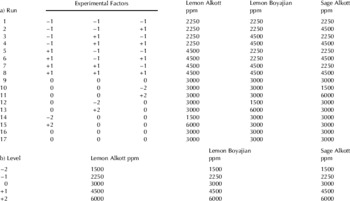
Samples of Fior di latte cheese (weight 50 g, diameter 5–7 cm, pH 6·00) produced by the chemical acidification were purchased from a cheese factory located in Puglia (Southern Italy) and brought to our laboratory under refrigeration. Each cheese sample was packaged in polypropylene tubs using active brine. Brine, consisting of tap water and NaCl (2%), was prepared by the same factory. The essential oils were added to the brine according to the combinations reported in Table 1a, as calculated by the CCD. A solution without active compounds was used as the control. The CCD reduces the number of possible combinations to a manageable size, because it uses only a fraction of the total number of factor combinations for experimentation (Gacula, Reference Gacula and Mastzowitz1988). The effects of the three natural origin antimicrobial compounds, two different types of lemon, Boyajian (USA, Canton, Massachusetts) and Alkott (Milan, Italy), and sage Alkott, (Milan, Italy) were investigated by modulating their levels according to a three-factor, five-level CCD (Box et al. Reference Box, Hunter, Hunter and Hunter1978). The five levels chosen for each of the three considered factors (independent variables) are listed in Table 1b. The samples were stored at 10°C for 8 d.
a) Run, experimental factors and concentrations of central composite design and b) coded values of experimental factors

Microbiological analyses and pH determination
Microbiological analyses were performed before packaging and after 1, 2, 3, 4, 7 and 8 d storage. Twenty grams of Fior di Latte cheese were diluted in 180 ml Ringer's solution and homogenized in a blender (Stomacher, International PBI, Milan, Italy). Subsequent serial dilutions were made in Ringer's solution and plated in the following media: PCA, incubated at 30°C for 48 h for total mesophilic bacteria; MRS agar, supplemented with cycloheximide (100 mg/l; Sigma), incubated under anaerobiosis (Anaerogen Gas Pack, Oxoid, Basingstoke, United Kingdom) at 37°C for 48 h for lactic acid bacteria; M17 agar, incubated at 37°C for 48 h for for coccus-shaped lactic acid bacteria; VRBLA incubated at 37°C for 24 h for total coliforms; Pseudomonas Agar Base, with added SR103 E selective supplement (Oxoid) and incubated at 25°C for 48 h for Pseudomonas spp. All media were obtained from Oxoid. Each microbial test was made twice on two different batches.
pH determination was performed at the same sampling time as the microbiological analyses by using a pH-meter (Crison). Measures were carried out on both liquid and cheese samples from two different batches.
Modelling
The microbiological acceptability limit (MAL), defined as the time at which the viable cell concentration reached its acceptability limit, was obtained by fitting a modified version of Gompertz equation (Gammariello et al. Reference Gammariello, Di Giulio, Conte and Del Nobile2008) to the growth cycle data:

where: N(t) is the viable cell concentration (CFU/g) at time t, A is related to the difference between the decimal logarithm of maximum bacteria growth attained at the stationary phase and the decimal logarithm of the initial value of viable cell concentration, μmax is the maximal specific growth rate (▵ Log[CFU/g]/day), λ is the lag time (day) and t is the time (day), Nmax is the microbial threshold value (CFU/g), MAL is the time at which the microbiological threshold value is reached (day) (i.e., the time at which N(t) is equal to Nmax) and t is the storage time (day). The value of Nmax was set to 106 CFU/g for Pseudomonas spp. and 105 CFU/g for coliforms. The latter is imposed by the DPR 54/97 (European Union, 1997), whereas the former value is the contamination level at which the alterations of the product start to appear (Bishop & White, Reference Bishop and White1986).
Statistical analysis
Differences between the calculated MAL values were compared by one-way variance analysis (ANOVA). A Duncan's multiple range test, with the option of homogeneous groups (P<0·05), was used to determine significance between means. STATISTICA 7.1 for Windows (Stat-Soft, Inc, Tulsa, OK, USA) was used for this purpose. The same statistical software was also used to fit a second-degree polynomial function (Eq. (2)) to the independent variables (sage and two lemons) using the following equation:

where y is the generic dependent variable examined in this work, B0 is the value of fitted response at the centre point of the design, Bi, Bii and Bij are the linear, quadratic and cross-product regression terms, respectively; xi and xj are the independent variables accounted in this work. The Eq. (2) permitted evaluation of the effects of linear, quadratic and interactive terms of the independent variables on the selected dependent variables (P<0·05). Surface response plots were generated by fixing investigated variables at the centre value of CCD.
Results and Discussion
In this study the microbial quality of packaged Fior di latte cheese was assessed by monitoring the growth cycle of both Pseudomonas spp. and total coliforms, as representative spoilage microorganisms of the selected dairy product (Gammariello et al. Reference Gammariello, Di Giulio, Conte and Del Nobile2008). To assess the effect of different natural compounds on typical microbiota, the viable cell concentration of lactic acid bacteria was also monitored. Results on each microbial group are reported as follows.
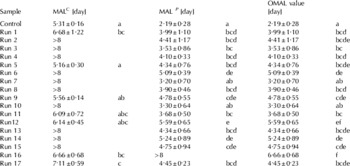
As an example, Fig. 1 shows the evolution during the storage period of Pseudomonas spp. viable cell concentration for control, as well as for some runs. Data related to the control show the following trend: a short lag phase, followed by an increase in the viable cell concentration until the stationary phase is reached. To quantitatively determine the effectiveness of the tested compounds in inhibiting the Pseudomonas spp. growth cycle, equation (1) was fitted to the experimental data. The value of log(N max) was set to 6 because at this level of contamination with Pseudomonas spp. alterations in the product begin to appear (Bishop & White, Reference Bishop and White1986). As can be inferred from data shown in Fig. 1, run 16 did not reach the Pseudomonas spp. threshold value (106 cfu/g), suggesting a MALP higher than 8 d (Table 2). For all the other runs, the presence of the antimicrobials slowed down the growth of Pseudomonas spp., compared with the control sample. Conte et al. (Reference Conte, Sinigaglia and Del Nobile2007b) and Gammariello et al. (Reference Gammariello, Di Giulio, Conte and Del Nobile2008) also showed that lemon may exert an inhibitory effect on the growth of spoilage microorganisms in fresh cheese. In addition, literature data recorded on different food matrices also confirmed the pronounced antimicrobial effect of citrus essential oils (Tassou et al. Reference Tassou, Drosinos and Nychas1996; Caccioni et al. Reference Caccioni, Guizzardi, Biondi, Renda and Ruberto1998; Dorman & Deans, Reference Dorman and Deans2000; Lanciotti et al. Reference Lanciotti, Gianotti, Patrignani, Belletti, Guerzoni and Gardini2004). It should be noted that run 16, which has an essential oil concentration equal to 3000 ppm for each tested compound, was the most effective against Pseudomonas spp. thus assuming a potential synergy between the three natural compounds.
Best fit of modified Gompertz equation to the experimental data on growth kinetic of Pseudomonas spp. in control (•), run3 (□), run6 (▪), run9 (▿), run12 (▴) and run16 (◆).

Microbiological acceptability limit for coliforms (MALc), microbiological acceptability limit for pseudomonas spp. (MALp) and overall microbiological acceptability limit (omal) of each investigated run

Data are presented means±standard deviation for n=2
a–f Means within the column with different letters are significantly different (P<0·05)
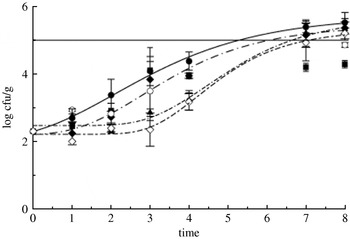
Fig. 2 shows the evolution of total coliform count over the 8-d storage period for some runs. The control shows a short lag phase, followed by a continuous increase in the viable cell concentration up to the stationary phase. The MAL values related to coliforms (MALC) were determined according to the procedure reported above. Results are listed in Table 2. As stated in DPR 54/97 (European Union, 1997), the value of log(N max) was set to 5. As can be seen, some runs presented a MALC similar to the control, whereas most of the runs did not reach the coliform threshold value, suggesting that for these samples the MALC is higher than 8 d. To sum up, in most cases the combinations of the three essential oils extended the coliform microbial acceptability limit. Conte et al. (Reference Conte, Sinigaglia and Del Nobile2007b) and Gammariello et al. (Reference Gammariello, Di Giulio, Conte and Del Nobile2008) also assessed the antimicrobial activity of essential oils, in particular citrus oil, on total coliforms. Both active packaging systems tested in these previous works were able to slow down microbial growth, leading to an increase in the shelf life of fresh cheese.
Best fit of modified Gompertz equation to the experimental data on growth kinetic of total coliforms in control (•), run3 (▪), run11 (◆), run14 (○), run16 (▴) and run17 (◊).

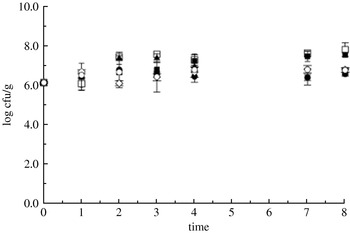
Fig. 3 shows the growth kinetics of LAB during the entire observation period. Similar results were also obtained for all the other runs. As can be inferred from the figure, the functional microorganisms grew during the refrigerated storage. Moreover, there were no marked differences between the control sample and those containing the active compounds, thus demonstrating that the natural agents did not affect, to a great extent, the growth of LAB, in agreement with reports in the literature. It is reported that of the generally sensitive gram-positive bacteria, LAB are the most resistant to essential oils (Shelef, Reference Shelef1983; Blaszyk & Holley, Reference Blaszyk and Holley1998). This microbial group was already present at high concentrations in the product immediately after packaging as a result of the technology used in dairy manufacture. The ineffectiveness of the tested compounds against useful dairy bacteria is particularly important for a product such as Fior di Latte cheese, which is increasingly advertised as being ‘preservative-free and rich in viable lactic acid bacteria’ (Coppola et al. Reference Coppola, Sorrentino, Cinquanta, Rossi, Iorizzo and Grazia1995).
Evolution of lactic acid bacteria count in Fior di latte cheese during the storage period. Control (•), run3 (□), run6 (▴), run14 (▪), run16 (◊) and run17 (○).

The total microbial count (CMT) was similar in all samples (data not shown), with the viable cell concentration increasing slightly over the storage period.
Results show (data not shown) that pH did not change much during storage, as also reported in other similar work (Gammariello et al. Reference Gammariello, Di Giulio, Conte and Del Nobile2008). Moreover, the pH values were not affected by the presence of active compounds, suggesting that the observed antimicrobial activity should be exclusively ascribed to the effectiveness of the investigated natural compounds.
Unfortunately, a comparison between the selected antimicrobial compounds with published data is very difficult, as the outcome of a test is affected by numerous factors, such as the food matrix and, of course, the source of antimicrobial compounds used (Rios et al. Reference Rios, Recio and Villar1988). The composition of essential oils can greatly depend upon the geographical region, the variety, the age of plant, the method of drying and the method of extraction (Jerkovic et al. Reference Jerkovic, Mastelic and Milos2001). Moreover, some intrinsic food properties (fat/protein/water content, preservatives, pH and salt) and extrinsic determinants (temperature, packaging and target microorganisms) can influence the antimicrobial compound effect (Shelef, Reference Shelef1983; Tassou et al. Reference Tassou, Drosinos and Nychas1996). It is also reported that during application of antimicrobial compounds to foods, interaction between phenolic compounds and some food components can occur (Ultee et al.Reference Ultee, Gorris and Smid1998; Nychas & Tassou, Reference Nychas, Tassou, Robinson, Batt and Patel2000).
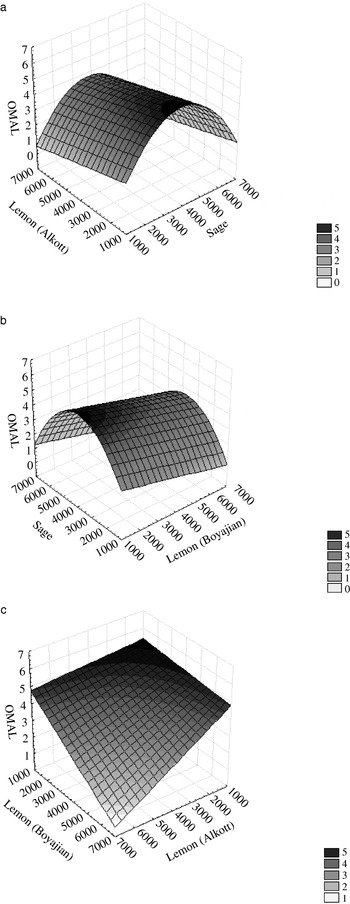
In order to evaluate the combined effect of the selected natural compounds on the microbial stability of Fior di latte, the CCD approach was the subject of study. To this aim, the Overall Microbial Acceptability Limit (hereinafter referred to as OMAL) was taken into account. The OMAL was defined as the lowest value between the MALP and the MALC (Corbo et al. Reference Corbo, Speranza, Filippone, Granatiero, Conte, Sinigaglia and Del Nobile2008). The values of OMAL are also listed in Table 2 for each run. As can be inferred, the highest OMAL values relative to cheese packaging with active compounds were significantly different from the control, except for run 7 and run 10. The sole run 16 recorded the best OMAL. By means of the best fit equation (OMAL=0·0030256 [sage] – 0·0000004 [sage]2 – 0·0000001 [lemon Alkott] [lemon Boyajian]) it was possible to determine the effects of linear, quadratic and interactive terms of the independent variables on the dependent one. The R value equal to 0·99 indicates the adequacy of the model proposed, whereas, the F value of 263·62 indicates a high level of significance (P<0·0001); the Standard Error was equal to 0·66. A three-dimensional surface plot can be used to assess the influence of the independent variables on OMAL values. In particular, 3-D graphs can be obtained by plotting the OMAL values against two of the three investigated independent variables (the value of the third variable is kept constant and equal to the central point of CCD) (Figs. 4 (a, b & c). As can be inferred, a maximum is present when the three essential oils are used at middle concentration, thus suggesting that the investigated compounds may act in a synergic way to improve the microbial stability of Fior di latte cheese. In contrast, an antagonistic effect between the essential oils was found when sage oil was used at concentration above 4000 ppm. Therefore, combination of oils may lead to additive, synergistic or antagonistic effects, as stated by Delaquis et al. (Reference Delaquis, Stanich, Girad and Mazza2002) and Fu et al. (Reference Fu, Zu, Chen, Shi, Wang, Sun and Efferth2007). It is also interesting to note (Fig. 4c) that the two lemons increase the antimicrobial effectiveness when used at low concentrations, as stated by Conte et al. (Reference Conte, Scrocco, Sinigaglia and Del Nobile2008). Thus, the addition of lemon essential oil to fresh cheese seems to be very promising because the antimicrobial effect was verified for low concentrations. Possibly, reducing the concentration of essential oils should help to achieve a satisfied antimicrobial effect and acceptability consumers' requirements (Busatta et al. Reference Busatta, Mossi, Rodrigues, Cansian and de Oliveira2007; Conte et al. Reference Conte, Scrocco, Sinigaglia and Del Nobile2008; Mastromatteo et al. Reference Mastromatteo, Lucera, Sinigaglia and Corbo2009).
Effects of the interaction (a) [sage] [lemon Alkott]; (b) [sage] [lemon Boyajian] and (c) [lemon Boyajian] [lemon Alkott] on OMAL value (day).

To sum up, the results of the present study highlighted the possibility to prolong the MAL of a fresh cheese. In fact, an increase in the MAL value was observed for all cheese samples packaged with the essential oils, compared with the traditional product. Moreover, the use of a CCD made it possible to evaluate the individual and interactive effects of sage and lemons on microbial stability of Fior di latte, thus allowing determining the optimal composition of essential oils to be used for maximizing the microbiological acceptability. The experimental data clearly indicated that these oils, characterized by efficacy, low cost and commercial availability, could meet industrial requirements to be applied for dairy applications.
This work was financially supported by the Ministero dell'Economia e delle Finanze, Ministero dell'Istruzione, dell' Università e della Ricerca Scientifica e Tecnologica e l'Assessorato Bilancio e Programmazione Regione Puglia by the programme ‘Accordo di Programma Quadro in Materia di Ricerca Scientifica della Regione Puglia – Progetto Strategico’ – Title: ‘Miglioramento della qualità dietetico-nutrizionale e sicurezza di produzioni casearie tradizionali della Capitanata’.